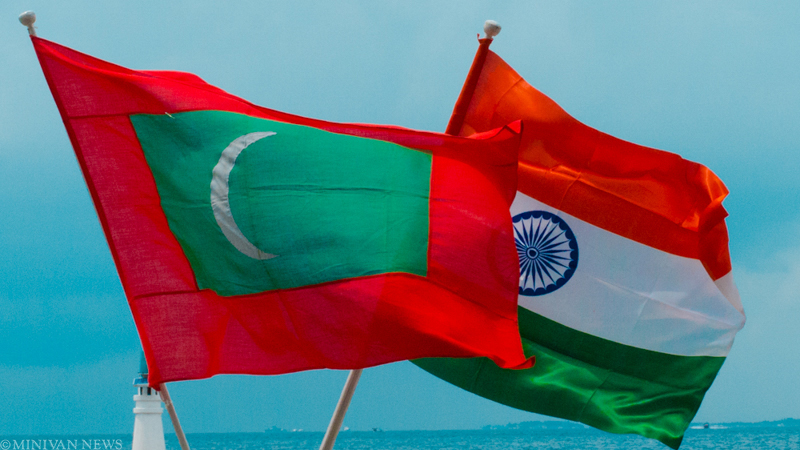
Maldives blames GMR, Axis Bank for sanctions by India after airport takeover

An Indian infrastructure company and a bank successfully lobbied India for sanctions on the Maldives over the 2012 cancellation of a deal to develop the international airport, the government has claimed.

The government made the allegation last month at a Singaporean arbitration tribunal, where India’s Axis Bank is seeking the repayment of a US$160 million loan from the Maldives. The loan was given to GMR group in 2011 to upgrade and manage the Maldives’ main airport.

India had tightened visa regulations for Maldivians and ceased exporting some construction materials to the Maldives, after the government took over the airport in 2012, but neither India nor the Maldives had explained the reasons for the sanctions.

India only lifted the restrictions after President Abdulla Yameen was elected in November 2013.

In its submission to the Axis Bank tribunal – obtained by Minivan News – the government claimed the bank had been involved in an “attempt to secure political pressure from the Indian government” to prevent cancellation of the deal.

The Axis Bank in 2012 also told the government it would “approach the regulatory-diplomatic authorities in India” after GMR was ordered to handover the airport, the government said.

GMR also wrote to the prime minister in August 2012 “requesting intervention by the Indian government, when it was clear that future of the concession agreement was in jeopardy,” the government said.

GMR is meanwhile claiming US$803 million from the Maldives in a separate arbitration after the tribunal ruled last year that the government had “wrongfully” terminated a “valid and binding” concession agreement.

The campaign by GMR and Axis Bank led to Indian officials including then-Prime Minister Manmohan Singh telling ex-president Dr Mohamed Waheed that the “Indian government stood ready to assist GMR in making sure [the cancellation] did not happen.”

According to minister Mohamed Hussain Shareef, “the message [Waheed] got from them was confident and unbending: they expected [the Maldivian government] not to take any action to terminate the concession agreement”.

The Indian government subsequently “insisted on the repayment of outstanding debts of US$100m” in mid-November 2012 and warned of “repercussions” shortly before the agreement was terminated, lawyers representing the Maldives said.

The lawyers also alleged that then-Indian high commissioner to the Maldives “sought to intervene through several meetings with [then-defence minister Mohamed Nazim] in which he asked the Maldives to cooperate in allowing GMR/GMIAL back into the airport.”

Nazim in his testimony said that the message from India was “either back off or suffer the consequences.”

Documents disclosed during arbitration proceedings also showed that the Axis bank’s officials had met the Indian High Commissioner in January 2013, a month after the government took over the airport, lawyers added.

The submission noted that former president Mohamed Nasheed stated after a visit to India in February 2013 that “India believes the deteriorating ties between Maldives and India will recover” if the 25-year contract is restored.

“On 11 March 2013 several Indian Navy attack craft were reported as having conducted exercises just outside Maldivian territorial waters,” it added.

With the tightening of visa regulations for Maldivian citizens, dozens of people to queued outside the Indian High Commission to obtain visas to travel for medical treatment.

In February 2013, the Indian government revoked a special quota afforded to the Maldives for the import of aggregate and river sand. The move led to a shortage of the supply of construction material and rising costs for construction companies.

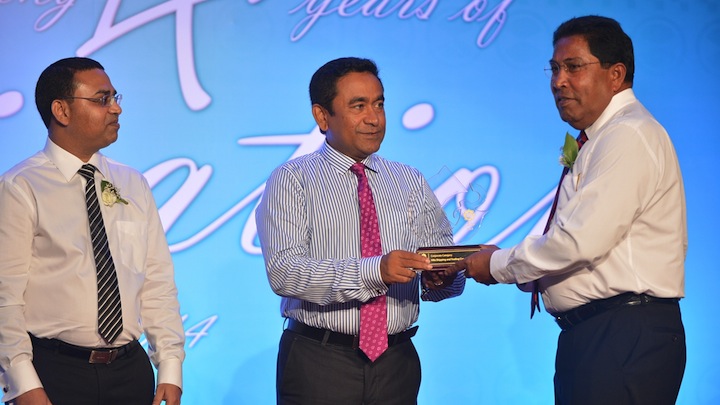
The current Indian Prime Minister Narendra Modi meanwhile invited the GMR chairman to a state banquet in honour of President Abdulla Yameen in January 2014, lawyers representing the Maldives noted.

Minivan News is awaiting a response to the allegations from the Axis Bank and GMR, while the government has declined to comment on the ongoing arbitration.

The Axis Bank is seeking repayment of the US$160 million loan as well as an additional US$10 million as interest and fines from the Maldivian government. The bank contends that state is liable for the loan in the event of an early termination or an expropriation of the airport.

However, the government has argued that declaring the concession agreement invalid from the outset does not amount to an early termination. The government also accused the Axis Bank and GMR of colluding to extract large sums of money, claiming the developer paid for the bank’s litigation fees for the separate arbitration process.

The Axis Bank meanwhile dismissed the argument as “highly semantic” and stated: “what words were used by the government to characterise its own acts are irrelevant to establishing whether the acts of the government amounted to an expropriation.”

Verdicts are expected in both the GMR and Axis Bank arbitrations in June.

Likes(2)Dislikes(0)

Villa accounts freeze will ‘send shockwaves’ through Maldives economy

Jumhooree Party leader Gasim Ibrahim’s Villa Group has warned of negative repercussions for the Maldivian economy if the tax authority freezes the company’s bank accounts next week.

A 20-day final notice seeking US$90.4 million allegedly owed as unpaid rent, fines and interest expires on Saturday (April 18), while the civil court last week refused to grant stay orders halting enforcement of the notice.

The enforcement policy for defaulting taxpayers involves freezing bank accounts to recover the unpaid amounts and ceasing to provide services from any state institution.

Villa – which won the tax authority’s “Ran Laari” award last year as one of five companies that paid the highest amount to the state – insists it does not owe any money to the state.

“It is not only Villa’s shareholders’ and the company’s rights that are lost [if bank accounts are frozen]. The rights of a lot of employees who work at the company, small and medium-sized businesses dependent on this company, guests who have made bookings at our resorts, tour operators, and many other people, would also be lost,” said Villa Group executive director Shimad Ibrahim at a press conference last night.

Banks that have issued loans to Villa will also be affected, he added.

“In sum, we are having to face something on Sunday that will send shockwaves through the whole economy,” he said.

The holding company Villa Shipping and Trading Pvt Ltd conglomerate operates businesses in shipping, import and export, retail, tourism, fishing, media, communications, transport, and education.

Villa business secretary Ibrahim Rasheed added: “We are all holding our breath.”

Rasheed said the company will continue to seek “a peaceful resolution” and “hope for justice”.

He noted that Villa companies employ about 5,000 people.

In an interview on his Villa Television on Saturday, Gasim repeatedly appealed for talks with president Abdulla Yameen and tourism minister Ahmed Adeeb to resolve the dispute.

However, the Villa officials said the government has not responded to “pleas” for discussions.

Adeeb meanwhile accused Gasim at a ruling coalition rally last week of hoarding islands and lagoons and refusing to pay money owed to the state.

“Fabricated”

The Maldives Inland Revenue Authority (MIRA) issued the US$90 million notice after the tourism ministry terminated agreements for several properties leased to Villa and subsidiary companies for resort development.

The move followed Gasim’s JP forming an alliance with the main opposition Maldivian Democratic Party. However, the government denies the opposition’s accusations of unfairly targeting Gasim’s business interests.

Some 27 cases challenging the termination of the agreements and MIRA’s notice as well as appeals of the civil court’s refusal to grant stay orders are ongoing at court.

While the tourism ministry cited lack of “good faith” as the reason, the Villa officials insisted the terminations were unlawful and that the fines were “fabricated”.

If rent is not paid, the government is required to give a 30-day notice before issuing fines or seizing the properties, they noted.

The lease agreements also specify procedures for termination on the grounds of financial or non-financial breaches, but the tourism ministry’s termination notices did not refer to any violation.

“This is something that investors should seriously consider. This is a frightening and dangerous thing,” said Villa lawyer Ahmed Shafeeq.

In response to a letter from Villa contending there was no basis for the fines, Shimad said MIRA told the company it was “following instructions” from the tourism ministry.

Settlement agreement

The properties at stake were leased under a settlement agreement signed with the tourism ministry on December 12, 2013, less than a month after president Yameen took office.

The settlement agreement was reached after the Supreme Court on November 19 ordered the state to pay US$9.7 million to Villa in one month as compensation for damages incurred in a project to develop a city hotel in Laamu Kahdhoo.

As part of the settlement, Villa withdrew cases involving a dispute over a city hotel in Haa Dhaal Hanimadhoo and resort development on Gaaf Dhaal Gazeera.

In return, the government signed five ‘amended and restated lease agreements’ with Villa for three islands and several Kaafu atoll lagoons.

The government also agreed to forgo rents for the islands and lagoons for a construction period of five years and seven years, respectively.

However, after the settlement agreement was terminated in February, MIRA’s notice stated that Villa owed US$75.5 million as fines, US$600,000 as interest, and US$14.8 million as unpaid rent dating back to original lease agreements signed in 2006 and 2007.

The Villa officials noted that the company has paid over US$15 million as advance payments for the properties.

In the case of Kahdhoo, MIRA claimed an unpaid rent of US$293,000 and a fine of US$10 million – 34 times the allegedly unpaid rent – despite the 2013 Supreme Court judgment declaring Villa does not owe rent for the property, the officials said.

Likes(3)Dislikes(0)

Hundreds of inmates display artwork at national gallery

Some one thousand inmates displayed a variety of artwork showcasing their creativity and skills in an annual exhibition at the national art gallery today.

Nimal Ibrahim, who won first place for his painting, said: “This is a great opportunity to showcase our potential and be a part of the society.”

Ibrahim’s painting depicted a man in a suit holding a scale jeering at four people, one of whom carried the Maldives flag.

The three-day exhibition organised by the Maldives Correctional Services (MCS) is open to the public and will continue till Saturday night.

Inmates from the Maafushi and Asseyri jails exhibited over 850 paintings and hundreds of handicrafts and furniture today. Plants grown by inmates in an agricultural training session were also on display.

Hundreds of inmates were present at today’s exhibition, accompanied by security guards.

Several paintings depicted interrogation rooms and courtrooms, demonstrating the trials inmates go through in the Maldives criminal justice system.

A member of the organising team, corporal Abdulla Ameen, said inmates had worked on their artworks over the last year.

“There are about 500 inmates who have participated every year since this exhibition began in 2011,” he said.

Winners are given a prize of MVR500 (US$32). Members of the public can purchase any artwork and proceedings are to go to the correction centre’s cooperative society.

inmate art 2

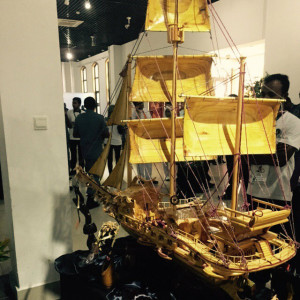
Mohamed Shifag, who made a large wooden sail boat, said inmates worked on their artworks for a few hours every day.

“I learned how to do craft work from the courses we are taught,” he said.

In addition to art classes, inmates are also given classes in agriculture and religion.

“We receive help from the authorities for the courses we hold, and inmates are always looking for such opportunities,” said superintendent of jails, Mohamed Asif.

Inmates are selected for the courses based on their discipline.

The exhibition will be open from 2-6pm in the afternoon and from 8-10pm on Thursday, Friday and Saturday.

Likes(1)Dislikes(0)

Police in row with opposition MP over tweet

Police have accused opposition MP Rozaina Adam of posting a photo of a police officer on Twitter to intimidate security personnel.

Rozaina had accused the officer in question of obstructing her car on Wednesday night while she was heading to the parliament for a committee meeting.

The MDP said in a statement today that police officers had refused to remove a barricade set up near Dharumavantha School to allow Rozaina’s car through.

When one officer tried to let the car pass, another officer insisted that they must seek permission from a superior officer, the party said.

However, he removed the barricade after talking on a handheld transceiver.

Rozaina posted a tweet with a photo of the officer, her account of the incident, and an article from the parliamentary privileges law, urging police to “keep officers near barricades after teaching them the law.”

“If we are stopped on the way to Majlis, police will have the opportunity to stop us on the road until a vote is taken,” she argued.

However, police said a fire evacuation drill was ongoing at a nearby school at the time and said the officer had informed the senior officer in charge that a car will be passing through as the students were preparing to rush out.

Police criticized Rozaina for posting the photo of the officer, saying her intent was to intimidate, undermine public confidence in police, and bring the institution into disrepute.

The MDP said the police statement was symptomatic of the politicisation of the institution and its senior officers, whom it accused of bearing personal animosity towards opposition MPs.

The opposition party advised senior officers against exerting “political influence” over junior officers and against encouraging illegal actions.

Likes(1)Dislikes(0)

Gayoom’s son seeks PPM ticket for Dhiggaru by-election

Former president Maumoon Abdul Gayoom’s eldest son, Farish Maumoon, is seeking the ruling party’s ticket for the upcoming by-election for the vacant Dhiggaru constituency parliament seat.

The by-election, scheduled for June 6, was triggered by the conviction of former Progressive Party of Maldives (PPM) MP Ahmed Nazim on corruption charges. The Supreme Court sentenced Nazim to 25 years in prison on April 6 for defrauding the state of MVR1.4 million (US$91,400).

Ahead of a 4:00pm deadline today, four others have submitted applications to contest the primary, including Meemu atoll councillor Moosa Naseer, Imran Ismail, Moosa Naseer Ahmed, and deputy environment minister Mohamed Hanim.

The candidates are to be first vetted on their loyalty to the party, role in campaigning for the party’s candidate in the 2013 presidential election, and the duration of membership in the party.

A primary will only take place if more than one candidate receives over 75 percent or higher.

The opposition coalition, made up of the main opposition Maldivian Democratic Party, religious conservative Adhaalath Party, and leaders of the Jumhooree Party, are meanwhile holding discussions on fielding a single candidate.

Adhaalath spokesperson Ali Zahir told the press today that he will contest the by-election.

Likes(0)Dislikes(0)

Second victim of link road accident dies

A second victim of a motorcycle accident in southern Addu City died while undergoing treatment in India last night.

Ahmed Sammah, 20, suffered severe head injuries in the accident on Addu City’s link road on April 1o.

Mamdhoon Ahmed Ali Didi ‘Mandey,’ who was sitting on the back seat of Sammah’s bike died within a few hours of the accident. He had also suffered severe head injuries.

Sammah was treated at the Hithadhoo Regional Hospital and Malé’s Indhira Gandhi Memorial Hospital before he was flown to India on April 12.

The accident occurred when Sammah attempted to overtake a car.

His death is the third fatality in Addu this month. A 16-year-old victim of an accident died of injuries on March 30 while undergoing treatment at the regional hospital.

Hussein Hilmy, an Addu City councillor, said more police officers are needed to effectively control traffic.

However, police said most accidents in Addu City were caused by speeding rather than traffic congestion.

Likes(0)Dislikes(0)

Visiting specialist doctors to improve healthcare services

The government is enlisting the services of visiting specialist doctors to improve healthcare services in the Maldives.

The ‘Super Specialist Service’ will employ neurologists, cardiologists, urologists, neurosurgeons, ENT doctos and pediatricians to provide consultations in different parts of the country.

The CEO of the national social protection agency, Mujthaba Jaleel, said twenty two foreign hospitals registered with the government’s health insurance scheme, Aasandha, have applied to send specialist doctors to the Maldives.

The visiting doctors will improve healthcare for people suffering from serious conditions, he said.

“Teams of Super Specialists have arrived today morning and have started work at the blood services unit and the Thalasseimia center. Some will start work at hospitals in the north and south tomorrow,” Mujthaba said.

President Abdulla Yameen inaugurated the Super Specialist service on Wednesday and handed over agreement copies to the overseas hospitals contributing to the super specialist program.

Likes(0)Dislikes(0)

Comment: International community must not ignore the plight of ‘Mandela of the Maldives’

The following op-ed was written by Anders Henriksen and Lykke Friss from the University of Copenhagen and first appeared on The Conversation. Republished with permission.  

This year has been anything but tranquil in paradise. In March, after a prolonged period of tension in the Maldives – the Indian Ocean island nation better known as a honeymoon paradise – a panel of judges found the former president, Mohamed Nasheed, guilty of terrorism and sentenced him to 13 years imprisonment.

The international community has condemned Nasheed’s trial as a farce. The charges against him were highly dubious, he was denied the right to legal counsel, given just a few days to prepare his defence – and two of the presiding judges even testified on behalf of the prosecution. Amnesty International labelled the trial as “a travesty of justice”.

As numerous UN reports have shown, the Maldivian judiciary is highly corrupt. It is a judiciary that is loyal not to the rule of law, but to the regime that has been in charge since a coup d’état in 2012. Nasheed is now back in the same jail where he spent years as a prisoner of conscience during the former Maldives dictatorship.

Shattered dreams

At the end of 2008, when democracy swept aside 30 years of dictatorship, it all looked so promising. The Maldivian people chose Nasheed as president in their first democratic elections and, for a brief moment, freedom blossomed.

During Nasheed’s presidency, Maldivians could speak freely for the first time, enjoy new found political freedoms, and express themselves through art and culture. Internationally, the charismatic new leader gained fame for his remarkable efforts to persuade the world to combat climate change, which threatens low-lying Maldives. Nasheed toured the world as a political rock-star, receiving accolades from the White House to Windsor Castle.

But it did not take long for the old regime to move against the young democratic government. On February 7 2012, Nasheed was forced to resign and the presidency was handed to Mohamed Waheed, a puppet of the former regime. The Maldivessoon reverted to type: journalists were targeted, protesters beaten up, and opposition politicians threatened and murdered.

The subsequent presidential elections 2013 were marred by widespread allegations of vote-rigging. The former dictator’s half brother, Abdulla Yameen, won – despite an overwhelming expectation that Nasheed would be returned.

Democracy trampled

Nasheed’s incarceration should be cause for concern to anyone who cares about democracy, liberty or the rights of women. In the Maldives, the moderate, freedom-oriented version of Islam that Nasheed espoused is under threat from a regime that colludes with Islamic extremists.

Unless the current trajectory is turned, the liberal forces in the countries will lose the on-going battle with fundamentalist Islam. In the last year alone, Islamic State supporters have rallied in the streets of Male, the Maldivian capital, and a growing number of Maldivians – some with experience of terrorist training camps in Pakistan – have gone to Syria to fight for Islamic State. Only Nasheed and his Maldivian Democratic Party have been willing to tackle the growing problems of Islamic radicalism.

There are few statesmen of Nasheed’s stature. Many foreign journalists, with good reason, refer to him as the “Mandela of the Maldives”. In the interests of democracy and stability, the international community must take a clear stand. Unless Nasheed is swiftly released from prison, the European Union and other nations should impose targeted sanctions against those in power.

These sanctions should include travel bans and foreign asset freezes. The sanctions should target President Yameen, his cabinet ministers, including the minister of tourism, and the corrupt judges who imprisoned Nasheed, and members of the security forces responsible for attacks on peaceful protesters.

Furthermore, since the survival of the regime depends on the annual arrival of the more than a million foreign tourists, individual countries should also supplement sanctions with a tourism boycott. Just like potential tourists should think twice before spending their money on the atolls. Yameen’s regime is baring its teeth. It is time for the international community to respond in kind.

Anders Henriksen is an associate professor of public international law and Lykke Friis is the prorector for education at the University of Copenhagen.

All comment pieces are the sole view of the author and do not reflect the editorial policy of Minivan News. If you would like to write an opinion piece, please send proposals to [email protected]

Likes(6)Dislikes(0)

Maldives faces second crippling payout in airport dispute

The Maldives faces a payout of US$170million to a bank in the dispute over the government’s abrupt takeover of the main airport from an Indian developer in 2012, Minivan News can exclusively reveal.

India’s Axis bank, which loaned US$160million for airport development in 2011, is seeking repayment of the loan and an additional US$10million in interest and fees from the Maldives, according to submissions made to a Singaporean arbitration tribunal.

The airport developer, GMR group, is meanwhile claiming US$803million from the Maldives in a separate arbitration after the tribunal ruled the government had “wrongfully” terminated the concession agreement.

President Abdulla Yameen estimates Maldives will be required to pay a much lower figure of US$300million to GMR. If the Axis Bank wins its claim, the payout of US$470million may cripple the domestic economy.

Although total foreign reserves stood at US$614.7million by the end of 2014, usable reserves stood at only US$143.9million, according to the central bank.

Public debt meanwhile stands at 75 percent of GDP and is likely to increase this year with the government seeking additional loans to finance key projects including a US$600million loan for airport development.

The attorney general’s office last year denied receiving notice of the arbitration, but since then has been silent on the proceedings.

The office declined to comment on the arbitration today, and the ministry of finance was not available for comment at the time of going to press.

A verdict is expected in both the GMR and Axis Bank arbitrations by June.

Early termination?

The Axis bank, in a submission in February, said it is entitled to recover the US$170million from the government under an agreement that states the Maldives state is liable for the loan in the event of an early termination or an expropriation of the airport.

But the government in its first statements in 2013 denied having knowledge of the agreement with the Axis Bank.

When the signed agreement was produced, the government said declaring the concession void ab initio or invalid from the outset does not amount to an early termination.

When the separate tribunal in the first phase of the GMR arbitration said the concession agreement was valid and constituted a “wrongful repudiation” (refusal to honor the contract), the government in March this year claimed that “repudiation” alone does not lead to termination.

The government went on to blame the GMR for terminating the concession agreement by “accepting” the government’s repudiation, and said no force was used in the takeover.

Axis Bank is “perfectly entitled to recover the loaned sums from the party to which it loaned them” i.e. GMR, it continued.

However, the Axis Bank contended the Maldives argument to be “highly semantic” and said: “what words were used by the government to characterize its own acts are irrelevant to establishing whether the acts of the government amounted to an expropriation.”

The bank also pointed out the Maldives civil aviation authority had cancelled GMR’s aerodrome certificate from December 7, 2012, making it “legally impossible for GMR to continue to operate the airport.”

The government also accused the Axis Bank and GMR of colluding to extract large sums of money, claiming the infrastructure giant had paid for the bank’s litigation fees for the separate arbitration process.

As an Indian Bank for whom GMR was a major customer, the Axis Bank wanted to cement its relationship with GMR “by assisting it in making a very substantial claim for damages,” the government alleged.

The Axis Bank has dismissed the allegations as baseless.

Likes(2)Dislikes(1)