Defence lawyer of minor sentenced to flogging appeals case in High Court

The defence lawyer for a 15 year-old rape victim who was sentenced to flogging after the Juvenile Court found her guilty of fornication, has appealed the case at the High Court today.

Attorney General Aishath Aziam Shukoor told local media today (April 1) that the case had to be appealed because the Juvenile Court had taken statements from the witnesses in violation of procedure.

The Attorney General said the Juvenile Court ruling was in violation of Islamic Sharia as it had not considered psychological reports produced to the court.

The 15 year-old child was now under the charge of the ‘Kudakudhinge Hiya’ orphanage on Villingili, she revealed.

President Mohamed Waheed’s government has previously criticised the verdict, pledging in January to review the use of flogging as a punishment for sexual offences – a practice it alleged in some cases actually serves to punish victims of rape and abuse.

Sources from the girl’s island of Feydhoo in Shaviyani Atoll told Minivan News previously that concerns had been raised by islanders since 2009 that the minor was allegedly the victim of sexual abuse not just by her stepfather, but an unidentified number of other men on the island.

The case has brought international attention to the country’s legal system, including the launch of an online Avaaz.org petition signed by 1.7 million people that threatens to boycott Maldivian tourism, as well as public criticism from British multi-billionaire Sir Richard Branson, founder of the Virgin group of companies.

In June 2012, the girl gave birth to a baby which was later discovered buried in the outdoor shower area of her home. Her stepfather was later charged with child sexual abuse, possession of pornographic materials and committing premeditated murder. Her mother was meanwhile charged with concealing a crime and failing to report child sexual abuse to the authorities.

On February 26, 2013, the 15-year-old was convicted of premarital sex at the Juvenile Court and sentenced to 100 lashes and eight months of house arrest, after confessing to fornication with another man during the investigation.

President Waheed’s  stated on his official Twitter account at the time: “I am saddened by the sentence of flogging handed to a minor. Govt will push for review of this position.”

However, the religious Adhaalath Party (AP) – which largely makes up the ranks of the Islamic Ministry and with which President Waheed’s Gaumee Ithiaad Party (GIP) last week entered into a coalition – has endorsed the sentence.

“The purpose of penalties like these in Islamic Sharia is to maintain order in society and to save it from sinful acts. It is not at all an act of violence. We must turn a deaf ear to the international organisations which are calling to abolish these penalties, labeling them degrading and inhumane acts or torture,” read a statement from the party.

“If such sinful activities are to become this common, the society will break down and we may become deserving of divine wrath,” the Adhaalath Party stated.

Likes(0)Dislikes(0)

High Court orders halt to Nasheed’s trial pending decision on legitimacy of judge panel

The High Court has ordered the Hulhumale’ Magistrate Court to halt former President Mohamed Nasheed’s trial until it decides on the legitimacy of the panel of judges appointed to examine his case.

Nasheed is being tried in the Hulhumale’ Magistrate Court for his controversial detention of Chief Judge of the Criminal Court Abdulla Mohamed in January 2012.

The High Court has previously issued an injunction halting the case following the appeal made by Nasheed’s legal team contesting the legitimacy of the Hulhumale’ Magistrate Court itself.

However, the Supreme Court took over the case from High Court and declared that the Hulhumale’ Magistrate Court was formed in accordance to the law.

After the trial resumed, Nasheed’s lawyers again made a request to the Hulhumale’ Magistrate Court to delay the trial until the end of the scheduled presidential elections in 2013.

At the same hearing, the state prosecutors expressed no objections to the team’s request to delay the trial until the presidential elections, scheduled for September.

However, the magistrate court refused to delay the trial until the end of the elections, instead deferring the trial for a period of four weeks. The hearing was scheduled for April 4.

Nasheed’s legal team subsequently appealed the Magistrate Court’s decision not to grant a deferral until after the elections, and also filed a case regarding the legitimacy of the bench.

The High Court in the new stay order issued today and signed by Judge Ahmed Shareef, stated that the court was of the view that Nasheed’s ongoing trial must come to a halt until the legitimacy of the bench was established.

The decision – if not quashed by Supreme Court – means that Hulhumale’ Magistrate Court’s scheduled hearing of the trial set to take place on April 4 will be cancelled.

An official from the Judiciary Media Unit was earlier quoted in the local media as stating that a summoning chit had been sent to Nasheed, and that the next hearing will see the confessions of witnesses presented by the prosecution.

The decision comes at a time when the Judicial Services Commission (JSC) has come under heavy scrutiny over its appointment of the panel of the judges – which several lawyers and members of JSC itself have claimed exceeded the JSC’s mandate.

Among the JSC’s critics include JSC member Sheikh Shuaib Abdul Rahman – the member appointed from among the public.  Sheikh Shuaib Abdul Rahman previously claimed the JSC had arbitrarily appointed three magistrates from courts across the Maldives to Nasheed’s case after dismissing the three names first submitted to the commission by the Hulhumale’ Magistrate Court.

“Moosa Naseem (from the Hulhumale’ Court) initially submitted names of three magistrates, including himself. This means that he had taken responsibility for overseeing this case. Now once a judge assumes responsibility for a case, the JSC does not have the power to remove him from the case,” Sheikh Rahman explained. “However, the JSC did remove him from the case, and appointed three other magistrates of their choice.”

Sheikh Rahman stated that the commission had referred to Articles 48 to 51 of the Judge’s Act as justification.

“But then I note here that the JSC breached Article 48 itself. They did not gather any information as per this article. They stated that it was due to the large amount of paperwork that needs to be researched that they are appointing a panel. However, this is not reason enough to appoint a bench,” he said.

Rahman further stated that the judicial watchdog body was highly politicised, and openly attempting to eliminate former President Nasheed from contesting the presidential elections.

Meanwhile, Speaker of Parliament Abdulla Shahid – who is also a member of the JSC – stated that he believed that the judicial watchdog had acted unconstitutionally in assigning magistrates to a particular case.

“In deciding upon the bench, the JSC did follow its rules of procedures. As in, it was voted upon in an official meeting and six of the seven members in attendance voted on the matter. The seventh member being the chair, does not vote in matters,” Shahid explained.

“However, whether it is within the commission’s mandate to appoint a panel of judges in this manner is an issue which raised doubt in the minds of more than one of my fellow members,” he added.

Other critics included United Nations Special Rapporteur (UNSR) on the Independence of Judges and Lawyers, Gabriela Knaul, who also said the appointment was carried out arbitrarily.

“Being totally technical, it seems to me that the set-up, the appointment of judges to the case, has been set up in an arbitrary manner outside the parameters laid out in the laws,” Knaul said, responding to questions from media after delivering her statement in February.

Meanwhile, the UK’s Bar Human Rights Committee (BHRC) – that has observed the ongoing trial of the former President – in its report concluded that charges against Nasheed appeared to be a politically motivated attempt to bar the Maldivian Democratic Party (MDP) candidate from the 2013 presidential election.

Speaking to Minivan News previously, Kirsty Brimelow QC, one of three UK-based experts on former President Nasheed’s legal team, contended that the prosecution of his case before the Hulhumale’ Magistrate Court fell “below international standards for fair trial procedure”.

She added that there remained a “strong argument” in the case that the prosecution of Nasheed was “not in the public interest”.

“It is a strong argument that a prosecution is not in the public interest. The currently constituted court comprises of judges who may be biased or have the appearance of bias. They should recuse themselves,” she argued at the time.

Likes(0)Dislikes(0)

Comment: Seeking to put the judiciary in a spot

On specifics they may differ, but a common view seems to be slowly emerging on the imminent need for effecting reforms to the nation’s judiciary among the divided polity in Maldives.

Included in the discourse is also the role of the Judicial Services Commission (JSC), whose membership has also come under question, as should have been anticipated at the drafting of the 2008 Constitution.

To the opposition Maldivian Democratic Party (MD) of former President Mohammed Nasheed, everything that could go wrong with the judiciary and the JSC has gone wrong. The party often identifies its immediate concerns with the ongoing trail against Nasheed in the ‘Judge Abdulla abduction case’ when he was in power in January 2012. A conviction accompanied by a prison term not less than one year could cause his disqualification from contesting the presidential polls, slated for September this year.

Yet, the MDP’s larger concerns over judicial reforms pre-dates the ‘Judge Abdulla’ arrest, which contributed to the pervasive mood when the power-transfer occurred a couple of weeks later. President Nasheed went to the extent of ordering the Supreme Court shut down for a day – a rarity this in any democracy – until he had got the seven-judge bench of his choice when the mandatory two-year term ended for reconstituting the same after the commencement of the new Constitution.

The party did have to make compromises, and compromises are also what democracies are all about. It is not unknown to democracies that judges with political leanings often get elevated to the respective Supreme Courts in particular. In the US, the presidential model of which the Maldives has adopted under the 2008 Constitution, the political branding of Supreme Court Judges are so very complete that analysts would identify them either as ‘conservative’ or ‘liberal’ in their judicial approach.

Both the ideological background of the judges and their branding are inevitable, too. In a two-party system where most people choose to enroll as members of either of the two majors, namely, the Democrats and Republicans, students grow up to become lawyers, to be elected or elevated as judges. Whether they try to be non-partisan in ideological terms, starting with abortion but extending to state ownership and intervention, heir past accompanies them as an unburdened baggage.

Gayoom legatees, all

In the Maldives, everything government and everyone in government other than President Nasheed could be effortlessly branded as a ‘Gayoom legatee’. Most Nasheed aides, political and otherwise, belong there, too, but their timely cross-over may have helped the larger ‘democratic cause’ when it all unfolded. It is another thing to paint the whole judicial system and individual judges but in bulk with the same brush can cause greater trouble for democracy than can solve any of the existing problems, real and imaginary.

Not that the current scheme did not foresee the possibilities and problems. It has provided a seven-year term for ‘retraining’ of judicial officers at all levels in the country. Neither President Nasheed, nor his present-day successor President Waheed Hassan seem to have taken any serious step in this direction. The slanging-match, which contributes to the discrediting of the nation’s judiciary alone keeps cropping up time and again.

The MDP continues to claim that the three-member trial bench of the suburban Hulhumale’ court is illegal, unconstitutional and biased against President Nasheed, despite the Supreme Court dismissing its plea in the matter. The party has since sought the reconstitution of the seven-judge Supreme Court Bench itself. At an official function, Chief Justice Ahmed Faiz Hussain flatly ruled out any such reconstitution, saying that the present bench would continue as long as democracy existed in Maldives. Where a vacancy arose, it would have to be filled, he said.

President Nasheed reportedly added a new element when he publicly claimed that Chief Justice Hussain has been meeting regularly with President Waheed, and discussing the ‘Judge Abdulla case’ with him. From a public platform, he declared that he had never ever called the Chief Justice(s) of his time for any consultation whatsoever. Neither the judiciary, nor the Government, nor the President’s Office is known to have joined issue with him.

Row over JSC membership

Under the Constitution, Parliament has its nominee on the Judicial Services Commission (JSC), in turn entrusted with the appointment of judges and the overseeing of their conduct and acquittal as judges. The Jumhoree Party founder and presidential nominee is a member of the JSC, along with Parliament Speaker Abdulla Shahid, which chose the three-judge bench to try President Nasheed.

The MDP, after challenging the authority of the JSC in the matter, has since questioned the impartiality of the bench, chosen with Gasim as member. The office of the Parliament Speaker has however been kept out of what is essentially a political controversy. The two incidentally had participated in the JSC when it chose the seven-Judge Supreme Court bench, after President Nasheed and his government insisted on the executive having its say in the matter.

Attorney General Azima Shakoor opined that given the sensitivity of the issues involved, Gasim Ibrahim could have kept out the selection of the judges trying President Nasheed. She however clarified that the constitution having provided for parliament to nominate a member to the JSC, it was neither illegal, nor unconstitutional on Gasim’s part to have participated in the selection process.

One too many?

Larger questions remain. For starters, for a country of its size and population, the 2008 Constitution provides for one too many ‘Independent Institutions’ aimed at overseeing the functioning of various arms of the Government. The JSC is only one of them. The idea of having a Parliament’s nominee on the JSC was a creation of the new Constitution. So were so many committees of Parliament, tasked to oversee the functioning of the Government and its arms.

Whether intended or not, some of these committees and some of these Independent Commissions have assumed ‘sky-high powers’. Their disposition has been as much political as they could have been expected to be at birth. On occasions, their positions have changed with the changes in the political scenario and equations. These are inevitable consequences of democracy, particularly when politicians are consciously made part of the process where they are expected to be insulated from the rough and tumble of politics outside.

The problem with the Maldivian scheme, if any, owes to the political perception that underlay the thinking of various stake-holders at the time they comprised the Special Majlis to draft a new Constitution. With President Maumoon Gayoom on the defensive after 30 long years of unbroken rule, the co-sponsors of various constitutional provisions aimed at checking another ‘autocrat’ in power. This included a possible return of President Gayoom through what was being planned to be a ‘multi-party democracy’.

Given the over-arching run-up to the presidential polls, followed by Parliament elections next year, the time may not be just right or ripe for a review of the working of the constitutional scheme, that too with an open mind. Yet, with multi-party democracy taking deep and permanent roots in the country, and the emergence of an anticipated autocracy ruled out mostly, it may already be time for the new government and new parliament to set in motion an open-ended process aimed at addressing some of the present concerns, gained out of the working experience of the five years that have gone by.

Any final judicial verdict in the ‘Judge Abdulla’ case, impacting on President Nasheed’s candidacy one way or the other, has consequences for the nation and the constitutional scheme as a whole. That would just be the beginning of a new beginning – and not necessarily the end of anything gone-by.

Any process of the kind could serve its purpose if the political stake-holders look not at the immediate present alone but at the wholesome future, where they will be remembered not for what they ought to have been, but did not – but for what they actually proved to be.

The writer is a Senior Fellow at the Observer Research Foundation

All comment pieces are the sole view of the author and do not reflect the editorial policy of Minivan News. If you would like to write an opinion piece, please send proposals to [email protected]

Likes(0)Dislikes(0)

Widespread ‘secret’ slaughter of endangered sea turtles despite ban; “very tasty” say killers

Sea turtles are being slaughtered en masse in the Maldives with no action taken by authorities to uphold local conservation laws or adhere to international agreements to protect the endangered species.

A photo of one such slaughter taken earlier this year and obtained by Minivan News shows dozens of dead sea turtles on a dhoni (local boat).

The Maldives is home to five species of sea turtles. Protecting the endangered species is crucial for maintaining environmental health and functioning – and by extension human health – in the Maldives. Without this keystone species the unique Maldivian ecosystems – ocean, reef, sea grass, and coasts – would cease to exist altogether.

Reports of sea turtle slaughter, hatchlings kept as pets, and nests destroyed for egg collection are commonplace in the Maldives despite the government recognising the problem through national legislation and international agreements.

Kakaaeriyadhoo killing

Approximately 90-180 sea turtles have been killed this year by locals from Kan’ditheemu island in Shaviyani Atoll, who have been traveling to the nearby uninhabited island of Kakaaeriyadhoo to slaughter the turtles and take their eggs, an informed source told Minivan News.

“This is a well known nesting island and every night a group is going and hunting the turtles. It is so obvious, every day since January one or two are killed,” the source stated.

“They wait for them to nest on the island, or go snorkeling to hunt them. Even on Kan’ditheemu sea turtles that come into the sea grass area are killed.

“The police know about this as well as the Kan’ditheemu Island Council, who say there is nothing they can do.

“More local awareness is needed and actions need to be taken by the authorities, like issuing fines and jail time. The lack of monitoring is challenge. Additionally, fishing vessels that participate in sea turtle slaughter should be held for a time as punishment,” the source suggested.

According to the source, the Shaviyani Atoll Council is not caring for the uninhabited islands and there is no longer a caretaker for Kakaaeriyadhoo.

One individual who admitted to killing sea turtles but would not provide his identity, told Minivan News why the sea turtle slaughter occurs.

“Sea turtles have very tasty fat and meat, but it’s very rare to get. There are not enough turtles in the sea,” the source said. “The killing is done very, very secretly.”

The source acknowledged the legal prohibitions against killing endangered sea turtles, but remains undeterred. He also explained this sentiment is common nationwide, so sea turtle killing often goes unreported.

“I don’t know why the government is not taking the issue very seriously. If the government doesn’t worry, then why should we worry? I’ve never heard of anyone prosecuted or arrested, ever,” the source declared.

“People don’t know how important turtles are for the environment. Even youth don’t know that’s the truth.

“People are not very aware of legal things. If anyone sees [or knows of] someone killing turtles, they won’t report it. Communities are very small and no one wants their friends, colleagues, cousins etc, to get arrested. You’d feel guilty,” the source added.

Government disavows knowledge: “No one complains legally”

Kan’ditheemu Island Council President Nasrulla told Minivan News that the sea turtle killing is not “directly an issue” because “no one has complained legally”.

“It’s a secret thing. People go at night time,” Nasrulla stated.

“No one has officially reported this. It’s all been rumors,” he added.

No reports have been filed according to Shaviyani Atoll Council President Moosa Fathy.

Fathy explained the Ministry of Fisheries and Agriculture is responsible for regulating uninhabited islands.

“They have the authority to give any island to a particular person for a long term lease or they can ask a caretaker to look after the island,” Fathy stated.

“Atoll councils have not been given the [uninhabited] islands in any atoll. It’s not our duty according to article 153 of the Decentralisation Act.

“The Attorney General has to do this within six months, but it’s been nearly three years now. The Local Government Authority and the Ministry of Finance and Treasury have to do a lot.

“We cannot lease to any person or change any agreements. Two or three years before an uninhabited island would be given to a caretaker, but those agreements are not valid now,” he added.

Minister of Fisheries and Agriculture Ahmed Shafeeu told Minivan News that the ministry has not received any reports of sea turtle slaughter from the Kan’ditheemu Island Council or Shaviyani Atoll Council, but said he would look into the matter.

Shafeeu explained that in February 2012, the Fisheries Ministry handed over uninhabited island care to the atoll councils. The councils are expected to assign caretakers and look over leases issued by the ministry.

“It’s their responsibility to properly look after these islands. However, it’s not a requirement that someone always has to be stationed there,” Shafeeu stated.

“There are issues with atoll councils taking responsibility for uninhabited islands as per the law. They are reluctant because they have not been given the authority to lease these islands,” he added.

Shafeeu emphasised that anyone identified or suspected to be participating in sea turtle killing should be reported to the police, who should take action to enforce the law.

“Sea turtle capture and slaughter are unlawful – it’s completely forbidden. They are protected. It is a criminal offense and there are penalties for that.

“Any responsible authorities that receive any reports that come, need to attend to it immediately. Any responsible person can report directly to the police,” Shafeeu added.

In late 2012, 104 hatchling sea turtles were taken from Kakaaeriyadhoo in Shaviyani Atoll and sold to islanders on Kan’ditheemu.

Earlier in 2012, a marine biologist working in the Baa Atoll UNESCO Biosphere Reserve reported the discovery of the remains of a baby shark and endangered sea turtle barbecue on the uninhabited island of Funadhoo, one of the country’s 14 priority nesting beaches legally protected under Maldivian law.

In 2010, sea turtles were discovered dead on the beach of Laabadhoo island in Gaafu Dhaalu Atoll, cut open for their eggs and left to rot on the sand.

Culture of killing

Environmental conservationist and Kan’ditheemu resident Hassan Solah discussed the endemic problem of sea turtle slaughter with Minivan News.

“This is illegal, but no one is following the law. They kill the sea turtles for the body fat and eggs. All the meat is thrown away.”

The turtle fat and derived oil is believed to be an aphrodisiac that works similarly to erectile dysfunction drugs, such as viagra.

Solah explained this belief is common throughout the Maldives and the ‘aphrodisiac’ oil is referred to as ‘theyokundi’ or ‘velaakaleyya’.

Eggs are also taken from sea turtle nests or gutted from dead adult sea turtles and cooked in a similar fashion to chicken eggs. The eggs are used to make the dish ‘velaa folhi’, similar to quiche.

“It’s not a tradition to eat sea turtles. We grow up only eating tuna, garudhiya (fish soup eaten on rice), rihaakuru (fish boiled down into a thick paste), and curries are recent since they began incorporating spices from India and Sri Lanka,” stated Solah.

Conversely, a source who has participated in sea turtle slaughter explained there is a cultural history of killing turtles for their meat and fat-derived oil.

“The practice of killing sea turtles is very traditional in many ways. We eat the flesh and the fried fat,” the source stated.

“We also used to use the oil [derived from their fat] for lights in our homes. The sea turtle oil was previously put on dhonis (boats) to protect the wood from fungus.

“Island communities used to make a huge feast where everyone would eat together. People would catch six or seven turtles. This stopped around the 1980’s.

“There used to be a big store owned by the island chief. During that time if anyone caught a turtle they would have to give the oil to the shop,” the source added.

Some of these practices have stopped because “traditions change”, he said.

Crucial for Maldivian survival

Protecting endangered sea turtles is vital given the environmental pressures the Maldives already faces – which also amplify threats to turtles – such as extreme vulnerability to climate change impacts, declining fish stocks, as well as the lack of waste management and the resulting pollution on most islands.

“Sea turtles are a big part of the food chain. All species are sea grazers and keep the ocean in balance. They need to be protected and saved,” stated Solah.

“They eat jellyfish, which have become a huge problem in some parts of the world. Hawksbill turtles primarily live on the reef, while green turtles maintain the seagrass. Because sea turtles eat predators, this allows juvenile fish to grow and flourish. They also keep algae blooms in check,” he added.

Solah also explained that protecting sea turtles and leaving their nests untouched is essential for protecting coastal erosion.

“Turtles also support coastal ecosystems. When they lay their eggs, a few do not hatch. This is important for providing the shoreline with nutrients so trees are able to grow; their roots then hold the sand in place,” he said.

There is currently a nationwide ban on catching or killing sea turtles and under this moratorium 14 priority nesting beaches are protected, however collecting eggs is still permitted.

The Environmental Protection Agency (EPA) of the Maldives has voiced its concern regarding the ongoing killing and capturing of protected species, such as sea turtles, and has urged these illegal activities stop immediately.

In March of this year, the country acceded to Convention on International Trade in Endangered Species of Wild Fauna and Flora (CITES). This treaty aims to ensure the international trade in specimens of wild animals and plants does not threaten their survival and legally requires the Maldives to adopt domestic legislation to ensure national implementation.

The Maldives became a party to the Indian Ocean South-East Asian (IOSEA) Marine Turtle Memorandum of Understanding in July 2010. This international agreement seeks to conserve and replenish depleted marine turtle populations via an associated conservation and management plan that focuses on “reducing threats, conserving critical habitats, exchanging scientific data, increasing public awareness and participation, promoting regional cooperation, and seeking resources for implementation”.

The Maldives committed to the international Convention on Biological Diversity (CBD) in 1992, requiring the country maintain biodiversity and the conservation of endangered species. The Convention on Migratory Species (CMS) has not been ratified.

Local tourism opportunities

Keeping these ecosystems health is vital to meet Maldivian subsistence needs, as well as maintain the fishing industry and attract tourists. Both sectors account for approximately two-thirds of Maldivian GDP.

“Sea turtles are protected and by keeping their populations up, more tourism profits can be gained. Every day tourists pay a lot of money to see the turtles. They will stop to visit a local island and spend money in local businesses for a full day trip,” stated Solah.

“Instead of killing sea turtles, turtle ‘points’ should be protected, so in the future it will become popular and many dive boats and safari boats will come.

“This is what happened Ari Atoll with whale sharks. Local islanders used to hunt the whale sharks, but now they have a daily ‘show’ for tourists that explains how they used to hunt the sharks, what tools they used, and it generates lots of money from tourist excursions,” Solah added.

Likes(0)Dislikes(0)

Maldives minister slams “dubious” motives behind Avaaz boycott campaign

Deputy Tourism Minister Mohamed Maleeh Jamal has slammed what he calls the “dubious” motivations behind an Avaaz.org petition calling for tourists to boycott the Maldives in protest over the sentencing of a 15 year-old rape victim to flogging, alleging the campaign is “politically motivated”.

While accepting a need for “capacity building” in parliament and other institutions, Maleeh said tourism had been a key driver in ensuring national development and democratic reforms for the last 40 years, granting the industry “sacred” importance in the Maldives.

“People should not be doing anything to damage the industry. In Switzerland, you would not see a campaign designed to damage Swiss chocolate. Likewise you would not see a German campaign to damage their automobile industry,” he said.

The comments were made as over 1.7 million people worldwide have signed a petition on the Avaaz site aiming to target the “reputation” of the Maldives tourism industry and encourage the dropping of charges against the 15 year-old rape victim, as well as wider legal reforms to prevent similar cases.

The girl was sentenced on charges of fornication after confessing to having consensual sex with an unknown man during investigations into her alleged abuse by her stepfather. The girl is also alleged to have been abused by a number of unidentified men on her island dating back to 2009, according to sources on the local council.

The government of President Dr Mohamed Waheed has pledged to appeal the sentence given to the minor by the country’s Juvenile Court, while also reviewing local laws to enact potential reforms of the use of flogging. No time-line for such reforms has yet been set beyond the commitment to hold talks.

Democratic path

In an interview with Minivan News today, Deputy Minister Maleeh argued that over the last 40 years, the tourism industry has been an intrinsic part of not only relieving poverty nationally, but also driving the country’s democratic transition process – leading eventually to elections in 2008.

Presidential elections are now scheduled for later this year in a highly-polarised political environment that follows a controversial transfer of power in February 2012 that saw President Waheed come to power following a mutiny by sections of the police and military.

Former President Mohamed Nasheed and his opposition Maldivian Democratic Party (MDP) have alleged that his government was ousted in a “coup d’etat”.  Nasheed has maintained these claims despite the findings of a Commonwealth-backed Commission of National Inquiry (CNI).

“Chaos and anarchy”

Considering the present political landscape, Maleeh claimed Avaaz.org had been deliberately “misinformed” in a politically motivated attempt to destabilise the government and tourism industry through negative media headlines.

“By misinformed, I mean that I don’t think they have taken the government’s stand into account, the president has already spoke on the issue , as has the attorney general,” he said. “I think that in time, Avaaz will be informed of this and will even be our partners.”

Maleeh criticised the intentions behind the campaign, alleging the petition was being used for political gain, rather than focusing on the welfare of the 15 year-old girl at the centre of the sexual abuse allegations.

“I would say the motivation [behind the campaign] is dubious. The problem ultimately needs to be addressed by the judiciary and parliament, not the tourism ministry,” he said. “We are in the middle of a successful democratic transition. Killing the most important industry in the country will not give way for reforms, but chaos and anarchy.”

Maleeh claimed that when accounting for the economic significance and societal benefits of tourism to the Maldives, the industry was very fragile.

He added that the tourism industry has ensured continued national developments in “the right direction” that had helped to alleviate general poverty and improve the quality of life in the country. Maleeh pointed to the availability of consumer goods such as like branded coffees and other foods and produce as an example of the quality of life.

Maleeh added it had been tourism that helped drive democratic developments in the nation, with international parties encouraging former president Maumoon Abdul Gayoom, who served as the country’s autocratic leader for 30 years, to undertake a path towards democratic reforms.

“In the last 40 years [since the introduction of tourism]. we have listened to groups like the World Bank and the United Nations World Tourism Organization (UNWTO),” he said.

Pointing specifically to reforms that had brought a new constitution to the Maldives in 2008, Maleeh said that rather than seeking a damaging boycott, international partners like the EU, the US and Australia had in the past engaged in dialogue instead.

“We have western-educated people here. We know there are issues in parliament and with capacity building that needs to happen. But we cannot be compared to a Middle Eastern country for example,” he said. “ We are a successful transitional democracy.”

“Concerted effort”

Maleeh said that after facing the impact of negative international and domestic headlines following the controversial transfer of power last year, the country had undertaken a “concerted effort” to promote the Maldives.

“Negative news needs to be minimised as I believe that tourism should be sacred here in the Maldives. In recent years, the democratic system has helped tourism, so we encourage openness and are not afraid of media.  What we want to see is correct information being out there. There needs to be more accountability with stories proven with facts,” he said.

“As far as the tourism ministry is concerned we don’t discriminate against any media. It is only those channels who call to boycott [the industry] that we would hesitate to speak to.”

The government last year agreed a US$250,000 (MVR 3.8million) advertising deal to promote the country’s tourism industry on the BBC through sponsorship of its weather services, as well as signing a £93,000 per month (US$150,000) contract with public relations group Ruder Finn to try and improve the country’s image internationally.

For the coming year, Maleeh added that the Maldives was again seeking similar support from private groups to engage in high-profile marketing efforts with media organisations like CNN and the BBC to try and push the Maldives unique selling points – namely “sun, sea, sand and spa”.

He added that with the expected introduction of new high-profile hotel chains to the country’s resort industry, including Louis Vuitton Moët Hennessy (LVMH), there was strong potential for positive international headlines in the media.

With a reduced promotional budget available for the coming year, Maleeh added that regardless of the allegiance of the next government, consistency needed to be seen in the country’s promotional budget to better plan future campaigns.

Accepting the potential budgetary challenges ahead, Maleeh said he believed that the Maldives tourism industry had become adept at promoting itself even with limitations, pointing to the growing importance of social media services like Twitter and Facebook to destination marketing – especially in terms of photo sharing.

“The Maldives stands at an advantage in that no one can take a bad picture here,” he said.

Addendum: Avaaz Executive Director Ricken Patel sought to justify the organisation’s petition in a subsequent comment piece published in Minivan News.

Likes(0)Dislikes(0)

British government must “acknowledge what is really happening in the Maldives”: Salisbury MP John Glen to UK parliament

The international community “will not find it tenable” if former President Mohamed Nasheed is excluded from elections in the Maldives later this year, Deputy Leader of the UK’s House of Commons Tom Brake has stated.

Brake was responding to a speech in British parliament on March 27 by UK MP for Salisbury, John Glen, who called for the British government to “acknowledge what is really happening” in the Maldives “and stand firm later this year”.

“The [Maldives] is now in a critical state. The free and fair elections that should happen later this year are in the balance. It is difficult to get clarity from the international community, and even from the British Government, on how assertive it is prepared to be to deal with the country,” Glen stated.

“There is systematic corruption among the judiciary, and almost every week new stories of human rights violations reach the press. Although the ousted [former President] Nasheed is expected to run in the forthcoming elections, it is difficult to say that he will have a clear pathway to the elections, given the legal machinations put up against him almost every week.

“As I have mentioned, there are the most vile human rights abuses in the Maldives. A 15-year-old girl has been sentenced to 100 lashes in public when she turns 18, and to eight months of house arrest. It is appalling that the international community can apparently do nothing about the situation. I stand today to generate some publicity, I hope, so that people are aware of the direness of the situation in the country,” he stated.

“We will only get changes in the Maldives if there is public awareness of what is going on. Similar things are happening in many countries across the globe, but I am not prepared to just stand back and let these things happen.”

Glen added that, “people often ask why the Member of Parliament for Salisbury is so concerned about the smallest Asian country.”

“I am concerned because the ousted President of the Maldives has a strong association with my constituency,” he said. “He was educated just outside it and has spent a lot of time in exile there. Since I came to the house, I have taken a great interest in the Maldives. The situation there is dire and appalling, and it deeply concerns me. I am also very worried by the reaction of the international community.’

http://www.youtube.com/watch?v=WaIPCH92cmQ&feature=youtu.be

The European Union (EU) has also earlier this month declared that it would be “difficult” to consider the Maldives’ upcoming presidential elections credible unless former President Mohamed Nasheed is allowed to contest.

Following the EU’s comments, President’s Office Spokesperson Masood Imad tweeted on March 16 that “it’s not proper for governments to discredit the independence and integrity of our judiciary. Doing so is undermining Democracy in Maldives.”

Masood added that the 2013 elections would be free, fair and exclusive, but would be “exclusive” of individuals who did not meet the legal criteria.

The Salisbury connection

Glen’s predecessor in the Salisbury seat, UK Conservative Party MP Robert Key, first brought the Maldives to the attention of British parliament prior to the country’s first democratic elections in 2008.

In an interview with Minivan News in 2010, Key described his first encounter with the self-exiled Maldivian activists, including Nasheed, who had established the Maldivian Democratic Party “in a room above a shop in Millford street in Salisbury.”

“[Nasheed] walked in through the door with his school-friend David Hardingham (Nasheed attended Dauntsey’s school with the founder of the Salisbury-based Friends of Maldives NGO), and said: ‘I have problems. I have problems with visas, I have problems with police, I need some advice from police about how to protect my little office in Salisbury’ – all these sorts of issues.”

“There were bigger problems: such as how to engage the British government ministers and the Commonwealth with what was happening in the Maldives. He quite rightly, as a good democrat, used the democratic system in the UK to pursue answers to his problems,” Key said at the time.

Unsettled by the political opposition growing overseas, the then Gayoom government in the Maldives commissioned private investigators to investigate Hardingham and the MDP’s Salisbury origins, in a project dubbed ‘Operation Druid’.

“When there was emergency rule here, there were a number of concerns as to who was funding the MDP. The government wanted to know who was behind it, and whether it was a foreign government,” Gayoom’s (and later Nasheed’s) Foreign Minister at the time, Dr Ahmed Shaheed, told Minivan News in an interview in 2011.

“The government may have wanted to see what was going on. What these operations did was try to see who was who. And a lot of the operations the government felt were against it came from Salisbury, and I think the government of the day felt justified in engaging a firm to look into what was going on,” Dr Shaheed said.

“We’re talking about people who they had deported from the Maldives for proselytisation, people involved in all sort of activities. They felt they needed to check on that, and what came out was a clean bill of health. Nothing untoward was happening, and these people were by and large bone-fide.”

After the investigators failed to turn up anything untoward, Hardingham and MP Key were vilified by Gayoom’s government as ‘Christian missionaries’ intent on building a church in the Maldives, on behalf of Salisbury cathedral.

“Well I recognised it as a political ploy. But we had to take it seriously as a threat because that was how it was presented – that Salisbury cathedral might become a target for some kind of activity. It was very specific,” said Key.

“The actual threat was that Salisbury and Salisbury Cathedral were trying to convert the Maldives to Christianity. Which was absolute nonsense but had to be taken seriously, because quite obviously in the Maldives that would be seen as a significant threat in a country that is 100 percent Islamic. I understood that straight away.

“It was not true, and therefore we had to say ‘It is not true.’ The Dean of Salisbury Cathedral understood the issue, she took it at face value, and we sought security advice as necessary. But it was never a serious threat. It was a juvenile political ploy.”

“It was just a mischievous suggestion,” said Dr Shaheed, in the subsequent interview. “At the time everyone was accusing each other of being non-Muslim, and this accusation that the MDP was non-Muslim was getting very loud.”

Meanwhile, following the controversial transfer of power on February 7, 2012 and the resignation of Nasheed, the Salisbury-based Friends of Maldives NGO reverted from health, education and sports development to advocating human rights and democratic restoration.

“FOM’s focus has been forced to revert to protecting human rights and promoting social justice until safety and democracy is restored,” the NGO states on its website.

Likes(0)Dislikes(0)

President Waheed praises police, urges public cooperation

President Waheed Hassan Manik praised the virtues of the police service and urged public cooperation and support to ensure national stability, during the police force’s 80th anniversary celebrations held March 29.

Waheed called for public cooperation with police to ensure presidential “polls can be made fair and peaceful”, according to local media.

Waheed also urged Maldivians to give the police the “necessary respect and honour” and allow them to do their duties.

“It is therefore extremely regrettable that a few in the society have been trying to defame the Police, making baseless allegations, and call them traitors to the nation,” Waheed stated.

He congratulated the current police leadership, saying the police service was “very honourable” and a “necessary service” directly connected to the people that “works independently and with professionalism”.

“The previous year has not been an easy year either. However the police had bravely dealt with such situations,” Waheed said.

Waheed also stated he would not give “unlawful orders” to the police and said the government would “work to find more opportunities for the police”.

Likes(0)Dislikes(0)

Deputy Speaker Ahmed Nazim to join PPM “very soon”

People’s Alliance (PA) MP and Parliament Deputy Speaker Ahmed Nazim has revealed he intends to join Progressive Party of Maldives (PPM).

Nazim told local media that despite being PA’s parliamentary group leader, he had always worked closely with the PPM since the party’s inception in October 2011.

PA’s former president, Abdulla Yameen, was elected as PPM’s presidential candidate on Saturday (March 30) ahead of the  2013 presidential elections in September.

“PA was formed for a specific purpose wasn’t it? It was formed for the political future of Yameen as he wanted out of the DRP [Dhivehi Rayyithunge Party] at the time,” Nazim told local newspaper Haveeru.

“So when Yameen chose to further his political career through PPM the result is very clear isn’t it? However, my switch to DRP had to be put off as the political party bill was still in the parliament,” he explained.

PPM is the second largest party in the Maldives with a total of 22,765 members, according to February’s figures. The party is led by former autocratic ruler of the Maldives and half-brother of Yameen, Maumoon Abdul Gayoom.

In regards to the PA, Nazim stated that future progress of the Maldives lies with the functioning of larger parties, hence why he voted in favour of the Political Parties Act to dissolve parties with less than 10,000 members.

The Political Parties Act, ratified by President Mohamed Waheed Hassan Manik on March 12, saw a total of 11 parties removed from the Election Commission’s political parties register – including the PA.

Out of the 16 parties that had existed prior to the bill’s ratification, only the Maldivian Democratic Party (MDP), PPM, Dhivehi Rayyithunge Party, Jumhoree Party and Adhaalath Party remain registered in the Maldives.

“It doesn’t mean we shouldn’t listen to smaller parties. But if so there is a fear that it would lead to a tribal system in the Maldives,” Nazim told local media.

“If we start giving every party a seat in the cabinet and companies, the whole thing will function without a proper system. We can see that from the coalitions we’ve formed so far,” he added.

According to local media, PPM will have secured a total of 19 seats in parliament should Nazim sign to the party.

Although Nazim did not give an exact date for the switch, he told Haveeru that it would take place “very soon”.

Deputy Speaker Ahmed Nazim was not responding to calls from Minivan News at time of press.

Likes(0)Dislikes(0)

Prepared to go “to any depth” to win 2013 presidential elections: PPM presidential candidate

Winner of the Progressive Party of Maldives (PPM)’s presidential primary and now the party’s official Presidential Candidate MP Yameen Abdul Gayoom has said that he is willing “to go any depths” necessary in order to secure a PPM victory in the 2013 Presidential Elections, scheduled for September 7.

The remark was made in a statement released by Yameen following his victory in PPM’s presidential primary.

Former President Maumoon Abdul Gayoom’s half brother was selected as the party’s presidential candidate on Saturday (March 30) in a landslide victory in the party’s presidential primary, securing 63 percent of the vote.  The preliminary results revealed Yameen had won the election with a total of 13,096 votes, while his sole competitor Umar Naseer received just 7,450 votes – a margin of 5,646 votes.

Yameen – who is also the PPM’s parliamentary group leader – in his victory statement said that he would remain “firm and determined” in protecting the “faith and trust” placed in him by the party members.

“The decision that you beloved people have made is a very important decision that concerns the future of both PPM and the Maldivian soil,” read Yameen’s statement. “All of you party members have placed a huge trust and faith in me. By the will of Allah, I am ever more determined to protect that trust and faith you have placed in me. I have rolled up my sleeves and am prepared to serve PPM and this beloved nation.”

The PPM parliamentary group leader also promised to work towards broadening the party in terms of membership through membership drives and campaigns.

He also appealed to  Umar Naseer whom he referred to as “fellow brother”, asking him to “not let down your courage in despair” and to join him side by side to work on establishing a PPM government by winning the presidential elections.

“As you would all know, this is the time in which the PPM should unite as one and start working in spirit to win the upcoming presidential elections. I am with all you party members, prepared to make any sacrifices required to ensure that PPM wins the presidential elections 2013,” the statement added.

Umar Naseer’s team pledge to back Yameen

Following the election results, Yameen’s presidential rival Umar Naseer accepted defeat and congratulated Yameen on his election victory.

“If it’s a free and fair election, I will always accept the final result. I believe so far the election has been fair. As I said we will know how to proceed once we assess the complaints,” Naseer told local newspaper Haveeru.

“The party won’t be divided. I believe this will further strengthen the party as this exercise shows the strength of democracy within this party,” he added.

Speaking to local media outlet CNM, Umar Naseer’s Campaign Manager Ahmed ‘Maaz’ Saleem said that Umar’s team would back Yameen and was prepared to work together with him.

“This is something like a practice match played by two groups of one football team. During the practice match, players will tackle and they will even score goals. However, when you face a tournament, the team comes out as one to compete with other teams. This is something like that,” he said.

Saleem stated that the team had received some complaints during the voting period, and that these complaints were forwarded to those in charge of holding the elections. However, Saleem added that it was no longer an issue and that “the primary is over now”.

Saleem – who is a close aide of Umar Naseer – also earlier claimed that he personally doubted the fairness of the election claiming that Yameen had attempted to create disruptions at the polling stations by sending “groups of thugs”.

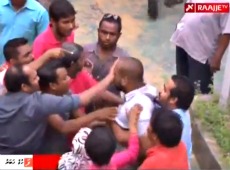
During the time of voting, local TV station Raajje TV captured a brief scuffle on camera between supporters of the two presidential primary candidates.

The footage shows police being brought in to control the crowd, who are dressed in the party’s pink colour scheme.

Yameen told local media shortly after casting his vote outside the Aminiya School in Male’ that despite the minor conflicts, the party would not split.

“Overall, the voting is alright. But people from within the party have entered voting centres and have tried to start fights,” he was quoted as saying in Sun Online.

“They have raised they voices, used foul language, this should not happen in an internal election. It is very sad.”

PPM’s elections committee has said that the party will announce the official results of the election within a week’s time.  Chair of PPM’s Election Committee, Mohamed Tholal said that the election took place in a very peaceful environment and the voting proceeded very swiftly.

Meanwhil,e former President of the Maldives and PPM president Maumoon Abdul Gayoom, called for PPM members to show the world what a “responsible party” the PPM was during Saturday’s primary.

Gayoom also said following the elections that he would work with PPM members to see its candidate win the presidential election.

Likes(0)Dislikes(0)