Former President to appear in webcast by US Institute of Peace, 10pm Male’ time

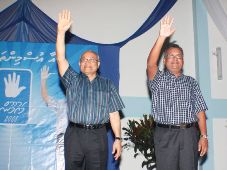
Former President Mohamed Nasheed will speak at the US Institute of Peace (USIP) today in a live webcast that will be streamed online from 10:00pm Male’ time.

The topic will be ‘Democracy in Question in the Maldives’, and online viewers will be able to engage panelists and each other through live chat and Twitter discussions at #NasheedUSIP.

In a statement, Nasheed’s Maldivian Democratic Party (MDP) said the talk would involve “an engaging conversation with Nasheed on nonviolent action, democracy and climate change, and an excerpt of ‘The Island President’.”

The event will be co-hosted by the International Center on Nonviolent Conflict, while Dr Peter Ackerman will lead a discussion with the former president.

The event can be watched at www.usip.org/newsroom/webcasts from 10:00pm Male Time / 1:00pm EDT.

Nasheed is in the US until July 1.

Likes(0)Dislikes(0)

Maldives on Tier 2 Watch List for Human Trafficking three years running

The Maldives has appeared on the US State Department’s Tier Two Watch List for Human Trafficking for the third year in a row.

Having “not demonstrated evidence of increasing efforts to address human trafficking over the previous year”, the country only narrowly avoided a descent to Tier 3 – the worst category – after presenting a written plan that, “if implemented, would constitute making significant efforts to meet the minimum standards for the elimination of trafficking.”

Particular areas of criticism included “a lack of systematic procedures for identifying victims of trafficking among vulnerable populations, and not taking sufficient law enforcement steps or concrete actions to protect trafficking victims and prevent trafficking in Maldives.”

“Counter-trafficking efforts are impeded by a lack of understanding of the issue, a lack of legal structure, and the absence of a legal definition of trafficking.”

The report noted that in 2011, “13 suspected victims of human trafficking and two suspected human traffickers were intercepted and deported in three cases of human trafficking identified at the Ibrahim Nasir International Airport (INIA).”

The Maldivian government’s response to trafficking victims was to deport them, the report noted, without providing access to services “such as shelter, counseling, medical care, or legal aid.”

“It did not provide foreign victims with legal alternatives to their removal to countries where they might face hardship or retribution,” the report noted. “Authorities did not encourage victims to participate in the investigation or prosecution of trafficking offenders. Due to a lack of comprehensive victim identification procedures, the government may not have ensured that migrants subjected to forced labor and prostitution were not inappropriately incarcerated, fined, or otherwise penalised for unlawful acts committed as a direct result of [their] being trafficked.”

The Maldives made some progress towards prevention, the report noted, including the approval of an Anti-Trafficking plan in March 2012 and the establishment of an Anti Human-Trafficking and People Smuggling Unit in January 2012.

However, despite an operation in April 2011 by police and immigration into an “unknown number” of ongoing cases involving fraudulent recruitment, the deportation of two foreigners as a result and the raid and closure of several recruitment agencies by court order on suspicion of fraud and forgery, “no labour recruiter or broker was punished or fined for fraudulent recruitment practices.”

The Maldives is mainly flagged as a destination country for victims of labour exploitation, particularly from Bangladesh and to a lesser extent, India, but was noted as a destination for sex trafficking.

“An unknown number of the 80,000 to 110,000 foreign workers that government officials estimate are currently working in Maldives – primarily in the construction and service sectors – face conditions indicative of forced labor: fraudulent recruitment, confiscation of identity and travel documents, withholding or nonpayment of wages, or debt bondage,” the 2012 report notes.

“According to a diplomatic source, an estimated 50 percent of Bangladeshi workers in Maldives are not documented and a number of these workers are victims of trafficking. Migrant workers pay the equivalent of US$1,000 to US$4,000 in recruitment fees in order to migrate to Maldives,” the State Department said.

“In addition to Bangladeshis and Indians, some migrants from Sri Lanka, Pakistan, and Nepal reportedly experienced recruitment fraud before arriving in Maldives. Recruitment agents in source countries generally collude with employers and agents in Maldives to facilitate fraudulent recruitment and forced labor of migrant workers,” the report added.

The Maldives’ expatriate population makes up almost a third of the country’s population. Minivan News previously reported in 2010 that the scale of labour trafficking in the Maldives was so disproportionately vast that the revenue generated made it the second greatest source of foreign currency to the economy after tourism, eclipsing fishing.

In addition, a smaller number of women were trafficked from Sri Lanka, Thailand, India, China, the Philippines, Eastern Europe, and former Soviet Union countries and Bangladesh for sex work in Male’.

The new government has closed down many illegal brothels in Male’ since coming to power, with nearly a dozen reported raids of so-called ‘beauty salons’. The expatriate women arrested during these raids are typically quickly deported, however there have been few reports of brothel owners being prosecuted.

“Some reports indicate that internal sex trafficking of Maldivian girls,” the report noted. “Maldivian children are transported to Male from other islands for forced domestic service, and a small number were reportedly sexually abused by the families with whom they stayed. This is a corruption of the widely acknowledged practice where families send Maldivian children to live with a host family in Male for educational purposes.”

‘Cash bounties’

The State Department’s report was swiftly followed by news articles in local media this week claiming that private companies and individuals had begun posting ‘cash bounties’ for absconded expatriate workers.

According to a report in Sun Online, notices had been posted in cafes windows and garages offering rewards of between Rf1000 (US$65) and Rf3000 (US$195) for information leading to the whereabouts of foreign nationals in hiding.

“We let people paste announcements when they request for it. We don’t ask who they are or anything,” a garage employee told the publication, when asked about one such notice.

Immigration officials and police quickly condemned the practice.

Police Sub-Inspector Hassan Haneef told Minivan News that while police had received no official reports of the posters, a journalist had raised the matter in a press conference. Posting such notices was illegal, he said, and opened those responsible to charges of harassment.

An official from the Immigration Department also expressed surprise at the reports.

“We did not know that was going on. It is absolutely against international human rights,” he said, adding that it the matter would be examined.

Standard practice among employers in the Maldives has been required to post the photographs and details of missing and absconded expatriate workers in the local newspaper – on most days, the pages include rows of such faces. However the Immigration official emphasised that no money was offered as an incentive for locating the missing workers.

“I think somebody is playing politics,” he said, of the report of cash bounties. “The US State Department released its report three days ago. We’re still on the watch list. My thinking is that somebody [put up the posters] to tarnish our reputation.”

Likes(0)Dislikes(0)

Comment: Government of the people, by the people, for the people…

The type of government that a nation consents to has a profound influence on its people and their quality of life. In the writings of early historians, Maldivians were depicted as “a most gentle people.”

Less than forty years ago, when a tourist visiting Male killed his girl-friend, practically the whole population of the island stopped their work and went to pay their respects. People were genuinely moved with sympathy for a victim of violence. “We were in deep shock. We were stunned really,” one man recalled.

How things have changed.

A single day’s headlines now expose the darker reality of this ‘Sunny Side of Life.’ A sixteen year old boy is murdered in a public park while law enforcement agents are busy arresting people for the crime of being “in possession of a cursed chicken.” A 65 year-old man is killed for his meagre pension money.

Meanwhile, the police pepper spray, beat and arrest people with impunity and young children are given guns to hold and admire as a tactic to enhance the profile of the Maldivian National Defence Force (MNDF).

Yes, change is inevitable. However, it is important to ask why such a fundamental change has occurred in the psyche of the whole nation in a 30 year time-frame. There might be many contributing factors but one of them stands out.

The style of governance under Gayoom’s regime affected the attitude of the whole nation. The violence, torture and lack of regard for other people’s dignity that characterises his regime, is unfortunately colouring the mind-set of ordinary citizens. The recent shameful episode of three policemen and an MNDF officer robbing expatriate workers makes sense in this dog-eat-dog society which is frighteningly becoming our reality. And why not? When ‘the best and the brightest’ of a country usurp power by pillage and brute force, the masses have no reason not to emulate their example. Exposure to violence desensitises us and reduces our sense of humanity.

There are a plethora of practical and philosophical reasons why the Maldives should embrace democracy at this stage of its development. One outstanding reason is the failure of the ‘Unity’ government that has emerged following the coup, which is neither a united nor a legitimate government. It is a loosely held conglomerate of ambitious individuals vying for power. The last thing on their minds is the well-being of the citizens. The sudden increase of police numbers, promotions and bonuses, in a period of economic recession, is testimony to the fact that the limited resources of the country are being squandered for the self-serving obsession of holding on to power.

Journalists, politicians and individual citizens discuss the execution of the coup that brought this regime back to power. While there is no doubt that a coup took place, and a legitimate, democratically-elected government overthrown, it is simply too generous to accept that a successful coup has been executed. A coup is not simply the acquisition of power. It also entails the maintenance of power by providing a functioning system of governance that would enable the usurpers to achieve legitimacy, at least through longevity.

What is obvious now is that the coup was a botch-up of gigantic proportions. The perpetrators of the coup underestimated the resilience of the people, ignored the determination of the MDP and assumed that Nasheed would walk away quietly and the rest of the population would return, sheep-like, to the conditions prior to the 2008 elections. However, three years of freedom from police persecution and terror has prompted a paradigm shift in the psyche of the nation. The coup government is struggling and is in a state of limbo. Their recent dealings with political activist and lawyer Mariya Didi and Chief Superintendent MC Hameed, Head of Intelligence of the Maldivian Police Service (MPS), have demonstrated the inadequacies of the regime in dealing with people who cannot be frightened into submission.

The regime has also made it clear to the general public that they are not capable of anything other than knee-jerk reactions. Meanwhile the people suffer as they watch the drama unfold and the numbers of political detainees continue to increase.

This failure to consolidate power is partly because autocracy of any form is an anachronism in the 21st century. Traditional respect for authority and the unquestioning subservience of citizens to those in power are fast disappearing. This is an age of social media and instant dissemination of information. Syria, Egypt and Libya provide clear evidence of how autocratic governments all over the world have been under increasing pressure. The type of Machiavellian political philosophy that advocates the suspension of common-place ethics from politics is out-dated and irrelevant in the 21st century, as is the Hobbesian interpretation of the social contract that people should submit to the authority of an absolute sovereign power.

Yet, these ideas form the political creed of the current regime in the Maldives; a cynical, out-dated creed that ignores the human potential for growth, both morally and intellectually. Thus, all autocratic governments, as the one that the old dictator has ‘gifted’ to the Maldives for a second time, are preoccupied with the business of propaganda, creating their own versions of the truth in an increasingly information-rich world.

Ruder Finn, the PR company employed by the regime to sanitise their record of human rights abuse, is not a new phenomenon, but the effectiveness of this huge monetary investment in disinformation, remains to be seen. Dr Hassan Saeed may indeed be destined forever to keep ‘applying lipstick to hideous pigs,’ as Yameen Rasheed so aptly puts it. However, the regime would be ill-advised to believe that the rest of the animals on the farm are impressed by the propaganda of Snowball and Napoleon.

It is generally agreed that the stability of a government is directly related to the economic well-being of a nation. What is less well understood is the fundamental human need for justice, order, goodness, and unity. In his hierarchy of needs for self-actualisation, Abraham Maslow defines these as ‘Meta-needs’, crucial qualities that help people to develop to their potential.

Where is justice when power is acquired and sustained by force? Where is order when the roads are filled with disenfranchised protesters and thousands are demanding that their right to vote be taken seriously? It is laughable to expect the nation to be united when the ruling hierarchy itself is divided by their personal agendas and are incapable of investing energy in the well-being of the people. The previous democratic government was much maligned for detaining a judge who was regarded as corrupt and morally questionable. While this may have been ‘impolitic’ in the cut-throat business of staying in power, it is a refreshing sign that the people’s government had the moral fibre to act decisively in a question of right and wrong, rather than be intimidated by political expediency.

But why democracy?

Winston Churchill’s words that “Democracy is the worst form of government except all the others that have been tried” have often been used as an apology for democracy. It seems to suggest that democracy is the best of a bad lot and we may as well make do with it because nothing else works any better. But modern research and experience seem to suggest otherwise. ‘The Spirit Level’ written by researchers Richard Wilkinson and Kate Pickett is based on a variety of cross- country comparisons. They argue that greater equality does not only produce better outcomes for the poor.

“Equality,” they point out, “is better for everyone,” including the rich and the elite of the society. Their well-evidenced thesis shows that unequal societies suffer from more insecurity and status-related fears, which permeate through the whole society, destroying the positive influences of community living and lowering the spirit of the poor and the rich alike.

Although it is simplistic to assume that democracy provides a totally equal society, empowering the people of the country to decide the direction of their government and its policies are crucial pre-requisites for a healthy and inclusive society. The good health of a society is of huge benefit even for the rich as it provides a stable, educated and flexible workforce capable of keeping up with the demands of a constantly changing world.

Thomas Paine, in his treatise Rights of Man points out that representative democracy is the most inclusive and the fairest form of government. Three centuries later, this claim still holds good. Democracy opens the door for the utilisation of everyone’s energy, ideas, creativity and intelligence for the well-being of the whole population. Conversely, the raison d’etre of any autocratic government, as with the regime currently in power in the Maldives, is the preservation of their own privilege and exclusivity.

It is not a historical accident that the democratic movement, especially since the coup, has resonated strongly with the combined voices of women and the youth of the nation. Any successful society in the 21st century must address the needs of these two powerful, but traditionally over-looked groups. Islamic fundamentalism has been legitimised in the Maldives by the coup of February 7 which saw the regime’s cynical manipulation of a small group of radicals to overthrow the democratic government. The inclusive nature of democracy is also the only response to the mindless, patriarchal and antiquated agendas of these individuals who consolidate power and maintain their own personal self-esteem through the subjugation of such groups as women and youth.

As a form of governance, democracy has the added advantage of allowing a safe and disciplined transfer of power. Autocratic rulers, who invariably need to abuse basic human rights to stifle opposition and to stay in power, inevitably carry with them increasing political baggage. Just as with Gaddafi in Libya, Assad in Syria provides a contemporary example of an autocratic ruler who has little to gain but much to lose by relenting to the demands of those who see that his days are numbered. The only option open for him is to fight to the bitter end.

The fact that Gayoom has initiated a court case against an 82 year-old Maldivian historian who claimed that there were 111 custodial deaths in the 30 years of Gayoom’s rule is a timely reminder of how insecure autocratic rulers feel as they come to the twilight years of their political careers. The costs of this predictable path of action are staggering in human, social and economic terms; not just for the perpetrator of the crimes, but for the nation as a whole. Democracy, where the head of a government is decided by the consent of the majority of the people, is the only way of avoiding such a political quagmire.

Ultimately, however, it is a question of governance. In this context governance describes the methods a government use to ensure that citizens follow its processes and regulations. Good governance, like good parenting, is not simply a set of rules to achieve compliance through fear and punishment. Good governance is underpinned by a strong set of moral and social imperatives. It relies heavily on a series of ethical and social requirements such as justice and a shared vision by all its constituents. As abusive and violent parents enslave their children in a vicious cycle of similar behaviour, oligarchic systems of governance which portray that ‘might is right’, have a hugely negative and vicious impact on the citizenry.

Just as thirty years of life under Gayoom saw an increasing number of Maldivians lose their innate sense of fairness and compassion, Waheed’s recent sanctifying of the MNDF has ramifications for the type of society we live in and will continue to live in.

What the country needs is healing, justice and the voices of its populace to be heard. What is on offer is more imprisonment, more thuggery and more money being wasted in white-washing these actions. For many people, including large segments of the police force, MNDF and ordinary citizens, there is something extremely obscene in the disparity between what the country needs and the oppressive responses of the regime.

Maldivians have the courage and maturity to take risks and grow as a nation. The only way forward now is through an early, democratic election, before the powerful tentacles of autocracy reduce the country into another abyss of hopelessness, as it did for thirty years under Gayoom. History does not have to repeat itself.

Democracy is premised on the understanding that human dignity is an inherent right. But with the exception of a short period of three years under a fledgling democracy, generations of Maldivians have grown up and grown old with the belief that life is an inevitable submission to force, brutality and loss of dignity. Violence begets violence. It is an insidious force which destroys the very foundation of nationhood: justice, trust and compassion. To live wisely, the nation must attend to the welfare of all its citizens, not just a privileged few. The rule of the few must end. Government should be of the people. It should be by the people. And most importantly, it should be for the people.

All comment pieces are the sole view of the author and do not reflect the editorial policy of Minivan News. If you would like to write an opinion piece, please send proposals to [email protected]

Likes(1)Dislikes(0)

“Surprise” water sports event kicks off in Maafushi children centre

A water sports programme for the children at the Education and Training Centre for Children (ETCC) on Maafushi island kicked off on Sunday.

ETCC is an all-boys shelter and a school for children above 10 who are taken under the state care for various reasons such as having no legal guardians or for rehabilitation on parent’s request.

According to the program organiser, NGO Advocating the Rights of Children (ARC), over next three days the children shelter will have the “unique opportunity to learn and enjoy windsurfing, sailing, beach games, wake board, water ski, banana and fun tubes”, thanks to the support from Club Aeolous Waters Sports from the Club Faru Resort.

“Through fun water sports, we are trying to promote a healthy lifestyle. It will also build children’s skill and talents and inspire them to work as a team,” Zeneesha observed.

According to ARC, all 37 children currently housed at the centre are participating in both theory and practical lessons of water sports on the island beaches.

“The children are very happy,” Mohamed Abdullah, Principal of ETCC, told Minivan News over the phone. “We did not tell the kids about it until yesterday. It was a surprise. They were very happy to go into the water.”

“The children stay inside the centre for 24-hours. They don’t have opportunities for fun sports like these. All the kids want to wind surf,” he added.

“I am really glad ARC took the initiative to help the center and its children,” he observed, noting that the centre is facing numerous challenges including staff shortages, poor infrastructure and budget cuts.

Zeneesha said that the NGO believes such sports activities will open new future prospects for the children living at shelters.

ETCC Principal also agreed; “Often, when the children reach legal age and move out from the shelters, they struggle to find jobs and earn a living. They wont even have the same confidence as others. So we are putting great emphasis on helping the children find a way to earn a living when they leave the shelter.”

He noted that the centre has talked with resort operators to open apprentice slots for children who graduate from the shelter: “This year hopefully the first batch of 16 year-olds will be be sent for training.”

Despite several challenges, Zeneesha said the NGO has expanded its support to the three shelters following the ARC’s Stakeholder Conference on Children’s Shelters 2012 focused on ETCC, Kudakudhinge Hiyaa on Villigili providing care for children below nine years and the Correctional Training Centre for Children (CTCC) on Feydhoo Finolhu.

She noted that under its sports program initiative, a total of 27 children from the Villigili shelter participated in a chess programme, which was held every weekend for two months. A similar badminton program is underway.

Meanwhile she added that these centres need a lot of capacity building. “Therefore, we have been providing life-skill and parental skill development workshops to the shelter’s staff,” she says.

Likes(0)Dislikes(0)

“Maldives’ moral authority wasted, reputation tarnished”: former diplomat Abdul Ghafoor Mohamed

The Maldives’ most senior diplomat prior to his resignation after February 7, Abdul Ghafoor Mohamed, has spoken to the media for the first time since tendering his resignation from the post of Maldives’ Ambassador to the Unite Nations live on Al-Jazeera.

In an interview with Haveeru, Abdul Ghafoor said that the country’s image has been tarnished by recent events and that the moral authority built up over the years has been wasted.

“A sound foreign policy perfected through the years enabled us to establish a voice internationally, much louder than our diminutive size,” Ghafoor told Haveeru.

“We showed the maturity to change a thirty year old governance system without a civil war or much unrest. That truly gained the respect of much larger developed nations. We secured a moral authority and political influence over our international partners when we, a small island nation changed a government through legitimate means” .

“With Maldives’ domestic feats suddenly we were seen in whole different light. We had the potential to play a bridging role between Islamic States and Western countries. We had the ability to talk to both sides, and usually they listened.”

Abdul Ghafoor went on to detail his view of the current investment climate in the Maldives, arguing that the unpredictable situation in the country meant the situation is an unnattractive one for foreign investors: “The policies adopted now could be much different in one and a half years time.”

The former diplomat also questioned the government’s claims to have been accepted by the international community.

“It is a diplomatic norm to congratulate any head of State when the office is assumed. How many States congratulated President Waheed on his assumption of office? Most countries stated that they would work with Waheed’s government while stressing early polls and probe into the regime change,” Ghafoor told Haveeru.

Likes(0)Dislikes(0)

Who turned out the light: Maldives’ solar ambitions plunged into darkness

On the afternoon of February 7, 2012, the Maldives was set to sign into existence a plan that would have revolutionised the country’s energy sector, immediately attracting US$200 million of risk-mitigated renewable energy investment.  It was proposed that investment would eventually reach US$2-3 billion – a gigantic step towards the country’s goal of carbon neutrality by 2020.

The Scaling-Up Renewable Energy Program (SREP) proposal was produced by the Renewable Energy Investment Office (REIO) under President Mohamed Nasheed’s administration, and driven by Nasheed’s Energy Advisor Mike Mason – an unpaid position.

Mason, a UK national, former mining engineer and expert on renewable energy, carbon finance and offsetting, collected and analysed data on energy use and the existing diesel infrastructure across the Maldives.

He discovered that the Maldives was facing an energy crisis that was as much economic as it was existential.

The greater Male’ region generates 30 MW, with a further 8-10 MW for industrial purposes, while government utilities across the island chain generate a further 18 MW. The tourist resorts privately produce and consume 70 MW.

All this power – and the fuel that propels the country’s fishing and transport fleet – is generated through imported oil. Importing that fuel cost approximately US$240 million in 2011, a figure projected to increase to US$350 million in 2012. That represents 20 percent of the country’s entire GDP, at a time the Maldives is facing a foreign currency shortage, plummeting investor confidence, spiraling expenditure, a drop off in foreign aid and a crippling budget deficit of 27 percent.

The SREP plan reveals the scale of the problem: “If the oil price rises to $150/bbl by 2020, and consumption grows by four percent per annum, oil imports are expected to reach around US$700 million – or almost US$2,000 per head of population.

“This is clearly unsustainable. Decarbonisation is at least as much a matter of national economic security and social welfare as it is a matter of environmental concern,” the report notes.

Energy revolution

Former Energy Advisor Mike Mason

Mason calculated that solar photovoltaic (PV) could be supplied directly to consumers at US$0.23 per kWh during the day, but only at US$0.44 per kWh from batteries at night. However an optimum mix of solar, battery and wind could supply 80 percent of power requirements at US$0.36 per kWh. Biomass could be supplied to Male at US$0.16 per kWh, or US$0.20 a kWh including capital.

Mason compared this to the volatile cost of import-dependent diesel generation, which ranged from US$0.28 per kWh hour in Male’, and up to US$0.70 per kWh on some of the most inefficient islands.

Existing solar initiatives in the Maldives, such as the Japan International Cooperation Agency (JICA)’s 675 kWh of solar panelling on schools and other public facilities across Male’, were “stupidly priced, uneconomic, symbolic, and don’t address the problem of energy storage,” Mason noted. He also proposed that large scale wind generation suffered from extreme seasonal variability and risked impacting the stability of the grid.

Mason concluded that the most realistic and commercially-viable renewable option was to run 90 percent of the country on solar supplemented by small-scale wind power, while a 24 megawatt biomass plant could provide the baseload of the greater Male’ region at more than 40 percent less than existing rates.

The pricing was attractive, but the challenge was attracting the significant upfront capital investment required: “with renewables, on day one you buy 20 years of electricity,” Mason explained.

Attracting this capital investment was therefore crucial, however “because of its political history and economic inheritance, the Government of Maldives is poorly placed to raise capital at normal ‘sovereign’ rates of interest,” the SREP report noted.

This was to be a key innovation in Mason’s proposal: rather than pour donor funding into myriad haphazard capital-intensive renewable energy projects, Mason’s plan was to instead use the available World Bank and Asia Development Bank funding to dramatically reduce the commercial and sovereign risks for foreign investors, lowering the cost of capital to attractive levels comparable to other countries.

“In practice, the guarantees may not be needed for all projects or by all developers, and once the Maldives becomes an established destination for renewable development finance the need for guarantees is expected to diminish,” the SREP proposal notes.

“Right now the cost of capital, if you are in Germany, is very low. In a country like the Maldives, it is stupidly high,” Mason explained to Minivan News.

“If [the Maldives] wants to get somewhere it has to take out the risk – at least risks not in control of the investor. If you can do that, then the cost of capital drops to 6-7 percent – about the same as a powerplant [in the West]. The whole thing becomes economic – the sensible thing to do – rather than a matter of subsidies,” he explained.

The World Bank team working on the project had given verbal approval for the plan, describing it as one of the most “exciting and transformative” projects of its kind in any country, according to Mason.

“It was a shoo-in. But the coup happened the day we were due to submit it – later that very day, in fact,” he said.

Amid the disintegrating political situation, the decision was made to suspend the submission.

“The whole point of the plan was to take out the instability. The thing about a coup is that it takes that model and turns it upside down,” Mason told Minivan News.

As the political instability increased, so did the cost of capital. Investors who had been “queuing up” made their excuses.

In an email exchange, incoming President Dr Mohamed Waheed Hassan requested that Mason continue with the submission and remain in his current position as Energy Advisor.

Mason chose to resign.

“I don’t think Dr Waheed is a bad man – actually I like him a lot personally,” he wrote, in an email to an official in the Trade Ministry obtained by Minivan News. “However, he has done nothing to assure me that this is really a democratic process. Rather, my intelligence tells me this is a Gayoom inspired coup with Dr. Waheed as an unfortunate puppet.”

Mason added that if the new government sought political accommodation with the MDP, made “a concerted attempt to remove the corrupt judiciary”, and ceased police brutality “so that people can walk the streets freely as in any other civilised country”, “then I will be back on side in the blink of an eye.”

“I have given the best part of my life to this over the last 18 months, but I fear I have a set of democratic and moral principles that override other considerations,” Mason stated.

President Waheed responded on March 23:

“It would be nice if you listened to something other than Nasheed’s propaganda. He is free to go anywhere he wants and say what ever he wants,” Waheed wrote.

“Have you ever thought that Nasheed could have made a stupid mistake under the influence of what ever he was on and blown everything away? I thought you had more intelligence than to think that I am someone’s puppet and Maldives is another dictatorship,” the President said.

Further emails obtained by Minivan News show that Waheed’s new government was interested in continuing with the submission of the SREP plan.

“I am certain that this is the wrong time to press ahead with the SREP IP. It relies at its heart on getting the cost of capital down by reducing risk,” wrote Mason, to a government official.

“That is not believable in an atmosphere in which [airport developer] GMR is being attacked as an investor in infrastructure; the legal system is, frankly, corrupt so contracts cannot be relied upon; the politics are (in the most charitable possible interpretation) a major risk factor; and the President has no parliamentary party of consequence. I also doubt that the SREP sub-committee will approve funding the plan as they too will see through the plan to the problems (or at least they should if they are any good),” he wrote.

“If things clear up, and faith in democracy and the rule of law is restored than a second go at this would be worth while – but meantime I am sceptical. A much more limited and less ambitious plan – say for the smaller islands only, might fly.”

The very premise of the plan – mitigating investor risk – had been scuttled by the political upheaval and both domestic and international challenges to the legitimacy of Waheed’s government, said Mason.

“Even if I did work with Waheed, I couldn’t deliver the plan now [because of falling] investor confidence,” he told Minivan News. “[The perpetrators] have destroyed US$2-3 billion worth of investment and condemned the country to an unstable economic future based upon diesel.”

Climate of crisis

Earlier this month President’s Office Spokesperson Abbas Adil Riza said the new government would “not completely” reverse the previous government’s zero carbon strategy: “What we are aiming to do is to elaborate more on individual sustainable issues and subject them to national debate. Previously, these discussions on sustainability were not subjected to a national debate, such as through parliament,” Riza said.

President Waheed last week attended the Rio +20 summit and announced the Maldives’ intentions to become the world’s largest marine reserve in five years.

During his speech in Rio, Waheed also pledged that the Maldives would “cover 60 percent of our electricity needs with solar power, and the rest with a combination of biofuels, other clean technologies and some conventional energy.”

“Progress towards achieving these goals is slow because of the huge financial and technological investments involved. If we are, as a global community, committed to the concept of transitioning to a green economy, then developing countries will need significant financial and technical support,” the President stated, going on to appeal for financial assistance.

“A small island state like the Maldives cannot, on its own, secure the future we want. We rely on our international partners to ensure that their development paths are sustainable and don’t negatively impact on vulnerable countries like the Maldives,” Waheed said.

Former President Nasheed’s Climate Change Advisor – UK-based author, journalist and environmental activist Mark Lynas, who drew a monthly stipend of Rf10,000 (US$648) for expenses – told Minivan News that the loss of democratic legitimacy in the Maldives had destroyed its ability to make a moral stand on climate change-related issues, and be taken seriously.

“I think that the Maldives is basically a has-been in international climate circles now,” Lynas said.

“The country is no longer a key player, and is no longer on the invite list to the meetings that matter. Partly this is a reflection of the political instability – other countries no longer have a negotiating partner that they know and understand,” he said.

“Partly, I think it is because of the lack of democratic legitimacy of the current regime – in the climate negotiations the entire ask of the small island and vulnerable countries is based on their moral authority to speak on behalf of those who are most suffering from the impacts of climate change.

“Yet Waheed and his representatives have no moral authority because they were not elected, have strong connections with corrupt and violent elements of the former dictatorship, and took power in the dubious circumstances of a police coup,” Lynas argued.

The government’s high expenditure on international public firms such as Ruder Finn – also responsible for the Philip Morris campaign disputing the health hazards of smoking – had further undermined its credibility with journalists across the world, Lynas said.

“Journalists and others are aware that the Waheed regime has hired PR agencies to act on its behalf – which makes them doubly suspicious. It is widely understood that the Maldives post-coup government has no real interest in the climate issue, but is instead trying to use it as a greenwashing tool in order to buff its credentials abroad and in order to obscure its undemocratic nature at home. I don’t think this will work, as it is hardly very subtle and journalists are not stupid,” said Lynas.

“The Maldives has lost many years of work already – it has little credibility left with donors or international investors. Investors and donors alike are looking for stability and strong governance – and they will not get either of those whilst the political system is essentially deadlocked between competing parties, with regular protests and ensuing police violence.

“In climate terms the Maldives is well on its way to becoming a failed state – I see no prospect of it achieving Nasheed’s 2020 carbon neutral goal, even if that goal is still official policy,” Lynas said. “I think time has basically run out now – unless there are early elections quickly and a legitimate government re-established there is no real prospect of resurrecting the Maldives’ leadership on climate change. By 2013, it will certainly be too late – other countries will have overtaken it and the Maldives will essentially be left behind.”

Likes(1)Dislikes(0)

Nasheed government “failed to combat extremism”: Islamic Minister Sheikh Shaheem

The Maldives’ Islamic Affairs Minister has said religious scholars have not been politicised by the rhetoric of various parties since February’s controversial transfer of power, as his ministry had sought to counter the “ideological problems” of extremism in the country.

Sheikh Mohamed Shaheem Ali Saeed told Minivan News that since President Dr Mohamed Waheed Hassan came to power on February 7, scholars representing the government-aligned, religiously conservative Adalaath Party had been “calling for peace” in the country between rival political factions. He said that he did not believe scholars were taking sides in the current political deadlock.

However, Shaheem did contend that his party was “much more comfortable” working with the present government addressing potential concerns about the nature of the country’s faith.  He indicated that the threat of home-grown terrorism was a key issue needing to be addressed in the Maldives – something he alleged the previous government had neglected to assist through funding.

The Maldivian Democratic Party (MDP), which contends that it was ousted from governance back in February through a “coup d’etat” sponsored by opposition politicians, businessmen and mutinous section of the police and military acting on a platform of extremist Islamic rhetoric, has since seen some of its local councils refuse to authorise sermons in mosques by prominent scholars of the Adhaalath Party. The party claimed its elected councils had refused certain scholars over fears allowing them to speak could “disrupt the peace and create unrest”. The action led Shaheem’s Adhaalath Party to criticise such protests as “lowly and secular acts”.

While both Shaheem and Sheikh Ilyas Hussein, head of the Adhaalath Party’s scholar’s council, both participated in protests against the government of former President Mohamed Nasheed on December23 in order to “defend Islam”, the Islamic Affairs Minister stressed he was not in the country during the events of February 7.

Shaheem claimed that having not taken part in the transfer of power, he did “not think there was a concern” about some scholars being politicised among party lines for taking positions under the new government.

Pointing to other nations like the UK, where serving monarch Queen Elizabeth II was both the head of state and the church, Shaheem said that political leaders in the Maldives focusing on religion was no different.

Shaheem himself previously served under the Nasheed government as Islamic State Minister before resigning back in December 2010 over differences of opinion with the administration over issues such as claims it was strengthening links with Israel.

Shaheem added that in working in line with a coalition government of former opposition parties and President Waheed, he was “much more comfortable” and confident that religious issues raised on December 23 would be addressed – particularly funding of religious programmes.

“At present, we follow a moderate view of Islam here in the Maldives. We are requesting a comfortable amount to oversee our work from next year’s budget,” he said, adding that he was confident that the present government would be able to address the issues raised on December 23.

Extremism and terrorism

Shaheem claimed that amongst the present challenges facing the Islamic Ministry, a need to focus on addressing social issues and improving the manners of young people were needed, as well as “ideological problems” linked to religious extremism.

“The previous government did not give us the budget we needed to run programmes to address these issues,” he said. “There are problems here with extremism and terrorism, these are idealogical problems that need to be targeted through religious awareness campaigns.”

“Islamic upbringing”

Shaheem’s comments were made as Vice President Waheed Deen yesterday stressed the need to provide children with a “proper Islamic upbringing” based around laws and customs of the faith.

Speaking during the 27th National Quran competition held at the Islamic Centre in Male’, the vice president said that upholding Islam was vital to ensure nationhood, while also addressing “weak social standards” .

According to the President’s Office website, Deen claimed that the progress and prosperity of a nation was the satisfaction of its people; and the people will be content only when they are truly faithful and devoted to their religion.”

President’s Office spokesperson Abbas Adil Riza said that the vice president’s comments yesterday were based on wider government policy relating to economic reform, particularly within its aims to reduce the gap between the country’s richest and poorest people.

He added that Deen had raised the issues of a need for “good discipline” through Islamic principles.  However, Abbas said that the speech was  not outlining a specific government focus on Islamic developments across the nation.

“The Maldives remains a moderate country and will remain so.  We do not encourage acts of extremism here,” he said.

“Political control”

Without directly responding to Sheikh Shaheem’s comments regarding the former government’s commitments to try to eradicate religious extremism, the MDP said it wished to let the Islamic Affairs Minister’s own “ethics and comments” made during the December 23 protests speak for itself.

Increased diplomatic relations with Israel, including possible service of El Al airlines, and recent debates over Shariah law, were among examples given by speakers at the December 23 demonstrations as examples of the Nasheed government’s alleged attempts to undermine Islam in the Maldives.

Party Spokesperson and MP Hamid Abdul Ghafoor claimed that with the MDP failing to recognise the legitimacy of the current government, the same was true for ministerial appointments like Sheikh Shaheem.

Ghafoor also alleged that issues such as Islamic fundamentalism were a well established tool used during the 30 year rule of former President Maumoon Abdul Gayoom to pit different factions in the country against each other, something he believed was once again happening with the present government.

“I see Shaheem as a just a little cog inserted into the larger machine of Gayoom’s political control,” he said.

December 23

Last year’s December 23 protest was established by NGOs and six political parties as part of a demonstration to “to defend Islam” in the nation amidst allegations the Nasheed government had sought to introduce freedom of religion and un-Islamic “idols” to the country – a charge it vehemently denied.

Speakers from various religious and political opposition parties addressed an estimated 5,000 men, women and children of varying ages and attire. Protesters were handed t-shirts and banners reading “Maldivians in defense of Islam” along with Maldivian flags.

Banners bearing slogans including “We stand united for Islam and the nation”, “No idols in this holy land”, “No to the Zionist Murderers”, “No to [Israeli transport group] El Al Airlines” and “We stand for peace” led participants to gender segregated areas across from the Tsunami Memorial area, where approximately 20 protest leaders spoke from a mounted podium.

“We don’t know there is a moderate, higher or lower Islam. We only know Islam, which is above all the religion. The only road we must follow is based of Allah’s callings,” said Jumhoree Party (JP) Leader and tourism tycoon Gasim Ibrahim during the protest.

Sheikh Shaheem also spoke on the day reiterating that his party does not support terrorism, adding that the security forces would know the actual people provoking such acts.

Meanwhile, the Dhivehi Rayyithunge Party (DRP) Leader and MP Ahmed Thasmeen Ali said that he was there on behalf of his party to assure Maldivian citizens that the party will stand with the religion of Islam.

”We are gathered here to uphold Islam for the future of the next generations,” Thasmeen said, accusing the current government of trying to establish anti-Islamic policies such as non-islamic idols and strengthening relations with Israel.

“We are here to show that will not support those policies yet we are not extremist,” he said. ”We will stay forever as an Islamic nation.”

However, in a counter-protest held the same day, former President Nasheed called on then opposition leaders of political parties to explain their exact stance on religious issues to the public ahead of a 2013 presidential election.

“Should we ban music? Should we circumcise girls? Should we allow nine year-olds to be married; is art and drawing forbidden? Should we be allowed to have concubines? We have to ask is this nation building? Because [the government] won’t allow these things, we are being accused of moving away from religion,” he said.

Nasheed also urged MPs to discuss the inclusion of Sharia punishments in a revised penal code “without calling each other unbelievers.”

“At this moment we may not realise how important this gathering is, but years down the line we will look back and realise this was a crucial moment,” he said at the time.

“I asked you to come here in support of the middle, tolerant path. And I believe that most citizens want to continue our traditional form of Islam,” Nasheed said at the time.

Likes(1)Dislikes(0)

JP, MDP share spoils of island council by-elections

Candidates of the former ruling Maldivian Democratic Party (MDP) and government-aligned Jumhoree Party (JP) won by-elections yesterday for vacant seats in the island councils of Alif Dhaal Hagnameedhoo and Alif Alif Mathiveri.

JP and MDP candidates went head to head in both by-elections, which were not contested by other parties or independent candidates. While MDP candidate Ahmed Firaq won in Hagnameedhoo, JP candidate Ali Riza Mohamed emerged victorious in Mathiveri.

In Hagnameedhoo, Firaq won with 190 votes (52 percent) against JP contender Ibrahim Naseer Adam, who received 178 votes (48 percent).

JP’s Riza meanwhile won the Mathiveri council seat with 250 votes (54 percent) while MDP candidate Ali Risham came second with 212 votes (46 percent).

Following the victories, leaders of both parties congratulated the winning candidates. JP President Dr Ibrahim Didi expressed confidence in winning future elections and praised the party’s “strong” leadership as the main reason for the success.

MDP Chairperson ‘Reeko’ Moosa Manik congratulated MDP’s winning candidate Firaq and expressed gratitude to Hagnaameedhoo islanders as well as the party members who worked in the campaign.

Yesterday’s result showed that “the people of Hagnameedhoo are opposed to the coup, have political foresight and make decisions wisely,” the Hulhu-Henveiru MP said.

Noting that MDP only received nine votes from Hagnameedhoo in the first round of the presidential election in 2008, Moosa said yesterday’s results represented the party’s growing strength and support.

The Mathiveri island council seat was vacated in November 2011 after a councillor elected on a Dhivehi Rayyithunge Party (DRP) ticket quit the party. Under the Decentralisation Act, councillors who leave their party are stripped of their seats. The Hagnameedhoo seat was vacated after a councillor resigned due to poor health.

In the February 2011 council elections, four independent candidates and one JP candidate were elected for the five-member Hagnameedhoo island council while four DRP candidates and one MDP candidate were elected to the Mathiveri island council.

Likes(0)Dislikes(0)

Police arrest dismissed DPRS officer for theft, impersonating police

Police have arrested a man posing as a police officer and wearing a police uniform, after he attempted to rob a group of expatriate workers in a Male’ residence.

According to police, the man attempted to rob the house where expats working at ‘Muneer hotel’ live and he was caught Saturday afternoon.

In a statement police said the man was a former Department of Penitentiary and Rehabilitation Service (DPRS) officer who was dismissed for his involvement in a theft case.

Police did not provide the name or age of the man but said he was 26 years-old.

The man entered the house where the expats lived and tried to pretend he was a police officer by using his old DPRS identification card, according to police.

Earlier this month, police arrested three police officers and a Maldives National Defense Force (MNDF) officer after they allegedly robbed a large amount of cash from expatriate workers in a house near the State Bank of India (SBI), in Male’s Heniveru ward.

Newspaper Haveeru reported at the time that one police officer was a member of the police investigations team, while another was a Special Operations (SO) officer.

Haveeru reported that the men entered the house and attacked and threatened the expatriate workers on Friday night around 9:00pm.

Two of the police officers were in uniform during the incident, according to Haveeru.

On August 29 last year, police arrested the three MNDF officers accused of entering an expatriate residence in Male’ in army uniform and robbing the Bangladeshi workers with threats of violence.

The MNDF officers have returned to work after the MNDF concluded its investigation.

Newspaper Haveeru reported at the time that the uniformed officers entered the house on three consecutive nights and took Rf30,000 (US$1,945), Rf24,000 (US$1,556) and Rf12,000 (US$778) respectively.

In a parliament’s committee meeting MPs supporting the ruling party alleged that after police stations were set alight in nationwide protests on February 8, people had stolen police uniforms and were using them to conduct criminal activities.

Likes(0)Dislikes(0)