The Maldives has topped a poll of most desirable travel destinations among its UK customers, according to a study by tour giant Kuoni. The country has held the rank since 2005.
The Maldives was followed by Thailand, Sri Lanka, the United Arab Emirates (Dubai) and the USA, including New York holidays.
“The Maldives also retained its top slot for honeymoon destinations and topped the wish list for digital natives, better known as Generation X, Y and Z. Sri Lanka holidays retained ‘Number one Destination for Weddings’, Kuramathi Island Resort in the Maldives kept the top slot for ‘Family Destinations’, as did Thailand holidays for solo travelling,” read a statement from the tour operator.
Specific trends in demand identified in the customer survey were, according to Kuoni, “a thirst for discovery, authenticity of experience, social responsibility, and face to face contact with a travel expert when booking.”
The Commonwealth will provide technical expertise to the Maldives to help resolve the ongoing judicial crisis in the Maldives, the Ministry of Foreign Affairs has stated.
High Commissioner of the Maldives to the UK, Dr Farahanaz Faizal, met with Deputy Secretary-General of the Commonwealth Mmasekgoa Masire-Mwamba this week and raised “the urgent need to modernise the Judiciary to international standards and possible Commonwealth assistance in this regard.”
The crisis was sparked on January 16 when the government ordered the military to detain Chief Judge of the Criminal Court, Abdulla Mohamed, after he filed a High Court injunction against his police summons.
Allegations against the judge dating back to 2005 include misogyny, sexual deviancy, throwing out an assault case despite the confession of the accused, political bias, obstruction of police duty, disregarding decisions of high courts, deliberately holding up cases involving opposition figures, barring media from corruption trials, ordering the release of suspects detained for serious crimes without a single hearing, maintaining “suspicious ties” with family members of convicts sentenced for dangerous crimes, and releasing a murder suspect “in the name of holding ministers accountable” who went on to kill another victim.
In one instance Abdulla Mohamed was accused of requesting that two underage victims of sexual assault act out their attack in court, in front of the perpetrator.
The judge had previously been under investigation by the Judicial Services Commission (JSC), but had successfully sought an injunction from the Civil Court against his further investigation by the judicial watchdog.
The ongoing detention of the judge has polarised public opinion in the Maldives and resulted in several weeks of opposition-led protests consisting of between 200-400 people, some of them resulting in violence and injuries to police, protesters and journalists.
Judge was “clearly demonstrating his independence”: ICJ Australia
Earlier this week ABC Radio in Australia aired an interview with John Dowd, President of the Australian branch of the International Commission of Jurists (ICJ), who stated that Judge Abdulla Mohamed had “clearly been demonstrating independence as he’s supposed to do and the government doesn’t like it.”
None of the government’s allegations against the judge warranted his arrest, Dowd argued, “and it’s clear that the must be immediately released. This will do serious damage to the Maldives internationally and their tourist industry is a big part of their income and they just can’t allow this to go on.”
The Maldivian judiciary, Dowd claimed, was “generally competent”.
“It’s not a legally focused country. They’ve had a change of government after some 30 odd years and there’s obviously a settling down period and they do need assistance in terms of bringing their legal system up to date. But nonetheless, there is nothing wrong with the way the judges carry out their duties and it’s just a classic situation of a government not liking someone’s decision.
“It’s got a funny legal system in that there are aspects of Sharia law in it and British Commonwealth law and so on. But I would have thought that the Commonwealth Secretariat could have arranged some judges or someone that could go in there to mediate, and the Commonwealth is the more likely basis for resolving the issue. It really is very difficult for outsiders to intervene and I don’t think the UN is the correct body,” Dowd told the ABC.
Maldives Foreign Minister Ahmed Naseem responded to the criticism on ABC Radio the following day.
The government, he said, did not want to keep Abdulla Mohamed under arrest, but did not want him sitting on the bench until the charges against him were cleared – “but the point here is that we are in a Catch-22 situation – which court do we go to?
“Existing judges swore themselves in unilaterally without looking into the relevant clauses of the constitution, which says that they have to be sworn in according to the new constitution.
“Now, this new constitution strictly stipulates that these judges should have qualification to act as judges. The present judges that we have don’t have these qualifications.
“There are quite a lot of people whose interests are vested with these judges. That is, there are politicians connected to the former regime, who have many court cases. Now all these court cases are being held by the judge who is under detention at the moment. No cases have been conducted on this and no sentence has been passed. So it’s in the interests of the opposition to see that this judge remains as a judge.”
The country’s “entire judiciary is at stake”, Naseem argued. “What democracy can we have, when we don’t have a proper judicial system and we can’t dispense justice properly? The democracies of the world should really help us and find ways of sorting this issue out. We have requested UN bodies to help us in this and they’ve promised to send us some people to sit down with us and work something through.”
Criminal Court letter
Meanwhile, a group of Criminal Court judges this week sent a letter to Chief Justice of the Supreme Court, Ahmed Faiz, contending that the Supreme Court had as much responsibility for the crisis as President Mohamed Nasheed.
Ensuring an independent judiciary as envisioned in the new constitution adopted in August 7, 2008 was “a legal as well as national duty” of the Supreme Court, the judges noted, adding that it was “regrettable” that the Criminal Court’s functions have not been developed in line with the changes to the criminal justice system.
Among the main points raised in the letter included the Supreme Court abolishing an article in the Judicature Act – “without any discussions with anyone” – that stipulated the formation of judicial councils, intended to represent all courts and provide advice and counsel.
The Supreme Court also took over a case filed at the Civil Court challenging the legality and validity of the JSC’s process for vetting candidates to the High Court “in the name of public interest litigation” and dismissed the case without issuing a verdict.
Moreover, the letter stated, the Chief Justice “turned a deaf ear” to numerous complaints from the public as well as judges and took no action regarding Chief Judge Abdulla Mohamed.
The judges also criticised the Supreme Court for not undertaking efforts towards dialogue with the government or President Nasheed to resolve the current crisis, calling on the Chief Justice to bring both sides to the negotiating table.
The letter took note of inconsistent standards and rulings made by different judges of the Criminal Court regarding extension of detention and evaluating evidence as well as the release of suspects detained for serious crimes, and referred to a list of “urgently needed” reforms previously recommended to the Supreme Court.
A documentary regarding New7Wonders, aired on South Korean national broadcaster KBS, has drawn on the Maldives’ experience with the foundation and ignited controversy in the country regarding the nature of the competition.
Korea’s Jeju island was announced as one of the winners in the competition, along with the Amazon rainforest, Vietnam’s Halong Bay, Argentina’s Iguazu Falls, Indonesia’s Komodo, the Philippines’ Puerto Princesa underground river, and South Africa’s Table Mountain.
Votes were collected online and via paid SMS and phone voting in the various countries, in collaboration with telecom sponsors. Final vote counts for the winners were not revealed, however New7Wonders maintains that the process is “uniquely democratic”.
Following the airing of the program in South Korea, founder of the Swiss-based New7Wonders operation and self-described filmmaker, museum curator, aviator and explorer, Bernard Weber, visited the country to denounce it.
“Only a few reporters were able to attend the conference due to the short notice,” noted the Korea Herald.
“Since the announcement [about Jeju] was made, however, media outlets and activists here have been raising suspicions concerning the foundation’s identity, the money Jeju spent to be chosen and whether it was fair for government officials to take part in the voting multiple times,” the paper reported.
During the press conference, President of the Jeju Tourism Organisation Yang Young-keun revealed that Jeju residents and tourism officials spent 20 billion won (US$18 million) on international phone voting for the competition.
“With the tourism industry accounting for more than 80 percent of Jeju’s economy, 20 billion won does not seem like an unreasonably large amount of money,” Yang added.
Park Dae-seok, an official at Korea’s National Committee for Jeju New7Wonders of Nature, was also quoted as stating that “with Jeju’s 500,000 people, it would have been impossible to have the island named the New Seven Wonders and it is only fair to allow multiple voting in this sense.”
The Maldives’ cabinet announced it was withdrawing from the competition in May 2011, after claiming to have received unexpected demands for cash not explicitly specified in the original contract, in order to continue to “compete meaningfully” in the competition.
Indonesia followed suit, with the country’s tourism authorities announcing the withdrawal of Komodo from the running. In both instances, New7wonders insisted that the Maldives and Komodo remained in the competition while seeking new promoters in both countries.
Demands included ‘sponsorship fees’ (‘platinum’ at US$350,000, or two ‘gold’ at US$210,000 each) and the funding of a ‘World Tour’ event whereby the Maldives would pay for a delegation of people to visit the country, provide hot air balloon rides, press trips, flights, accommodation and communications.
In a comment piece published on Minivan News, New7wonders spokesman Eamonn Fitzgerald responded that the authority to withdraw a participant from the campaign “is a decision for New7Wonders alone, not for any government agency.”
“With the Maldives still a finalist, the critical choice to be made by the key decision-makers in the Maldives is whether to support the campaign or not,” Fitzgerald said at the time.
“I think that it would be a good idea for all the leaders in the Maldives to be active participants in the campaign for the simple reason that it makes good business sense. After all, this is why so many countries, with their public and private sectors, are enthusiastically involved in this global event.”
Voting controversy
Besides Jeju in South Korea, other winning countries responded energetically to the campaign, notably developing countries with large populations desperate to boost tourism revenue.
Vietnam’s central bank in November 2011 sent an urgent communication to the country’s financial institutions, urging them to force their employees to vote for Vietnam’s Halong Bay in the New7wonders competition.
“Vietnamese officials, perhaps mindful of the growing importance of tourism to the economy, are going the extra mile to try to secure victory, pulling on the many control levers available to the pervasive Communist party,” the FT reported.
However some Vietnamese tourism officials cited by the FT raised concerns about the country’s expenditure on paid voting to win the competition, suggesting that the money and time “would be better spent cleaning up the worsening pollution in Halong Bay, raising safety standards on tour boats after two fatal sinkings in recent years and improving the overall environment for tourism.”
President of the Philippines, Noynoy Aquino, also urged his population to hit the phones and vote for the Puerto Princesa Underground River.
“In the Philippines we have no less than 80 million cellphone users sending nearly 2 billion text messages every day. All we need is one billion votes, so that is half a day,” Aquino said, during the river’s campaign push – a commitment of US$58 million, at PHP2.50 (US$0.058) a vote.
In the Maldives, the Swiss foundation approached telecom provider Dhiraagu seeking US$1 million in sponsorship to be its telecom partner in the Maldives, a figure that dropped by half when the company complained that the price was too high.
In a recorded interview with Korean journalists, obtained by Minivan News, Bernard Weber defends the sponsorship as “not a requirement, but a proposition.”
New7Wonders Director, Jean-Paul de la Fuente, interjects: “The Maldives people basically lied. They said if they did not bring sponsors we had threatened they would be expelled from the campaign. That’s a lie. There was no conditional sponsorship, and the proof is that five of the seven winners had no sponsors.”
Fuente continued: “The reason the Maldives person lied is because he had a personal financial interest in another business. What he did was show selected documents that clearly said there was no condition. When he resigned an alternative civic group tried to become a new committee, and he threatened them not to become a new committee.
“Unfortunately the Maldives was until recently a dictatorship, and maybe they still have some of the bad habits of a dictatorship. But we are absolutely clear that the Maldives lied,” Fuente said, and identified Managing Director of the Maldives Marketing and PR Corporation (MMPRC), Simon Hawkins, as “the main problem.”
In response, Hawkins told Minivan News today that “the only financial incentive and gain was to save the country over 500,000 US dollars for ridiculous charges from a disreputable organisation, and I succeeded. The Cabinet did their own investigation and reached their own conclusions, which was the same as ours. I also fail to see how Mr Weber can say that we were lying with the concrete evidence against him.”
Following the Maldives’ withdrawal, New7wonders approached the Maldives Association of Tourism and Travel Operators (MATATO) to take over from the MMPRC as the organising committee of the Maldives’ campaign – a move opposed by the MMPRC, as “the democratically elected Government of the Maldives is the only legitimate authority to act in the name of the Maldives and its people”.
Secretary General of MATATO, Maleeh Jamal, said at the time that the association was considering taking over the event in the government’s stead, as the studies offered by New7Wonders promised an “enormous return on investment”, and “US$500,000 for such an award would be quickly recovered. Although the money was a concern, we had a fair chance of winning,” he said at the time.
Asked today whether the MMPRC had threatened MATATO not to continue in the competition, Jamal said he did not wish to comment: “It was a huge controversy and now the whole saga is over,” he said.
Business model
The studies referred to by MATATO were also referenced by Fitzgerald in a letter to Minivan News following the cabinet decision to withdraw:
Study published by Pearson of London in April 2010: US$5 billion overall in economic, tourism and brand image values for the participants and winners in the man-made New 7 Wonders of the World campaign;
Study published by Grant Thornton of South Africa in April 2011: US$1.012 billion each in economic and employment value for the first five years for being successful in the New7Wonders of Nature;
New study published by JDI of South Korea in May 2011: up to US$1.837 billion each per annum in economic benefits for being successful in the New7Wonders of Nature.
The New 7 Wonders of Nature was the second competition of its kind to be held by the foundation. The first, concerning man-made wonders of the world, awarded the title to Chichen Itza in Mexico, Christ the Redeemer in Brazil, Colosseum in Rome, Great Wall in China, Machu Picchu in Peru, Petra in Jordan, and the Taj Mahal in India. The Pyramids of Giza in Egypt – one of the original 7 wonders, was eventually awarded an honorary title after the Ministry of Tourism complained.
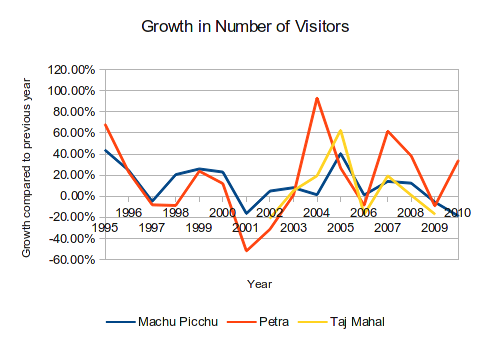
Following Indonesia’s decision to withdraw Komodo, Indonesian blogger Priyadi Nurcahyo Faith collected 15 years of tourism statistics for three of the winning attractions in the first competition, as well as national tourism arrivals, and graphed them in an attempt to correlate the effect of winning the competition.
Visitor numbers to 2007 New 7 Wonders winners. Source: Priyardi's Place
Machu Picchu recorded high growth in (overseas) visitors between 1998 and 2000 of over 20 percent a year. Visitor numbers slumped over 16 percent in 2001, returning to 40 percent in 2005. By 2006, visitors had plunged to 1.14 percent. In 2007 – the year Machu Picchu was announced a winner of the New 7 wonders competition, it had risen to 14 percent, slowing to 12 percent in 2008. In 2009 growth plunged 5 percent, worsening to 18 percent in 2010. Overall arrivals to Peru increased 41 percent in 2004, and 14 percent in the year of the competition. Arrivals dropped 4 percent in 2009.
The Taj Mahal in India showed a broadly similar trend. Foreign visitors increased dramatically 62 percent in 2005, before plunging 17 percent the following year. In 2007, visitor numbers grew 19 percent, but in 2008 the increase was less that 1 percent. Visitors dropped almost 17 percent in 2009. The increase in tourism arrivals to India as a whole continued a downward trend from 13 percent in 2005 to 7 percent in 2008.
Petra, which recorded both foreign and domestic visitors, saw a significant spike in 2007 of over 60 percent, building on a broadly positive trend from a dramatic increase of 93 percent in 2004. Visitors increased 38 percent in 2008, dropped nine percent in 2009, and increased 34 percent in 2010.
At the same time, overall visitors to Jordan dropped 3 percent in 2007, despite almost 19 percent growth the year before.
The blogger’s conclusion was that the New 7 Wonders contribution to visitor numbers was difficult to correlate amid other factors – but was likely “not so significant”.
The controversy surrounding Indonesia and the Maldives’ withdrawal from the competition, and most recently the growing attention in South Korea, has sparked interest in the foundation’s business model.
A ‘New7Wonders Foundation’ is registered in the Swiss canton of Zurich as a charitable foundation, however the New7Wonders own website describes it as “a major, global-scale proof of a business concept based on mass virtual online dynamics creating concrete economic positive outcomes in the real world”.
The Maldives Tourism Ministry initially paid a US$199 participation fee and signed a contract not with the foundation, but rather a commercial arm of the operation: New Open World Corporation (NOWC), which listed its address on the contract as a law firm in the Republic of Panama.
The fate of the money paid to NOWC by tourism authorities, sponsors and telecom partners in unclear. Funds raised, the website states, are used “to set up and run the global New7Wonders voting platform, to run the first campaign that chose the Official New 7 Wonders of the World, to run the current campaign electing the Official New7Wonders of Nature, to run the New7Wonders organisation, [and] to create a surplus for distribution.”
Swiss law does not require charitable foundations to disclose how much they pay executives, unlike the UK, and no filings, declarations of assets or record of funds distributed are available on the foundation’s website.
Qatar Airways CEO Akbar Al Baker has warned that the airline will re-consider flying to the Maldives if airport operator GMR maintains its apparent plan to raise airport handling fees at Ibrahim Nasir International Airport (INIA) by 51 percent.
Reuters reported that the airline was “‘dismayed’” over what it understood to be GMR’s plan to increase the handling fee at some future date, and suggested such a move would “threaten Quatar Airways’ continued presence in the Maldives.”
Noting that the Maldives’ economy is based on tourism, Akbar Al Baker called the planned increase “totally unreasonable.”
“If we or any other major player withdraws services because of these unwarranted and draconian measures, it will be the people of the Maldives who will lose out, affecting their livelihoods as they rely heavily on the tourism industry,” he said in a statement released on Wednesday.
“My message to the Maldives authorities is to think rationally about the future prosperity of your tourism industry. These steps may have not been thought through seriously by the airport operator and I urge them to think again.”
GMR spokesman Amir Ali said that the fee hike had already been made by the Maldives Airport Company Ltd (MACL) shortly before GMR assumed control of the airport, adding that while there were no plans for a further increase at present, prices were dependent on factors such as fuel prices.
“I believe the fee was increased because of the rise in fuel prices, but I’m not sure since the decision was made by MACL some time ago,” Ali said.
GMR had received no official communication from Qatar Airways, he added.
Since taking over INIA in 2010 GMR has made several adjustments to airport operations in an effort to match the airport’s facilities to those expected by visitors to the country’s upmarket resorts. While progress has been rapid, the local population has also voiced discontent with changes to baggage handling services and departure fees.
GMR was recently challenged in court over its recent attempt to collect an Airport Development Charge (ADC) beginning in 2012, a stipulation which was included in its concession agreement with the government. While the Maldives Civil Court ruled against the ADC in December, the government appealed the case to the High Court, declaring that it was obliged to honor its agreement with the airport developer.
The Maldives first resort-style tourist guest house to operate on a local inhabited island opened yesterday on Laamu Atoll Gan Island, the Maldives largest island (six kilometres squared) and three times the size of capitol Male’.
President Mohamed Nasheed attended the opening of Reveries Diving Village along with over 600 island residents, several government officials and a few representatives from neighboring resort Six Senses Laamu.
Speaking at the opening ceremony, President Nasheed said the guest house would benefit the island by providing jobs and boosting local industrial activity and income.
At the moment, a majority of the guest house is staff is Maldivian. “They are a very friendly group, not terribly experienced but very willing,” said Reveries Manager Boris A. Salam.
President Nasheed elaborated that industrial expansion on islands is directly proportional to government priority. To support development on all islands, the government is obliged to provide clean water, efficient sewerage systems and durable roads for its people, he said.
Reveries Diving Village was designed by a Maldivian architect and developed by BISON Maldives Pvt Ltd; it is owned by BISON Chairman Abdul Majeed. The President pointed out that Reveries is part of a larger push to expand tourism to inhabited islands and incorporate local businesses in the nation’s leading industry.
Re-inventing the Maldives’ traditional “one island one resort” theme, Reveries encourages guests to explore the local side of Gan through sight-seeing excursions, picnics, fishing trips and meals at local cafes, while maintaining a variety of standard resort services including a spa, conference facilities, PADI certified dive school and water sports facilities.
The location will also likely attract an ambitious surf community–famous surf points Yin Yang, Isdhoo Bank and Refugees Lefts are easy to access.
Offering 25 guest rooms and one villa for under US$200 per night (Rf 3000) and compliant with Shariah-based regulations, Reveries aims to serve the needs of vacationers, business folk and backpackers alike–foreign and Maldivian.
“The island life and serenity of Laamu Gan, added with the unique features such as a mythical freshwater lake that is estimated to be 60 meters deep and old Buddhist Temple ruins add distinctive value to any traveler,” reads a press release.
Manager Salam said he had received positive feedback about the guest house’s humble intent. “People said that from the outside the building doesn’t look like much, it could be anything. But when they come in they’re very nicely surprised, the design immediately makes you feel cozy,” he said, observing that the public beach area in front of the house adds a neighborhood feel.
Reveries is part of a string of recent developments on Laamu Gan, which is connected by causeways and bridges to three other islands in the atoll forming a total land area of approximately nine kilometres. The domestic airport on nearby Kadhoo island affords easy transportation to and from capital Male’, located 250 km to the North.
Harbours and a hospital developed by the French Red Cross have improved the economy and lifestyle of Laamu residents, and an international school is also expected to open this year.
The addition of Reveries appears to please Laamu residents. Reveries Manager Boris A. Salam said “people are curious, they’ve been popping in during the development stage to see what’s happening.”
According to a press release one lifetime resident, Hussein, said, “this is the happiest I have been after the opening of the airport. It will create a lot of jobs and opportunities for small business to grow. The success of Reveries will surely bring more investments to the region.”
Reveries plans to develop a second property in Laamu Gan later this year with Amin Construction Pvt. Ltd. The property will offer 20 rooms in 6 villas, along with a swimming pool and other food and beverage facilities.
The presidential commission has forwarded a case for prosecution against former President Maumoon Abdul Gayoom’s half brother and MP, Abdulla Yameen, for his alleged involvement in the international illegal oil trade worth up to US$800 million whilst he was the chairman of the State Trading Organisation (STO) till 2005.
Yameen has publicly dismissed the allegations on several occasions, distancing himself from the Singapore branch of the STO where the trade to Burma took place, as well as disputing any illegality in the trade.
The allegations first appeared in February 2011 in India’s The Week magazine in a cover story by Sumon Chakrabarti, Chief National Correspondent of CNN-IBN, who described Yameen as “the kingpin” of a scheme to buy subsidised oil through STO’s branch in Singapore and sell it through a joint venture called ‘Mocom Trading’ to the Burmese military junta, at a black market premium price.
The article draws heavily on an investigation report by international accountancy firm Grant Thorton, commissioned by the Maldives government in March 2010, which obtained three hard drives containing financial information detailing transactions from 2002 to 2008. No digital data was available before 2002, and the paper trail “was hazy”.
Investigators learned that Mocom Trading was set up in February 2004 as a joint venture between STO Singapore and a Malaysian company called ‘Mocom Corporation Sdn Bhd’, with the potential lucrative deal of selling oil to Myanmar and an authorised capital of US$1 million – but instead, acted as a front to an international money laundering racket that has cost Maldives millions of dollars.
The report subsequently prompted an investigation into the alleged illegal trade by the Presidential Commission, investigative body appointed by President Mohamed Nasheed and the parliament’s National Security Committee questioned the alleged parties.
Chair of the presidential commission ‘Sarangu’ Adam Manik stated in a press conference on Tuesday that the investigation’s findings implicated Yameen and two other shareholders of STO Singapore – Former Managing Director of STO Mohamed Manik and former Managing Director of STO Singapore Ahmed Muneez.
“The three together were involved in this [illegal oil trade],” claimed Manik. “The oil trade carried out through Mocom Singapore is alleged to have involved fraud, transactions that deliberately caused losses to the company as well as a lot of illegal transactions which were against general business principles.”
Therefore, he said, the commission has requested the police and Prosecutor General’s Office (PGO) this week to file the criminal charges against the three men, and asked the Attorney General’s Office (AGO) to pursue civil compensation suits against the three. Singaporean authorities will also go forward with the prosecution cases, he added.
However, he said the authorities will make the final decision on who will be prosecuted based on the findings.
Manik pointed out that the findings reveal that Mocom did not make any sales between 2004 and 2005, while 2001, 2002 and 2003’s financial statements audit showed that the company made a total profit of only SD 51,930.
However, in 2004 alone, an unnamed shareholder of Mocom received SD 51 million as sales commission, according to Manik.
“Hence, even though the company’s [Mocom’s] sales belong to STO Singapore, it did not receive anything and kept facing losses while certain shareholders and alleged parties kept making undue financial gains,” Manik explained.
He added that while the investigation is still not over they had decided to put the alleged parties on trial as the commission believed there was enough evidence to prosecute them.
However, more evidence of fraud will likely to be exposed during the trial, Manik said.
Operation history
“The Maldives receives subsidised oil from OPEC nations, thanks to its 100 percent Sunni Muslim population. The Gayooms bought oil, saying it was for the Maldives, and sold it to Myanmar on the international black market. As Myanmar is facing international sanctions, the junta secretly sold the Burmese and ‘Maldivian’ oil to certain Asian countries, including a wannabe superpower,” alleged Chakrabarti, who is writing a book on Gayoom’s administration and the democratic movement that led to its fall.
“Sources in the Singapore Police said their investigation has confirmed ‘shipping fraud through the diversion of chartered vessels where oil cargo intended for the Maldives was sold on the black market creating a super profit for many years,’” the report added.
Referencing an unnamed Maldivian cabinet Minister, The Week stated that: “what is becoming clear is that oil tankers regularly left Singapore for the Maldives, but never arrived here.”
According to The Week, Grant Thorton’s report identifies Myanmar businessman and head of the Kanbawza Bank and Kanbawza Football Club, Aung Ko Win, as the middleman acting between the Maldivian connection and Vice-Senior General Maung Aye, the second highest-ranking member of the Burmese junta – one of the world’s most oppressive regimes, perhaps exceeded only by North Korea.
Also allegedly implicated in the Grant Thorton report are Brigader-General Lun Thi, the junta’s Minister of Energy, Aung Thaung, the Burmese Minister of industry, “and his son, Major Pye Aung, who is married to Aye’s daughter, Nander Aye.”
“Another Burmese business couple, Tun Myint Naing (aka ‘Steven Law’) and his wife, were linked to the Gayooms,” alleged The Week.
According to a 2000 report on the Golden Triangle Opium trade by Hong Kong-based regional security analysis firm, Asia Pacific Media Services, “in 1996 Steven Law was refused a visa to the USA on suspicion of involvement in narcotics trafficking”, and several companies linked to him were blacklisted because of his suspected involvement in his father’s drug empire.
His father, Lo Hsing Han, also known as Law Sit Han, is named in the report as a notorious ‘Golden Triangle’ heroin baron turned businessman, with financial ties to Singapore. He was also responsible for arranging a lavish wedding in 2006 for the daughter of Burmese dictator Than Shwe.
“Lo Hsing-han and his family set up the Asia World Company… involved in import-export business, bus transport, housing and hotel construction, a supermarket chain, and Rangoon’s port development,” APMS wrote.
According to The Week’s report, “Yameen was allegedly aided by Muneez, and by Mohamed Manik.”
The operation continued with fuel purchased by STO Singapore from companies including Shell Eastern Petroleum Pvt Ltd, Singapore Petroleum Company and Petronas, and sold mostly to the STO (for Maldivian consumption) and Myanmar, “except in 2002, when the bulk of the revenue came from Malaysia.”
The “first red flag” appeared in an audit report on the STO by KPMG, one of the four major international auditing firms which took over the STO’s audits in 2004 from Price WaterhouseCoopers.
Investigators learned that Mocom Trading was set up in February 2004 as a joint venture and had four shareholders: Kamal Bin Rashid, a Burmese national, Maldivians Fathimath Ashan and Sana Mansoor, and a Malaysian man named Raja Abdul Rashid Bin Raja Badiozaman. Badiozaman was the Chief of Intelligence for the Malaysian armed forces for seven years and a 34 year veteran of the military, prior to his retirement in 1995 at the rank of Lieutenant General.
As well as the four shareholders, former Managing Director of STO Singapore Ahmed Muneez served as director. The Week reported that Muneez informed investigators that Mocom Corportation was one of four companies with a tender to sell oil to the Burmese junta, alongside Daewoo, Petrocom Energy and Hyandai.
Under the contract, wrote The Week, “STO Singapore was to supply Mocom Trading with diesel. But since Mocom Corporation held the original contact, the company was entitled to commission of nearly 40 percent of the profits.”
That commission was to be deposited in a United Overseas Bank account in Singapore, “a US dollar account held solely by Rashid. So, the books would show that the commission was being paid to Mocom, but Rashid would pocket it.”
In a second example cited by The Week, investigators discovered that “STO Singapore and Mocom Trading duplicated sales invoices to Myanmar. The invoices showed the number of barrels delivered and the unit price. Both sets of invoices were identical, except for the price per barrel. The unit price on the STO Singapore invoices was US$5 more than the unit price of the Mocom Trading invoice. This was done to confuse auditors.”
As a result, “the sum total of all Mocom Trading invoices to Myanmar Petrochemical Enterprises was US$45,751,423, while the sum total of the invoices raised by STO Singapore was US$51,423,523 – a difference of US$5,672,100.”
Furthermore, “investigators found instances where bills of lading (indicating receipt of consignment) were unsigned by the ship’s master.
Despite his officially stepping down from the STO in 2005, the Grant Thorton report says that debit notes in Singapore “show payments made on account of Yameen in 2007 and 2008.”
“The debit notes were created as a result of receiving funds from Mr Yameen deposited at the STO head office, which were then transferred to STO Singapore’s bank accounts. This corresponded with a document received from STO head office confirming the payments were deposited by Yameen into STO’s bank accounts via cheque.
“In conversation with Mr Muneez, this was to provide monies for the living expenses of his [Yameen’s] son and daughter, both studying in Singapore. Their living expenses were distributed by Mr Muneez,” the Grant Thorton report stated.
In a previous interview with Minivan News, Yameen confirmed that he had used the STO’s accounts to send money to his children in Singapore, “and I have all the receipts.”
He at the time described the then STO head in Singapore as “a personal friend”, and said “I always paid the STO in advance. It was a legitimate way of avoiding foreign exchange [fees]. The STO was not lending me money.”
He denied sending money following his departure from the organisation: “After I left, I did not do it. In fact I did not do it 3 to 4 years before leaving the STO. I used telegraphic transfer.”
Yameen described the wider allegations contained in The Week article as “absolute rubbish”, and denied being under investigation by the Singaporean police saying that he had friends in Singapore who would have informed him if that were the case.
The article, he said, was part of a smear campaign orchestrated by current President of the Maldives Mohamed Nasheed, a freelance writer and the dismissed Auditor General “now in London”, who he claimed had hired the audit team – “they spent two weeks in the STO in Singapore conducting an investigation.”
Progressive Party of Maldives (PPM) Vice President Umar Naseer, formerly Dhivehi Rayyithunge Party (DRP) Vice President prior to his eviction from the party, has filed a suit in the civil court against the police and Maldives National Defence Force (MNDF).
Speaking at a press conference yesterday, Umar said that he decided to sue the MNDF for unlawfully arresting Chief Judge of the Criminal Court Abdulla Mohamed, and police for not working to set Judge Abdulla free.
He filed the suit against Police Commissioner Ahmed Faseeh, Deputy Commissioner Ismail Atheef and Deputy Commissioner Ahmed Muneer, and on the MNDF side, he sued Chief of Defence Force Major General Moosa Ali Jaleel and Vice Chief Brigadier Faruhath Shaheer.
Umar claimed at the press conference that superiors at the MNDF had been giving unlawful orders, and that it was one reason why he felt he had to file the suit.
He claimed that if the court rules that the senior officers have been giving unlawful orders they would be dismissed from their jobs.
Criminal Court Chief Judge Abdulla Mohamed was arrested by the MNDF on the evening of Monday, January 16, in compliance with a police request, after he attempted to block his summons in the high court.
After he was arrested the Supreme Court declared that the arrest was unlawful and ordered his immediate release, but the MNDF did not respond.
Later the High Court ordered the MNDF three times to produce him at the High Court, but the MNDF did not respond.
Yesterday the Human Rights Commission of the Maldives (HRCM) was summoned to parliament’s Independent Commission’s Committee. President of the HRCM Mariyam Azra told the MPs that there were “issues with the judiciary”.
She also said that HRCM had forwarded these issues to concerned institutions such as Judicial Service Commission (JSC), which has halted its investigation of Judge Abdulla after he obtained a civil court injunction against his own investigation.
Azra told the committee that HRCM had the legal authority to investigate human rights violations.
Recently Umar has filed two cases against President Mohamed Nasheed at the police.
PPM Spokesperson Ahmed Mahlouf was unavailable at time of press.
A police spokesperson said the police have not officially received any information about the suit.
The Jumhoore Party (JP) council yesterday appointed party leader and MP ‘Burma’ Gasim Ibrahim as the party’s presidential candidate to run for presidency in the 2013 presidential elections.
In an interview Gasim gave to his own TV station, Villa TV (VTV), he thanked the council for making the decision and vowed to bring prosperity to the Maldives, and solve all the current issues if he was elected as President.
He accused the current government of destroying the social justice, the constitution and selling state assets, and said the Maldives was “currently in a very serious situation”.
Gasim then called on the citizens to work with courage, saying that he would establish a legal administration and would keep his actions within the law.
Gasim is one of the country’s most successful local resort tycoons, and well known philanthropists, as well as an MP and leader of the JP who enjoys strong support in his home constituency of Maamigilli and was key to the development of Maamigilli airport.
Formerly a coalition partner of the Maldivian Democratic Party (MDP), his small party subsequently aligned itself with the opposition Dhivehi Rayithunge Party (DRP), and later with former President Maumoon Abdul Gayoom’s Progressive Party of the Maldives (PPM).
As well as owning VTV, Gasim was last year narrowly appointed as parliament’s representative on the Judicial Services Commission (JSC), the body at the centre of the current judicial crisis following its acceptance of a civil court injunction against the investigation of Chief Judge of the Criminal Court, Abdulla Mohamed.
During the recent protests Gasim has campaigned for the judge’s release, and was also a key figure supporting the December 23 protests calling for the defence of Islam in the Maldives.
Under the former government he presided over the treasury as finance minister during a period in which expenditure on the civil service increased 400 percent, leaving the incoming government with a budget deficit of 33 percent.
In 2010 he was accused by the current government of corruption and bribery, however the case was swiftly thrown out by Chief Judge Abdulla Mohamed.
MDP MP Mohamed Mustafa told Minivan News that it was “not surprising” that Gasim had been appointed as the JP’s presidential candidate.
‘’JP is owned by Gasim and it is Gasim himself that decides that Gasim should be the presidential candidate. No one should be surprised about it,’’ Mustafa said. ‘’JP is not a very democratic party, everyone knows that.’’
Mustafa contended that Gasim would be inappropriate as president because he did not have the necessary capability and knowledge.
‘’He will not win the next presidential elections. When it is time for the elections this opposition coalition will split because everyone in the coalition wants to be president,’’ he predicted, adding that Gasim would find himself competing with the ambitions of former President Maumoon Abdul Gayoom and his half-brother Abdulla Yameen, DRP leader Ahmed Thasmeen Ali, and Dhivehi Qaumee Party (DQP) Leader Dr Hassan Saeed.
‘’When Gayoom feels like he may win the elections, he will ask the others to wait,’’ Mustafa said. ‘’We are all going to wait and watch this happen.’’
He speculated that the Adhaalath Party would likely side with Gasim “because senior figures of Adhaalath are employed by Gasim.”
Progressive Party of Maldives (PPM) Spokesperson and MP Ahmed Mahlouf did not respond to Minivan News at time of press.
State television journalist Moosa Naushad has had a successful operation in Colombo for injuries sustained during a protest on Male’ last week, and will return to the Maldives in a few days’ time, according to Maldives National Broadcasting Corporation (MNBC) Director Adam Shareef.
Naushad was attacked outside of MNBC by 15 people while covering an opposition-led protest on January 23. The aggressors broke his hand and left him with fractures to his shoulder blades and feet, while MNBC editor Thoyyib Shaheem was tasered after trying to intervene. Both sides of the political spectrum blamed the other for the attack, with the opposition alleging that MDP activists mistook Naushad for a VTV reporter.
Since the nightly protests began on Male’ over two weeks ago a number of journalists, activists and police officers have sought medical attention for related injuries. Although security personnel are covered by their employer, others have discovered that injuries sustained during a protest are excluded from coverage by most available insurance programs, including the government’s recently introduced Aasandha scheme for every Maldivian citizen.
“As far as I know, no insurance scheme in the Maldives would cover somebody injured during a protest,” said Allied Insurance and Aasandha Program Manager Ahmed Shabiq, pointing out that protests are considered high-risk and voluntary.
To fill the coverage gap, Naushad’s injuries have been treated with “a gift from the government, and some contributions from MNBC,” MNBC’s Shareef said. He added that the station tries to cover injuries other journalists have sustained while working, but said that there is no company insurance program.
Some hospital patients have been surprised to discover the caveat, and several have filed queries and complaints with Aasandha. Shabiq pointed out that “that policy is clearly listed in our exclusions section, printed in pamphlets and on the website. But I think people just aren’t aware of those details.”
However, “it’s not so easy to identify if someone was involved in a protest, and if they’re responsible for their injury.”
All injured individuals are treated on the assumption that they did not engage in high risk behavior until evidence to the contrary is presented. Shabiq claimed hospitals are asked to determine the individual’s level of involvement in any high-risk behavior, while another Allied official said police reports are used to clarify responsibility.
Private practitioner at Central Medical and Clinic, Dr Ahmed Razee, agrees with the policy: “Insurance should not cover intentional injuries. If you jump off the roof of a house you jump off the roof of a house!” he said.
However Dr Fathimath Nadia at Indira Gandhi Memorial Hospital (IGMH) believes the scheme’s policy leaves room for skepticism.
“I think injuries should be covered, but then again if you go to a protest I guess you have to expect that something could happen. But it’s difficult for a medical staff member to know if a person has been injured because of something they did or not.”
Dr Nadia suggested that the policy could have a preventative impact.
“At a protest you should expect that injuries could happen, so if you’re not going to be covered then maybe you won’t go, or you’ll be very careful,” she supposed.
In a separate case, Dr Nadia pointed out that some of the most important partnerships exist in the no-coverage grey zone.
“Three days ago I saw a 22 year-old boy who had had a diving accident. He needed a decompression chamber so we wanted to send him to Bandos but Bandos isn’t part of Aasandha so he wouldn’t be covered,” she explained, adding that the high cost of decompression chambers – of which only one of the Maldives’ five is not operated by a resort – effectively reserves them for the elite.
“It’s a problem, because we see a lot of dive- and sea- related injuries. The boy is now paralysed from his waist down, but what to do?”
However, Dr Nadia pointed out that Bandos had seen the boy and to her knowledge the family had kindly not been billed.
Health insurance programs around the world have their limits. The Maldivian public appears keen to find out first-hand just where those limits lie.
In a previous article Minivan News reported that hospital traffic had increased dramatically since Maldivians became eligible for up to Rf100,000 (US$6500) in free health care annually.
Public health expert and Chief Operating Officer at Male’s ADK hospital, Dr Ahmed Jamsheed, noted in a January 16 blog post that during the scheme’s first two weeks ADK had seen a 50 percent increase in specialist consultations and a 100 percent increase in demand for basic services.
In addition, 41,000 individuals sought health care at ADK – 11 percent of the country’s population – costing the scheme millions and raising serious concerns over its sustainability, Dr Jamsheed observed.
“In the absence of an ongoing epidemic, statistically and epidemiologically speaking, it is unlikely that so many people would be sick needing health care simultaneously,” he wrote, later noting that some patients are seeking multiple and even extraneous appointments.
At IGMH, Dr Nadia has also seen the appointment book fill up. She suggested that repeat appointments stem from a public belief that bi-monthly check-ups are merely proper maintenance – you can’t have too much of a good thing.
However, she noted that the validity of a person’s complaint could be hard to gauge. “It’s difficult to know if a person will receive correct medication from the pharmacy staff, and what they will do with that medication. We can’t follow them to find out,” she said.
In Dr Razee’s opinion, multiple visits to the doctor are important, even if only to put one’s worries to rest.
“Medically speaking, it’s not a waste of time or money,” he said.
“Many people are coming in with complaints that they couldn’t afford to address before. And they are seeing several doctors in succession because they want to get a second, even third, opinion, or they are looking for a doctor they feel comfortable with, or they were unable to tell everything in the short period of time they were first given with the doctor and they want to finish the story,” he said. “It’s normal human nature.”
 (0)Dislikes
 (0)
(0)