Maldives Red Crescent gains membership of IFRC

The Maldives Red Crescent (MRC) has been recognised by the International Committee of the Red Cross (ICRC) as the 187th National Society of the International Red Cross and Red Crescent Movement today.

According to a message by MRC Secretary General Rasheeda Ali, the awarding of the full membership of the International Federation of Red Cross and Red Crescent Societies (IFRC) will take place on November 23 during the IFRC’s 18th General Assembly in Geneva, Switzerland.

“On this momentous occasion, I wish to express my sincere appreciation and thank all MRC volunteers, members and staff for their valuable contribution towards this significant achievement,” reads the message.

Likes(0)Dislikes(0)

Parliament deadlock continues

A third consecutive week of parliamentary sittings have been cancelled over an ongoing dispute over the attendance of Independent MP Ismail Abdul Hameed, who was convicted of corruption on August 29.

The last sitting on October 24 was cancelled after heated arguments between opposition and ruling party MPs over the Kaashidhoo MP’s right to participate in sittings until he exhausted the appeal process.

The High Court has since upheld the Criminal Court verdict.

Meanwhile a statement put out by the secretariat on Sunday explained that this week first sitting yesterday was called off as Speaker Abdulla Shahid’s efforts to resolve the dispute through discussions among parliamentary group leaders have been so far been unsuccessful.

The statement noted that according to article 74 of the constitution, “Any question concerning the qualifications or removal, or vacating of seats, of a member of the People’s Majlis shall be determined by the Supreme Court.”

The Supreme Court meanwhile concluded hearings today on a case filed by a private party over Hameed’s seat. According to the Majlis secretariat, Speaker Shahid has written to the Chief Justice requesting the case be expedited so that sittings could go ahead.

According to local media reports, the Supreme Court today heard from third parties who had entered into the case.

The statement however noted that committee meetings, where legislation is reviewed and stakeholders are consulted, have been taking place.

Likes(0)Dislikes(0)

New7wonders announces winners of competition

The Switzerland-based New7wonders foundation have announced the seven winners to be the Amazon rainforest, Vietnam’s Halong Bay, Argentina’s Iguazu Falls, South Korea’s Jeju Island, Indonesia’s Komodo, the Philippines’ Puerto Princesa underground river, and South Africa’s Table Mountain.

The Maldives, the Dead Sea, Mount Kilimanjaro, the Great Barrier Reef and the Grand Canyon did not make the final seven.

Votes were collected online and via paid SMS voting in the various countries, in collaboration with assorted telecom providers. Final vote counts for the winners were not revealed.

In an announcement aired on YouTube, New7wonders founder and self-described “filmmaker, aviator and adventurer”, Bernard Weber, stated that “once the voting validation process is completed in early 2012, we will work with the confirmed winners to organise the official inauguration events.”

Weber also announced that New7wonders would be launching a competition to determine the greatest cities in the world.

Indonesian and Maldivian tourism authorities withdrew from the competition earlier this year, citing demands for large amounts of money from New7wonders for licensing and event hosting, that had not been explicitly outlined in the original contracts.

Indonesia’s Tourism Minister Jero Wacik claimed in the Jakata Post that the decision was taken “because the organisers – the New7Wonders Foundation – have taken actions that are not professional, consistent and transparent.”

“We have spent around (US$1.1 million) on campaign activities over the past three years,” Wacik told the Jakarta Post, claiming that New7wonders had subsequently demanded a US$10 million licensing fee and a US$35 million fee to host a ceremony celebrating the competition’s winners.

Meanwhile, Maldives State Minister for Tourism Thoyyib Mohamed announced in May that the Maldives was similarly withdrawing “because of the unexpected demands for large sums of money from the New7Wonders organisers. We no longer feel that continued participation is in the economic interests of the Maldives.”

The Tourism Ministry initially paid a US$199 participation fee to New7Wonder’s commerical arm, New Open World Corporation (NOWC), registered to a law firm in the Republic of Panama.

Subsequent requests for money included ‘sponsorship fees’ (‘platinum’ at US$350,000, or two ‘gold’ at US$210,000 each), and funding of a ‘World Tour’ event whereby the Maldives would pay for a delegation of people to visit the country, provide hot air balloon rides, press trips, flights, accommodation and communications.

After complaining, the Maldives was offered a bare-bones ‘protocol visit’, but informed that winners of the previous competition had all hosted a big event.

NOWC also attempted to charge telecom provider Dhiraagu US$1 million for the right to participate in the New7Wonders campaign, a fee that was dropped to half a million when the company complained about the price.

In response to the Maldives’ decision to resign from the campaign, New7wonders spokesman Eamonn Fitzgerald quoted John Donne’s ‘No man is an island’, and insisted that the Maldives remained in the competition “because the authority to withdraw a participant from the campaign is a decision for New7Wonders alone, not for any government agency.”

Following Indonesia’s decision to withdraw, Fitzgerald said that “Despite a series of malicious attacks on New7Wonders by the [Ministry of Culture and Tourism], the public and media opinion consensus in Indonesia is that the MCT should not interfere in the democratic right of the Indonesian people to vote for Komodo Island in the New7Wonders of Nature.”

“The MCT had no authority in this matter as it ceased to be the legitimate New7Wonders representative in Indonesia in February, so the announcement was absurd,” Fitzgerald said, stating that the foundation’s new representative in Indonesia was a group called P2Komodo.

“P2Komodo is an alliance of positive and forward looking members of Indonesian civil society, who are keen to ensure that Komodo Island has a fair chance of participating in the New7Wonders of Nature,” Fitzgerald said.

In the Maldives, New7wonders approached the Maldives Association of Travel and Tour Operators (MATATO), but the arrangement was never cemented.

Secretary General of MATATO, Maleeh Jamal, said at the time that the association had been in contact with New7Wonders and was considering working on the event in the government’s stead.

The studies offered by New7Wonders promised an “enormous return on investment”, Jamal suggested.

“I think US$500,000 for such an award would be quickly recovered. Although the money was a concern, we had a fair chance of winning. A lot of competing destinations, such as Australia and South Africa, are taking this competition very seriously,” Jamal said in May.

Likes(0)Dislikes(0)

India not worried about Chinese presence in Indian Ocean: Economic Times

India on Tuesday indicated that it was not too worried over China’s increasing presence in the Indian Ocean region, after Beijing opened a new embassy in the Maldives ahead of last week’s SAARC summit in the island nation, reports the Economic Times.

“Defence Minister A.K. Antony told reporters that such efforts by China in the region cannot be prevented, but the only cause for worry was Beijing building military infrastructure along India’s borders and expansion of its defence capabilities.

“‘How can you prevent any country from establishing an embassy or furthering relations with any other country in the world,’ Antony asked, when his response was sought on Beijing setting up its embassy in the Maldives last week.

“We are also establishing embassies and building relations with every country. It is a natural process,” he said.

However, “China is expanding its military capabilities and building military infrastructure along the borders with us. We know that…we are aware of that, and we are concerned about that,” Antony said.

Read more

Likes(0)Dislikes(0)

Three arrested over assault of MP Amir

Three suspects have been arrested for allegedly assaulting Independent MP Ahmed Amir last week and handing him to police semi-naked after accusing him of an extra-marital affair.

Amir was severely beaten in the early hours of Thursday morning in a house in Maafanu ward by a group claiming they found him with with a married woman. The MP is currently undergoing treatment in Sri Lanka.

Newspaper Haveeru reported that the suspects were two women and a man from the house where Amir was assaulted. According to the local daily, one of the women was the one the MP was having the alleged extra-marital affair with.

Police confirmed that the three were arrested under a court warrant and had their detention extended by the Criminal Court.

The MP for Kudahuvadhoo told police that he was on his motorcycle near Indira Gandhi Memorial Hospital when a group grabbed him, took him inside a room and assaulted him.

The attackers reportedly ripped Amir’s trousers and stole his wallet and two mobile phones before turning him in to police around 5am Thursday morning. Police borrowed a jeans from the house to clothe the MP before taking him to the station for questioning.

Likes(0)Dislikes(0)

Pakistan’s ‘idolatrous’ SAARC monument set ablaze by protesters

A group of people in Hithadhoo, Addu City, have set fire to the allegedly “idolatrous” Pakistani monument erected for the SAARC summit in the early hours of the morning.

Police Sub-Inspector Ahmed Shiyam confirmed that the incident occurred before dawn today, and the perpetrators escaped before police arrived at the scene.

It is believed that the group threw objects lit with petrol and burnt one side of the monument, Shiyam explained, adding that no arrests have been made yet and police are investigating the act of arson.

According to an eyewitness in the Hithadhoo Power Park restaurant last night, which is located next to the monument, a group of people first attempted to torch the monument using petrol around 11pm.

However, their attempts were unsuccessful and the fires were quickly put out by Hithadhoo residents at the area.

SAARC Pakistani monument
Photo from Dhiislam website

Meanwhile, two young men who toppled the monument during an earlier protest led by members of opposition parties last Wednesday remain in custody, facing charges of damage to private property.

The protesters contended that the monument featured “idols and objects of worship” and demanded it be taken down.

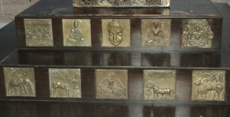
The monument, which features engraved symbols of ancient civilisation of Pakistan and a bust of the country’s founder Mohamed Ali Jinah, had been removed by the Addu City Council last Tuesday night but was replace back on its plinth with a cover ahead of Thursday’s unveiling ceremony.

Monuments representing the eight SAARC nations were erected across Addu City and unveiled by heads of state and government during the summit.

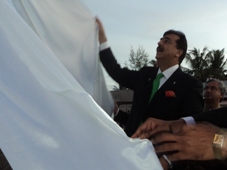
A large crowd of Hithadhoo residents gathered for the official unveiling by Pakistani Prime Minister Yousaf Raza Gilani, after which they took photographs in front of the monument.

A member of the Pakistani delegation at the unveiling ceremony explained to Minivan News that the monument represented artifacts of the ancient Indus Valley civilisation and were not specifically religious symbols.

Following the first attempt to vandalise the monument, a second member of the Pakistani delegation told Minivan News that they approached the Foreign Ministry over the incident but was informed by an official that it had not occurred, and was a rumour spread by the opposition.

Foreign Minister Ahmed Naseem said yesterday that the delegation had not expressed concern to the Foreign Ministry, and noted that besides prosecuting those responsible for the damage, there was “little we can do.”

The attacks on the monument, said Naseem, had been instigated by people with “strange ideas”. He observed that there were statues of Buddhas in the National Museum in Male’. “Some people are not happy, but I’m not too excited about it,” he said.

“Illegal”

Hithadhoo Councillor Hussein Hilmy explained that the monument was “designed and built by Pakistan”, and that the City Council had helped erect the monument.

Islamic Minister Dr Abdul Majeed Abdul Bari was not responding at time of press and officials at the ministry did not respond to inquiries today. Bari however told local media last week that the monument was “illegal” as it “represented objects of worship of other religions.”

Bari said he had discussed the matter with the Pakistani High Commission and requested it be taken down at the end of the summit.

Meanwhile, Adhaalath Party President Sheikh Imran Abdulla told Minivan News today that the monument “should not be kept on Maldivian soil for a single day” and “should be removed immediately.”

SAARC Pakistani monument“We believe it conflicts with the constitution of the Maldives, the Religious Unity Act of 1994 and the regulations under the Act,” he said.

The monument was “illegal” because it depicted “objects of worship” that “denied the oneness of God,” he explained.

Imran contended that the engravings on the monument represented objects of worship for “a lot of other religions.”

The religious conservative party has asked the Prosecutor General’s Office today to take legal action, he revealed.

In a statement condemning the “idolatrous” monument, the Adhaalath Party’s Hithadhoo branch claimed that “no Maldivian of sound mind” would allow idols or iconography of other religions to be erected in the country.

The Pakistani monument was “part of efforts by adversaries of Islam to turn the faith that Maldivians embraced 900 years ago upside down,” the statement reads.

The party noted that under section six of the religious unity regulations, public displays of “symbols or slogans belonging to a religion other than Islam” were illegal, and called on those responsible for erecting the monuments to be “brought before the law protecting religious unity.”

Likes(0)Dislikes(0)

MP beaten and handed to police semi-naked after alleged extra-marital affair

Independent MP Ahmed Amir was assaulted by a group of people around 3:00am in the morning last Thursday, following allegations that the MP for Kudahuvadhoo was caught with a married woman in a residence in the Maafanu ward of Male’.

The MP was reportedly severely beaten and handed over to police semi-naked before dawn on Thursday, and has now flown to Sri Lanka for treatment.

Police Spokesperson Sub-Inspector Ahmed Shiyam told Minivan News that MP Amir insisted that the allegations against him were completely false.

“The [attackers] called police at the time, so officers went there and brought MP Amir in for questioning,” Shiyam explained. “Both parties have reported the same case differently, MP Amir said he was stopped and attacked while he was passing by, while the group claims that he slept with the wife of another man.”

Amir had bruises on his face and suffered other injuries, he added, stating that police were investigating the case.

A ruling party MP told Minivan News today on condition of anonymity that the incident occurred when MP Amir was caught with the woman by her family.

“Then they attacked him and this really happened, according to what I know,” he said.

MP Amir was meanwhile was unavailable for comment as both his mobile numbers were temporarily disconnected.

Amir however told local media that he was grabbed by a group of men while passing by a road near Indira Gandi Memorial Hsopital (IGMH), taken inside a room, stripped and beaten up.

Amir claimed the attackers robbed him of his mobile phone and wallet before turning him in to police.

Secretary General of Parliament Ahmed Mohamed told Minivan News that Amir was not arrested and police therefore did not inform the secretariat about the incident.

According to parliamentary rules of procedure, police have to inform the parliament if they intended to arrest an MP and escort him to parliament sittings before a court decided on his or her case.

Likes(0)Dislikes(0)

Prosecutor General’s Office spent Rf145,596 in violation of Public Finance Act, finds audit report

The audit report of the Prosecutor General’s Office (PGO) for the financial year 2010 has found that the office spent a total of Rf145,596 (US$9,706) in violation of the Public Finance Act.

In the report made public yesterday, Auditor General Ibrahim Niyaz revealed that the PGO spent Rf 40,745 (US$2640) in additional expenses for interior design after moving to its new offices without an agreement on price and quality of the work as required by section 8.21 of the public finance regulations.

In addition, the PGO spent Rf 58,913 (US$3800) out of its 2010 budget to settle outstanding bills from 2009 without requesting the funds from the Finance Ministry in the duration stipulated in the Public Finance Act.

Moreover, the PGO spent Rf45,938 (US$3000) on an official dinner to participants of an e-crime conference participants in June 2010 without a publicly-announced bidding process.

In an issue highlighted in previous audit reports of state institutions for 2010, the Auditor General noted that financial statements were not prepared in accordance with international public sector accounting standards (IPSAS) following principles of “accrual accounting” or the “financial reporting under cash basis of accounting” issued by the IPSAS board.

The PGO however informed auditors that it would discuss the issue with the Finance Ministry to prepare financial statements in accordance with international standards in the future.

Attorney General’s Office

Meanwhile the audit report of the Attorney General’s Office (AGO) published along with the PGO audit report, the Auditor General noted that staff were paid overtime salary for the time spent waiting in a queue to sign out at the fingerprint system at the end of working hours.

The audit report also found that the Attorney General’s Office had not settled bills for services obtained from different parties within the duration stipulated in the public fiance regulations.

The AG Office was meanwhile owed a total of Rf 71,637 (US$4640) from different parties dating from 2009 but had not taken adequate efforts to recover the money, the audit found, adding that the cases had not been filed at court two years on.

A comparatively high amount of money had meanwhile been spent since 2002 for a software installed to maintain records of employees and case files, the audit found, noting that Rf1.5 million (US$100,000) had been spent as of last year to the company that created the software for maintenance fees, upgrades and other expenses.

The AGO informed auditors that the software initially purchased for Rf376,200 (US$24,000) would not be used from next year onward.

Likes(0)Dislikes(0)

Comment: ‘All religions guide to the path of God’

Like all Maldivians, I have always known that former president Maumoon Abdul Gayoom articulated an Islam that he calls a ‘meduminuge’ (moderate) religion, or in Quranic terminology a religion of wasatiyyah. But until recently, when I immersed myself in Gayoom’s speeches and books for my Master’s thesis, I could not have fully articulated this Islam. I have only space to use material from three important speeches. (All quotes of Gayoom are from their original English versions.)

Progressive face or phase

The best place to start is Gayoom’s paper in 1985 on the ‘Flexibility of Islamic Shari’ah’ presented at a seminar in Kuala Lumpur. In this paper, Gayoom laid out his broad outlook on Islam:

Gayoom’s understanding of Islam is fundamentally ‘progressive’. He argued, ‘the message of Islam was never meant to be limited to the confines of a backward nomadic community of fourteen centuries ago’.

For him, the use of ijtihad (independent reasoning) should be wide-ranging: ‘there might be many problems, albeit already covered in traditional works on Islamic law, which need reconsideration in light of the changing circumstances’. This means, according to Gayoom, ijma (juristic consensus) can be overturned.

Gayoom maintained that ‘[t]he so-called closing of the door of ijtihād [is] quite alien to [Islam’s] encouragement of scientific and intellectual research and the attaining of knowledge in all fields’.

Thus, he concludes reflecting on the importance of ‘reason’ to Islam by saying: ‘Islam does not exclude a reasoned and diligent attitude to change; it does not instruct us to impede the flowing stream that is essential to human nature and its development.’

If this is Gayoom’s jurisprudential outlook, his substantive views are equally ‘progressive’ or even more radical than many of us might have thought.

Universal message of equality, love and tolerance

Thus, in an address in 1983 at Aligarh University of India, Gayoom laid out a radical message of tolerance, mutual love, and equality among people of all faiths.

On tolerance and love, he says:

The tolerance and magnanimity shown by the great Prophet of Islam, Muhammad (Peace Be Upon Him), the Second Guided Khalīfā, Umar ibn al-Khattāb, Salahuddin al-Ayyūbī and other renowned Muslim rulers of all times towards not only non-Muslims but also towards those who had waged war against the Muslim state will bear witness to the spirit of love and human brotherhood inherent in the teachings of Islam.

On equality, Gayoom argues there is no distinction whatsoever to be made with regard to the equality of rights between Muslims and non-Muslims:

The Holy Quran clearly establishes the right of every individual to follow whatever religion or creed of his choice when it says: ‘There is no compulsion in religion; surely right has become distinct from wrong.’ Islam safeguards the rights of non-Muslims…to no less a degree than it safeguards the right of its own followers.

For Gayoom, the tolerance and equality of all people is premised on the equal normative status of all religions:

No religion preaches hatred, jealousy or animosity. Religious intolerance, which inevitably leads to friction and conflict, and more often than not to bloodshed, is therefore an unforgivable departure from the path of God.

The path of God, according to Gayoom, is not a unique possession of one religion. Therefore, even more radically Gayoom points out that:

All religions guide to the path of God – the path of love, understanding and peace.

Subjecting the message to politics

Now, of course, this deeply anti-authoritarian, even radical, ideology contradicts the authoritarian political policies of president Gayoom. I am here referring to his discourse of nationhood. His nationhood discourse, which is now our taken for granted background national self-understanding, is based on the mythical and authoritarian motif of ‘100% Muslim nation’.

In another speech in 1983 at the ‘Seminar on the Call for Islam in South and South East Asia’, held in Male, president Gayoom again acknowledged that Islam provided for complete equality of rights for all humans. Nonetheless, he implied that the ‘unique’ national self-understanding overrides even the commandments of Qur’an:

The real essence of Islam, as you know, is that it is non-discriminatory. Its tolerance of other beliefs and religions is clearly established in the Holy Quran, the Sunnah of the Prophet (Peace be upon him!)…We Maldivians, as true believers of Islam, hold freedom of belief as sacred and we abhor discrimination between man and man on any grounds whether of creed, colour or race.

In spite of this, he continues, because:

[w]e are such a homogenous and closely-knit society based on one national identity, one language, and one faith…we are convinced that the preservation of this oneness in faith and culture is essential for the unity, harmony, and progress of the country.

It is this homogenising political discourse that underpins the dominant national self-understanding. But this discourse is not an Islamic discourse. In fact, as we saw above, it is at odds with Islam’s universal messages outlined by Gayoom.

A degree of godliness

Whether or not we will seriously uphold Islam’s anti-authoritarian universal messages as Gayoom so clearly laid out and whether or not we will rethink the authoritarian national self-understanding, are some of the most crucial questions we must address individually and as a society.

This task of serious self-reflection has become even more urgent under an increasingly interdependent and pluralistic world. This task has become socially necessary with the pluralisation and fragmentation of religious discourses, and with the increasing diversity in the society, not least because of migrant people of different faiths.

The task at hand is a transformation of ourselves as subjects and citizens: this task ultimately is one of inculcating a degree of godliness – mercy, compassion and love – in all of us.

This is indeed a more transcendent endeavour than the selfish, materialist politics that has always spread fear about a non-existent Other conspiring to destroy Islam. We all really deserve a better politics.

All comment pieces are the sole view of the author and do not reflect the editorial policy of Minivan News. If you would like to write an opinion piece, please send proposals to [email protected]

Likes(1)Dislikes(0)