Maldivians to be allowed to travel to Minicoy visa free

Maldivians will be allowed to travel to Minicoy without a visa following the signing of an agreement between President Mohamed Nasheed and Indian Prime Minister Manmohan Singh, during his SAARC visit.

Minicoy is part of the island chain that makes up the Maldives and its 9000 inhabitants share many cultural similarities, including religion, and speak an old form of Dhivehi. It has been under Indian authority since the middle of the 16th century.

Press Secretary for President Nasheed, Mohamed Zuhair, said that many Maldivians had family ties with Minicoy, but obtaining visas was “really difficult, and could in some cases take up to three months.”

The new arrangement, he said, was “a very welcome development”, and comes as part of the establishment of an Indian Ocean ferry and cargo service.

The ferry service, which President Nasheed claimed during the SAARC Summit would be finalised by the end of December, will operate between Kulhudhuffushi in Haa Dhaal Atoll, Minicoy and the Indian city of Kochi.

As part of the agreement India will develop the harbour at Kulhudhuffushi, a population hub in the north of the Maldives that overwhelmingly supported the Maldivian Democratic Party (MDP) in the local council election.

“It is very significant in the sense that small-to-medium businesses, such as handicraft producers and cottage industries, will be able to produce and export to India without needing to use air transport,” Zuhair said.

The government was currently debating the mix of passenger and cargo requirements for the ferry service, he said, and was optimistic that the service would be launched by the end of the year.

Likes(0)Dislikes(0)

“India will be at your side”: Dr Manmohan Singh addresses parliament

Indian Prime Minister Dr Manmohan Singh pledged support at parliament yesterday for the Maldives’ democratic transition through financial assistance and bilateral initiatives for development, becoming the first foreign head of state or government to address the legislative body in its 78-year history.

The Indian Prime Minister was greeted with a ceremonial welcome in Male’ for his first official state visit after the conclusion of the 17th SAARC summit in Addu City on Friday.

“India will be at your side in your transition to a fully functioning democracy,” Singh declared at the special sitting of the People’s Majlis. “We will assist the Majlis by way of training, formulation of rules and regulations and any other assistance that you may desire.”

The Speaker of the Lob Shaba, the lower house of the Indian parliament, is due to visit the Maldives, Singh noted, while the formation of India-Maldives parliamentary friendship groups “augur well for the development of relations between our two parliaments.”

Prior to his historic address before parliament, the Indian Prime Minister signed five agreements under a ‘Framework for Cooperation in Development’ with President Mohamed Nasheed after official bilateral talks at the President’s Office.

“This is a blueprint for cooperation in areas such as trade and investment, food security, fisheries development, tourism, transportation, information technology, new and renewable energy, communications and enhancing connectivity by air and sea,” Singh said in his address.

In addition to a US$40 million line of credit to construct housing units, India extended a credit facility of US$100 million to help the Maldives “meet its short-term budgetary needs” and import essential commodities.

India extended similar financial assistance in December 2008 to plug the fiscal deficit and in the following year subscribed to US$100 million in treasury bonds. The new loan is to be used to settle Rf4.76 billion in T-bill sales sold through the Maldives Monetary Authority (MMA) by April 30, 2012.

US$30 million of the credit facility was issued on October 31 by the Indian government.

As part of the aid programme, said Singh, India will undertake “a major renovation” to be completed by 2013 of the India Gandhi Memorial Hospital (IGMH) in Male’, the main referral hospital in the Maldives.

The Prime Minister noted that Indian companies were engaged in infrastructure projects in the Maldives and wished to “forge closer economic links through banking and financial institutions” and “cooperate in the modernisation of your fishing and food processing industry.”

Among the agreements signed yesterday was the inception of a regular passenger cum cargo ferry service between Cochin and Male’ and the development of a regional port in Kulhudhufushi, the main population hub of the north.

Interlinked security interests

On global warming and climate change, Singh said India understood the threat Maldives faced from rising sea levels and shared its concerns.

“I wish to state in no uncertain terms that India will stand as one with Maldives in combating global warming. Maldives’ views must be heard with respect in global councils,” he said.

“We will help Maldives to achieve its aim of becoming carbon neutral. We will help build your capacities through sharing of energy efficiency technologies and provide scholarships for students from Maldives in areas such as coastal zone adaptation and management.”

On the “extended neighbourhood” of the Indian Ocean and shared security concerns, Singh noted that “over 97 percent of India’s international trade by volume and 75 percent by value passes through the Indian Ocean.”

“The challenges we face are well known – extremism and religious fundamentalism, piracy, smuggling and drug trafficking to name a few. Maldives is additionally concerned about poaching in the coral reefs and illegal commercial fishing by foreign trawlers. We have together experienced the devastation caused by the tsunami in 2004,” Singh observed.

As part of a “multi-pronged approach” to dealing with the problems, India has pledged to support the construction of a police academy in the Maldives while agreements were signed for cooperation in combating terrorism, drug trafficking, disaster management, coastal security, and transfer of sentenced prisoners.

The Indian Prime Minister also congratulated President Nasheed and his administration for “the outstanding manner in which the [SAARC] Summit was organised,” a conference that has helped “further consolidate the process of regional integration in South Asia.”

Singh praised the “impressive strides in nation-building” the Maldives has made since independence in 1965, with the highest socio-economic indicators and progress on Millennium Development Goals in the South Asia region.

“You have chosen the path of democracy, freedom and respect for human rights. You have shown how even a small nation can stand up and be counted in the affairs of the world,” he said.

“I am confident that the people of Maldives will continue to consolidate their achievements. As an abiding friend, India will always stand by you in these efforts. Our relations are time-tested and I wish to reaffirm that they shall remain so in the future.”

Likes(0)Dislikes(0)

Maldives has seen nothing like Addu’s SAARC Summit: BBC

The Maldives has seen nothing before like the SAARC Summit in Addu, writes Charlie Haviland for BBC News.

“Every so often ordinary vehicles, including the buses that ferry the journalists around, have to pull into the tiny country lanes and wait while fleets of black Maldivian limousines carrying VVIPs pass by.

“They move back and forth along the road which, at 14km, is the longest in the entire Maldives archipelago, spanning four southerly islands via causeways.

A stringent security regime has been set up to protect the top officials.

“Appropriately, the tiny host nation has chosen “Building Bridges” as the theme for this 17th conference of the South Asian Association for Regional Cooperation (SAARC), which was founded in 1985 grouping Bangladesh, Bhutan, India, the Maldives, Nepal, Pakistan and Sri Lanka and admitted Afghanistan in 2005.

The chosen theme reflects a desire that the boundaries so evident in the region should start to dissolve and that transport, communication and trade linkages should thrive.

The historically tense relationship between India and Pakistan has been the focus of strong interest here.

Their two prime ministers, Manmohan Singh and Yusuf Raza Gilani, had warm words for each other after their bilateral talks on the summit’s sidelines at a luxury island resort, which took place in a luxury thatched hut above a white sandy shore.

The building of confidence is the theme of the moment, three years after the relationship plunged to rock-bottom after the Mumbai attacks in which 166 people were killed.

The Indian foreign secretary said the two neighbouring, nuclear-armed rivals would be moving to implement easier trade and travel measures, agreed in July.

Full story

Likes(0)Dislikes(0)

Sarudhaaru Dhon Maniku: the pioneer of ‘souvenir’ art in the Maldives

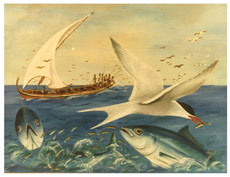
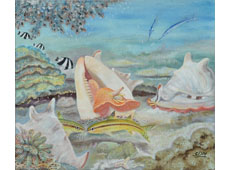
Sarudhaaru Dhon Maniku, who often signs his paintings SDM, is considered the pioneer of ‘souvenir art’, or art and craft produced with the primary purpose of selling or gifting it to a tourist.

Also one of the first Maldivians to scuba dive, SDM’s imagination is infused with the colors and rich and varied life forms of the underwater world. The son of a craftsman, SDM was initiated into the trade of craft making and art at an early age. Commissioned by various friends and others, SDM initially produced various gift and craft items. Later on, he was commissioned to produce portraits or copy printed images by the Indian (Bhora) traders who were stationed in Male from the late 1800s until mid 20th century.

SDM was first noticed for his talent and skills during the 10 year period beginning from the end of the reign of Sultan Hassan Noordeen, and the formation of the first republic in 1953 with Mohamed Amin Didi as the first president.

SDM was then a teenager. He recalls President Amin Didi as a great patron of the arts and crafts, and indeed it was he who organised a nationwide arts and crafts fair in the capital for the first time in the history of the country. More generally, the short tenure of Amin Didi’s presidency is also regarded as a period of literary and cultural renaissance.

Even though SDM was noticed for his talents at an early age and in the 1940s and ‘50s, he says it was the advent of tourism in the early1970s that really helped him to carve out a profession in which he could dedicate his skills as an artist and craftsman fully to his profession. The ‘tourist market’, as it became later known, proved to be a lucrative avenue for all aspiring craftsmen, artisans and hopeful artists in the country, and given the rich traditions of craft in the Maldives, this was a welcome development for the country at large.

In the 1980’s more than 20 highly developed craft forms were documented. These ranged from coir rope-making from coconut husk, to weaving mats from a variety of dried grass and then coloring it with natural dies, to intricate and exquisite looking lacquer ware and expensive jewellery made from gold and silver.

By coincidence, the year SDM was born was also the year the French Impressionist painter Monet died. And during the course of SDM’s life, Europe experienced the trends of Modernism, DADA, Surrealism, Abstract Expressionism, Pop and Post-Modernist art.

While it may be futile to interpret SDM’s works through the prisms of these aesthetic and stylistic trends, it’s interesting to note that SDM’s works exhibit many qualities of these very trends of which he may never have known about first hand.

SDM as a young man

Perhaps more importantly, SDM admits he always strived to make something that maybe of use; admiration of aesthetical beauty being one of these uses. Additionally, he also meticulously documented the shells and fishes commonly found in the Maldivian reefs and lagoons. One of the first series of posters depicting shells and fishes of the Maldives was illustrated by SDM, which is still in print and published by Novelty Printers and Publishers Maldives.

Apart from the sheer output of his work over a period of several decades (SDM is now in his late eighties), what is most apparent in SDM’s long career are the different media he has mastered over time. This includes the pencil, water, acrylic and oil colors as well as sculpting and carving. In addition to this, he has also consistently demonstrated a knack for invention, often experimenting with different materials and techniques, and continuing even today. Senior Maldives artist Ahmed Abbas has commented on SDM; “Dhonbe is a great artist, especially his underwater scenes have something special and great about them. He has applied color to great effect. Even when we were kids, Dhonbe was a renowned artist .”

In recognition of SDM’s contribution to Maldivian culture and to celebrate his achievements in the arts, the National Art Gallery of the Maldives commissioned him in 2005 to produce a series of works for the permanent collection of the gallery. Some of these works are also now exhibited in the Maldivian Ministry of Foreign Affairs and Maldivian embassies abroad, and others are displayed at the gallery in temporary exhibitions.

The Gallery also commissioned a book documenting the life of SDM which was published in 2009 in Dhivehi, and an English translation is due to be published in 2012.

SDM lives at his home in Male and continues to produce paintings, handcrafted objects and other items such as hand painted greeting cards and says he is very content with the life he has lived. He continues to be an inspiration to younger generations of artists and is one of the most prized individuals in the country.

Mamduh Waheed is Deputy Minister for Tourism Arts and Culture. He is also a writer on Maldivian art and has written several reviews and essays for catalogs, and was curator of the National Art Gallery from 2004 to 2009.

Likes(1)Dislikes(0)

India and Pakistan steal show at SAARC: The Nation

Addu city’s resorts have probably never seen so many suits in its equatorial climate before – and probably never will, unless a convention of undertakers comes to town, writes Rameeza Majid Nizami for The Nation.

“As harried delegations tried to squeeze in hurried meeting after meeting to obtain maximum benefit from the event, the feeling remained that all eyes on SAARC were in fact on the two most powerful countries there, India and Pakistan. This time around, I got an opportunity to observe the difference between the work ethic and style of the two regional powers, which I will attempt to describe here. After all, Pakistanis are masters of reverse engineering – when we see something that works well we believe in paying the compliment of ‘imitation is the sincerest form of flattery’. And there is no doubt the Indian side at SAARC were the perfect example of doing something simple, well.

“The Indian approach to their work is meticulous. From the diplomats, to the journalists, planning, setting modest, achievable goals and securing equally modest wins through burning good old-fashioned foot leather is the strategy of their success. The speech of the Prime Minister appeared to have been written to portray an image of a humble billionaire and benevolent sugar-daddy.

“Pakistan, by comparison, was to put it in an analogy, the prettiest girl at the party in the dowdy dress and unflattering accent. Exhibiting tremendous potential and receiving the kind of attention reserved for someone genuinely important, whose relevance is expected to continue to increase, Pakistan was observed with keen interest. Trying to deal with every subject under the sun, the Pakistani delivery at SAARC lacked focus, simply because, through the best of intentions, it tried to deal with too much.”

Full story

Likes(0)Dislikes(0)

Indian Ocean ferry service and renewable energy investment among key SAARC agreements

The 17th SAARC Summit concluded today with the signing of the ‘Addu Declaration’, containing a number of key agreements affecting the region.

One of the most significant for the Maldives was a commitment to ensure that final preparations for an Indian Ocean passenger and cargo ferry service were completed by the end of December.

In a press conference following the closing ceremony, SAARC Chairman President Mohamed Nasheed pointed out that this development would allow someone to cheaply travel from Kulhudhuffushi in the country’s north to Colombo or Kochi in as much time as it would take them to reach Male’.

Other agreements included the strengthing of the SAARC Secretariat, the establishment of a South Asian Postal Union, and intensification of efforts to reduce non-tariff barriers to trade and reduce the sensitive list.

During the Summit, India had announced its intention to reduce its sensitive list for Least Development Countries (LDCs) from 480 tariff lines to 25, with zero customs duty for those items removed.

An unexpected commitment was an agreement in principle that SAARC countries would spend an “appropriate proportion” of their national income on renewable energy technologies.

The percentage would be determined by energy authorities and finance ministers in each country, but Nasheed said that if investment reached even one percent it would create the world’s largest market for renewable energy technology overnight.

No agreement was reached regarding the possibility of installing a human rights mechanism in SAARC, however Nasheed said the matter had come up as dear to several SAARC leaders, who had spent time in jail and faced torture over their politics.

“I don’t think they will stop talking about human rights,” he said.

The Heads of State also agreed further measures to combat maritime piracy in the region.

“When the next season of pirates drift into the Maldives, we must be able to deal with them,” he said.

“It is not a matter of stopping them, but what we do with them after we capture them,” he said, noting that the Maldives currently had 37 in custody.

“They have no ammunition on board by the time they reach the Maldives, and no passport or identification papers, so we can only treat such a person as a refugee adrift.”

Observer statements

During the closing ceremony observers from eight countries made statements in support of SAARC, reaffirming various commitments in the region.

The Australian representative observed that Australia was united with South Asia not just through sharing the Indian Ocean, but through a shared love and appreciation of cricket – 80 percent of the market for which was based in South Asia.

Australia pledged an additional AUD$20 million over two years, extending its support for infrastructure development to AUD$40 million over six years, and announced 297 scholarships to South Asian countries in 2012.

China meanwhile announced an additional donation of US$300,000 to the SAARC Development Fund.

The European Union welcomed steps taken at SAARC to move beyond trade to also cover political issues, such as counter terrorism.

The former “complexity” of SAARC had compelled the EU in one instance to decommit funds allocated for developing standards, the representative noted, but highlighted a €6.5 million commitment in civil aviation cooperation.

Iran noted its shared linguistic heritage with South Asian countries and raised the possibility of tourism cooperation.

Japan meanwhile thanked the Maldives for its contribution of 69,000 tins of tuna following the earthquake in March, and pledged broad support around the region. Particular emphasis, the representative said, included stability in Afghanistan, democracy in Pakistan, peace and security in Nepal, disaster preparedness in Bangladesh, and democracy consolidation in Bhutan and the Maldives.

The representative from the Republic of Korea noted that it was only in the last 50 years that Korea had transformed itself from a recipient of donor aid to an OECD country, and announced that the country intended to triple its overseas development commitment by 2015.

The representative from Myanmar/Burma announced his country’s desire to promote trade with SAARC countries, given its proximity.

The country was in the process of transitioning from a military government to a democracy, he claimed, appealing for the “understanding and support of the international community.”

The United States representative reiterated Secretary of State Hillary Clinton’s ambition to help establish “a new silk road” in South Asia, which would in turn address insecurity and extremism plaguing the region.

The US was very encouraged by the bilateral talks and trade agreements negotiated between India and Pakistan during the SAARC Summit.

At the same time, the US urged the need for greater transparency and accountability of government “in the pursuit of better government.”

Parallel ‘People’s SAARC’

The parallel ‘People’s SAARC’, a collective of South Asian civil society organisations, meanwhile observed that the Summit was taking place “at a time when South Asian states are beginning to look inwards to realize the region’s immense political, economic, and diplomatic potential.”

“While the agenda of economic and social development might have moved up as a priority item for the SAARC countries, South Asian states continue to veer towards their aspirations for superior military might, prompting them to divert resources from developmental goals.”

The parallel SAARC urged leaders to close the income gap by dropping “wasteful” expenditure of further militarisation, institute a regional human rights mechanism protecting the rights of migrant workers, and create and independent climate commission.

“We would also like to see the establishment of a regional monitoring body with a mandate to assess the compliance of the member states in installing, safeguarding and institutionalising democratic governance.”

“SAARC should encourage member states to adopt competent and credible constitutional, legal and administrative framework to end all forms of discrimination, displacement, deprivation and the deeply rooted culture of impunity to secure a better future for the billions on inhabitants of the region,” the statement read.

Likes(0)Dislikes(0)

Comment: Burning bridges – SAARC Summit exposes depths of Maldivian intolerance

Democracy strips a people naked by giving them the freedom to be who they really are. Recent events reveal that the Maldivian so exposed is not a pretty sight: she is bigoted, xenophobic, and ignorant.

First came the gutter press hullabaloo about an illustration of Jesus on a banner welcoming leaders of the SAARC region which, as it happens, is home to the largest collection of deities known to man.

Pardon me if I am bordering on the verge of apostasy here, but is Jesus not Easa? You may know him from such books as the Qur’an.

Perhaps the good people of the Sun magazine, which ‘broke’ the ‘news’, are not too familiar with the book. Be that as it may, truth is, Sun writers had not been this excited about alleged ‘anti-Islamic activity’ since they went under covers in a brothel.

When the public failed to foam at the mouth (not about the brothel, about Jesus), other plans had to be hatched to ratchet up hatred. Along came MP Ahmed Mahloof, our saviour from the unlikely Second Coming of Jesus as a line-drawing flapping about in the warm breeze of a tropical island.

The ex-footballer as a public figure is an interesting (side)step in the evolution of man. To begin with, he possesses a brain that accepts kicking a ball into a net for money is a life well lived. The capacity of such brains to adjust to other styles of living is minimal, though not non-existent.

It has been proven, for instance, that they can successfully switch from playing ball to building a career of provocatively displaying one’s own balls for couturiers of men’s underwear. But a career in politics? Mahloof is proof that electing ex-footballers to political posts is an own goal of epic proportions.

As if the MP and his idiocy were not enough to make us the laughing stock of South Asia, we then set about destroying a monument installed by Pakistan because it contains idolatrous images.

Maldivians destroying a Pakistani creation for alleged anti-Islamic imagery. Now, tell us – does that not make it clear once and for all who is the more Islamic of the two states: the Islamic Republic of Pakistan with its 97 percent Muslim population, or Always Natural Maldives, the tourist destination extraordinaire with a hundred-percent-minus-one-Muslim population? Surely we have won this religious pissing contest that Pakistan probably did not even know they were engaged in.

At least we cannot be accused of bias in our India-Pakistan foreign policy. Last month we deported an Indian for having on his laptop a religious hymn. This week we destroyed a religious display from Pakistan.

In fact, we are very even-handed in our policies and attitudes towards all our neighbours. Just ask any of our hundred thousand Bangladeshi Muslim brethren: we treat them all with equal inhumanity and cruelty.

And surely Sri Lanka would attest to just how seriously we take the commandment to love thy neighbour: for didn’t we, while on the UN Human Rights Committee, describe the UN’s condemnation of Rajapaksa’s war policy as ‘singularly counter-productive’?

Somewhere in this unpalatable exposé of the 21st century Maldivian is a lesson, not just for Maldivians but also for democracy itself. And it is not just that ex-footballers should not be elected to public office but also that, given the freedom, a majority of people are just as likely to choose intolerance as they are to choose tolerance.

That is the tragedy of three years of democracy in the Maldives: we have chosen to use its liberties to exercise our freedom not to be free.

All comment pieces are the sole view of the author and do not reflect the editorial policy of Minivan News. If you would like to write an opinion piece, please send proposals to [email protected]

Likes(1)Dislikes(0)

Scheduled flights commence to Fuvahmulah airport

Scheduled flights commenced to the newly-built Fuvahmulah airport today after the airport operating license was granted.

According to state broadcaster MNBC One, scheduled flights from Island Aviation will travel to the atoll island four days a week. A return ticket from Male’ to Fuvahmulah costs Rf3,194 with the fuel surcharge.

An Island Aviation test flight landed in the 1,200-meter runway on October 31.

Likes(0)Dislikes(0)

MJA condemns arrest of journalists in airport

The Maldives Journalist Association (MJA) has strongly condemned the arrest of journalists that covered Wednesday night’s attempt by opposition parties to take down banners depicting Christian imagery at the Ibrahim Nasir International Airport.

In a press statement, MJA said the arrested reporters were carrying press passes but had their cameras and phones taken from them before being taken to the police detention island of Dhoonidhoo.

The press NGO said it considered the “unacceptable” arrest an attempt by police to “obstruct the work of journalists and intimidate them,” calling on the authorities to provide protection for reporters covering such incidents.

The statement however noted that the journalists were released shortly after being taken into custody after the association intervened and spoke to police.

Likes(0)Dislikes(0)