Foreign workers locked in house after allegedly “refusing to work and attempting to flee”

Police have discovered six foreign workers locked in a house after they were reportedly accused “of refusing to work and attempting to flee”.

All six of the male workers were found in a house located in the Male’ neighbourhood of Henveiru, according to local media.

While responding to a report made by a foreigner, the police discovered the the workers at approximately 10:30am Monday (April 8).

As the foreign workers exited the house, spectators claimed the workers had refused to do their jobs and as a result had not been receiving their salaries. The man responsible for the workers was also present, reported local media.

Immigration Controller Dr Mohamed Ali told Minivan News that police were investigating the case and would report back to the Department of Immigration and Emigration.

“We are working on it,” Ali said.

Police Spokesperson Chief Inspector Hassan Haneef was not responding to calls at time of press.

The workers’ nationalities, the conditions of their employment and housing have yet to be confirmed.

Migrant workers

Last week the Department of Immigration said 57 unregistered foreign workers were detained by police on April 1 and were being processed by authorities ahead of a decision on whether they will face deportation.

In February, a Maldivian trade union alleged that corrupt immigration practices and the use of unregulated employment agencies by private and state employers was limiting efforts to curb abuse of migrant workers and prevent illegal practices such as retaining their passports.

The Tourism Employees Association of Maldives (TEAM) claimed that while companies are not permitted to retain the passports of foreign workers, some hospitality operators – as well as unregulated third party agencies and government ministries – are still keeping employee travel documents without consent.

At the same time, a source with knowledge of the current immigration system told Minivan News that the practice of retaining passports – a long-standing habit of Maldivian employers – was a key contributor to human trafficking in the country.

In May 2012, a total of 47 Bangladeshi nationals working for a local security firm were seized by the Department of Immigration as part of a wider crackdown on unregistered migrant workers.

Immigration officials at the time claimed that the company the men had been working for had been in operation for 10 -12 years, yet no information could be found on its operations during a subsequent investigation by authorities.

In 2010, it was claimed that the exploitation of foreign workers in the Maldives rivals fishing as the most profitable sector in the Maldivian economy after tourism.

Human trafficking

The Maldives has appeared on the US State Department’s Tier Two Watch List for Human Trafficking consecutively for three years. Should the Maldives drop to tier three – the worst category – then the country is expected to face significant reductions in aid and potential travel restrictions on its citizens.

The Maldivian government recently launched a special campaign intended to raise awareness of foreign workers’ rights, while earlier this year eight “fundamental” International Labour Organisation (ILO) conventions were ratified in order to bring legislation on employee rights and trade unions in line with international standards.

However, independent institutions in the Maldives have maintained that the country – under successive governments – has yet to ratify a core convention on protecting migrant worker rights, while no legislation is in place to punish those involved in smuggling workers though the country’s borders.

The Prosecutor General (PG’s) Office has also confirmed that a lack of legislation has meant no cases have been prosecuted against human traffickers in the Maldives at present.

Meanwhile, the Human Rights Commission of Maldives (HRCM) has accused state and private sector employers in the country of lacking consistency in their efforts to address human trafficking, preventing “real” change in controlling illegal migration.

In January, President Waheed expressed concern about the rising number immigrants in the Maldives, claiming that the “foreign influence” threatens the country’s “Maldivianness”.

Likes(0)Dislikes(0)

India needs to re-examine relationship with neighbours: Hindustan Times

Recent developments in the Maldives and Sri Lanka suggest a need for a re-examination of India’s relations with its neighbours, write Charan Singh and Arvind Virmani for the Hindustan Times.

Some political pundits have expressed concern about China’s build-up on the Tibetan plateau, its plans to build numerous dams on the Brahmaputra and takeover of the management of Gwadar, a commercial port in Pakistan. China’s growing defence expenditures ($119 billion in 2013) — three times that of India’s $40 billion (2013-14) — have allowed it to extend its naval presence into the Indian Ocean, making it imperative for us to use our limited resources more efficiently.

Military and political strategy are generally intertwined, and sometimes buried inside a commercial one. The world respects power. India’s growth acceleration in the 1980s and 1990s created the conditions for a greater role in global politics, but it was Pokhran II that catapulted India onto the world stage. China’s military might, focused mission and astute diplomacy have been successful in resolving many border issues and fostering strategic economic relations with its immediate neighbours.

Read more

Likes(1)Dislikes(0)

BML chief auditor dies during air travel

Bank of Maldives (BML) Chief Internal Auditor and Chief Compliance Officer Lucian Jayakody has died while travelling on an aircraft from Dubai to Canada, according to local media.

Jayakody, a Sri Lankan national who has been working with BML since 2006, had 25 years experience in the finance sector and was reported by Sun Online to also be a member of BML’s Corporate Management Team and Executive Committee.

BML Managing Director and chief Executive Officer Peter Horton told local media today that Jayakody’s passing would be a huge loss for the bank.

Likes(0)Dislikes(0)

Ministry of Islamic Affairs and Palestinian Embassy announce Masjid Al-Aqsa conference

Maldives Minister of Islamic Affairs Sheikh Mohamed Shaheem Ali Saeed and Palestinian Islamic Minister Dr Mahmoud Al Habbash have announced the Masjid Al-Aqsa conference will be held in the Maldives during a joining press conference Sunday (April 7).

Shaheem said the Mufti and Imam of the Masjid was invited and various “renowned” religious scholars will participate, reports local media. A joint committee with officials from the the Maldives Ministry of Islamic Affairs and the Palestinian Embassy will finalise the conference date and participants.

The purpose of the conference is “to increase the love in the hearts of Maldives citizens, and other Muslims around the world towards [the holy mosque] Masjid Al-Aqsa,” according to Shaheem.

The joint committee will address “troubles” Maldivians face visiting Masjid Al-Aqsa, enable 10 Maldivian men (religious scholars, students, journalists and members of the public) to visit the holy mosque, and “facilitate opportunities” for Maldivian students to study in Palestinian universities.

Likes(0)Dislikes(0)

New Indian High Commissioner arrives

Rajeev Shahare, the new Indian High Commissioner, arrived in the Maldives Thursday (April 2) but has not yet set a date to present his credentials to President Mohamed Waheed Hassan Manik, reports local media.

Shahare is replacing D M Mulay, who left the Maldives last month to take the position has India’s Consul in New York.

Previously Shahare was a joint secretary in the Ministry of External Affairs, West Asia North Africa division.

Likes(0)Dislikes(0)

Hoax photo of Nasheed meeting Artur Brothers circulated by State Defence Minister turns into meme

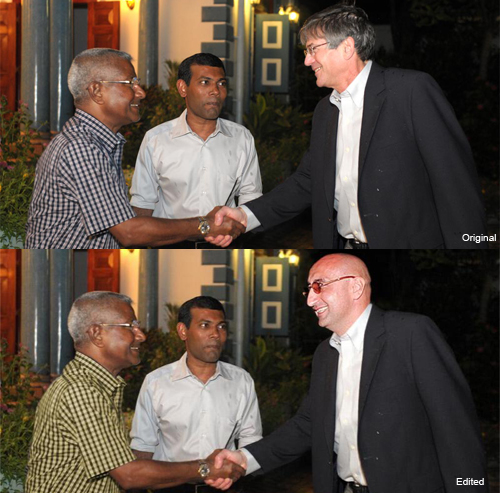
A photograph widely distributed by local media outlets depicting former President Mohamed Nasheed and his Special Envoy Ibrahim Hussain Zaki meeting the infamous Armenian ‘Artur Brothers’ has turned out to be a hoax.

The Armenian brothers – linked with drug trafficking, money laundering, raids on media outlets and other serious crimes in Kenya – were recently photographed with current Minster of Tourism Ahmed Adheeb and Defence Minister Ahmed Nazim during the Piston Motor Racing Challenge, organised by the Maldivian National Defence Force (MNDF).

The two ministers initially denied any involvement with the brothers or their apparent business interests in the Maldives, however a letter from the Tourism Ministry to immigration authorities requesting a residency visa for Margaryan and Sargsyan Artur, dated January 27 and signed by Adheeb, was subsequently leaked on social media.

Zaidul Khaleel, General Manager of the Club Faru resort which is operated by the state-owned Maldives Tourism Development Corporation (MTDC),  has also reportedly been sacked after he was found to have paid the brothers’ US$6000 bill.

Meanwhile, on Sunday a photo depicting former President Nasheed and Special Envoy and former SAARC Secretary General Ibrahim Hussain Zaki apparently meeting Artur Sargsyan was leaked on social media and widely republished by local media.

Local media outlet Channel News Maldives (CNM) reported that the photograph was originally leaked by the former Immigration Controller and current State Minister for Defence, Ilyas Hussain.

However the photograph turned out to be an edited photo taken during a formal reception for US Deputy Secretary of State James Steinberg, held at the former Presidential residence of Muleaage in January 2011, with Sargsyan Artur’s head carefully photo-shopped onto Steinberg.

According to CNM, Ilyas at the time confirmed to the media outlet that the photo of Nasheed with Artur Sargsyan was real and authentic.

Speaking to Minivan News, Ilyas Hussain stated that he no longer wished to comment on the matter.

Following the publication of the leaked photo, a member of President Waheed’s Gaumee Ithihaad Party (GIP) told Minivan News that Waheed had prepared a press conference following the release of the edited photo, but later called it off after the photo was discovered to be a hoax.

Minivan News was unable to confirm the claim as President’s Office Spokesperson Masood Imad was not responding at time of press.

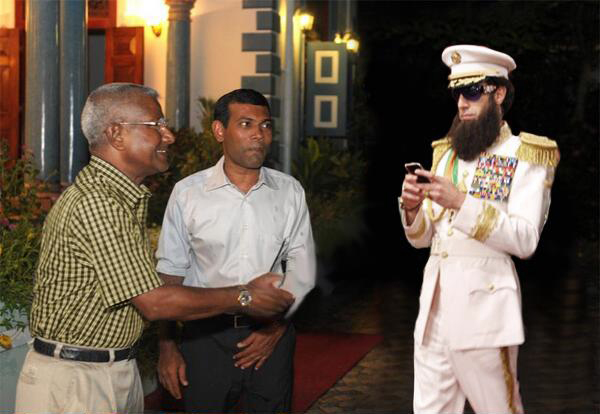
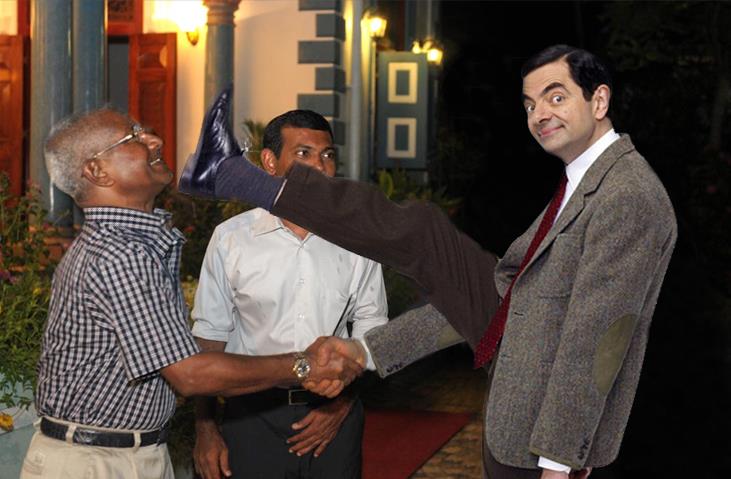
The photo has since gone viral across Maldivian social media and has been widely photoshopped to depict Nasheed meeting a wide variety of celebrities and fictional characters.

The meme has blossomed to include Nasheed encountering deceased Chairman of Apple Inc, Steve Jobs, Albert Einstein, Justin Beiber, Professional Wrestler/Rapper/Actor John Cena, the Pope, popular antagonist of the Star Wars franchise Darth Vader, fictional lead character in the Sacha Baron Cohen comedy ‘Dictator’ Admiral General Haffaz Aladeen, DC Comics superhero Batman, Rowan Atkinson’s UK comedy icon Mr Bean, and ‘Big Bird’ from US children’s television show Sesame Street.

Likes(0)Dislikes(0)

Ministers slam Nasheed for “bluffing” over guesthouse commitments

Former President Mohamed Nasheed’s pledge to expand guest house tourism in the country has been strongly criticised by senior government figures, who accuse him of lacking sincerity and “bluffing” over his commitments to mid-market tourism.

State Minister for Finance Abbas Adil Riza and Minister for Tourism Ahmed Adheeb both this week slammed Nasheed, claiming guesthouse bed numbers more than doubled last year after President Dr Mohamed Waheed came to power.

The ministers, who represent the government-aligned Gaumee Ithihaad Party (GIP) and  the Progressive Party of Maldives respectively, also criticised Nasheed over previous remarks he made in international media calling for a boycott of the country’s tourism sector.

However, Nasheed’s Maldivian Democratic Party (MDP) has claimed that after reintroducing the guesthouse concept to the Maldives during its administration, the party’s latest manifesto gave further importance to growing mid-market tourism.  The MDP claims such growth will be vital to tackling what it called a “total disconnect” between the lucrative island resort model and local people.

With the inclusion of development of small and medium businesses – particularly in the emerging guesthouse sector – in a “mini-manifesto” drawn up by the MDP, mid-market tourism has emerged as a key potential issue for elections in September 2013.

Bed numbers

Speaking to Minivan News, Abbas Adil Riza accused Nasheed of lying in regards to his commitments to mid-market tourism development, criticising him for a wider failure to protect small and medium businesses in the country.

“My concern is that Nasheed is bluffing. Between 2009 to 2011, there were 16 new guest houses built,” he said, claiming these properties amounted to some 180 tourism beds.

Abbas said that in 2012 alone, the number of guesthouse beds available to tourists in the country had almost doubled as a result of programs implemented by the Waheed government to provide smaller-scale loans leading to 37 guest houses being developed.

“During Nasheed’s administration, outsiders were given public land and there was no funding supplied,” he said. “After February 7, we gave small-scale loans to 37 individuals.”

Abbas also accused former President Nasheed of failing to support small and medium enterprises and local industry in general.

He added that small and medium scale businesses had to be set up in harmony with local culture and traditions, particularly on small islands.

“He can’t just say that he is the champion of these things,” Abbas added.

Boycott concerns

Traditional holiday staples for large numbers of tourists coming to the Maldives, including being able to wear bikinis and drinking alcohol, are not permitted by law on local islands that are classed as being inhabited.

Speaking to local media, both Abbas and Tourism Minister Adheeb have hit out at claims by the MDP published in international media last year calling for travellers to boycott Maldives tourism.

Adheeb told Sun Online that Nasheed had not made sense by previously calling for the promotion of guest houses in the build up to this year’s presidential election after calling for a boycott last year.

“President Nasheed had made a global call to boycott Maldives tourism, and now he is calling to promote guest house businesses, targeted at Maldives tourism. This does not make sense,” he was quoted as saying.

Nasheed last year called for a tourism boycott of the Maldives, as he continued to question the legitimacy of the government of President Waheeed – his former vice president.

However, these calls were soon dropped by Nasheed and supporters of the now opposition MDP.

The Ministry of Tourism last year fell short of its stated aim of welcoming one million visitors to the country during 2012, citing difficulties resulting from media coverage of political turmoil following the change of government that brought President Dr Mohamed Waheed to office.

However, authorities in the country have since pledged to surpass the one million visitor goal in 2013, claiming late last year that the “hard days” were over for tourism in the country following 2012′s political turmoil.

Despite this stance, as part of a so-called silent protest at this year’s ITB event, anti-government campaigners distributed leaflets entitled ‘the cloudy side of life‘ – a play on the country’s official ‘Sunny Side of Life’ tourism slogan to draw attention to alleged human rights violations under the new government.

“Paradigm shift”

MDP MP and Spokesperson Hamid Abdul Ghafoor responded that Nasheed’s government had sought to reintroduce and expand guest houses in the Maldives – a development the party claimed was needed to bring a “paradigm shift” in general thinking and economic development in the Maldives.

After 40 years of concentrating primarily on exclusive island-based resort tourism, Hamid accused former President Maumoon Abdul Gayoom during his 30 years of power of creating a “total disconnect” between local people and the country’s famous high-end tourism product.

“They local people Islamic rhetoric while talking something very different to tourists,” he claimed.

Pointing to the ‘mini-manifesto’ released by the MDP in the build up to this year’s elections, Hamid claimed that was capacity for an additional 600,00 tourists to travel to the Maldives annually, yet there was not enough options to accommodate them.

“All across this country, you see that many islands are ready for [middle-market tourism]. There are impressive cafes. People who have worked in the tourism industry are setting up businesses based on their experiences,” he said. “Tourism is very much a business we know and some of these places are quite sophisticated.”

As part of the MDP’s election pledge, Hamid claimed that some MVR120 million was set to be pledged as part of a policy to provide “seed money” to help establish guest houses and supporting industries.

He said that guest houses have always been a central policy of the MDP to support national development.

By comparison, Hamid claimed that before coming to power, the previous government under former President Gayoom had tried to paint tourism on local islands as “haraam” to discourage interest and investment.

He claimed such a strategy was overseen by certain resort owners and tourism magnates alleged by the MDP to being central in bringing the present government to power on February 7, 2012.  Nasheed himself resigned following a mutiny by sections of the police and military.

Both Nasheed and the MDP have continued to contend that the transfer of power was a “coup d’etat”, despite the findings of a Commonwealth-backed Commission of National Inquiry (CNI) last year.

Responding to the party’s previous reported support for a tourism boycott, MP Hamid claimed the party had always committed itself to what it called selective boycotts – rather than calling for tourists to outright reject the destination.

“We are not saying that all resort operators are bad. But some of them were directly involved in the coup and have sought to exploit their positions,” he said.

Hamid denied the party had sought to boycott the industry outright, claiming instead to be targeting resort owners that he alleged ran their businesses unethically in the style of “cartels”.

Nasheed’s tourism potential

Just last month, in an open-editorial piece reprinted in Minivan News, former President Nasheed claimed that only 50 people directly profited from the resort industry in the Maldives, limiting what he claimed were a wealth of economic and social policies.

“What the average Maldivian wants is basic. We want a way to increase our income. We want to broaden our narrow financial horizons through development.

It is not that we lack this capacity to develop. We have plentiful natural resources. If we settle for the current economic status quo, believing that what we have now is the limit to what we are entitled to, it will mean that our true wealth potential remains untapped,” he wrote at the time.

“What the MDP and I have always pointed out is this basic fact: we want to develop. To upgrade beyond the current status quo. The ordinary Maldivian’s complaint is that of poverty, of financial anxiety. We want a wallet with the wads; we want to realise that financial progress is possible. The political office is a place that should offer solutions to these complaints. This is its responsibility and obligation.”

Meanwhile, an island owner involved in the country’s burgeoning mid-market holiday sector last week slammed new regulations imposing financial restrictions on tourism joint venture projects with the government, claiming the legislation outright excludes small and medium-scale investors.

Likes(0)Dislikes(0)

Parliament to hold no-confidence vote against Home Minister Jameel, Defence Minister Nazim, JSC member Gasim Ibrahim

Parliament has scheduled a series of no-confidence votes for tomorrow concerning Home Minister Mohamed Jameel, Defence Minister Mohamed Nazim and JSC member Gasim Ibrahim.

Parliament rules state that a minimum of 39 votes are required to successfully pass a no-confidence vote against a government minister. The opposition MDP currently has 29 MPs, short 10 votes of the required majority.

While the Progressive Party of the Maldives (PPM) has said it will back the trio, the DRP, which has 15 MPs, has said the party will “decide tomorrow”.

Following the scheduling of the vote, President Mohamed Waheed Hassan told local media that he was confident that the government-aligned parties would “defend” his ministers from impeachment.

Likes(0)Dislikes(0)

High blood pressure “silent killer” of one in 10 Maldivians

High blood pressure is the leading risk factor for Maldivian deaths, and is much more prevalent among women than men nationwide.

One in 10 deaths in the Maldives, equaling over 100 yearly, can be attributed to this “silent killer” which often presents no symptoms.

High blood pressure – also referred to as hypertension – is a condition where blood vessels have a persistently raised pressure which can lead to heart attacks, heart failure, stroke, kidney failure, loss of vision, and premature death.

In the Maldives 32.9 percent of women, compared to 29.7 percent of men, are affected by hypertension, although the prevalence of men with hypertension is higher regionally and globally.

Hypertension has been increasing over the past decade in the Maldives. Economic progress has caused lifestyles to change drastically, reads a World Health Organisation (WHO) World Health Day report.

“In the era of globalisation, all countries are interrelated, rapid urbanisation, transition from agrarian life to wage-earning, and modern city life are considered to be the major contributors in the elevated blood pressure in urban areas,” WHO Representative Dr Akjemal Magtymova told Minivan News.

Unhealthy lifestyle and behavior risk factors for hypertension have increased, including consumption of processed foods containing excessive salt, low levels of physical activity, tobacco use, and obesity.

“Increasing levels of mental stress contribute to the adoption of unhealthy behaviors thus putting people at a higher risk of acquiring hypertension and related noncommunicable diseases,” the WHO South-East Asia Regional Director Dr Samlee Plianbangchang stated in his World Health Day 2013 message.

Magtymova explained “Some of the factors that may contribute to the higher prevalence of hypertension among Maldivian women include: no enough physical activity (affecting 41 percent of women in the Maldives compared with 37 percent of men), unhealthy diet (higher intake of salt, sugar and fat, – total cholesterol level in women is higher than in men), higher stress level, malnutrition in childhood and during reproductive age.”

For both men and women the prevalence of being overweight or obese is the highest in the Maldives compared to other countries in the South-East Asia Region.

“The 2008 data from the Maldives shows that among the adult population, 53 percent of women are overweight and 30 percent of men are overweight,” said Magtymova.

Over the past 14 years there has been an increasing trend of hypertension at the Indira Gandhi Memorial Hospital (IGMH), physician Dr Ali Abdul Latheef explained in the WHO World Health Day report.

“What is alarming is that we now see a lot of young hypertensive patients. Many patients are in their early thirties and sometimes as young as early twenties,” said Dr Latheef.

Prevention

High blood pressure is both preventable and treatable, but remains a growing global public health issue, which is why ‘control your blood pressure’ is the WHO’s World Health Day 2013 (April 7) theme.

The WHO recommends at least 150 minutes of moderate physical exercise weekly to prevent diseases like hypertension, according to the WHO World Health Day article.

Eating a healthy diet including fruits and vegetables, while reducing salt and processed foods is also important.

Stopping tobacco use and reducing harmful alcohol intake must also be addressed.

However, regular blood pressure checkups are essential, because there are rarely warning signs of hypertension and it can also develop as blood vessels harden with age.

Magtymova stated the WHO recommends implementing evidence based strategies to address all behavioral risk factors for preventing hypertension.

“High level commitment is needed to reverse the growing burden of noncommunicable diseases in the Maldives.

“The WHO is assisting the Government of Maldives and working closely with the Ministry of Health to improve available data on risk factors, prevalence and trends, as well as address risk factors by establishing preventative measures,” said Magtymova.

She further detailed that the WHO closely collaborates and supports non-governmental organisations (NGOs), such as the Diabetes Society of Maldives, SHE (Society of Health Education), Aged Care, the Autism Association, and Care Society.

Magtymova emphasised “A multi-sectoral approach is a key in addressing prevention and control of noncommunicable diseases as many determinants of non-communicable disease lie outside of the health sector.”

Thus, other UN agencies are also promoting healthy lifestyles, eating habits, school health education, as well as monitoring trends in malnutrition among children and mothers.

Likes(0)Dislikes(0)