American high school teacher implementing sustainable mosquito control project in the Maldives

“For most people in Siskiyou County, mosquitoes are no more than a nuisance. But in the Maldives, where they breed rapidly and transmit painful and sometimes deadly Dengue fever, they’re much more of a problem”, Californian publication Mount Shasta Herald  reports.

“Former Mount Shasta High School teacher Trudy Rilling-Collins is working to control mosquitoes in the Maldives in an environmentally friendly way. She recently enlisted help from MSHS graduate Sydney Miller to implement sustainable mosquito control projects with local islands in the Maldives, a double chain of 26 atolls consisting of 1,200 islands off the coast of India and Sri Lanka.

Rilling-Collins hopes to create a project model that will empower the Maldivian people to effectively control mosquitoes on their own. Not only will this benefit the people – both local Maldivians and tourists – but it will also help the environment, she explained.”

To read more, click here.

Likes(0)Dislikes(0)

MDP accuse Commonwealth Secretariat of complicity in “coup” cover-up

The Maldivian Democratic Party (MDP) has accused the Commonwealth Secretariat of being involved in an alleged cover-up of key details surrounding the controversial transfer of power on February 7, 2012.

In a statement released yesterday (January 23), the MDP claimed that parliament’s Executive Oversight Committee (EOC) had uncovered evidence of a “systematic government cover-up designed to subdue testimonies from key witnesses to the coup d’etat”.

The statement accused the Commonwealth Secretariat of having “close involvement” with the government’s Committee of National Inquiry (CoNI) that reported on the power transfer on February 7, 2012 – making it implicit in any alleged cover-up.

Among the MDP’s allegations, the Commonwealth Secretary-General’s Special Envoy to the Maldives Sir Donald McKinnon was accused of “giving in” to government demands to appoint certain individuals to oversee the report.

“The CoNI, established by Dr Waheed shortly after he came to power, was originally made-up of three people – all well-known sympathisers of former President Gayoom – and chaired by President Gayoom’s former minister of defence,” the statement read.

“After an international outcry, the government was forced to agree to reform the CoNI. The Commonwealth Secretary-General’s Special Envoy to the Maldives, Sir Donald McKinnon, was subsequently sent to the Maldives to mediate an agreement, but eventually gave in to government demands that President Gayoom’s former defence minister must remain as chair, and that the other two members must remain in place.”

The MDP added that the final report of the CoNI had maintained that the transfer of power had been constitutional and rejected allegations of a “coup d’etat” despite what it claimed was “widespread evidence to the contrary.”

Minivan News is awaiting a response from the Commonwealth Secretariat at time of press.

The statement was released the same week in which senior military and police intelligence figures gave evidence to the EOC alleging that the transfer of power on February 7 “had all the hallmarks of a coup d’etat”, and claimed that the final CoNI report had not reflected their input.

The figures included Brigadier General Ibrahim Didi, Commander of Male’ area on February 7, Police Head of Intelligence Chief Superintendent Mohamed Hameed, Chief of Defense Force Major General Moosa Jaleel, Head of Military Intelligence Brigadier General Ahmed Nilaam, Chief Superintendent of Police Mohamed Jinah and Commissioner of Police Ahmed Faseeh.

All six have since resigned or been suspended from duty.

President’s Office Spokesperson Ahmed ‘Topy’ Thaufeeq told Minivan News today that the CoNI report was a “transparent” process undertaken by “qualified Maldivian people”.

“Because of this, the CoNI report is accepted by the government. We have a judiciary, if anyone has a problem with this affair they can go to the courts themselves,” he added.

Asked whether the MDP’s allegations that the suspension of senior military staff who gave evidence to the EOC was an attempt by the government to “subdue testimonies from key witnesses”, Thaufeeq argued that the government “was not in a position to talk about a military matter”.

Likes(0)Dislikes(0)

Two men arrested with 325 bottles of alcohol

Police have arrested two men found to be in possession of 325 bottles of alcohol in Male’ on Thursday afternoon.

According to the Maldives Police Service, the two men were arrested as part of a joint operation conducted by the Police Intelligence and Drug Enforcement Department (DED).

Police confirmed to local media that a Bangladeshi and Maldivian national were arrested as part of the operation.

Police said the Maldivian suspected was 34 years-old, while the Bangladeshi man was 22 years-old.  No further details on the suspects were provided.

Meanwhile in Addu City, police have also announced the arrest of six men and a minor with MVR 53,000 (US$3430) and illegal narcotics.

The arrests, which were made on Tuesday (January 22), formed part of a wider on-going operation called ‘Our Peaceful Addu City’, which was commenced by police to try and reduce crimes rates in the area.

“The six men were arrested at about 10:50 pm on January 22 during a raid on Thamannaa House in Addu City,” police said in a statement, adding that the raid was made following intelligence reports.

When police searched the house, officers discovered nine bullet-sized packets containing illegal narcotics, another 13 small packets of illegal drugs and a 500ml bottle containing home-made alcohol.

According to police, a sum of money totalling MVR 53,538, a laptop and a projector all suspected to have been stolen were also discovered inside the building at the time.

Likes(0)Dislikes(0)

Environment Ministry seeks alternative funding to meet development aims

The Ministry of Environment and Energy will attempt to diversify how it finances infrastructure projects in order to compensate for a reduced budget during 2013.

State Minister for Environment and Energy Abdul Matheen Mohamed told Minivan News that reductions to government expenditure over the next 12 months would create “operational difficulties” in its ability to provide water and sewerage projects to a wider number of islands.

The claims were made as the Environment Ministry yesterday unveiled its work plan outlining developments for the next twelve months that will include water projects across 15 islands and sewerage developments on 47 islands.

Despite these commitments, Matheen stressed that the ministry’s development focus has been limited by parliament last month approving a budget of MVR 15.3 billion (US$992 million). The approved amount had been cut by over MVR 1 billion (US$65 million) from the budget originally presented by the Finance ministry to parliament as part of efforts to curb concerns over a budget deficit.

In order to try and make up for possible shortfalls in spending for development projects, Matheen said private sector collaborations were among initiatives sought by the Environment Ministry.

“Definitely we will be facing operational difficulties due to the budget cuts, so we are trying to diversify the financing sources for the development projects and apply the maximum flexibility in the procurement process,” he explained.

“In addition, we are aiming to increase the private sector participation and contractor financing for project implementation.”

Renewable focus

Along with water and sewerage projects, Matheen claimed that efforts were also under way by the ministry to secure MVR800 million (US$51.9 million) for development of the country’s energy sector.

A key focus of this development would be focused on renewable energy, reflecting ongoing commitments to try and become a carbon neutral nation by the end of the decade.

He added that donor funding and private sector finance was presently being sought as part of this green focus.

According to local media, the Environment Ministry yesterday unveiled that state funding would be supplied for water projects on five islands, as well as the introduction of sewerage systems to a further 32 islands.

Further projects on 13 other islands were reported to be funded through loans, while two sewerage systems would be implemented as part of Corporate Social Responsibility (CSR) initiatives.

According to the Sun Online news service, Environment Minister Dr Mariyam Shakeela claimed that MVR315 million (US$20) was to be spent from the state budget to fund environment ministry projects.

Dr Shakeela was reported as saying that an estimated MVR500 million (US$32 million) was needed to fund the total number of water and sewerage projects it had outlined for 2013.

“Due to the budget difficulties we are almost not able to pay salaries in some areas. But we are working through the projects we have in hand and other ways.  We are trying to find a solution by holding discussions with the Finance Ministry,” she was quoted as telling local media.

Concerns

Back in December 2012, State Minister Matheen claimed that there were “concerns” about the amount of funding allocated to the Environment Ministry in the proposed state budget.

Such concerns were addressed this month by Finance Minister Abdulla Jihad, who pledged to hold discussions with government departments, independent institutions and the Maldives judiciary to try and reorganise their respective spending allocated within the 2013 budget

Despite the efforts to reallocate monies within each ministry, Jihad has maintained that the present state budget was likely to be insufficient to cover costs over the next year. “We will have to submit a supplementary budget this year,” he contended.

The parliamentary committee that reviewed the state budget last month had originally recommended MVR2.4 billion (US$156 million) worth of cuts to state spending.

A number of the committee’s members claimed expenditure could be reduced largely by cutting “unnecessary recurrent expenditures” within the budget such as ministerial spending on foreign trips and office expenses without impacting services.

Likes(0)Dislikes(0)

Hearing cancelled for 15 year-old girl facing fornication charges

The hearing of a 15 year-old girl charged with having “consensual sexual relations” was cancelled on Wednesday (January 23) following a request from the Prosecutor General (PG).

Juvenile Court Official told local media that the PG wanted to cancel the hearing as “charges had been raised against an individual for engaging in sexual activity with an underage person while holding a trustworthy position”, local media reported.

The hearing – to take place in Juvenile Court – had been cancelled in order for the PG to see if there was any reason to withdraw the fornication charges against the girl.

According to local media, the letter sent by the PG to Juvenile Court requesting the cancellation of the hearing did not mention who the “trustworthy” person was.

Earlier this month, a PG’s Office spokesperson confirmed that the charges against the minor were related to a separate offence under Sharia Law, which had been filed on November 25, 2012.

The 15 year-old, who is from the island of Feydhoo in Shaviyani Atoll, last year gave birth to a baby that was discovered buried in the outdoor shower area of a home on Feydhoo. Her stepfather was later charged with sexual abuse, possession of pornographic materials and committing murder without intent.

According to local media, the mother is now facing charges of concealing a crime.

The PG’s Office and the Juvenile Court were not responding to calls from Minivan News at time of press.

The charges against the 15 year-old have been labelled an “absolute outrage” by NGO Amnesty International.

In a statement Amnesty International’s Maldives Researcher Abbas Faiz stressed that suspected victims of rape and sexual abuse required counselling and support rather than criminal prosecution.

“We urge the Maldivian authorities to immediately drop all charges against the girl, ensure her safety and provide her with all necessary support,” the NGO’s statement read.

Amnesty Intentional also raised concerns that should the minor be found guilty of “fornication” as reported in the media, she could potentially be flogged in line with sentencing for similar cases held in the country.

“If found guilty of ‘fornication’ the girl could be punished with flogging. She would likely be kept under house arrest until she turns 18 when, under Maldivian law, the flogging can be carried out. Flogging is a violation of the absolute prohibition on torture and other cruel, inhuman and degrading treatment or punishment,” Amnesty International stated.

Likes(0)Dislikes(0)

Maldives’ waste management hampered by local politics, lack of funding

Government civil servants are still working to create functional waste management systems despite numerous failed projects nationwide and a lack of ministerial collaboration.

Establishing a national waste management system is dependent on the success of a US$6.5 million pilot program implemented by the Ministry of Housing and Environment.

Ahmed Nizam, Solid Waste Management Coordinator for the project, told Minivan News that construction of one system on the uninhabited island of Vandhoo in Raa Atoll will hopefully be completed by late 2013 and the system should be operational by the beginning of 2014.

Nizam explained, “This differs from previous projects because it is holistic, sustainable, and state of the art. It is a regional waste management system that includes everything – community awareness, equipment, infrastructure, transportation, and processing – whereas previous projects lacked in one or more of these areas.”

The World Bank funded Maldives Environmental Management Project (MEMP) will cover four northern atolls – Noonu, Raa, Baa, and Lhaviyani – and plans to process 52 tons of waste daily for 45 inhabited islands (over 7000 households), 15 operational resorts, 15 resorts in development, and nine industrial islands.

“The Vandhoo processing system has been engineered by a German company and meets European standards. The World bank would only provide funds to a properly functioning facility,” Nizam stated.

The processing facility on Vandhoo differs from previous waste management endeavors in that it has learned from the horrific failures of Thilafushi. There will be controlled incineration and no open burning, mixed waste, or land reclamation using trash.

Instead, composting of organic waste – which accounts for 70 percent of trash volume – will be dealt with at the island level, while the incinerated ash that cannot be reused for making bricks will be landfilled in “cells” that prevent chemical leaching into groundwater.

“Thilafushi is not what we want. The current conditions there pose serious health and safety threats to Bangladeshi workers living there and those toxins spread to Male’ and Villingili as well.

“The citizens of Raa atoll have expressed concerns the Vandhoo site will be another Thilafushi and we have gone to great lengths to ensure that will not happen,” Nizam added.

Although recyclables will be separated, there will be no facilities on Vandhoo to process them. Currently, the only alternative is to sell to neighboring countries.

However, there are plans to convert heat produced from the incinerators using a “donkey boiler” into electricity.

Nizam also explained to Minivan News that current government policy dictates waste must be brought to the nearest designated processing facility.

In practice, this “proximity principle” means that waste from the northern atolls can be transported to Vandhoo instead of Thilafushi.

“With only two transport vessels for this regional system we lack the capacity to expand transportation to the northern-most atolls. However, there is a possibility the transportation network can expanded in the future,” Nizam stated.

Depending on the success of this pilot program and access to development funds, regional centers are planned to be built throughout the country. In the interim, transporting waste to Vandhoo island will serve as a stop-gap measure.

A waste tracking system is included in this regional system, which will monitor how much garbage is being sent by resorts and matching this against what is received on Vandhoo, to discourage dumping into the sea by rogue garbage contractors trying to avoid fuel bills.

To further ensure the project’s sustainability, island councils in the region as well as civil society organisations are partnering with the MEMP to educate islanders through community-based awareness programs.

“Resort fees and household fees will cover operational costs, so this regional system will not be dependent on government funds. However, the government has the option to subsidize fees for islanders,” Nizam said.

The newly created state utilities company Fenaka Corporation Ltd will run the Vandhoo operations.

MEMP is currently negotiating with civil works contractors to develop Vandhoo infrastructure.

Past failures and current shortcomings

Establishing waste management systems on the islands has been an ongoing struggle.

Most islands have waste areas that vary in quality and have no means of processing or removing trash from the garbage areas.

Nizam explained that after the 2004 tsunami the United Nations (UN), Canadian and Australian Red Cross built infrastructure and provided equipment for some islands, however no island level program plans or systems were put in place.

A more wide-scale failure was the European Union (EU)-supported Ari Atoll waste management program.

“All the studies were completed and islands were provided infrastructure and equipment, however funding was withdrawn [for a regional processing facility] because the government-proposed equipment was deemed too expensive and no regulations were established,” according to Nizam.

Former President Mohamed Nasheed’s government attempted to correct the problem but could not secure funds, or establish sustainable public private partnerships due to political polarisation fueling a lack of island council support, he added.

Currently, under the EU and Australia Aid funded Climate Change Trust Fund (CCTF), a pilot program is being launched to support waste management development on five Ari atoll islands and one waste transfer vessel that will bring garbage to Thilafushi, Nizam further explained.

Correcting the mismanagement of Thilafushi remains a work in progress.

The previous government under Nasheed had signed a waste management agreement with India-based Tatva Global Renewable Energy back in May 2011 to implement a system designed to generate power from recycling waste.

The contract has been undergoing renegotiation with the current government as part of efforts to provide what it has called a more “mutually beneficial” agreement – a move slammed by the Male’ City Council (MCC), which accused authorities of trying to “sabotage” the deal.

Meanwhile the Ministry of Tourism, Arts and Culture has pledged to take the “lead” in addressing waste management issues in Male’ should the city’s council and the Ministry of Environment and Energy fail to effectively deal with concerns about garbage.

There are no regulations or laws for waste management, only the Environmental Protection Act, however the Environmental Protection Agency is in the “final stages” of completing regulations and should be releasing them within the next few weeks, according to Nizam.

Is civil society filling the gap?

The opinion of many islanders is that since there is no way to process or remove the waste, there is no point in not littering.

Imad Mohamed, Executive Director of Huvadhoo Aid (HAD), told Minivan News about some of the projects and related challenges this non-governmental organization (NGO) has encountered regarding waste management and environmental conservation.

Huvahdoo Aid’s main focus in this area is helping other NGOs throughout the region develop community-based waste management plans.

“However, last year HAD tried to construct waste management center on Hoadedhdhoo island in collaboration with the Male’-based NGO Community Aid, funded by the Mangroves for the Future (MMF) program. We also had a partnership agreement with a neighboring resort that was willing to donate an incinerator.

“However, the Hoadedhdhoo Island Council claimed that they did not want HAD to build the [waste management] centre, because it is ‘mandated’ that the island council should run the centre,” according to Imad.

A source from the partnering resort explained that they were excited to donate the incinerator to HAD, assist with installation, and even modify it to create hot water free of change.

“It had been sitting on our dock for five months rusting,” the source explained.

However, logistics to transport the incinerator could not be arranged.

The incinerator has now been given to a different island in the atoll.

The Hoadedhdhoo Island Council did not respond to calls at the time of press.

Resorts going it alone

Resorts are aiming for “self-sufficiency” when it comes to waste management, since there are no regional centres in operation.

While there are tourism regulations that require certain waste management systems are constructed on resorts, they are only inspected once constructed, Nizam told Minivan News.

“Facilities are not properly used, are very costly, and some resorts claim tourists do not want to see waste burning,” he said.

Whether resorts adopt sustainable, environmentally-friendly practices is de facto voluntary.

Some are motivated by the need to maintain an eco-friendly reputation and sell the Maldives as a “premium [vacation] destination” that is also “environmentally sensitive,” a resort manager told Minivan News.

Their resort is “trying to do the right thing” and has developed a waste management system that has reduced 70 percent of their waste.

“Thilafushi is just wrong. We have reduced our trips there from seven per week to one,” the source stated.

The resort also conducts training for staff and their Maldivian team has “embraced” these environmentally friendly practices, the manager claimed.

Likes(2)Dislikes(1)

“We have been off the streets for some time – now we are back”: MDP

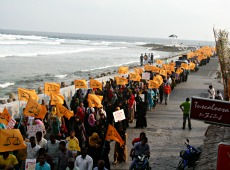
Maldivian Democratic Party (MDP) supporters marched through Male’ on Tuesday (January 22) for the first time in several months to protest against the current coalition government.

The protest was the first large-scale march through the city since the Freedom of Assembly Bill was ratified by President Mohamed Waheed Hassan Manik earlier this month. The party claimed over three thousand attended.

MDP Spokesman Hamid Abdul Ghafoor told Minivan News that the party plans to hold more assemblies and protests in next coming months around Male’.

“The MDP have been off the streets some time, we had taken a break. Now we are back. We have too many options and ideas opening up and people need to know what’s going on,” Ghafoor added.

The demonstration took place the same day former President Mohamed Nasheed called on parliament to create an interim, caretaker administration following a week in which senior members of the defence and military gave evidence alleging the transfer of power on February 7 “had all the hallmarks of a coup d’etat.”

Minivan News observed the protest as it moved down through Majeedhee Magu at around 5:00pm on Tuesday evening.

Despite the large turnout of protesters and disruption caused to traffic, Minivan News witnessed only four police officers observing the march from down a side street off Majeedhee Magu.

Asked as to why police presence had been limited during the protest, Maldives Police Service (MPS) Spokesman Hassan Haneef said police had been “observing the protest”.

“Under the Freedom of Assembly Bill there are guidelines for protests. We made no arrests and I do not see why there should be a problem if there is no trouble caused,” Haneef added.

Minivan News witnessed only one incident of confrontation when a protester threw a handful of Maldivian rufiya notes at the face of a police officer – who did not react.

As protesters walked passed two police stations on Ameene Magu they began to chant “Baghee” to officers watching from outside.

“When you compare to how the police have reacted to us in the past, it was very different today. I still do not believe that the whole of police and Maldivian National Defence Force were involved in the coup,” Ghafoor said yesterday.

“In the past there is only trouble from police when we move into areas where they get nervous. They do not confront us as long as we keep away from those areas,” he added.

President’s Office Spokesperson Masood Imad and Police Commissioner Abdulla Riyaz were not responding to calls from Minivan News at time of press.

Usfasgandu handover

The protest took place a day after Male’ City Council (MCC) Mayor ‘Maizan’ Ali Manik appealed to High Court to suspend a Civil Court ruling ordering it to hand over the MDP protest site – Usfasgandu – to the Ministry of Housing and Infrastructure.

“The government want the MDP to go onto the streets, that way they can say there is no stability in the country and preventearlyelections from being held,” Manik alleged to Minivan News on Monday.

Responding to the Mayor’s allegations, President’s Office Spokesperson Masood Imad claimed the mayor needs to be more “Male’ mayor” than “MDP mayor”.

“Who is to say the MDP will start protesting on the streets if Usfasgandu is handed over? Why do some people think the [MDP] always protest?

“Contrary to what Mayor Manik thinks, I don’t think they go around making protests, I think the MDP are good guys,” Imad said.

Freedom of Assembly

The recently ratified Freedom of Assembly Bill imposes a number of restrictions on protesting from both protesters and police alike.

Among the key features of the Freedom of Assembly bill is the outlawing of demonstrations outside private residences and government buildings, limitations on media covering protests not accredited with the state and defining “gatherings” as a group of more than a single person.

One of the main stated objectives of the legislation is to try and minimise restrictions on peaceful gatherings, which it claims remain a fundamental right.

Under the legislation, demonstrations will be outlawed within a certain distance of the residences of the president and vice president, tourist resorts, harbours utilized for economic purposes, airports, the President’s Office, the courts of law, the Parliament, mosques, schools, hospitals and buildings housing diplomatic missions.

Earlier this month Ghafoor told Minivan News that the MDP stood against the principles of the Freedom of Assembly Bill, alleging its ratification is a response to the ‘Ingilaab’ proposed by former President Mohamed Nasheed last month.

Speaking at yesterday’s protest, Ghafoor said that the MDP had obtained permission from Male’ City Council to protest. MCC Mayor ‘Maizan’ Ali Manik also took part in the protest.

Likes(0)Dislikes(0)

Two Pakistani nationals arrested for carrying forged passports

Customs authorities in the Maldives have arrested two Pakistan nationals for carrying two forged passports.

The two men arrived on an Emirates flight to the Maldives and were arrested based on information provided by the Immigration Department, local media reported.

Upon a security check, three more passports including two Pakistan passports and one Belgian passport were found in their luggage.

Likes(0)Dislikes(0)

Land leased by Jabir’s company revoked due to outstanding rent payments

Land leased on Kaashidhoo in Kaafu Atoll to Maldivian Democratic Party MP Abdulla Jabir’s J Hotels and Resorts has been revoked by the government due to failure to pay rent.

According to local media, Kaashidhoo Council President Ali Sulthan said the land – leased for the construction of an 80-bed guest house – had been leased for the past ten months, of which only three months’ rent had been paid, local media reported.

An amount of MVR 166,000 (US$10,758) is apparently due from the company, which was contracted to pay a sum of MVR 15,000 (US$972) per month.

“The land was leased to a company owned by our constituent member Jabir. We have revoked the land because they were not paying the rent at all,” Sulthan was quoted as saying by Sun Online.

J Hotels and Resorts is operated under Jabir’s Yacht Tours Maldives.

Executive Director of J Hotels and Resorts Ibrahim Rasheed confirmed to local media that that the company does own a land in Kaashidhoo, but it does not have land with outstanding rent payments.

Likes(0)Dislikes(0)