Reeko Moosa condemns MDP expulsion as a move to bar his 2018 presidential candidacy

Deputy Speaker of the Majlis MP ‘Reeko’ Moosa Manik has condemned his expulsion from the opposition Maldivian Democratic Party (MDP), describing the move as a plot by former President Mohamed Nasheed to bar him from contesting the party’s 2018 presidential primaries.

“I am certain the expulsion was to bar me from contesting the presidential primaries. President Nasheed must accept there are other political leaders within the party,” Moosa told Minivan News today.

Moosa, a founding member of the MDP and a vocal critic of the 30-year authoritarian ruler Maumoon Abdul Gayoom, announced his intent to contest MDP’s 2018 presidential primaries on October 25.

The MDP’s disciplinary committee expelled Moosa on Monday after he repeatedly breached the party’s three-line whips including the vote on the 2015 state budget, the amendments to the Judicature Act – which reduced the seven-member Supreme Court bench to five judges, and the removal of former Chief Justice Ahmed Faiz and former Justice Muthasim Adnan.

If Moosa wishes to rejoin the party, he is required to issue a public apology and obtain 50 new members for the party, but he will be barred from standing for any leadership position or contesting in party primaries for five years.

He described the disciplinary committee’s decision as “undemocratic” and “discriminatory” pointing out that five MDP MPs who were absent from the vote to dismiss the Supreme Court judges were given lesser penalties.

Moosa said he does not trust the party’s appeal process, and said he has now requested the Elections Commission to review the decision.

He also dismissed local media reports which had suggested he may join the ruling Progressive Party of the Maldives (PPM): “I will not sign onto another party. I am not one who can be part of another party. Where will I go other than the MDP? There is no second ideology that can fight against the dictatorship.”

Dictatorial

Moosa, a prominent figure in the Maldives’ pro-democracy movement, said a faction within the MDP has continued to harass him on social media since he announced his intent to contest the presidential primaries.

“I did not think they would expel me. I did not think [the party] would treat me so badly. I’ve served MDP with sincerity. On February 8, I was severely brutalised while acting as a bodyguard to Nasheed,” he said.

Moosa had to be flown to Sri Lanka for medical treatment for injuries sustained during a brutal police crackdown on MDP supporters a day after Nasheed’s ouster on February 7, 2012.

He described Nasheed as dictatorial, claiming the former president had systematically sidelined rivals within the party including Dr Mohamed Munawar, Dr Ibrahim Didi, and former MP Alhan Fahmy.

“Nasheed is a green dictator, championing the environment to get attention on the international front, but look at what he has done to Dr Munawaar, Dr Didi and Alhan Fahmy. He wants to keep the MDP under his control,” he said.

On Monday, a group of ten Moosa supporters staged a protest outside Nasheed’s residence, Kenereege, calling the MP’s expulsion “unfair”.

Moosa suggested Nasheed was behind the rumour that he may join PPM the next day.

“There are a lot of members who support me within the MDP. The rumour that I would join the PPM on the next day at a ceremony at Nasandhura Palace Hotel at noon, at a time when I was out of country, was engineered to make my supporters believe I would leave the MDP and thereby dissipate their criticism of the party’s decision,” he said.

The news was first reported in pro-government newspaper Vaguthu and later on opposition-aligned Raajje TV.

Breach

Explaining his decision not to participate in the vote to dismiss Faiz and Muthasim, Moosa said the former chief justice had caused enormous harm to the MDP.

On Nasheed’s resignation on February 7, Faiz had sworn in then Vice President Dr Mohamed Waheed “without raising a single question on whether Nasheed was coerced,” Moosa said.

During Faiz’s tenure, the Supreme Court bench had stripped three MDP MPs of their membership and annulled the first round of presidential elections held in September 2013, he continued.

The Supreme Court’s removal of former Elections Commission President Fuwad Thowfeek and Vice President Ahmed Fayaz in March was a deliberate attempt to “damage MDP’s chances in parliamentary polls,” Moosa said.

“But that day [December 14], MDP came out to defend Faiz. I did not participate in the vote because I do not support Faiz. I do support Muthasim, but their names were put up together for a single vote. I did not want to remove Muthasim,” he explained.

He also criticised the party’s three-line whip calling on MPs to be present at the sitting, claiming a whip can only be issued on the vote itself, not on MPs presence at the Majlis.

He contended the MDP had failed to take action against MPs Eva Abdulla, Abdulla Shahid, and Rozaina Adam for their absence from the vote on the Special Economic Zone bill. Eva and Shahid had been in Geneva for a meeting of the Inter-Parliamentary Union at the time.

Moosa also condemned Minivan News’ inclusion of a Raajje TV report on his company Heavy Load Pvt Ltd receiving islands for resort development in compensation for a terminated reclamation deal in its previous report on his expulsion from MDP.

He did confirm that Heavy Load Pvt Ltd has received islands, but said the deal was a transaction between the company and the government after the company threatened to file charges at the court for the termination.

The MDP has said the sudden removal of the two Supreme Court Judges is an attempt to stack the judiciary in President Abdulla Yameen’s favour.

Commonwealth groups have described the judges’ removal as unconstitutional, saying it constituted a clear breach of the Commonwealth Principles to which the government of Maldives has subscribed.

“As a result the independence of the judiciary and the Rule of Law have been “severely jeopardised”.

The International Commission of Jurists said the Maldivian parliament and executive “have effectively decapitated the country’s judiciary and trampled on the fundamental principles of the rule of law and separation of powers in a democratic State.”


Related to this story

MDP expels MP ‘Reeko’ Moosa Manik

MDP calls on six MPs absent from Supreme Court vote to answer disciplinary charges

Reeko Moosa unveils plans to contest 2018 presidential primary

Abdulla Saeed appointed as new Chief Justice, dismissed Justice Faiz laments “black day”

Likes(1)Dislikes(0)

Comment: A decade after the 2004 Tsunami – recalling the turning point for disaster management

Dr Poonam Khetrapal Singh is WHO Regional Director for South-East Asia. As Deputy Regional Director (2002-2012)-she was overall lead in the Tsunami 2004 response. She is a staunch advocate and practitioner of emergency risk management in the health sector.

Documentation and publications of the tsunami 2004 and its lessons available at www.searo.who.int

There is debate among language scholars on the two Chinese language characters for the word crisis; one represents danger and the other possibility or opportunity. This has led to the often quoted cliché that “In every crisis, there is opportunity” when in fact these two characters define a crisis: the opportunity or the possibility of danger.

Recalling that late morning of 26 December 2004, when the Asian tsunami hit some countries of WHO’s South-East Asia Region, I remember receiving phone calls from our country offices in the Region describing the emergency as water entering the office compound in Maldives to waves rising as high as 40 meters lashing Sumatra, Indonesia, Andaman, sea coast area of Thailand, Myanmar, the eastern shoreline of Sri Lanka and South India.

What was common about their stories was that the water receded from the shores till as far as the eye could see before it all struck back with a vengeance. From all the reports, it seemed only Indonesia felt an earthquake. The story evolved quickly for the world to see – the final death toll reached close to 200 000; around 800 primary and secondary health facilities were destroyed; coastal villages and people’s livelihoods were wiped out; the tourism sector suffered a major blow in Maldives and Thailand.  The total damage was estimated at US$11 billion.

The response to the health needs was overwhelming—there was no recollection of a tsunami in recent times so there was no preparation. Coordination of response was rushed. For many countries systems were built as we responded. Donations in cash and in kind from individuals to governments became an event in itself and hard to manage. The WHO Regional Office for South East Asia deployed over 160 people over a period of three months to respond to the initial health needs. Every essential public health function – surveillance, maternal child health services, immunization, psychosocial support, management of dead bodies – was conducted on a massive scale tailored to the needs of each of the affected countries.  Field offices were set-up, logistic requirements put in place and technical experts were deployed wherever needed.  It was a response and recovery operation WHO had not seen or committed to in its history.

Today, a decade later, the important question before us is: how do we prepare ourselves for such an event? More importantly, how prepared is prepared? Measuring preparedness should be the basis for addressing risks, no matter what the cause. A series of lessons learnt meetings, evaluations, review of responses, culminated in 2005 with a set of Benchmarks for Emergency Preparedness and Response which includes standards, indicators and guide questions.

This tool intended to measure in detail what is in place for legal frameworks, plans, finance, coordination mechanisms, community capacities, and early warning for health events. The rest of the humanitarian and development actors were also looking to advance in this direction. The Hyogo Framework for Action (HFA) was developed in 2005 along with the UN Humanitarian Reform. This brought about a better approach to coordination in response, accountability and rapid predictable funding.

Indeed, we can do better and we can measure our actions so we can objectively identify gaps and address them.  Countries have used the WHO South-East Asia benchmarks for capacity assessments and development for better risk management in the health sector.

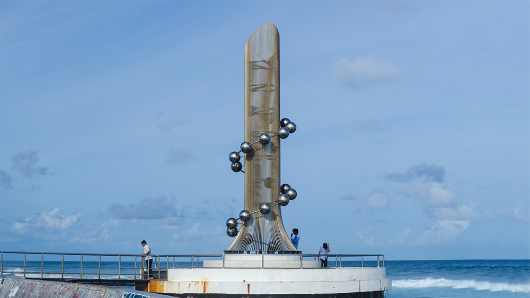
Tsunami monument, Malé

This also helped countries that were not affected by the tsunami. The tsunami was the turning point for countries to see that risk management is an essential public health function and crucial for protecting people’s health and investments. Countries also use HFA targets across sectors. Humanitarian reform has been applied in several emergencies with varying success but with systematic documentation of gains and gaps providing a clearer way for corrective action. Even with all these tools, investments, new plans and building back better – the only proof of effective preparedness would be another event.

On 11 April 2012 an earthquake of 8.7 on the Richter scale rocked Aceh in Indonesia for four minutes. Tremors were also felt in neighbouring countries. It seemed like a repeat of 2004. But certain specific actions of that day clearly demonstrated that we had learned since then. There was evacuation to higher ground by all coastal communities from Aceh, Nias Island, Sri Lanka, Maldives and Thailand.

The clear link of the tsunami warning system (now in place in the Indian Ocean) and community relay of the communication was seen in many coastal areas such as Chennai where loudspeakers from local government representatives informed everyone to move to safer locations and heed the warning. Eight were reported dead and those injured were treated promptly and were accounted for. Hospitals in Banda Aceh evacuated their patients in an orderly manner- a result of their preparedness plans and drills. Although some health posts were damaged, the city infrastructure did not suffer from major destruction, in fact very few were damaged. The tourism sector in Sri Lanka was very organized in moving resort guests to higher ground.

Those initial 6 hours of response on 11 April proved that we have learnt what our risks are and know how to manage and continue confidently to live with them. Indeed, it pays to invest in making risk management capacities pervasive in all levels of society – in all sectors. We have seen India, Indonesia, Maldives, Sri Lanka and Thailand continue to improve systems they set-up with knowledge and tools developed through the lessons of the tsunami. Other countries have also done so using the same knowledge. The death tolls in various events have decreased over the past years as preparedness and response capacities have increased phenomenally. Today, as we look back at the devastating tsunami, we can say that it taught us valuable lessons. .

To further build on these lessons, we must remain insightful of the linkages of hazards, risks and capacities. Reducing our vulnerabilities require an iterative, honest process of correction in what we invest in, where we invest and what we do to further decrease the risks to our people.  Why? Because, even though our capacities increase, so do our risks. We are facing new risks today. Cities are sprouting unplanned, extreme weather events due to climate change are occurring with regularity; people are moving globally with much more ease – all of which contribute to another “perfect storm”.

Maybe our current capacities will not be enough for the next event so we need to keep questioning our status in order to improve. Global tools and mechanisms like the WHO South-East Asia Benchmarks will undergo regular use and review, the HFA will be updated in March 2015 and humanitarian reform has given way to the transformative agenda for the UN and partners to respond to mega-disasters.

It seems though that no effort is ever enough, the world is facing another global health emergency requiring resources from everywhere –Ebola is an old disease in new places.  An event where there is no obvious physical proof of destruction but it is just as destructive to individuals, families, societies and nations. The Ebola outbreak is another event we need to learn from. We must continue to invest in prevention and preparedness to save more lives. This will eventually decrease the resources needed for the response and recovery in a future event.

Meanwhile, what is clear is that both statements are true- we live in a world where there is always a possibility for danger; and in every crisis there is an opportunity. Knowing what we know now, we must look ahead and use that knowledge as an opportunity to keep getting better in saving lives, preventing diseases, and protecting health.

All comment pieces are the sole view of the author and do not reflect the editorial policy of Minivan News. If you would like to write an opinion piece, please send proposals to [email protected]

Likes(1)Dislikes(0)

Weak Russian ruble sees drop in resort bookings

Minister of Tourism Ahmed Adeeb has noted that the fall in the price of the Russian ruble has affected occupancy rates in the Maldives.

Local media outlet Haveeru has reported industry insiders as saying that bookings are at a five-year low, with some anticipating the Russian market could drop by 10 percent.

Russia represented the fourth biggest source of tourists to the Maldives in 2013, with 76,479 people making up 6.8 percent of the total market share. As the second fastest growing tourist market in the world (behind China), arrivals to the Maldives from Russia have grown by an average of 10.7 percent over the past five years.

A combination of low oil prices and Western sanctions on Russia in relation to the conflict in the Ukraine has seen the rouble fall to an all-time low this month.

While Adeeb said he was confident the government would meet its target of 1.2 million tourist arrivals in 2014, he said the country must diversify its tourism markets: “The international arena is heating up,” he told a press conference on Monday.

The current government has suggested that diversification of the economy – to be encouraged through the Special Economic Zones Act – will reduce the country’s vulnerability to external shocks.

Tourism currently contributes directly to around 35 percent of the country’s GDP.

Likes(2)Dislikes(1)

Defence minister Nazim faces no-confidence motion from LGA board

Local Government Authority (LGA) board members have tabled a no-confidence motion against Chairperson and Minister of Defence Colonel (retired) Mohamed Nazim.

Board members Shamau Shareef and Shujau Hussein have told Minivan News that Nazim has refused to follow procedures in considering the motion.

“He should consider it immediately. He said he is president and he can do whatever he wants. He was very arrogant, and very childish,” said Shujau Hussein, the public’s representative on the board.

Following a proposal from another board member to postpone consideration of the motion today, four of the nine members signed a resolution to consider it on December 31. This resolution was rejected by Nazim, explained Shujau.

Formed under the 2010 Decentralisation Act, the LGA is tasked with overseeing and coordinating the work of the Maldives’ 199 city, atoll, and island-level councils.

Both Shujau and Malé City Councillor Shamau expressed concern that Nazim – also acting minister of health – was not working to protect decentralisation in the country.

“He is not standing up to protect the system,” suggested Shamau, who noted that the chair had failed to protect Malé City Council from persistent reduction of its powers.

“His answer was that, since he is sitting in the cabinet, he can’t speak against colleagues,” explained Shamau.

Shujau – who said he had presented 18 procedural issues to support today’s motion – pledged to take the matter to the Civil Court if it is not heard on December 31.

Removal of public lands from the purview of Malé City Council earlier this month left the opposition-dominated authority with next to no authority, after the gradual removal of powers since 2012.

Decentralisation

The original Decentralisation Act assigns a number of services and lands to the councils, though failure to make amendments to relevant legislation – particularly the Land Act and the Finance Act – has led to contradiction in the current laws.

The LGA board is tasked under the act with ensuring that “the work and activities of the councils created under this Act is functioning in accordance with the Constitution, this Act, and other Laws”.

When asked to comment on today’s events Nazim told Minivan News that he would have a spokesman explain what had been discussed at today’s meeting, though no spokesman had called at the time of publication.

Concerns over the government’s plans for decentralisation prompted councils from the country’s southernmost atolls to sign a pact to defend the system earlier this week.

The Medheaari Declaration – signed by the Gaaf Dhaalu, Gaaf Alifu, and Fuvahmulah atoll councils, and Addu City Council – calls upon the government to protect decentralisation, as well as making plans to secure fiscal autonomy.

“What happened in Malé, will it be repeated in the atolls?” asked Addu City Council Mayor Abdulla Sodig.

“We always have the fear that the government will come after Addu City Council after it deals with Malé City Council,” he told Minivan News.

Shujau explained that the southern pact had not been discussed at today’s LGA meeting

Recently proposed amendments to decentralisation – from pro-government MP Riyaz Rasheed – called for a reduced number of local councils and to cut the salaries of all councillors except the council presidents.

The government proposed similar changes in March of this year to the previous Majlis, with Nazim stating that the changes would allow professionals to hold council positions without having to leave their jobs.

The government has also expressed a desire to cut down on the cost of decentralised governance.

The current model of more than 1,000 elected councillors approved in 2010 by the then-opposition majority parliament was branded “economic sabotage” by the Maldivian Democratic Party (MDP) government, which had originally proposed limiting the number of councillors to no more than 220.


Related to this story


Malé City Council helpless as housing ministry takes over all land, public services staff

Can decentralisation take root in the Maldives?

Southern atolls sign pact to defend decentralisation

Likes(3)Dislikes(0)

UK appoints new High Commissioner

The United Kingdom has appointed a new high commissioner to Sri Lanka and the Maldives, with James Dauris set to replace John Rankin in April.

“I am delighted to have been appointed to be the United Kingdom’s next High Commissioner to the Maldives. Our two island nations enjoy and benefit from a long-established relationship,” said Dauris in a Foreign and Commonwealth Office (FCO) statement.

“Tourism is among our countries’ important links – more than 74,000 British holiday makers have visited the islands this year. At the same time we share concerns and ambitions around some of the big challenges facing us today, including climate change. I am looking forward to working on issues that are priorities for both our countries.”

Dauris has recently served as British Ambassador to Peru for four years as well as having served in Russia and Colombia after joining the FCO in 1995.

Likes(2)Dislikes(0)

Removal of Supreme Court judges will have “chilling effect” on work of judiciary: UN special rapporteur

United Nations Special Rapporteur on the Independence of Judges and lawyers Gabriela Knaul has expressed serious concern about the removal of Supreme Court Chief Justice Ahmed Faiz and Judge Muthasim Adnan.

“This decision seriously undermines the independence of the judiciary in the country and will have a chilling effect on the work of the judiciary at all levels,” said Knaul.

The rapporteur called for a reconsideration of the pair’s removal, noting that it had been characterised by a “lack of transparency and due process”.

Removal of the judges followed amendments to the Judicature Act made in the People’s Majlis, which called for the reduction of the Supreme Court bench from seven to five.

The Judicial Services Commission (JSC) promptly selected Faiz and Adnan for dismissal, though the reasons for their selection were not shared with MPs who subsequently voted to dismiss both on December 14.

“The fact that the grounds for removal were not publicized is particularly unacceptable,” added Knaul in a statement released yesterday (December 22).

Knaul has joined numerous local and international organisations in condemning the move, while the political fallout in the Maldives has seen the expulsion of Majlis Deputy Speaker ‘Reeko’ Moosa Manik from the Maldivian Democratic Party (MDP).

Moosa was one of six MDP MPs who failed to attend the December 14 vote, despite a three-line whip being issued by the party.

Censure

The ruling Progressive Party of Maldives (PPM) has rounded on critics of the dismissals, with the party accusing Jumhooree Party leader Gasim Ibrahim of attempting to deceive the public when stating that the Maldives had received international censure.

Similarly, PPM Parliamentary Group leader Ahmed Nihan this week accused the US of hypocrisy after the State Department suggested the Maldives still has “issues” regarding judicial independence.

Local opponents to the move have included the opposition MDP and civil society groups, while the Civil Court bench passed a resolution stating that the Majlis had “forced” the JSC to deem Faiz and Adnan unfit for the Supreme Court bench.

Faiz himself has described his dismissal as raising doubts over the separation of powers and the continuation of judicial independence in the Maldives.

“Today will be written down as a black day in the constitutional history of the Maldives. I state this is a black day for the constitution. Taking such a vote against the constitution is, I believe, disrespectful to the constitution,” he told local media immediately after his removal.

Elsewhere, the International Commission of Jurists have called the decision an “astonishingly arbitrary” one which has “effectively decapitated the country’s judiciary”, while Commonwealth groups have expressed fears that the rule of law has been “severely jeopardised”.

Reform

In her own statement, Knaul noted that under both Maldivian and international norms judges could only be removed on grounds of incompetence or misconduct.

Knaul’s 2013 report into the the state of the Maldivian judiciary called for drastic reform, noting that the appointment of the current Supreme Court bench in 2010 had “no legal or constitutional basis” and that the JSC was unanimously regarded as “inadequate and politicised”.

“Since my visit to the Maldives in February 2013 I have been closely following a series of developments in the country that point at a serious deterioration of respect for the rule of law and the independence of the judiciary,” she warned yesterday.

UN special rapporteurs are independent human rights experts with mandates to report and advise on human rights from a thematic or country-specific perspective. Knaul was appointed to the position in 2009 after having worked as a judge in Brazil for over a decade.

Knaul’s 2013 report was welcomed by the Maldivian government – despite some suggestions that the country’s sovereignty was being undermined. The Supreme Court, however, has dismissed the findings.

After the Human Rights Commission of Maldives (HRCM) used recommendations from Knaul’s report in its submission to the UN Human Rights Council’s Universal Periodic Review this year, the Supreme Court initiated ‘suo moto’ proceedings against the commission in September.

The (ongoing) case against the HRCM followed similar charges against the Elections Commission (EC) in February, which resulted in the removal of the EC’s chair and deputy chair just weeks before the Majlis elections. The EC case was linked to the presidential election in 2013, in which the court was accused of “subverting the democratic process” by United Nations High Commissioner for Human Rights Navi Pillay.

Following the HRCM case, former Justice Minister Ahmed ‘Seena’ Zahir suggested the country was facing a “judicial dictatorship”, calling for immediate reform to end misinterpretation of the constitution.

Pro-government MPs have suggested the removal of the two judges is a move towards reform of the courts.

Attempts to obtain comment from officials at the President’s Office and the PPM were unsuccessful at the time of publication.


Related to this story

Majlis removes Chief Justice Ahmed Faiz, Justice Muthasim Adnan from Supreme Court

A justice system in crisis: UN Special Rapporteur’s report

ICJ says Majlis has “decapitated the country’s judiciary”

Likes(3)Dislikes(0)

Nolhivaranfaru ground water contaminated as flooding causes septic tank overflow

Severe flooding on Haa Dhaal Atoll Nolhivaranfaru Island has caused a sewage overflow resulting in contamination of the island’s ground water.

According to Nolhivaranfaru Councilor Adham Jaufar, torrential rains on December 18 and 19 caused damage to septic tanks on the island resulting in sewage overflowing in bathrooms and onto the streets.

The Health Protection Agency (HPA) has issued an alert expressing concern over health risks due to contaminated water, and urged Nolhivaranfaru’s residents to pay attention to cleanliness to avoid the spread of water-borne diseases.

“We appeal to the public to use chlorinated well water in all areas of the island, to only use boiled water or rainwater that has been stored safely for cooking and drinking and to pay particular attention to general cleanliness. We note it is important to wash hands with soap after using the bathroom or before cooking,” a statement by HPA said.

The National Disaster Management Center (NDMC) has said it has distributed chlorine to disinfect wells and puddles on the streets, and the HPA conducted an awareness campaign on health risks.

Although the 1,030 strong population have access to potable drinking water, the sewage overflow has left 47 households without any water for bathing or washing, Jaufar said.

Over 50 residents staged daily protests this week over the lack of safe water, but suspended activities today after an environment ministry team arrived on the island to inspect damage.

Protestors have warned they would resume demonstrations within three days depending on the outcome of the visit.

The Maldives National Defense Force (MNDF) has drained water from the streets and is now in the process of cleaning and draining overflowing septic tanks.

Jaufar said Nolhivaranfaru requires a sewerage system to prevent sewage overflow in the future.

The worst affected areas are at a lower elevation than the rest of the island, and residents of the 47 houses have to periodically drain septic tanks to avoid overflows, Jaufar said. Maldivian islands are on average only one meter above sea level.

Meanwhile, the NDMC has allocated 100 tonnes of water for Nolhivaranfaru, but the water has not yet been transported to the northern island as there are no mechanisms to store water there.

Head of the Environmental Protection Agency Ibrahim Naeem said the agency is waiting on a report from the ministry team on the extent of the damage.

In addition to a sewerage system, the island would also needs an artificial drainage system, Naeem said.

According to Jaufar, the government had promised a sewerage system in 2012, allocating funds for the project in 2012, 2013, and 2014. But there has been no progress yet.

In early December, a fire at Malé’s desalination plant left the capital’s 130,000 residents without running water. The government declared a crisis, set up water distribution centers throughout the city, and requested foreign governments for assistance.

India, China, and Bangladesh airlifted bottled water, and India sent in ships equipped with desalination plants to produce water for the capital.

Normal operations resumed at the Malé water plant on December 13.

In June, residents of Laamu Atoll Gan also staged protests over a sewage spill on the island following severe damage to the island’s sewerage system.


Related to this story

Malé water supply cut after fire at MWSC

Water distribution to stop as Malé water crisis nears end

Gan Council fears “health disaster” after severe sewage spill

Likes(3)Dislikes(0)

Police Special Constabulary charged with security at Hulhumalé Hospital

The Maldives Police Services’ private security provider Special Constabulary Forces are now in charge of providing security at Hulhumalé Hospital.

“This move will give customers additional satisfaction and establish a safer environment,” the Hulhumalé Development Corporation’s Managing Director Suhail Ahmed said at a ceremony this morning.

Police’s Special Constabulary are also in charge of security at the Indhira Gandhi Memorial Hospital and the Youth Center in Malé.

Likes(2)Dislikes(0)

3G services must be available to all islands next year, says CAM

The Communication Authority of Maldives (CAM) has said that that all inhabited islands in the Maldives must have access to 3G internet services.

While universal coverage was previously optional for the country’s two telecommunications providers – Dhiraagu and Ooredoo – the regulator has said that new policies make 3G mandatory in all 196 inhabited islands.

Source: Haveeru; Sun Online

Likes(2)Dislikes(0)