Gayoom calls for Muslim World League assistance to protect national peace, order and faith

Former President Maumoon Abdul Gayoom has called for assistance from Islamic Arab countries in developing education and other services in the Maldives, as well to protect the country’s faith by “groups” he alleged are trying to weaken it.

Speaking at the Constituent Council of the Muslim World League in Saudi Arabia, Gayoom said that cooperation from Islamic Arab countries would be vital to fight political and economic challenges currently facing the country, according to the Sun Online news service.

The former president reportedly claimed that the present economic downturn, a loss of peace and order in the country and efforts “by groups of people to weaken people’s Islamic faith”, were among the most pressing challenges presently facing the Maldives.

The Muslim World League is an Islamic NGO said to consist of sixty members representing 30 different nations.

Likes(0)Dislikes(0)

Government silent over Maldives bankruptcy claims

The government has refused to comment on claims made in local media by leader of the coalition-aligned Jumhoree Party (JP) that the Maldives was now bankrupt and already unable to pay some civil servants.

JP Leader and MP Gasim Ibrahim claimed that despite government efforts, the Maldives was now bankrupt and unable to pay some civil servants after steady economic decline within the nation, according to newspaper Haveeru.

Just last month, Parliament’s Financial Committee revealed that expected revenue for 2012 had plunged 23 percent, whilst spending was set to increase by almost 24 percent.

President’s Office Spokesperson Abbas Adil Riza today said that he was unaware of the bankruptcy comments linked to Gasim and could not comment on the matter, referring Minivan News to Minister of Finance and Treasury Abdulla Jihad.

Both Jihad and Economic Development Minister Ahmed Mohamed were not responding to calls by Minivan News at the time of press.

Although the country’s Civil Service Commission (CSC) said that it had been involved in discussions with the Minister of Finance to try and overcome economic concerns, Chairman Mohamed Fahmy Hassan said that there had as yet been no issue with payments to staff.

“As of last month, all payments have been made in full, however it is the Finance Ministry who would know about the current situation,” he said.

Speaking to Minivan News on Saturday, Maldives National Defence Force (MNDF) spokesperson Major Abdul Raheem said despite some reports circulating to the contrary, he was not aware of any problems with payments to military officers.

Spending review

In attempts to counter its present spending shortfall, the government has unveiled proposals such as a revision to the country’s import duties and Goods and Services Tax (GST) to alleviate its financial difficulties.

The proposals have come under criticism from former finance chiefs serving under the previous government, who allege that such changes “do not make sense”.

Whilst committed to reducing state expenditure, Jihad recently announced his aim to avoid cutting the salaries of civil servants in order to tackle the nation’s budget deficit, seeking to make savings in other areas of expenditure first.

“Civil servants are the lowest ranking of all government employees. We will try to cut all non-wage expenditure by 15 percent. Salaries will be considered after this,” he said at the time.

Despite this pledge, Jihad added that a review of public salaries was set to be conducted by a pay review board that would also focus on independent commissions in order to reach an agreement on the necessary reductions.

Civil Service salaries

Between 2004 and 2009, the country’s fiscal deficit increased exponentially on the back of a 400 percent increase in the government’s wage bill.

The year’s 2007 to 2009 included the most significant largesse as the World Bank found wage expenditure to have increased from Rf 2 billion to almost Rf 5 billion even as revenues began to recede.

According to statistics from the Civil Service Commission (CSC), the number of permanent civil servants has more than halved between 2006 and June 2011.  There has been some contention in the past, however, that the transfer of many civil servants to state owned companies under the previous government masked the true figures.

The Maldives Monetary Authority (MMA) published figures for May that estimated the government will spend Rf2.6billion (US$168 million) on salaries and wages in 2012.

Maldives Bankrupt?

JP Leader Gasim – himself a former finance minister – claimed the Maldives had already been bankrupted after steady economic declines in recent years. He said that the evidence of the country’s troubled economy may not be immediately apparent, but would be seen in the “near future” as the state lacked the “necessary finance” to settle debts, according to Haveeru.

Gasim was reported as saying that “pointing fingers and blaming others” would not provide the country with an economic solution, calling instead for parliament to pass bills to alleviate the economic situation. The nature of these bills were not specified in local media.

Gasim’s phone was today switched off, while JP presidential candidate Ibrahim Didi was not responding to calls.

However speaking to local media, the JP leader added that the “actions of some” had negatively impacted on the nation’s economy, pointing to what he claimed were calls for a boycott of the Maldivian tourism industry.

Gasim, Maldives Vice President Waheed Deen and Progressive Party of the Maldives (PPM) MP Abdulla Jabir are among a number of figures associated with the present coalition government that are included in a list of resort owners included in the Maldives Tourism Advisory (MTA).

The advisory, established by the Friends of Maldives NGO, has a website utilising a ‘traffic light’ system recommending guests avoid resorts alleged by the Maldivian Democratic Party (MDP) to be directly linked in bringing about February’s controversial transfer of power.

Travel associations in the country have in turn criticised the MTA, expressing “serious concern” over what it alleged was a “concerted international campaign against several of the country’s resort operators.

Likes(0)Dislikes(0)

Independent Institutions Committee investigating CSC Chair for alleged sexual harassment

Parliament’s Independent Institutions Committee has launched an investigation into alleged harassment of a female staff member by the Civil Service Commission (CSC) Chair, Mohamed Fahmy.

Local newspaper Haveeru reported that the incident occurred on May 29 and the victim was a female senior research officer.

According to the paper, both Fahmy and the victim were summoned to committee after the complaint was lodged in the first week of June.

Fahmy was alleged to have called the female staff member over to him, taken her hand and asked her to stand in front of him so that others in the office could not see, and caressed her stomach saying ”it won’t do for a beautiful single woman like you to get fat.”

According to local media, the woman told her family about the incident, who then called Fahmy. Fahmy then sent her a text message apologising for the incident, reportedly stating, “I work very closely with everyone. But I have learned my lesson this time.”

Speaking to Minvian News today, Fahmy said the allegation was false “and a blatant lie.”

“The female staff member concerned did not win a scholarship to Singapore, and that is why she is doing this in return,” Fahmy said.

He alleged the claim was politically motivated issue, as she would have otherwise filed the case with police and not parliament.

“All I have to say is that it isn’t true,” he added.

Police Sub-Inspector Hassan Haneef said the police cases database did not show that the case had been reported.

Likes(0)Dislikes(0)

Political changes in Maldives would have gone unnoticed if not for SAARC: World Bank official

A senior official at the World Bank has told a journalism workshop that attention of the world on the recent political strife in the Maldives is a result of the nation’s membership in the South Asian Association for Regional Cooperationn (SAARC), reports Sri Lanka’s Sunday Observer.

“Considering its size, the political changes in Maldives would have gone unnoticed to the rest of the world if not for its position within SAARC,” Diep Nguyen-Van Houtte told the event, organised by the World Bank.

“It received unprecedented attention from the world’s media due to its position within SAARC,” she continued.

Nguyen Van Houtte told the group of journalists from across the region that the smaller SAARC countries could strengthen their positions within the organisation by focussing on the provision of services such as tourism, medicine and IT, rather than trying to compete with the larger members in trade and production.

“Size is no reason for them to be sidelined within the grouping. Take the example of Singapore. Despite being such a tiny country, the South East Asian nation is at the top of World Bank’s development indices”, the Sunday Observer reported Nguyen Van Houtte as saying.

“This proves that small is beautiful and that size is no barrier when it comes to holding your own.”

Likes(0)Dislikes(0)

MDP elects Nasheed as presidential nominee

The Maldivian Democratic Party’s (MDP) members have elected former President Mohamed Nasheed as the party’s candidate for the next presidential elections.

Nasheed stood unopposed for the presidential nomination, although MDP regulations state that sole candidates must receive the votes of at least 10 percent of the party’s membership.

The MDP’s current membership stands at 48,181 according the Election Commission (EC)’s figures, giving it the largest membership of any party in the country. Therefore Nasheed had to gain just over 4,800 votes to secure the nomination.

Following the final count of the 258 ballot boxes, Nasheed recorded 31,798 votes in favour to 269 against his being the party’s presidential candidate, after over two-thirds of the party’s membership turned out to vote. Chairperson candidate Moosa ‘Reeko’ Manik had 29,044 votes in favour to 2160 against, while Deputy Chairperson candidate Ali Shiyam had 563 in favour to 7 against.

The MDP has called for fresh elections on a regular basis since Nasheed’s resignation from the presidency on February 7 – a resignation he later claimed was made under duress. The party has held regular demonstrations since that time calling for early elections.

The current President, Dr Mohamed Waheed Hassan, has stated repeatedly that the earliest date elections can be held is July 2013 according to the constitution. He recently also told UK media that he refused to resign and hand power to the speaker, a decision which would also trigger an early election. Speaking to the BBC last week, Waheed also said that holding elections before key institutions can be strengthened would be hazardous to the stability of the country.

Despite the questioned  legitimacy of the current President , MDP spokesman Hamid Abdul Ghafoor said the party had never wanted to return Nasheed to the Presidency without fresh polls.

“The remedy is election, not reinstatement,” he said.

Ghafoor also stated his belief that, with the reformed CNI due to begin its investigations soon, there was no reason for the MDP not to begin its election preparations.

Today’s internal elections decided upon a number of other key posts within the party including chairperson and deputy chairperson, as well as atoll constituency presidents and secretaries.

Polling took place around the country as well as in three locations around the capital Male’, including Male’ City Hall.

MP for the Hulhu-Henveiru constitutency in Male’ Moosa ‘Reeko’ Manik was standing uncontested for the role of party chairperson, having served in this position on an interim basis previously. The position of deputy chairperson was being vied for by Nasheed’s former economic advisor Ali Shiyam.

Both men also appeared to have achieved the 10 percent minimum vote at the time of press.

In-fighting

The elections come after a period of internal dissent within the party, culminating in a vote to oust the party president and vice president from their positions.

The MDP’s National Council met on April 30 to vote on the no-confidence motions against the President Dr Ibrahim Didi, and Vice President Alhan Fahmy.

Hamed Abdul Ghafoor said at the time that the motions had come after both men had been making statements considered to be against the official party line regarding the events surrounding Nasheed’s resignation, alleging they were trying to bring about a coup within the party.

A party resolution on February 8 had declared that the previous day’s events had amounted to a coup d’etat and that Nasheed and his cabinet should continue to sit in the party’s National Council as senior members of government.

The motions were approves by 95 percent of those present and both Didi and Fahmy have since left the MDP, joining the Jumhooree Party earlier this month.

Didi and Fahmy have criticised the internal democracy of the party, alleging that Nasheed’s authority within the party has become too great, blaming him for personally instigating their ejection.

“No one person or a group can hijack a party like that,” said Fahmy at a rally held to ‘free the MDP’ from Nasheed’s allegedly nefarious influence.

Didi and Fahmy have also been quoted in local media as describing Nasheed as a ‘spiritual leader’ who removes anybody that speaks out against him.

Last month, the pair also alleged that the recent removal of MDP General Secretary Hassan Shah, who subsequently moved to the JP, was intended to manipulate today’s elections

Fahmy is reported to have grouped Nasheed with former President Maumoon Abdul Gayoom, charging both men with “hijacking” Maldivian politics.

“These two people had hijacked the whole country’s political beliefs during the political turmoil in the country. This is not an idea anymore. Former President Gayoom and former President Nasheed are here now. The people need to understand that democracy is not something we get by following a certain person’s belief,” Haveeru reported Fahmy as saying in late May.

‘Reeko’ Moosa has since been called on any prospective candidates to replace the two deposed members to halt their campaigns whilst the party considers whether the posts of party President and Vice President are still needed.

Voting for these posts was scheduled for August 31.

Likes(0)Dislikes(0)

ACC wades into airport development charge debate

The Anti-Corruption Commission (ACC) has issued a statement in support of the government’s bid to obtain concession fees lost due to the legal debacle surrounding the levying of an airport development charge (ADC) by airport developer GMR.

A Civil Court case filed by the then opposition Dhivehi Qaumee Party (DQP) late last year ruled against the charging of an ADC, as stipulated in GMR’s contract with the government-owned Maldives Airports Company Limited (MACL).

The court decision compelled the then-ruling Maldivian Democratic Party (MDP) to deduct the ADC charges from the concession fees due the government, which was pending appeal prior to the change of government under controversial circumstances on February 7.

However as a result of the DQP’s successful court case while it was in opposition, the government only received US$525,355 out of an expected US$8.7 million in concession fees for the first quarter of 2012.

The Transport Ministry has maintained that the former government’s decision to deduct the fee was illegitimate, initially claiming the authorisation letter was invalid as the new government had reappointed the MACL board, and insisted GMR pay the concession fees due. GMR has maintained that the ADC is chargeable under the terms of its concession agreement, and offered to exempt Maldivian nationals from paying the fee.

In its statement last week, the ACC claimed that according to article 9 of the Public Finance Act, the Finance Minister was not authorised to forgo revenue to the state without submitting the figures to the President under guidelines set by the Auditor General.

The ACC statement alleged that former MACL Chairman ‘Bandhu’ Ibrahim Saleem agreed to deduct the ADC and insurance surcharge without approval from the company’s board. As all three stakeholders had not signed the changes to the agreement, it could not be considered legally binding, the ACC claimed.

The ACC contended that the clauses in the concession agreement (18.2 and 18.3) that allow changes to the contract under certain political circumstances could not be activated as the Civil Court ruling was not a political decision, despite the case being filed by a political party.

That case was filed by DQP in a long-standing campaign against Nasheed’s government awarding the airport redevelopment to GMR. DQP leader Dr Hassan Saeed is now President Mohamed Waheed Hassan’s special advisor, while DQP Vice-President Dr Mohamed Jameel is the new Home Minister.

A 24-page book released by the DQP while it was in opposition presents the government’s lease of Ibrahim Nasir International Airport (INIA) to developer GMR as a threat to local industry that will “enslave the nation and its economy”.

Former President’s Office Press Secretary Mohamed Zuhair at the time of the pamphlet’s publication said that he felt the title’s wording was “very strong”, and drew a faulty comparison between international cooperation for mutual benefit and foreign occupation of a people and market for selfish purposes.

“The purpose of all this is to make Maldivians mistakenly feel like they are under occupation and the country is being sold out,” claimed Zuhair at the time.

Likes(0)Dislikes(0)

MDP holds anti-government protests in Colombo

Maldivian Democratic Party (MDP) supporters took to the streets of the Sri Lankan capital Colombo yesterday to protest for early elections and the resignation of President Dr Mohamed Waheed Hassan.

Gathering outside the Maldivian High Commission in Colombo, “a few dozen” anti-government protesters were said to have taken part in the demonstrations, according to newspaper Haveeru.

The demonstration, which was attended by Former president Mohamed Nasheed’s Press Secretary Mohamed Zuhair, also focused on the alleged use of excessive force by Maldivian security forces in order to disperse protesters on the streets of Male’.  The MDP contends February’s controversial transfer of power that brought President Waheed to power was a “coup d’etat” sponsored by mutinous sections of the police and military.

According to Haveeru, yesterday’s demonstration ended peacefully at about 5:30pm. However, the gathered crowd were said to have become briefly “unruly” after President Waheed’s brother, Assad Waheed, attempted to film coverage of the protest using his camera phone before returning into the High Commission building.

Likes(0)Dislikes(0)

Comment: Maldives politicians take to twitter, results mixed

This article first appeared on DhivehiSitee. Republished with permission.

British Prime Minister, David Cameron, when asked for his views about politicians on Twitter, famously replied: ‘Too many tweets might make a twat.” Cameron was discussing the instantaneousness of modern communication, and the perils of politicians tweeting without thinking.

It should be said that neither side of the divided Maldivian political landscape are too keen to listen to Cameron right now. The authoritarians have a bone to pick with him for declaring President Nasheed his ‘new best friend’ and ‘ideal stag party-companion’ not long before the coup; and Nasheed’s supporters aren’t happy with him for abandoning his new best friend at the first sign of trouble. But, on lessons about tweeting, Cameron’s advice is spot on for Maldivian politicians.

Twitter is as popular in the Maldives as it is in all other countries going through political turmoil. Ordinary Maldivian Twitterians and Tweeps have the same behavioural patterns as those of their foreign counterparts. Both supporters of the government and opposing democrats are on Twitter everyday, expressing their divergent opinions, heckling the opposition, drumming up support for and covering protests, having fun, and of course, trolling.

The behaviour of Maldivian politicians and other leaders on Twitter, however, is an entirely different matter. Their Twitter life is remarkably different from tweeting politicians in other countries. Like the sheer amount of time they seem to have to devote to Twitter for one thing. Whereas other leaders such as American President Obama or say Dr Manmohan Singh, the Indian PM, all have their staff tweet for them, President Waheed likes to do it himself.

To be fair, Dr Waheed has only tweeted just over a hundred times but, clearly, he does it himself, and also thinks it is about himself as a person rather than about his presidency. He likes to post pictures with supporters (an inordinate number of them appear to be children), and at times provide some intimate insights into his life such as how he enjoys taking the time to smell flowers on weekends.

Then there’s the large number of fake accounts that have sprung up pretending to be some politician or another. By fake accounts I don’t mean those that are obviously parodies. The new president Dr Waheed and his wife Ilham Hussein both have good ones. Witty and insightful, they satirise the couple well:

President Waheed became the butt of many jokes when his first Tweet as president was one about having his account verified as authentic by Twitter. It was a similar story with newly appointed Attorney General Azima Shukoor. Her first order of business after assuming office was to send out a press release – on official letterhead of the Attorney General’s Office – to confirm which of two Twitter accounts in her name was the authentic one. Don’t know why she bothered. She doesn’t have much to say anyway. Perhaps Twitterians shouldn’t have laughed at their antics so hard. Differentiating between fake accounts and real ones has become important, given the content of some Tweets. One of the most dubious ones is that of the President’s Spokesperson Abbas Riza. He has said on television that the account is his, but I still inadvertently do a double-take at some of the Tweets he sends out. He never refers to MDP (Maldivian Democratic Party) – to which President Nasheed belongs – as MDP. He prefers to call it ‘NDP Terror Wing’. Presumably the N stands for Nasheed. Any protest that MDP organises, the President’s Spokesperson refers to as activities of ‘NDP Terror Wing’. What’s worse are his personal attacks on Nasheed. His most offensive Tweet of late has been:

‘Run’di Kaalhu’ is an insult in Dhivehi. Loosely translated, it means ‘whoring crow’. That’s the name the President’s spokesperson has decided to refer to the protest camp MDP had on the South eastern corner of Male’. I don’t think the rest of the tweet needs any explanation. These types of tweets on a regular basis, from a person in such a job, would be regarded as highly offensive, and often defamatory, in any other country which claims to be a democracy. In the Maldives, however, they go un-remarked upon by the mainstream media or anyone else. The only people who seem to care are the Twitter community. Pro-government Tweeps find it hilarious, the other side is outraged. But they remain on record, and the President’s Spokesperson keeps on tweeting. The Commissioner of Police, Abdulla Riyaz, has an account which nobody doubts is his, and is quite possibly the most frequently updated timeline of all leaders appointed to high ranks after February 7. He is convinced that his role in 7 February events [he was one of the three civilians who ‘negotiated’ President Nasheed’s resignation inside the military headquarters] was heroic, and has boasted on Twitter that he has nothing to apologise for as he’s ‘proud of what he did’. Here’s a typical example:

And it’s not uncommon for him to come out with an absolute shocker, something that a police commissioner wouldn’t say even in your wildest dreams. Like this one:

Another account that caused consternation among the Twitter community is that purported to be of Masood Imad, Dr Waheed’s Media Secretary. Masood’s timeline is less shocking than that of the President’s Spokesperson, but it seems to have got the President’s goat more than any others.

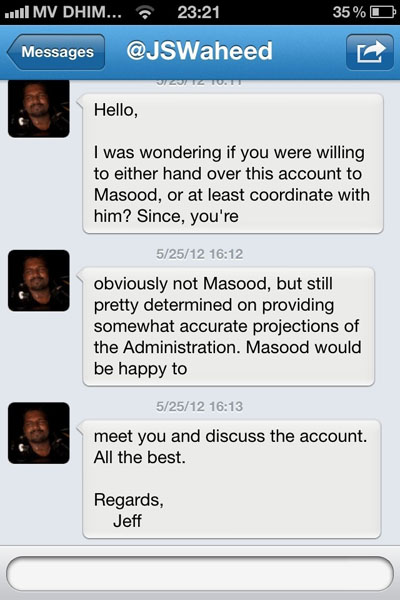
Dhivehi Sitee has come upon some evidence to show that the President has tried hard to stop the ‘Masood Imad’ account. Not because it’s insulting, but because it was deemed to be providing ‘somewhat accurate projections of the administration.’

Here is a screen shot of the President’s son – it is not known in what capacity he is acting – trying to get the owner of the account to hand it over to the Real Masood Imad.

I guess this means that although the Masood Imad account is fake, it is one that we should follow if we want to have some ‘somewhat accurate projections of the administration’.

Azra Naseem holds a doctorate in International Relations.

All comment pieces are the sole view of the author and do not reflect the editorial policy of Minivan News. If you would like to write an opinion piece, please send proposals to [email protected]

Likes(1)Dislikes(0)

Reformed CNI ready to begin work from Thursday: President’s Office

The government has said the reformed Commission of National Inquiry (CNI) will be in a position to officially begin its work from Thursday (June 21) with the arrival to the country of an as-yet unnamed Singaporean judge chosen to co-chair the body.

The opposition Maldivian Democratic Party (MDP) continues to allege the government is working to delay reforms to the CNI that have been backed by the Commonwealth, however the government has claimed the commission would start work upon the judge’s arrival.

President’s Office spokesperson Abbas Adil Riza told Minivan News that the entire panel would be in place to begin its work following the arrival of the judge, adding that there had been “no delays” in revising the CNI in line with Commonwealth and international concerns about its impartiality.

“As it stands right now, President Waheed has met with (Former president Nasheed’s nominee) Ahmed ‘Gahaa’ Saeed, who will be taking up his position on the panel from Sunday (June 17). He will then have access to the CNI’s findings other and information,” he said. “On June 21, the Singaporean judge will be arriving and work will then start.”

The CNI was established by President Mohamed Waheed Hassan to investigate the controversial transfer of power that took place on February 7. The Maldivian Democratic Party (MDP) claimed that Nasheed was forced out of office in a coup d’etat.

The composition of the panel has since been revised to include a representative of former President Mohamed Nasheed and a retired Singaporean judge, as well as international monitors from both the Commonwealth and UN.

Riza added that the government had been in touch with the Commonwealth regarding the latest developments and said the intergovernmental organisation was “satisfied” with the work being undertaken.

He added that the commission, including the original three member panel of Chair Ismail Shafeeu, Defence Minister under former President Maumoon Abdul Gayoom, Dr Ibrahim Yasir and Dr Ali Fawaz Shareef were all ready to begin work.

However, following a tense, but largely peaceful demonstration by MDP supporters yesterday – led by former President Mohamed Nasheed – the party claimed that the government was working to try and “deceive” the international community over commitments to conduct its work.  The CNI was expected to have been reformed by June 15.

“Cat and mouse game”

MDP Spokesperson and MP Hamid Abdul Ghafoor alleged today that the president had been playing a “cat and mouse game” with the composition of a reformed CNI.  He added that uncertainty remained over whether the three previous CNI members would continue on in their position, or if replacements would be needed.

Ghafoor claimed the government had been responsible for several delays to deadlines set by the Commonwealth to enact changes to the CNI.

“One month on from May 16, we have seen the government delay the appointment of a representative for [former] President Nasheed, now it seems another twenty days could be needed to resolve this current mess,” he said. “This whole saga suggests the president wishes to deceive the international community over the CNI in the hope interest will be lost in the idea of backing early elections. I do not think the MDP is in the mood to tolerate this.”

Hamid added that despite the Commonwealth Ministerial Action Group’s (CMAG) having scheduled its next meeting for September, he expected for the Maldives’ political situation and the CNI to be on the agenda of a teleconference held by the group on Wednesday (June 20). CMAG, which is the Commonwealth’s human rights arm, has taken an active role in calling for revisions to the CNI, as well as backing early elections to be held in the country during 2012.

MDP uncertainty

While the government has today said that Ismail Shafeeu will continue to serve as co-chair on the CNI with Dr Ibrahim Yasir and Dr Ali Fawaz Shareef also retaining their positions, the MDP claimed there was uncertainty over what role they may play.

Pointing to the publication this month of a ‘timeline’ of events by the former three-member CNI panel for “finding public opinion” on the transfer of power, Hamid pointed to comments previously made by the panel’s members that their work had now been completed.

The 282-point Dhivehi ‘timeline’ document does not feature any input from the Maldivian Democratic Party (MDP), who contested the panel’s impartiality prior to the re-composition. The report begins its findings on the day police attempted to summon Chief Judge of the Criminal Court, to the day the controversial transfer of power took place. The panel conducted interviews with assorted non-MDP participants, however the report does not source its findings.

The MDP have maintained that with the former CNI’s mandate having expired last month, uncertainty remained over whether the panel’s original three members were committed to the revised body or not.

The party has repeatedly called for Shafeeu to be removed, citing his connection to Gayoom, leader of government-aligned Progressive Party of Maldives (PPM). Dr Waheed had previously confirmed he has no intention of changing Shafeeu or two other members during the scheduled reformation.

Nasheed criticisms

Speaking to reporters at Male’ City Hall after voting in the MDP’s internal elections today, former President Mohamed Nasheed said that the government did not wish to reconstitute the CNI despite President Mohamed Waheed’s insistence that the reformed CNI would be able to begin proceedings mid-June.

Responding to questions from the press, Nasheed noted that it was halfway through June and it was still unclear whether former CNI members Dr Ibrahim Yasir, Ali Fawaz and Ismail Shafeeu would remain on the reconstituted commission.

Nasheed accused the government of “deliberately” delaying the reconstitution of the CNI. He added that CMAG was expected to hold a session on the Maldives’ political situation next Wednesday.

“CMAG gave additional time to the Maldivian government to complete the work it asked to be done by May 17,” he explained. “But [the Waheed administration] hasn’t done it. They haven’t constituted the commission.”

Friday demonstration

Nasheed at MDP protestAside from the work of the CNI, MDP supporters yesterday continued calls for President Waheed’s resignation and early elections during a protest around the capital that police say resulted in one protester being taken into custody for throwing a bottle at security forces.

The MDP has been protesting around Male’ every Friday during the last few months – with varying numbers of participants – to voice criticisms over the legitimacy of the current government, which it contends came to power in a “coup d’etat”.  Former President Nasheed took part in yesterday’s demonstration, which the party claimed saw tense stand off with security forces, despite only one participant being taken into custody.

Hamid said yesterday’s protest also made a point of criticising the “arbitrary arrest” of Chief Superintendent Mohamed Hameed on Thursday, owing to his contribution to the MDP’s own report (Dhivehi) into February’s transfer of power.

Asked whether the high-profile publication of potentially sensitive information in the report could be construable as a criminal offence for those involved, Hamid contended that such as assumption was “based on the grounds that the present government is legitimate.”

Following an MDP national council resolution passed on February 8, 2011 the party agreed treat the transfer of power as an illegitimate act masterminded by members of the coalition government and mutinous sections of the police and Maldives National Defence Force (MNDF).

“All the democratic changes that have been fought for in recent years we are now seeing slip away” he said.

Present at the protest yesterday, Hamid said the demonstrations were in the large part peaceful, even when members of the security forces marched through the gathered crowd.

“I suspect that this may have been done to try and incite the crowd so people might try and attack them,” he said. “A lot of people present did attempt to claw at the security forces, but they managed to pass through the crowd.”

With the former president in attendance at the time, Hamid added that supporters also wanted to keep Nasheed away from security officers, though he stressed that he did not believe police were coming for him.

Hamid also contended that the country’s security forces appeared to be in “disarray” at present, with protesters claiming that some officers were already not receiving salaries due to “bounced cheques”.

“The security forces had hoses, but no one was able or willing to use them on the crowd,” he added.

MNDF response

MNDF spokesperson Major Abdul Raheem said that the military was tasked yesterday specifically to protect a so-called “green zone” in Male’, that includes important structures and areas like the President’s residence and military headquarters.

“There was nothing special about yesterday’s operations. If there are any concerns about illegal activities police can come to us and ask for assistance,” he said.

Major Raheem also denied that there had been any difficulties in providing salaries to MNDF officers.

“I have received no information that payments have not been made to officers,” he added.

“Peaceful” and “calm”

Speaking to Minivan News today, police Spokesperson Sub-Inspector Hassan Haneef that the protests had proceeded in a generally “peaceful” and “calm” manner.

“One person involved in the protest was taken into custody for throwing a bottle, but  they were later released,” he said.

Haneef added that although water hoses were present as a potential means to control crowds, the decision had been taken by police not to use such measures.

“Operationally, we will prepare all the equipment we believe will be necessary [during protests],” he said. “However, the decision was taken that action such as hoses were not needed yesterday.”

Likes(1)Dislikes(0)