Maldives withdraws from regional sports tournament over financial concerns

The Maldives has pulled out of the 12th South Asian Federation (SAF) Junior Table-Tennis Championship due to financial concerns, Indian media has reported.

The withdrawal leaves six nations competing in the championships, including Pakistan, Bangladesh, Nepal,  Sri Lanka, Bhutan, and hosts India. The tournament will run from June 16 until June 19, according to the Times of India newspaper.

The Maldives, also a member of the South Asian Federation, was unable to attend due to “financial constraints”, the report added.

Attendance at the SAF championship is said to be mandatory for countries wishing to participate in next month’s Asian Junior TT Championship, the Times of India added. The tournament will be hosted in china from July 11 to July 17.

Likes(0)Dislikes(0)

Abdul Raheem leaves DRP for the second time

Maafannu-West MP Abdulla Abdul Raheem has announced his decision to switch parties for a third time, reports Haveeru, although the Dhivehi Rayithunge Party (DRP) member has not revealed which party he intends to join.

Raheem, who is currently in Sri Lanka, said that he had informed the party of his decision on May 31.

He claimed to have been restricted from speaking in the Majlis after going against the DRP’s official line when commenting on the recent media council.

Raheem had previously left the DRP for the then-ruling MDP before re-crossing the floor at the end of March.

Haveeru believes Raheem may join the Jumhooree Party (JP) which today announced that it expects its representation in the Majlis to have increased by the end of a special signing ceremony scheduled for this Saturday.

The party’s Registrar General Mohamed ‘Inthi’ Imthiyaz told Haveeru that many MPs would be signing, adding to the four seats they currently hold, as well as 1000 new members.

Inthi promised that the JP would hold an even larger ceremony at the artificial beach in July, adding that the only limit on the flood of new party members was the time the Elections Commission (EC) took to process the forms.

Likes(0)Dislikes(0)

Delays slow implementation of public sex offenders registry

Almost one in seven children of secondary school age in the Maldives have been sexually abused at some time in their lives, according to an unpublished 2009 study on violence against children.

Gut-wrenching details of heinous child sexual abuse cases grabbing headlines in the past few years eventually gathered enough public pressure in the Maldive  for the  authorities to pass a law stipulating stringent punishments for sexual predators.

Since the passage of “Stringent Punishments for Perpetrators of Sexual Violence Against Children Act’ in 2009, several pedophiles have been incarcerated for 10 to 20 years of life.

According to Prosecutor General Office (PGO), 46 cases of sexually abusing a minor were submitted to the courts in 2011. In 2010, 35 cases were submitted. The year before, 41 cases.

Some high profile cases make headlines but often cases go under-reported. With no public statistics on the number of incarcerations, the total figures on how many cases are successfully prosecuted and who has been put behind bars are unknown.

Yet, more cases are being reported and investigated.

In 2010, the magistrate court on Ungoofaaru island alone convicted eight people in relation to 10 different child abuse cases from Raa Atoll. Among them were fathers who raped their daughters, a mother who hid her husband’s sexually deviant crimes,  and men who abused little boys no older than 10.

Do you know who they are? No – but it is definitely your legal right to know.

Article 77 of the aforementioned legislation not only obligates the authorities to publicise  the identity of the offenders convicted under the law, but also tells the authorities to create a website through which the can public know who the sexual offenders are.

Were the system stated in law to be established, people can even retrieve information on sex offenders by sending a text. Almost four year after the law has been passed, the Gender Department says the system “is still under maintenance.”

According to Police Sergeant Abdul Jaleel fromt the police Family and Children Protection Department (FCPD), discussions are underway between the authorities to create the database of offenders. He admitted, “the delays are unfortunate and we need to make it a priority issue.”

Stressing on the importance of such a database, Jaleed recalled an incident in Meemu Atoll where a man who had a record of child abuse was found to have committed the same crime against another child.

“This man was banished to an island onto an island in Meemu Atoll. When we were investigating a child abuse case in 2009, we found that this man was responsible and he even had a previous record of abusing children.” Jaleel noted. “But the islanders did not know that.”

He noted that the dispersion of the 300,000-strong population over 190 islands made it easier for perpetrators to switch islands, and blend in among people unaware of their crimes.

“Therefore, a central website where sex offenders can be tracked, monitored and public can find about the convicted offenders is crucial to safeguard children and adults from such perpetrators.” Sergeant Jaleel observed.

“It would also definitely expedite our investigations with better coordination between authorities on different islands.”

Several countries worldwide have adopted such measures.

For example, the National Sex Offender Public Website (NSOPW) in the US, provides not only an opportunity for several states  to participate in an unprecedented public safety resource by sharing public sex offender data nationwide, but provides a platform for parents and authorities to collaborate for the safety of both adults and children.

However, often arguments are taken against such public registries as it may be defamatory and makes life difficult for a person identified as a “sexual predator”.

Jaleel agreed that the idea of a public sex offenders registry is new to the Maldives and may face similar challenges.

However, he argued that legislation can be made clarifying who can be included or not depending on the magnitude of the crime. “If we look at domestic violence cases, the perpetrator’s name can be avoided depending on whether it was first offence or the matter is solved if its between a couple.”

“But in heinous crimes such as sexually abusing a child, there should be no excuses,” he contended. “And repeat offenders must be made public too.”

He also said provisions can be made whereby police or authorities can decide to release a name of a person not convicted for the sexual offence, should they have reason and substantial evidence to believe the person is a threat to society.

Aishath Ibrahim, the mother of a five year old working as a teacher in Male’ says, “It will be very easy for parents to identify potential threats and protect our children if we can know who the offenders are.”

“Today we don’t even know who is our neighbor,” she added.

In the crowded capital Male’, people live closely together in rented housing or shared apartments within large family units, a factor that has been identified as contributing to instances of child sexual abuse.

Likes(0)Dislikes(0)

People are misusing right to freedom of expression: Waheed

In a speech today President Dr Mohamed Waheed Hassan said that freedom of expression ought not to be permitted to the extent that it impinges on the rights of others, reports Sun Online.

Speaking at a preschool earlier today, Dr Waheed used the example of the way other democratic countries used the right to freedom of expression, arguing that the Maldives will not be able to truly enjoy the benefits of democracy.

To this end he expressed his hope that the parliament would act to curb the actions of those who abuse this right by shouting whatever they feel like at others.

Since his accession to the Presidency, President Waheed’s public appearances have often been accompanied by heckling crowds who dispute the legitimacy of his government.

“People misuse the right to freedom of expression and yell whatever words that come to mind at other people. You have seen and heard this, not just on TV or radio, but on the streets, in front of houses and schools. This is not how it should be,” Dr Waheed is reported as saying.

During his visit to the UK last week, President Waheed told the press that getting balanced media coverage on the current situation in the Maldives was difficult.

Likes(0)Dislikes(0)

Don’t shoot the referee: Dr Hassan Saeed

As people across the Maldives enjoy the European football championship, Special Advisor to the President and leader of the Dhivehi Qaumee Party (DQP) Hassan Saeed, draws an analogy between opposing reports of the events of February 7 and opposing football supporters after a contentious incident on the pitch.

“I was reminded of football when I saw the very different reactions to the publication of the National Enquiry Commission timeline last week. It was like two sets of supporters who witnessed the same goal but had equally strong and diametrically opposed opinions about whether it was off side or not,” Dr Saeed writes for Haveeru.

“However the football analogies don’t stop there.  We appreciate the skill of the players and also applaud fair play. I think we would all agree football works best when the players follow the rules, have respect for the other side and heed the rulings of the referee.

It would be really wonderful if our political process operated the same way. However this week we have the MDP claiming they are being ‘intimidated’ through the legal system, simply because the Defence Minister speculates that officers of the MNDF might seek a legal remedy for what they perceive as untrue and libelous statements on the part of the MDP. In fact, all people are doing is following judicial rules, no different to the way a referee has to interpret footballing disputes on the pitch.”

Read more

Likes(0)Dislikes(0)

Maldivian dies in Sri Lanka after falling off from 18 storey hotel

A Maldivian man died in Sri Lanka on Wednesday night after falling off from the 18th floor of the Jaik Hilton Hotel.

Local media identified the victim as Mohamed Midhushah, 37, who traveled to the country on May 12.

According to local news website Sun Online, Sri Lankan police have decided to conduct a post mortem to find the cause of death.

The officials of the hotel said the incident took place around 3:45am in the morning.

The hotel officials also said that Midhushah had fallen into the compound area of the hotel, and that the Slave Island Police station was investigating the matter.

In an interview given to the website, Inspector Ariya Singha from the Slave Island Police station said that at the time of the incident there were nine other people in the apartment including three foreign women: one from Madagascar and two from Sri Lanka.

The inspector also said that police had found a lot of alcohol bottles in the apartment, and that the occupants had been partying when the incident occurred.

He also said that according to the suspects, the incident was believed to have happened after Midhushah went to the balcony for a smoke.

“Witnesses said Midhushah went to the balcony only with a cigarette. They had been partying until it was very late. We found bottles of alcohol inside the premises,” he said.

He also said that the people on the balcony only found out what had happened after they noticed that he was not inside the apartment, and while searching for him they saw lot of people gathered in front of the hotel where they found Midhushah lying on the ground.

Inspector Singha said that Midhushah was dead when he was taken to the hospital, and that the Colombo National Hospital had confirmed his death upon arrival to the hospital.

He further added that the case is being investigated and preparations are underway to conduct a post mortem in the presence of the deceased’s family.

According to the media, Midhushah’s family had already flown to Colombo for the post mortem.

The Ministry of Foreign Affairs also confirmed of a death of a Maldivian abroad but refused to reveal any further details.

Minivan News was unable to contact the family of the deceased.

Likes(1)Dislikes(0)

Government’s revision of import duties “doesn’t make sense”, say former economic ministers

Minister of Finance and Treasury Abdulla Jihad yesterday announced the government’s intention to revise the changes made to import duties and to reduce the Goods and Services Tax (GST), after arguing that these policies had failed to improve the state’s finances.

The measures, introduced under the previous government, followed consultations with the International Monetary Fund (IMF) over how to strengthen and stabilise the economy.

These policies included introducing a general Goods and Services Tax (GST); raising import duties on pork, tobacco, alcohol and plastic products; raising the Tourism Goods and Services Tax (T-GST) to 6 percent; and reducing import duties on certain products.

The shortfall from reduced import duties was expected to be more than compensated for by Rf 2 billion (US$129.8million) in Tourism Goods and Services Tax (T-GST), effective since February 2011, and Rf1 billion ($US64.9 million) as general Goods and Services Tax (GST), introduced in August 2011.

Jihad yesterday explained that it was the failure of these taxes to cover lost import duties that prompted a revision of these policies.

“There hasn’t been an increase in State revenue by increasing GST after reducing duties. The GST had been increased from this year to cover the cut down on duty rates. But GST revenue does not even come close to covering it,” Jihad told Haveeru.

Amendments to the Export-Import Act were passed in the Majlis in November last year. The amendments eliminated import duties for items such as construction material, foodstuffs, agricultural equipment, medical devices, passenger vessels and goods used for tourism services.

Duties were raises for tobacco, whilst the motion to increase pork and alcohol duties – items considered haraam under Islam and therefore consumed only on the resort islands – was defeated.

T-GST, as well as GST, was raised to 6 percent in January this year. The IMF has more recently urged that T-GST be raised to 12 percent in order to expedite the government’s deficit reduction efforts.

Jihad is reported as having told Haveeru that the government will also look to increase T-GST as it works to reduce a budget deficit that is anticipated to reach 27 percent of GDP this year – Rf9.1billion (US$590million).

Last month Jihad told Minivan News that the government was seeking to reduce all non-wage expenditure by 15 percent. He also explained that a pay review board was to be convened in order to “harmonise” the pay of all government employees, although he was keen to add that wage cuts would only be considered as a last resort.

“It doesn’t make sense”

Haveeru yesterday reported that around Rf1 billion (US$64.9 million) had been lost after the reduction in import duties.

Former Finance Minister Ahmed Inaz, who presided over the previous government’s economic reforms, said that this figure was inaccurate. He argued that the import duties lost amounted to a figure closer to Rf500million (US$32.5million).

Inaz also pointed out that Jihad’s proposed policy revision went against the Maldives’ previous commitments to free trade.

“We are founding members of the World Trade Organisation (WTO) and members of the South Asian Free Trade Area (SAFTA). We should be increasing trade – tariffs are not the best way to do this,” said Inaz.

“GST is a more transparent system [than import duties] which also enhances opportunities for the business sector,” he added.

GST benefits companies with less initial capital as products are taxed at the point of sale rather than up front upon entry to the country.

Jihad’s assertions that the previous government’s economic reforms are failing appear not to be borne out by the Maldives Inland Revenue Authority (MIRA) figures, the most recent of which show that the state has received Rf 418 million (US$27.1million)  and Rf 789 million (US$51.2million) in GST and TGST respectively, over the first five months of this year.

Should this revenue stream continue on a similar path, the government can be expected to receive around Rf 2.9 billion (US$188.3million) from GST and TGST. The government income from import duties over the past five years has been just over Rf 2 billion (US$129.8million).

Jihad was not responding at time of press.

Former Minister for Economic Development Mahmood Razee believed that the government was “trying to confuse the issue”.

“They are trying to create the illusion that this is the case but the calculations were confirmed and passed through the Majlis,” he said.

Failing a large reduction in the amount of goods coming into the country, Razee continued, these calculations should  still be valid. He added that he had been unable to get specific details on such figures from customs.

Both Razee and Inaz were confused as to the merit of the seemingly contradictory measures of increasing import duties whilst reducing GST.

Speaking to Minivan News separately, both said: “It doesn’t make sense.”

Inaz last night Tweeted: “Rationalising state expenditure and increasing revenue from tax is the only way forward”.

“We need political agreement to reduce expenditure in order to achieve maintainable economic stability,” he told Minivan News today.

Likes(0)Dislikes(0)

Fifth suspect arrested in connection with the murder of Arham

Police have arrested a fifth person involved in the murder of 16 year-old Mohamed Arham, who was killed in ‘Lorenzo Park’ last month.

Police today said that an 18 year-old man was arrested this afternoon in connection with the case, at about 2:15pm.

No details of the man were disclosed to the media.

Recently, police arrested four men allegedly involved in the murder and said the death was related to a gang war and not political.

Deputy Head of Police Serious and Organised Crime, Dhaudh Mohamed, previously said that 16 year-old Mohamed Arham was killed in a revenge attack in an argument that night between two gangs.

Dhaudh said that the police investigation had found out that Arham had a close relationship with the gang, who were based in the park in which he was found dead. The victim had no previous criminal record, although he used to visit the park frequently, police stated.

The hearing into the murder of Abdul Mueeth ‘Bobby’, 21, was also scheduled for today at the Criminal Court but was later cancelled as the accused three men, Muhujath Ahmed Naseeh, Mohamed Maimoon and Ali Mushaf had not appointed lawyers.

According to local newspapers, at today’s hearing the judge told the state attorney that in cases of this type the accused can only respond to the charges with a lawyer.

Ali Mushaf today complained to the judge that he was restricted from basic rights such as the opportunity to make phone calls while under pre-trial detention.

On February 19, Abdul Muheeth of G. Veyru, was rushed to Indira Gandhi Memorial Hospital (IGMH) after he was stabbed at 1:45am near the Finance Ministry building. He later died during treatment.

The family of Muheeth have said that he was waiting outside his house for a friend after finishing a family dinner.

Likes(0)Dislikes(0)

Police deny “witch-hunt” of officers who contributed to MDP ‘coup report’

Police have denied arresting or investigating any police officers who provided information to the former ruling Maldivian Democratic Party (MDP) for use in its recently released report, entitled “Military and Police coup”.

The report claims to cite primary sources, including police officers, who reported the “unlawful and criminal activity” of mutinying police officers in the events leading up to former President Mohamed Nasheed’s resignation on February 7 afternoon, in what the party alleges was a opposition-backed military coup. The report named those oficers it alleged were the key conspirators.

“We have not arrested anyone or any officers regarding the MDP’s report,” Sub-Inspector Hassan Haneef told Minivan News, following reports that a police officer was arrested this morning.

He added, “I am not aware of any such investigation. But we have numerous ongoing internal investigation relating to several officers.”

Nasheed’s party has however claimed police are on a “witch-hunt”  against key police witnesses who provided crucial information to the investigative report, co-authored by former Environment Minister Mohamed Aslam and National Security Advisor Ameen Faisal (also former Defence Minister).

According to the MDP’s Facebook page Yellow Force, an officer identified as Staff Sergeant Ahmed Naseer was arrested this morning on suspicion of aiding MDP’s investigation.

Pictures circulating over social media show Sergeant Naseer being taken to a police vehicle by two plain-clothed police officers.

Meanwhile, a copy of a court warrant dated June 13 was posted on the same page indicating that police are investigating another officer, Mohamed Hameed, for “violating police duty” and “abusing authority to provide information to help specific people gain political benefit”.

He is suspected of “assisting the compilation” of MDP’s report, which the police alleged “is misleading and has tarnished public confidence in the institution.”

According to the warrant, an email containing MDP’s draft report with amendments was sent to Hameed’s gmail account, and further messages were found suggesting that he had discussions about the report prior to its release.

Asked about the warrant and the apparent arrest, Sub-Inspector Haneef repeated that no one was arrested: “That’s all we can confirm at the moment,” he said.

Sub-Inspector Haneef however stopped short from denouncing the authenticity of the court warrant.

Evidence of  police brutality on February 7

As violence escalated in capital Male’ on the early morning of February 7, the country witnessed police and military officers siding with opposition protesters who had been calling for Nasheed’s resignation and release of Criminal court Judge Abudulla Mohamed – who was at the time detained by the military on the grounds that he was a threat to national security.

MDP’s report alleges that military intelligence had learned of Nasheed’s opponents consipiracy to topple his three-year old government by soliciting “about 500 police officers to protest at the Republic Square” and had also gathered backing from high rank military officers.

Identity of some of the leading rogue officers were revealed in the report- prompting the government to call denounce the report as an act of terrorism, alleging that the information had endangered lives of those officers and their families.

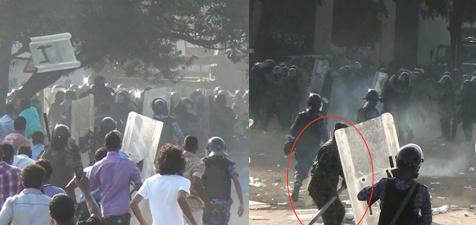
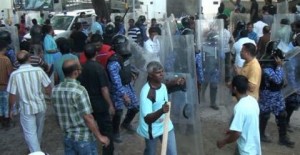
The report recounts the confrontations and provides evidence of police brutality against MDP members, with authorities arming opposition protesters with police shields, gas masks and pepper-spray canisters. It highlights recording showing police protesting in the Republican Square and attacking the Maldives National Defence Force (MNDF) Headquarters, while President Nasheed was still inside.

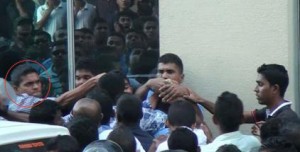
Pictures included in the MDP report show former Deputy Minister for Home Affairs Hassan Mahir being kicked in the back and forced to the ground during the unrest while surrounded by police and protesters.

Senior MDP member Ahmed Shahid (husband of MDP MP Eva Abdulla) was pictured being similarly kicked by a man identified as Corporal Mohamed Niyaz (now promoted to Sergeant). His shirt was ripped off and he was beaten up by police.

Meanwhile, Chief Superintendent Mohamed Jinah, head of police drug unit, was pictured handcuffed on a launch. He was reported to have been beaten up by rogue police officers before being taken to Dhoonidhoo Detention Centre along with several other senior officers.

A picture showing an attack on Superintendent of Police Ibrahim Manik was also included. He was struck on the head using an extendable steel baton, by a man identified as Corporal Waseem from Police Special Operations (SO).

However, to date no action has been taken against any of the officers, while both police and MNDF have refused to comment on the subject until the CNI concludes its investigation.

Neither have any independent institutions including the Human Rights Commission, Prosecutor General Office, Police Integrity Commission announced of an investigation into the criminal activities of the police during the events of February 7.

They all say, “a coup investigation is not within our mandate.”

Likes(0)Dislikes(0)