Didi and Fahmy allegedly poised to reprise MDP leadership roles in JP

Local newspaper Haveeru has reported that the former President and Vice-President of the Maldivian Democratic Party, Dr Ibrahim Didi and Alham Fahmy are on the verge of joining the Jumhoree Party (JP).

The paper quotes “reliable sources” – as it did when successfully predicting the defection of Shifag ‘Histo’ Mufeed from the MDP to the Progressive Party of Maldives (PPM) at the start of the month.

Prominent figures within the JP reportedly told the paper that the pair had both held discussions with the party leader Ibrahim Gasim although Dr Didi has denied that any such meeting had taken place.

Haveeru continued, stating that the pair have insisted on retaining Presidential and Vice-Presidential positions within the new party. This would require an amendment to JP regulations, for which a meeting of the national council has supposedly been arranged.

Both Dr Didi and Alhan were not responding at time of press.

Didi and Alhan were removed from their posts in the MDP after being accused of making statements in contradiction of the party’s official line concerning the the events that led to the resignation of President Mohamed Nasheed on February 7.

A motion of no confidence was supported by 95 percent of the MDP’s National Congress on April 30. Both men disputed the legitimacy of the process which led to their ousting.

Dr Didi filed a complaint with the Elections Commission (EC), which was later dismissed, whilst Alhan staged a poorly attended ‘free MDP’ rally, protesting against what he alleged was the negative influence of Nasheed on the party.

Didi told Haveeru earlier this week that he intended to challenge this decision. In the same interview he said it was “very likely” that he would soon leave the MDP for another party, criticising what he described as the undemocratic inner workings of the party.

Should Alhan, who is currently the MP for Feydhoo constituency,  join the JP, its representation in the Majlis would rise to four. This would bring the overall number of MPs in the pro-government coalition up to 46 out of the total 77 , reducing the MDP’s numbers to 31.

At the time of Shifag’s move to the PPM, the party’s group leader Abdulla Yameen told Minivan News: “The MDP will have to make extra efforts, they have an uphill battle to fight. They will have to arrest the movement of MPs to other parties.”

Likes(0)Dislikes(0)

Comment: To serve and protect dictators

You cannot teach an old dictator new tricks.

As the Maldives continues to experience the reversal of their democracy, the Maldives Police Service was out on the streets once again yesterday, demonstrating their tired old Gayoom-era tricks.

Early Tuesday morning, an unprecedented number of police arrived at Usfasgandu, the protest site on the south eastern side of Male’, where pro-democracy protesters led by the MDP have been demonstrating for months calling for early elections.

Armed with a search warrant, they forcibly evicted the protesters from the scene. Hundreds of police men and DED officials then combed through the area, later claiming to have recovered such criminal loot as a box of condoms and a potentially illegal “brown substance” – conveniently wrapped in MDP membership forms, lest anyone doubted their story.

The scenes evoked memories of March 19, when a joint police and military raid on the previous MDP protest camp at the nearby Raalhugandu area recovered more unlawful substances and cans of illegal alcohol, that were rather thoughtfully stored by the protestors in convenient MDP branded boxes, presumably with a large colourful arrow pointing towards it.

Those familiar with the Maldives’ painful transition to democracy would remember a time when the police were routinely employed by the state to harass and intimidate dissidents and crush all opposition.
Those times, it is evident, have come roaring back.

“Rule of law”

According to the Police narrative, the mutiny that culminated in the toppling of the first democratically elected government was ostensibly led by patriotic police officials who were disillusioned with the ‘unconstitutional orders’ they were being handed by the elected leaders.

In keeping with that noble spirit, hundreds of police officers publicly renewed their vows to “uphold the rule of law” in dramatic television footage captured at the Republican Square on that fateful morning.
It is the pride of any nation to have a Police Service that espouses such fanatical devotion to the “rule of law”.

Yet, one can’t help but call into question the sincerity of the Maldives Police Service’s newfound love for their constitution, and their hastily arranged commitment to the ‘rule of law’.

What is one to make of the brazen criminal actions of the rogue Police and military personnel who went on a public rampage, ransacking the MDP party quarters and beating up their activists?

How does one explain away the storming of the State broadcaster and airing on it content from a private TV propaganda outlet belonging to businessman politician Gasim Ibrahim – who is alleged to be among the primary financers of the coup d’état?

What does one make of the intensely politicised nature of a police department that appears to stop just short of publicly swearing allegiance to a certain political party run by a former dictator?

Exactly which law were the Maldives Police Service upholding when they threatened and physically assaulted elected MPs and the democratically elected President of the Nation? Under which clause of the Police Act did they assault some of their own senior officers inside the Police HQ on the day of the coup d’état?

Certainly, the rule of law could not be more violated than when the Police continued to dismantle the Usfasgandu camp site last night, in direct contravention of court orders forbidding them from doing exactly that? From their actions, it is plainly obvious that the Maldives Police Service couldn’t care less about “the rule of law” – which continues to be the ruse employed to explain away their treason on February 7.

For their part, Waheed and his newly appointed Commissioner Abdulla Riyaz have also publicly lauded the police for their unapologetic actions on February 7th, hailing it as a great example of ‘upholding the rule of law’.
There has been no investigation, and not a single police officer or military personnel has been booked for the brutality and wild excesses of that dark day.

Instead, in keeping with the Gayoom-era tradition, the Police have been richly rewarded for their services. For their troubles, the newly installed regime has lavished the Police and military with a record number of promotions, and monetary rewards.

Waheed – the problem, not the solution

With his various public utterances about ‘National unity’ and pledges to uphold the constitution, Waheed has attempted to project his regime as some kind of force for stability.

Unfortunately, Waheed’s appeal to ‘unity’ appears to be about as hollow as the Police Service’s professed love for the ‘rule of law’. He continues to eagerly defend the indefensible by refusing to take action against identified cops, who brutalised civilians in full public view and continue to do so with impunity.

While his helmeted riot cops continue to beat back thousands of angry protesters every week with their batons and shields, Waheed appears to not be interested in even acknowledging their sincere grievances. Instead, in the months following the coup d’état, he has lost no chance to colour the supporters of the MDP – by far the largest political party in the country – as ‘terrorists’.

It must be noted that the MDP led protests that have continued unabated since February have been largely non-violent, marked by weekly rallies and public forums – and often music, dancing, exhibits, videos, and speeches.

Yet, during the latest raid yesterday, Police again took into custody several MDP leaders, including MDP spokesperson and MP Imthiyaz ‘Inthi’ Fahmy, and a couple of elected MDP councillors. When enraged protesters poured out onto the streets again last night, the Maldives Police Service responded yet again with heavy-handed tactics.

Apparently pleased with this campaign of intimidation, Waheed’s Home Minister Mohamed Jameel Ahmed said on his public twitter account, “I commend the way our MPS attend (sic) Usfasgandu”.

From delaying tactics and misinformation, to harassment and intimidation, Waheed’s regime appears to have played all its cards since February 7th, and yet it is clear that the protesters simply aren’t willing to go back indoors until their demands are met.

The fact of the matter is that the continuing unrest – where a significant percentage of the population feels robbed of their legitimate government in highly questionable circumstances – can only be resolved by free and fair elections, and ensuring justice for the victims of mindless police violence.

These are absolutely essential for the public to restore their confidence in the government and heal the deep rifts with the security forces.

However, thus far, Waheed has shown no inclination to quit his stalling tactics, keep his erring ministers in check, ensure justice is served to the criminals in uniform, or stop his posturing against international bodies like the CMAG, or actually let the public have their say as a way out of the crisis.

Thus, it naturally follows that Waheed is the problem and not the solution – for he and his newly adopted network of Gayoom cronies are exactly what lies between the public and their vote.

To maintain this unsustainable status quo, Waheed has resorted to the same tactics that Gayoom did – namely, taking the Maldives Police Service off their leash and letting them loose upon the public, assigned with the singular task of cracking down on dissent with impunity.

Thus, the regime that was brought to power in a hail of batons, shields and tear gas continues to be sustained by the same ugly means and the country as a whole continues its free-fall into a dissolute police state.

All comment pieces are the sole view of the author and do not reflect the editorial policy of Minivan News. If you would like to write an opinion piece, please send proposals to [email protected]

Likes(0)Dislikes(0)

HRCM completes investigations into February 8 “human rights abuses”, “terrorism”

The Human Rights Commission of the Maldives (HRCM) has completed investigations into alleged police brutality and retaliatory “acts of terrorism” alleged to have been conducted by anti-government protesters on February 8, 2012.

Two separate investigations related to the conduct of both police and anti-government protesters on February 8 were today sent to authorities including the Prosecutor General’s office and parliament.  The completion of the investigations comes just 24 hours after the HRCM sent its findings concerning the controversial detention of Criminal Court Chief Judge Abdulla Mohamed to the same bodies.

HRCM member Jeehan Mahmoud said all but one of its investigations into the government changeover in February and the events that led up to it had now been completed.  One more report into the alleged human rights abuses conducted by police on the day of February 7 was left to be completed, she added.

Despite not having yet seen the findings, representatives of the government-aligned Progressive Party of the Maldives (PPM) today welcomed investigations from national independent institutions such as HRCM.  The now opposition Maldivian Democratic Party (MDP) meanwhile said it too would wait on the outcome of the investigations, but claimed that it remained sceptical about the independence of the investigation and the HRCM.

Nasheed investigation

The HRCM investigations, which saw former President Mohamed Nasheed become the first leader of the Maldives to be brought before the commission over the detention of Judge Abdulla Mohamed, also looked into acts perpetrated against the deposed former leader and his supporters following his controversial resignation. Nasheed claimed he was forced to resign from office on February 7 in a “coup d’etat.”

Jeehan Mahmoud said that aside from the investigation into Judge Abdulla Mohamed’s detention, additional reports had today been dispatched to the Prosecutor General’s Office, the government and the People’s Majlis for official responses as required under HRCM protocols.

“As well as the judge case, we today forwarded investigations into cases of alleged police brutality and also a separate review of the so-called “terrorism activities” carried out in Addu Atoll that saw police stations and other buildings attacked,” she said. “We have one more investigation to be completed on the alleged human rights abuses of February 7.”

Mahmoud claimed that no date had yet been set for the investigation to be concluded – due in part to ongoing difficulties in conducting interviews with various parties believed to be involved.

“So far this has been the most difficult investigation as not many people that we have requested to come to give testimonies have arrived. There are many high-profile political actors involved [in the investigation]. They have obviously prioritised what issues they need to address right now,” she said.

Mahmoud claimed that certain people that the HRCM wished to interview about the events of February 7 were not appearing after being requested to attend on numerous occasions.

“We are looking at human rights abuses right now. If someone in a uniform has committed acts of abuse, or whoever’s rights have been violated, we want to know. There has never been an investigation as complicated as this for us.”

Majlis response

PPM MP Ahmed Nihan told Minivan News that he welcomed any findings by independent institutions such as the HRCM that could shed light on the political unrest that had occurred both leading up to and after February 7.

In relation to both the investigations into former President Mohamed Nasheed’s alleged conduct in detaining Chief Criminal Court Judge Abdulla Mohamed, as well as human rights abuses claimed to have been carried out by police, Nihan said anyone found to have committed crimes should be brought to justice.

“Though I cannot speak for my party as a whole, it is my personal opinion that I welcome any independent investigations that can be viewed by all political parties here. Any investigations that are submitted to authorities should be fully probed,” he said.

With independent institutions having been appointed by parliament, Nihan added that it was right for groups like HRCM and their work to be accountable to the Majlis’ Independent Institutions Oversight Committee.

“Of all of these reports , it is the Majlis which has the authority to take proper action against anyone found of wrong doing,” he said.

Depending on the reports’ findings, Nihan claimed that if there was evidence to support such an action, former President Nasheed, police officers and any other party found to have acted illegally must face prosecution.

“Every person has the right to be innocent until proven guilty of a crime. However, whether a former president or a representative of the courts, no one is above the law,” he said.

MDP MP Hamid Adul Ghafoor told Minivan News that he had also not seen the HRCM reports that had been dispatched during the last few days and would wait to review any findings before commenting on them directly.

However, Ghafoor, who also serves on the Independent Institutions Oversight Committee, said that from his previous experiences of the HRCM’s conduct, he would take their findings “with a pinch of salt”.

“I wonder what these reports are going to say regarding the police brutality allegations. I have personally lost confidence in the institutions such as the HRCM,” he claimed. “Take for instance the time they summoned [former] President Nasheed. He was happy to be interviewed but they did not have a strategy in terms of their questioning. Let us see what they conclude, but I do not think it bodes well on their ability to conduct these investigations.”

Ghafoor alleged that the members presently sitting on the country’s independent institutions such as the HRCM, the Police Integrity Commission (PIC) and the Judicial Services Commission (JSC) had all been appointed at a time when now government-aligned Dhivehi Rayyithunge Party (DRP) had a majority within parliament.

“I do have to question the independence of a lot of these institutions, which have several outstanding motions against them relating to the Independent Institutions Oversight Committee,” he added. “Ultimately, the whole system is just so corrupt right now.”

According to Ghafoor, the HRCM had shown itself as a body in the past that had failed to be proactive in terms of investigating alleged abuses, particularly those claimed to have been commited under the tenure of former President Maumoon Abdul Gayoom.

“The HRCM has not to date looked into the cases of abuse, torture and missing persons that occurred under Gayoom,” he claimed. “They have constantly failed in my eyes and have shown themselves to be very selective in the cases they have pursued. They have actively said they would not be investigating cases linked to the Gayoom government.”

Likes(1)Dislikes(0)

Transparency Maldives and UNDP launch new project on Right to Information

Transparency Maldives and the United Nations Development Programme (UNDP) have launched a new project on Right to Information in the Maldives.

“The right to information is most vital in preventing corruption,” Executive Director of Transparency Maldives, Ilham Mohamed said in a press statement.

Transparency Maldives stated that the two-year project “Promoting Transparency and Accountability through Access to Information in the Maldives”, will be funded by the United Nations Democracy Fund (UNDEF) and aims to promote accountability within state institutions, through “strengthening the national access to information”.

“Right to information is central to strengthening open and transparent decision making processes, as well as in promoting good governance and the rule of law. It is not only essential in an open and democratic society but is critical in the fight against poverty and in accelerating human development,” said UNDP Resident Representative, Andrew Cox.

Likes(0)Dislikes(0)

Nasheed nominee to CNI accepted, reportedly withdrawn

Confusion surrounds the appointment of former President Mohamed Nasheed’s latest nominee to the Committee of National Inquiry (CNI). The government today confirmed its acceptance of Mariyam Manaal Shihab to the CNI before local media reported that the nominee had been withdrawn.

President’s Office spokesperson Abbas Adil Riza told Minivan News at around 3:30pm this afternoon that Manaal’s nomination had been deemed acceptable to the government.

“She fits the criteria set down by the government and the Commonwealth. The government welcomes the changes and the MDP’s desire to move forward,” said Abbas.

Abbas said that Manaal had been working as a legal consultant for the Ministry of Economic Development and was “well respected in her field”. She is the daughter of Mohamed Shihab, former Speaker of the Majlis and Minister of Finance under the previous government.

When asked about the nomination at around 4:30, MDP International Spokesman Hamid Abdul Ghafoor said that he had heard about the matter but believed the nomination had happened in a “very direct” manner.

Shortly after this time, however, local media reported an unnamed government official as saying that the nominee had been withdrawn. The same article quoted MDP Spokesman Imthiyaz ‘Inthi’ Fahmy as denying that any such nominee had been posited.

When Minivan News called Abbas at 6:00pm, he said he was aware of these new reports but had yet to receive confirmation of the withdrawal.

“Maybe the MDP is flip-flopping,” he said.

Minivan News witnessed video footage of Inthi being led away by police at the National Council meeting just outside the Usfasgandu area. This area was closed off before being raided by police this morning. Inthi was not answering his phone at time of press.

When Ghafoor was re-contacted, he also said he was aware of the fresh media reports. Ghafoor could not confirm what had happened but pointed out that it had never been the MDP’s policy to discuss the names of potential nominees.

“It has always been the government that releases the names of the nominees. We have never given the names of those proposed,” said Ghafoor.

False dawn

The appointment would have completed the composition of the reformed CNI, representing the culmination of months of internal and external pressure to enhance the credibility of the body assembled by President Dr Mohamed Waheed Hassan to investigate the events of February 7 and 8.

The new-look CNI is scheduled to begin its work on June 1 and is expected to have completed its work by July 31.

The government has threatened to appoint a lawyer of its choosing to the commission should a suitable Nasheed nominee not have emerged by the start of proceedings.

The major impetus for these alterations came from the Commonwealth’s Ministerial Action Group (CMAG) which had set a mid-May deadline for the CNI’s satisfactory reform.

As the deadline approached, the Commonwealth’s Special Envoy to the Maldives Sir Donald McKinnon arrived in Male’, eventually reaching a deal with the government to allow Nasheed to nominate a “suitable” nominee.

These criteria, later clarified by the Commonwealth as people who have not taken a stand on the events in question and who are not expected to testify before the commission, was interpreted more onerously by the government.

The government added the conditions that the nominee must not have served in a political post in the past two years, and must be of “good behaviour and integrity”.

These conditions were labelled “subjective” by the MDP as its first 11 nominees were considered “generally unacceptable” by the government.

This had led to pessimism from within the MDP, with Ghafoor anticipating last week that the Commonwealth would again have to mediate before the issue was resolved.

A successful nomination would bring the CNI closer to being “impartial, credible and broadly acceptable”.

These were the words prematurely attributed to Don McKinnon by the Maldivian government in a statement to the international media, released on the PR Newswire service last week.

This statement brought a swift response from the Commonwealth, which labelled the statement “misleading”.

“Indeed, [Sir Donald McKinnon’s] efforts while in Maldives, and since his departure have been focused on achieving that objective, so that a truly impartial, credible and broadly acceptable Commission of National Inquiry can be put in place within the agreed time-frame,” the Commonwealth stated.

The government’s efforts to implement a commitment made to McKinnon, to strengthen the powers of the CNI and broaden its composition with an international co-chair and nominee of former President Nasheed, “are still ongoing”, the Commonwealth stated.

Likes(0)Dislikes(0)

Police forward nine names to PG regarding VTV attack

The police have forwarded nine names to the Prosecutor General’s (PG) Office in relation to the attack on Villa Television (VTV) on March 19, reports Haveeru.

Police Inspector Abdulla Shatheeh is also reported that the police are searching for five more individuals in relation to the incident. In order to trace the whereabouts of the suspects the police have made public the photos of those under suspicion. They have also appealed to the public for any information regarding this incident.

Shaheeth told Haveeru that the nine names forwarded to the PG are:  Hussain Hameed – 26,  Ahmed Hameed – 29, Mohamed Hameed  – 50, Ahmed Naeem – 27, Ghaanim Haasan – 19, Hussain Shifau Jameel – 19, Ismail Hammad – 19, Ahmed Muheen – 22, and a 17 year old who could not be named for legal reasons.

The attack on VTV occurred during protests against the re-opening of the people’s Majlis on March 19. The building, as well as the soldiers guarding its entrance on Sosun Magu, came under attack as police tear gas forced the protesters south, past the building from the police barricades nearer to the Majlis building.

Likes(0)Dislikes(0)

Potential for power cuts across Male’ today as STELCO test new generator

The State Electricity Company (STELCO) has announced that there may be power cuts in Male’ between 3:00PM and 5:00 PM today as it tests one of its two new generators, reports Haveeru.

“We have notified customers that there would be a possibility of power failure as the performance of the new generators is being tested today. We have estimated that the process would take approximately two hours,” a STELCO official told Haveeru.

The official added that the second generator will undergo similar testing soon, with both devices scheduled to be up and running by June 5.

It is anticipated that the installation of these two generators, said to cost Rf547 million (US$36million), will end the regular power cuts experienced in the capital Male’. The frequency of these cuts has obliged the company to provide an update service on its website, informing its customers when and where their districts will be without power.

The current grid is capable of providing 36MW, whilst the city requires 39MW. The two new generators will provide an additional 8MW each.

Likes(0)Dislikes(0)

Condoms and black magic: police raid Usfasgandu

Additional reporting by Daniel Bosley

Police raided the opposition Maldivian Democratic Party (MDP) protest camp at Usfasgandu this morning, after obtaining a search warrant from the Criminal Court and cordoning off the area from MDP demonstrators.

MDP MP Mariya Ahmed Didi was inside the cordon showing the warrant to a group of media representatives shortly after 8:00am, as dozens of police began to gather in the area.

Reasons for the search as stated on the warrant included: “suspected criminal activity”, “damage to public property”, and “suspected black magic performed in the area”.

Under evidence, the warrant alleged that people in the Usfasgandu area verbally abused police officers and damaged a police vehicle on April 20, obstructed a Maldives National Defence Force (MNDF) exercise of May 9, and on May 25 “MDP protesters threw a cursed rooster at MNDF officers.”

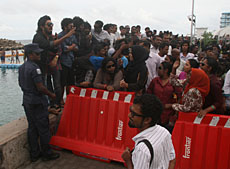
As blue-gloved officers from the Drug Enforcement Department (DED) arrived, a group of largely female protesters began to gather at the barricades set up near the STELCO building. The barricade was itself lightly manned by police, however a group of police stationed further back near the Dharubaaruge convention centre were equipped with riot shields, gas masks and rubber bullet guns.

The crowd was noisy and upset, but non-violent. An altercation erupted at the front between a group of women and several young men, whom protesters claimed had been sent by a government-affiliated party to provoke the crowd. Minivan News later observed one of these men being arrested by police after trying to break through the barricade.

Meanwhile, DED officers fanned out at the Usfasgandu site and began poking through plants and debris around the padlocked container under the main stage. A large group of police on the other side were picking through rocks along the seawall, while a police boat waited outside the harbour.

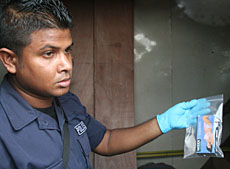
Media raced over to photograph the first discovery, retrieved from a nearby bush: cigarette butts and a brown substance wrapped in an MDP membership form. Police near the stage had meanwhile lifted up a wooden board and found a small plastic baggie containing the remnants of a dried substance.

A major find occurred after police broke open the container, searching through old paint tins and debris before reaching into a ceiling cavity, triumphantly producing a packet of condoms (‘Moods’ ultrathin).

The Usfasgandu area had been given to the MDP by the (MDP-dominated) Male’ City Council, after it was evicted by police from its previous camp just metres down the road at the tsunami monument. Police at the time claimed the area was being used as a hub for criminal activity and assorted deviancy, and a similar raid uncovered beer and condoms. The camp was immediately dismantled by the police and MNDF, and walls were painted over grey to remove all trace of the MDP from the area.

The Usfasgandu raid this morning ends a stalemate between the Home Ministry – headed by former Justice Minister during Maumoon Abdul Gayoom’s rule, Dr Mohamed Jameel – and Male’ City Council.

The Housing Ministry initially sought to repossess the area from the Council, which refused to cooperate. The Home Ministry then instructed police to retake the area, who approached the Criminal Court for a warrant. The court initially denied this warrant, stating that the repossession was a civil matter and not within its jurisdiction.

Eight days later and Home Minister Jameel yesterday announced that the Ministry had received complaints of criminal activity in the area: “No complaints of any criminal activities had been raised with us at the time [of the original court order request]. But now many complaints have been received including criminal offences,” he told local media.

Police Spokesperson Sub-inspector Hassan Haneef said that following a search of the area a decision would be taken on whether to shut down the site.

“If there is reasonable evidence of crimes being committed there, we would look to close the area,” he said.

Male City Mayor Ali ‘Maizaan’ Manik was standing next to a cage full of crows – kept on the site by the MDP demonstrators to mock President Mohamed Waheed, who is caricatured as a crow on the popular Maakanaa Show.

“I’m too angry to talk right now,” he told Minivan News, as police were left to pick through the area after media scurried to protect their cameras from the sudden downpour.

Back through the police barricades, one visibly upset protester expressed frustration at what he described as “a police state”.

“We just want somewhere to peacefully protest,” he said. “They are just going to plant something, like drugs or explosives, so they can blame us. What can we do? We are helpless.”

An older man came up, put his hand on his shoulder, and led him out of the rain.

Likes(0)Dislikes(0)

Former shark fishermen learn farming and aquaculture at M&S-sponsored workshop

Mohamed Rauf is a father of three from Kanditheemu in Shaviyani Atoll. Like most fishermen in his island, he took up shark fishing as a means to provide for his family.

For three years Rauf’s family depended on selling sharks to local buyers until the government of the Maldives imposed a nationwide shark fishing ban, bringing a halt to his income from shark fishing.

In March 2010, the government banned all types of shark fishing within its territorial waters, which covers about 90,000 square kilometres, technically making it the largest shark sanctuary in the world at the time. A trade ban on all shark products was imposed in July 2011.

Rauf is just one of the estimated 200 shark fishermen whose livelihood was affected following the ban.

Although the government in March 2010 said it would provide the fishermen with financial support and retraining, Rauf had to wait two years for any action on the matter. Last week, his hopes were finally raised.

‘Alternative livelihoods for former shark fishermen’ is a training workshop funded by UK retailer Marks & Spencer, focusing on farming and aquaculture training. The workshop was held last week for former shark fishermen and their families from the islands of Kulhudhuffushi in Haa Dhaal Atoll and Kan’ditheemu and Goidhoo in Shaviyani Atoll.

Seamarc Pvt Ltd, an environmental consultancy in the Maldives, coordinated the workshop in collaboration with the Ministry of Fisheries and Agriculture and New England Seafood.

Environmental consultant at Seamarc, Marie Saleem, said the workshop was conducted by experts from the Hanimaadhoo Agriculture Centre and Marine Research Centre, and was a great success.

“The workshop served as an inspiration to people – they have being asking for this since 2010. Now they realise they can really do things like hydroponics and agriculture on the islands,” Saleem said.

The farming course focused on home gardening and hydroponic techniques. Participants learned to cultivate different crops including chilli, watermelon and papaya. Participants also acquired knowledge on common pest and disease control related to these crops.

The aquaculture course focused on different species of aquaculture including food fish, clown fish, grouper, pearl, seaweed and sea cucumber cultivation. A lecture on the commercial aspects of mariculture was also given by the Maldives Industrial Fisheries Corporation (MIFCO).

The Hanimaadhoo Agriculture Centre will conduct a further, more in-depth agricultural training course later this year. The three-month course and another two-week long training on aquaculture planned for the year are expected to equip the participants with more hands-on experience.

“It was more of an introductory workshop this time. We really hope participants will continue with the other workshops that are coming up,” Saleem added.

Rauf, who has now achieved a certificate from the workshop, agreed that further workshops, especially in aquaculture, would be helpful.

“The workshop was great. We learned a lot of new things. But I am only confident with the farming techniques so far. Another workshop in aquaculture will be very useful,” he said.

Likes(0)Dislikes(0)