Maldives “on the tip of a dark cloud of hatred”, warns Sheikh Fareed

Prominent religious scholar Sheikh Ibrahim Fareed has given a sermon denouncing Friday’s planned protest, on the grounds that “it will be the blood of fellow Muslim brothers flowing down the roads.”

Islam did not preach unrest and violence, Sheikh Fareed said, and it was not honoring Islam if Muslims should clash with Muslims in the name of protecting it.

He said that the Maldives was currently “on the tip of a dark cloud of hatred”, and warned about aggressive activities that might take place during the December 23 event, calling on people not to destroy property, or damage the sanctity and good name of another Muslim.

Sheikh Fareed referred to 2;11,12 of the Quran which states: ‘’ When it is said to them: “Make not mischief on the earth,” they say: “Why, we only Want to make peace!” Of a surety, they are the ones who make mischief, but they realise (it) not.’’

According to Sheikh Fareed, Anas Radi allah Anha narrated that the Prophet [PBUH] said ‘’Be patient, there will come a time, where the time that comes after that time will be worse than the other, until you shall meet your god [judgement day].’’

He called not to give space for disputes and to try and make peace instead, and called for people to “protect our wives and children from danger rather than feeding wood to a burning fire.”

He said that everyone will have to be accountable to Allah, and reminded that there were two angels that keep writing all good and bad deeds including the words we say.

Sheikh Fareed said that this life was not eternal and that everyone has to believe that “we might have close our eyes for the last time at any moment.”

‘’Then comes the time you feel bad about how you lived and start crying, although you did not want to leave you had to. Then you will be amazed of the persons that come to question you. Indeed, with a strong voice they will question you,’’ Shaiekh Fareed said. ‘’The persons that encouraged you to destroy people’s property and to damage the good name of others will not be there.’’

He added that the deeds people committed in this world “will be the only thing they will have.”

Sheikh Fared further said it was regrettable to hear of the news that two Muslim groups were to confront with each other.

Likes(0)Dislikes(0)

Comment: The Intolerant Constitution

In 1959, an expedition of historians unearthed an exquisitely carved ancient statue of Gautama Buddha from the island of Thoddoo.

Buried under slabs of stones, possibly to protect it from being demolished along with the the temples following the Islamization of the Maldives in 1153 AD, the statue was a priceless archaeological find.

Before long, however, the island was gripped with controversy. ‘The religion of worshipping statues has begun!’, some islanders were described as saying, according to the book ‘A New Light on the History of Maldives’.

One early dawn soon after its discovery, the ancient statue was found decapitated by vandals.

The statue was then taken to Male’ and displayed at Mulee’aage, the current Presidential residence. Before the week had ended, another mob barged in and smashed it to pieces leaving behind just the serenely smiling head, which is now displayed in the National Museum in Male’.

The Prime Minister at the time, strong-man Ibrahim Nasir, who didn’t hesitate to personally lead gunboats to forcefully depopulate the island of Thinadhoo following the southern rebellion, knew better than to investigate the vandalism.

It was simply pointless, because half a century later, unidentified vandals would proceed to smash, burn and destroy the SAARC-gifted monuments in Addu, for allegedly being ‘idols of worship’.

The State vs. the Tolerant

Just like Nasir, the modern Maldivian politician knows better than to challenge the deep-rooted fear of ‘other religions’ that is so firmly ingrained in the Maldivian psyche.

On the other hand, it makes for a great political gimmick.

Quite tellingly, the ruling party, seven opposition parties and a network of 127 NGOs are all planning to protest on December 23 in order to renew their vows against allowing ‘other religions’ in the Maldives.

It seems a rather redundant cause, considering the 2008 Maldivian constitution already forbids non-Muslims from becoming citizens, and mandates that the nation remain 100% Sunni Muslim.

This status quo, however, was recently challenged by a group of Maldivians who gathered in Male’ on December 10, on the occasion of the International Human Rights Day, in silent protest against the lack of religious freedom in the Maldives.

The sit-down protest was disrupted within minutes by a violent gang, leaving one man with serious injuries to the head.

Joining the chorus of local politicians eagerly latching onto the controversy, “Reeko” Moosa, the former MDP Parliamentary Group leader, demanded the prosecution of those who called for ‘religious tolerance’ – otherwise considered a positive phrase elsewhere in the world.

Independent journalist and blogger, Ismail Hilath Rasheed, who was among the freedom advocates, has been taken into police custody.

Meanwhile, the National Security Committee in parliament has decided to summon participants of the protest, citing their duty to defend Islam and uphold the country’s constitutionally imposed religious unity.

It is abundantly clear that there’ll be no debate on the subject, and that at the heart of it lies the holy writ of country’s unchallengeable Constitution.

The immutable constitution

Thomas Jefferson, one of the great founding fathers of America, once proposed that the American constitution should be rewritten every 20 years, lest the dead end up ruling over the living.

There are, of course, excellent reasons to deliberately make it difficult to modify a country’s constitution, not the least of which is to protect it from whimsical rulers.

In this regard, however, the Maldives goes one step further than the rest.

Speaking about the incarceration of Hilath Rasheed, Police Sub-Inspector Ahmed Shiyam said “Calling for anything against the constitution is illegal”.

There appears to be a general consensus among lawmakers and the public alike that the constitution is beyond all criticism, and any dissenting word spoken against it should be considered a grievous crime.

This would perhaps imply that the entire Chapter 12 of the constitution is now utterly redundant, for what good is a chapter on amending the constitution when apparently it is illegal to find any fault with the existing one?

One presumes that President Nasheed himself must now be put in chains and dragged before the courts for blasphemously uttering in July 2010 that he was in favour of a Parliamentary democracy, whereas the holy constitution explicitly decrees a Presidential system.

Thankfully, other democracies of the world recognize that obeying the constitution doesn’t necessarily mean agreeing with it.

In neighboring democracies like India, writer activists such as Booker Prize winning author Arundhati Roy write fiery articles openly defying the State, and major political parties publicly campaign to remove specific Constitutional clauses they have philosophical differences with.

In a true representative democracy, the public is generally free to advocate and lobby their representatives for causes they believe in.

In the past few weeks, it has emerged that Maldivian public apparently doesn’t have this freedom.

The other sacred text

Perhaps, then, it is not the Constitution, but Islam that imposes certain limits on the debate?

Unfortunately, in the Maldives, there is no way to tell apart the limits imposed by Islam from the ones imposed on it.

It appears that many Maldivians are convinced that the ultra-conservative Adhaalath Party and their Salafi cousins are the foremost authorities on the subject of Islam in the known universe.

But for that to be true, one must argue that every other Islamic nation in history has been wrong.

While one Maldivian blogger has been languishing in a prison cell for the past week for advocating religious tolerance, there is an abundance of Imams, caliphs and even a certain Prophet from history who seem to be in agreement with that blogger’s opinion that Islam does indeed have room for religious tolerance.

Didn’t the Prophet himself say, “Whosoever does injustice to a protected non- Muslim, then I will be his enemy (on the Day of Judgement)”?

The Cairo Declaration on Human Rights in Islam, drafted by the Organisation of the Islamic Conference as a Shari’ah compliant alternative to the UDHR, declares the right of people to a dignified life free of discrimination on the grounds of religious belief, among other things.

Maldivian scholar Dr Abdulla Saeed of Melbourne University, argues in his book ‘Freedom of Religion, Apostasy and Islam’ that there is “a vast amount of clear Qur’anic texts in favour of freedom of religion”.

Needless to say, his book was banned in the Maldives.

The burden of defining ‘true Islam’, instead, fell on a small group of short-sighted conservative political Mullahs working out of a Ministry building in Male’. And in their opinion, Islam forbids the mere mention of ‘other religions’ – despite what the Qur’an says.

‘Because we’re special’

12th century copper plate grants found in the Maldives reveal the blood-soaked, painful process of conversion of the Maldives to Islam. The Sultans of the day went through the trouble of bringing in Buddhist monks and beheading them in the capital.

The modern day Maldives takes a much simpler route. The 2008 Constitution unilaterally declares all Maldivians to be Sunni Muslim without the courtesy of so much as an opinion poll.

Maldivians in general are quite proud of the ‘100% Muslim’ statistic that is frequently bandied about.

But it raises a few fundamental questions that are nevertheless extremely taboo in the Maldivian society.

At what point of Maldivian history has there ever been a public census on religion?

Does the Maldivian state even have the right to unilaterally declare a citizen’s beliefs? Which other Islamic State or Empire in Islam’s 1400 year old history has taken this liberty – and under whose authority?

Those We Do Not Speak Of

A cursory look at online Social networks easily proves the existence of several non-Muslim Maldivians, and Dhivehin who appear to not subscribe to a religion at all.

If we were to do the unthinkable and disregard the holy constitution for just a minute, how morally justified is it really to make their mere existence a crime potentially punishable by death?

Consider the fact that our very economic survival depends on treating other non-Muslims – those who are non-related by blood, culture or language – with generous hospitality.

Does this radical notion of unilaterally enforced Islam only apply to those born of Dhivehi parents? Could the Parliament conceivably declare tourists and other visitors also to be Sunni Muslims while within Maldivian territory?

At what point does the whole affair begin to sound absurd?

Chaos theory

Politicians of both major parties argue that introducing the freedom of conscience to minorities would result in chaos and disorder in society, much like introduction of democracy did with the introduction of political rights. But are any of these politicians sincerely willing to return to the non-chaotic days of the past when they were jailed for simply expressing an opinion? If not, why not?

The Maldives has been “100% Muslim” since at least the Gayoom days. So why do we not see the utopian fantasy of a prosperous, peaceful, gentle society of fellow Muslims treating each other with kindness?

Instead, it appears that Maldivian lawmakers and government no longer have to talk about roads or health or food or development, for they now have the one dead horse of religion to flog for all eternity.

Is it really that hard to see there’s something wrong with the picture when eight political parties – both the ruling and the opposition – plan to rally in order to “defend Islam” against each other?

Which Islamic principle was being followed by the MPs who tried to force their way to the International airport in an effort to remove a banner depicting the region’s cultural diversity?

Presumably, it takes a tremendous amount of will power for these lawmakers to restrain themselves from forcing their way past security into the National Museum to destroy the still intact head of the ancient coral-stone idol of the Thoddoo Buddha that our ancestors had failed to destroy.

What Islamic value lies behind the sort of blood lust that drives an ordinary Maldivian to go and violently attack a fellow Maldivian simply for being a non-Sunni Muslim?

Based on what Islamic criteria do we religiously uphold certain parts of the Shari’ah penal code such as flogging, while completely disregarding others such as amputating limbs, or stoning half-buried humans to death?

These are all important, crucial questions. But until there’s room for an honest debate, how would we ever find out?

End of Reason

“I disapprove of what you say, but I will defend to the death your right to say it”, wrote S.G. Tallentyre in 1906, in a quote widely misattributed to French philosopher Voltaire.
Over a century later, we Maldivians have yet to appreciate the sentiment behind this powerful phrase.

While jihadist literature with fiery, cataclysmic titles are openly sold in Salafi bookshops around the capital, the slightest spark of reason is immediately stamped out by an unthinking brigade of conservative clerics and opportunistic politicians.

The broken, still smiling Buddha in the National Museum bears witness to our long history of stubbornly refusing to accept reason.

But today, more than ever, it is necessary to ask difficult questions and face hard facts, because the line that marks where the debate stops also marks the point where, as Thomas Jefferson feared, we become enslaved to the past.

All comment pieces are the sole view of the author and do not reflect the editorial policy of Minivan News. If you would like to write an opinion piece, please send proposals to [email protected]

Likes(2)Dislikes(0)

Pakistani money fueling Maldivian extremists: The Hindu

The Maldives is bracing for another showdown between the traditional, democratic Maldivian Islamists and those who hold extreme views on Islam, writes R K Radhakrishnan for India’s The Hindu newspaper.

And, according to a top source, the Maldives believes there is Pakistani money helping the extremists.

Last Christmas, trouble erupted after a restaurant decorated itself for Christmas. Under Maldivian law, no religion barring Islam can be publicly practised. The buntings were pulled down in no time but as news spread, protesters filed into the capital, Male, and ended up fighting pitched battles with the police. Tourism during the season took a serious knock after the protests.

The religious extremists, growing in numbers despite international efforts to preserve the Maldivian brand of tolerant Islam, have called for a protest on December 23. The Opposition has backed the protests. One official told The Hindu that the protesters had received support from both Pakistan and the former Maldivian President, Maumoon Abdul Gayoom.

Against the backdrop of religious protests over the past few weeks, and the vandalism of SAARC monuments, the government has made it clear that it will stand up to the attempts to push the country into the hands of fanatics.

Press Secretary Mohamed Zuhair said on Monday: “Former President Gayoom, the Adhaalath Party and religious extremists are whipping up hatred, intolerance and xenophobia for political purposes. They hope to topple the government from the streets because they can’t defeat it through the ballot box.”

But not all agree with the government view. Vocal protestors who have occupied every fora, including the Internet insist that the protest is to inform people and force the government to “reverse every un-Islamic thing” done, “stop trying to bring freedom of religion, gay rights and also dealing with Israel.” One writer, venting on the Minivan News website, told Mr. Nasheed: “Choose honest people who fear Allah (swt) and has no love for Israel. Also tell the U.N. that our current constitution is perfect the way it is and we do not need a non-Muslim coming to tell us how to live when they cannot solve their own problems in the UN. From what I last recall, United Nation is still not a democracy.”

Full story

Likes(0)Dislikes(0)

Committee to review HRCM nomination

A temporary committee will review President Mohamed Nasheed’s nomination of Ahmed Tholal of Henveiru Adduge for deputy human rights commissioner. Parliament endorsed the committee today with 66 out of 68 votes.

The President made the nomination on Sunday.

The committee includes Dhidhoo MP Ahmed Sameer, Machangoalhi-North MP Mohamed Rasheed, Madaveli MP Mohamed Nazim, Kela MP Dr Abdulla Mausoom, Hithadhoo-South MP Hassan Latheef, Velidhoo MP Ali Mohamed, and Maavashu MP Abdul Aziz Jamaal Abu Bakr.

The Human Rights Commission of the Maldives (HRCM) has been without a deputy president for over a year. On October 4, 2010 Parliament unanimously approved Mariyam Azra as HRCM President but rejected the President’s nominee Jeehan Mahmoud by ten votes.

A coalition of local NGOs called the vacant posts “an immense obstacle to the effective functioning of the commission” at the time.

MPs said they opposed Mahmoud’s nomination for reasons of gender equality.

DRP Deputy Leader Ilham Ahmed told Minivan at the time that while he considered the people appointed for HRCM as capable, the role of President and Vice President “should include a male.”

“Even if you look at it from a religious perspective or from the perspective of good policy, there should be a male in either post,’’ he said.

Independent MP for Kudahuvadhoo, Ahmed Amir, said it was “against human rights” to have two females in the roles of President and Vice President.

“It is the woman who calls for equality most of the time,’’ Amir said, regarding the case.

Likes(0)Dislikes(0)

Audit report finds HRCM spent Rf133,639 in violation of public finance regulations

The audit report of the Human Rights Commission of the Maldives (HRCM) has revealed that the office has spent a total of Rf133,639 (US$ 8666) in violation of the public finance regulation during 2010.

In the report published on Sunday, Auditor General (AG) Ibrahim Niyaz revealed that the commission spent Rf127,939 on the UNDP project “Collaborating with Civil Society” and Rf5700 on “Strengthening the Administrative Functioning of the Commission” in violation of section 4.01 of the public finance regulation.

According to the report, the money was spent on a reimbursement basis; however the AG noted that it was not repaid till 29 September 2011.

HRCM however informed auditors that the money was deposited to the state’s income account. The Commission also assured the auditors that reimbursement mechanism would be improvised.

The report further reads that the auditors identified several outstanding bills for items and services purchased by the commission in 2010 – which the commission members were unaware of prior to the audit.

Therefore the AG concluded that the internal control system established within the commission to monitor the authenticity of financial statements was “not functioning properly”.

Furthermore, the report noted that a total of Rf44,746, which was stolen from the commission’s safe in 2008, still remains unaccounted for.

The money was stolen without any damage to the safe; hence the two members of the staff who knew the secret code to the safe should take responsibility for the theft, Niyaz claims in the report.

He also told the commission to recover the money from the two staff and reimburse it to the budget.

However, the commission noted that the police investigations had initially revealed that a double key to the safe was in the office key holder and four staff knew the combination to the safe – therefore, the commission could take no action until the negligent or responsible party is found by the police, the commission told the auditors.

Likes(0)Dislikes(0)

NSC to summon five cabinet members over Israel airline issue

The National Security Committee has decided to summon five cabinet ministers, Vice President of Adhaalath Party Dr Mauroof Hussein and Chief of Defence Force Major General Moosa Ali Jaleel in a bid to determine the potential consequences for allowing an Israel airline to operate to the country.

The matter was submitted to the parliament by Adhaalath Party Vice President Dr Mauroof Hussein.

Maldivian Democratic Party (MDP) MP Mohamed Nazim, who is also a member of the National Security Committee, confirmed the summonses to Minivan News.

‘’The Chair of the committee will decide a date to summon them, it has not been decided yet,’’ Nazim said. ‘’They will be summoned and questioned about the issue.’’

MDP MP Mohamed Riyaz refused to comment on the matter while DRP MP Ahmed Mahlouf did not respond to calls at time of press.

During yesterday’s meeting MPs also reviewed the matter  of the ‘silent’ protest for religious tolerance held on Human Rights Day on December 10, and the planned protest due to be conducted next Friday to ‘protect Islam’ in the country.

In May this year Israel’s national carrier El Al formally applied to the Ministry of Civil Aviation to begin flying to the Maldives from December.

Later, Adhaalath Party severed its coalition agreement with the ruling Maldivian Democratic Party (MDP) in September, soon after the Transport Ministry granted a licence to Israeli flag carrier El Al to begin operations to Maldives.

Recently the Adhaalath Party sent a letter parliament’s national security committee which has begun debating whether to permit Israeli flights to land in the Maldives.

“If there is a terrorist attack in the Maldives due to the commencement of Zionist Israel’s flight operations to Maldives, the tourist arrival rates for the next 12 months will decline by 10-36 percent,” Adhaalath predicted in the letter, adding that the tourism industry would face a loss of US$200 million to US$1 billion. The party did not elaborate on how it reached the figures.

In the letter forwarded to the national security committee, which has an MDP majority, Adhaalath alleged that the Israeli flights are “targeted by the terrorists” and said that terrorist “eyes” would turn on Maldives if the operations commence, posing “serious threats to the national security”.

Transport Minister Adhil Saleem that time observed that opponents of allowing Israel to fly to the Maldives “don’t seem to have an issue with Israeli tourists coming to the Maldives and spending their money.”

His mandate as Transport Minister was to increase air, sea and cargo transport to and from all countries, Saleem said, “and if there is no specific legal exemption for Israel, I cannot treat it any differently as that would mean I was corrupt.”

Likes(0)Dislikes(0)

Civil Court orders MVKB to vacate duty free shop within 48 hours

The Civil Court has ordered MVK Maldives Private Limited to vacate the Alpha MVKB Duty Free shop and hand the premises to GMR Male’ International Airport Private Limited within 48 hours, or face eviction by the authorities. The deadline expires at 10:00am on Wednesday.

Civil Court Judge Maryam Nihayath ordered the Police and Customs Department to implement the verdict in the event that MVKB refused to comply.

MVK’s lawyer Azima Shukoor said that shop evacuation and handover by MVKB was not possible as the shop was currently the property of Customs. “There is nothing we can do about the 48-hour deadline since we don’t have access to the shop. We are forwarding the court order to Customs and requesting access to take inventory of the shop before anything further is done,” she said.

Shukoor explained that certain goods required specific air temperatures, and the shop does not currently have cupboards or shop doors.

Shukoor added that MVKB’s case had been appealed to the Supreme Court, and that the company is awaiting that ruling.

The verdict came after GMR filed a case in the Civil Court for the second time when MVKB refused to implement the earlier verdicts of the Civil and High Courts on the issue.

Judge Nihayath recalled that the High Court has ruled that MVKB has no right to use the land without GMR’s consent because it violates contractual rights.

On December 4, GMR officials began to physically remove the Alpha MVKB Duty Free Shop at Ibrahim Nasir International Airport (INIA) after “several notices” to vacate the area were “ignored”.

On December 13, the High Court ruled that GMR had vacated the Alpha MVKB Duty Free Shop at Ibrahim Nasir International Airport (INIA) legally and according to the agreement between both companies.

The High Court stated that GMR gave notice on March 1 and, as per the agreement, the contract terminated on March 31. As no party could extend the termination notice, the court concluded that MVKB had no right to remain at the airport without approval from GMR.

Company CEO Ibrahim Shafeeq subsequently organised a protest on Thursday, December 15 “to demonstrate our opinions and dislike of what GMR has done to us, and to get public responses.” Posters and banners read “Leave us Alone” and “GMR Go Home.”

Shafeeq today said the protest was “very successful, and more people are signing the petition [against GMR].”

Shafeeq said he would continue to protest GMR. “It hurt me and as an individual I have to defend myself,” he said.

Speaking to Minivan News yesterday at the groundbreaking ceremony to mark the beginning of work on the new airport terminal, GMR Chairman G M Rao said the company had encountered similar resistance from existing concessionaires when developing airports in Delhi and Istanbul.

Likes(4)Dislikes(0)

Bangladeshi man suffers head injuries in assault

Police have arrested three men and a minor on suspicion of a brutal attack on a Bangladeshi national on Goidhoo in Baa Atoll, which left him with serious injuries.

According to a police media official, the man was attacked by the group around 1.45am on Monday night, at the Goidhoo harbour area.

The reason for attack was unspecified by the police as the investigation is still ongoing.

However according to a Goidhoo Councillor, islanders are claiming that the Bangladeshi man was attacked in retaliation for “holding the hands of a married girl”, with whom he was claimed to be friends.

The councillor said the Bangladesh national was a security guard working at a Goidhoo harbour construction site and added that he was attacked while on duty.

He noted the man suffered severe injuries to his head, and his left hand was broken in two places.

“He was bleeding really badly from the bruises on his head and back. We found two wooden planks with his blood on it close to the area he was beaten,” the councillor said.

The man was brought to Male’ and admitted to IGMH after receiving care at Baa toll hospital.

Likes(0)Dislikes(0)

Exhibition gives voice to abused, neglected and abandoned children

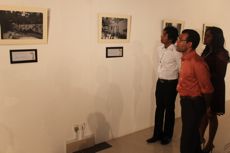
Among the black and white images on display was a picture of a hoisted national flag, captured by a six year old boy who dreams to become a policeman. This was one picture among the 41 images showed at the photo exhibition “Me through my lens”  – which provides the first glimpse into the life of abused, neglected and abandoned children living at the state orphanage “Kudakudhinge Hiyaa” in Villigili Island.

The two-day photo exhibition open from 10:00am to 10:00pm is organised by two friends; photographer Hussain Sinan and Dr Aishath Saistha Rasheed, a paediatrician at IGMH- who have started a voluntary movement called “Voices” to help the children at the orphanage.

Speaking to Minivan News Dr Shaistha said that the photo exhibition is the “beginning of a series of events to help the children build their skills”.

According to Shaisthaa, all the basic needs of the children like food, shelter and clothing are fulfilled, but the children lacked the opportunity to harness their talents and skills.

“When we were young, our parents worked really hard to build our skills. But the children at the orphanage don’t have this opportunity. So we decided to help by starting to teach them photography,” Dr Shaisthaa said.

Under the initiative, a team of professional photographers taught the children the basics of photography. The children were then gifted disposable cameras and encouraged to take photos, out of which the best were displayed at the photo exhibition launched by President Mohamed Nasheed on Sunday night.

She noted that people often identified the children at Hiyaa as abused or victims. “But we wanted to show that is not what defines them,” she said.

“Even these children have skills. Just like any children at their age, they wish for small things that bring them joy.”

She noted that the money raised through the exhibition will be invested to run more skill-building programs involving sports, creative writing and art.

According to the other organiser Sinan, 35 out of 41 photos exhibited at the gallery had now been sold for Rf 500 each. He also added that for every donation above Rf 199, a calendar with photos of children will also be gifted.

“We didn’t get the details on the past of these children. But these pictures tell their story. They have brought up what they feel through these pictures,” Sinan said.

Dr Shaistha and Sinan urged the public to help the children at the orphanage. “There are just 55 kids at Kudakudhinge Hiyaa. I am sure we can find 55 people who are willing to help these children, to make a difference in their lives”.

The exhibition provides enough incentive for those seeking the motivation to lend a hand to the abused, neglected and abandoned children.

The exhibition will be shown at the National Art Gallery until 10pm, December 20.


Likes(0)Dislikes(0)