The Drug Enforcement Department (DED) of the Maldives Police Service have arrested a man they claim is a prominent drug dealer in Male’.
Head of the DED, Superintendent of Police Mohamed Jinah identified the person as 40 year old Ibrahim Shameem, who was arrested at Azum in the Henveiru district of Male’.
”He sells a illegal drugs across a wide area,” alleged Jinah. ”He was arrested last week inside Heniveru Azum, with other two persons also suspected to be involved with his operation.”
Jinah identified the other two persons as Ali Nazih, 29 and Ibrahim Shafeeu, 27.
”Shameem was arrested in August 2008 with suspected narcotics and his trial was also conducted in the court,” he said. ”But at this stage we do not know whether he was convicted or if the case is ongoing.
He said large amount of heroin and hash oil was found with Shameem.
”Last week 23 persons were arrested in different cases related to illegal drugs, 36 cases of which were sent to Prosecutor General’s office,” he added.
Last week police seized 1.6 kilograms of drugs from inside a house in Maafannu.
Each year hundreds of tourists hold wedding ceremonies on the pristine beaches of Maldives. Though existing regulations do not allow non-Muslims to marry in the country, tourists can’t resist the temptation of holding ‘mock’ wedding ceremonies against the backdrop of azure lagoons and white beaches.
The ceremony is often Maldivian, with traditional boduberu drummers providing the music for the occasion. The grooms look dashing in shirts while the brides are dazzling in wedding gowns.
Alas the clothes are imported much the time, despite the fact that there are very good Maldivian designers and tailors capable of making unique ‘one-off’ gowns.
The bride fair recently held at Dharubaaruge aimed to bridge that gap.
“We’d like Maldivian designers and tailors to be able to showcase their talents to the tourists who hold wedding ceremonies here,” said Mohamed Shafi, Managing Director of Bride Maldives company which organised the fair.
Wedding masquerade
The Bride Fair aims to be a one-stop place for those looking to tie the knot. Every aspect of the big day was covered by one of the stalls present.
Caterers like Juways and Salsa Catering had stalls.
“We have special menus for weddings and can cater different cuisines like Chinese or Indian depending on the request,” says Ibrahim Amir, Managing Director of Salsa catering.
His participation at the fair was intended to create more awareness and with five bookings to cater for weddings and 37 ‘potentials’ just in one evening, he deems the fair a success.
Brides to be seems to be the main visitors to the fair: “99 percent of the girls who enquire at our stall say they are about to get married,” he observes.
“Weddings involve a lot of things, and even when the bride and groom go for their photo shoot they are still unhappy or stressed out over some thing,” says Shafi,who is confident the fair has helped prospective married couples find all the services they need.
“Locally only two or three [designers] are well known, so we want to showcase unique and talented individuals to the local as well as international market.”
That talent is very much evident at Saadha Ali’s stall.
A diploma holder in fashion designing from Sri Lanka, at Ali’s stall three gowns take pride of place. One with a bodice made up of ties, striped and plain, tapering off towards the waist and held in place by huge orange roses. A white gown has paper birds on its skirt, while an eye-catching orange gown shows that Saadha can dabble in ordinary materials as well as unusual ones.
Not all gowns on display are locally made. Wedding planner Bridal Boutiques showcases an ethereal white gown, imported, and so are the gowns on display at another wedding planner, El Momento.
“In future we would like to work with a local, but to avoid the stress of chasing after a designer we are starting off with imported gowns,” says Hudha Haleem, El Momentos director. With their showrooms in the process of being finished, Hudha says the fair is giving them ample exposure.
“All the gowns are not locally made – we also want to cater for those who can’t afford designer gowns or who get married in haste,” Shafi explains, pointing out that there are Maldivian companies in the business.
In a country where marriages often take place less than three months after the decision, ready-made gowns are also much in demand.
For those looking to venture into the lucrative wedding cake business, EFFES institute stall gave information on their courses, where you can learn basic cake-making in just two weeks.
Even gyms like Heat and Male’ Fitness Centre have stalls, where one can see young women inquiring.
“We mostly get girls who come and enquire about our ready made fitness programs for couples,” says the girl at the MFC stall. Even though a poster on the wall offers three distinct types of fitness programmes for the couple, she says mostly the man declines saying “it’s just for the girl.”
A male staff member of MFC promises that the changes will be evident on the wedding day if one enrolls in the three month programme.
One of the visitors to the stall turns to her female friend and says she “needs to get rid of the flab around my waist.”
As promised, the stalls at Bride Fair covered every aspect of the big day.
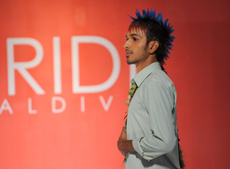
Grooms had mohican hair styles
Runway Brides
The highlight of the fair however seems to be the runway show, with photographers jostling for a good view alongside spectators throng to the catwalk podium once it starts.
Shamla is easily the most famous wedding gown designer in Maldives, and showcases her collection first. It’s impossible to get a good view of it.
The crowd settles a bit. Next, Aishath Roza’s collection, modeled to the theme song of Bride Fair ‘Forever bride to be’ by singer Unoosha.
Her collection diverges from the classic white gown, to include a maroon gown with a crunched skirt. An off shoulder gown with a chequered bodice of black, white and maroon and a golden gown with a ruffled skirt, and of course one white gown.
Saadha Ali’s collection is colourful, bright orange and blue wedding gowns give way to light pink and purple ones, a row of red flowers snaking down the bodice of the white gown gives it a pop of colour. Men make an appearance in shirts with pleating details on the front, however its their hair cut in a Mohican fashion, with blue colourings and a pony tail at the back that grab attention. Screams of appreciation fill the air when child models appear on the runway, the boys with the Mohican cut while the little girls sports flowers.
Colours give way to white gowns for the collection titled Venus by Naisha Ibrahim. The gowns are sleek, with detailing like silver bow ties on the bodice, ruffled full skirts, and flowers of earthy colours. Complimenting the gowns is the hair, pulled back and in a bun, with hers a slight re-working of the classic white gown. The models are breathtakingly beautiful and carry the wedding dresses well.
“All the designs showcased on the runway are made locally by Maldivian designers,” says Nuha.
The sheer variety of the gowns would leave a bride-to-be spoiled for choice. The Bride Fair seemed to be a success both in terms of showcasing local talents and providing a place for would be brides to get help in planning the big day.
The Maldives welcomes Chinese investment in the country’s resort industry, Maldives Ambassador to China Ahmed Latheef has told the Chinese newspaper Global Times.
Chinese visitors have eclipsed European arrivals as the country’s major tourism market this year, according to figures from the Maldives Tourism Ministry.
Latheef told the Global Times he welcomed investment from China in resorts to boost the development of local tourism, explaining that “the difficulty we have at the moment is that we do not have enough hotels or beds to cater to the growing market in China.”
“The Maldives and China have enjoyed excellent bilateral relations, and there are many areas that can be developed through Chinese involvement and engagement in the Maldives,” Latheef said. “We would welcome initiatives from Chinese investors in the development of tourist resorts.”
Democracy in the Maldives would have little credibility if it failed to empower the country’s women, Foreign Minister Dr Ahmed Shaheed has told the Council for a Community of Democracies.
The Council, which includes President of Lithuania Dalia Grybauskaite, President of Libera Ellen
Johnson Sirleaf and former Prime Minister of New Zealand Helen Clark, convened to discuss female representation in democracies and other issues pertaining to the empowerment of women.
Dr Shaheed told the Council that the Maldives has yet to adequately include women in its major democratic bodies, and that the exclusion of half of any given population from public and political life rendered notions of democracy hollow, and marginalising a large portion of society.
Religious extremism in the Maldives is the long-term result of the previous government’s repression of religious debate and learning, Minister of Islamic Affairs Dr Abdul Majeed Abdul Bari has said.
“As Muslims, Maldivians were keen to learn about Islam”, Dr Bari told Minivan News. The country’s education system as well as certain government policies, however, shut the door to such knowledge.
Dr Bari said many Maldivians were forced to travel abroad to seek religious enlightenment, and several ended up at the “wrong type” of institutions.
Some Maldivians attended the religious schools or ‘madhrasaas’ of Pakistan, targeted in the US-led War on Terror as ‘breeding grounds’ for terrorists. In addition to those indoctrinated at the madhrasaas, Dr Bari said, several Maldivian extremists were radicalised over the internet.
Dr Bari’s conclusion that some Maldivian extremists were radicalised online is in line with emerging Western literature on the subject as well as new anti-radicalisation laws in the West.
The Violent Radicalisation and Homegrown Terrorism Act 2007 passed by the United States House of Representatives, for example, identifies the internet as one of the main tools through which extremists spread their ideology.
The export of Dr Bari’s approach to rehabilitation was recently discussed on the popular American news blog, The Huffington Post.
Although Dr Bari was quoted in the article as having said his programme was successful in rehabilitating “hard-core terrorists”, he clarified that it was aimed at extremists.
“There are no hard-core terrorists in the Maldives. There are extremists, but no terrorists”, Dr Bari said.
The line between terrorists and extremists are too often blurred in both Western media and its policies, he added, as could be seen in the US-led military invasion of Afghanistan.
Dr Bari’s own definition of a ‘terrorist’ is “someone who commits violence against innocent people in the pursuit of a certain goal”. Harming innocent people, be it during peacetime or war, Dr Bari said, “is against the teachings of Islam.”
“If an American in the Maldives was harmed by someone who is angry with the policies of its government, that would be wrong”, he said. As practising Muslims, Maldivians should welcome and protect visiting Americans as they cannot be blamed for their government’s policies, he said.
The only known incident where extremists had crossed the line into terrorism in the Maldives was the bombings at Sultan Park in September 2007.
The confrontation between extremists and police in Himandhoo in October 2007, he said, may have been officially categorised as ‘terrorism’ but it was not a terrorist inciden t:”It was a violent confrontation that could have been avoided had there been discussion and dialogue.”
How to deradicalise
Dialogue is key to Dr Bari’s approach to the rehabilitation or de-radicalisation of extremists.
“We approach known extremists on friendly terms. Ministry-appointed scholars make the initial contact with known fundamentalists, meet them on their own terms and establish a rapport. This is followed by discussion and dialogue through which they come to realise that, in many cases, they have been misinformed about the teachings of Islam”, Dr Bari said.
All the people who were involved in the confrontation at Himnadhoo have now “fully reintegrated” into the community as a result of the programme, he said.
Dr Bari was unable to determine how many people in the Maldives have been categorised as ‘extremists’ in the Maldives. Neither was he able to provide the criteria used to define a person as an extremist: “It can be seen from a person’s behaviour. What they say and what they do”.
Dr Bari earned his doctorate at the University in Saudi Arabia’s Islamic University of Al-Madinah, focusing his research on a critical analysis of Fath al-Bari’s commentary on Sahih al-Bukhari.
Asked if religious discussion and debate should now be allowed more freely given the consequences of repression in the past, Dr Bari replied that any such debate “should be within Islam.”
Despite the lineup of international literary luminaries, ticket sales for October’s Hay Festival Maldives, the first Dhivehi ‘Woodstock of the mind’, are so dismal organisers are reluctant to divulge the exact figures. Less than ten were sold on the first day the tickets went on sale, and the daily sales figure has remained unchanged since.
The national and international line-up is impressive, the venue is Aarah, and the tickets cost a Rf100 for two days of literature, music and intellectual discussion. It is billed as a celebration of the ‘world’s most hopeful new democracies and oldest island cultures’ bringing together international and national artists for ‘a festival of ideas’.
“As a new democracy, the Maldives is the logical setting for the vital debates that affect us all,” President Nasheed said of the Festival.
Reading habits and local education levels suggest the logic maybe flawed.
What do Maldivians read?
Although the international authors lined up by the Hay Festival are all relevant to the emerging democracy of the Maldives, none of their books are available in any of the bookshops in Male’.
Enthusiastic Maldivian volunteers organising the event told Minivan all the books will be available from Aster’s bookshop before the Festival begins. For the moment, none of their work can be bought in a Maldivian bookshop. The National Library is currently closed, and Minivan could not check whether it stocks the books.
Without getting into a debate over what can and cannot be classified as ‘serious literature’, a random sample of bookshops in Male’ reveal their shelves to be almost entirely bare of any fiction at all, let alone any great works of literature or the works of the authors participating in the Festival.
The Minivan survey revealed the most recently opened bookshop in Male’ to be its the most well-stocked in terms of literature – it had a copy of Shakespeare’s Hamlet and Harper Lee’s classic ‘To Kill a Mockingbird’ as well as a few children’s classics, a few Roald Dahls, almost all the Harry Potter books, and a vast collection of Enid Blyton.
American teenage sensations Hannah Montana and Mary-Kate Ashley filled the remaining shelves, along with copies of four books on Maldivian law written by the proprietor.
The one and only bookshop in Hulhumale’ carried one book of fiction for adults written in English – ‘Three sexy tales: Playing Hard to get’ by Grace Octavia – according to the blurb, a ‘chic tale’ of three New York ‘It Girls’ and their lives.
There too, was a collection of Enid Blyton and the same American teenage fiction as the previous bookshop.
None of the local authors billed at the Hay Festival – Abdulla Sadiq, Habeeba Hussain Habeeb or Fathimath Nahula – featured on its shelves. The only Maldivian literature were religious publications promoting spiritual guidance.
What can Maldivians read?
Only one percent of all Maldivian students are interested in the arts. Less than a quarter have shown an interest in science, while more than half pursue commercial subjects, according to 2008 O’Level exam figures published by the Education Ministry.
If less than one percent of Maldivian students are interested in the arts, it indicates that only a minuscule number of Maldivians will grow up to be interested in literature, music, art, film, poetry or any of the activities that the Hay Festival celebrates. Had science had a stronger pull, perhaps the line-up of world-class environmental writers may have drawn a bigger crowd.
Although 90 percent of students sat the compulsory subject of English as a Second Language, only 0.1 percent took the English Language exam. The number of students who took the literature exam was marginally higher at 0.2 percent.
Of the 90 percent of students who did study English as a second language, only 20 percent passed. It was also English as a Second Language that received the most number of ‘U’s meaning ‘Unclassified’ or ‘Ungraded’ in 2008. In the same year, over 24 percent of students who sat the O’levels did not pass any subjects at all.
The ‘logic’ of choosing Maldives as a venue for the Hay Festival, a celebration of some of the best international and local literature, appears less than clear cut in view of local reading habits and education levels.
China has eclipsed the traditional European tourism markets of the Maldives to become the highest contributor of tourist arrivals to the country, but that gain is unlikely to last, says the Maldives Association of Tourism Industry (MATI).
Figures from the Ministry of Tourism indicate that that 15.3 percent of all arrivals this year originated from China – a staggering growth rate of 137 percent compared to the first eight months of 2009.
UK arrivals, traditionally the Maldives’ greatest market, sits at 14.9 percent followed by Italy at 12.6 percent. Average length of stay has dropped to 7.7 days, compared to the same period 8.1 last year.
Secretary General of MATI, Sim Mohamed Ibrahim, told Minivan News that Chinese tourists regarded the Maldives as a “novelty” destination, and that the growth would not last.
“The Chinese can swamp a destination in terms of numbers, but this is not the tourism the Maldives is about. Our product attracts sunseekers – Europeans,” he said.
“The Chinese who come do not come for the sun and the beach – they come because the Maldives is a novelty, a safe destination, and because of their new-found freedom to travel. Resorts are saying there are not many repeat visitors from China.”
Sim said that while it was “a good thing” that the spike in Chinese arrivals had filled in a seasonal gap in the market, Chinese tourists were comparatively low “yield” compared to other markets.
“137 percent growth is huge, but that’s heads-on-beds,” Sim said. This had not “had the impact on yield as much as it should” because of lower-than-average length of stays, uptake of full board packages and a general disinclination among Chinese visitors to spend on resort restaurants, bars and excursions.
“What we’ve seen January to August is that while most traditional markets have grown, except Italy, there hasn’t been much difference in arrivals figures from Jan-August last year. But Germany, France and the UK are all registering growth and picking up.”
Seasonal dips in the Maldives market during warmer months in the northern hemisphere have historically been filled with the arrival of Russians and Japanese, Sim explained.
“he Japanese market is not growing – it used to be a good market but it hasn’t been showing growth, and we need to do more work in Japan,” he said.
Early visitors from Russia used to be among the highest yield tourists, “but they have since become more seasonal like everyone else.”
“South Africa would be a good market for us, but it requires good flight connections, perhaps via Mumbai.”
The Maldives was proving a victim of fashions in the travel industry, Sim noted, particularly in the high-end segment.
“Right now the Seychelles and Mauritius are in fashion. We haven’t done much in terms of destination marketing, and we have lost the buzz we used to have. We have no new products that people can afford, there’s been mismanagement of the local economy, and it’s been hard for the new government to put things back together,” he said.
“Environmental doomsday messages” had not helped attract investors either, he added.
“Hopefully the new budget will have more money for destination marketing.”
Police have arrested three individuals in connection with the alleged murder of oil businessman Hussain Mohamed Manik, who found dead inside an abandoned house on Hoarafushi in Haa Alifu Atoll yesterday.
Police Sub-Inspector Ahmed Shiyam said it was “too early in the investigation for police to release information”, however newspaper Haveeru published the names of those it claimed were the suspects and said they were Hoarafushi natives of 18-25 years of age.
Manik”s alleged murder has gripped the country and triggered uproar among the islanders, who have blamed the incident on gang attacks and set several huts on fire in retaliation.
Media reported yesterday that Manik’s hands were tied behind his back with rope, and that the body was lying on the ground in a prone position when discovered. An island official told Minivan News that there were no injuries on the outside the body.
President Mohamed Nasheed has meanwhile issued a statement of condolences to members of the bereaved family, while the Human Rights Commission of the Maldives (HRCM) has “strongly condemned the violation of the right to life”, and called on “concerned state institutions” to “take strong action against such inhuman activities.”
Islanders have reported that oil is unobtainable on Hoarafushi since Manik’s death.
The Maldives National Defence Force (MNDF) has denied threatening to set fire to the car of DRP MP and Football Association head Ali Azim.
The media reported allegations by Azim that the MNDF had threatened him after the Football Association of Maldives (FAM) decided not to allow any of the Force’s teams to participate in their tournaments.
“It is false to say MNDF threatened him, I am totally sure that MNDF would never fall to such a low level,’’ MNDF spokesperson Major Abdul Raheem told Minivan News. “All the telephones here are easily accessible to almost all the staff, so it is possible that a staff member working here called him and made the threat.’’
He said that did not mean that it was an “official call” from the MNDF.
‘’It is very difficult to track down the person who called, but MNDF and the police are trying to figure it out,’’ Raheem said.
“Although we were all demoralised by the decision of FAM to disallow our participation in the tournaments, we would not do something like this,” he said. “We eagerly want to take part in the FAM tournaments and we are still trying for it.’’
Everything the MNDF did to regain access to the tournament would be conducted in accordance with the laws.
Azim had told local newspapers that a number belonging to the MNDF contacted his brother and threatened that his car will be set on fire.
‘’The phone call was made from an MNDF number to Mohamed Shiyaz [brother of Azim]. The caller said they had been trying to get in touch to me, and told him to tell me they will set fire to my car,’’ Azim told the media.
Haveeru called the number and found it belonged to the MNDF’s communication department.
 (0)Dislikes
 (0)
(0)