President’s Human Rights Ambassador calls on Elections Commission to dissolve “terrorist” MDP

Human Rights Ambassador of the President’s Office Ahmed Ibrahim “Sandhaanu” Didi has called on Elections Commission (EC) President Fuad Thaufeeq to dissolve the Maldivian Democratic Party (MDP), calling it an “unlawful organisation which commits terrorist activities and attempts to undermine the powers of the state.”

“Fuad Thaufeeq must pronounce the MDP an illegal party and remove it from the political party registry immediately. They shouldn’t be allowed to exist,” he told a press conference on Monday afternoon.

“Article 27 and 32 of the constitution allows freedom of expression and assembly without any limits. However, we must bear in mind that we cannot exercise these rights in a manner which infringes upon the rights of others,” Ibrahim Didi said.

“The roads of Male’ have been in chaos for the past year. One of the groups is calling for early elections, which itself is against our constitution,” he continued.

“I see no reason for there to be dissenting political views. Former President Mohamed Nasheed handed in his resignation on live TV. There should be no questions around this.”

Ibrahim Didi stated that all concerned parties had initially accepted the findings released by the Commission of National Inquiry (CoNI), a Commonwealth-backed inquiry commission set in place through presidential decree by President Dr Mohamed Waheed Hassan Manik.

“If some of these people later decided to go against that stand, we are not obliged to listen to them. If we are to go on like this, the world will come to believe we are fools,” Ibrahim Didi said.

He added the charges against former President and current MDP presidential candidate Nasheed will not become political “just because he and his supporters say so.”

“Even Almighty God loves all of his subjects. But if any of us sins, He will punish as is due. The same law of nature applies to the case at hand,” said the human rights ambassador.

Ibrahim Didi stated that the current MDP protests were unlawful as they are calling on the Prosecutor General (PG) to withdraw charges against Nasheed, which he said was unlawful under the Maldivian constitution.

“If in their protests, the MDP are calling for the charges against Nasheed to be withdrawn, their demands are unlawful as per the constitution. These charges are being pressed by an independent institution. They are calling to undermine the powers of this institution. So I must ask for this party, these people, to be arrested and detained. I am saying this because this party is trying to undermine the powers of the republic and the constitution.”

Ibrahim Didi alleged that MDP supporters had set to the streets “with one objective alone: to undermine the powers of our constitution.”

Ibrahim Didi further spoke about the importance of all political parties having the same views and objectives.

“I cannot believe, in fact, I do not at all want to believe, that there can be anyone with views opposing that of the government. There should be no opposition parties. Everyone should have the same views. There can, however, be parties created to hold the government accountable.”

Ibrahim Didi alleged that “more than political activities, [MDP] is creating havoc on the streets, setting places on fire and creating chaos.”

“Even when their presidential candidate is a criminal, they keep saying no, no, no, we still want him,” Ibrahim Didi said of Nasheed’s supporters.

Ibrahim Didi responded that he “personally held no doubts that Nasheed is a criminal”, when a journalist asked how he could refer to Nasheed as a criminal before the courts ruled on the case.

Elections Commission “disappointed”

President of the Elections Commission Fuad Thaufeeq stated that he was “deeply saddened that a person like Ahmed Ibrahim Didi would call for such an undemocratic act as terminating a political party.”

“The MDP is the largest political party with over 46,000 members. If we add together the membership numbers of the second and third largest parties, DRP and PPM, the total number is approximately equal to the membership of MDP as a single party. Is he asking us to take away the rights of this many citizens?” Thaufeeq said.

“Protesting is a constitutional right granted to all people. That is not a reason to terminate any party. The EC, to date, has not seen any reason to terminate any political party. We are also observing the activities of the parties,” Thaufeeq continued.

“I am appalled that Ahmed Ibrahim Didi would call on us to do such a thing. Since freedom of expression is a constitutional right, anyone can say what they please as long as it aligns with the constitution and Islamic values,” he said.

“Hence, Ibrahim Didi has a right to call for MDP to be terminated, and MDP has a right to call for Nasheed’s trial to be postponed. There is no valid reason here for a party to be terminated.”

No police brutality: HR Ambassador
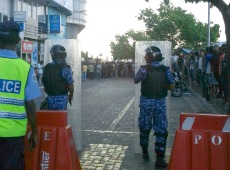
Ibrahim Didi further stated that he did not believe that the police had committed any acts of brutality in the past year.

“I am very concerned that the Human Rights Commission released a statement saying police have used excessive force. If someone comes at police with a wooden club with excessive force, then police too will respond and go at them with excessive force. One can’t judge these actions unless they are there on the spot,” he stated.

“I saw on DhiTV today that Fuad Thaufeeq has said we can have a free and fair election if we can resolve issues between MDP and the police. This is a highly irresponsible statement,” he said.

“Anyone who speaks against the police are traitors to the nation. People who have problems with the police are all criminals. People from political parties will never have problems with the police,” Ibrahim Didi said.

Vice President of the Human Rights Commission of the Maldives Ahmed Tholal said the commission had always called on people to demonstrate peacefully as allowed in the constitution, and the police to exercise restraint.

“Even in an instance where a demonstration becomes violent, I do not believe the state should respond in kind. None of our laws allow any form of violence. Should protesters get violent, then the state should only take proper legal action against the perpetrators. The state cannot at all respond with similar forms of violence as the perpetrators,” Tholal said.

Roles of the Human Rights Ambassador

Ibrahim Didi said that one could compare protests under past administrations to the current protests being held by MDP.

Asked by journalists if, as Human Rights Ambassador, Ibrahim Didi believed the December 2011 protests by the current government aligned parties could be termed “peaceful”, in which protesters uprooted trees and a policeman was attacked with fire, Ibrahim Didi stated that “we are not here to hold a hearing on this” and “we will need to review past protests before commenting on that.”

“Any persons who challenge the constitution, who challenge the judicial system, cannot be termed as a political party. They must be termed an unlawful organisation and must be removed from the political party registry,” Ibrahim Didi responded, when asked if the parties that participated in the December 2011 protests which had called to “topple” the then government should also be terminated for undermining the constitution.

Local media also asked Ibrahim Didi what he, as current Ambassador and previously a strong critic of Gayoom, had done to ensure that justice was delivered for victims of human rights abuses during Gayoom’s 30 year regime.

“I stand by everything I have said about Gayoom’s actions. Even though I am here as an Ambassador for Human Rights, I think it is better if those questions are asked of the commission Nasheed made during his administration to look into those very allegations.”

Ibrahim Didi concluded the press event by stating that he did not accept the judiciary was functioning, saying “these arsonists would not be walking around on our streets freely if the judiciary could perform right.”

“Sheer madness”: MDP
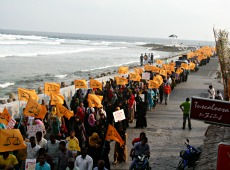
MDP Spokesperson Imthiyaz Fahmy said it was not at Ibrahim Didi’s discretion to terminate a political party, adding that such things were done under certain norms and procedures.

“The MDP is the party that stood up for Ibrahim Didi himself, when he was sentenced to life imprisonment for exercising freedom of expression during Gayoom’s brutal regime. And today has he no shame calling for this party to be terminated?” Fahmy asked.

“It is sheer madness to call for the termination of the country’s largest and first democratic political party. Terminating a political party in this manner is simply not possible in a democratic environment, it is like calling a square a circle. I cannot understand what kind of policies the man is following. It is sheer madness to make remarks like he has made today,” Fahmy said.

“He doesn’t understand the simple concept of the presumption of innocence, and has proceeded to call Nasheed a criminal. In fact, he has today called almost half the population criminals by saying anyone who has issues against the police are criminals,” Fahmy said.

Likes(0)Dislikes(0)

“Certain actions by protesters could be classed as terrorism”: Police Superintendent

Superintendent of Police Abdulla Nawaz has claimed that certain actions performed by protesters in the recent demonstrations in Male’ could be defined as acts of terrorism.

The recent protests in the capital have seen supporters of former President Nasheed clash with riot police, resulting in multiple arrests and damage to police property.

Nawaz told Minivan News on Monday (February 18) that certain acts performed by protesters over the last few days – including setting fire to a police vehicle – “could be classed as terrorism”.

“It is not that we [Maldives Police Service (MPS)] are directly saying it was terrorism, but more the setting fire to a police vehicle and barricade, as well as threatening phone calls to officers, could be defined under terrorism.

“We always ask protesters not to opt for violence, it doesn’t matter which party they belong to. I personally believe things should not have happened like they have been recently,” Nawaz added.

Superintendent Nawaz, who is also Head of Public Affairs Department, stressed that while the police welcomed peaceful protests, demonstrations over the last three days have not always remained that way.

Asked whether police would have to respond differently to tackle “actions that would be defined as terrorism”, Nawaz said: “From the torching of  a vehicle to protesters throwing stones and bottles at police, of course police will have to act differently depending on how serious the crime is”.

On Saturday night (February 16) a police vehicle belonging to the Police Family and Child Protection Department was set on fire while parked in Male’.

Police also claimed protesters set fire to a police barricade in the early hours of Sunday (February 17) morning.

Following the recent protests, a statement from MPS released today announced that the Criminal Court had issued warrants for the arrest of 16 individuals allegedly involved in the “unrest and mob violence” in the recent protests of the Maldivian Democratic Party (MDP).

A police press briefing revealed that a total of 84 people, including two minors and four females, had been taken into police custody following the unrest.

Out of 61 individuals later presented to the court, 16 were allowed to remain in police custody in order to continue with the investigation.

According to the statement, Nawaz said police will also continue investigations into those who have also been released by court order.

Officers injured, harassed on the street

Speaking at the press briefing Nawaz said that in the last four days of the protest, 14 police officers and one Maldives National Defence Force (MNDF) security officer had suffered injuries from protesters throwing bricks and glass bottles into police lines.

Nawaz said that the recent protests could be described as peaceful assembly adding that the protest “is rather believed as an act to impeded police duty and terrorise the capital city Male’”.

According to the statement, “Police officers of different ranks have received threatening calls and text messages from unknown numbers from abroad”.

The statement specifically notes an incident whereby a police officer on the street was harassed with inappropriate language in front of his three-year-old child, “who has since suffered from psychological trauma”.

Likes(1)Dislikes(0)

DRP overtakes PPM in member numbers

The Dhivehi Rayyithunge Party (DRP) has become the second largest political party in the Maldives, overtaking Progressive Party of Maldives (PPM) in membership numbers.

According to local media, the number of members in the DRP now stands at 22,687 – a 64 member lead on the 22,263 members of PPM.

The largest party in the Maldives, the Maldivian Democratic Party (MDP), stood at 47,192 members as of December last year.

However, local media reported that the latest Election Commission (EC) numbers for the MDP show that the party had lost 237 members this month alone.

President Mohamed Waheed Hassan Manik’s Gaumee Ittihad Party (GIP) gained the most members in February, according to local media, increasing its membership by 372.

Amongst the 16 political parties in the country, Jumhooree Party (JP) currently has the most member registration forms pending in the EC with 2595 waiting to be approved.

Likes(0)Dislikes(0)

Hulhumale’ Magistrate Court issues second arrest warrant for Nasheed

The Hulhumale’ Magistrate Court has issued a second arrest warrant for former President Mohamed Nasheed, an official from the Judiciary Media Unity has confirmed.

Five days after Nasheed sought refuge inside the Indian High Commission, the Judiciary Media Unity confirmed to Minivan News that Hulhumale’ Magistrate Court has now issued a new arrest warrant, ordering police to produce Nasheed at the court on February 20 at 4:00pm.

Police Spokesperson Sub Inspector Hassan Haneef also confirmed that the Maldives Police Service had received the court order for Nasheed’s arrest.

The former president has been taking refuge inside the Indian High Commission building in Male’ since February 13 to avoid arrest, after Hulhumale’ court previously ordered police to produce him at his scheduled trial.

Nasheed and his party have maintained that the charges put forward against him – of illegally detaining Chief Criminal Court Judge Abdulla Mohamed during his final days in office – are a politically-motivated attempt to prevent him from contesting presidential elections scheduled for later this year.

The latest arrest warrant comes after Nasheed failed to attend the last two scheduled trial hearings on February 10 and February 13.

An official from the Indian High Commission told Minivan News they were waiting to see the arrest warrant and are “watching the current situation”.

The situation has contributed to an escalation in diplomatic tensions between India and the Maldives, which has accused the former of interference in internal Maldivian affairs.

High Commissioner D M Mulay was summoned to the Foreign Ministry on Sunday and presented with a protest note from the government.

On Monday the High Commission released a statement “denying in entirety” allegations that it was being used by the former President “for political meetings and instigating street violence”.

Thousands of supporters of the former president have been protesting in the capital Male’ since Nasheed moved into the Indian High Commission last Wednesday.

On Saturday (February 16) over 5000 supporters marched through the streets of Male’ clashing with police, which resulted in 55 arrests during the night.

Nasheed’s decision to seek asylum in the Indian High Commission caught the attention of the international community last week. The US, UK, EU, UN and Commonwealth have since urged the Maldivian government to show restraint, whilst calling for “inclusive, free and fair elections” in September.

Arrest warrant is a threat to Nasheed’s life: MDP

Following the news of the latest warrant, Maldivian Democratic Party (MDP) Spokesperson Hamid Abdul Ghafoor said that the party are “firmly” against the former President from standing trial in an “illegitimate court”.

“The party firmly believes that he should not go [to Hulhumale’ Magistrate Court] and we firmly believe that the arrest warrant threatens his life.

“The moment he steps out of the Indian High Commission, that will be the end of him. Even the international community have recognised this as a witch hunt,” Ghafoor told Minivan News.

When asked as to whether former president will comply with the court order, Ghafoor said “it is Nasheed’s call”.

“The question is, what do the Indians do now? The Maldives authorities will now have to approach the Indian High Commission and ask them to hand him over.

“The minute the Indian government gave him refuge, they took a position. I can’t see the Indian government dropping Nasheed like a hot potato,” Ghafoor added.

The MDP spokesperson claimed the government had alienated itself from the international community given their stance on the matter. Ghafoor further claimed that foreign governments and organisations “can see” that attempts to arrest Nasheed “are nothing more than a witch hunt”.

India’s involvement criticised by Maldives officials

India’s involvement in the political dispute has been criticised by members of the Maldivian government, with the Home Minister Mohamed Jameel Ahmed tweeting last week: “What’s happening now gives us an indication of the extent and level of interest some countries prepared to take in our internal matters,” he said.

“I would strongly urge everyone to let our institutions deal with the challenges, and allow the Maldives to uphold rule of law,” he tweeted.

President of the Maldives, Mohamed Waheed Hassan Manik released his own statement yesterday condemning Nasheed’s actions on Wednesday.

“I am dismayed that the former President Nasheed sought refuge in the Indian High Commission in Male’ when he was summoned to the court. The court order which required the Police to arrest Nasheed and have him appear before the court was due to his refusal to attend court hearing. It had expired at 1600 hours on the 13 February 2013, and there is no reason for him to remain in the High Commission and to instigate street violence.

“The court order has nothing to do with my government. Upholding the rule of law means nobody is above the law. I would like to assure the people of Maldives that the law and order will be maintained,” the President’s statement read.

Likes(1)Dislikes(0)

Uncertainty the only certainty in Maldives capital

As tensions between the Maldives’ government and India continue to rise over allowing former President Mohamed Nasheed high commission refuge from his arrest warrant, conspiracies spread through social media networks are furthering uncertainty in the capital.

The rumours first came around 10:00pm – and social media was quick to respond.

Former President Nasheed was once again facing a warrant for his arrest, in what his party contend are a politically-motivated attempt by the country’s compromised courts to bar him from standing for election.

With both the government and Indian officials claiming yesterday evening they were unaware of any new arrest warrant, the real drama – it seemed – was happening on Twitter.

One prominent representative for the Nasheed-aligned opposition Maldivian Democratic Party (MDP) wrote on the social media site yesterday:

“Local media reports new Court order to Police to Present Prez Nasheed before court on Wednesday [February 20]. Will the police barge into the Indian HC?”

Other social media users were quick to respond in a manner critical of the former president’s actions:

“police might nt barge in.. but that doesn’t mean indian high commission is not hiding the suspected criminal@MohamedNasheed.”

Fanciful tales from either side of the Maldives political divide are nothing new. Yet it is a sign of either the impact of social media, or the diplomatic unease between Male’ and the Indian government, that the prospect of a police raid on diplomatic territory or a one-time head of state being smuggled out of the country can hold any credibility.

Nasheed has been in the chancery building since Wednesday (February 13), pulling India into domestic Maldivian politics.

How long he is able to remain there is uncertain, considering pressure from senior government figures that he be handed over to face trial.

The tweets hinted that a hugely significant event in an already turbulent period in Maldives history was on the verge of coming to pass.  There was just one problem: neither the government or the High Commission of India were aware of any plot or conspiracy to remove the former president from his sanctuary.

Had India been made aware of attempts to re-issue an arrest warrant and possibly bring Mr Nasheed into custody? “Not yet,” said an Indian High Commission source.

Had the government heard of whether judicial authorities and police would be taking proceedings against the former president? “No, not heard of it before,” a government official responded off the record.

Rumour and uncertainty were once again the driving force of political discourse concerning the government, Nasheed and the Indian High Commission.

Outside the Indian High Commission building at 10:30pm last night, staff were servicing a sedan car and seemingly working to ensure nothing was visible through  its back seat windows. Meanwhile, police officers at infrequent intervals would pass the commission building on their way to deal with a third consecutive night of demonstrations.

Most of the officers paid little attention to diplomatic building at the centre of the nation’s latest political turmoil. However by midnight, a handful of officers had set up temporary barricades outside the chancery.

At the same time, MDP protesters made their way to barriers set up around the corner on Sosun Magu.

Was this the beginning of an audacious attempt to retrieve the former president from his diplomatic confines? The relatively free passage of tourists, students and a small number of locals through the nearby barricades suggested not.

Half an hour later, a single figure finally appeared from the high commission building – surveying the scene up and down the street before entering the sedan and quickly reversing the vehicle into a concealed garage area. The vehicle’s lights remained visible for a few minutes behind the garage door – then they were switched off.

Things remained quiet until 1:30am, when two police officers guarding the temporary barricades outside the Indian High Commission building took notice of some discarded material staff had left behind after the servicing of the vehicle.

The material raised great interest from one of the officers as he lifted a thin piece of dark tape up to eye level for further inspection. He called over his fellow officer.  Then for a brief moment, they engaged in what appeared to be a game of peek-a-boo before returning to manning their barricade.

The street, as for the last three hours, returned to relative silence.

By morning, Nasheed – as far as anyone knows – remained in the high commission. Meanwhile, diplomatic relations between India and Maldives, though reportedly strained, are still being observed.

Nasheed, it is confirmed, is to be summoned before the courts in 48 hours time.  His immediate future remains unknown.

In the Maldives capital it seems, the only certainty remains uncertainty.

Likes(0)Dislikes(0)

Further protests as MDP calls for international community to be “mindful” of Maldives judiciary

The Maldivian Democratic Party (MDP) has called for the international community to be “mindful” of the status of the Maldives judiciary, claiming it to be systematically flawed and biased.

The party’s sentiments were echoed in last night’s (February 16) protest as thousands of supporters of Nasheed once again took to the streets of Male’.

The former President has been inside the Indian High Commission since Wednesday afternoon after he sought refuge from a court warrant ordering police to present him before the Hulhumale’ Magistrate Court.

Nasheed and his party have maintained that the charges – of illegally detaining Chief Criminal Court Judge Abdulla Mohamed prior to his controversial resignation on February 7, 2012 – are a politically-motivated attempt to prevent him from contesting presidential elections scheduled for later this year.

In contrast to Friday night’s protest, where 55 people were arrested following clashes with police, demonstrators last night took part in a “seated protest” in the intersection between Majeedhee Magu and Chaandhanee Magu.

Maldives Police Service (MPS) Spokesperson Sub Inspector Hassan Haneef told Minivan News today that while there had been no arrests made, a vehicle belonging to the Police Family and Child Protection Department was set on fire.

Police also allege that protesters set fire to a police barricade in the early hours of the morning.

However, MDP Spokesperson Hamid Abdul Ghafoor claimed the circumstances surrounding the barricade fire were suspicious.

“There had been reports that a police barricade was set on fire by protesters. However police tweeted about the fire two minutes before it actually happened,” Hamid claimed.

Minivan News observed around 4,000 demonstrators at last night’s gathering and witnessed multiple charges at the crowds by riot police.

MDP concern over Nasheed’s trial

statement released by the MDP yesterday expressed concern regarding the trial of former President Mohamed Nasheed, adding that the status of the judiciary and rule of law in the country was not conducive to ensuring a fair trial for the former president.

The statement accuses judges within the Maldives judiciary as being “under qualified, of dubious moral character, corrupt with political bias, and unduly influenced by members of the former regime”.

“When international actors refer to rule of law and due process, it is only a presumption that rule of law exists in the Maldives,” Ghafoor stated.

“When calling for rule of law in the Maldives our international partners must bare in mind the current state of the judiciary, and its ability to conduct a fair trial.”

Speaking to Minivan News on Thursday, trial observer Stephen Cragg, who compiled a report on Nasheed’s trial, said it was clear the former president was concerned he would not receive a fair trial with the current judges on the case.

Cragg visited the Maldives last year on behalf of the Bar Human Rights Committee (BHRC) to observe the hearings of former President Nasheed’s trial.

“I think it is clear that Mr Nasheed is concerned that he will not get a fair trial if the case goes ahead with the current judges due to hear the case, and his action is likely to highlight those concerns internationally,” Cragg said.

The report compiled by Cragg notes: “BHRC is concerned that a primary motivation behind the present trial is a desire by those in power to exclude Mr Nasheed from standing in the 2013 elections, and notes international opinion that this would not be a positive outcome for the Maldives.”

In the statement, the MDP welcomed calls from India, United Kingdom, United States, the Commonwealth, United Nations and the European Union for a free, fair and inclusive presidential election in the Maldives.

On Friday, EU High Representative Catherine Ashton said she was following the latest developments “with concern” and “called on all parties to refrain from actions or statements which are liable to inflame the political climate in the country”.

“I underline the urgent need to resume dialogue between the parties, so as to ensure that the presidential elections set for September 2013 are credible, transparent, inclusive and fully representative of the wishes of all Maldivians, and so that the reforms identified by the Commission of National Inquiry in August 2012 can be rapidly implemented,” she said in a statement.

President of the Maldives, Mohamed Waheed Hassan Manik released his own statement yesterday condemning Nasheed’s actions on Wednesday.

“I am dismayed that the former President Nasheed sought refuge in the Indian High Commission in Male’ when he was summoned to the court. The court order which required the Police to arrest Nasheed and have him appear before the court was due to his refusal to attend court hearing. It had expired at 1600 hours on the 13 February 2013, and there is no reason for him to remain in the High Commission and to instigate street violence.

“The court order has nothing to do with my government. Upholding the rule of law means nobody is above the law. I would like to assure the people of Maldives that the law and order will be maintained,” the President’s statement reads.

Likes(0)Dislikes(0)

PPM Yameen meets Indian High Commissioner DM Mulay

Progressive Party of the Maldives (PPM) Parliamentary Group Leader Abdulla Yameen met with Indian High Commissioner to the Maldives DM Mulay yesterday (February 16), local media reported.

The High Commissioner told local media that the meeting was to encourage dialogue in order to resolve the current situation in the Maldives.

According to local media, Mulay said he is in contact with officials in the government of Maldives, political parties and other intellectuals to encourage conversation towards a peaceful resolution to the current political instability.

Yameen said he met with Mulay in the PPM office and that the high commissioner visited to assure him the relationship between India and the Maldives would remain unchanged, local media reported.

The meeting follows former President Nasheed’s decision to seek refuge within the Indian High Commission in Male’ after he failed to attend a court hearing last week.

Likes(0)Dislikes(0)

Police used disproportionate force against MDP protesters: HRCM

The Human Rights Commission of the Maldives (HRCM) has accused police of using disproportionate force when dispersing Friday night’s demonstrations by the Maldivian Democratic Party (MDP).

“HRCM is concerned that police have used disproportionate force when dispersing protesters, which caused different levels of injury and damage,” HRCM said in a statement.

The commission noted that male officers had been deployed to arrest female protesters, and had used undue force in making those arrests.

HRCM also stated that police officers had at times “used inappropriate language” during the demonstrations.

Police Sub Inspector Hassan Haneef, while welcoming the remarks of the HRCM, said “We hope HRCM will submit a detailed report, pointing out where and when these things happened, all the details, and then carry out discussions with us on it. We will then look into the issues we feel are necessary.

“However, we believe that we have used proportionate force in all instances during that protest,” Haneef stated.

“Male officers arresting female officers is not prohibited in the Police Act. I do understand that may not be the desired route of action. However, according to the situation at hand, it’s not always logically possible to send officers of the same gender to the scene,” he added.

Children in protests

HRCM also expressed concern that under-age participants were seen at Friday’s protests.

Haneef previously confirmed one minor had been arrested on Friday along with 54 other protesters.

HRCM also alleged some demonstrators acted in a manner which would “create conflicts and harm the peaceful nature of the protest.”

“This commission has also noticed that when broadcasting updates of the protests, some TV channels show news and footage in a manner that distorts the reality of the events that occur,” HRCM said, without naming specific TV channels.

HRCM Vice President Ahmed Tholal was not responding to calls at the time of press.

“Lots of statements, no action”

The Police Integrity Commission (PIC) has recently complained that the government takes no action even when cases of police brutality and misconduct are forwarded to the Home Ministry.

One officer the PIC accused of misconduct and recommended be suspended following its investigation of the events of February 8, 2012, was instead promoted twice.

“We have already seen a lot of these statements and reports. Some have pointed out many acts of police brutality and the use of excessive force. Why is it that no actions are taken against any of these people?” MDP Spokesperson Imthiyaz Fahmy said, in response to the statement by the HRCM.

“It must be because all these institutions have failed. We can say that the brutality is encouraged by the failure of the institutions. The police are acting with total impunity. The inaction of the institutions is an endorsement of these vile acts,” Fahmy said.

Fahmy also responded to HRCM’s concerns that underage participants had been observed at the protest.

“When the nation has fallen to the state it is in now, everyone, be they young toddlers or the elderly, must come out and take a stand. An innocent action carries warrant. Everyone must come out now,” Fahmy said.

The Progressive Party of Maldives (PPM) meanwhile condemned the protests, with PPM MP Ahmed Mahlouf telling local media they were intended to “create chaos”.

“A number of protests were held during last year. We did not seen the police obstructing protesters during peaceful protests,” Mahlouf said.

Former President and MDP presidential candidate Mohamed Nasheed has been taking refuge in the Indian High Commission since February 13 after police sought to arrest him and present him to the Hulhumale’ Magistrate Court.

Nasheed’s supporters and MDP members have since taken to the streets in a series of protests, calling on the state to facilitate an “inclusive free and fair election” where all candidates are allowed to participate.

Likes(0)Dislikes(0)

High Court concludes city council’s appeal into ownership of MDP protest site

The High Court on February 13 concluded an appeal by Male’ City Council (MCC) over the ownership of the ‘Usfasgandu’ land plot in the capital, leased to the opposition Maldivian Democratic Party (MDP).

The court is expected to rule on the appeal during the next hearing of the trial, which has yet to be scheduled.

The council’s High Court appeal followed a case filed by the Housing Ministry at the Civil Court ordering the MCC to hand over the land in seven days. The plot of land has been used by the MDP as a base for protests in Male’ for much of last year.

Lawyers from the Attorney General’s told the court that the MCC had given the land to a political party that was supposed to be used for social and leisure purposes.

The MCC claimed that had not been given adequate opportunity by the lower court to present its defense before the ruling to hand over the land was made.

According to local media present at the court, the AG’s lawyers claimed it was the duty of the council to prove their innocence in the matter.

The presiding judges said a verdict would be delivered at the next hearing unless the court needed to further clarify the matter.

The Male’ City Council gave the land to the MDP after its protest site near the tsunami monument area was dismantled by military and police on March 19, 2012.  The camp was dismantled the same day President Dr Mohamed Waheed delivered his presidential speech to the parliament, amid protests inside and outside the parliament chamber.

In May 2012, the Maldives’ cabinet ordered the Usfasgandu site be handed over from the MDP-dominated council to the jurisdiction of the government’s Ministry of Housing.

Following what it called the “non-compliance” of the MCC in handing over the area, police were asked to intervene and “take over”.

A chain of appeals eventually led to the MDP being evicted from the site and cordoned off by police on the orders of the High Court.

Police has previously raided the site on the morning of May 29, 2012, after obtaining a search warrant from the Criminal Court.

The reasons for the search as stated on the warrant included: “suspected criminal activity”, “damage to public property”, and “suspected black magic performed in the area”.

Under ‘evidence’, the warrant alleged that people in the Usfasgandu area verbally abused police officers and damaged a police vehicle on April 20, obstructed a Maldives National Defence Force (MNDF) exercise of May 9, and on May 25 “MDP protesters threw a cursed rooster at MNDF officers.”

Likes(0)Dislikes(0)