Civil society groups slam government for “failure to ensure conducive environment for elections”

Prominent NGOs have released a joint human rights brief accusing the Maldivian government of failing to create conditions conducive to free and fair elections, ahead of the Commonwealth Ministerial Action Group (CMAG) meeting to be held in London this Friday.

The International Federation for Human Rights (FIDH) and the Maldivian Democracy Network (MDN) reported that with less than six months before the presidential elections “there are clear signs indicating that the coalition government in power since February 2012 has so far failed to set the conditions for free and fair elections in which ‘all parties and leaders are able freely to conduct election campaigns’.”

“The most critical matter in this regard is the continued interference of the executive on other branches of power, as manifested by the trial of several opposition members to prevent the opposition from running in the upcoming elections,” the brief reads.

Authorities have both failed to ensure a ‘free and fair’ atmosphere with respect to freedom of information or freedom to assembly, as well as made no efforts to inform and educate voters on electoral rights and responsibilities, the report claims.

FIDH and MDN highlight that promoting and protecting human rights has suffered from a “substantial lack of progress” and that a “culture of impunity for perpetrators of past human rights violations” has been institutionalised.

While “human rights abuses reduced drastically” following former President Mohamed Nasheed’s election in 2008, past and present police brutality, torture and impunity have gone unaddressed, states the brief.

Institutions such as the Police Integrity Commission (PIC), the Human Rights Commission of the Maldives (HRCM), and a Presidential Commission – created in 2009 and disbanded in 2012 – failed to investigate and address human rights abuses, including torture committed by the police services, given their limited mandates.

“The coalition government established in February 2012 has been accused of a wide range of human rights violations, from violent repression of street protests, arbitrary arrests, sexual harassment of female protesters, torture, harassment of pro-opposition media, to legal and physical harassment of members of the opposition,” states the brief.

“Since the HRCM made public its reports on these allegations in August 2012, no action has been taken for investigation or redress,” the brief continues.

Systematic omissions have been identified in the the Commission of National Inquiry (CoNI) “serious enough to raise fundamental questions about the accuracy of the report’s conclusions.” Furthermore, recommendations made by the CoNI on August 30, 2012 regarding human rights abuses, torture, and impunity “were immediately dismissed by senior government officials; this could only encourage the security forces to disregard the rule of law and commit further human rights abuses in impunity,” the brief reads.

“Uncertainties” have caused a “new phase of slowdown” in the country’s legal reform process as well.

“Women have suffered and still suffer from the absence of a strong legal framework… and women’s rights remain at risk of being curbed by religious parties influencing the governing coalition and pushing for the full implementation of Sharia,” the report states.

Rising tensions regarding interpretations of Islam is “particularly an area of concern” given the “fundamental views being introduced by the Adalath party and some religious groups, mainly those that are being linked with Shari’a and harsh punishments,” claims the brief.

“Bearing in mind that there is absolutely no public trust in the judiciary to have the capacity to deliver justice under these circumstances, those critical of these [religious] interpretations have faced violent consequences,” reads the brief. “To date, there are no reports of an investigation or any on-going effort to find the perpetrators of these crimes [of murder and attempted murder].”

Following Nasheed’s claim he was deposed in a coup d’état, the Commonwealth suspended the Maldives from the CMAG, and said it had decided to place the Maldives on its formal agenda in February 2012 because of “questions that remain about the precise circumstances of the change of government, as well as the fragility of the situation in the Maldives.”

In September 2012, CMAG decided the Maldives would remain on the agenda under the item “Matters of Interest to CMAG”, however its suspension from the international body’s democracy and human rights arm has now been revoked.

CMAG recommendations

FIDH and MDN emphasised that the newly reformed CMAG mandate includes “situations that might be regarded as constituting a serious or persistent violation of Commonwealth values”, and the “systematic denial of political space, such as through detention of political leaders or restriction of freedom of association, assembly or expression.”

“These situations have continuously characterised the political environment of the Maldives especially since the change of power of 7 February 2012.”

FIDH and MDN provided CMAG with five key recommendations in regard to the deteriorating human rights situation in the Maldives.

They compelled CMAG to raise concerns regarding human rights violations in the Maldives, especially allegations of police brutality and torture, and request government authorities take all necessary measures to prevent violence, respect the due process of law and prevent arbitrary arrests.

A review of CMAG’s position on CoNI report should be conducted, especially in reference to “later developments”.

CMAG should also advocate for the preservation and consolidation of democratic achievements and take all necessary steps to guarantee the conditions for free, fair and inclusive elections in September 2013.

Providing technical assistance to the Maldives’ government is recommended. This is necessary to strengthen the rule of law and support the development of public institutions, in particular the judiciary, as well as independent commissions such as the HRCM, the PIC, and the Judicial Service Commission (JSC).

Finally, provide support to civil society organizations to raise public awareness about the role of public institutions and the importance of separation of powers, develop human rights education programs, and play a key role monitoring democratic and independent institution building.

Maldivian government recommendations

FIDH and MDN also provided the Maldivian government with a list of 11 recommendations to improve the country’s human rights failures.

This includes strengthening independent commissions, such as the PIC, JSC, and HRCM, in accordance with CoNI report recommendations. Reforming the judiciary should also be prioritized.

The physical and psychological integrity of human rights defenders, journalists and members of the opposition must be also guaranteed in all circumstances.

Initiating a national campaign to address past human rights violations (1978-2008), including “accountability for perpetrators, acknowledgement, truth-telling mechanisms, reparations, and legal and institutional reforms to prevent occurrence of new violations” is recommended.

“Such mechanisms would also act as a deterrent to prevent any future form of harassment, intimidation, arbitrary arrest or ill-treatment by State security personnel,” the brief states.

Additionally, the Majlis (parliament) should “urgently enact” pending legislation, ensure civil society is consulted, and that the bills “fully conform with international human rights commitments and obligations of the Maldives.” Furthermore, the death penalty should not be enshrined in those texts.

FIDH and MDN also recommend the government fulfill its various international commitments. This includes investigating allegations of torture, adopting implementing legislation for the International Criminal Court statute, as well as guaranteeing the human rights and protections enshrined in the International Covenant on Civil and Political Rights (ICCPR).

Additionally, the scope of the Maldives’ reservation to Article 16 of the Convention on the Elimination of All Forms of Discrimination against Women (CEDAW) – which aims to eliminate discrimination in all matters relating to marriage and family relations, and ensures gender equality – should be significantly reduced.

Adhering to the recommendations of various UN Special Rapporteur’s, which have addressed some of the systemic problems within the judicial system and various human rights issues, is also recommended. As is arranging future Rapporteur’s missions regarding transitional justice and additional human rights challenges.

Government reaction

Minister of State for Foreign Affairs Dhunya Maumoon told local media yesterday (April 23) that Foreign Affairs Minister Dr Abdul Samad Abdullah had left for London April 22 to participate in the CMAG meeting.

Maumoon highlighted that this marks the first occasion the Maldives has been invited to a CMAG meeting since its removal from the agenda.

“The opportunity for the Maldivian Foreign Minister to participate in a CMAG meeting was a great achievement, and one which resulted from the efforts by President Waheed’s government in cooperation with the Commonwealth,” said Maumoon.

“Now Maldives will have the opportunity to partake in discussions at CMAG. But the Maldives delegation will not be present when the group discusses the Maldives,” she added.

Maumoon also reiterated the government’s position that the Maldives should not have been on CMAG’s agenda and that “the move was prompted by a lack of understanding of the true events that transpired in the Maldives.”

“Some countries” had realized this error and accused Nasheed of influencing CMAG members, Maumoon claimed.

While Maumoon admitted “there was always a fear of instability in Maldives due to the rather infant democracy in the country,” she also highlighted that “international partners have acknowledged the positive strides the country has made brought about in a relatively peaceful manner.”

In April 2012, Maldives’ permanent representative to the EU Ali Hussein Didi criticised the Commonwealth’s involvement in the Maldives, telling the European Parliament that the Commonwealth’s Ministerial Action Group (CMAG) lacked a clear mandate to place the Maldives on its agenda.

Likes(3)Dislikes(0)

Teen seriously injured in boat propeller accident

An 18 year-old was serious injured trying to disentangle a fishing line from a dhoni propeller and is being transferred to Sri Lanka for further medical treatment, reports local media.

Nauf Ibrahim suffered serious injuries from the ‘Mashhooru’ boat propeller while trying to remove an ensnared fishing line. His family members told local media that he dove into the sea to disentangle the line and was hit in the head by the propeller, which resulted in a skull fracture and internal bleeding.

The accident occurred yesterday (April 23) while the dhoni was fishing near Laamu Atoll.

Ibrahim first received medical treatment Laamu Atoll regional hospital, however he was transferred to the intensive care unit of Indira Gandhi Memorial Hospital (IGMH) in Male’ via the Maldives National Defence Force (MNDF) ‘Kurangi’ helicopter.

Ibrahim’s family claims he is not receiving sufficient medical treatment at IGMH and will be transferred to Sri Lanka today, courtesy of Meedhoo MP Ahmed Siyam Mohamed.

Ibrahim is from Meedhoo Island in Dhaalu Atoll.

Likes(0)Dislikes(0)

Islamic Ministry calls for lowering age of prosecution for minors to 10 years-old

The Islamic Ministry’s Fiqh Academy has requested parliament lower the age of prosecution for minors stipulated in the the Penal Code bill from 14 to 10 years-old, reports local media.

MP Ahmed Hamza, chairperson of the parliamentary committee reviewing the Penal Code Bill,
has said that international conventions state the age of prosecution for minors is 15 years-old.

“The age for a minor to be advised to mend his ways for forgoing compulsory deeds is 10 years-old,” according to the Fiqh Academy. Their commentary submitted to the parliamentary committee also claims that minors who commit offenses in the Maldives are 11 years-old or above.

Hamza claims that the Prosecutor General (PG) supports keeping the age of prosecution at 14 years-old, as stipulated in the current penal code bill draft.

“We will decide on setting an age after reflecting on the [international] conventions Maldives is party to, amongst other things. They are saying that the age given in the current penal code already poses some constraints,” said Hamza.

“The PG in favour of it being kept as it is, as in the current penal code, at 14 years. The Foreign Ministry has no objection to this either. But the Islamic Ministry is asking that it be lowered to 10,” he added.

The age for prosecuting minors is one of two penal code issues currently under debate. The second issue surrounds a recently added clause regarding someone convicted of a crime being sentenced according to the penal code stipulations, according to Hamza.

Likes(0)Dislikes(0)

Addu International Airport Company outsources dredging and reclamation of Gan International Airport

Addu International Airport Company (AIA) has contracted a Dubai-based group to undertake the dredging and reclamation component of developing Gan International Airport, Addu City Mayor Abdulla Sodig said today.

He confirmed a company called Gulf Cobla had been awarded the $11.7 million (MVR 180 million) project, which will include land reclamation to build seaplane terminals.  The contract will also include work on constructing revetments on the reclaimed land.  Revetments are barricades used to prevent aircraft from overshooting a runway.

“I had a word with [AIA and the State Trading Organisation (STO)] Managing Director Shahid Ali this morning and he said the project is going well. However, some people have misinterpreted the situation because a contract was given to Lagan and another was awarded to Gulf Cobla,” Mayor Sodig told Minivan News.

AIA is itself a joint venture formed by the Gan Airport Company Ltd (GACL), Maldives Airports Company Ltd (MACL) and the STO.

Sodig explained that a UK company called Lagan had won the main contract to develop the airport, but added that it was AIA who had outsourced additional dredging work that was required to be completed before the main runway expansion could begin.

AIA and STO Managing Director Shahid Ali confirmed to Minivan News today that: “AIA contracted directly with Gulf Cobla to conduct the dredging and land reclamation components.”

Shahid previously told local media that Gulf Cobla’s segment of the project would be completed within eight months and that it will facilitate seaplane services being provided from Gan International Airport.

“Dredging will take about eight months. We predict that the physical work can begin within one month of signing this contract,” he said.

Shahid said he expected the overall airport development project to be complete by September 2014.

AIA is also conducting negotiations with Sri Lankan Airlines, Bangkok Airways, and Air Asia to increase the number of international flights from the airport,” he added.

Gulf Cobla’s Managing Director Joost Post has also made assurances to media that the project would be completed within eight months, noting that the company had previously conducted four projects in the Maldives.

“Southern gateway to the world”

Mayor Sodig today said that the airport development would provide a huge boost to  transport links in the country.

“The airport will start seaplane operations to resorts in the Southern Atolls. Once the Gan Airport is developed, it will be the southern gateway to other parts of the world,” Sodig declared.

Gan Airport’s main runway needs a one kilometre extension toward the northwest and it will also be resurfaced with asphalt, Sodig explained.

“The seaplane base will be developed on the western side of the island,” he added.

“The shallow lagoon across from the western beach will be dredged and the sand will then be used to develop the seaplane strip and reclaim land for the main runway.  The area of the former Maldives National Defence Force (MNDF) Commander’s residence will be used to develop the seaplane terminal.”

Airport development controversy

Thirty percent of the AIA was sold in November 2012 to tourism pioneer ‘Champa’ Hussain Afeef’s Kasa Holdings to raise finances to develop the Gan airport in Addu City.

Goverment-aligned Jumhoree Party (JP) Leader MP Gasim Ibrahim previously denied in parliament that he had spoken against the sale of shares of AIA with the intention of buying shares himself. He claimed he had done so “in the best interests of Addu and the country.”

JP MP Alhan Fahmy added that he also wished to see the Addu airport developed, but was concerned with how the sale of shares had been carried out. Fahmy said that 30 percent of shares being sold off for MVR 60 million (US$3.89 million) was “nothing but daylight robbery”.

Meanwhile, a number of MPs from the opposition Maldivian Democratic Party (MDP) stated at the time that the party supported the concept of privatisation, adding that the development of the Addu airport was originally an MDP initiated plan.  However, the opposition MPs also expressed concern over how the bidding process had been carried out.

During a November 2012 press briefing, STO Shahid Ali stated that contrary to general speculation, the airport had not been “sold”, but rather shares from the company AIA that had been sold to KASA Holdings.

He also refuted allegations of corruption, saying that KASA Holdings had been given higher priority since it was a local company and that all proceedings had gone through the bidding process in a matter which was completely free of any corruption.

Addu City Council previously released a statement welcoming the signing of the contract which they said would lead to the development of the Addu airport.

The statement further noted “the importance of leaving politics aside and for the good of citizens in letting the venture bring positive changes to Addu’s economy.”

The MDP also released a statement in November urging “not to let political feuds, political needs and power play interfere in important work directly related to the development of Addu City citizens, and generally all Maldivian citizens.”

The statement also condemned Gasim’s threats to sack Shahid Ali, stating “This party calls on political leaders to refrain from making unlawful threats through the greed for power and political wants.”

Likes(0)Dislikes(0)

State seeks High Court ruling on President’s discretion to grant clemency in death sentences

The Maldivian state has sought a High Court ruling on the President’s discretion to commute death sentences to life imprisonment.

During a hearing on Monday in a case filed by five citizens seeking to annul laws granting the President discretionary powers of clemency,  the state attorney said the government would prefer the court itself provided a decision on the matter in accordance with Islamic Sharia.

The state attorney insisted that the decision be made by the court, despite the High Court Judges Bench emphasising that the state must provide an answer since the case concerned a constitutional matter.

The plaintiffs’ lawyer alleged that the state had previously been given a number of opportunities to be answerable to the case against them, and that it had used the excuse of conducting research as a bid to buy time, and waste the time of the court. He asked that the bench accept the state’s request and provide a verdict on the case at the earliest.

In the case’s last hearing held in November 2012, the High Court gave the state the last opportunity to be answerable to the charges against them.

Concluding today’s hearing, the bench announced that it will come to a verdict during the next hearing of the case.

The case, submitted in August 2012, seeks the annulment of Article 5(a.i) and Article 21 of the Clemency Act (2/2010).

Article 5(a.i) states that the punishment for the crime of murder cannot be pardoned, although clemency is allowed under restrictions stated in the Act.

Article 21 states that although it may have been stated otherwise in the Act, if the Supreme Court issues a death sentence, or if it backs a death sentence issued by the lower courts or the High Court, it is at the President’s discretion to grant clemency and transfer it to a life sentence with reference to the condition of the sentenced person, related legal norms, the interests of the state and the principles of humanity.

The case against the state asks for this annulment while referring to Article 10 of the Constitution of the Maldives, which states that no law can be enacted in the country which contradicts Islamic principles.

It then adds that according to Article 268, all legislation ratified in the country should be drafted within the principles detailed in the constitution, and that all laws and articles which do not align with this will be considered invalid.

The case, as reported previously by local media, further states that in Islamic Sharia, only the heir of the victim has the right to grant clemency or mercy to a murderer. It then states that a murderer can only be sentenced to death (ie gisas/retribution) if all heirs of the victim agree to it. It then goes on to say that neither the President nor any state institutions have the right to change a death sentence issued by a court of law.

It further states that should the President have it in his discretion to grant clemency in murder cases, this infringes upon the rights of the living heirs of murder victims.

It cited that the last time a death sentence was implemented in the country was in the year 1953, opining that although courts continued to sentence persons to death, “since then, the country has not had even one leader who has had the courage to implement this sentence.”

They case claims that the failure to implement the death penalty has “ruined this nation”, and that it infringes upon the citizens’ right to live, right to equitable treatment and right to travel among a number of other civil rights.

The case was submitted to court by five individuals; Abdul Maniu Hussain of Anbareege in Haa Alif Atoll Ihavandhoo, Hussain Shaheed of Baazeege in Seenu Atoll Hithadhoo, Abdulla Shiyaz of Naseema Manzil in Lhaviyani Atoll Naifaru, Abdulla Naseer of Boalhadhan’duge in Gaafu Dhaalu Atoll Gahdhoo and Hassan Waheed of Rankokaa in Haa Dhaalu Atoll Kurin’bi.

Government in support of death penalty implementation

In October 2012, the government announced its intention to introduce a bill to the People’s Majlis in order to guide and govern the implementation of the death penalty in the country.

President’s Office Spokesperson Masood Imad at the time referred to the October 2012 murder of religious scholar and MP Afrasheem Ali and stated, “We are having enormous pressure since these high profile murders. We have indications – the talk around the town – that there will be more murders.”

He added that the government had received a large number of calls for implementing the death penalty.

Similar to the ongoing case, in April 2012, MP Ahmed Mahloof from the government-aligned Progressive Party of the Maldives (PPM), proposed an amendment to the Clemency Act to ensure that the enforcement of the death penalty be mandatory in the event it was upheld by the Supreme Court.

In December 2012, the Attorney General’s Office completed drafting a bill outlining how the death sentence should be executed in the Maldives, with lethal injection being identified as the state’s preferred method of capital punishment.

However, earlier this year religious NGO Jamiyyathul Salaf has called on Attorney General (AG) Azima Shukoor to amend the government’s draft bill on the implementation of death penalty, urging that convicts be beheaded or shot instead of given lethal injection.

The bill is currently pending approval by parliament, and has given rise to dissenting opinions on the matter.

Likes(0)Dislikes(0)

India to provide Maldives with equipment, financial assistance for defence

India has pledged to provide the Maldives with an assortment of defence equipment, infrastructure, and training, reports local media.

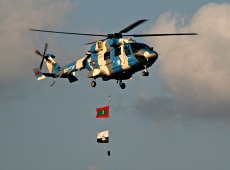
Seven radar systems, adding to the three already in place, are being given by the Indian government, as well as a helicopter for search, rescue and emergency evacuation in the northern Maldives.

Financial assistance is also being provided to construct a Coast Guard building and a harbor for Coast Guard vessels, in addition to establish a Maldives National Defence Force (MNDF) composite training centre in Lhaviyani Maafilaafushi.

The pledges were made by Indian Defence Minister A K Antony during Minister of Defence and National Security Minister Colonel (Rtd) Mohamed Nazim’s recent visit.

Likes(0)Dislikes(0)

Defence Minister forbids soldiers to publicly participate in politics

The Maldives’ Defence Minister has ordered soldiers to surrender their rights to political participation, despite allegations he has forming a political party.

Minister of Defence and National Security Colonel (Rtd) Mohamed Nazim said soldiers must forgo rights granted to civilians, refrain from politics, and limit their political participation to voting only, as stipulated in the Constitution and military law.

Speaking at an early-morning flag hoisting ceremony on Sunday (April 21) as part of the military’s 121 anniversary celebration, Nazim stated that there is “no room for politics in the military as long as I remain in this office”.

“Every soldier has to accept that some of the rights granted to a civilian in an open society are restricted to a soldier. One of these rights is the right to participate in political activities. I would like to tell you that the Constitution and the military law have curbed these rights from the soldier for a greater and larger purpose,” Nazim stated, according to local media.

“I would like to tell you today, that the role of a soldier is done once you exercise your right to cast your vote, entitled to every person above the age of 18. I would like to bid from all military personnel to refrain from partaking in political activities,” he added.

Nazim “assured” soldiers he will not issue political orders as long as he remains Minister of Defence.

He also stated that welfare benefits would be given to the defence forces once the government’s budgetary constraints are relieved, according to local media.

“Keep quiet and obey”

Maldives National Defense Force (MNDF) Spokesperson Colonel Abdul Raheem reiterated that military personnel cannot take part in any political activities or gatherings at any time. This includes registering for, or being a member of, any political parties.

Asked why the rule applies to military personnel, Raheem emphasised that orders must be followed.

“The MDNF does not want any soldiers participating in political activities. They have to keep quiet and obey,” Raheem said.

He explained that political activities even in a personal capacity are not allowed.

“Soldiers are not seen as ever being off duty, even when they are on leave or in the barracks,” Raheem said.

“The only time military personnel can politically participate is when they go to vote. They can decide for themselves who to vote for. Around 7-10 years ago soldiers could not vote,” he added.

Nazim was not responding to calls at time of press.

Nazim already involved in politics: MDP

“Nazim seems to be swallowing his own words and reflexively wriggling back,” claimed Maldivian Democratic Party (MDP) MP Hamid Abdul Ghafoor.

“Nazim had political ambitions and wanted to profit, but he is trying to cover that up now because the [Maldivian] people won’t accept it,” said Ghafoor.

“They pulled of a coup, but couldn’t sustain it. Now Nazim’s trying to look more mainstream,” he added.

Ghafoor alleged that Nazim had himself created an as-yet unregistered political party called the Maldivian Industrial Development Alliance.

He also accused Nazim of seeking to emulate Turkish and Pakistani history, whereby a military-affiliated political party gains political power in order to maintain the status quo and influence civil affairs.

“The forms were filled [to create the party] and he could then attract all the armed forces to his political entity,” said Ghafoor. “It would also be used to protect and sustain Waheed.”

“The MDP’s position is that uniformed civil servants and military personnel should be able to vote. Any citizen should have the right to vote, but it doesn’t mean your institution should be engaged in politics,” Ghafoor stated.

Anniversary celebration

Following a week of practice preparations, the MNDF celebrated the 121 anniversary of the security services Sunday (April 21) with the Commander in Chief’s Force and Fleet Review as well as a “show” for spectators.

Thousands of Maldivians gathered near Raalhugandu and the Tsunami Monument areas of Male’ – in addition to President Mohamed Waheed Hassan Manik, Chief Justice Ahmed Faiz Hussain, Defence Minister Nazim, and other senior government officials – to witness the spectacle.

“I wanted to bring my son to watch the baghee (traitor) show,” the father of a toddler told Minivan News.

The celebratory events began with an MNDF parade of soldiers carrying assorted firearms, a military band, as well as three armored vehicles, a tank, and firefighting vehicles.

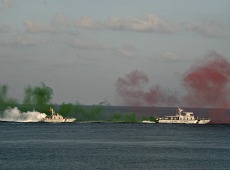
Five Coast Guard ships of assorted size “steamed” by the east coast of Male’, with smoke billowing fromtheir decks in the national colors of red, green and white.

The MNDF also staged a “show” whereby terrorists hijack a local fishing boat.

“The MNDF made it a show so the public could enjoy [themselves] and get a feeling for how the MNDF conducts operations, it was not actually how a tactical operation would be run,” Colonel Raheem said.

Following a helicopter reconnaissance fly-by of the hijacked boat, six small coast guard vessels descended on the fishing dhoani.

The special forces, coast guard, and marine corps then “destroyed the terrorists” to gain control of the dhoni, followed by a casualty being airlifted out, Raheem recounted.

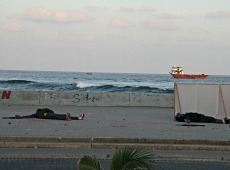
A portion of the special forces show also included “an attack of the terrorist hideout on land”.

“Dead” bodies accompanied by fake blood could be seen sprawled on the pavement.

“The parade was of no cost, since soldiers had the equipment and uniforms already. Additionally, coast guard vessels are in daily use anyway,” said Raheem.

“All of the MNDF’s units combined forces to take part in the anniversary,” he added.

Although the MNDF was not established in name until 2006 – two years after the National Security Service (NSS) was split to create the Police Service – the presence of Maldivian security forces has remained constant, according to Raheem.

Likes(0)Dislikes(0)

Man sentenced to one year in jail for carrying a knife “without a valid reason”

A man has been sentenced to one year in prison for carrying a knife on the street, reports local media.

Fahud Moahmed was found guilty of “carrying a sharp object in a public place without valid reason”, following witness testimony that he was seen with the knife on a thoroughfare in Male’.

Moahmed could not provide the court with a reason why he was carrying the knife.

Likes(0)Dislikes(0)

Maldives Bar Association established

The Maldives Bar Association is being established to build legal capacity, lobby, and address problems faced by lawyers in the judiciary, reports local media.

The association will also aim to improve the educational standard of lawyers as well as hold problem solving discussions.

The association was founded by Attorney General Husnu Al Suood, Lawyer Ismail Wisham, Company Registrar of Economic Ministry Ali Shujau, Fayaz Ismail and Aishath Sheeza, according to local media.

It was registered with the Ministry of Home affairs April 11.

Likes(1)Dislikes(0)