Don’t interfere in Maldives’ internal affairs, acting Foreign Minister tells UN General Assembly

The Maldivian government has called on the UN to ensure “non-interference in internal affairs of sovereign states.”

In her address to the UN General Assembly on October 1, Acting Foreign Minister Dr Mariyam Shakeela referred to “concerted efforts by external forces to prevent the emergence of an indigenous democratic system of governance in the Maldives [by] attempting to shape the outcome of, what is, an internal issue”.

Dr Shakeela’s comments follow global concern over the Supreme Court’s indefinite suspension of a constitutionally-mandated run-off election scheduled for September 28. Police enforced the order on Saturday by surrounding the Elections Commission with orders to storm the building and seize the ballot papers unless the commission capitulated.

“Democracy consolidation is not just about holding elections. Nor is it about having a democratically sound Constitution. In the Maldives too, we quickly found that changing the Constitution, or having a multi-party election, did not instill democratic values within our society,” Dr Shakeela told the UN.

“For democracy to be cultivated and consolidated, the supremacy of the constitution must be upheld above all. The institutional deficiencies we face, must be addressed within constitutional provisions. And the political leadership must sustain an unshakable commitment to the principles and values of states.”

Presidential candidate Gasim Ibrahim, who placed third in the first round with 24.07 percent of the vote, went to the Supreme Court seeking to annul the vote alleging widespread electoral fraud and declaring “God Willing, Gasim will be President on November 11”.

He was swiftly joined in court by second-placed Abdulla Yameen, who received 25.35 percent of the vote, and Attorney General Azima Shukoor, Yameen’s former lawyer. Siding against the Elections Commission, the three alleged electoral irregularities despite the unanimous positive assessments of local and international election observers, including the UN itself.

In a statement, UN Secretary General Bai Ki-moon said he was concerned about the Supreme Court’s postponement of the second round, given that the first round was “widely recognised as a success by international and domestic election observers.”

“It is of the utmost importance that the will of the people be respected in deciding the future of the country. These are pivotal elections for reaffirming the democratic process in the Maldives,” stated the UN Secretary General.

Dr Shakeela meanwhile told the UN that “Some of the parties that competed in the election have identified serious issues with the conduct of the elections, and have asked the Supreme Court of the Maldives for a ruling. We are expecting the Court to come out with a ruling in the coming days. The integrity of the second round of our Presidential election cannot be maintained without ensuring the integrity of the first round through Constitutional means. We await the Supreme Court’s verdict to continue the electoral process.”

Dr Shakeela went on to accuse “some external forces” of “attempting to shape the outcome of, what in effect is, an internal issue. The Maldives is small. Our democracy is at an infant stage. Our institutions are young. That does not, however, mean that larger countries have a right to intervene and attempt to dictate outcomes in domestic affairs of the Maldives.”

Protests resulting from the suspension of the election have meanwhile led to other countries including the UK, China, Canada and Australia to upgrade their travel advisories.

Likes(1)Dislikes(0)

MACL denies imminent strike action by air traffic controllers, as staff allege pay and safety concerns

Air traffic controllers in the Maldives say they are building up to a full work stoppage over ongoing grievances and safety concerns left unaddressed by the current government.

Such strikes could lead to delays and disruption of flights to the luxury tourism destination, that welcomes almost one million tourists a year.

Several controllers responsible for organising the strike explained to Minivan News that they have been raising safety concerns with all relevant government authorities following the restructuring of the state-owned Maldives Airports Company Limited (MACL). Despite countless promises, no action had been taken, they said.

“For the last six months we’ve been ‘going by the book’, following all the procedures which causes a lot of delays. In the aviation industry that is considered a mild strike,” the air traffic controllers explained.

The air traffic controllers are now “building towards a full strike”, and many are even now calling in sick to work, the sources said.

A full strike would involve notifying all the relevant regional and international agencies, airlines, and all relevant government agencies in the Maldives, because no planes will be able to land except for hospital and humanitarian aircraft.

“This strike affects everyone, sea planes as well. Whatever happens at Ibrahim Nasir International Airport (INIA) will cause delays at the domestic airports as well,” they added.

Six air traffic controllers should be on duty at all times, three in the control tower and three in area control, the sources said.

“Last night only two people showed up to work,” they confirmed.

“The [MACL] management and Maldives National Defence Force (MNDF) had to run the system last night,” the air traffic controllers claimed. “Management is totally stressed.”

“This morning only one person was working area control, so management has had to fill in and today at 1:00pm nobody one went into work,” the controllers stated.

As a result, MACL management is also trying to close the area control centre and combine all operations in the control tower, the sources said.

“A pilot from a domestic carrier called me today to say he’s hesitant to fly because the guy currently in the tower doesn’t know what he’s doing – it’s a big safety issue,” one of the controllers alleged.

Ground staff at Kaadedhdhoo domestic airport in Gaaf Dhaal Atoll told Minivan News that since strike activity began many domestic flights had been delayed “three or four hours” while a number of international flights coming into Male’ “have been diverted to Colombo”.

CEO of the Maldives Airports Corporation Limited (MACL), Ibrahim ‘Bandhu’ Saleem, told Minivan News no such strikes were occurring.

“As far as I’m concerned there is no strike – you are wrong,” said Saleem.

He explained that there have been no flight cancellations or delays at INIA and that “only Male’ international [airport], not domestic airports, are under my control.”

While Saleem insisted there is no strike, he noted “there are contingency plans in place [in the event of a strike].” He declined to answer further questions.

The air traffic controllers told Minivan News that while they were not aware of flights being cancelled as of early this afternoon, a flight from Dharavandhoo airport in Baa Atoll was one-and-a-half hours delayed this morning “because INIA couldn’t handle the air traffic.”

Safety and standards

The air traffic controllers claimed strike action was supported by 75 controllers – over 95 percent of the country’s qualified staff.  They are demanding the reinstatement of a professional grading system, adherence to International Civil Aviation Organisation (ICAO), and the holding of the presidential run-off election that remains suspended by the Supreme Court.

“This was not a political issue,” they emphasised. “But now because we’ve lost trust in and cannot negotiate with the current government, [the strike has taken a political direction],” the air traffic controller sources told Minivan News.

“We were counting on a new election and government so we could bring our problems to them. If there’s no election our grievances will be exacerbated. [Now] we don’t know when we’ll be able to vote and elect a new government,” the sources continued.

The controllers repeatedly emphasised that the Maldivian Air Traffic Controllers Association (MATCA) was not involved [in organising the strike], “because they don’t want this to appear a politically motivated thing.”

Concerns and demands

The air traffic controllers said staff were not getting proper breaks, domestic airports are understaffed, the radar system – installed at INIA in 2008 – does not meet ICAO standards, and the professional grading system for controllers had been abolished.

“Everyone got knocked down to the same grade one position, there have been no promotions or pay raises in four years,” the sources explained.

The professional grading system ranks experience level and qualifications, with four levels: 1) basic air traffic, 2) aerodrome (tower) controller, 3) approach controller, and 4) area controller. While the same task is performed at each level, the airspace area each controller is responsible for increases.

“If air traffic controllers are continuously stressed out they might get into trouble by losing a picture [on radar],” the sources warned. “More fatigue means more mistakes, but we can’t makes mistakes is this job.”

The sources said MACL staff from Male’ are sent to work the domestic airports. However, the majority of domestic airports are understaffed, with only one or two air traffic controllers. At least three people should be running the control tower at any given time, the sources explained.

“Where there is only one person working the tower – like in Forvumulah’s airport – that individual has to stay awake. He only gets four hours of sleep a day and has to work 30 days continuously without a day off,” they continued.

“If you are the only person on duty you cannot leave the room, it’s a safety issue,” the controllers explained.

Thimarafushi airport in Thaa Atoll has no air traffic controller, however the Civil Aviation Authority gave authorisation for the airport to operate anyway, the sources alleged.

“That’s totally fine by us, even in the US there is uncontrolled airspace. It’s not a big issue as long as the pilots feel that they can land and take off,” the sources added.

“No one to trust” in government

“The government is trying to say everything is running smoothly, while trying to buy us out,” alleged the air traffic controllers. “We also gave an interview to Haveeru yesterday but they nothing has been posted about it.”

“Minister Adheeb called us today asking us if we were on strike. He’s pretending he didn’t know that our concerns hadn’t been addressed, even though we met with him earlier this year,” the sources noted.

“Three supervisors – of eight total – went to the MACL Managing Director’s meeting today. He’s asking them to talk to us to bring us back to work,” the sources continued.

“We are professionals and don’t want to create chaos in the Maldives, but with the current situation there is no one to talk to,” they explained. “We’ve tried to do it in a democratic way and did every single thing [to resolve our grievances]. We’ve exhausted all resources. There is no one to trust,” they added.

“We have been trying to raise these problems – again – since 7 February  2012 with the current government run by [President Mohamed] Waheed, [Jumhooree Party Presidential Candidate and MP] Gasim [Ibrahim], and [Progressive Party of the Maldives Presidential Candidate and MP Abdulla] Yameen,” the sources continued. “They promised us action but didn’t take it.”

The air traffic controllers have additionally met with Vice President Waheed Dean, Defence Minister Mohamed Nazim, Tourism Minister Ahmed Adheeb, Transport Minister Ameen Ibrahim, MACL, the Civil Aviation Authority, and the Labour Relations Authority, “but nothing happened,” they explained.

Over a year ago air traffic controllers submitted a case to the Labour Tribunal signed by more than 40 individuals, the sources noted.

“On December 21, 2012, over 60 air traffic controllers signed a petition that gave notice that we would be going on strike. We were promised that by January 1 our grievances would be addressed, the grading structure would be re-implemented and we would receive proper raises,” the sources added.

The controllers agreed to withdraw the case when promised the reforms and did, however  the promised action was still not forthcoming.

“We met with MDP’s Mohamed Nasheed and he pledged that under his government he would correct the mistakes and try to get us better pay,” the controllers noted. “We [also recently] met with the other political parties, but so far nothing.”

“Some [of us] are waiting for confirmation in writing [that our demands will be met], but many are waiting for the Supreme Court to rule so we can have an election,” the sources continued. “We’ve heard that MACL ground services employees are also planning to strike.”

Likes(1)Dislikes(0)

MDP MP Ilyas Labeeb appeals to police to refuse “unconstitutional” orders, as protests continue

MDP member of parliament and parliamentary whip Ilyas Labeeb appealed to police to protect the constitution, refuse to follow unconstitutional orders, and to learn from the action of the senior MNDF officers who recently sent a “letter of concern” to Chief of Defence Force about the matter.

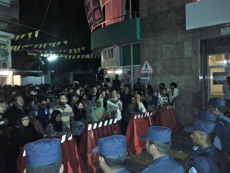
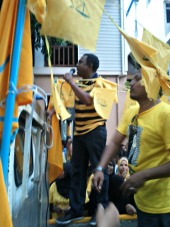
Ilyas Labeeb delivered his speech from the campaign truck kept on Fareedhee Magu in the middle of the crowd, facing the police standing behind barricades.

Just as Labeeb began addressing the crowd, police lit up floodlights to spotlight the MP.

“Shining that light in our faces, or implying we are marked for arrest, does not intimidate me. Violently taking MP Ali Azim into your custody does not intimidate me. Even if you come and take me away now, that still won’t scare me. I will come back here and speak out as soon as I am freed again. We are asking for elections, for our constitutional right,” Labeeb said.

“Aren’t you ashamed to be bowing down to unconstitutional orders? Nineteen MNDF officers have sent a letter against the following of constitutional orders, against the politicisation of the security forces. The MNDF is more senior than the police force. Listen to them, learn from them. Give it up now. Your stand on February 7 was that you were demonstrating against unconstitutional orders. What are you doing today?”

“We are standing up for the constitutional rights we are entitled to, for our sake, for the sake of our families, yes, but equally for the future of you and your families. Start protecting the constitution, police, that is in the best interests of the nation.”

Ilyas Labeeb ended his speech by leading the crowd in chanting “Where’s my vote? You stole my vote”, “Election now” and “Forward, forward, swiftly forward”.

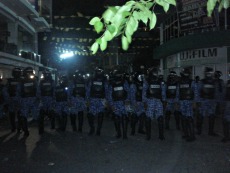
By this time, just over a dozen regular police officers formed a line of obstruction behind the barricades, facing the protesters.

Labeeb moved to the frontline of the protest and appealed to the police again, this time speaking directly to them without the aid of a microphone or making it a public speech.

“You boys must think deeply. Why are you following unconstitutional orders? Neither the Police Act nor the Constitution mandates you to do so, in fact it is clearly stated that you must not follow an unconstitutional order,” he said.

“Don’t you realise what they are doing? They send you out here against hundreds and thousands of citizens, you come with your name tags and in simple regular uniform, and you face scorn from the people. Yet it isn’t you, but the Special Operations who hide behind their masks and helmets who run into crowds and brutalise citizens. They are using you young boys as a shield to hide behind. You don’t have to be slaves to the SO officers or the Commissioner of Police,” Labeeb continued.

“Look at [Commissioner of Police] Abdulla Riyaz. He’s hiding in his rooms after sending you all here. He has secured an apartment abroad, planning to run away as soon as the government changes. All the leading people who were part of the coup have. They won’t think of you then. What will happen to you boys if you continue following unconstitutional orders?”

“Remember all that talk about housing flats for the police? Do you know who took the first flat? Abdulla Riyaz. It was meant for regular officers like you, but he took one for himself first. Is this how you want things to be? Are you still going to stay back quietly and let things proceed like this?”

“I know that as you are all listening to this speech of mine now, your seniors will take you in for a chat later tonight. But they are not the ones you should be believing, nor should you believe me. Instead, read for yourselves what is in the Police Act and the constitution. If you need assistance, we can arrange lawyers for you; not lawyers affiliated with MDP but other experienced lawyers.”

“Regardless of how long it takes to get back our right to vote, we will continue demanding it. And when the elections are on, we will beat them with votes. We will win the elections.”

MP went back into the crowds after concluding his monologue to the line of officers.

Monday – the fourth consecutive day of protests – saw protesters grow from a few hundred to just over a thousand by around 10:00pm.

Crowds later thinned out once the SO officers came to the area after protesters moved, and later hid the police barricades at the protest site.

Minivan News observed teams of SO officers run into the crowds twice and make two arrests – one of whom was a man who had previously crossed the police line set out by the regular police officers, referred to as ‘Blues’.

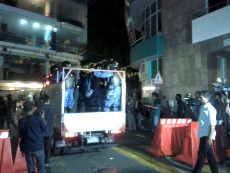
The SO later drove six times to and fro through the protest area in one of their trucks after crowds had thinned out, locating a barricade hidden in a construction site on Fareedhee Magu and sending regular officers to retrieve it.

“Targeting MDP MPs as an intimidation tactic”: MP Alhan Fahmy

Meanwhile, police have been arresting and summoning MDP parliamentary group members in relation to various cases in the past few days after the party started direct action asking for immediate elections.

MP Alhan Fahmy, who was summoned to police headquarters for questioning at 2:00pm on Tuesday described the events as “intimidation tactics being used by the police. They [the government] are using multiple state institutions in their actions of undermining the constitution and its powers”.

Fahmy said that the police had accused him of threatening Supreme Court judges and their families at a protest held on September 26.

“I told them I have done no such thing, that I never called for attacks or threatened any of these judges they speak of or their families. That all I said at the rally was my perspective on the current judges sitting on the SC bench. I told them that I had spoken of a video clip showing indecent behaviour that police has said Ali Hameed has been seen in, and that if so I believe Ali Hameed should no longer be sitting on the bench,” Fahmy told Minivan News today.

MDP International Spokesperson and MP Hamid Abdul Ghafoor was also taken into police custody on Monday afternoon, allegedly for not accepting court summons. He has been transferred to house arrest today after the first hearing of the case.

Ghafoor’s lawyer, Fareesha Abdulla O’Shea, however claims that due process was not followed when delivering the court summons.

She said that the case is being presided over by Criminal Court Chief Judge Abdulla Mohamed.

“The case is about Hamid’s refusal to give a urine sample and he is being charged under section 123 of the Drug Act. I advised not to enter a plea as we haven’t received any of the related documents or information from the court yet,” O’Shea said.

“Today, after the hearing, Hamid was issued another summons relating to charges levied for possession of alcohol,” she stated.

MP Ali Azim was arrested from the protests on Sunday night, with SO officers pulling him off the campaign truck, throwing him onto the ground and dragging him away into custody. He was brought to a court hearing on Monday, where the courts added a seven day extension to his detention on account of him being “a threat to national security”.

Azim attended a meeting of the Parliament’s Privileges Committee after his hearing yesterday, where he alleged that he had been ill-treated even after arrest.

“The SO officer on my right side tried very hard to break my finger, I have photos to prove this. Upon being pushed into the van, one of the officers grabbed hold of my groin area very hard,” Azim told the committee.

“They also asked me to provide a urine sample, but I didn’t because my lawyer advised me against it as the charges levied against me did not allow police to make such a request. I was also handcuffed on the trip from Dhoonidhoo to the court in Male’, and on the way to this parliamentary meeting,” he added.

DRP MP ‘Colonel’ Mohamed Nasheed was also arrested at protests and later released, while MP Ibrahim Rasheed is being investigated for allegedly assaulting police.

MP Eva Abdulla has also been arrested at protests on Tuesday.

Likes(0)Dislikes(0)

Suspension of democracy an assault on the Maldives’ fragile democracy: The Diplomat

The future of democracy on the archipelago looks bleak after a constitutionally questionable court intervention, writes Sudha Ramachandran for The Diplomat.

Late last week, the Maldives Supreme Court announced that the run-off vote should be postponed indefinitely. It is a move that is both unconstitutional and an assault on the country’s fragile democracy.

The decision has been criticized by Nasheed’s MDP as a “complete defiance of the Constitution,” an act of “betrayal of democracy and the will of the Maldivian people” by a “discredited court.” Indeed, Article 111 of the Maldivian Constitution says a run-off must be held within 21 days of the first round of voting. September 28, the day the Election Commission had scheduled for the run-off, was that deadline.

Many observers believe that the postponement of the run-off is an extension of what happened eighteen months ago. The sharp polarization between pro and anti-democratic forces persists.

“Anti-democratic forces who we thought we had defeated in 2008, asserted themselves in 2012 and have regrouped now, acting through the judiciary to keep Nasheed from returning as president,” a Maldivian businessman, who participated in the pro-democracy protests a decade ago and is based now in India, tells The Diplomat. “By keeping Nasheed out, these forces are preparing the ground for the Maldives return to full-fledged authoritarian rule,” he warns.

Maldivians will be anxiously awaiting the Supreme Court’s verdict. Will it annul the election result and call for fresh elections, enabling Ibrahim to mount a renewed effort for the presidency? Will it dismiss Ibrahim’s appeal and announce a new date for the run-off, facilitating Yameen’s campaign? Or will it keep the election process in suspension, extending Waheed’s presidency? The verdict will depend on who the apex court is backing. Meanwhile the Maldivian military will be planning its moves.

Whatever the outcome, the future of the Maldives’ badly damaged democracy looks bleak.

Full story

Likes(0)Dislikes(0)

Maldives’ media in spotlight as election fallout continues

The rising trend of death threats being sent via telecommunications devices has prompted the Communication Authority of the Maldives (CAM) to request police investigate and take action against offenders.

CAM’s statement comes a day after ongoing death threats received by the Elections Commission (EC)’s permanent staff and polling station officials prompted the commission to file a report with the Maldives Police Service (MPS).

CAM highlighted that intimidating threats and death threats are criminal offences and the institution called on all Maldivians to refrain from using telecommunications devices to commit such criminal acts.

The government agency called on everyone receiving threats to report the incident(s) to police.

CAM also emphasized that offenders would have their telecommunications services terminated without further notice.

Media council “lost faith” in broadcasting commission

Meanwhile, the Maldives Media Council (MMC) will file a no-confidence motion against Maldives Broadcasting Commission (MBC) members via Parliament’s Independent Institutions Committee, reported local media.

MMC believes the broadcasting commission has failed to fulfill its mandate to create a healthy broadcast media environment, instead creating fear and discomfort, is unable to uniformly treat media agencies equitably, and is unable to fulfil the Broadcasting Act’s mandates.

The media council has also called on MBC to “stop any action that might affect freedom of media” including creating fear and threatening media agencies.

“MBC was threatening media organizations [and] was failing to establish equality in implementing regulations…and therefore MMC has lost faith in the current members of MBC,” MMC President Husham Mohamed told local media.

MMC decided to file the case in Parliament after MBC issued a “warning” on Friday night (September 27), saying that broadcasting licenses would be revoked from any outlet transmitting content which “threatens national security”, Husham explained.

MBC said it would file legal proceedings against any media organisation it believed had broadcast such materials in violation of the Broadcasting Act.

Another factor prompting the MMC to take action against the broadcasting commission was MBC’s call on Thursday (September 26) that broadcasters to “refrain from airing photos of members of independent institutions – Supreme Court judges and Elections Commission members – in a derogatory manner which could jeopardize national harmony, until the Commission concludes adjudication of the related complaints”.

Seven of 11 MMC members voted in favor of the action against MBC members during the extra-ordinary meeting held on Saturday (September 28).

Last week the Broadcasting Commission ruled that the Maldives Broadcasting Corporation’s televising of the Jamiyyathul Salaf’ ‘Al Andhalus’ preacher Sheikh Adam Shameem Ibrahim did not violate any regulations.

The decision came after the Broadcasting Corporation’s chairman Ibrahim Umar Manik along with MBC members were summoned before Parliament’s Independent Institutions Committee, following complaints by Maldivian Democratic Party (MDP) MPs that the sermon infringed the rights of the party’s presidential candidate.

MMC Elections Commission complaint

The MMC has also called on the Elections Commission to “refrain from discriminating between media organizations when sharing information regarding the presidential elections”.

“I haven’t heard that complaint [officially from the Maldives Media Council],” EC Chair Fuwad Thowfeek told Minivan News yesterday (September 29).

“I have respected calls from various media [outlets, however] what I say is not properly addressed in reports, so I’m private as possible,” Thowfeek explained. “I give interviews to people I can trust to write what I say [accurately].”

“Also it depends on the time I have, [for example] if I’m in a meeting I can’t speak to anyone, but once I have free time I do,” he continued.

“If I believe the journalist will give [my] message accurately then I will give [that person] reports,” he emphasised.

MBC recently launched an investigation into Villa TV (VTV) – owned by resort tycoon, former Judicial Services Commission member, and Jumhooree Party Presidential Candidate Gasim Ibrahim – broadcasting unsubstantiated content to incite hatred against the Elections Commission in violation of the broadcasting code of practice.

Local media broadcasting unsubstantiated information about the Elections Commission and electoral process catalyzed unrest throughout the Maldives.

Confusion over the presidential election’s first round voting figures was created by local media reports not matching those of the EC during counting, with sluggish EC figures supplemented by differing poll results, depending on the outlet chosen.

Media misrepresentation

Inaccurate local media reporting was also highlighted as a problem by Maldivian Democratic Party (MDP) Chairperson ‘Reeko’ Moosa Manik during an press conference held today (September 30).

“My comments made in public on Friday have been changed a lot [in local media reports],” said Manik.

“I want all Maldivians to know this. I work against brutality. I specifically said if any of the police officers here hit me, I will tell my wife to go and tell his wife not to brutalize us,” he emphasised.

Police are currently investigating Manik for threatening police and their families.

Meanwhile, the Police Integrity Commission (PIC) has ruled that it had not come across any substantial evidence supporting the claims of Manik being attacked by Corporal Mohamed Atheef during the brutal police crackdown on February 8, 2012.

UN human rights encouragement

In light of these local media issues, the Maldives’ United Nations Resident Coordinator’s Office has encouraged journalists to leverage the UN human rights system to collectively advocate for freedom of opinion and expression to be upheld.

“As media professionals, I would encourage you to build your awareness and knowledge of international human rights standards, and reflect on how you could use the UN human rights system to, especially collectively, advocate for the respect and protection of freedom of opinion and expression in the Maldives, including the protection of journalists,” said UN Human Rights Adviser Safir Syed.

“I cannot emphasise enough that it really is in your interests,” he added.

The UN Human Rights Committee’s General Comment on freedom of opinion and expression was attached to an email sent to various local media outlets yesterday (September 29).

“A free, uncensored and unhindered press or other media is essential in any society to ensure freedom of opinion and expression and the enjoyment of other Covenant rights. It constitutes one of the cornerstones of a democratic society,” Syed quoted from the General Comment document.

Likes(3)Dislikes(1)

Senior military officers send “letter of concern” to Chief of Defence Force

Additional reporting by Zaheena Rasheed and Mohamed Naahii

Senior officers in the Maldives National Defence Force (MNDF) have sent a “letter of concern” to Chief of Defence Force Major-General Ahmed Shiyam, following the failure of the country to hold scheduled elections on Saturday (September 28).

Police surrounded the Elections Commission (EC) on Friday with orders from Commissioner Abdulla Riyaz to storm the building and confiscate ballot papers should the EC continue to attempt to hold the election.

The Supreme Court had the previous evening opened at midnight to order security forces to physically obstruct the election in line with its earlier suspension, invoking article 237 of the Constitution, concerning the authority of the security services to “protect the nation’s sovereignty, maintain its territorial integrity, defend the constitution and democratic institutions, maintain and enforce law and order, and render assistance in emergencies.”

The MNDF’s letter to Major-General Shiyam was initially signed by four senior officers, but 16 officers across the top brass subsequently added their names to it.

MNDF Spokesperson Colonel Abdul Raheem, himself a signatory, confirmed the letter’s existence to Minivan News.

“It was to inform the leadership of our concerns about political turbulence in the country right now and how the military should plan and prepare for it,” Colonel Raheem said, and implied that it was not unusual for senior officers to brief the Chief of Defence on such matters.

One signing officer told Minivan News on condition of anonymity: “This is not a petition. It is a letter of concern over the Supreme Court’s order to delay elections, the failure of state institutions, and the possible politicisation of the military, and asking that unconstitutional orders not be issued,”

The officer said the letter had been signed by ranks including Generals, Colonels, Lieutenant Colonels, Captains, First Lieutenants, Sergeant Majors and Warrant Officers.

The 3000-strong MNDF is responsible not just for defence, but also the Coastguard and civil services such as firefighting and rescue operations.

The letter seems to have prompted an internal shuffle in the organisation, including a marine commander switched to another unit. One resignation letter obtained by Minivan News, of First Lieutenant Mohamed Haleem, was addressed to Defence Minister Retired Colonel Mohamed Nazim.

“I do not believe the security services are currently adhering to the constitutional provisions stated in articles 237 and 238. Also, while the spirit of article 246 of the constitution is, to refrain from political affiliations and to treat equally among the people and different groups, respecting the principles of Islam and human dignity, I do not see this currently happening [within the security services],” First Lieutenant Haleem stated.

“For the last 23 years [of my military service]; I have served this country under a solemn oath taken in the name of Allah, I do not see any way that I can carry out my duties as prescribed in the constitution and the military act, while in this position, therefore I request you to relieve me from my duties,” he concluded.

Former Brigadier General Ibrahim Mohamed Didi, who as a junior soldier was instrumental in defending the Maldives from the coup attempt of 1988 which saw 80 mercenaries from the Tamil militant group the People’s Liberation Organisation of Tamil Eelam (PLOTE) launch a frontal assault on the Maldives’ military headquarters, issued a letter today over social media.

“My advice to the military officers is: ‘Do not give the opportunity to anyone who plans to rule this country by taking the laws to their own hands and override the constitution and undermine the constitutional framework of this country’,” wrote Didi, who was the Male’ Area Commander during the 7 February 2012 controversial power transfer before resigning “prematurely” from his 32 year career on July 16, 2012.

“Given the sad state of affairs this country has fallen to, as a person who came out to sacrifice my life to protect holy Islam and this nation when required, as a person who would still take any action required in the best interest of this country, people and religion and as a person who has been trained and acquired military expertise at the expense of the public funds, I could not remain silent today. I believe it is a national and a religious duty to say something on the issue,” he wrote.

This country is in a state of chaos since February 7, 2012. The government elected by people of this country were not given the opportunity to breathe. Opposition politicians, businessmen and religious clerics who supported them were continuously seen calling for the ousting of the government.

The people within the government were claiming that the opposition was insincere and irresponsible. The opposition claimed that the government officials were insincere and irresponsible. In this situation, conflicts between three powers of the state led to the military being unduly influenced.

Also, it is shameful and unacceptable in such a highly polarised society to see the government which the military ought to legally defend, regardless for whatever reason, be thrown out to the street.

In that circumstance, the international community saw the best solution for the country was to find a peaceful solution. And in that discourse, they saw the need to facilitate a presidential election, in which the people would make the ultimate decision. [It had to be this way] because of the conflicts within the three powers of the state and between these powers.

With that, I must disappointingly highlight that I am seeing the country falling into a state of chaos. I have heard some businessmen claiming that the only solution left for the country is a military solution. I am ready to challenge those who say this. That is a theory based on lies, deception and greed which only serves them a temporary benefit. We have seen what happened to countries that followed this theory.

In this situation, my advice to the military officers is, do not give the opportunity to anyone who plan to rule this country by taking the laws to their own hands and override the constitution and undermine the constitutional framework of this country.

The reason is, if such a thing happens, it would be all of us, our children and our children’s children who would suffer the consequences.

What does the constitution say about this? Article 268 says that any act committed in contrast with the constitution is void and invalid.

Article 124 states that in case of incapacity of the President and Vice President, it must be the Speaker of Parliament who takes up the duties and responsibilities in running the state.

Article 107 states that the duration of a presidential term is five years.

Therefore after November 11, 2013, regardless of who gives the orders and regardless of the situation, I sincerely urge the military to not let anyone take over the country in contrast with the provisions in the constitution, as this would have dire consequences. I request all military officers to sincerely and peacefully protect the interests of this country in such a situation.

By any means, the head of state should not be someone who assumed powers in contrast to the constitution of this country.

Translated from Dhivehi – read original

Likes(1)Dislikes(0)

MP Ali Azim arrested on third consecutive night of MDP protests

Maldivian Democratic Party (MDP) supporters protested for the third consecutive day on Sunday (September 29), resulting in confrontations between the police and protesters with multiple arrests – including that of party parliament members.

Protests began at around 2:00pm near the FDI Station on Fareedhee Magu – the closest protesters can go to the Supreme Court building, as the area remains cordoned off by police and military forces.

Crowds grew and thinned alternatively throughout a period of 12 hours, with the main confrontations occurring after 10:00pm.

Minivan News observed that earlier in the night the MNDF was in charge of security operations in the area. About 400 protesters, while playing campaign songs and chanting slogans – “Forward, forward, swiftly forward”, “Give us our right to vote”, “We don’t want to selectively follow parts of the constitution” – were peaceful.

Police, including Special Operations (SO) officers, took over security operations later in the night, around which time the atmosphere became more heated.

Leading the protest were MDP Vice Presidential Candidate Dr Mustafa Lutfi, MP Ali Azim, former foreign minister Ahmed Naseem, and former Attorney General Dhiyana Saeed.

MDP MP Ali Azim was addressing the protesters from a campaign truck close to the police barricades when SO officers took him under arrest. A video on social media shows SO officers run up to the parliament member, pull him off the truck and onto the ground before dragging him away through the crowd and past the line of barricades.

Eye witnesses say that police kicked him and hit him with batons prior to dragging him to their vehicle.

The MDP has today released a press statement saying that the party “harshly condemns the brutal arrest of Ali Azim”.

“This is an act to intimidate the people and a violation of freedoms provided in the constitution.”

Protesters threw stones and empty plastic bottles over the barricades into the police lines, while police used batons, pepper spray and a substance with a strong chemical smell which caused wheezing and difficulty in breathing.

“I don’t know what this is, but having felt the pain of being pepper-sprayed and teargassed, I can tell you this is a different substance. An irritant of some sort. It smarts so very bad and feels like I have sand in my eyes. My skin feels like it is peeling away and burned,” said a 34 year-old male protester affected by the substance during last night’s protests.

“Do I deserve this in return for asking for justice? For demanding an elected government?” he asked, while pouring Coca Cola over his face in an attempt to regain sight and take away some of the pain.

According to police media a total of eight arrests were made last night. Police denied that any substance or chemical besides pepper spray was used to control the protests.

“Nothing except pepper spray. No new chemicals were used,” the spokesperson stated.

Minivan News observed at least 13 male protesters being taken into police custody after snatch teams of SO officers went into crowds and chased them.

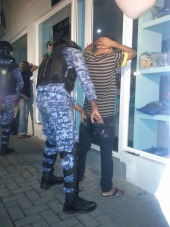
Many of the protesters were frisked in the presence of media behind police lines prior to being taken into the police vehicles – a practice which has not previously been observed at the protests following the February 7 controversial transfer of power.

After consecutive and frequent SO officer charges into the crowd, protesters thinned out around 1.45am, leaving a few dozen people standing by in small crowds, defiantly chanting “justice now”. Police left the area at approximately 2:00am when protests died down for the night.

The MDP has said that it will continue the protests and has called on the Human Rights Commission of Maldives (HRCM) and the prosecutor general to investigate the arrests of the DRP MP and other protesters.

MP Ali Azim was brought to court at 2.30pm this afternoon and his detention has been extended for seven days.

Meanwhile, police have said they are investigating four MDP MPs for contempt of court and threatening police, judges and their families. These are Feydhoo MP Alhan Fahmy, Malé MPs Imthiyaz Fahmy, Mohamed Rasheed (Bonda) and Reeko Moosa Manik.

Furthermore police arrested Malé MP Hamid Abdul Gafoor today to ensure his presence at a Criminal Court trial tomorrow on alleged possession of alcohol.

MDP MP Ali Waheed’s car was vandalised in the evening, and a motorcycle and car were torched at 3:00 am. The police also said wife of a policeman was hit by a motorcycle at noon. She is eight months pregnant.

MP Ali Azim arrested during Sunday night’s protests

Likes(0)Dislikes(0)

Death threats force Elections Commission to seek police assistance

Ongoing death threats received by the Elections Commission (EC)’s permanent staff and polling station officials have prompted the commission to file a report with the Maldives Police Service (MPS) today.

A lack of state cooperation prevented the commission from holding a “free and fair [presidential election] vote without intimidation, aggression, undue influence or corruption” on September 28 as constitutionally-mandated, the (EC) announced on Friday night, shortly before it was surrounded by a police barricade.

Lack of police support, “some political parties” threatening to set ballot boxes on fire, and death threats made against Elections Commission members, staff, and officials involved in the voting process were highlighted as reasons for postponing the second round run-off, which would otherwise have taken place yesterday.

Special Operations police surrounded the EC secretariat on Friday, with orders from Police Commissioner Abdulla Riyaz to take over the building and ballot papers should it proceed with holding the election.

In addition to the MPS stating it would not cooperate with the EC and ceasing to providing security requested by the commission for the second round, police prevented EC staff and visitors from entering the secretariat on Friday. However, staff were later allowed to return after a series of phone calls between Riyaz and EC Chair Fuwad Thowfeek.

As of Thursday, the EC insisted that it was constitutionally mandated to hold the runoff within 21 days of the first round, in spite of an order from the Supreme Court to suspend the election indefinitely. This prompted Assistant Commissioner of Police Hassan Habeeb to call the Elections Commission Chair on Thursday night (September 26) and warn that police would not allow the election to take place.

Death threats continue

“It’s not just myself and my family, but Elections Commission staff, including most directors and even some heads of ballot boxes and other polling station staff who have received threatening messages that they and their families will be killed,” Elections Commission Chair Fuwad Thowfeek told Minivan News today.

“They are very much scared about the situation. Some are even afraid to come out of their homes. It’s very sad,” Thowfeek lamented.

“I hope we will be safe, we have been trying to follow the constitution,” he said.

Thowfeek said the EC had sent a report to the MPS detailing the threats, phone numbers the messages were sent from, and other relevant information.

He noted that the EC was still considering whether to send an official letter to the Telecommunications Authority regarding the death threats “because we are waiting for action to be taken through the MPS, since they have the authority to investigate.”

The following SMS was sent to EC and polling station officials yesterday:

“What you did to rig the vote near ballot boxes will be exposed. YOU resign. Or else even your family will be killed. Allah Akbar we are with the religion.”

On Thursday senior Election’s Commission staff received the following message around 6:00pm:

“We will kill anyone who allies with Fuwad Thowfeek against the Supreme Court order and the Maldivian constitution and continues with voting activities. Allah Akbar.”

Additionally, during an interview Minivan News conducted with Thowfeek last week, he noted that “some of us are getting threats from unknown people. I have received SMS messages saying ‘be careful when you come out on the street, you’ll be stabbed in the stomach’.”

Only the EC’s human resource section and other section heads of the commission have a list of all election officials and temporary staff, explained Thowfeek.

The commission had provided the four political party presidential candidate representatives with a list of all elections officials, including polling station staff, but that list did not include their phone or ID card numbers, he noted.

Police integrity

The Police Integrity Commission (PIC) called for the police to provide any assistance the EC requires to go ahead with the second round.

Earlier this month the PIC determined Police Commissioner Abdulla Riyaz violated the Police Act by posting a letter on Twitter urging police officers not to vote for former President Mohamed Nasheed and recommended administrative action be taken against the police chief.

Minivan News enquired with the PIC whether Commissioner Riyaz would be able to impartially issue orders to prevent the EC from conducting election preparations and holding the second round runoff, or whether the MPS – under his leadership – would be able to impartially investigate the death threats EC staff have been receiving.

PIC Director General Fathimath Sareera Ali Shareef told Minivan News today that she needed to consult with their legal department and would reply as soon as possible. She had not responded at time of press.

Elections Commission secure

Police meanwhile remained outside the Elections Commission until yesterday (Saturday) evening, guarding the secretariat and patrolling the road, noted Thowfeek.

“It was our request to have the police in front of the security room, on the ground floor [of the secretariat], and surrounding the building so nobody could enter from behind. They are keeping full security of the building for the protection of the commission and our own safety,” said Thowfeek.

The Elections Commission confirmed there was “no danger” its data could be tampered with because it remained “fully protected” and is being “closely monitored”.

The commission’s server was intentionally shut down on Friday night to prevent anyone from accessing data through a “remote medium”, explained Thowfeek.

Additionally, beginning Friday night, the EC established a rotational schedule to ensure staff are present in the EC’s secretariat 24 hours a day, seven days a week, “so there is no chance an outsider can get in” and tamper with any materials or data, he continued.

“Our own staff are present in the IT, security, and records section rooms – the most important places are constantly monitored,” said Thowfeek.

Police “misunderstanding”

Thowfeek also explained the “misunderstanding” between the MPS and the EC that led Special Operations police to surround the secretariat and prevent staff or visitors from entering, with orders from Police Commissioner Riyaz to take over the commission and arrest staff who disobeyed the Supreme Court order to halt presidential election preparations.

After a Raajje TV journalist called to enquire about the situation, Thowfeek explained to the reporter that “even staff and visitors were not allowed” to enter the EC.

This led Police Commissioner Riyaz to contact Thowfeek and explain that police were sent to protect the commission against any “angry people” trying to enter the EC and harm its staff, according to the EC Chair.

Riyaz also instructed Thowfeek “not to listen to stories from different people about the situation”.

Thowfeek then sent the EC’s Secretary General and Director General downstairs to confirm what was occurring. The commission’s IT and coordination section directors had been prevented from entering the building and police informed the Secretary General that visitors would not be allowed to enter on Saturday either.

The EC Chair again contacted Riyaz and explained that the action being taken by the special operations police differed from what the Police Commissioner had said the MPS officers would do.

Fifteen minutes later, Elections Commission staff with proper identification were allowed into the building and the commission was informed that invited visitors would be permitted to enter as well.

Minivan News had journalists present inside and outside the EC secretariat building throughout the events and did not observe protesters present at the time Special Operations police surrounded the building.

International observer visits

EC officials had previously planned to meet the British High Commissioner in the commission’s secretariat on Saturday, however after the EC’s Secretary General was informed by police Friday night they would not be able to hold the meeting in the commission, it was relocated to the High Commissioner’s hotel, explained Thowfeek.

“The British High Commissioner was here during the first round and commended our work,” said Thowfeek. “He came to see the second round and was disappointed when he found out it had been stopped.”

“He hoped for a quick solution and wished us [the EC] well,” he added.

A team of Nigerian election observers also arrived on Friday and were “very much disappointed” polling did not take place, explained Thowfeek. However, because they “made such a long trip” the EC has still been working with the West African observers and providing information about the electoral process.

The Danish Ambassador and the Commonwealth [observation group] Chair met with EC officials Friday, noted Thowfeek.

“We have had no news from any other [international election] observers,” he added.

Election not possible before November 11, says EC

Holding the second round – or another first round – of the presidential election will now “not be possible before November 11 within existing elections laws”, Thowfeek told Minivan News.

While the EC usually requires 60 days of preparation time for the whole process, “even if we don’t waste a single minute” 45 days will still be required before another presidential election can take place, he continued.

“We have to update the voter list, gazette it, receive complaints and input from the public regarding the list, see who will be present where on that date and allow them to re-register accordingly, add just-turned 18 year-olds and remove anyone who has died during the [voter registry updating] process, etc,” he noted.

Thowfeek explained that general and presidential elections law mandates specific periods of time are given for each step of the election preparation process, for example the voter registry must be published in the government gazette 45 days before polling, 10 days are given to submit complaints, and five days are provided to file cases of unaddressed complaints with the High Court.

“If special laws are made, then maybe it will be possible,” said Thowfeek.

“[Timetables within] the existing laws have to be rescheduled and another set of laws passed [before the November 11 constitutional election deadline],” he elaborated. “The other difficulty is that the Majlis is currently in recess. They may reconvene next week, but any law [passed] has to be ratified by the president.”

“We have just 42 days left before [the end of the presidential term on] November 11, so time is limited,” he added.

The date for the Supreme Court’s verdict in the Jumhooree Party’s case against the Elections Commission remained unscheduled at time of press.

HRCM and civil society support for elections

The Human Rights Commission of the Maldives (HRCM) has called on the Supreme Court and state institutions to ensure that Maldivians not be stripped of the right to vote, guaranteed by constitutional article 26 and the International Covenant on Civil and Political Rights (ICCPR), and to ensure that there would be an elections within the duration stated in the constitution.

HRCM also called on everyone not to pave way for unrest and to hasten all work that had to be done to uphold the constitution.

The commission also called on the EC to solve all the issues with the voters’ registration.

HRCM further called on the authorities to take legal action against those to pose death threats and threats of violence and also called on everyone to give high priority to national interest.

Yesterday Transparency Maldives appealed to all actors “especially the Supreme Court, to uphold the spirit of the Constitution and electoral deadlines and respect people’s electoral choice.”

The NGO expressed its “concern over the delay of the second round of elections and rising tensions as Transparency Maldives did not receive any reports that suggest systematic fraud in its nationwide observation and no credible evidence that supports such allegations has been made public.”

Transparency Maldives, the HRCM and the Maldivian Democracy Network observed the first round and praised the EC’s free and fair electoral process.

Global election support

Global condemnation followed the Supreme Court’s issuing of the injunction, with the UK, EU, and the Commonwealth specifically calling for the run-off to go ahead as scheduled.

International election observers unanimously commended the first round of polling, calling for losing parties to accept defeat and allow the second round to proceed as scheduled.

The Commonwealth’s human rights and democracy arm has since “expressed concern at developments” in the Maldives following the first round of elections.

Business as usual

The Election’s Commission is meanwhile “going ahead” with preparations for the upcoming local council and parliamentary elections.

“We are doing the work for local council elections to take place in December [2013], said Thowfeek.

“[Additionally] last night we issued one draft document for constituencies. According to the law, eight months before the existing term of Parliament expires, we have to check the population figures from various localities and [based on the data] create a report on how constituencies should be formed for the next election,” explained Thowfeek.

Currently there are 77 seats in the People’s Majlis, however 85 seats will be needed, he added.

The Parliamentary election is scheduled to take place on March 2014.

Likes(2)Dislikes(0)

Maldives foreign travel advisories updated after recent protests

The UK, Australia, Canada and China have updated their travel advisories on the Maldives, warning of intensifying political instability and encouraging their nationals to take care, especially in the capital city of Male’.

“Demonstrations have already started in the capital, Malé and on some non-resort islands. Further demonstrations are likely. Previous political demonstrations have led to violence and arrests. Friday afternoons are traditionally potential flashpoints,” stated the September 27 notice on the UK Foreign and Commonwealth Service’s travel advisory service.

The guidance urged visitors to keep away from demonstrations: “There is no indication at present that any political unrest will affect tourist resorts or airports, but if you have any concerns you should check with your hotel or tour operator,” the statement read.

The Australian alert on the government’s Smart Traveller website flagged Male’ yellow and urged travellers to “exercise a high degree of caution” in the capital due to “unresolved political tensions and risk of further unrest and violence.”

“Since February 2012, there have been regular political protests in Male, some of which have turned violent. The political environment remains uncertain and further violent clashes could occur. You should avoid public gatherings and protests, particularly in Male, as they may turn violent. Extra care should be taken when moving around Male’ after dark,” stated the advisory.

The Canadian alert urged travellers to “exercise a high degree of caution” due to civil unrest, stating that “the political situation is volatile following the indefinite postponement of the second round of presidential elections by the Supreme Court. Demonstrations by political parties are likely to occur.”

The Chinese advisory, updated on September 27, noted that while the Maldivian social order “is generally stable”, “partisan conflicts around the presidential elections are intensifying.”

The Chinese Embassy in the Maldives urged Chinese visitors – who make up 25 percent of all tourism arrivals – to monitor the local security situation, contact and confirm the hotel booking before departure, and avoid non-essential travel to Male’.

Friday’s protests were also extensively reported by Chinese state-run press agency, Xinhua.

The US Embassy in Colombo previously issued a travel notice to US citizens planning to travel to the Maldives, stating that the run-off presidential election previously scheduled for September 28 “has been postponed.”

“The U.S. Embassy recommends that US citizens exercise caution, avoid large crowds, and monitor media coverage of local events,” the advice read.

Tourism dependency

The vast majority of tourism to the country is through package tours and holidays, with guests arriving on the airport island of Hulhule and being taken by boat, seaplane or domestic air transfer directly to their resort islands without stepping foot on Male’.

The tourism industry’s traditional market has been the UK, Italy, Germany and Russia, however following the 2008 recession this market has been displaced with a surge in Chinese arrivals. Smaller but growing markets include the Middle East and Eastern Europe.

The Maldives is indirectly dependent on this luxury tourism industry for over 70 percent of its GDP and up to 90 percent of its foreign currency exchange. As small island nation with scarce natural resources and very little agriculture, the Maldives also has near-total reliance on imports, particularly for tourism commodities.

The Tourism Employment Association of the Maldives (TEAM) last week indicated that it would encourage its 5000 members to strike should the election be delayed, while the Maldives Port Workers Union (MPWU) went on strike today “to send a message to the government”.

While the political situation in Male on Sunday remained tense ahead of an expected but unscheduled Supreme Court verdict on the fate of the run-off election, protests over the past several days were confined to just several intersections in the capital.

Yesterday’s protest near Male’s main tourist street attracted small crowds of passing Chinese and German tourists who took photos of the rally. A group of four Germans, asked what they thought was happening, said “I don’t know, something to do with the flags?”

Tourism Minister Ahmed Adheeb told Minivan News yesterday that international media coverage of proposed strike action predicting “travel misery” for UK tourists travelling to resort was “irresponsible”, and challenged the veracity of reports such as that in the Independent’s travel section.

“The scuba dive tanks will stay empty, the pool towels unchanged, and there will be nobody on hand to mix a cocktail [should the protests go ahead],” wrote the paper’s Whitehall editor, Oliver Wright.

Likes(1)Dislikes(1)