MP Abdulla Jabir files complaint against Prosecutor General for not taking action against police

Maldivian Democratic Party (MDP) MP Abdulla Jabir filed a complaint in parliament against the Prosecutor General (PG) for not taking action against the Maldives Police Service  after he was assaulted by arresting officers last year.

Jabir requested on Wednesday (October 2) that parliament’s Independent Institutions Committee investigate the matter and take action against the PG as necessary.

Jabir and fellow MDP MP Hamid Abdul Ghafoor are among several senior party figures charged with drug and alcohol offences, after being arrested on on Hondaidhoo Island in November 2012 whilst allegedly under the influence of illegal substances.

Jabir was presented to the Criminal Court by police September 12, after being kept in custody for two days ahead of his trial for alleged possession of alcohol and cannabis.

Earlier this year the Police Integrity Commission (PIC) said that no charges could be pressed against police in relation to the alleged attack against Jabir.

Despite a complaint filed by Jabir’s brother, Ibrahim Shiham, which claimed that there is sufficient evidence proving that police beat Jabir during the arrest, the PIC decided that the case could not be sent to the PG office for criminal prosecution, local media reported.

Likes(0)Dislikes(0)

Supreme Court hearing delayed to 5:00pm

The Supreme Court hearing to give the verdict in the Jumhooree Party’s bid to annul the first round of elections has been delayed to 5:00pm today.

The hearing was initially due to be held today at 2:30pm.

Despite widespread local and international election praise of the credibility of the polls, the third-placed JP alleged the vote was flawed due to electoral discrepancies and irregularities amounting to a “systematic failures”.

The delay in polls prompted global and domestic outcry, and has led to unrest in Male’.

Maldivian Democratic Party (MDP) supporters have taken to the streets in protest, officers in the military have been suspended for allegedly “sowing discord” and air traffic controllers, customs officials, ground handling services and port workers have staged strikes.

Likes(0)Dislikes(0)

Government finances “further deteriorated in first six months of 2013”: MMA Quarterly Economic Bulletin

Government finances “further deteriorated in the first six months of 2013” due to a sizeable shortfall in expected revenue coupled with a marked increase in recurrent expenditure, according to the Quarterly Economic Bulletin of the Maldives Monetary Authority (MMA) released last week.

The central bank observed that the government’s target of reducing the budget deficit to 3.6 percent of gross domestic product (GDP) this year from 12.6 percent in 2012 “now seems rather challenging.”

“These developments have resulted in a widening of the budget deficit as indicated by the large financing requirement of the government during the first six months of 2013. The difficulties in accessing long-term foreign funds to finance the budget deficit resulted in the government resorting to the Maldives Monetary Authority (MMA) and other domestic sources to finance its growing deficit,” the report stated.

The economic bulletin explained that around 15 percent of total revenue budgeted for 2013 – MVR1.8 billion (US$116.7 million ) – was to be raised from new revenue measures, “which so far have not materialised.”

The revenue raising measures proposed in the 2013 budget included hiking Tourism Goods and Services Tax (T-GST) to 15 percent from July 2013 onward, raising airport service charge to US$30, leasing 14 islands for resort development, raising tariffs on oil, introducing GST for telecom services, and “selectively” reversing import duty reductions.

In April, parliament rejected government-sponsored legislation to raise the departure tax on outgoing passengers, prompting Finance Minister Abdulla Jihad to seek parliamentary approval to divert MVR 650 million (US$42 million) allocated for infrastructure projects in the budget to cover recurrent expenditure.

The move followed a cabinet decision to delay implementation of new development projects financed out of the budget due to shortfalls in revenue.

The economic bulletin meanwhile revealed that total revenue in the first half of this year (MVR5.9 billion or US$382 million) increased by 22 percent compared to 2012 on the back of a 35 percent increase in tax revenue.

Tax revenue was “boosted by favourable receipts from GST [Goods and Service Tax] and Business Profit Tax (BPT).”

While GST receipts rose by 46 percent, “contributed by the increase in the rate of GST on the tourism sector (T-GST), from 6% to 8% on 1 January 2013,” BPT receipts increased by 83 percent.

The MMA report explained that BPT collection this year was “based on financial returns for the twelve months ending June 2012, while the BPT collections made in 2012 were based on the financial returns of for the six months ending August 2011.”

Growing government spending

The economic bulletin also revealed that the total government expenditure of MVR6.7 billion (US$435 million) in the first half of 2013 was 8 percent higher than the same period in 2012.

The growth of government spending was “entirely due to the 21 percent (MVR965.3 million) growth in recurrent expenditure, which was partly offset by the 26 percent (MVR440.6 million) decline in capital expenditure during the period.”

Capital expenditure declined due to the government’s decision to suspend infrastructure projects financed out of the budget “in the face of significant shortfalls in revenue due to the inability to implement new revenue measures.”

The increase of recurrent expenditure was meanwhile “driven by the increase in spending on wages and salaries and government pension contributions, both of which largely reflects the transfer of employees in health corporations to civil service commission and employees in Aviation Security Service to Ministry of Defence and National Security starting from January 2013.”

In its professional opinion on the budget proposed for 2013, the Auditor General’s Office had suggested “major changes” to right-size the public sector and “control the salary of state employees and expenditure related to employees” to rein in the budget deficit.

The Auditor General observed that, compared to 2012, the number of state employees was set to increase from 32,868 to 40,333 – resulting in MVR 1.3 billion (US$84.3 million) of additional expenditure in 2013.

This anticipated increase included 864 new staff to be hired by the Maldives Police Service (MPS) and Maldives National Defence Force (MNDF).

Deficit financing

The budget deficit forecast for 2013 was MVR 2.33 billion (US$149 million) – to be financed by MVR 1.15 billion (US$74.5 million) in foreign loans and MVR 1.17 billion (US$75.8 million) in domestic finance.

The MMA’s economic bulletin noted that the budget deficit was largely financed from domestic sources, including the issuance of treasury bills (T-bills) to banks and non-bank sectors.

“At the end of June 2013 the total outstanding debt stock of government securities (T-bills and T-bonds) rose to MVR11,702.3 million which reflects a net issuance of MVR586.9 million in the first half of 2013 compared with MVR615.8 million in the same period of 2012,” it stated.

“Meanwhile, with the increasing challenges faced by the government in financing its growing deficit through domestic sources, the government at times had to resort to the MMA, to finance its deficit. During the first six months of 2013, the change in MMA net credit to government increased to MVR781.0 million from MVR131.2 million in the first six months of 2012.”

The country’s trade deficit also widened in 2013 compared to the same period last year due to higher level of imports, which “reflects the increase in domestic demand driven by economic recovery and the increase in government expenditure.”

While gross international reserves increased in the first six months of 2013 due to the “accumulation of foreign assets by the commercial banks,” the bulletin noted that, “in terms of import cover, gross reserves remained unchanged at 2.5 months in June 2013 reflecting the acceleration in import growth.”

Likes(0)Dislikes(0)

Police arrest 12 during large MDP protest on charges of police assault, obstruction

The Maldivian Democratic Party (MDP) held a large protest on Saturday night calling for immediate elections, with thousands of participants in several locations in the capital city Male’.

The rally – which started from the party’s rally grounds near the Tsunami monument – split up into three different groups while walking down the main road of Majeedhee Magu.

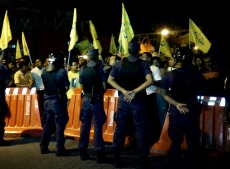
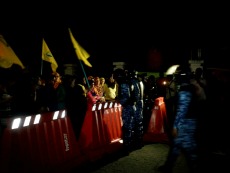
The leading group, with several MPs in attendance, was stopped near the parliament building by police and Maldives National Defence Force (MNDF) lines. The second group, consisting of mainly female protesters, was blocked near the National Library by SO police officers, while the third group went to the Chandhanee Magu-Fareedhee Magu junction where the MDP has been holding protests for over a week.

Protest one – near the parliament

The protest near the parliament – with over a thousand in attendance – was headed by MDP Vice Presidential candidate Dr Mustafa Lutfi, Chairperson ‘Reeko’ Moosa Manik and MPs Imthiyaz Fahmy, Ahmed Rasheed, Ahmed Sameer, Mohamed Shifaz, Mohamed Gasam and Ahmed Easa among others. Several MPs addressed the crowd via sound systems on one of the many campaign lorries that accompanied protesters, constantly playing party-themed campaign songs.

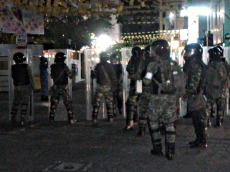
While a line of regular police officers, referred to as ‘Blues’, in riot gear formed the first security line behind the barricades, about 12 Special Operations (SO) officers in full riot gear and holding shields lined up about 10 feet behind them, with yet another security line behind them formed by over a dozen MNDF soldiers, also in riot gear.

The protest continued at the area until just after midnight, though numbers at the location decreased to a few hundred by then. The protesters then marched to join the main cell of protesters who were by then at the Majeedhee Magu-Chandhanee Magu junction. Police barricaded off Majeedhee Magu near the Agora Superstore, which led to the loudly chanting protesters taking a detour through side roads to join the main group, reaching the junction despite police hurrying to block off side roads.

Protest two: Chandhanee Magu-Fareedhee Magu junction

The second group of protesters marched down Chandhanee Magu to the party’s protest site of previous nights, which have followed the Supreme Court’s indefinite delay of the presidential election run-off.

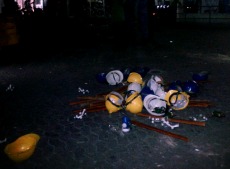
Minivan News observed a number of protesters wearing helmets and dive masks, with one protester saying “this gear is protection against the police’s random attacks with batons and pepper-spray every night”.

SO officers worked to disperse crowds and bring back order after alleged violence incidents took place, including a CCTV camera at the junction smashed to pieces by a man with a large piece of wood. MNDF officers formed a security line between media and the police and protesters.

Police have since announced a manhunt for the person allegedly responsible for smashing the camera, identifying him as Kamil Ibrahim of Beach House from the island of Ukulhas in Alif Alif Atoll.

Police ordered media to remain on the pavement behind police and MNDF lines while the SO officers took possession of the alleged “weapons of violence”, arresting offenders and dispersing crowds, warning media that “if you get off the pavement, you will be removed”. Asked what they meant by “removed”, one officer stated that media “will find out if you step off that pavement”.

Media were however allowed to take photos once police had finished gathering up the ‘weapons’ that were allegedly gathered from the protest site.

One protester claimed to have seen a police vehicle unload bits of wood on Fareedhee Magu, which police allege were collected from the crowd. Minivan News could not confirm these reports as media was ordered to stay behind security lines during the time.

Protesters were pushed off the site, which caused the crowd to split into groups in three different locations: near Maldives Monetary Authority (MMA) offices, near Fantasy Store on Fareedhee Magu and near the National Museum on Chandhanee Magu.

After police pushed backed the crowd, the SO loudly chanted their oath, after which Minivan News heard the commander on duty ask the officers to “without much ado, just arrest anyone in any area in Male’ who you think has consumed alcohol”.

Police then went into the crowds and searched a number of protesters and smelled their breath, allegedly checking for the smell of alcohol.

Protest three: near National Library

The final group consisted of over a thousand protesters, mainly female. They marched through the first set of barricades, with protesters voicing intentions to reach Republican Square.

The protest was brought to a halt just in front of Medhuziyaaraiy Magu on the street around the corner from the National Museum by scores of SO officers in full riot gear, wielding batons.

Protesters remained in the location for approximately an hour before police attempted to disperse the crowd, leading them to regroup and join protests on Chandhanee Magu, where police lined up barricades a few feet away from the National Museum.

Sitdown at Chandhanee Junction

At around midnight, protesters in different locations started joining the majority of protesters who were at the Majeedhee Magu-Chandhanee Magu junction.

With a few thousand protesters at the site at around 1:00am, still chanting and asking for immediate elections, a police truck with several SO officers rode through the crowd, taking photos and videos of the protesters.

Protesters initiated a sit down in the middle of the junction at around 2:00 am, with MDP Vice Presidential candidate Dr Mustafa Lutfi and a number of MPs still active in the site.

At 2:40 am, two trucks with over 20 SO officers arrived at the protest site. Minivan News observed at least two people being taken into custody.

An hour later, the SO dispersed the hundreds of protesters still left at the site, arresting additional protesters after frisking many.

Response

“The October 5 protest was an unconstitutional gathering,” a police media official told Minivan News on Sunday.

“Twelve people were brought under police custody at last night’s protests, all of whom were arrested on charges of assaulting police officers, disobeying police orders and obstructing police duties. We are currently working to find the man who is accused of breaking the security camera on the Chandhanee Magu – Fareedhee Magu junction,” he said.

Police said eight out of the 12 arrestees have had their detentions extended by a week by the court today, with one person detained for an 15 days.

Police also confirmed that two persons have been arrested this afternoon on a fishing vessel from Ukulhas – the island of origin of the man police are looking for in relation to the smashing of the security camera – which was docked in Male’ harbour.

Meanwhile, the Human Rights Commission of Maldives (HRCM) has released a statement noting that during its protest monitoring “some people gathered at the Chandhanee Magu – Fareedhee Magu junction at last night’s protests used wooden bats in a manner which was not peaceful and has conducted unlawful activities. We condemn this act and call on all to exercise the right to freedom of expression in a peaceful manner.”

The statement also said that the commission is receiving a number of complaints about the ongoing protests disturbing the studies of students preparing for their GCE O’Level exams, and called on protesters to not obstruct the students’ right to learn.

The Maldives Police Services has said it will file complaints against the MDP with the relevant authorities for conducting “violent” and “illegal” protests.

Police footage of a protester smashing a CCTV camera and threatening officers

Likes(0)Dislikes(0)

Translation: MNDF officers’ ‘letter of concern’

The following is a translation of a leaked “letter of concern” circulating on social media, submitted by senior officers of the Maldives National Defence Force (MNDF) to Chief of Defence Force Major-General Ali Shiyam on September 28. Following the release of the letter the MNDF amended its regulations to punish officers who promoted “upheaval and chaos”. Brigadier General Abdulla Shamaal was subsequently removed from his position as the Commandant of Training and Doctrine,while First Lieutenant Abdulla Shareef (Marine Corp), Sergeant First Class Ali Waheed and Lance Corporal Sharhaab Rashid were dismissed from service. First Lieutenant Mohamed Haleem resigned, stating “For the last 23 years [of my military service]; I have served this country under a solemn oath taken in the name of Allah, I do not see any way that I can carry out my duties as prescribed in the constitution and the military act, while in this position, therefore I request you to relieve me from my duties.”

To Chief of Defence Force Major General Ali Shiyam:

Whereas Article 236 in Chapter 9 of the Republic of Maldives’ Constitution states the Maldivian security services, consisting of the Military Service and the Police Service, is established to enable all persons in the Maldives to live in peace, security and freedom,

Whereas Article 237 states the security services shall protect the nation’s sovereignty, maintain its territorial integrity defend the constitution and democratic institutions, maintain and enforce law and order, and render assistance in emergencies,

And whereas Article 238 states that the actions of the security services must be exercised in accordance with the Constitution and the law, and operate on the basis of accountability,

And whereas Article 111 states that if no candidate wins by over fifty percent of the votes in a presidential election, a run-off election must be held within twenty one days of the first election,

And whereas Article 142 states judges must comply with the constitution and the law,

On 7 September 2013, a presidential election was held as per Article 110 of the Constitution. The Elections Commission announced a second round of election on 28 September 2013 as per Article 111 of the constitution.

According to Article 111 of the constitution, a second round of election must be held within 21 days after the first election, and that date is 28 September 2013. We believe, given Article 8 of the Constitution states that the powers of the state shall be exercised in accordance with the constitution, and as 28 September 2013 is the last date on which the second round of the presidential elections can be held, the Supreme Court order to delay the election is one that creates dangers for the nation and its citizens and creates challenges from a national security point of view, and may impede the military from carrying out is constitutionally mandated duties.

As per Article 237 the security forces are mandated with defending democratic institutions, and maintaining and enforcing law and order.

Given the shifting national security atmosphere in the country, and as the Maldivian state’s independent institutions and the international community are repeatedly calling for all parties to respect the constitution, we believe any military act that violates constitutional rules and democratic norms, will destroy the sovereign state established in the Maldives, destroy law and order in the country, and allow for a military state to be established in the Maldives.

This is due to influential actors who may abuse the turmoil and constitutional void following the delay in presidential elections. We are concerned that the chain of command established in the military as per the laws will be lost, and will allow for the military to be used as a tool to hand over administration of the state to a certain group of people.

Article 245 states that no one is allowed to issue an illegal order to a member of the security services and that members of the security services should not obey such an order. Hence, due to orders issued in the above mentioned situation, this institution [military] may fall into a deep pit, and we fear that subordinate commanders and lower ranks may be legally locked into a dark cell and may be criminally charged at a later date.

Hence, we express grave concern, and appeal for this institution not to be propelled into a deep pit, and state that we will steadfastly remain with good military behavior and good order against any illegal order.

28 September 2013

Signed:

Brigadier General Shamal
Colonel Abdul Raheem
Brigadier General Ahmed Jihad
Brigadier General Ahmed Nilam
Colonel Hamid Shareef
Lt. Colonel Nasrulla Majdhee
Captain Abdul Muizz
Lt. Colonel Ibrahim Hilmee
Sergeant Major Hassan Fawaz
Sergeant Major Naushad Ali
First Lieutenant Abdulla Shareef
First Lieutenant Mutholib [unclear]
Sergeant Major [first name unclear] Vaseem
[name unclear]
[name unclear]
Captain Hassan Amir

Likes(0)Dislikes(0)

“Potential for trouble”: UN Security Council briefed on Maldives

The UN Security Council has been briefed on the situation in the Maldives, following the suspension of the run-off elections, ongoing protests and the submission of a “letter of concern” signed by senior military officers to their leadership.

UN Assistant Secretary-General for Political Affairs Oscar Fernandez-Taranco briefed the Security Council on Wednesday.

Citing a diplomatic source present at the briefing, AFP reported the senior UN official as warning the 15-nation council that recent democratic gains were “under threat” and that there was “potential for trouble”.

“We continue to follow the situation in the Maldives with concern in light of the mounting tension following the postponement of the second round of its presidential election,” said the UN Secretary General’s spokesperson Martin Nesirky, at a press briefing on Friday.

The UN Security Council Briefing came a day after Acting Foreign Minister Dr Mariyam Shakeela addressed the UN General Assembly, and blamed “external forces” for “concerted efforts to prevent the emergence of an indigenous democratic system of governance in the Maldives [by] attempting to shape the outcome of, what is, an internal issue”.

“Democracy consolidation is not just about holding elections. Nor is it about having a democratically sound Constitution. In the Maldives too, we quickly found that changing the Constitution, or having a multi-party election, did not instill democratic values within our society,” Dr Shakeela told the UN.

Instability

The Supreme Court indefinitely postponed the second round of the run-off elections, initially scheduled for September 28, after third-placed candidate Gasim Ibrahim alleged electoral irregularities and declared “God Willing, Gasim will be President on November 11″.

The injunction was issued despite unanimous positive assessments of the polling by local and international election observers. The EC meanwhile contested the credibility of the evidence submitted to the court, observing that even if factual it was insufficient to impact the results of the first round. The subsequent delay of the second round was met with global concern.

Gasim was nonetheless joined in the case by second-placed Abdulla Yameen, and Attorney General Azima Shukoor, his former lawyer.

A second Supreme Court ruling issued at midnight prior to the vote ordered police and military to enforce the suspension, leading to police surrounding the Elections Commission (EC) and issuing an ultimatum. The EC relented, stating that it would be unable to hold the election without police and state cooperation, and noting that its staff had received threats of death and arson.

Now, two weeks after the suspension of the election, the hearing for the Supreme Court’s verdict has yet to be scheduled.

Protests resulting from the suspension of the election have led to other countries including the UK, China, Canada and Australia to upgrade their travel advisories to the luxury tourism destination, while port workers, customs officials, air traffic controllers and ground handling staff have staged strikes.

Senior officers of the Maldives National Defence Force (MNDF) last week sent a “letter of concern” to Chief of Defence Force Major General Ahmed Shiyam, “over the Supreme Court’s order to delay elections, the failure of state institutions, and the possible politicisation of the military, and asking that unconstitutional orders not be issued,” according to one signatory.

The letter prompted a rapid reshuffling of the organisation, dismissals, suspensions, resignations, warnings to media and amendments to its regulations to to impose punishments on officers found guilty of inciting ‘upheaval and chaos’.

Former Brigadier General Ibrahim Didi, Male’ Area Commander at the time of the controversial 7 February 2012 transfer of power, meanwhile wrote a letter urging officers to “not give the opportunity to anyone who plans to rule this country by taking the laws to their own hands and override the constitution and undermine the constitutional framework of this country.”

“After November 11, 2013, regardless of who gives the orders and regardless of the situation, I sincerely urge the military to not let anyone take over the country in contrast with the provisions in the constitution, as this would have dire consequences,” he wrote.

Likes(1)Dislikes(0)

Comment: Speaking of sovereignty – US interest in the Maldives

This article first appeared on Dhivehi Sitee. Republished with permission.

It is misguided to focus the current Maldivian sovereignty debate on possible military intervention by a foreign power. The Maldives is a long way away from the kind of humanitarian disaster that today qualifies for foreign military intervention and such talk serves no other purpose than provide politically inflammatory rhetoric to be used in the current political crisis. If we are to discuss threats to sovereignty, it would be more fruitful to talk about the role that non-military foreign relations play in shaping Maldivian domestic affairs.

For the better part of the twentieth century, Maldives held little interest for global, and even regional, powers. This status-quo of Maldives as inconsequential in international affairs changed shortly after the beginning of this century, not from its own doing, but due to two major changes in global politics: the dramatic change of world order in which several developing states—among them India and China—have risen to challenge the United States’ post-Cold War only-superpower status; and the United States-led global War on Terror.

Both matters made the Maldives, for the first time in its history, a country of interest to the United States, signalling an end to the days in which it could remain sheltered from the threat of becoming a pawn in global power games.

The rise of China: United States, India and the Maldives

China will overtake the United States as the world’s largest economy in 2016, according to a recent report by the Organisation for Economic Cooperation and Development (OECD). India, too, is no longer just the strongest regional power, but is rapidly becoming a global force to be reckoned with.

US relations with India has been dictated by its own interests almost from the time of India’s independence. Throughout the Cold War, when India doggedly stuck to its non-aligned stance, US foreign policy vacillated wildly between favouring India and favouring Pakistan as best suited its fight with Soviet Russia. Once George W Bush’s declared the War on Terror and invaded Afghanistan, Pakistan once again became a premier ally, while India was made to take a backseat until US relations with Pakistan soured once again, and George W Bush signed a nuclear treaty with India in 2005. Today, as India’s foreign policy has gone from one of determined non-alignment to the formation of a strategic alliance with the US, America has begun to view India as ‘a swing state’ in Asia’s balance of power.

Control of the Indian Ocean, which connects West Asia, Africa and East Asia with Europe and the Americas is important to not just India and the US but also for China as it  rises to global preeminence. Maldives is strategically located 450 miles off the south-western tip of India, making it of significant strategic interest to all those fighting to maintain a dominant presence in the region.

Recent analyses predict that China will become the world’s largest importer of oil by 2017, and 80 percent of this oil is transported through the Indian Ocean (Kumar 2012). Given the long-existing US dominance in the Indian Ocean, China—not surprisingly—is keen to ensure that its vital energy routes remain open and have strengthened its military presence in the region. This is where China’s interest in the Maldives lies.

Countering China is thus one of the main reasons for United States increased interest in the Maldives and its expressed desire for a military presence in the country, even if it is not the boots on the ground as outlined in the draft SOFA as discussed here. The United States may have denied the draft SOFA and a possible military base, but it did not deny that negotiations for some sort of an arrangement — whether a lily pad or whatever other name it is called — is underway.

The geo-strategic alliance between the US and India helps both countries counter China’s expanding ambitions. The US has long been the dominant player in the Indian Ocean and will fight to maintain this at whatever cost. It will be US’ strongest card to play in stalling the unbridled rise of China if and when it needs to do so. Thus the increased maritime activity in the Indian Ocean region in general and, more specifically, the so-called Asia Pivotin US foreign policy.

With US as a strategic ally, China is less likely to confront India over the many disputes that exist between the two countries such as those over the borders of Kashmir and Arunachal Pradesh and the continuing Chinese financial and military assistance to arch enemy Pakistan.The importance of India’s new alliance with the US is apparent from the fact that since 2005 India, which from 1995-2005 opposed the US in the UN in 80 percent of all its votes, has voted with them on sanctions against Iran, opposition to a Small Arms and Light Weapons Treaty and on the Kyoto Protocol (Chenoy & Chenoy :2007).

It should come as no surprise then that India and the US supported each other in the rapid recognition of Waheed’s presidency of the Maldives as legitimate.

The War on Terror: United States and the Maldives

When the US launched its global War on Terror, it force-created another bi-polar world: those with the United States and those against it. The Maldives, led by President Gayoom, was firmly ‘with the US,’ despite the War’s decidedly anti-Islamic overtones. This status of the Maldives—as an Islamic state willing to co-operate with the US in the War on Terror is how the Maldives first appeared in the American consciousness. Unfortunately for the Maldives, this is still her primary (and often only) identity as far as the United States is concerned. Unlike India, and even Britain, the US has no experience or knowledge of Maldivian culture and its long relationship with Islam that is so vastly different from the radical Islam that dominates its society identity today. Nor did it, until very recently, have any tourism or travel related interests in the Maldives, unlike other Western states.

If the United States was honestly interested in tackling the rapid radicalisation of the Maldivian society instead of its own counter-terrorism efforts in the region, it would have taken steps to understand the root causes and nature of extremism in the Maldives. Very little is known about how and why Maldivians have succumbed so easily to radical Islamist ideology. Neither is it known whether the people who outwardly show signs of radicalisation—change of religious practices, clothing, general behaviour— in fact have anything to do with the adoption of an ideology. Serious intent of curbing radicalistion would involve attempts to understand it, followed by a counter-radicalisation strategy custom-designed to solve the problems so identified.

The United States has a vast budget and plan for counter-radicalisation efforts that go beyond its borders, but it has not initiated or supported any research in the radicalised Maldivian community. Instead, it sends dubious US ‘terrorism experts’ to teach Maldivians about tackling radicalisation, according to what the Americans know and has defined radicalisation to be. Rather than tap into the vast potential for building a knowledge base on how an entire population can embrace radical Islamist ideologies after remaining far removed from them for centuries, the US tells Maldivians what their society is about, and implement actions governed not by what is at stake for Maldivians, but by a generic idea of what the US perceives should be done in a ‘rapidly radicalising Islamist society’.

This lack of knowledge and cultural disinterest has meant US foreign policy towards the Maldives is entirely governed by its own realist interests, which has had a largely negative impact on Maldivian attempts to consolidate democracy. These detrimental effects have been created by, and are manifest in, several characteristics of US engagement with the Maldives.

American view of the Maldives as a backward Islamic state which is a breeding ground for Islamist radicals and Jihadhis was made obvious, for instance, by its push to have the PISCES border control system installed in the Maldives. The PISCES, as explained here, is not a border control system but a system designed and installed in various countries designated by the United States as ‘terrorist hotbeds’.

That the Maldives would willingly participate in the invasion of privacy of its own people and millions of visitors without consultation or debate is bad enough; what is even worse is that the system has been installed ‘for free’, at the cost of Maldives’ authority and ability to control its own borders.

Attempts to implement the PISCES in the Maldives met with intense opposition from almost all senior local immigration officials. Their objections do not stem from corruption and bias towards Nexbiz [the Malaysian company originally contracted with designing and implementing a sophisticated border control system for the Maldives] as was widely portrayed in the media, but from what the PISCES does not do.

The system is so basic that Immigration officials who attended the training programme had a module on ‘how to use a keyboard.’ Anyone familiar with Maldivian culture would know the Maldives is also one of the most Internet and technology savvy countries in the region. Computer literacy among the youth must be close to a 100 percent, not to mention the complete saturation of the Maldivian market with smart phones and all other modern technological gadgets. For Maldivian immigration officials, used to operating the most advanced immigration control system in the region for years, the ‘Computers for Dummies’ class was an affront.

If only things stopped at imperial condescension.

The PISCES is unable to do even the most basic of border control work—it cannot, for instance, keep track of the number of tourists coming to the Maldives. There is no Drop-Down Menu to automatically select which resort a tourist is staying in. There is no way to automatically feed and calculate the number of days a tourist will be staying in the country by inputting dates. Now it is essential for immigration officials to keep pen and paper as well as a calculator beside them when manning the Immigration counters at various ports across the country. In addition, immigration officers need to have two other systems running simultaneously to the PISCES if they are to check visas and monitor the arrival and departure of expatriates for PISCES can do neither. Not only is this causing great frustration among officials highly trained in maintaining a sophisticated border control system, it is also leading to negligence of some of their most important responsibilities.

The most important thing for us is to compare the person standing at the counter and the passport that s/he presents to the official. Is it the right person? We can’t do that now because we are so busy punching the buttons on our calculators or manually typing in the person’s address in the Maldives. Of course, mistakes are being made (A senior immigration official, September 2013).

To circumvent  immigration officials’ resistance to PISCES, the Minister of Defence Mohamed Nazim—with whom the United States has been negotiating to have the PISCES installed in the Maldives—handed over their work to staff at the National Centre for Information Technology (NCIT). When Immigration officials resisted this handover, their senior IT personnel were summoned to the Defence Ministry, sat down with large numbers of uniformed military personal in a highly intimidating atmosphere, and told to agree to the new arrangement, or else.

One of the main problems that modern Maldives has to confront, flagged by the United States itself, is the issue of human trafficking. Tens of thousands of Bangladeshi labourers are in the Maldives illegally. They are heavily exploited by ‘employers’  who make them work for little or no money, and regularly treat them inhumanely. The PISCES does not have the capacity to trace the movement of any foreigner in the Maldives—be they expatriate workers or tourists. The Nexbis system included the introduction of an ID card with a 3-D Bar Code that, even a photocopy kept by an expatriate, would allow immigration officials to trace their whereabouts, greatly reducing the opportunities for them remaining in the Maldives illegally and/or their exploitation by those running the slave labour trade in the country.

With PISCES, nobody knows where anyone is—it just counts the number of Mohameds and Ahmeds and other passengers with Muslim names [terrorists by default] who enter and leave from the geo-strategically important Maldives so that US’ Terrorist Database is kept up to date. There is huge corruption involved in the ousting of Nexbis and the Maldives’ agreement to accept the PISCES as our ‘border control system’, but that is for another day’s discussion. The relevant point here is that the US—which, by the way, does not consider PISCES to be a good enough system for monitoring its own borders—is quite happy for the Maldives to totally lose control over its own borders and become wholly inept at handling the human trafficking crisis that it confronts. What matters to the US is having an additional weapon in its ‘crusade’ against radical Islamists.

What governs US foreign policy in the Maldives?

Discussed above are two examples of how US has ridden roughshod over Maldivian domestic affairs and interests since it noticed the Maldives as important to its power play in the region. Common to both matters is the imperialist neo-colonial attitude with which the US conducts its business with the Maldives. These interests, and this attitude, very much contributed to the role that the United States has played in bringing the Maldivian democracy to its current crisis.

The US was the second, after India, to rapidly recognise the incidents of 7 February 2012 as a ‘legitimate transfer of power.’ Just as the United States designated the Maldives as a backward Islamic terrorist state without knowledge of the characteristics and nature of its radicalisation issues, it began meddling in the Maldivian democracy without a clue about Maldivian culture and traditions. Instead of attempting to find out, it brought into play its own preconceived notions of what a democracy, and what a leader of a democracy, should be.

Mohamed Nasheed, according to a view widely propagated by US Embassy officials, and almost as widely accepted among the diplomatic community, is that he is ‘not a statesman’. Waheed, on the other hand, educated in Stanford, San Francisco, and by all likelihoods the holder of a US green card and the father of children who are US citizens, is the embodiment of what counts as a statesman for the US. It does not matter that it is precisely the non-statesman like behaviour of Nasheed that has appealed to a majority of the Maldivian population. It is Nasheed’s willingness to get out of a suit more than his eagerness to get into one, his ordinary language, his fluency with Dhivehi vernacular and history, and his ease with people of every age that inspires people of all ages to unite behind him for democratic reform in the Maldives. For thirty years Maldivians had a leader who fit the international community’s idea of a statesman—he did nothing to empower the people. Why should they want another ‘statesman’?

But, US embassy officials—who swan into the country on a brief visit from their ‘Virtual Presence Post’ in Colombo, usually stay in the swanky five-star Traders Hotel where a room costs over US$300 a night [the monthly salary of an average Maldivian worker] for one or two working days, then speed off to a resort island for the weekend to sip cocktails and unwind before returning to their lives in Colombo—are adamant that what the Maldivian democracy really deserves is a ‘statesman’. They have no idea what a majority of Maldivians think of Nasheed. None of them stay long enough to watch the rallies, the street demonstrations, the Door to Door campaigns, and the hard graft of the grassroots based community efforts that have enabled Nasheed to wake a majority of Maldivians to dream of democracy.

So US ‘virtual’ staff in the Maldives quickly moved to have Dr Waheed [now widely known as Doctor Five Percent after gaining only that much of the vote in the elections held on 7 September] installed as the legitimate president. Ironically, US attitude towards Nasheed—enthusiastically endorsed by the current Obama government—is one that most closely resembles the Republican Tea Party attitude towards Obama with the mad Birthers and whatnot. It is totally ridiculous and out of touch with how a majority of domestic and international populations think of the leader in question.

Just as influential in shaping US policy towards the Maldives as its Orientalist condescension are the realist national security interests of the US discussed above. The US did not just stop at saddling the Maldives with an incompetent statesman, it capitalised hugely on Waheed’s presence to push its interests in the Maldives as rapidly as possible. Negotiations regarding the PISCES were initiated by Waheed who became the chief procuring agent of the PISCES system, having opened discussions about Maldivian border control problems with the US during a visit to New York in 2009.

Once Waheed ‘rose to the presidency’, he appointed the dishonourably discharged former army general [Baaghee] Nazim as the primary go-between the US and the Maldivian government. Despite Nazim’s very public role in the forcible removal of Nasheed from presidency, he was quickly adopted as a darling of the US diplomatic community.[Dubious generals, it seems, are quick to win favour with Washington.]  Nazim is the main mover and shaker not just in having the PISCES implemented but also in securing a SOFA with the Maldives for the United States. Until the current political crisis, Nazim’s main preoccupation since early this year was to put pressure on all immigration staff to have the entire PISCES system up and running everywhere in the Maldives by a specific date—October 20th—for unspecified reasons.

It is not just the PISCES or the SOFA that have been pushed on the Maldives since the US, with its strategic ally India, helped Waheed the statesman and Nazim the General into top positions in government. US state department officials have since been given access to certain areas of the Maldives to conduct an ‘economic and social survey’, a US company—Blackstone—has bought out the entire seaplane industry of the Maldives, and it is also to a US company that the MNDF training island of Thanburudhoo, complete with a popular national surfing spot, has been sold. It is makes one neither an alarmist nor a conspiracy theorist to suspect there is a lot more we do not know about.

Since authoritarians began conspiring to disenfrachise Maldivians by cancelling the second ever democratic presidential election in the Maldives, most of the international community seems to have moved away from, if not officially revised, their assessment of the 7 February 2012 events as ‘a legitimate transfer of power’. Where a majority of the international community reacted with concern over the indefinitely postponed election, the United States’ first response was this statement.

We note the Maldivian Supreme Court’s ruling to delay the second round of presidential elections, scheduled for September 28, as Justices continue to hear arguments. While this judicial process moves forward, we encourage all political parties to work together peacefully and ensure that the democratic process can continue in a way that respects the rule of law and that represents the will of the people.

To describe the current farce in the Maldivian Supreme Court as ‘the judicial process’ and the ridiculous claims of opposition parties challenging the election results as ‘the democratic process’ is to know nothing—and/or to care nothing—about the current state of the Maldives and its fight for democracy. Despite a flurry of statements expressing concern over the Supreme Court behaviour from various other members of the international community, the second US statement was not much better than the first.

It is states like the US, and their realist national security interests that threaten Maldivian sovereignty today more than direct foreign military intervention. It is such interference that in the long run takes away from the power of the Maldivian people to have an independent country led by a leader of their choice in a government of their own. We are better off preparing for resisting such invasions of our identity and ‘sovereignty’ by foreign powers than inviting or contemplating the repercussions of armed military intervention. When ‘soft power’ is packed with so many dangerous explosives, who needs guns or boots on the ground?

Dr Azra Naseem has a PhD in International Relations

All comment pieces are the sole view of the author and do not reflect the editorial policy of Minivan News. If you would like to write an opinion piece, please send proposals to [email protected]

Likes(3)Dislikes(0)

Maldives customs workers suspend strike, give management one week to meet demands

Maldives’ Customs Service workers initiated strike actions on Thursday morning and have threatened a full work stoppage if senior management does not meet their demands by the end of next week.

At 8:30am approximately 90 customs officers began protesting in the main customs building in Male’. They met with Deputy Commissioner General of Customs Mohamed Kamal and other senior management at 10:30am to discuss customs workers’ grievances, communicate their demands, and provide a petition signed by over 250 workers.

As of 11:00am the strikers agreed to give management one week to fulfill their demands and “give a solid answer”, otherwise the strike will restart Thursday.

“From the olden days there has been favoritism and the same thing is still practiced now. We will protest, we won’t stop. These problems should be solved if senior management wants us to be calm,” one of the strike organisers told Minivan News today.

“We decided [to strike] for our children’s future, for their sake we thought we should come out and express ourselves,” the source said. “This is the first time ever customs workers have participated in any strike.”

“We are not fighting for our own individual rights, but for the [customs] staffs’ rights,” the source noted.

Customs workers are aggrieved about senior staff engaging in discriminatory, nepotistic practices, that have led to inequitable promotions, retirement packages, and training opportunities, multiple customs workers told Minivan News today.

“Inequality is very high within customs, people won’t tolerate this,” a source lamented. The source also noted that gender discrimination is a factor impacting women within the government agency.

While “favoritism has been a problem from the beginning”, customs officials noted that these problems have been exacerbated since individuals with education and experience have been overlooked and mistreated by senior staff. “Promotions have not been based on qualifications, these things shouldn’t be happening,” said a customs official.

“On August 15, 2013 senior management met at 12:00am and developed a promotions list in secret. That’s not legal,” the source alleged. The source noted that the promotions criteria was altered to include the subjective “competency” category, however staff were not shown their employment appraisals.

The sources alleged that the promotion grading system has not been adhered to, and instead senior staff have unfairly advanced employees.

“There have been discrepancies in promotions, for example some have received double promotions, while others have not been promoted at all due to their political affiliations,” a customs officer said.

“Promotions have not been lawfully done. The management board includes staff with relatives working under them. They can’t make decisions [regarding promotions] in that state,” said another customs official.

“Some of the senior staff have not attended [the office regularly] and amended their attendance [record], but their status in the human resources [section] says they have attended,” the source noted. “Since there are problems with their performance, how can they objectively evaluate ours?”

In addition to grievances about inequitable promotions, nepotism has led to unfair working conditions as well, a customs official explained.

“Wives and relatives of senior staff are allocated tasks and assigned to sections [within customs] where they only have to work in the morning. There are many sections that require shift duty, but they don’t get assigned shifts,” the source noted.

“Senior staff follow separate rules, they come and go as they please, don’t swipe their finger, and no one is supervising them,” the source continued.

“Recently a case happened regarding a high level shipment, but senior staff instructed us not to fine the shipment and to let it go,” the source added.

Also, employees are being transferred to different departments repeatedly and frequently without reason, according to one source who reported being shifted between three different sections over the last six months.

Another customs official highlighted inadequate working conditions, such as the lack of desks and chairs for some employees, are also problematic for some employees.

The strikers noted that after the promotions were announced in August, they communicated their grievances to the Commissioner General (CG) of Customs, the Home Minister, President Mohamed Waheed, and filed a petition with the Anti-Corruption Committee (ACC).

“The CG said he did what he wanted and no one can do anything about it, the Home Minister said he’d look into it and the President said he’d establish a separate committee to look into the matter,” according to a customs officer. “But still there has been no decision or action taken.”

Customs officers presented a list of demands that include correcting discriminatory practices as well as holding the Human Resource Board of Directors accountable for their corrupt practices.

The board consists of the CG, eight section directors, as well as the human resource section head, customs officials explained.

“The Human Resources Board thinks that this is their company, but this is a government agency,” declared a customs official.

“We are demanding a separate entity be established to deal with promotions and the previous promotions awarded [since August] be cancelled,” the source added.

Some of the customs officers who participated in this morning’s strike claim that senior management told them their protest action was illegal and threatened to fire participants.

“They can fire us, we are ready for that, but they have to fire the board first,” said a customs officer. “We don’t trust [the management] anymore.”

Senior management’s response

Meanwhile, senior customs officials are considering the workers demands but have denied threatening to fire strike participants.

“A group of staff voiced discontent with some aspects of evaluating performance and promotion criteria used, which they claim are unfair,” Deputy Commissioner General of Customs Mohamed Kamal told Minivan News today.

“Management met them and noted the issues. Possible remedial actions are being analysed,” he continued.

“Firing employees are not being considered, that’s speculation,” he added.

Likes(2)Dislikes(0)

Comment: Yameen the Meek

So much for ‘Yameen The Strong’, the tough, gunda boss: alleged purveyor of illegal oil to the Burmese Junta and other illegal substances to Male’s youth. Instead, he should be known as Yameen The Chicken, or Yameen The Meek.

For Abdulla Yameen is clearly scared of the Maldivian electorate, and afraid of losing the second round presidential polls. Why else would he conspire with half-brother Gayoom to get the Supreme Court to indefinitely postpone the vote? There can only be one explanation for PPM’s delaying tactics: Yameen knows that in a second round fight, the MDP’s Mohamed Nasheed will kick his ass.

Yameen’s election campaign has been lacklustre at best. He rarely campaigns, his policies sound as if they are made up as he goes along and, as I pointed out in my previous column, Yameen seems incapable of dropping his semi-permanent and voter-off-putting sneer.

Yameen barely scraped second place in the first round on 7 September, despite inheriting the second largest political operation in the country: the PPM. Yameen acquired a paltry 25.35 percent of the vote, to Nasheed’s 45.45 percent. Since then, the DRP has joined forces with Nasheed, likely pushing his vote above 50 percent and leaving Yameen’s campaign in big trouble.

And so, rather than choosing to man-up and fight Nasheed head-on, Yameen has hidden behind a bench of thieves, porn-stars and illiterates otherwise known as the Supreme Court of the Republic of Maldives.

The Supreme Court has entertained a ludicrous case about voter irregularities by third-placed Gasim Ibrahim – another Gayoom stooge. This farcical trial, involving witnesses “who heard from someone there was voter fraud”, has been used by the court to delay the second round indefinitely, despite numerous foreign and local election observers praising the vote for being free and fair.

Yameen’s gambit appears to be to delay the second round for as long as possible – perhaps until the New Year – so, in the words of his lawyer, PPM has “time to campaign.” Or maybe his game-plan is to get rid of the Elections Commission, so his mate Abdulla Riyaz – Police Commissioner and coup d’état perpetrator extraordinaire – can take over the voting process and rig it in Yameen’s favour.

Yameen’s running mate, Mohamed ‘Angry Bird’ Jameel has even muttered dark thoughts about disqualifying Nasheed from the race entirely, by re-starting the politicised trial against him over his decision, when president, to detain a corrupt judge.

Yameen’s undemocratic (and unconstitutional) behaviour might not be surprising. He is, after all, the little brother of a vicious dictator. But it does smack of cowardice. Because leaders – real leaders, that is – don’t hide. They don’t cower. And they don’t duck out of a fight, and get big brother to fight it for them.

Yameen has been accused of many things since the start of the election campaign. Hassan Saeed vowed to put Yameen on trial for the theft of US$800 million of state-owned oil, which Yameen allegedly stole while head of STO. Umar Naseer claimed Yameen peddles drugs, and pays street gangs to attack his political opponents. Mohamed Nasheed has called on people to be “mindful” of Yameen’s dark past and dodgy character.

But now the PPM candidate faces a new charge. One that, for an aspiring Head of State, is perhaps most damaging of all: that he is a chicken and a coward. He is Yameen The Meek.

All comment pieces are the sole view of the author and do not reflect the editorial policy of Minivan News. If you would like to write an opinion piece, please send proposals to [email protected]

Likes(0)Dislikes(0)