Body of Bangladeshi national found in Thilafushi harbour

Police have reported the discovery of the body of a 45 year-old Bangladeshi worker floating in Thilafushi harbour early on Tuesday.

Local media identified the victim as Samar Bis Saas, a cook who worked for the BMC Company.

Samar was reported to have gone fishing on a barge in Thilafushi harbour on Monday, and was reported missing at 11:00pm that evening. Police said his fishing equipment was later discovered on the barge.

Likes(1)Dislikes(0)

Comment: Making the Maldives’ post-poll transition smooth

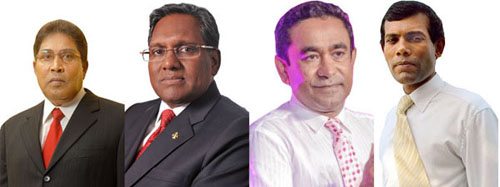
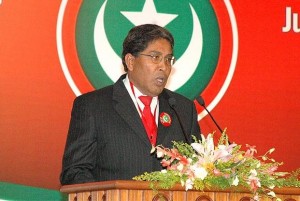
In a nation where rumours rule the roost ahead of the 7 September presidential polls, President Mohamed Waheed Hassan Manik, seeking re-election, may have set the right tone for post-poll transition. President Waheed has said that he would not leave the country, if defeated. The same approach could be expected from the other three candidates, and the running mates of all four.

Over the past year and more, the international community is concerned only about political stability in the Indian Ocean archipelago. India, the closet neighbour with a regional and global presence to match, has clarified more than once that it is all for an ‘inclusive’ election that is free and fair without violence, followed by a ‘smooth transition’ that belies avoidable speculation of all kind. The rest of the international community seems to concur.

Under the Constitution, the first-round polling is scheduled for 7 September, followed by a second, run-off round involving the top two within 21 days should no candidate manage to cross the half-way mark. For an atolls-nation with thinly spread-out population spread across 950-km north-south, and not used to multi-party and multi-layered elections, Maldivians voted in large numbers in 2008 after the new Constitution came into being.

In 2008, the first round witnessed high 85-plus percent polling. It was followed by an even higher 86-plus percentage vote in the run-off. The figures were lower at 80 percent for the parliamentary polls six months later. It slipped further to 75 percent in the local council polls a year later. With the result, the voter-turnout has become an object of study. It could show the disenchantment or otherwise of the first-time voters, who were still in their early teens in 2008.

Voter turnout this time would also be a measure of the attitude of the rest, particularly the first-time voters from 2008 and those a generation before them. The events of the past five years, particularly since the controversial power-transfer and subsequent nation-wide violence of 7-8 February 2012, are an object lesson for the Maldivian polity to learn from. The population, insulated from the rest of the world until the tools of information technology, like television and mobile phones, made it all possible, would also have to understand and appreciate the ways and waywardness of coalition leadership, which they had consciously mandated in 2008.

Job cut out

Post-poll, a new president has his job cut out. He will have to put together a cabinet, which has to be cleared by an existing parliament close to the end of its term. As under other presidential systems like in the US, the government is answerable to parliament, but elected members do not become ministers. It comes with hopes and possibilities, problems and burden. The existing system commands that parliamentary clearance for the cabinet can cut either way, going by past experience.

In 2008, after the nation elected Maldivian Democratic Party (MDP) candidate Mohamed Nasheed as President, parliament approved his first set of 13 cabinet ministers without question. In 2010, alleging that the new parliament, elected year earlier, with an opposition majority, was adopting a ‘scorched earth policy’ viz the executive powers of the government’s 13 cabinet members, barring then Vice-President Mohamed Waheed’s submission of their resignation to President Nasheed, as if to force a political showdown between the two arms of the government.

After the Supreme Court ruled that the resignations stood, President Nasheed re-appointed the old set of Ministers. This time, parliament refused to clear them all, necessitating the nomination of fresh faces in the place of the rejected ones, but with informal consultations between the president and parliament. The trend of parliament rejecting the President’s nominees for cabinet positions has continued under President Waheed. Here again, there were no rejections at inception. It has since become a routine after the coalition partners supporting President Waheed in parliament and participating in his government through ministerial nominations decided to contest the presidential polls on their own. All this has set bad precedents as far as political stability goes, until a future dispensation proves otherwise.

On assuming office, a new President will have to present the annual budget in November, and get it passed by parliament in time for the government to start its New Year spending from 1 January. In between, the nation would be called upon to vote in the local council polls in December, followed by parliamentary elections in May 2014. The new President can think of doing something about implementing the manifesto of his party in full measure only after that. The premise does not rule out the possibility of the President not enjoying a majority in the existing parliament or the new one coming up after the polls.

A tough task even under relatively favourable circumstances, but a new President will be assuming office in a not-so-favourable political environment. In political terms, parliament would not have had enough time to switch from the ‘election mode’ to take up more serious work. The past five years in general and the months after 7 February power-transfer have ensured that parliamentary committees in particular have acted in a politically partisan manner, even though they may still be well within the letter of the law.

The past years in general and one-and-a-half years in particular have witnessed a spate of ‘defections’ from one party to another, at times within the ruling coalition. It is very difficult for a keen observer of Maldivian politics, even from within the country, to say which MP is now with which party – and if anyone intends crossing over (one more time?) in the near future. The months after the presidential polls could witness another spate of defections, possibly to the elected leader’s side. There could be exceptions, but of defections, there could be many. Such a course could contribute further to the existing sense of instability.

The Maldivian economy is in bad shape now (as has often been in the past years and decades). The reasons are many, though the inability of successive governments to make the successful resort tourism to share an equitable size of the revenues as the share that it makes of the nation’s economy has not paid off. Recently, the government has obtained promises of a $29.5-million credit from the Bank of Ceylon, for ‘budgetary support’.

In what is possibly an unprecedented move, MDP nominee for the 7 September polls, former President Nasheed called on Indian Finance Minister P Chidambaram to discuss post-poll fiscal support that his country might request from India. Nasheed was in Delhi, followed later by another presidential candidate, Abdulla Yameen of the Progressive Party of Maldives (PPM), and called on the Indian leadership starting with Prime Minister Manmohan Singh. India has also invited Gasim Ibrahim, presidential nominee of the Jumhoree Party, to New Delhi for a pre-poll exchange of views. The Delhi discussions, according to reports, have centred on political stability, free and fair elections and smooth transition.

Lame-duck presidency or what?

Traditionally, Maldivian Presidents from the days prior to multi-party elections have been sworn in on 11 November. The current constitution has continued with the existing norm of an incumbent President completing five years in office before the elected/re-elected one is sworn in. President Maumoon Abdul Gayoom ruled the country as quasi-elected Head of State and government for 30 years ending 2008, with elections every five years. Before him, President Ibrahim Nasir had done so for 10 years, after he was elevated from the post of Prime Minister.

The earlier experience thus had an inherent safety-clause as for continuity. Transition, if at all, affected only individual ministers that the President nominated to his cabinet, post-poll. Such changes were made even between two elections. There was no question of parliamentary clearance for cabinet ministers, some of whom had also been elected to the People’s Majlis. So were many government officials at all levels.

The question of transition thus really came into play only after the 2008 multi-party polls. The euphoria of multi-party polls took care of some of it. The proximity of the second-round poll date in late October and the swearing-in on 11 November took care of most of it. Despite avoidable speculation and motivated rumours to the contrary, outgoing President Gayoom, who lost the polls, and the incoming successor in MDP’s Nasheed were determined to make a ‘smooth transition’. They did the transition work smoothly.

There is nothing to suggest that the post-poll transition this time would be anything but smooth. The question will not arise if Maldivians chose to re-elect the incumbent. That is a different matter. Otherwise, the relatively long gap between the polls and the inauguration could make the incumbent a ‘lame-duck’. This could be more so if adversarial tendencies identified with the entire political and poll process in the country over the past five years and more come to play even more vigorously after the elections.

‘Revolving door’

In the US, from where the executive presidency model for Maldives and the phrase ‘lame-duck’ may have been borrowed, the interregnum is used for ensuring smooth transition. With nearly 4000 political positions in government falling vacant, such a time-gap has helped an incoming President and his team to discuss and decide on successors for each one of them. It also gives the newly-appointed ones enough time to acclimatise themselves to the new jobs. It has been quite beneficial, particularly for academics using the ‘revolving door’ between the government and universities, to make the personal transition smooth.

Whenever the incumbent is re-elected, American Presidents have often used the interregnum to set the agenda for the bow-out term, based on their election manifesto and the party’s expectations four years hence.Should the incumbent not contest re-election or be defeated, only then does he become ‘lame-duck’ for the remaining period of his term, until the inauguration of his successor.

In their first terms, Presidents in the US are often seen to favour personal loyalists, old townsfolk, university friends, erstwhile professional colleagues and fund-raisers’ nominees for advisory roles – if they do not fit in for any cabinet berth. They use the interregnum after re-election to give a new shape to their administration, based on their higher levels of confidence, experience and exposure.

In case of re-election President Waheed could be expected to use the interregnum to work out sustainable policies and program, and also choose his team to deliver on them in his second term. His successor, whoever else is elected, could be expected to do so at his level. It is the interactions between the two teams during the interregnum of lame-duck presidency would matter the most. The US, over the past decades and centuries, has evolved a scheme of the incumbent and the elected naming their ‘succession teams’ to ensure a smooth transition. Maldives could set a precedent for itself this time round.

Creating precedent(s)

It is for the first time the Maldives would be coping with an interregnum of this kind. Experience is non-existent, expectations are high, and apprehensions even more. President Waheed’s elevation at the head of a post-poll coalition, yet without fresh elections, was a hurried affair. There was no interregnum, so to speak, though some of the coalition partners took their time choosing their nominees for his cabinet.

President Waheed’s quick-fire succession, if it could be called so, may have also set a precedent that was not relevant to Maldives under the earlier schemes. Democracy comes with its compelling baggage, and has a way of finding satisfactory solutions to the problems that dissatisfaction – and, not disaffection – throws up from time to time. New situations may thus demand new look at the existing scheme, and throw up new solutions. A new-generation leadership should be prepared to accept it and acknowledge it.

The past five years should have taught Maldives and Maldivians that multi-party democracy is a ‘dynamic process’ and that the nation would have to be prepared for surprises at every turn of its democratic career from now on. In the early days of such initiation, the dynamic surprises may have proved to be dynamite-shocks to some, the larger community included. In a unique situation thus, President Waheed, whether re-elected or not, would be facing interregnum of two kinds – one, between the presidential poll and the inauguration, and the second between now and the parliamentary polls.

It is unclear how the existing parliament would be disposed towards a new President, if the incumbent is not re-elected, until the parliamentary polls in May next. Only then would have some clarity appeared on the political equations between the two institutions under the constitution. It is another matter if the new President would have a parliament of his liking, or if he would be able to work on a broad-based consensus, where a broad-based coalition is not possible.

Over the past one-and-half year, the MDP ‘opposition’ in parliament – otherwise the ‘majority party’ in terms of numbers in the 77-member house – has tried in vain to have President Waheed voted out. It could not muster the two-thirds majority, and did not press the resolutions after a point, on two occasions. The post-poll situation under the constitution has not provided a solution if such attempts were to be made in and by parliament against a ‘lame-duck’ President. Nor does it say, if his Vice-President would still (have to) succeed him, if he were to resign alone or be voted out during the interregnum.

Likewise, the constitution-makers did not think of contingencies like the one in which the outgoing President resigns with his entire cabinet, including the Vice-President, after the election of his successor, but before the traditional day for the swearing-in. The constitution now provides for the Speaker of the Majlis to take over as President for two months, with the sole purpose of conducting fresh elections to the presidency. The constitution is also silent on the Speaker’s role, if any, where the incumbent resigns, and so does his Vice-President, after a successor has been elected and an election, notified!

The writer is a Senior Fellow at the Observer Research Foundation

All comment pieces are the sole view of the author and do not reflect the editorial policy of Minivan News. If you would like to write an opinion piece, please send proposals to [email protected]

Likes(0)Dislikes(0)

Maldives Decides 2013

Click to visit Maldives Decides 2013

Minivan News has launched ‘Maldives Decides 2013’, a hub of content concerning the four candidates competing in the 2013 presidential election.

Each candidate’s entry includes an overview of their recent political history with extensive links to relevant articles published by Minivan News, an overview of their policy positions, and a brief analysis of their support base.

The hub also includes an unofficial poll, links to Minivan News’ ongoing election coverage, and resources provided by the Maldives Elections Commission.

Additionally, all candidates have been sent and invited to respond to the following 10 questions, which will be published unedited as received:

  1. What about your personal experience makes you suitable to become President?
  2. What are the top three challenges facing the Maldives, and how do you intend to address these?
  3. Given the present state of the economy, how are you going to get the money to fulfill your pledges?
  4. Is there a need for judicial reform, and how do you intend to address the state of the judiciary should you be elected?
  5. How do you expect the events of 7 February 2012 to affect voter sentiment at the ballot box?
  6. Is Islamic fundamentalism a growing concern in the Maldives, and how should the government respond?
  7. What role should the international community play in the Maldives?
  8. Why should a woman vote for your party in the election?
  9. Why should a young person vote for your party in the election?
  10. What will the Maldives be like in 10 years time, should you be elected in September?

Minivan News hopes ‘Maldives Decides 2013’ is of value to its readers, and looks forward to a free, fair and inclusive election on September 7.

Visit Maldives Decides 2013


Feel free to discuss this project below, or send enquiries directly to [email protected]

Likes(2)Dislikes(0)

PPM predicts election win, barring any “major incidents”

Progressive Party of the Maldives (PPM) Spokesperson and MP Ahmed Mahloof has stated that the party is confident of winning the September 7 presidential election unless there are “major incidents” on the day.

The party’s biggest concern was the chance that a large part of the electorate registered in polling stations other than those at their permanent residences may be denied the right to vote, he said.

“We are confident that unless such a problem arises, or some major incidents are carried out on voting day, we can smoothly win the elections even if things carry on as now,” Mahloof continued.

“Honestly, what worries us is that thousands from the electorate may be unable to cast their votes. However, the Election Commission (EC)’s Vice President [Ahmed] Fayaz has assured us at the last meeting we had that the EC will ensure no more than 50 people will be unable to vote due to any complications that may arise from re-registration,” he stated at a press conference held today (August 26).

Fayaz today suggested that the PPM’s concerns may have resulted from them “somehow misquoting” what he had said to them during an informal meeting.

Mahloof said although the party accepted that a low number of persons may be unable to vote due to unavoidable complications that may arise on election day, he felt it was better to air any concerns prior to polling day.

“This country needs peace and calm. There will never be peace in this country if the day after the elections, a group comes out again, expressing dissatisfaction with the results, and commits arson and assaults,” Mahloof said.

Mahloof declared that the PPM’s weekly survey showed the Maldivian Democratic Party (MDP) was rapidly losing the support it had previously had.

The PPM poll currently predicts the PPM will receive 46% of the votes, the MDP 29%, the Jumhooree Party (JP) coalition 18%, and President Mohamed Waheed’s Gaumee Ihthihaad Party (GIP) just 7%.

“If we consider the number of votes, MDP gets about 63,000 votes, PPM gets 103,000 votes, JP will get about 39,600 votes, and it looks like GIP will get approximately 15,000 votes,” he revealed.

Mahloof claimed that these sudden changes in survey figures were a result of the electorate becoming aware of the policies of different candidates through various televised interviews.

Mahloof went on to suggest that a drop in support may have been behind the MDP’s decision not to compete in Saturday’s (August 24) council by election held in the island of Nolhivaram in Haa Dhaal Atoll.

“There are some very active and courageous MDP activists in that island, and yet the party head office in Male’ didn’t dare contest as it might expose the lack of support the party has now,” he alleged.

“We’re democratic, unlike the PPM”: MDP

Responding to Mahloof’s allegations, MDP spokesperson and MP Imthiyaz Fahmy stated that his party refused to take part in any election if it could not democratically select a candidate.

“With the presidential elections this close, that is our main focus. We do not have time to hold primaries for a post in local councils that will only last for the next four months, as holding primaries is itself time consuming,” Fahmy said.

Fahmy also dismissed the PPM’s survey as “baseless”, saying that few Maldivians were even aware of such a poll.

“It’s easy to come out with poll results ‘conducted’ by themselves and announce a clear win, but it’s absolutely baseless. No surveys have thus far been conducted in the country with the oversight of an independent body.”

“All the candidates have at one point or another agreed that MDP is leading the race. The debate they engage in is about which of them will come second in the elections. MDP has garnered even more support as more people are becoming aware of our policies,” Fahmy said.

“MDP wishes to engage in competitive multi-party politics, and to contest in a free and fair competitive election. We are not the ones with a culture of attempting to win elections through bribery, vote-rigging or influencing the authorities,” Fahmy stated.

“Look at the allegations PPM is levying against the EC… we suspect that they are voicing so many complaints about the EC now only because the commission is standing as a barrier between them and some underhand plans they may be cooking up,” Fahmy alleged.

PPM is aiming to create unrest, discord: JP Coalition

JP Spokesperson Moosa Ramiz meanwhile alleged that PPM press conferences were often used for “fear-mongering”, aiming to “create discord and unrest.

“Although they’re working under a different name now – from DRP [Dhivehi Rayyithunge Party] to PPM – these are the same people who threw balls of fire at crowds and created havoc in 2008,” Ramiz continued.

“Mahloof’s statement saying ‘unless ‘huge incidents’ occur seems like a forecast they are giving, possibly meaning that if they lose, they will create unrest. That’s how we interpret it.”

“As for those polls and surveys they speak of, we do not accept those results at all. They are just saying whatever works in their benefit, probably without even having actually conducted any research,” Ramiz said.

“Although [Abdulla] Yameen appears to be the PPM candidate, it is actually [former President and PPM Leader Maumoon Abdul Gayyoom] who is doing the campaigning, and Maumoon who will be in pulling the strings. And we know who Maumoon is. He has remained two-faced, both when in power and now. He will appear all sincere and benevolent, but will be burning inside. Even now, with this survey, we see his habits on display, the habit of working in the interests of nepotism, doing whatever will benefit him, his family and those he considers ‘close’ to him,” Ramiz stated.

Ramiz further argued it was unbelievable that the PPM could gather that much support from the public, suggesting that the public had no trust in Yameen, and that his running mate – Dr Mohamed Jameel Ahmed – was a man “full of nothing but envy.”

“Jameel’s always throwing a fit, loudly proclaiming to put all his competition in jail for long term, or to flog someone, or to amputate someone, or something of this sort. He’s another man that the public no longer accept in the political arena. The poll they speak of is a farce. How can they have such support with men like this,” asked Ramiz.

“Insha allah, the elections may turn out exactly opposite from what they have predicted,” he added.

Gaumee Ithihad Party (GIP) Spokesperson Abbas Adil Riza was not responding to calls at the time of press.

Likes(0)Dislikes(0)

‘Costed and Budgeted 2013-2018’: MDP manifesto launched

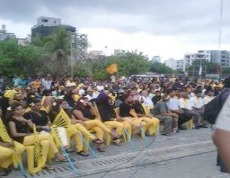
The Maldivian Democratic Party (MDP) held a parade and rally on Saturday (August 24) that it claims was attended by over 8,000 supporters in order to launch their complete manifesto, titled “Costed and Budgeted 2013 – 2018”.

After a parade down Majeedhee Magu – the main street through Male’ – MDP presidential candidate and former President Mohamed Nasheed addressed his supporters and explained the contents of the party’s manifesto.

“These policies in our manifesto are based on what we learned when we walked door to door, conversing with citizens, enquiring what your thoughts and needs are,” Nasheed said at the rally held in the ‘Raalhugandu’ area.

“In the next 5 years, the state will make a revenue of MVR 72 billion [US$4.6 billion] through the tax system, investments and other programmes we run. Within those 5 years, we will implement 137 development projects. We have budgeted to spend a total of MVR 30 billion [US$1.9 billion] on policies directly related to the people’s development,” Nasheed explained. “The rest will be spent on salaries of civil service staff, debt repayment and administrative matters.”

“I am not contesting in the upcoming elections with a handful of empty vows. Our competitors’ pledges are made in a manner where, if coming on to an island the first person they meet asks for a fishing vessel, they promise to deliver fishing vessels for them all. And then say they meet a teacher who asks for an iPad, whereupon they’ll pledge to give iPads to all teachers. The next person in line might say he is not feeling well, whereupon the candidate may vow to deliver a nurse and doctor to each house. This is not how a political party should form its pledges,” said Nasheed, criticising the competing candidates for the upcoming September 7 election.

“Our pledges contain things that will be fulfilled upon implementation of our policies. Take a look, this manifesto will not contain even a single policy which has not been accounted for. Even if we are asked to submit a budget to the parliament by tomorrow, we are ready to do so.”

Highlighting the contents of the manifesto, Nasheed stated that it included plans for introducing 51,000 job opportunities, a MVR120 million (US$7.7 billion) savings scheme for higher education, MVR118 million (US$7.6 billion) student loan scheme, 20,000 accomodation flats, a MVR2000 (US$129) allowance for every single parent and person with special needs, and an allowance of MVR2300 (US$149) for the elderly.

Nasheed further stated that the party found it highly concerning that “the national debt is 82% of national production”, saying that the manifesto has been designed keeping the factor in mind.

“We will continue to implement the tax system we established in our first term. We will carry out development work without increasing GST and taxes from business profits. We will also introduce income tax, as we previously proposed in 2010,” he continued.

The presidential candidate also stated that it was “of utmost importance” to establish a development bank in the country.

“We especially discussed this with the Asian Development Bank and the World Bank, and based on existing studies made with the assistance of the UNDP, our aim is to establish a development bank within the first year of our term,” he stated.

“With 600 million rufiya from our state budget, and 400 million rufiya from international financial bodies, the development bank will be able to release funding for the generation of 1 billion rufiya capital,” he continued.

“Our aim is for the development bank to issue to private entities 20 percent [of total funds] for the construction of houses, 8 percent to implement a transport system, 44 percent for agriculture, travel and fishing, 13 percent for the education field, 13 percent for education.”

“MDP’s basic objective has been to ensure that if there is a service that is available to any citizen of the Maldives, then to make it available to all other citizens equitably.”

According to Nasheed, the manifesto includes plans to spend MVR16 billion (US$1 billion) on social protection.

Concluding his speech, Nasheed stated that the MDP Manifesto included plans to assure that life becomes better in many aspects for the public. The former president finished by stating that all that was now left for the public was to go vote.

“September 7 is the day we vote to regain the development that we lost on February 7, 2012.”

Parade of Pledges

Prior to the rally, MDP held a parade down Majeedhee Magu with over 8,000 supporters.

In addition to Nasheed, Speaker of Parliament Abdulla Shahid, Male’ City Mayor Ali Manik, and several MDP MPs were seen in the frontlines of the parade.

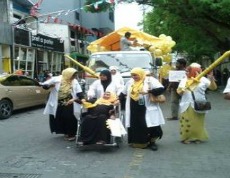
The atmosphere appeared festive, with different groups performing different acts throughout the parade.

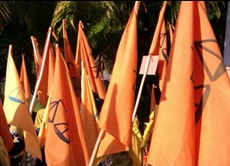
Besides pompoms, streamers, and balloons, each ward of Male’ had prepared a small truck to represent one of the pledges included in the party’s manifesto.

While one truck represented the health insurance policy – with actors depicting a scene in a hospital’s maternity ward – another represented the guest house policy – with an actor lounging on a truck designed to look like a beach.

Traffic police officers provided security throughout the parade.

Contrary to some previous demonstrations and rallies, no hostility was observed between police and participants of MDP’s rally.

Minivan News observed one policeman being asked by rally participants if he had received a letter from Nasheed, adding that if he had not then he must be ‘baaghee’. The young participants were referring to a speech delivered by Nasheed last week, in which he stated he had sent letters to all police officers, except those who had directly partaken in what the MDP alleges to be the February 7 coup d’etat.

The policeman responded by taking a folded up piece of paper out of his pocket and showing Nasheed’s signature on it to the supporters who had questioned him.

“I am not a baaghee. We will win ‘eh burun’ [in one round],” he said

Read the full MDP Manifesto here (Dhivehi)

Likes(0)Dislikes(0)

Maldivian bodyboarders shine in Australian competition

Maldivian bodyboarders who took part in the Jeff Wilcox Memorial 2013 competition held in Australia this weekend stood out as “some of the best in the event”, with 17 year-old bodyboarder Ali ‘Shaam’ Raafiu winning first place in the competition’s Junior Division.

The Jeff Wilcox Memorial is described as one of the longest running, most respected, prestigious, and independent bodyboarding competitions in Australia – having held 16 contests since 1990 – with some of the best riders in the sport participating.

The competition was revived, after a nine year hiatus, by the Forster Tuncurry Bodyboard Association (FTBA) and is being held on August 24-25 in the Great Lakes region of New South Wales, Australia, with over 100 bodyboarders participating.

Representing the Maldives, the Maldives Bodyboarding Association (MBBA) sent their top three bodyboarders – Ali ‘Kuda Ayya’ Khushruwan, Ali ‘Shaam’ Raafiu, and Ali ‘JD’ Javid – who took 1st, 2nd, and 3rd places, respectively in the Burunu Shikaaru Bodyboarding Challenge held in Male’ this May. Team official and MBBA Vice President Mohamed Khushruwan Ahmed also attended the event.

The MBBA team “made their presence felt” early on, despite the challenging surf conditions on Saturday (August 24) that eventually opened up by the afternoon with four to five foot waves, the FTBA reported.

“The MBBA riders took a little time adjusting to the cooler climate, but when they did they found their groove and were amongst some of the best in the event,” Jeff Wilcox Memorial Event Director Aaron Dodds told Minivan News today (August 25).

After placing first in his heat during the opening round of the competition, Ali ‘Shaam’ Raafiu went on to win the Junior Men’s Division today.

“Shaam built his assault early, the music and great vibe keeping him in the mood. He continued with his clean consistent comp surfing, drawing tight lines for big aerials and quick whipping spins,” Dodds said of Ali ‘Shaam’ Raafiu’s winning performance.

“Shaam drives clean lines and [demonstrates] brilliant combo surfing by linking multiple maneuvers. His lightweight frame always helps,” Dodds added.

In addition to this being Shaam’s first international competition, this was also his first bodyboarding contest win.

“The competitors were tough and the wave conditions were small on the first day of the event, but the final day was pretty challenging with better, good sized waves,” Shaam told Minivan News today.

Shaam explained the keys to winning the competition were “staying sharp and wide eyed during the competition. Also, having the Maldives’ team here supporting me gave me a lot of confidence.”

“This is the first [competitive] invitation MBBA has received after forming the association [earlier this year]. Winning the Juniors title seems good for the youngsters in the Maldives,” he added.

While Shaam does not yet have a professional bodyboarding sponsor he is “looking forward to it”.

Meanwhile, during the first round of the Men’s Open Division, Khushruwan fought off tough opposition.

“Ali Khushruwan beat top seed IBA Australia Jones Russell in his first heat, securing Khushruwan as a potential favourite,” explained Event Director Aaron Dodds.

However, on the competition’s final day, four to five foot waves with “clean wedging bowls” allowed Russell to “shine and just notch out” Khushruwan from the Men’s Open Division quarter finals, Dodds continued.

While Khushruwan did not advance beyond the first round heat of the Drop Knee Division, he still established himself as a formidable competitor.

“Looking for an opportunity to show his skills, Khushruwan made the most of the challenging conditions and busted out some solid maneuvers,” the FTBA highlighted in their competition coverage ‘Visitors Dominate Day 1 at the Jeff Wilcox Memorial‘.

Although the Maldivian bodyboarders are no strangers to difficult wave conditions, the cold water posed an entirely new challenge.

“It’s totally different, we don’t wear wetsuits. We wear only board shorts and surf, so it’s really difficult for us,” Khushruwan told Australian media outlet NBN News.

Javid also competed in the Men’s Open Division, but was eliminated after the first round of competition, as only the top two bodyboarders from each heat advance to the next round.

In addition to the competition, the Jeff Wilcox Memorial 2013 also provided coaching sessions to the junior bodyboarders, as well as free surf awareness and CPR courses for competitors as “a lot of surfers are responsible for thousands of unsung rescues”.

Three coaching and development sessions that focused on nurturing younger riders’ skills were led by professional bodyboarding coach Haydon ‘Da Boogie Man’ Bunting.

“One of the major things that is missing from bodyboarding is mentoring at club level, these kids have great style and posture, it is a matter of building their confidence and the young riders understanding that it is more than catching waves,” said Bunting.

“Just observing others surfers, watching their techniques and having good understanding of the ocean is very important,” he added.

Photographs 1 & 2 provided by Shane Chalker Photography

Likes(2)Dislikes(1)

Maldivian Foreign Minister dies during treatment in Singapore

Maldivian Foreign Minister Dr Abdul Samad Abdulla has died during treatment after undergoing kidney dialysis at Mount Elizabeth Hospital in Singapore.

The 67 year-old died during treatment at 1:05am Male’ time on Sunday morning, according to the Foreign Ministry.

Dr Samad was first admitted to intensive care on August 20 in a critical condition after suffering a severe heart attack. The 67 year-old had undergone heart bypass surgery 15 years ago.

On Thursday the Foreign Ministry reported that Dr Samad’s condition appeared to have stabilised, although he remained in intensive care in a state of induced unconsciousness after undergoing dialysis.

“On behalf of the Government and people of the Maldives, and on his own behalf, President Waheed extends his heartfelt condolences, at this time of national tragedy, to the family of the late Dr Abdul Samad,” read a statement from the President’s Office.

“The President recognises Dr Abdul Samad Abdulla’s sincere services to the government and the people of Maldives, especially as the Minister of Foreign Affairs of the Maldives, in strengthening diplomatic relations with other countries,” the statement added.

Dr Samad has served in numerous roles for both the Maldives Health Ministry and the World Health Organisation (WHO).

He has also served as the first High Commissioner of the Republic of Maldives to the Peoples Republic of Bangladesh and was appointed Minister of Foreign Affairs in March 2012, by President Dr Mohamed Waheed’s new government.

Dr Samad’s funeral will take place in Singapore after Zuhr (afternoon) prayers. Vice President Mohamed Waheed Deen will attend the funeral, reports local media.

Dr Samad is survived by wife Ameena Ali and three children.

Likes(1)Dislikes(0)

Elections looking smooth – but what about transition period, asks Eurasia Review

Despite the heat generated by various political parties in the campaign, there have been no major incidents of violence and it looks that the elections will be gone through smoothly on September 7, writes Dr S Chandrasekharan for the Eurasia Review.

The Election Commission has wisely decided to start polling earlier by 7.30am itself and conclude by 4:00pm. The idea is to minimise possible disturbances that often occur after sunset and this I believe has been done on the advice of police.

The police have generally been alert and the Police Commissioner has given detailed instructions on ‘do’s and don’ts’ on the election day. These efforts are laudable. The only jarring note that I noticed was the statement issued by the Police Commissioner Abdulla Riyaz that the police will continue to refuse any orders they decides are “unconstitutional”.

Who is the Police Commissioner to decide whether the order is unconstitutional or not? This statement has intrigued the political parties, particularly the MDP which has declared that its main task is to reform the police, military and the judiciary.

Riyaz is a post coup appointee and is also a person who was actively involved in the overthrow of President Nasheed. So is the Defence Minister and my concern is- Will they accept the election results in the event the present regime does not come to power? Will they create a constitutional crisis?”

Read more

Likes(0)Dislikes(0)

Q&A: Elections Commission Chairperson Fuwad Thowfeek

The 2013 Maldives presidential election is set to occur amid the political polarisation and institutional mistrust that has escalated since the controversial transition of power in February 2012.

Former President Mohamed Nasheed and his Maldivian Democratic Party (MDP) maintain that a coup d’etat had been orchestrated by loyalists to the former 30-year autocratic ruler President Maumoon Abdul Gayoom and led by mutinying police and military officers. This was followed by the security services’ crackdown on demonstrators, months of MDP protests, and demands for early elections, as well as fears the judiciary may prevent Nasheed from contesting.

With the Maldives’ presidential election taking place on September 7, there is considerable national and international pressure on the Elections Commission to deliver. Minivan News discusses some of these key elections issues with Fuwad Thowfeek, Chairperson of the country’s first independent Elections Commission (EC), established on November 24, 2009.

The role of security services…

Leah R Malone: Is the Elections Commission (EC) document outlining the Maldives Police Service (MPS) elections mandate available?

Fuwad Thowfeek: For every election since 2008, a Memorandum of Understanding (MoU) has been signed between the Elections Commission and the police service. The same document – containing more or less the same content – will be prepared and signed between the MPS and EC indicating the election duties of both institutions – when we need their services, how to approach them, what they will do for us, how we will greet them, etc. This type of understanding is there, it will help both institutions to stick to our duties.

Both institutions agreed on the prepared draft more than two weeks ago, it just needs to be finalized and signed. It’s very close to ready now. Because we have so much other work pending, and our deadlines are reaching, priority has been given to other activities, but very soon we will sign this.

LRM: Was the EC notified regarding MPS ‘Operation Blue Waves’? Were the parameters of the operation developed in collaboration with the EC?

FT: Yes, it will be our MoU in their mind. They gave us information that they will be having this operation and expressed the activities that they will be undertaking with our knowledge.

We’ve had a number of meetings with the MPS and even on our advisory committee we have an assistant commissioner of police who was present at all of our meetings. We’ve also had meetings with other branches of the police service – we are very much in contact with each other.

LRM: The MPS website states that the operational priority for ‘Operation Blue Waves’ includes “stopping campaign members from breaking any campaign laws” – is that an appropriate rule for the police to be enforcing, or should this fall within the purview of the EC?

FT: If anybody does anything that constitutes any criminal act the police are entitled to stop that activity, whether it is related to elections or otherwise. But we have not yet requested police to stop any [campaign activities].

If there are any complaints we give the specific details of that place and information to the police, and we request them to take actions according to the legal framework they have. [Stopping campaign activities is] not something specifically requested of the police [by the EC], but because the legal framework allows them to address any kind of law that’s being breached, if they’re choosing to focus on that, it’s still within their jurisdiction.

Almost the whole country is working on campaigning… We don’t request anybody to just focus [on those activities] to see if there’s anything going wrong. If anybody reports [complaints] to us then we request the police to look into it. That is our main target, not to look for any crimes, just to see how the things are going on.

LRM: The MPS has stated that police will remain 100 feet away from voting centres in “normal situations”. What will happen in an ‘abnormal’ situation? If a polling station head does request the MPS enter in the event of a disturbance, what is the protocol, how soon would they need to leave the polling station?

FT: If there is any disturbance on the day of voting, first the elections officials will try to control the situation. If the officials are unable to control it, then we will request the police to come in and take the person away from that ballot box area. In that case, once he or she or the group is taken out of that area, activities will again resume.

LRM: In July, former President Nasheed voiced concerns that police would try to influence the election by having individuals create a disturbances as a pretext for police officers entering the polling station. Additionally, Progressive Party of Maldives (PPM) presidential candidate Abdulla Yameen has recently said that disturbances are likely on election day.

What type of training have the polling station heads received to address these kinds of situations? If the polling station head is a younger individual, are they going to have the authority to actually stand up to a Special Operations (SO) officer – particularly in the more disputed areas where there’s anticipated tension, such as Addu City, Thinadhoo [Gaafu Dhaal Atoll], Kulhudhuffushi [Haa Dhaal Atoll], and/or Male’?

FT: First, we have given a 10 day training to the trainers, which was completed last week. We trained 77 trainers. They will be going out to all the atolls and giving two day trainings to the polling officials. The two day training will be good enough for them to understand all the laws, rules, regulations, and procedures of the polling activities.

In each polling station there will be at least seven to ten officials and about 50 percent will have experience with previous elections. The head of the polling station will be responsible for the whole team and, on behalf of the team, the head of the polling station will make all the decisions, and even if required will call for police assistance. In the polling stations we will have young [EC] officials, but the polling station heads will be experienced officials over 30 years-old. But we are trying to place people over 35 years of age as head of each polling station. In general, we are trying to employ people with previous elections experience, [who are] not very young. We always prefer to take people, if available, above 30 years of age. In cases where we don’t get enough officials, then we go for some younger adults, but mostly you will find the average age is over 30 years.

LRM: What should the Maldives National Defence Force’s (MNDF) elections role be? Have they been in contact with the EC or have you been coordinating more with the MPS?

FT: We are coordinating more with the police services and, even in the previous elections, we have been in touch with the police to see to the security of all the ballot boxes and polling stations. The police will seek assistance of MNDF only if they find it necessary to ask for help, but it’s very unlikely.

The security of the presidential candidates and running mates will be looked after by the MNDF. That is the only role they should be playing.

Election preparations…

LRM: Police Commissioner Riyaz recently noted that a national coordination committee has been established with representatives from different political parties and relevant institutions, so the committee can address any election issues that may arise “using diplomacy rather than out on the streets”.

Is this a committee that the EC participates in? What is the committee’s purpose?

FT: I think he was referring to the National Advisory Committee. We have in this committee a representative from each of the presidential candidates, the Maldives Police Service (MPS), the Human Rights Commission of the Maldives (HRCM), the Maldives Broadcasting Commission (MBC), the Maldives Media Council (MMC), Transparency Maldives – representing all the local civil society organisations – plus five members of the EC.

The purpose of the committee is to facilitate communication between the different institutions. The representative from each candidate or institution will take our decisions or discussions to their organisations and/or the concerned people.

LRM: How many EC staff will be placed on smaller islands during the presidential election?

FT: On every inhabited island we will have a minimum of seven EC officials at each ballot box, even if the number of people [voting] is less than 500, or even 200. In the tourist resorts and industrial islands we are planning to send five officials to each ballot box [location], because there will be an average of 200 people to vote at each ballot box. There are 700 to 1000 people expected to vote per each ballot box on the inhabited islands. In Male’ also we have 103 ballot boxes. For example, there are 48 boxes for residents of Male’ voting in Male’ and 55 for people from other atolls living in Male’.

LRM: How do you plan on coordinating elections observers from so many different institutions, including the EC, HRCM, Transparency Maldives, media, and other individuals from the Maldives and abroad?

FT: Actually, our planning section will be dealing with all the observers, monitors, and all the [election] officials. We will hold a training session  – what they can do, what they should avoid and each individual will be given a photo ID pass, so with that ID they can visit any ballot box, whether it is in Male’, Hulhumale, Villingili, even Addu or Fuvahmulah – any place depending on their need, they can go and see it.

For the coordination [of these various individuals] we will keep some special staff for that, but we don’t have much to communicate with them. Once the training session is completed, the observers and the monitors will be very sure about their roles and work. And we are going to leave them very independent actually, so that it is their duty. That makes it very easy for us as well as easy for them.

After making their observations, they write their reports, we will like to receive all the comments and remarks from all the observers. That’s something that will help to develop our process for the next election.

LRM: Why is the 2013 presidential election being held September 7, when the 2008 election was October 8?

FT: We have to follow the dates and periods given according to the constitution, the presidential elections law and also the general election law. September 7 is the first round and then in three weeks time on September 28 we have to hold the second round if nobody gets over 50 percent of the valid votes. The president will be sworn into office in November.

In 2008, it was a special period given, as noted in the constitution. [This year] if the second round is going to be on the 28 of September, one week from that date on October 4 we will be announcing the final result. There will be over one month for the elected president to prepare to take office. I think that’s good because last time the period was too short. There was not sufficient time previously between when the president was elected and then took office. [This year] it’s only one month and one week [to prepare] or even if we count the date from the preliminary result there will be just six weeks for the president to prepare to take office.

LRM: To what extent have India and the US provided elections assistance as pledged?

FT: The Indian Elections Commission mainly and also the Indian High Commission in Male’, and USAID have been assisting. Last year, two batches of 10 people each [from the EC] were given a one month training in New Delhi in their elections institution. This year also two batches of six each received training, one batch in Bangalore and one in New Delhi. In addition, two commissioners have been given the opportunity to attend an observation tour and training program.

Also, the Indian Elections Commission has provided a team of IT experts, software developers, to produce programs for various activities of the EC, like maintaining a political party register, the dispatch of voting materials, result making of the various elections, and there are many other administrative requirements. The software will make the EC’s work simpler and help to maintain very transparent records.

For example, [regarding] the local council elections and parliamentary elections, in the Maldives people can live on any island, but they will be registered mostly on the island of their birth or their parents’ island. For example, I can live on Kulhudhuffushi for any period and there can be people lets say from 150 islands living on Kulhudhuffushi too, but for the local council election, if they are from 150 different islands then 150 different types of papers should go there. Sorting this out and sending the exact number of ballots manually – according to the law we cannot send more than 1 percent of the [islands] ballot papers, unless there are 100 voters belonging to that island – is kind of a nightmare for determining the results. Last time our staff were working day and night and found it so hard to make the appropriate packets for each island. A very powerful software [program] is needed [for this] process.

It’s very difficult and complex, but the presidential election is nothing compared to this. We are very comfortable with the presidential election – it is the same ballot paper we are sending all over the country.

Political party criticisms and next steps

LRM: The PPM has claimed that the EC has not provided adequate answers to their previous complaints/enquiries, and that the upcoming presidential election is not likely to be free and fair as there is a possibility voters’ information will be altered.

How did the EC respond to their concerns previously? Was it addressed in the Advisory Committee or was it addressed separately when speaking with their party representatives?

FT: A few times they have come and met me – twice a delegation from PPM came and met me and once a delegation met the Vice Chair of the Elections Commission.

Every time we have very clearly explained everything to them, answered all their queries and gave very detailed responses to them. But there are some demands that we cannot meet. For example, one of their demands was to see our IT section. They wanted to see the hardware and software of our network system, which we cannot do and we are not ready to do for the safety and security of our system.

Other than that we have attended to almost all their requests. We have given them very detailed answers. The interesting thing is that it is the same commission, the same five members have been in this commission for the last three and a half years. I was here for the last five years, but I was the only member during the interim period that is still with the commission – I have seen the entire progression.

We conducted local council elections – which were much more complex and complicated [than the presidential election] – without any problems we managed to do it. And we have also held three parliamentary by-elections and over 20 local council by-elections. In each election or by-election there were complaints [filed], but no one has ever complained about the members of the Elections Commission. [Now] suddenly they started questioning our competence and our ability, this is very strange.

LRM: Why do you think the PPM is putting so much pressure on the EC, since the commission addressed their concerns previously? Why do you think this is happening now, with less than 20 days to the election, when there were many months to file complaints?

FT: I don’t know actually, and regarding the questions they have raised, we have given really clear answers to them. We are not hiding anything, we are very transparent. Everything has been really clearly explained, so I don’t understand. President Mohamed Waheed and President Mohamed Nasheed are very confidant in this commission, they have no complaints at all.

We don’t hesitate to answer any questions from any party, whether it’s a political party, or media, or any social club or society. We are ready to meet each and everyone. We are willing to share our knowledge and experience. That is what even we have been hearing, that the public recognises our efforts and they have confidence in us. So it is very strange that suddenly PPM has found these types of problems with us.

LRM: What is the next step the EC will take to address these issues with the PPM, particularly if they pursue legal action? Do they have any legal grounds to stand on? If they do take these issues to court, given the need for judicial reform, do you think that could be problematic for the EC to hold the presidential election?

FT: They don’t have any grounds for legal action. That is why we are very comfortable. Even if they go to court we will have no problems at all. We will clarify everything to the court.

Today (August 22) we are trying to publish our voters list according to the ballot boxes, so this will be the list that will be used on the day of voting. A copy of this list will be given to all the presidential candidates and also to the political parties that are interested in obtaining a copy of the ballot boxes with the voters list. We have so much confidence in our work – we have done really good, professional work – that we are giving it openly [to the public] to see and tell the EC if we have incorrectly listed any person in the voter registry or if any person is missing.

If anybody is missing from the list, we will very clearly tell them why the person is missing. For example, during the last two weeks, we received complaints from 17 people that they were absent from the voter list, out of 239,593 people registered to vote. Only 17 are missing out of 239,593 [only .007 percent of registered voters].

This type of accuracy is kind of a world record. For this we did so much work. We produced a list on the government gazette website, we have been talking to the media, newspapers, radio, and TV, asking people to check their names and inform the EC if anybody’s name is missing. We have made it so easy for everybody that someone can sit at home and check our website, just enter your ID card number and if your name is not there you will get a message. Or call 1414 and one of our operators will answer, or send an SMS to 1414 and you will get an automatic SMS reply, or send somebody to the EC and ask the receptionist to check for the name in the voter list.

So much work has been done, but these are 17 people that for some reason ignored or didn’t hear our calls and they just realised it when it was too late. Another reason why some of them are not recorded [in the voter register] is that a lot of people go to Sri Lanka, India, Singapore, or Malaysia for delivery. Then after the birth of the child they don’t remember to put them in the local register, so this is one reason why some names are missed. But still we said if there is a second round we are going to include these people, because they have informed us we will take the necessary steps, however for this round there is nothing we can do.

We are not the people compiling the initial register, we are getting it from the island council offices and also the Male’ City Council office. So the primary source of the [voter] list is from all the council offices, then we have to communicate with them and also we have to check it with the Department of National Registration. It’s has been very hard work over the last five year to come up with a voter registry of this standard.

LRM: Is there any additional statement you would like to make or message you would like to give Maldivian voters and/or the international community?

FT: My request is kind of an advanced request to all the voters. Today we are uploading all the voters lists for each ballot box – make sure where you are going to vote. Please check it through our website, SMS, by making a telephone call to us at 1414, or sending someone here [to the Elections Commission] to check it.

On the day of voting, we are starting at 7:30am, so go to the ballot box as early as possible so you will not be standing in the queue for long – going early will avoid delays and facilitate all the officials. If you go at the closing hour at 4pm, the queue may be too long and you will have to wait.

Regarding the international community, we want them to observe all the [election] activities including the actions at the ballot box and also in the other areas, and to express their observations very frankly and very truly. That will help us in the future and give confidence to the world as a whole regarding how the election has gone, how good or bad it was. I’m sure we will get a very good result because we have worked very hard.

Likes(2)Dislikes(0)