PPM presidential candidate “root of all nation’s problems”, Umar Naseer tells JP rally

The “Jumhoree Gulhun” – a new coalition consisting of the Jumhoree Party (JP), Adhaalath Party (AP) and Dhivehi Qaumee Party (DQP) – held a rally on Monday night to celebrate new arrivals, including Progressive Party of Maldives’ former interim Vice President Umar Naseer, former PPM Youth Wing Leader Ibrahim Nazim, PPM MP Shifaq Mufeed and Islamic Democratic Party (IDP) leader Hassan Zareer.

“None of these fresh people joining us laid any conditions, demands or excuses before joining our coalition. They have come to join us to protect our sovereignty, our religion and the way of our ancestors,” JP Leader and presidential candidate Gasim Ibrahim said, addressing 200-300 supporters gathered in their Male’ campaign office.

“Their self interest is the self interest of the Maldivian citizens,” he continued. “I would like to tell all those who have newly joined us that we will not disappoint you. Our desks are extremely clean. There isn’t even a single piece of paper which might be stained.”

“It is my belief that together with the other parties’ members, our coalition will now have at least 50,000 members. Therefore, there is no doubt that our coalition will win the elections, be it in one round or even if we go to a second round,” Gasim predicted.

“Yameen is the root of all our country’s problems”: Umar Naseer
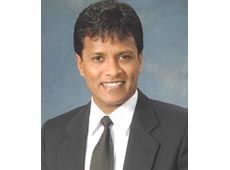
PPM’s former interim Vice President, who lost the party’s presidential primaries to PPM Leader Maumoon Abdul Gayyoom’s half-brother Abdulla Yameen spoke at the JP coalition’s rally tonight, criticising the presidential candidates of both PPM and MDP.

Stating that he and his supporters who had joined the JP coalition alongside him are “ultimately supporters of Gayoom”, Naseer said Gayoom’s half brother, Yameen “is a completely different story”.

“There is no way PPM can win the September 7 elections with Yameen as a candidate,” Naseer claimed.

“Yameen is the root of all the problems faced by our country today. The 40,000 illegal immigrants who have entered the country are people brought in under his nose. People say that there is a connection between Yameen and the illicit drugs that are sold on the streets of Maldives,” Naseer alleged.

“And so, any person who loves this country being in PPM and voting for a man like this is nothing but a betrayal to the nation. Even though you remain a member of PPM, you do not have an obligation to vote for a corrupt man like Yameen. The nation is far more important than that,” Naseer said.

Naseer stated that in the first round of elections, it will be Yameen who contests most closely with Gasim, adding that it is “of utmost importance to defeat him”.

“If Yameen comes to power, nothing but an empty pit will remain where the country’s safe deposit ought to be,” Naseer continued.

“I speak out of experience. And therefore, I pray we get Allah’s blessing in these efforts to save this nation, to prevent it from going into the hands of a corrupt group of people, to save it from the irreligious ideology of Mohamed Nasheed and to protect our nationalism.”

Naseer also stated that he had the utmost respect for current President Mohamed Waheed, but added that he could not support Waheed as he had appointed Dhivehi Rayyithunge Party (DRP) Leader Thasmeen Ali as a running mate.

Rationalising his refusal to support a Waheed-Thasmeen presidency, Umar alleged that Thasmeen had made “underhand deals with Nasheed to sell out the airport to GMR” and described him as “a traitor to the nation”.

He also predicted that the days leading to the September 7 election will prove to be “highly dangerous and risky”, stating that MDP’s apparent plans to file a case against Gasim gives weight to his concerns.

“It will also go to the point of physical fights on elections day. What I have to say to the people of this nation is that this is the time when history will be written. We must defeat Nasheed at any cost.”

“Be vigilant as [they] might attempt to stop you from voting”: Gasim
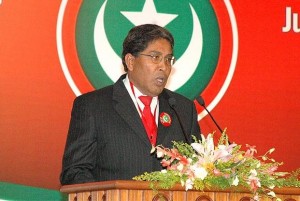
JP presidential candidate Gasim Ibrahim advised his supporters to be “very vigilant and careful” on election day.

“We all know there is a certain group of people who will vote first thing in the morning on election day, and will then proceed to harass people who try to go to the voting booths after them. So be extra careful to cast your votes as early as possible,” Gasim said.

“Beware of losing your national identity cards before election day. And be wary of other people living in the same house as you, as they may be instructed to hide your ID cards so as to stop you from voting,” he cautioned.

“If such things happen, then these people might win in one round, as they keep saying repeatedly. So be vigilant. Be extremely careful,” Gasim said, referring to the Maldivian Democratic Party.

“Nasheed keeps saying he will come to power ‘at any cost’. Listen carefully, he says ‘at any cost’, meaning he is willing to do anything at all to rise to power. This means they intend to create enough chaos and trouble to cause the international community to not accept the elections,” he stated.

“Some of your sons and daughters living in your homes are, like that man [Nasheed] says, not always in a sound state of mind or sober. They might be paid some amount of money to hide your ID cards and stop you from voting, so be very careful of this. Be vigilant and careful in order to fulfill this legal, national and religious obligation,” Gasim stated.

From PPM to JP

Along with Umar Naseer, other council members and general members of PPM also joined the JP coalition.

Ibrahim Nazim, who resigned from his post as PPM’s Youth Wing Leader on Monday night and joined the JP rally the same evening, also echoed Naseer’s claims that Yameen “has no way of winning the presidential elections.”

Nazim stated that he had defected to the JP as the PPM failed to respect elected positions in the party, including himself.

“It is impossible to even contact the leadership, be it via phone or even text messages. I do not see how a person like this can contribute to empowering youth. I have decided to support Gasim as he is the only one of the four contesting candidates who seem to be working with the common people.”

Having initially supported Naseer, Nazim later called on PPM youth supporters to back Yameen after he defeated Naseer in the party’s presidential primaries.

Following June’s Civil Court ruling that the outcome of the PPM primaries cannot be made void, Nazim called on Naseer’s supporters to remain or come back to the PPM, adding that he believed Yameen would maintain the political ideology of Gayoom.

Despite this, Nazim then left his position at the PPM and joined the JP coalition with Naseer and his supporters that evening.
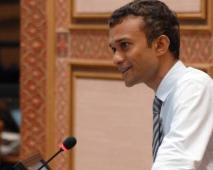
MP Shifaq Mufeed, who initially was in MDP and later defected to PPM in 2012, also joined the JP coalition.

Mufeed stated that he had come to the JP coalition not due to any monetary incentives, but because he believed in Gasim’s pledges and political ideology.

PPM’s ‘Maaz’ Ahmed Saleem, who supported Naseer in the party’s primaries also spoke at Monday’s rally.

Speaking in praise of JP’s presidential candidate, Saleem said, “Gasim already owns 30 percent of this country. What reason is there to not grant him the remaining 70 percent?”

“We gave power to Waheed on February 7, 2012 with a lot of hope. But today we are seeing Waheed filling his pockets with irreligious thoughts and imparting these anti-Islamic ideologies to the people,” he said.

“And as for Nasheed, if he wins the election, it is a fact without doubt that we will see the construction of temples in our Islamic nation.”

“Umar Naseer and I, we worked very hard to get the PPM to hold primaries. We did succeed in doing so. But then, the half-brother poked his hands in and meddled with the primaries, making it corrupt too,” Saleem alleged.

Other speakers at the rally included Abdulla Mohamed, who led the Civil Coalition of NGOs, the main organiser of the December 23 coalition which held the 2011 rally under the banner of “defending Islam” from the MDP.

Abdulla Mohamed said the JP stands an “irrefutable likelihood of winning the election if every member guarantees an additional 10 votes for Gasim.”

“Although initially Gasim was going to contest in the elections with only a handful of people backing him, as in just his Jumhoree Party, he now has the support of a large coalition, which guarantees he will win,” Abdulla claimed.

“On February 7 we rid the nation of a creature far more fearful than the historical sea demon known by the name of Rannamaari. We rid the nation of Nasheed and his sidekick, Mariya Ahmed Didi (MP and former MDP Chairperson), whom we can call ‘AnniMaari’. We must do so again in September,” he said.

“If we can do that, and if every member obtains 10 more votes, winning this election will be as easy as peeling an onion.”

Likes(0)Dislikes(0)

Comment: This is not a dictatorship

This article was first published on Dhivehi Sitee. Republished with permission.

Since the 7 February 2012 coup that was not a coup, a disconcerting dissonance between what people witness with their own eyes and what they are officially told they see has become a regular part of life.

Last week, thousands of voting Maldivians watched the X-Rated video of Supreme Court Judge Ali Hameed having sex with three prostitutes at a high-end hotel in Colombo, Sri Lanka. It was not just his clothes that Hameed shed in front of the people but also his dignity along with the ethical and legal right to sit on the bench. Ethical, because he so carelessly flouted the values of his profession, and legal because the Maldives defines unmarried sex between consenting adults as the crime of fornication.

Yet the official reaction has been like a ticker-tape running across the entire length of Hameed’s sexual marathon saying, ‘This is not sex. This is not zinah. This is not Hameed.’

Gasim Ibrahim, the presidential candidate for Jumhoree Party, has been one of the most vocal defenders of the judge. He asks us to ponder the infinite possibilities of why it was not Hameed in the video: “Anyone can dye their hair red.”

No one can argue with that – not in these days of L’Oréal.

Adhaalath, the self-appointed ‘religious leaders ’ – and the last Maldivian political institution one would expect to favour an informed decision over an ignorant one – has announced it cannot say “Hameed is fornicating” or “Hameed is not fornicating” unless the Judicial Service Commission says “This is Hameed” or “This is not Hameed”.

Until then Adhaalath — or any other government entity — will not see what it sees, nor must we believe our own eyes.

In November last year, 38 MPs in the Majlis agreed that President of the Civil Service Commission, Mohamed Fahmy, was more likely than not to have sexually harassed a female servant as she alleged. They voted to have him removed from the CSC.

Fahmy, though, is still there in the CSC, accompanied by a subliminal government-issue caption designed to appear under every image of Fahmy we come across: “This is not a sexual harasser” or “Sexual harassment is not a crime.”

Back in April this year, pictures emerged of Defence Minister Mohamed Nazim and Tourism Minister Ahmed Adheeb hob-nobbing with the Artur Brothers – Armenian gangsters who were chased out of Kenya in 2006 for heroin trafficking and involvement in the country’s troubled political scene.

Initially the official line was to say it was neither Nazim nor Adeeb hanging with the gangsters. Then came a very Gasim-esque defence: “It is possible that the Ministers and the Brothers were in the same place at the same time. That doesn’t mean they were together as in together together.”

Soon after, pictures emerged of the Brothers at the gala event organised by Nazim and Adheeb to re-open Olympus theatre. This was followed by evidence that one of them was staying in Farukolhufushi, a resort under direct control of Adheeb at the time. Still, the official line was: “This is not happening.”

It was the same with the leaked draft Status of Forces Agreement (SOFA) with the United States. Nazim and others denied they saw the leaked version on ‘social media’, but were able to confirm “this is not the SOFA”.

So it was not.

A similar story with the PISCES system gifted by the United States: “This is a border control system” said both governments, and so it is; even though controlling borders is the least of PISCES’ concerns.

Then there were reports of the forged ‘extension’ of the agreement to extend the lease of Farukolhufushi resort, a copy of which was shown on Raajje TV. The authorities have stuck the “This did not happen” label on the incident, so it hasn’t.

Latest in these series of events occurred yesterday, the day marked on the calendar as ‘The Independence Day’. Two events were held to confirm this: one at the museum and one at the Republic Square.

The event at the museum was a reception hosted by Mohamed Waheed Hassan Manik and his wife Ilham Hussein for local and foreign dignitaries. It was held in the hall usually reserved for the most precious of national heritage artifacts. Their storage requires specific conditions, their care and handling needs highly trained hands. This is the expert opinion.

The official line, however, is different. In direct contradiction of results of years of study, the President’s Office put out a statement saying: having the party at the museum, or having untrained labourers move the priceless artifacts would not damage them. So it won’t.

Male’ watched as Maumoon Abdul Gayoom was given the highest national award of respect. For 30 years, Gayoom ruled the Maldives without respect for either human freedoms, dignity or the rule of law. It was a dictatorship that stalled economic, social, cultural and intellectual development for an entire generation.

But, the national honour, the shining thing around his neck, screams “This is not a dictator”. So he must not be.

This is a democracy.

Dr Azra Naseem has a PhD in international relations

All comment pieces are the sole view of the author and do not reflect the editorial policy of Minivan News. If you would like to write an opinion piece, please send proposals to [email protected]

Likes(2)Dislikes(0)

Comment: Maldives preparing for presidential polls

Come September the Maldives will be having the second multi-party elections for the nation’s presidency.

Only recently, incumbent President Mohammed Waheed Hassan Manik said the 2008 Constitution has provided for a presidential form of government under a parliamentary scheme, and the nation is facing the consequences. Waheed did not say if it included the controversial circumstances revolving around his own ascendancy to power when he was Vice-President to Mohamed Nasheed, the first President elected under the multi-party scheme.

President Waheed and his government and coalition partners have had their way that the polls for the nation’s highest office would not be advanced as sought by Nasheed’s Maldivian Democratic Party (MDP). Yet, issues surrounding President Nasheed’s resignation of 7 February 2012 refuse to die down. The MDP itself may be paying a price for that in electoral terms, exactly 19 months after the ‘power-transfer’.

Candidate Nasheed is the issue thus in the upcoming elections. His three opponents readily concede as much. They also concede that the MDP is the single-largest vote-getter among them. The Election Commission has for months now acknowledged that MDP is the single largest political party in the country with the highest number of registered members.

The second in the line, the Progressive Party of Maldives (PPM), comes a distant second with less than half the MDP’s figures. Third is the Dhivehi Raayathunge Party (DRP). Both parties were founded by President Nasheed’s predecessor, Maumoon Abdul Gayoom, and together, their membership comes closer to the MDP membership.

Of memberships and votes

Yet, questions remain if the DRP will be able to translate its membership into votes, or if there will be a substantial migration towards the PPM camp. Should that happen, and should Waheed’s administration attract a substantial share from an anticipated high percentage of non-committed voters, as candidate Nasheed had calculated in 2008, the team may be in some reckoning.

DRP leader Thasmeen Ali gets to be the running-mate of President Waheed. Thasmeen may hold that record for a time, as he was similarly the running-mate of incumbent President Gayoom the last time round.

Apart from Nasheed and President Waheed, the poll involves PPM’s Abdulla Yameen, half-brother of former President Gayoom. Also in the race is Jumhoree Party (JP) leader, Gasim Ibrahim, with his vice-presidential running-mate, Dr Hassan Saeed. It is pertinent to recall that in the first multi-party presidential polls of 2008, contesting alone, Gasim Ibrahim and Hassan Saeed polled a total of 34 percent vote-share, second only to incumbent President Gayoom’s 40 percent.

Yet, under a system in which the first two contest the second run-off round if none poll over 50 percent votes in the first round, Nasheed with his stand-alone 25 percent first-round vote-share challenged Gayoom in the run-off in 2008.

Gasim and Saeed joined hands with him. Nasheed won. The final poll figures stood testimony to the effective transfer of their first round votes (Saeed: 16-plus percent, Gasmim: 15-plus percent) to Nasheed.

The question is if Saeed with his Dhivehi Quamee Party (DQP) have enough votes in the first place left with him, and also has enough ‘transferrable votes’, which JP’s Gasim alone seems to be enjoying in the country at the moment.

That leaves Yameen with his running-mate Dr Mohammed Jameel Ahmed, who was Home Minister in the Waheed government, sacked after crossing over from Saeed’s DQP. Saeed himself would later leave the government as Special Advisor to President Waheed, to join hands with Gasim, whose JP technically is still a partner in the non-MDP, anti-Nasheed administration, along with the PPM.

Having launched his campaign late, and amidst controversy attending on the PPM primary for selecting the party nominee for the presidential polls, Yameen relies on the better organisational structure of the party, the recognisable face and leadership of Gayoom.

In doing so, he however will have to face charges of ‘family rule’ within the party, which thankfully none of his political rivals are ready to flag in any specific and substantive way.

Realignment for run-off?

The issue is Nasheed, and his post-resignation polarising call, seeking to revive the past political fight for ushering in multi-party democracy in the country. It remains to be seen if excessive reference to, and reliance on the same as a campaign platform and tool over the past months since his leaving power can still help focus the limelight on the futuristic issues and constituency-based campaign manifestos that the MDP and Nasheed have painstakingly prepared and pointedly present to the voter.

For Nasheed to win the first round, he will require those additional votes, from new constituencies, or constituencies that were impressed by his socio-economic measures during the short-lived first term, and would hence like to give him a second chance.

Should the elections run into the second round, it could then become a wide-open race. If nothing else, the temptation is to constantly refer to the 2008 experience, in terms of form and content. There could be realignment, the contours of which remain to be explored and exploited in full.

The MDP has called upon the 240,000 voters of the country to hand down a decisive first-round victory in the first round to Nasheed, for the party and the leader to give a stable government and carry forward democratic and socio-economic reforms that they claim have been initiated during his ‘aborted’ first term.

It is also an acknowledgement of the ground reality, where the MDP cannot find coalition partners among the rest to work with the Nasheed leadership. His running-mate in former Education Minister and first Chancellor of the National University, Dr Mustafa Luthfy, along with the recent entry of Parliament Speaker Abdulla Shahid to the MDP fold after being elected MP under a DRP ticket, is expected to bring votes that Nasheed may need for a first-round win.

President Waheed has created history too. With the total membership of his Gaumee Iththihad Party (GIP) under the scanner, and the present law on 10,000 members for party registration under judicial review, he chose to contest as an ‘Independent’, though his DRP partner is a registered party.

He went around acquiring the signatures of 1500 registered voters for endorsing his nomination, an alternative requirement under the law. Tension remained in the Waheed camp until Election Commission officials had cleared all signatories as genuine voters, sitting through the night on the verification work.

Waheed’s poll call would be ‘stability in an unmanageable coalition set-up’, which it was. Today, every government party is contesting the presidential polls separately and against one another – apart from contesting against the MDP, the only party that is not a coalition partner. They have voted for and against government motions in Parliament, and run down one another, too. Only recently did they join hands to vote against ‘secret ballot’ on non-trust votes against the President, Vice-President and Government Ministers in the house.

Yet, some of them, particularly the PPM and DRP, have voted with the MDP opposition, to deny ministerial jobs to some nominees of President Waheed’s choice.

Yameen seems to resting on past laurels, many of which readily sit on the shoulders of President Gayoom. The PPM calls his rule the ‘golden age’, and positions Yameen’s candidacy as a return to that era.

Yameen, as may be recalled, is representing a party and leadership that converted a poor, ignorant and ignored nation to one with the highest per capita GDP in South Asia, through 30 years of rule that also gave Maldivians modern education and limited medical care, non-existent earlier.

‘Limited’ or ‘non-existent’ democracy as known to the West was the bane of generations and centuries. Gayoom’s presidency was satisfied with incremental changes to the scheme, when the younger generations in particular may have already been craving for wholesale changes.

If he was a lone fighter the last time round, JP’s Gasim has put together a ‘rainbow coalition’ this time. Apart from Hassan Saeed’s DQP, he has also successfully negotiated a partnership with the religion-centric Adhaalath Party (AP). As may be recalled, the vociferous and conservative leadership of the AP played a major role in mobilising the ‘December 23 movement’ that ultimately brought about their intended change of power without ballot in February 2012.

Missing reciprocity

With its conservative religious approach in a moderate Islamic nation, the AP is otherwise seen as a controversial political player. Their crossing over from the Waheed camp too close to the nominations date for the presidential polls caused eyebrows to rise.

Yet, by bringing together disparate groups that are otherwise desperate, Gasim may have ensured a political combination that could see him through to the local government elections in December this year, and parliamentary polls that are due by May next year.

For now, PPM’s Yameen has publicly declared his intention to work with Gasim in the second round polls (hoping that it would go in for a run-off). This may have also owed to the over-worked rumour-mill that put the PPM and MDP on the same side of the political divide should there be no clear verdict in the first round.

Gasim himself has not reciprocated positively, nor even responded to Yameen’s indicative support in anyway. Maybe he is keeping his options open. Maybe he has coalition compulsions that could flow on into the second round – if there is a second round.

The factors are varied, and so are the projected strengths and perceived weaknesses of the four tickets. There is then the question of 30,000 first-time voters, who unlike their preceding generation in 2008, seem unsure of themselves after the ‘democratic developments’ of the past year. Though they may not have begun focusing on it exclusively, at some point in the coming weeks contesting camps may have to do more to attract additional voters to the booth than may otherwise turn out to be.

In 2008 most, if not all first-time voters, and most of the total 40-plus per cent ‘young electors’ were believed to have voted for change. There was also an urge and consequent surge for participating in the historic event of their generation, from all sides. Thus the presidential election in 2008 witnessed a high 85-plus percent turnout in the first round and a higher 86-plus percent polling in the second round.

This time, too, voter turnout will have a say in the final outcome, starting with the fact if the polls would go into the second round – and more so, on who will get to rule Maldives for the next five years – and hopefully so!

The writer is a Senior Fellow at the Observer Research Foundation

All comment pieces are the sole view of the author and do not reflect the editorial policy of Minivan News. If you would like to write an opinion piece, please send proposals to [email protected]

Likes(0)Dislikes(0)

ACC forwards phone bill corruption case against Supreme Court Judge

The Anti-Corruption Commission (ACC) has forwarded corruption allegations against Supreme Court Judge Ali Hameed to the Prosecutor General’s Office (PG).

While the ACC has yet to officially comment on the case, local media reported that the matter concerned the transfer of MVR 2,223 (US$144) from the judge’s state-funded telephone noted in a 2010 audit of the Department of Judicial Administration (DJA), which was subsequently repaid.

Previous reports by the Auditor General’s Office have noted that between October 2008 and December 2011, Supreme Court judges paid their phone bills amounting to MVR 281,519 (US$18,257) from the state budget, despite the fact that parliament had not allocated any phone allowances to the judges. Additionally, MVR 117, 832 (US$7640) was found to have been overspent on wages and allowances to the driver of a judge’s car.

The judge is also currently subject to investigation over his alleged appearance in multiple leaked sex videos depicting him fornicating with foreign women in what appears to be a Colombo hotel room.

A further video also appears to  show Hameed and a local businessman, Mohamed Saeed, discussing political influence in the judiciary.

Justice Hameed in the video also goes on to reveal his political ‘hook-up’ with Abdulla Yameen Abdul Gayoom – the current Progressive Party of Maldives (PPM) presidential candidate – claiming that he was one of Yameen’s “back-ups” and that his stand was “to do things the way Yameen wants”, promising to “kill off” Dhivehi Rayithunge Party (DRP) leader Ahmed Thasmeen Ali “if it comes into my hands.”

Even [Speaker of Parliament] Abdulla Shahid will know very well that my stand is to do things the way Yameen wants. That the fall of this government was brought with our participation,” he adds.

However, he also claims that he was a person who “even Yameen cannot play with” and that over time he had “shown Yameen” who he is.

The Judicial Service Commission (JSC) meanwhile decided not to suspend Supreme Court Justice Ali Hameed citing “lack of evidence”, contradicting the recommendation of its own five-member committee appointed to investigate the matter.

Following the decision, JSC Deputy Chairman Abdulla Mohamed Didi and Latheefa Gasim resigned from the investigating committee. The JSC then voted not to accept their resignations.

Jumhoree Party Presidential Candidate Gasim Ibrahim, until recently a JSC member, has meanwhile publicly declared that Hameed’s sex tape was “a fake” orchestrated by “external forces” seeking to take over state assets, introduce other religions to the country, and create infighting in Maldivian society.

Likes(0)Dislikes(0)

“Maldives cannot afford to be an inward looking, xenophobic country”: former President Nasheed

The following speech was given by former President Mohamed Nasheed at the launch of the Maldivian Democratic Party (MDP)’s foreign policy. President Mohamed Waheed’s Independence Day address is available here.

Your Excellencies, distinguished guests, ladies and gentlemen,

We live in turbulent times. Times have always been turbulent.

We sit in the Indian Ocean, across a 1000km from North to South, where the bulk of the international trade passes. We are so strategically located that when the big boys fight, we are hemmed and wedged in-between.

The basis of our foreign policy is what my grandmother used to say, find a friend and stick with them, be good and be honest to them.

Our relationships do not depend on our fortunes, but on our ideals.

We are saddened that a number of countries with whom we shared our sentiments didn’t live up to our expectations.

But still our relationships do not depend on our political fortunes.

Down and under or up and above we still stick to our principles and beliefs.

A tolerant Islamic society, friends with everyone, enemies of no one.

The Maldives recently embarked on a remarkable journey towards democracy that sought to allow our people to live free, prosperous and dignified lives.

The adoption of a new constitution that guaranteed fundamental rights and allowed for separation of powers and term limits for the president was a key achievement.

So were the presidential, parliamentary and local government elections that took place in quick succession from late 2008 onwards.

Our party, the Maldivian Democratic Party, had the good fortune to become the first democratically elected government in our country’s history.

It is remarkable that after 30 years of one-man rule, the change took place through the ballot box, and that the transfer of power was peaceful and recognised as legitimate by both Maldivians and the international community.

We were also particularly proud and hopeful to be the first Muslim country in South Asia to have achieved a peaceful transition to democracy.

The people of Maldives placed a great deal of trust in us, and had high expectations that we would be able to deliver on our pledges so that the quality of their lives would be better.

In order to build the kind of society we want, we felt that it was imperative that we engage with the wider world and become responsible global citizens.

The Maldives has always maintained contact with the outside world. Historically we have been seafarers, traders, and explorers. We have never lived in isolation and we must not live in isolation in an interdependent world.

The mainstay of our economy is our hospitality industry. Close to a million tourists visit our shores every year to enjoy our country’s natural beauty and our people’s hospitality. Visitors to the Maldives has always been the norm.

Thus we feel that Maldives cannot afford to be an inward looking, and xenophobic country.

We need to be outward looking and cosmopolitan.

This is the foreign policy that the first MDP government pursued.

Human rights were an important part of our domestic policy platform. It was only natural that we took the promotion of these values to the wider world.

Our membership of the Human Rights Council was an important achievement. Indeed, we secured the highest number of votes in that election, and we used our platform to press for stronger global human rights protection mechanisms.

We aimed to increase foreign investment in the Maldives, through our pivot towards commercial diplomacy.

As we graduated from a Least Developed Country to a middle-income country, we knew that economic opportunities had to be expanded.

Trade not aid, became our new mantra. And the results were remarkable.

Statistics maintained by our Ministry of Economic Development show that out of the 1.5 billion dollars that flowed in through non-tourism foreign direct investment since 1980, over 50 percent was secured during our three years in government.

At US$500 million, the contract with GMR–Malaysia Airports consortium to develop the international airport in Male’ was the single largest investment in the country’s history.

A loan from the Export-Import Bank of China facilitated the development of 1,500 housing units in Hulhumale’ through a Chinese contractor.

By selling shares in Dhiraagu to the British company Cable and Wireless, we were able to begin work on a submarine cable project in partnership with the Japanese Hitachi Corporation that will provide high-speed internet connectivity throughout the length and breadth of the Maldives.

Climate change is a real existential threat to our country. Under the MDP government, Maldives moved away from being a victim of climate change to a leading voice in the debate. The role we played at the COP 15 Summit in Copenhagen attempted to bridge countries on different sides of the argument. We were pleased that the Copenhagen Accord pledged much needed funding for climate change adaptation for us and other countries vulnerable to the effects of climate change. We spoke on behalf of the Small Island States on the same platform as the world’s largest economies.

Maldives’ took a ‘can-do’ approach on climate change. We made a bold decision to become a carbon neutral country by 2020 and we were in the process of submitting our renewable energy investment plan to the World Bank in February 2012.

There were many other instances where our relationships with the outside world have proved fruitful to our people.

We have had important cultural exchanges, for instance through the Hay literary festival.

We set up an International Volunteer Corp, so that volunteers could travel to our beautiful country and help us with important social services.

We increased scholarships for our youth to study abroad.

These are just some examples of our interactions with our international partners and the benefits that our citizens gained through our foreign policy.

But of course, as you know, this story did not have a happy ending.

Fledgling democracies are fragile.

The success of a democracy does not rest upon the ability to give people a vote and to hold an election every few years. It requires a massive shift in power from a stronghold “deep state” to the masses.
On the 7th of February last year, I was forced out of the office that I was elected to just three years before. I set out the details of the coup in great detail in my testimony to the Commission of National Inquiry (CoNI). So I will not belabour the point here.

Some chose not to recognise the events that forced the country’s first democratically elected government out of office as a coup.

But what was clear to all even then, was that this was not how a democratically elected government in any country should be changed.

And what has become increasingly clear over time, is that the coup has reversed many political and developmental gains that the country had made during our three years of democracy.

We had taken one step forward, but were quickly forced to move two steps back.

The security forces continue to act with impunity and use excessive force against peaceful protesters.

Politically motivated prosecutions have become the norm. There are currently cases pending against all levels of the opposition, from the MDP’s presidential candidate to several hundred grassroots party activists.

Mismanagement of the economy has led to the government budget already being exhausted mid-way through the year, and many essential services are neglected.

Infrastructure projects in many islands initiated by the MDP government have come to a sudden halt.

The universal health insurance scheme established by our government has been scaled down.

The transport network we set up to connect our islands and bring goods and services closer to the people has become dormant in many parts of the country.

Local fishermen earn less for their catch after the competitive market has once again been monopolised.

While 115 schools were converted to single session by the end of 2011, no progress has been made on the program since then.

The airport’s roof still leaks when it rains and we have to rely on an archipelago of buckets to keep travelers dry.

Most recently, we saw how the thalassemia centre has been mismanaged to the extent that lives were put at risk.

One of our greatest achievements in our three years, I believe, were the gains in media freedom. With the ousting of the democratically elected government, Maldives’ press freedom fell 30 points back to pre 2008 levels.

Since the February 7th, 2012 coup, the country has not just seen the backsliding of democracy and greater affronts being committed against human rights. The state of our economy is deeply worrying. It has also seen decline in the country’s foreign relations.

There has been a nasty tide against many of our international partners, be it the Commonwealth, the EU, or indeed, India.

The coup government unceremoniously terminated the airport contract with GMR, amid some very unsavoury anti-Indian rhetoric. We now face a 1.5 billion dollar claim by GMR in international courts. This is a relationship that we cannot afford to turn sour, and a compensation bill that we cannot afford to pay.

In contrast, when the MDP took office in 2008 we made the decision to honour all financial commitments of the previous government. We believed in the importance of upholding contracts. It was the responsible thing to do. And it is a great tragedy that our example was not followed.

The bad relations with the international community means that there is little by way of assistance as our country’s democratic institutions and social and economic infrastructure crumbles.

It has meant that crucial visa arrangements have been jeopardized, making it harder for Maldivians to travel abroad.

And yet the coup government turns deeper inwards and shuns the wider world.

We were a beacon of hope.

We are no longer a leading voice in the climate change debate.

We are less concerned about widespread human rights abuse in Syria and Egypt.

We have once again become just another member state.

It is high time that this insular mentality is dropped, and that we reapply for our old job of being a responsible international citizen.

We pledge to repair our damaged relations with the wider world.

We pledge to work with our international partners to uphold human rights and establish a justice system that our citizens can have confidence in.

We pledge to carry on the increase in inward investment and outward trade to bring greater prosperity to our people.

We pledge to, once again, become a responsible member of the global community of nations.

An MDP government will reset important bilateral relations including those with our neighbours. South Asia is one of the most dynamic regions in the world. But it needs strong partnerships and strong leadership.

We will not seek to play one country against the other, but rather, maintain a balanced network of bilateral ties.

We were proud to host the SAARC Summit in 2011 and proposed the establishment of a regional transport link. But we greatly regret the fact that the coup meant that Maldives was not able to take advantage of its position as chair of SAARC to make our proposals a reality.

We will continue our advocacy of a two-state solution to the Middle-East crisis.

We will strive hard to push forward our human rights agenda. We successfully completed the Universal Periodic Review process between November 2010 and March 2011 and accepted over 100 recommendations. But of course, as the tragic events since the coup have shown, much more needs to be done to embed these values in our society.

The next MDP government will redouble our efforts to implement our international human rights commitments and to end the culture of impunity that is now so prevalent in the Maldives.

We will work with our international partners to reform crucial institutions such as the police, the military and the judiciary.

The actions of the Waheed regime have frightened away foreign investors. We will slowly, but surely, regain their confidence by strengthening our rule of law and respecting commercial contracts.

Our diplomatic missions will be encouraged to seek commercial opportunities from a diverse range of partners. This will be crucial to support our policy of economic diversification in areas such as mid-range tourism through guesthouses, as well as mariculture and agriculture projects.

Part of this effort will be to integrate Maldives and its people into the global village by promoting visa agreements, educational opportunities abroad and cultural exchanges.

An MDP government will work hard to solve global problems through multilateral institutions. We are proud of the role we played in reforming the Commonwealth Ministerial Action Group, to make it more proactive in holding perpetrators accountable.

It is no secret that we were extremely disappointed by the outcome of CoNI. But we will continue to engage with CMAG to ensure events that took place in the Maldives are not repeated elsewhere.

MDP will return climate change to the centre of Maldives foreign policy. It will return to its pragmatic approach of leading by example – by getting our carbon neutrality back on track. Maldives will once again lead at the UNFCCC, and will redouble its domestic efforts on building a more climate resilient and sustainable Maldives.

We thought democracy and human rights were here to stay simply because we had free elections and a new constitution. We were wrong. No country in the world has a perfect democracy. It takes constant effort. For that, we need strong institutions, an independent judiciary, good laws, and an active and vigilant civil society.

And we need the assistance of our partners to build these essential blocks of our country.

The flame of liberty and hope that once burned brightly has quickly dimmed to nothing more than a few embers. On the 7th of September we once again have the opportunity to rekindle this flame by having an elected government with a legitimate mandate from the people.

We need your assistance to ensure that these elections are free and fair, and that there will be a peaceful transfer of power once again to whomever emerges successful at the polls.
We urge you to be vigilant and welcome your engagement during this crucial time, as we in the Maldives, once again, find ourselves at the cross roads of history.

Five years ago we pledged to take our citizens to Another Maldives where they would enjoy freedom, prosperity and dignity. That journey was brutally cut short, but not before we delivered on important reforms domestically, and established ourselves as a responsible and globally connected nation.

We have been tortured. We have been beaten up. We have been threatened.
Yet, we continue to seek strength from one another.

Our strength has always been the people of the Maldives.

Our hope lies with the people.

Today, as we renew that promise, I am confident that brighter days are once again around the corner.

It has given me great pleasure to spend this time with you here today and share with you the foreign policy priorities of a re-elected MDP government.

Thank you very much.

Likes(2)Dislikes(1)

“A country does not have to be invaded to lose its sovereignty”: President Waheed

The following is a translation of President Mohamed Waheed’s address on the occasion of Maldives Independence Day 2013. Former President Mohamed Nasheed’s speech is available here.

Former President Mr Maumoon Abdul Gayoom, Chief Justice of the Maldives, Cabinet Ministers, Members of the People’s Majlis, beloved citizens of Maldives,

Assalaam ‘Alaikum wa Rahmatullah wa Barakaatuh.

On this momentous occasion, our proud Independence Day, I would like to extend my heartfelt greetings to all Maldivians. As I stand here, amidst the red, green and white decorations, my heart is brimming with nationalistic pride.

My first and foremost duty tonight is to congratulate the nine individuals who received the Honour of the State Award. I thank them for their services to this country. Among the recipients, I wish to recognise the services of one particular dignitary.

One of the Honour of the State Awards given tonight was the Nishann Ghazeege Izzaitheri Verikamuge Izzai.

This is the highest award of the State, which was given to former President Maumoon Abdul Gayoom. The Award, Nishaan Ghazeege Izzaitheri Verikamuge Izzai, is given in the honour of this country’s most brave warrior, our most beloved national hero, Al-Sultan-al-Ghazee Mohamed Thakurufaanu Al-Auzam Siri Savaadhee’tha Mahaaradhun.

This award’s first recipient was the hero of our national independence, the former President of the Maldives Sumuvul Ameer Ibrahim Nasir Rannabandeyri Kilegefaanu. He was awarded this honour 46 years ago, on 9 February 1967. The other recipient of this award was Queen Elizabeth II, who was given this award 41 years ago, on 15 March 1972.

I am aware of divergent views about the Government’s decision to award President Gayoom this honour, in different ways. Some people interpret this as a political decision. I however differ with such interpretations. I believe that those who have served the country in a multitude of manners and for many years are national treasures. The service of those individuals should be recognised and they should be awarded deservingly. Such distinguished individuals should be allowed to live a quiet and peaceful life, away from politics. They should not be demeaned because of different political persuasions. And they should not be disregarded because of personal grudges.

The Government decided to give this award to President Gayoom in recognition of his invaluable contributions to the betterment of this country, and to accord him the status that he truly deserves. I thank him for his service to this country. I wish you, Mr President, good health and happiness.

My fellow citizens,

Today is our independence day. Today we are remembering the battle fought by the Three Brothers from Utheemu and Dhandhehelu for this country; the courage and talent shown by Dhonbandaarain; how Ali Rasgefaanu sacrificed his life for this country; the resourcefulness shown by Ibrahim Nasir and Abdul Sattar Moosa Didi in their efforts to secure Maldives’ independence from the United Kingdom, and become a member of the UN; the resolve shown by Maumoon Abdul Gayoom, and our defence forces on 3rd November 1988 as they fought foreign aggressors. Each of these individuals played a large part in securing and safeguarding the independence of this country. Their service is invaluable. And without their service, our country would not have survived. We will be eternally grateful for their service.

My fellow citizens:

When I became the President of this country on 7 February 2012, the country was in a dire state. 2012 was the very tumultuous successor to a series of tumultuous years. It had been nearly a month since a Maldivian national had been arrested extra judicially and held hostage by the Government.

The Government had declared that the rulings of the Supreme Court would not be enforced, and that the Constitution was placed on abeyance. There was unrest on the streets. February 6 was the day that the government had decided to lock up the courts and establish a separate judiciary.

The day ended with no peace in sight. By the next morning, the situation had escalated. The defence force and the police, who are tasked by law to protect the peace, had turned on each other. Some members of the defence force, possibly under pressure, fired rubber bullets and tear gas at the police. The command and control within the defence forces was lost. While the defence forces and the police confronted each other, ordinary citizens started attacking each other; some were using tear gas, bullets and shields, while others used spears and clubs. The country was embroiled in confrontation; on the brink of a civil unrest. It was a frightening and critical time; a time when the country’s sovereignty and the safety of its citizens were at risk.

Moments after the resignation of the President was announced on media, the Speaker of the People’s Majlis called and asked me to come to the People’s Majlis to take the oath of office of President. The Speaker informed me that he had received the resignation of the President and constitutionally the Vice-President shall succeed to the office of the President in that instance, the Speaker had arranged the swearing ceremony to take place at 3 pm at the Majlis House.

As the elected Vice President of the country I felt that it was my constitutional obligation to take up the responsibilities of governing the country during that time of unrest; take over the wheel of a country in such a precarious situation and establish peace and stability, and to steer the country to safety. In doing so, my focus was on engaging as many people as possible in the spirit of reconciliation, leaving aside personal differences and try to make everyone come together.

The days that followed were not easy. The institutions that were tasked with safeguarding the priorities and policies of the government were not functioning effectively. Political differences had nearly resulted in creating deep cleavages within the society. While cooling down the heat within the country was difficult, the challenges posed from external sources were much bigger.

My fellow citizens:

It was the period in which the independence and sovereignty of the country was challenged most profoundly. External forces had infiltrated into our domestic affairs to the extent that such forces started dictating what should be taught in our schools. The government had become so weak that the leader of this country could be easily forced to sign agreements that directly affected the sovereignty of the country. Foreigners were deciding when our Constitution should be amended and when Elections should be held. Today, because of the patience and hard work of the past months, these things have slowly turned around for the better. We should ensure that they remain so.

Fellow citizens:

The Maldives is a responsible member of the international community. We have certain obligations and we will fulfill them. Yet, if that means surrendering our responsibility to govern the country to someone else, then it is a problem. We may be a small country. We may be in need of foreign aid for education, training, financial and technical assistance. Our economy may be dependent on catering to tourists from around the world. But our independence should not be the price we pay to meet these needs. We have a proud and illustrious history. This land has been enriched with the blood of those who sacrificed their lives for this country.

Fellow citizens:

With Allah’s will, two years from today, we will celebrate our 50th Independence Day. After 78 years of being a British protectorate, we earned the right to conduct our own foreign relations in 1965. The right to decide the objectives and priorities of our foreign relations in ways that best meet the needs of our country. Forty-Eight years later, what we should be asking ourselves is whether we are able to make full use of that independence.

Today, a country does not have to be invaded, or occupied for it to lose its independence and sovereignty. A country might not enjoy independence and sovereignty even though it might still be a full member of the UN. We should be mindful of situations like this. Independence is something that needs to be safeguarded from within and from outside. Today, it is hard to separate internal and external independence.

My fellow citizens:

In today’s globalised world, economic independence is one of the most important elements of a country’s independence. In many instances, external and internal independence depend on economic independence.

When I took over the leadership of this country, government debt was at 23 billion rufiya. Total amount of unpaid bills amounted to 2 billion Rufiyaa. The State’s expenses were not being managed with the revenues being generated monthly. Public companies had been weakened. After unrelenting work, by Allah’s grace, things are slowly improving. Public companies are recovering. Now we have paid 1.7 billion of the outstanding bills.

This money came at the expense of services to the Government had to provide to the people. It was at the expense of recruiting highly trained teachers and doctors. At the expense of developing our schools. And at the expense of building homes and offering family services.

My fellow citizens:

In an interdependent world, external and internal independence can only be achieved with economic independence. When the State can pay wages with its own money. When basic services can be provided to the people with revenues generated by the State. If the Government’s revenue is 9 or 12 billion rufiya, and our expenditure is 22 billion, we cannot sustain our national independence.

The government is able to relieve the people from begging for money to buy medicine. Yet, if the Government could do that only by begging for money itself from other countries, could we call that an independent country? If the country depends on the goodwill of someone else for paying salaries, fuel, food, and subsidies, would country be able to protect its independence? Sovereignty in this case, might become something that is only written in the constitution.

Dear citizens,

With lots of hard work, the economy has now begun to recover. Yet, more remains to be done. Businesses need to be expanded and jobs created. Investment must be increased and massive efforts need to be put into developing various industries. Foreign investors provide the most important boost to the economy. We must all accept that Maldives’ economy lacks sufficient drive to attract big investment. Yet, we, Maldivians must decide how much foreign investment we want. We must be in charge of driving our economy.

This is our country. We will safeguard our independence. No one else will do that for us. And I have no doubt that we can do that. It was us who sent away the Borah Merchants. We were in a much more dire state then. Maldivians were much poorer when we gained independence from Britain. Yet, Maldivians took charge that day, and took on the development of this country: we were capable and courageous Maldivians. So, why wouldn’t we be able to develop a key component of our economy, our main gateway, our airport?

My fellow citizens:

There are lessons to be learnt from this celebration. Just like there are two sides for almost every event, there are two sides whenever we lose our independence. A fellow Maldivian takes part in every such incident: every time our nationalism was threatened; every time we fought battle for independence; every time a Maldivian was widowed in such battles, and every time a child was orphaned in such battles.

In today’s world, attacks on countries are not limited to guns and swords. We must be vigilant to attacks in various manners, and from outside and within the country. We must be aware of the efforts being made by certain factions to dominate our economy. We must be vigilant of the efforts being made to destroy our religious unity.

We must be attentive to the efforts being made to damage the tourism sector of the Maldives. We should know the people responsible for these campaigns, and what they have to gain from these efforts. Whether it is trying to dominate our economy, or to destroy our religious unity, we must be concerned about their intentions. And we must not give these people any opportunity to do so.

It is not those that are in decision-making roles that will feel the pain of direct attacks to our economy. The money lost because of every tourist that boycotts the country is not only a loss to the resort owners. It is a loss to the tax revenues generated by the government from tourists. It is loss from the education and healthcare provided by those taxes. It is a loss for the workers at those resorts and the families they support: it is a loss to their children’s tuition and their parent’s healthcare costs.

My fellow citizens:

The new Constitution we ratified in 2008, was a step towards becoming a modern democracy. In this Constitution, we wrote a lot about freedom. Freedom of speech and expression: freedom of assembly and movement; judges and a judiciary free from the influence of the Government: an Elections Commission and a People’s Majlis free from the influence of the President: civil servants who cannot be removed by the President: a free and unrestricted media. All the things accepted by the most mature democracies and developed countries of the world.

Yet, we need to ask ourselves whether we have reached the necessary democratic maturity to sustain these values. We must also ask ourselves whether the objectives of the Constitution have been achieved. If our freedom encroaches on the rights of others, it is not the objective of the Constitution. If our shared spaces and parks have no space for our children, but are arenas used for political purposes all day long, we are not protecting the rights of the children as envisioned in the Constitution. It is not upholding the value and spirit of democracy if people accused of serious offences occupy senior positions of the State.

Freedom is something much more sacred. It has boundaries. It has limits. It does not protect only the most vocal and the most powerful people. But protects the weakest and the most vulnerable as well.

Such disregard to democratic values takes place not because of an inherent problem with the Constitution: or because of the weakness of the legal framework. Our thinking and actions must be more mature and developed than today.

Today, we are seeing people taking advantage of a nascent constitutional system with several loopholes: people flippantly widening those loopholes, if it is in their interest.

In a pluralist society, there will always be differences of opinion. An open society will think differently. But now we are seeing people being killed because of differences in political opinion. We do not seem to hesitate to invite outside influences into our domestic issues when our opinions differ. We do not seem to hesitate to sell our national assets for political power. This is not only sad, but also highly dangerous. If these are allowed to continue, the State would fail, and we would lose control of our own affairs. The repercussions of such a failure will not only be felt by some of us: but every single one of us.

Much work needs to be done to correct the situation. The Constitution has to be amended. But does the State have sufficient strength to carry out these big reforms? Not only is there lack of human and financial resources. But can decisions be made for the common good despite all the different ideas and ideologies? Can public interest triumph personal interest? Can we answer the distress call of our nation?

My fellow citizens:

Encroaching on other people’s rights is not freedom. Inviting outside forces into our domestic issues is not freedom either. This is not something that any Maldivian should be allowed to do. Nor should any foreigner be allowed to do that on our land. For, the freedom and independence that we enjoy have been handed to us for safekeeping. Handed down from our forefathers to be passed down to future generations. Our independence is something that every person born to these white sand beaches, has worked for.

One of the most important statesmen produced by the Maldives, the late Ibrahim Shihab once said that there is a lesson in the fact that the national flag that represents our independence is tethered on two ends. If it is allowed to flutter without any restrictions, it will fall to the ground and get muddied. Thus, there are limits to freedom as well. There are limits to competition. And there are limits to feuds as well. There are things we are not allowed to do, even in anger or jealousy. That is because we are Maldivians. That is because we are the children of this beloved land.

Ladies and gentlemen,

Today is our country’s independence day. Tonight is the 19th day of the Holy month of Ramadan. At this moment, in all manner of speaking, I am standing in front of the national flag. Behind the national emblem. We are all gathered near the spot where Shaheed Hussein Adam sacrificed his life for this country. Where I can see the Islamic Centre, which is the symbol of the country’s Islamic identity.

As I stand here tonight, my heart is trying to comprehend the thoughts of young Shaheed Hussain Adam, the twenty-year old soldier, as he lay breathing his last breadth, having tried with his own life to defend his country’s independence. What he must have willed to the people who came after him, who are now responsible for defending this country’s independence. The hope he must have had for the country he had just sacrificed his life for. It is our responsibility to fulfil his wishes. To let the light of independence shine bright. Take care of these responsibilities. Because we are Maldivians. Because we are the children of this beloved land.

May Allah, the Almighty, bring you all happiness and prosperity. May this beloved nation remain as an independent and free country forever. Aameen.

Wassalaam ‘Alaikum wa Rahmatullah wa Barakaatuh.

Likes(1)Dislikes(0)

Haveeru interviews fornication flogger Abdul Khalig

“Some may perceive a man who day in day out is tasked with whipping his fellows to be remorseless or even sadistic. However, Khalig, to the contrary is quite warm and extremely friendly,” writes Niumathullah Idhurees and Mohamed Visham for local newspaper Haveeru.

“He can be seen addressing the victims at the end of his whip outside of the courtroom with empathy even though he is at most times at the receiving end of verbal abuse and threats. His response to such abuse and threats is always a warm smile. For him, it is nothing new. For him, it’s just a job.

“‘It has to be done in a certain way. I was taught by judges and various other people before I was given this job. I see this job as a blessing. There aren’t many who want to do this job,’ the 33-year-old Khalig, who assumed his job in 2010, told Haveeru.

“According to his memory, Khalig has enforced flogging sentences of over 300 people which amounts to thousands of lashes with his leather whip.”

Read more

Likes(0)Dislikes(0)

Three years ago, the JSC colluded to reappoint Gayoom’s judges: Aishath Velezinee

On this day three years ago, on July 27, 2010, I cried in public, standing on the road, outside Maldives Police Headquarters.

I had gone to the police to report that the Judicial Service Commission (JSC) was sitting at work, on a public holiday, in a hastily called, irregular, unlawful sitting, putting the final stamp on a long-drawn conspiracy to hijack the judiciary.

It was, I now believe, the first major takeover in the coup that brought down the Maldives’ first democratically-elected President on Feb 7, 2012.

The station was on holiday mode and there was no one available to hear my complaint. The junior officers at the counter tried calling superiors but it appeared they had all been busy with the Independence Day, the day before, and were “off”.

There was none to speak to. I told the officers on duty that the Judicial Service Commission was sitting, at work, and that given two hours, they would bring down the state, and walked out. They stood, in silence.

I had tried all other avenues before, and had tried to reach President Nasheed through his office. The President was out of reach, out of Male’ on official ceremony with the Maldives National Defence Force (MNDF), on their territory, outside Male’ where he was Commander in Chief with the MNDF alone.

I was helpless to stop it, and I was convinced the state was collapsing. The Judicial Service Commission was at that moment sitting, colluding, to reappoint Gayoom’s judges en masse and approving them name by name, without check or inquiry.

No one else in the country appeared to know. The media found it all too fantastic. It appeared a Hollywood script, too unreal to be taken seriously.

I stood outside the Police Headquarters, frantic, tears streaming down my face from behind my big black sunglasses, trying to think what to do next, when Colonel Zubair came out of MNDF Headquarters saw me and came up. He saw me crying as I couldn’t stop the tears, though I pretended I wasn’t crying, and it just started pouring and poured more as I spoke. I explained my predicament to Zubair, who called up a police chief.

To cut short, it was explained to me that they understood my case but the police could not act to prevent the Judicial Service Commission from breaching the constitution, acting against the state, hijacking the courts, or robbing the people of the independent judiciary guaranteed by the constitution. These were the crimes I was reporting in my non-legal mind.

I walked back slowly, and went to Maanel, my haven, where I ran to breathe whenever the JSC stifled me, and where I went to vent and collect myself before running back when the JSC taunted, threatened, and attacked me as it often did in those days, in 2010. The JSC was just down the street.

I went to Maanel, left safe the documents I’d taken out from JSC that morning safe, and telling Wimla and Huchen what was going on, I left Maanel and walked back to JSC with only a water bottle, my phone and JSC keycard.

I was on my way to my first ever protest, having only been an observer, a reporter, in the years protesting had begun.

All along, I had been calling up media and contacts, telling people what was going on, and there was some public activity. A small crowd was already gathered outside the JSC when I went back.

I had gone that morning at 10:00am to find the Speaker, Abdulla Shahid, sitting at his place in the Commission, to the right of then Commission Chair, interim Supreme Court Justice Mujthaaz Fahmy, ready to complete the elaborate pretence of executing Constitution Article 285.

Until then, I had kept hope Abdulla Shahid was outside the matter, and despite all evidence to the contrary had kept my trust in him, and appealed to him, to bring an end to this awful charade that was about to kill the Constitution. I knew Abdulla Shahid understood constitution and democratic principles and standards like no other.

Seeing Shahid, I realised this was far bigger a conspiracy than I had wanted to believe.

I protested, inside the conference hall where the JSC continued with its treason despite my live commentary via my phone to a loudspeaker speaker outside. I protested until early evening when it finally ended.

By then there were MPs and a few lawyers speaking on the media, and the media was covering the protests outside JSC.

The people protested. And the JSC pretended to hear. After the protesters left, they returned the next day, and quietly carried out the crimes that haunt us today.

I stayed away on July 28, 2010, having informed the Commission that I would not be participating in any unconstitutional sittings or activities in the JSC.

It was Sheikh Shuaib Abdul Rahman, member appointed to the JSC from the Public by the Majlis, who protested on July 27, 2010, against the JSC’s breach of trust.

Sheikh Shuaib walked out in protest over the JSC approving the appointment of Chief Criminal Court Judge Abdulla Mohamed, despite the commission having evidence Abdulla Mohamed did not possess the qualifications of a judge required under Islamic Sharia.

Sheikh Shuaib then spoke tothe  media and informed the public what had happened in the JSC that day, July 27, 2010.

I spoke with JJ Robinson of Minivan News a few days later about what I was seeing.

The rest is history, to be written and rewritten, as it comes.

Velezinee protests the reappointments in 2010:

http://www.youtube.com/watch?v=HDiTN72684s

Likes(0)Dislikes(0)

Comment: Maldivian history a mockery of past and present

Marx said that history repeats itself, first as tragedy, second as farce.

In an isolated country such as ours, with a culture that goes back thousands of years, history has become twisted beyond all recognition and ended up as an unnavigable tangle of myths and falsehoods. And it appears we are not done yet.

An unreliable history

The story goes that in the mid-16th century, the Maldives was dominated for a period of 15 years by the Portuguese who – for reasons lost to history – attempted to forcibly pour alcohol down pious Maldivian throats.

Three brothers from the island of Utheemu – Mohamed, Ali and Hasan Thakurufaanu – then intervened heroically, in a tale of cunning and tact, to overthrow the infidel Portuguese, and became heroes of Islam who saved our pious nation from the alcoholic, Christian invaders.

This grand, sanitised version of the story, where an Islamic hero defends the faith of the Maldivians from evil infidels would prove very useful for later rulers of the country, like Maumoon Abdul Gayoom, who constantly stoked fears of evil Christian missionaries trying to take over the Maldivians precious Islamic faith – a tactic that persists to this day. In 2009, Pew Forum on Religion & Public Life found a paranoid Maldives to be among the world’s Top Ten most religiously intolerant nations.

Over time, it became apparent that it was not just foreign invaders that threatened to take away our Islamic faith, but our own dead forefathers whose entire rich Buddhist culture was swept under the carpet so tidily that to this day, it cannot be properly acknowledged – much less celebrated.

As much as we tried to erase it from memory, a vexatious history kept throwing at us evidence of a rich pre-Islamic cultural past in the form of statues, Buddhist stupas and ancient coral stone engravings uncovered from all parts of the country that became impossible to entirely ignore.

Thus, a legend came into existence; a fantastical story of a sea-demon, the Rannamaari, who came from the oceanic depths and had to be appeased by a virgin sacrifice every month. Then, Abul Barakat, a Berber scholar from Morocco arrived in the country in the early 12th century and heard of the story from a grieving family.

When it was time for the next girl to be sacrificed, Abul Barakat volunteered to step in. He stood vigil throughout the night, reciting from the Qur’an at the idol-house where the virgins were left every month to be ravished and killed. That night, the sea-demon rose from the depths and drew close, only to plunge again beneath the waves upon hearing the holy recitation which continued till dawn. In the morning, the islanders rejoiced, and upon hearing this, the King was pleased and instantly converted to Islam – willingly followed by the entire population of the country who discarded their idols and got enlightened overnight.

This happy outcome continues to be the version of history taught in schools today, although local historians have since discovered copper plate inscriptions from the 12th Century that describes a much more blood-soaked process of conversion – with Buddhist priests being summoned to Male’ and beheaded. Many terrified islanders buried their beautiful coral stone idols in the sand, covered with palm leaves, to protect it from the King’s men.

The idols survived the king’s men. But they could not survive the religious paranoia of their descendants, who are left with a toxic relationship with reality, having been brought up on a diet of distorted history.

In December 2011, this writer wrote a piece mentioning the statue of Gautama Buddha recovered from the island of Thoddoo in 1959, that was decapitated and soon afterwards had its body smashed to bits by paranoid Islanders, leaving behind only its serenely smiling head.

Less than two months after the piece was published, Islamic radicals vandalised the National Museum, and completed the job by destroying the head in a fervour to protect their Islamic faith from this perceived historical threat.

An embellished past

As far as stories go, the tale of the demon Rannamaari is only slightly more embellished a truth than the tale of a model Islamic hero overthrowing the Portuguese who were trying to force alcohol down our throats.

Maldives chronicler Abdul Majid points out that Buraara Koi, an ancient narrator of history, described Mohamed Thakurufaanu as “an adulterer, a necromancer, a cheat and someone who enjoyed trapping birds into his extended adolescence” – characteristics unworthy of an Islamic hero.

To set right this historical glitch, Hussain Salahuddin, a conservative twentieth century chief justice and a former royal commissioner of history, “openly purged the traditional versions of ‘objectionable’ events and accounts and inserted politically correct material in their place – some of it fabricated by his own admission”.

While no authoritative version of our history could survive our endless assault on facts, the end result of both these tales – the Rannamaari and the Portuguese invasion – is very politically convenient. In both cases, the tale inextricably weds our national identity with Islam in a grand, exaggerated and sanitised recalling of past events, while simultaneously assigning our history to be as much as an enemy of our identity as any foreign invader.

Recently deposed President Nasheed, a self-proclaimed history buff, marked the Independence day by narrating tales of Maldivian history on the radio. He added another spin on this already convoluted story by saying that there isn’t evidence that Islam was ever under threat by the Portuguese – asserting that Maldivians were simply more pious than that.

Nevertheless, the Portuguese, whose archives interestingly seem to record no evidence of direct rule of the Crown over the Maldives, ended up as being yet another incarnation of the Rannamaari;  another woven yarn about a demon that had to be defeated to demonstrate the valour of Islam that finds resonance to this day.

For instance, Umar Naseer – one of the primary actors in the overthrow of the elected government last year – has described his actions as being equivalent of the overthrow of the infidel Portuguese. In the Maldives, anything can become a Rannamaari. Even an elected government.

As a population, we revel in collective myths.

Muddying up the present

President Nasheed is also fond of pointing out the cyclicality of history – and how we are a nation with a long history of subterfuge, conspiracy and coup d’etats.

After all, the first Maldivian republic collapsed in 1954 after President Mohamed Amin Didi was deposed in a coup engineered by his Vice President Ibrahim Mohamed Didi, who in turn was deposed and exiled to make way for the restoration of the monarchy.

Yet, the police and military backed coup in 2012 that installed Waheed in power seemingly came out of the blue. For a nation as fearful and hostile to its own past, learning from history is out of the question and the cyclic nature of events becomes inevitable.

And thus, all the pieces fell into place on Friday night, on the occasion of the country’s Independence day, for a farce so gigantic that one could almost hear the giant wheel of history grind in motion.

On that night, Mohamed Waheed, installed in power in last year’s coup d’etat, conferred upon the former dictator Maumoon Abdul Gayoom, the NGIV (Nishan Ghaazeege ‘Izzatheri Veriya, the Most Distinguished Order of Ghazi) – the highest civilian honour recognized by the Maldivian state.

The location chosen for this travesty could not have been more appropriate. It was the very museum hall where the priceless, exquisitely carved coral stone remnants of our Buddhist history were reduced to dust last February as the coup was unfolding. Disregarding expert advice, the surviving artifacts in the museum were moved aside to make way for this momentous sham. Outside, the muscular SO riot police had forcibly shut down the neighbouring Art Gallery and held back protesters.

The coral stone dust of our forgotten past still lingered in the air when Waheed proceeded to essentially give a giant one finger salute to two generations of Maldivians – including, as many point out, his own mother and brothers – who have suffered under the yoke of Gayoom’s tyranny.

As far as this writer is concerned, the title bestowed upon Gayoom is about as legitimate as regime that conferred it upon him – which is to say, not at all.

Nasir spins in his grave

Another President – President Ibrahim Nasir – was conferred the same honour by the Sultan of the time.  However, President Nasir – who introduced modern English medium curriculum, and radio and television and civil aviation and tourism and mechanized fishing boats that breathed life into, and continues to prop up, the Maldivian economy in the decades ever since – was stripped of his kilege and other titles by his successor, the Gayoom regime.

Much like former idols, spirits and sea goddesses were demonised overnight to fit a new historical narrative, former President Nasir was vilified, exiled to Singapore and sentenced in absentia in the early days of the Gayoom regime. Indecent cartoons and songs mocking him were played by the Gayoom regime on the very government radio stations that Nasir introduced.

Today, Nasir’s reputation lies impossibly tangled. On one hand, he is praised as the hero of our national independence and architect of the modern Maldives who was harsh on corruption. On the other hand, he is criticised as a heavy handed autocrat who allegedly stole from the public coffers. He lived out his final years in ignominy and disrepute but, having died just after the fall of the Gayoom regime, was given a hero’s burial in Male’ alongside his royal ancestors.

Whether Nasir was a hero or a villain, we can no longer rely on our muddled history books to tell. Gayoom’s attempt at manipulating history and his muddying his predecessor’s legacy was thus an unqualified success.

And last Friday, Waheed stacked yet another card on the house of cards that we call our nation’s history; another attempt to muddy up the waters, another perversion of history itself in a bid to whitewash Gayoom’s indefensible legacy.

To quote from Hegel’s Philosophy of History, “What experience and history teach is this—that people and governments never have learned anything from history, or acted on principles deduced from it”.

In a country where gods have morphed into demons, and falsehoods have become the basis of our faith, and myths explain our origins, and history itself is a giant farce – it is clear that Gayoom intends to be remembered not as the vain leader of a corrupt, nepotistic, iron-fisted regime who never faced justice for his decades long crimes – but as someone who can now point to his shiny new medal and count himself among the highest, most distinguished and honourable among our citizens.

And it looks like he just might get away with it, and history will be none the wiser.

All comment pieces are the sole view of the author and do not reflect the editorial policy of Minivan News. If you would like to write an opinion piece, please send proposals to [email protected]

Likes(1)Dislikes(0)