Three lost divers found unharmed

Three people reported missing while scuba diving near Alimatha Resort in Vaavu Atoll on Saturday (June 1) have been found, local media has reported.

The divers were found “not too far” from the resort around 9:00pm on Saturday and had not sustained any injuries, a spokesperson for Alimatha told Sun Online.

The three individuals – two tourists from Dubai and a dive instructor from Italy – were first reported missing after going for a dive at a reef called ‘Bolikey Faru’.

The Maldives National Defence Force (MNDF) Coast Guard aided the resort’s search.

Likes(0)Dislikes(0)

Honeymooning tourist suffers “extensive” leg injuries from boat propeller

A female German national honeymooning at the Reethi Beach Resort has suffered serious leg injuries after being hit by the propeller of a boat while diving, local media has reported.

The incident reportedly occurred around 11:00 am on Saturday (June 1).

The honeymooning tourist was transported to Male’ to receive medical treatment for her “extensive” leg injuries, according to local media.

Likes(0)Dislikes(0)

“International actors should not undermine governments”: Maldives responds to UN Special Rapporteur

The Maldives government has issued a statement inferring that UN Special Rapporteur on the Independence of Judges and Lawyers, Gabriela Knaul, undermined the country’s sovereignty and legal jurisdiction in her recent report on the state of the country’s judiciary.

Knaul’s final report to the UN Human Rights Council extensively outlined the political, budgetary and societal challenges facing the judiciary and wider legal community, as well as the politicisation of the Judicial Services Commission (JSC) and its failure to appoint qualified judges under Article 285 of the constitution.

The Special Rapporteur also expressed “deep concern” over the failure of the judicial system to address “serious violations of human rights” during the Maldives’ 30 year dictatorship, warning of “more instability and unrest” should this continue to be neglected.

“It is indeed difficult to understand why one former President is being tried for an act he took outside of his prerogative, while another has not had to answer for any of the alleged human rights violations documented over the years,” Knaul wrote.

The government, which made no response to Knaul’s initial statement in February, on May 28 issued a statement via its Permanent Representative at the UN Human Rights Council in Geneva, Iruthisham Adam.

“Engagement between national governments and international actors should not undermine national jurisdiction and the court system of any country, especially relating to ongoing cases,” reads the statement.

In light of this the Maldivian delegation, said Adam, “wishes to discuss specific matters contained in the report with the rapporteur.”

At the same time the statement “welcomed” the UN Rapporteur’s report and “fully acknowledge[s] that the various challenges she has identified and raised in her report are in fact the residue challenges present in a system in the midst of democratic consolidation.The Maldives judicial system continues to be hampered by structural deficiencies and resource constraints in addressing the difficult challenges facing the country in general.”

Read the UN Special Rapporteur’s full report

Read the government’s response

Likes(1)Dislikes(0)

Maldivian terrorist was brainwashed in Pakistan, claims brother

The Maldivian citizen who conducted a terrorist attack against Pakistan’s Inter-Services Intelligence (ISI) headquarters in 2009, was brainwashed during his madrassa education in Pakistan, claims his brother.

On May 27, 2009, Ali Jaleel – along with two other men – stormed Pakistan’s Inter-Services Intelligence (ISI) headquarters in Lahore and detonated a car bomb that killed about 30 people and injured 300.

Jaleel allegedly received funding from a US citizen, Reaz Qadir Khan – currently charged in the US with conspiracy to provide material support to a terrorist – to pay for admission into a terrorist training camp in Pakistan.

Jaleel was brainwashed while studying at the Pakistani madrassa Jamia Salafia seminary, his brother Jalla claimed in an investigative feature story, conducted by US publication The Oregonian.

“He had been brainwashed,” Jalla told the US publication. “He thought jihad was the best way to meet God.”

Jaleel began his studies at the Jamia Salafia seminary in Faisalabad, Pakistan, in 1995. When Jaleel returned to the Maldives a year after beginning his studies at the Pakistani madrassa, he was “different”, according to The Oregonian.

Jalla explained that in addition to the changes in Jaleel’s appearance – he grew a beard and wore salwars, a popular form of Pakistani dress – “Ali was righteous and distant”.

Although the brothers previously had a very close relationship, a rift began to develop due to Jaleel’s new-found ideology and behavior.

By 2001, jihad became the only thing that mattered to 22 year-old Jaleel, who spoke of emigrating to Yemen and “being a messenger for Allah” and had abandoned his previous dreams of becoming a “sports here”, according to Jalla.

Madrassa drive

In the late 1970’s, former President Maumoon Abdul Gayoom wanted to westernise the islands to prepare Maldivians for the introduction of international luxury tourism and believed education was “the key”, according to The Oregonian.

However, few educational options were available in the Maldives beyond a 10th grade education, with opportunities to study abroad limited to “well connected” Maldivian families.

India and Pakistan responded by offering inexpensive postsecondary education opportunities to Maldivian citizens at religious schools, beginning in the late 1970’s and early 1980’s.

“It was very cheap. Pakistan said, ‘Give us your kids, we will teach them the Quran,'” President’s Office Spokesperson Masood Imad told The Oregonian, in regard to the “madrassa drive.”

Maldivian government officials began expressing their concern in 2006 that Maldivians were returning from their madrassa studies in Pakistan with radical beliefs, according to the US publication.

Imad claimed that the Maldivian government is no longer sending students to study in Pakistan, because “the risk is perceived to be too great”.

“When people say, ‘jihadis,’ we’re scared, damn scared,” Imad said. “It’s going to hurt our economy.”

Unclear government policy

Whether Maldivian students are still traveling to Pakistan for their postsecondary studies, or if there is a monitoring policy in place for the madrassas they are attending, remains unclear.

Islamic Affairs Minister Sheikh Mohamed Shaheem Ali Saeed told Minivan News to ask the Education Minister.

The Education Minister Asim Ahmed and Foreign Affairs Minister Dr Abdul Samad Abdullah were not responding to calls at time of press.

Religious conservatism and extremist violence have been increasing in the Maldives over the past decade, while incidents of Maldivians joining overseas jihadist groups are becoming more common, according to a 2013 report published in the Combating Terrorism Center (CTC) Sentinel, a publication based out of the West Point military academy in the US.

The report found that education in foreign madrasas has also contributed to growing extremism within the Maldives, with students “unwittingly attending more radical madrasas” and preaching these views upon their return.

“The offer of free education in madrasas in Pakistan and Saudi Arabia is widely acknowledged as a core means of radicalising Maldivians locally, with well-meaning parents sending their children off on scholarships to ‘study Islam’,” the report states.

Following the 2007 terrorist attack in Male’s Sultan Park, “Gayoom himself warned of this problem”.

“Maldivians are influenced by what is happening in the world. They go to Pakistan, study in madrasas and come back with extreme religious ideas,” the report quoted Gayoom as saying.

However, in August 2012, the Maldivian government said there was no truth in claims Maldivian citizens were being radicalised at Pakistan-based madrassas, following the publication of the US State Department’s 2011 terrorism report.

Active steps had been taken against permitting clearance for local students to study in any madrassas in Pakistan, President’s Office spokesperson Abbas Adil Riza said at the time.

“No Maldivians right now are being trained in Pakistani madrassas. Steps are being taken to ensure this with the Ministry of Foreign Affairs and authorities in Pakistan,” he said. “We will not issue visas to go there in this regard. So to say that such a threat exists is definitely not true.”

However, the following month, former State Minister of Education Aminath Ali highlighted the need to simplify the Pakistani visa procedure for Maldivian students hoping to enter the country’s higher-learning institutions.

In early 2010, then-Vice President Mohamed Waheed Hassan Manik told Indian media that young Maldivians are being recruited by militant groups in Pakistan and Afghanistan to wage ‘jihad’.

Waheed claimed an increasing number of young Maldivians “are embracing a version of Islam which is more strict than the traditional Islamic values [of the Maldives].”

In late 2010, a diplomatic cable was leaked that highlighted United States diplomats expressed concern back in October 2008 regarding the activities of “al-Qaida associates” in the Maldives.

“While many Maldivian participants of extremist online forums aimed to ultimately fight Coalition forces in Iraq and Afghanistan, mid-October 2007 debrief information following the September 29 bombing in Male’ that targeted tourists indicates at least two of the operatives participated in the attack in exchange for travel from the islands after the operation and arranged study at a madrassa in Pakistan.”

Likes(3)Dislikes(1)

Thai Prime Minister Yingluck Shinawatra visits the Maldives

Thai Prime Minister Yingluck Shinawatra has visited the Maldives in the first such visit by a Thai leader since the establishment of diplomatic relations 34 years ago.

Following a meeting on Friday, President of the Maldives Dr Mohamed Waheed announced the two countries had signed seven agreements, mostly relating to trade and economic cooperation.

“Thailand is one of the largest trading partners of the Maldives. Nearly 30 percent of our exports go to Thailand. And we would like to increase that number significantly in the coming years,” said Dr Waheed.

Shinawatra noted that trade between Thailand and the Maldives was worth US$100 million, and expressed an interest in this doubling by 2018.

Dr Waheed expressed interest in a visa waiver, and said he welcomed further Thai investment in the Maldives, including the tourism sector.

“We also discussed the need for expanding investment in other sectors, such as food processing, infrastructure development, construction, and health care,” Waheed said.

“I was pleased to see the agreement signed between the ADK Hospital and the Thonburi Hospital. I would like to encourage more Maldivian companies to enter into similar understanding with foreign partners that would allow sharing of experience and expertise,” he added.

“The Thai Exim-Bank was the major investor in the Hulhumale’ development project. The Bank’s role in the project would come to an end next year. We welcome Thai Exim-Bank’s investment in other large-scale infrastructure projects,” Dr Waheed added.

Thailand’s Minister of Defence, Air Chief Marshal Sukampol Suwannathat, meanwhile visited the Maldives National Defence Force’s hospital, and its training centre on the island of Girifushi.

Likes(0)Dislikes(0)

Trial delayed for US citizen accused of funding Maldivian terrorist in 2009 Lahore bombing

The trial of a US citizen who has been charged in the United States with conspiracy to provide material support to a terrorist who helped carry out a deadly attack in Pakistan in 2009 has been postponed.

Reaz Qadir Khan, a 49 year-old waste water treatment plant operator for the city of Portland, US, was arrested on March 5 on charges of providing advice and funds to Maldivian national Ali Jaleel.

On May 27, 2009, Jaleel – along with two other men – stormed Pakistan’s Inter-Services Intelligence (ISI) headquarters in Lahore and detonated a car bomb that left around 23 people dead and a further 300 injured.

Khan’s trial in the Oregon State US District Court has been postponed by the presiding judge, Judge Michael W Mosman, who stated that lawyers need more preparation time given the case’s complexity, according to US publication The Oregonian.

The head of Khan’s legal defence team, Amy Baggio, told the presiding judge that she had received 29,000 pages of government documents regarding the case, the US publication reported in late April.

The documents were mostly Federal Bureau of Investigation (FBI) investigative reports, immigration papers and other documents, according to Assistant US Attorney Ethan D Knight, lead prosecutor for the case. Additionally, another 10,000 pages of paperwork, including financial records, emails and other documents, were to be given to the defense by the government.

Once underway, lawyers expect the trial to last approximately two weeks.

Status conferences related to the trial were held in April and another is scheduled for July 8, however it remains unclear when the trial will commence.

Baggio, who was previously hired by Khan, was designated by Judge Mosman to be paid with public funds as Khan’s court-appointed attorney, given that the case meets US Criminal Justice Act standards for providing representation, The Oregonian reported.

The criminal case defense is expected to be “very costly” and Khan lacks the ability to cover the expenses, said Oregon’s federal public defender Steven Wax.

Currently, Khan is taking a two-year unpaid leave of absence from his municipal job, however he will receive 18 months of paid health benefits for himself and his family, reported the US publication.

“The City is unable and/or unwilling to accommodate the restrictions placed on the employee by the court,” an agreement sent to Portland City Council reads.

Khan will be placed back on the city’s call-back list if he is found not guilty, or the charges against him are dismissed, however if found guilty his leave of absence and health benefits would cease immediately, according to the US publication.

Khan has pleaded not guilty, however he faces a potential maximum sentence of life in prison if convicted.

Alleged support for terrorism

Prior to the attack, US media reported that in 2006 Khan had received an email from Jaleel “goading” him about his past devotion to seek martyrdom for Allah.

“Where are the words you said with tears in your eyes that ‘we shall strive until Allah’s word is superior or until we perish’???” the email stated, according to The Oregonian.

Following the message, Khan then allegedly communicated and provided financial backing through email to Jaleel and his family, making it possible for the Maldivian to attend a training camp in Pakistan ahead of the 2009 bomb attack.

The emails cited in the indictment against Khan – sent in October and November 2008 – were said to have included a coded note from Jaleel telling Khan that he needed US$2,500 to pay for admission into a terrorist training camp, and asked Khan take care of his family and educate his children.

Less than a week after the bombing, US$750 was allegedly wired from Khan to one of Jaleel’s wives in the Maldives from an Oregon store, according to a Portland FBI press release.

“Those who provide material support to terrorists are just as responsible for the deaths and destruction that follow as those who commit the violent acts,” said Greg Fowler, Special Agent in Charge of the FBI in Oregon.

Likes(3)Dislikes(0)

InterContinental Hotels Group and Maldives National University launch collaborative training academy

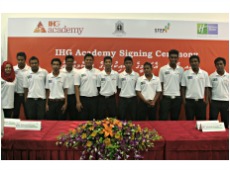
The Maldives National University (MNU) Faculty of Hospitality and Tourism Studies (FHTS) in partnership with the InterContinental Hotels Group (IHG) launched a collaborative training academy on May 29 to develop participating students’ skills and improve their employment prospects.

The IHG Academy is a collaborative program between the Holiday Inn Resort Kandooma, an IHG hotel, and MNU, in association with the government of Maldives STEP program.

The 13 students participating in the first IHG Academy batch will complete six months of training before graduating on December 31, 2013. They will arrive at the Holiday Inn Kandooma Resort on June 11 to begin training.

“This is the first step of a long sustainable program,” Holiday Inn Resort Kandooma General Manager Chris Batterham told Minivan News today.

He explained the initial batch of hospitality students will gain experience in all the resort’s departments.

“The training program started in England in 2012, but now it has expanded worldwide, and we thought we should definitely start the program in the Maldives and partner with a local educational institute,” Holiday Inn Resort Kandooma Training Manager Sander Smits told Minivan News.

“MNU has a lot of faculty departments, and although we’re starting with hospitality, our future ambition is to open the program to students from all departments,” Smits said.

“It will help young people gain knowledge and increase their chance of finding employment. This program trains and develops future talent as well as gives something back to the community,” he added.

“Each IHG Academy is uniquely tailored to continuously evolve around the needs of the local community and hotels,” said Holiday Inn Resort Kandooma Human Resources Director Shahid Hussain.

Through this academy “FHTS students will undertake Certificate 3 courses in housekeeping, food and beverage, kitchen, and front office,” he continued.

“The second academy batch, which will begin in January 2014, will have the opportunity to not only receive a training certificate, but complete diplomas and degree levels as well,” Hussain added.

Trailblazer

The only female participant in the program, Ana Naseem, is equally excited and nervous to begin her front office internship, she told Minivan News.

Naseem explained that her parents understand “this is a first step” and support her choice to pursue hospitality work, a “stable” career choice.

“Girls don’t go to resorts to work because their parents generally don’t understand what resort life is really like. They are not aware,” Naseem said.

“It is who you are and the choices you make, not the place you go to, which spoils you. You make your own decisions,” she added.

Tourism industry challenges

During the launch ceremony, FHTS lecturer Anil Adam both thanked the IHG for “this wonderful, socially responsible, and generous initiative” which addresses some of the serious challenges faced by the hospitality industry.

“I wish all the resorts would make a similar effort to follow the InterContinental Hotels Group in this regard, and needless to say few resorts are attempting to conduct [training] initiatives, but the numbers are appallingly low,” said Adam.

“The partnership with the IHG Academy would become truly fruitful if we would be able to exchange both talents and expertise in what we hope to be a mutually beneficial endeavor for both of our institutions,” he added.

Adam addressed some the the specific challenges faced by both the hospitality industry, as well as MNU’s FHTS which is trying to address these issues.

“As tourism contributes enormously to our GDP, we are in need of a trained workforce to remain competitive in this industry, which is an imperative of the incumbent government,” he noted.

“[Establishing] the FHTS was one such initiative by the then-government to develop competent employees to fill the vacancies in this industry.”

“Today one of the challenges that FHTS faces is the lack of resources needed to produce potential employees for the global brands that exist in the Maldivian tourism industry,” Adam continued.

“One of the biggest challenges the Maldives is facing today is the lack of knowledgeable persons to drive our economy to the next level,” he lamented.

“It is regrettable to note that when comparing our industry with that of the developed world, our tourism industry is still not knowledge driven.”

“The pivotal change needed to make the most of this industry is usable research into the industry itself. The vacuum of knowledge that exists is the true reason why we do not have a single local brand operating internationally,” he said.

“The Maldives National University cannot function alone to bring about the sustainable development to the tourism industry. It requires collaboration from the government of Maldives, industry stakeholders, and also international bodies,” Adam concluded.

Other training initiatives

The year-long Four Seasons Apprenticeship program was recognised as the Maldives’ first government accredited TVET certified apprenticeship scheme in 2010. Graduates are able to earn TVET, PADI divemaster, or Ministry of Transportation boat driving license certifications, the hospitality company claimed.

The Four Seasons Hotels group has graduated 288 students from their apprenticeship program in the Maldives over the last 12 years, with 47 youths completing the latest program in 2013.

Four Seasons has encouraged the government to promote technical and vocational training “much more aggressively”, while also expressing concern at declining female participation over the last decade in its apprenticeship program.

Likes(3)Dislikes(0)

Luxury tour operator highlights 35 percent slump in Maldives bookings

High-end luxury tour operator Hayes & Javis – part of the TUI group which also includes Thomson Holidays – has reported a 35 percent slump in bookings to the Maldives.

The company’s ‘long-haul trends’ report observed a similar slump in Caribbean island destinations, with Barbados down 51 percent and Antigua 58 percent.

“While off-the-peg beach packages are still popular – especially four and five-star all inclusive ones – there is no doubting the steady decline in demand for traditional fly-and-flop beach holidays,” said Hayes & Javis’ Commercial Head, Sean Dowd.

At the same time, the UK-based luxury operator noted an 11 percent rise in bookings to Mauritius, and similar increases for Tobago (16 percent) and the Dominican Republic (14 percent),” fuelled by the affordability of five-star all inclusive resorts”.

“Mauritius may yet prove to be the new Maldives. Strong airfare and hotel offers, high quality all inclusive resorts and the opportunity to twin with Dubai and other cities have all helped to fuel demand,” he added.

Implying that the trend away from ‘fly-and-flop’ holidays was not solely recession-related, Dowd observed that the operator’s multi-centre trip bookings “have doubled over the past two years because growing numbers of people are keen to see more of what a country – or a region of the world – has to offer when they travel further afield.”

The report noted that the destinations “making waves in 2013 are ones which lend themselves to a combination of city, beach and culture or heritage tours.”

“Multi-centre trips now account for over a third of our business and this growth trend is one which we expect to accelerate,” Dowd said.

Bad PR and changing demographics

The Hayes & Javis report attributes the sharp slump in Maldives bookings to “tough market conditions including increased land costs and poor exchange rates”, however the destination has recorded a steady increase in arrivals from around the world.

Tourism arrivals to the Maldives during the first quarter of 2013 were up 14.6 percent on the previous year, however up to a quarter of all arrivals at Ibrahim Nasir International Airport (INIA) are now Chinese, with the market eclipsing the country’s traditional staple of European holidaymakers. Some 70,570 Chinese arrivals were recorded for the first quarter of 2013, an increase of 51.2 percent over the same period last year.

Beyond changing demographics, the Maldives has also grappled with widespread negative global publicity in the wake of a flogging sentence handed to a 15 year-old rape victim in February.

The incident, which received particularly high volumes of media attention in the country’s core European markets – the UK and Germany – led to a petition calling for a moratorium on flogging by activist website Avaaz. The petition reached two million signatures barely a week – twice the annual number of visitors to the Maldives.

President Dr Mohamed Waheed pledged to appeal the sentence given to the minor by the country’s Juvenile Court, and review local laws to enact potential reforms of the use of flogging. No timeline for such reforms was set.

The tourism ministry meanwhile slammed what it labelled the “dubious” motives of the petition, alleging it to be “politically motivated”.

Deputy Tourism Minister Mohamed Maleeh Jamal in March said tourism had been a key driver of national development and democratic reforms in the Maldives for the last 40 years, and had “sacred” importance in the Maldives.

“People should not be doing anything to damage the industry. In Switzerland, you would not see a campaign designed to damage Swiss chocolate. Likewise you would not see a German campaign to damage their automobile industry,” he told Minivan News at the time.

Likes(0)Dislikes(0)

Sri Lankan police to support Maldives Police Service

Inspector General of Sri Lankan Police Mr N K Illangakoon has “reassured” President Mohamed Waheed Hassan Manik that Sri Lanka will continue to provide support and cooperation to strengthen the Maldives Police Service, during a meeting held in the President’s Office.

Waheed highlighted the “political challenges” the Maldives police face and “commended” their professionalism while executing their duties.

Waheed and Illangakoon further discussed ways to further strengthen bilateral relations, “especially in the area of police service”.

Amnesty International have accused police of using disproportionate force against protesters.

Likes(0)Dislikes(0)