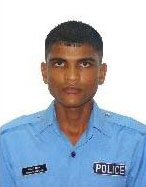
Speeding motorcyclist kills traffic policeman

A 22 year-old traffic police officer, Constable Misbah Abdulla, died today in Male’ after a speeding motorcycle collided with him near the president’s jetty, just metres from police headquarters.

Police said Constable Misbah was manning a vehicle checkpoint when he was hit by the speeding motorcyclist around 4:00am.

According to police, the collision threw the officer 80 feet from the checkpoint. He was taken to ADK hospital but later died of his injuries.

Local newspaper Haveeru, for whom Misbah previously worked as a printer prior to joining the police force, alleged the motorcyclist, 28 year-old Hussein Afeef from Foakaidhoo in Shaviyani Atoll, had a previous record of assaulting traffic policeman.

Afeef was taken into police custody and taken to Indira Gandhi Memorial Hospital (IGMH) for medical treatment.

Second crash

Following a second serious traffic incident on Friday, two men are being treated in Hithadhoo Regional Hospital after their motorcycles collided on the Addu link road near the convention centre.

Hassan Ahmed and Zaheenuddin Saeed are receiving emergency treatment, according to local media.

Likes(0)Dislikes(0)

Comment: The private eye?

This is the second of a series of articles as I attempt to unpack the Naaz Report, Access to Justice in the Maldives: Through the Eyes of a Colourless Lens published in May 2013.

Part one of Velezinee’s critique of the Access to Justice report is available here.

1. Naaz was a warden of Vice President Waheed Deen who taught and groomed her. He sponsored her study in Australia where she read Law, and lived and worked in Australia before returning home in late 2009.

2. I was first introduced to Naaz in 2009 by a mutual friend, a judge, who was a school friend of Naaz, and my closest friend at the time. As I understood, Naaz had been away for a long period, returned to the Maldives for a “break year,” and was excited by the changes she was seeing in the Maldives. She wanted to contribute to the nation with her knowledge and experience, and at the same time build her CV. Maldives lacks people of the knowledge, experience, exposure and grooming Naaz has, and she could help fill the gap. Naaz was living in Bandos Island Resort, courtesy of VP Deen, and was exploring opportunities. It was an exciting time.

3. She met with the then Vice President Dr Mohamed Waheed by appointment to introduce herself, and express her interest, and met others whom she knew from earlier, looking for a way to contribute.  I was aware of the issues in child protection and the lack of expertise in law or human rights in the then Department of Gender and Family Protection (DGFPS) and thought Naaz could contribute much to strengthening the child protection system, and encouraged her to take up the challenge.

4. In the end, Naaz joined the UNDP office in Male as a Project Director to lead the Access to Justice project, an ongoing UN program with the government.  With the UNDP, Naaz had privileged access to all institutions that few others had.

5. The author’s introduction in the publication, Access to Justice in the Maldives: Through the Eyes of a Colourless Lens (May, 2013) reads somewhat different.

6. In it she informs the reader she was the “Protecting Human Rights and Access to Justice Project” Program Specialist as well as the Project Manager with UNDP Maldives”, and that she is “a practicing lawyer in Australia” who has been “in the legal field for over 12 years”. All facts.

The “framing”, however, is misleading. It gives the reader the impression that the author is an Australian lawyer practicing in Australia, who happened to be in the Maldives working with the UN between 2010-12. A Maldivian would have “interests”, but what interests, as such, would an Australian have in rewriting a narrative? The framing, thus, gives a false impression of author as standing outside.

7. Second, the tag “Lead Researcher and Author: Naaz Aminath (LLB, GDLP, LLM)” implies the report is the work of a team. This too is misleading. There is no research team mentioned elsewhere in the report or credits, nor is there a reference list or bibliography included in the report.

8. Copy editing is credited to Maaeesha Saeed and Aishath Rizna, who was the Registrar at the Interim Supreme Court during the transition period, and is currently working for the Department of Judicial Administration.

10. Could the author be deliberately misleading the reader? Are these all innocent omissions and/or typos? Maybe. Or maybe not. What is the purpose of the Naaz Report?  What influence could it have on the political processes in the Maldives today? Everything, depending on the winners in the presidential elections scheduled for September 7, 2013.

11. Naaz’s long standing patron, Waheed Deen, a businessman, resort owner, and society-man of wide social contacts known for his philanthropy and gift-giving, is the current Vice President, handpicked by Dr Waheed following the February 7, 2012 coup d’état. And the fact is, with all the plotting and re-plotting, it was “on a judges’ back” that Dr Waheed rose to office.

What went on in the JSC during 2009 and 2010 is clearly linked to events of January and February 2012, as I tried explaining to the Commission of National Inquiry (CoNI) in my testimony.

So, what does Naaz say?

1. On “access to justice”, Naaz argues that the urban-rural disparity, the “deficiency in development and lack of access to justice creates inequality and injustice while giving an advantage to politicians to ‘buy’ their ideas rather than sell it.”  Access to Justice as a fundamental right, and the broader definitions of it, and the constitutional guarantees and requirements are not recognised.

2. There is no mention of the crucial role of an independent judiciary in democratic government, or necessity of independent judges and public trust in the justice system to protect human rights and provide access to justice.

3. The fact that a UNDP Study (2000) of governance found the judiciary to be “the weakest link” in transitional constitutional democracies; and that Article 285 of the Maldives’ Constitution provided exactly for this challenge, is not recognized by Naaz.

This, despite her position as the Project Director of the Access to Justice project with the UNDP in Male’ during the Maldives’ transition from a constitutional autocracy to a constitutional democracy.

4. The Maldives, I maintain, lost an independent judiciary and the independence of judges through the high treason of the Judicial Service Commission (JSC), on which I sat a member under oath.

The JSC nullified Article 285 unconstitutionally in an elaborate game of lies, deception and drama. The state refused to officially acknowledge the dispute in the JSC, or the alleged treason and constitution breach, with the Majlis majority unashamedly covering up the hijack of the judiciary in what I have since called the Silent Coup.

5. Post coup, the JSC has become exposed as it never was in 2010. The frequent public appearances of the JSC, especially the Chair, Supreme Court justice Adam Mohamed Abdulla, has revealed more about the Commission than any other intervention could.

Concurrently, renewed interest in transitional matters, and inquiries into the JSC and its functioning by independent experts have exposed the secrets of JSC: the JSC does not act to uphold the Constitution, is highly politicised, and misconstrues constitutional concepts and law for its own ends and the benefit of judges. In short, the JSC acts against the Constitution and the State.

6. The latest report on the Maldives’ judiciary and access to justice by the UN Special Rapporteur on the Independence of Lawyers and Judges, Gabriella Knaul, provides a substantive summary of the challenges Maldives faces, and highlights where a UN-led Access to Justice program must focus.

7. On the ground in 2010, Naaz was a sympathetic ear to my complaints against the JSC, and my grievances against the Parliament for their failure to hold the JSC accountable, and to ensure Article 285 was fulfilled meaningfully. I was advocating for substantive and meaningful action on Article 285 aimed at judicial reform as envisaged by the Constitution, and Naaz agreed with my interpretation and opinion.

8. Naaz always left with me a standing offer of assistance, which was much appreciated, as I do not have a background in law. In retrospect, that assistance never materialised, as Naaz was occupied when and where I did request help. My requests mainly were for assistance in reading through some of my drafts, and in translating to English and/or preparing briefs in English to share some information of the ongoing dispute, and the dozens of pages I was putting out in Dhivehi at the time.

9. With all attempts to get an inquiry into Article 285 and the JSCs’ constitution breach blocked, the judges took their infamous “symbolic” oath, en masse, on August 4, 2010. No one, neither the state institutions nor the media, questioned the oath or its legitimacy despite what was witnessed live and the questions it raised. It was the public left with unanswered questions.

10. The UN was satisfied. Naaz was on the ground, and was active in the efforts that followed to legitimise the judiciary, appointed unconstitutionally and without due process,  by the will of the majority. No one mentioned rule of law. Not until 2012.

Aishath Velezinee (@Velezinee on twitter) is an independent democracy activist and writer. She was the Editor of Adduvas Weekly 2005-07 and served on the Maldives’ Judicial Service Commission (2009-11). She claims the Commission she sat on breached constitution in transition; and advocates for redress of Article 285, and a full overhaul of the judiciary as a necessary step for democracy consolidation.

All comment pieces are the sole view of the author and do not reflect the editorial policy of Minivan News. If you would like to write an opinion piece, please send proposals to [email protected]

Likes(2)Dislikes(0)

Addu City Court magistrates go on strike

A majority of magistrates in Addu City have gone on strike claiming they fear for their personal safety, reports local media.

All courts in the Addu City administrative districts of Feydhoo, Hulhudhoo, and Meedhoo have only one magistrate, and are currently not functioning as a result of the strike. A Hithadhoo Court Magistrate – one of four – also failed to appear yesterday (May 29), resulting in all the cases he was presiding over to be cancelled.

The Judicial Service Commission (JSC) had not received any reports of a magistrates’ strike and told local media “all the courts in Addu are functioning properly”.

The magistrates went on strike due to alleged threats to their personal safety and property and some claim to have been harassed and abused.

The magistrates will continue the strike until “satisfactory actions were taken by the authorities”, some magistrates told Haveeru on condition of anonymity.

“We cannot work in such a tense environment, without any protection. Authorities should ensure our personal safety first. We will officially inform the JSC today,” a magistrate said.

Some court magistrates have sought police assistance on multiple occasions, but thus far they claim it has been ineffective.

“[Police assistance] is not happening in the most effective manner. We met with the police this week and discussed these matters,” a magistrate said.

Police have received reports of threats to Addu City court magistrates and will provide security upon request, Commander of the police’s southern division, Abdulla Riyaz, told local media.

Likes(0)Dislikes(0)

Male’ City Council member charged with obstructing police duty

Male’ City Council member Ibrahim Sujau has been charged with obstructing police duty, reports local media.

Sujau allegedly refused to comply with a police officer’s request to see his licence while driving a motorcycle on the evening of November 12, 2012, Criminal Court Spokesperson Ahmed Mohamed Manik told local media.

At approximately 5:48pm Sujau was allegedly driving his motorcycle on Sosun Magu in Male’, while speaking on his mobile phone, and was then questioned by police after stopping his vehicle, Manik said.

Sujau is accused of disobeying the officer’s request to be taken to the traffic police via police vehicle – claiming he was not required to do so – in addition to not showing his drivers license, Manik added.

Likes(0)Dislikes(0)

Comment: One of Maldives’ biggest killers entirely preventable

It is indeed sad that one of the biggest killers of people in Maldives is an addiction that is entirely preventable, but requires a good will to act from everyone.

In 2010, the Government of Maldives, in a commendable move, passed a Tobacco Control Law and in January 2013 introduced its first regulation to reduce the amount of public real estate on which smokers can indulge in their harmful habit – it banned smoking cigarettes inside all government buildings, private restaurants, cafes and other public places.

It further bans smoking tobacco at rehabilitation centres, children’s parks and spaces often visited by children, aboard transport vehicles and at any area where residents have to wait in a line to receive services. Individual violators can be fined MRF500 and proprietors MRF1000 for not enforcing the law on their premises.

Of course, with any law, enforcement is key and we know that the government is aware of the need to encourage law enforcement to not only uphold the law but to become better educated on the details. WHO has suggested incentivising law enforcement so that they will take a more active role in upholding this crucial piece of legislation. There is work to be done to gazette certain provisions, and provide support for more training and awareness-raising activities.

The statistics themselves are alarming enough:

  • According to the 2009 Maldives Demographic and Health Survey (DHS), 42 percent of people in the between the ages of 20-24 are smokers in the country, one of the highest in the region.
  • Although importation figures are showing some decline, in 2011 about 454 million cigarette sticks were imported. This represents a retail value of about MVR 910 million.
  • Globally – tobacco kills nearly 5.4 million people each year; and by 2030 it will kill more than 8 million people each year.
  • If no serious action is taken, up to 1 billion people could die from tobacco use in the 21st century.

There is well-established evidence: tobacco kills and its use carries many negative effects on health and quality of life.

However, despite efforts globally by governments, NGOs and individuals to curb tobacco smoking, it is no secret that the opposition backing the tobacco industry is well-organised and well-funded. Some of the firms will stop at nothing to silence the anti-tobacco lobby. Even for small nations such as Maldives, introducing anti-tobacco legislation and measures can face fierce resistance from those who promote their commercial interests.

The theme of World No Tobacco Day 2013 is “Tobacco advertising, promotion and sponsorship.” The WHO position is clear: all forms of tobacco advertising, promotion and sponsorship should be banned – full stop. We believe that banning tobacco advertising, promotion and sponsorship is one of the most effective ways to reduce tobacco use. In fact, this is a requirement under Article 13 of the WHO Framework Convention for Tobacco Control (FCTC), the international treaty that was developed in response to the globalisation of the tobacco epidemic.

Why is this measure so important? Nearly three in four children between the ages of 13 and 15 are exposed to pro-cigarette ads on billboards and to pro-tobacco messages at sports and other events.

The link between such messages and the uptake of the habit are indisputable. Our figures show that a comprehensive ban on all tobacco advertising, promotion and sponsorship could decrease tobacco consumption by an average of about 7 percent, with some countries experiencing a decline in consumption of up to 16 percent.

I commend the Government of Maldives for introducing a total ban on tobacco advertising, promotion and sponsorship. The Tobacco Control Law (Law15/2010), with the first regulation introduced in January 2013 and more underway, provides a base for reinforcing such a ban.

I know that the Government of Maldives is taking this matter very seriously and continues to place an importance on introducing a full set of regulations, coordination of efforts in multiple sectors and educating small traders and communities on the provisions of the law.

The evidence is clear: such bans work and help us to protect our youth from this deadly addiction.
The time to act is now.

Dr Magtymova is the World Health Organisation (WHO) Representative to the Republic of Maldives.

All comment pieces are the sole view of the author and do not reflect the editorial policy of Minivan News. If you would like to write an opinion piece, please send proposals to [email protected]

Likes(0)Dislikes(0)

Islam as a political weapon in the Maldives: Eurasia Review

It is very unfortunate that almost all the political parties except the MDP are using religion as a political tool to keep former president Nasheed from winning the presidential elections this September, writes Dr S Chandrasekharan for the Eurasia Review.

Their main thrust in the election campaign is that all the parties are out to save Islam from Nasheed and his MDP!

It may be recalled that in the famous February 7 coup of 2012, the Islamists along with other recalcitrant elements spearheaded the move to oust a lawfully elected government of Nasheed.

Nasheed is pitching for a “liberal Islam.” Last month on the 28th, he said that what is worrying is that “radical Islam” and “Wahabism” is spreading throughout the Middle East and East Asia and that this is not the Islam but more “hijaz or Saudi thinking, and their culture”. He said that it more an idea to impose that (Saudi) culture on all Islamic societies.

Nasheed added that people have not stood up and given an alternative narrative. It is so important now to come up with an alternative narrative, a liberal version of Islam or actual version” of Islam.” I have no doubt that this kind of statements would affect adversely his chances in the coming elections.

Nasheed is thus not only taking on other political parties but also the mighty Saudi Arabia in his electioneering campaign! He has also criticised the Islamic scholars who according to him “were using religion as a tool to attain their individual political aspirations.”

The crucial point that should be of interest is whether Nasheed will be allowed to contest the next presidential elections. His growing popularity may provoke the extremist elements to do away with him. His personal security is of utmost importance now. It is for India and other international players to ensure a free, fair, violence free and an inclusive election.

Read more

Likes(0)Dislikes(0)

Police request Elections Commission make “easier voting arrangements” for officers

The Maldives Police Service has requested the Elections Commission make “easier arrangements” to vote in the upcoming presidential for police officers and suspects in custody, reports local media.

Current regulations require eligible voters to cast their vote in September’s upcoming presidential election on the island where they have registered, according to police.

However, police officers have to make urgent trips for official purposes and might lose their constitutional right to vote, the police told local media.

Additionally, suspects might be held on an island other than where they are registered, which would deprive them of their right to vote, police said.

Likes(0)Dislikes(0)

Government cuts costs of foreign missions, sacks staff

The government is cutting the costs of its 13 overseas missions, Minister of Foreign Affairs Dr Abdul Samad Abdulla told local media today.

“Foreign mission expenses are very high. In addition to the salaries, a large sum is spent on rent for officials,” Samad said, noting that the Maldives spent MRV 3.5 million (US$227,000) a year just on rent for some employees based overseas.

As well as curtailing maintenance of some missions, Samad said Councillor at the high commission in Malaysia, Hassan Khalid, and Deputy High Commissioner of the Maldives to India Khadeeja Ibrahim had also been dismissed “after serious deliberation”, Samad said,

Likes(0)Dislikes(0)

O’Level pass rate improves 10 percent on 2011

The Education Ministry has announced a 10 percent improvement in Cambridge O’Level examination pass rates for 2012.

President Mohamed Waheed claimed the results were due to education sector improvements, while former Education Minister Musthafa Luthfy claimed that these policies were enacted under the previous government.

The Education Ministry announced 2012’s Cambridge O’Level (grade 10) examination results on Saturday (May 25), noting that 31 students achieved global top 10 rankings, with five of these students having the “highest results worldwide” in various subject areas, according to local media.

The five students who achieved O’Level scores categorised as some of the “highest in the world” were presented with a prize and newly created presidential medal by President Waheed.

Additionally, 426 students achieved local top 10 rankings, meaning they achieved high scores in various subjects compared to other test takers in the Maldives.

“The number of students who passed five subjects was at 46 percent last year, whilst in 2011 it was at 37 percent,” said Education Minister Dr Asim Ahmed.

Receiving a ‘C’ or above in five subjects is considered a pass.

The the number of students who passed eight subjects increased two percent, from 17 in 2011 to 19 percent in 2012.

Overall 8,456 students in the Maldives participated in the 2012 exams, an increase from 6,100 in 2011.

Announcement of marks delayed

Preliminary results for the 2012’s Cambridge O’Level examination were not released sooner due to “difficulties” in analysis, the Ministry of Education said earlier this year, despite claiming “one of the highest pass rates to date”.

O’Level exams began in early October and concluded in late November 2012, the Education Ministry’s Department of Examinations (DPE) Director General Ibrahim Shakeeb told Minvian News.

“This is just how the process is; 90 days after the final exam session the preliminary results are available. Candidates can then ask to have their marks rechecked, which takes about a month,” Shakeeb explained.

“Students have a week or two to apply for rechecking, once the [preliminary] results are issued,” he continued. “Then the exams are sent to Cambridge.”

Preliminary O’Level exam results were issued to students at the end of January 2013.

“There were quite a large number of requests for rechecking, so it took Cambridge over a month to respond,” said Shakeeb.

“Final results are only issued after the recheck is complete. Cambridge does not release results country by country, rather [marks] are released online, globally,” he noted.

“Three to four months for the process to be completed is the norm,” he added.

Shakeeb told Minivan News earlier this year that the recheck process was ongoing and estimated it would be completed around late March.

Students are currently “in the middle” of the A’Level exam period, which began May 7 and will conclude June 24, according to Shakeeb.

Former Education Minister Shifa Mohamed previously claimed it was a change in Ministry of Education practice for preliminary O’Level results not to be publicly disclosed prior to the final results.

Preliminary Cambridge exam results arrive in January or February, with little difference between these and the final results, she explained.

“Analysis of these findings should only require three days,” Shifa said at the time.

Previous education policies

“The current government would not have been able to do anything in the period of time between coming to power [Febuary 2012] and when students sat for the exams [October 2012],” former Education Minister Dr Musthafa Luthfy told Minivan News today.

“The high exam pass percentage rate is due to what we did when we were in government,” he claimed. “Before us, there was no target set.”

The Maldivian Democratic Party (MDP) had aimed to raise O’Level pass rates from 27 to 60 percent in five years by implementing a holisitc educational policy involving multiple strategies, Luthfee explained.

The quality of Maldives school education and exam pass rates will continue to improve if the current administration abides by the policy guidelines put in place by the MDP government, he emphasised.

“There are several strategies which should be included in all aspects of education. Working on one aspect will not improve exam scores or educational quality,” said Luthfee.

“We rapidly established single session schooling for 55 percent of institutions to provide children the opportunity to engage in opportunities outside of the classroom and develop their character through extracurricular activities,” he explained. “This enabled improved student discipline and motivation.”

“Educational standards were also improved, by developing ‘smart school’ indicators to assess teachers, school authorities, and the Education Ministry,” he continued. “Previously there were no assessment standards.”

“Educational management – classroom and school – was enhanced, which included institutionalising mandatory inservice teacher training each term,” he added. “The education system was also decentralised, and school boards were developed to bring parents into the decision making process, which improved teacher and parent motivation.”

“We also supported private higher education and established the Maldives National University (MNU),” said Luthfy.

He claimed these policies have not been maintained under Waheed’s administration.

“This year there was no money to continue the single session schooling,” Luthfy said.

“If they continue to dismantle the strategies we’ve set, exam results will not continue to improve,” he noted. “However, if they abide by these strategies then quality of education and motivation will continue to increase.”

“The vigour of the policy program made the public aware of the importance of education and the importance of exam pass rates, as well as other educational aspects,” he declared.

The Education Ministry was not responding to enquiries at time of press.

Likes(0)Dislikes(0)