An Indian teacher on Foakaidhoo in Shaviyani Atoll has been rescued by authorities after islanders tied her up and attempted to throw her off the island for allegedly drawing a crucifix.
Haveeru reported that senior teacher at the island’s school Ibrahim Rasheed attempted to explain to the “devout Muslim” parents that the design drawn was a plus symbol marking north, south, east, and west directions on a map.
Following a joint investigation by the Parent-Teacher Association and school management, “they refused to accept the facts when their claim that the teacher had drawn a [crucifix] was explained,” Rasheed told Haveeru.
Students and parents protested outside the school on Wednesday evening, he said.
Meanwhile the teacher, who has worked at the school for three years, has been moved to Funadhoo.
The Maldives government looks set to lock horns with the UK Foreign Office over the Maldives’ long-running claim to 160,000 square kilometres of British Indian Ocean Territory (BIOT).
The Maldives wants an extension of its Exclusive Economic Zone (EEZ) which impedes on a 200 nautical mile EEZ that the UK claims extends from the island of Diego Garcia.
The island is presently occupied by a US naval base, under an agreement in 1966 whereby the UK received favours including a US$14 million discount on submarine-launched Polaris missiles in exchange for use of the island until 2016. The base is now among the largest US naval bases outside the country, and has reportedly been used as a stop-off point for the CIA’s highly-controversial ‘extraordinary rendition’ flights to Morocco and Guantanamo Bay.
More recently, the UK has declared the Chagos Archipelago in the BIOT a marine reserve – an area larger than France – theoretically making it the world’s largest marine protected area (MPA). Funds to manage the MPA for the next five years have been provided by Swiss-Italian billionaire Ernesto Bertarelli.
The matter is further complicated by the existence of an indigenous population, the Chagos, who were forcibly evicted after the British bought the Chagos Archipelago from Mauritius for £3 million (US$476,000) in 1965. The then-Mauritian Prime Minister Seewoosagur Ramgoolam subsequently received a knighthood that same year.
The British attempted to resettle 1000-odd Chagos in the Seychelles and Mauritius, which demanded an additional £650,000 (US$1 million) to settle the refugees.
The Chagos were known to Maldivians in the southern atoll of Addu, as they occasionally rescued a stranded fishermen who had strayed too far south and sent him home. The islands themselves were never settled by the Maldivians, although they retained the Dhivehi name of Feyhandheebu.
Dispossession and the courtroom
The Chagos won a high court victory in the UK in 2000 enabling them to return to archipeligo, but the decision was extraordinarily overruled by the Queen’s royal prerogative. In 2008 the House of Lords overturned the high court verdict, forcing the Chagos to appeal in the European court of human rights.
The Maldives contends that as the islands are uninhabited, according to the Law of the Sea Convention the UK had no right to claim a 200 nautical mile EEZ.
“We will send a delegation to the UN in February and the UN will question us as to our claim, which we believe we have according to the Law of the Sea Convention,” said State Minister for Foreign Affairs Ahmed Naseem.
“Sri Lanka has also filed claims, and we need clarification of them,” he added.
The Maldives’ interest in the area extends to fishing and potential exploitation of mineral resources, Naseem explained.
“We are saying that since there is no population benefiting from the area, the British government cannot claim it as their territory. We feel the [original] claim made by the British is not legally valid [under the Law of the Sea Convention],” Naseem said.
Were the Maldives – or any other country – to succeed in its claim, it would be indirectly benefiting from the homelessness of the Chagos by claiming the territory from which they were forcibly evicted.
“That’s not our issue – the fact of the matter is that there is no native population on the island,” Naseem explained.
On Tuesday the Chagos community in the UK, who live in Crawley next to their arrival point of Gatwick airport, expressed surprise at the UK Foreign Office’s apparent opposition to the Maldives’ claims on their homeland.
In an interview with the UK’s Guardian newspaper, Roch Evenor, chairman of the UK Chagos Support Association, said the Foreign Office “seems to be more interested in defending the seabed than the interests of Chagossians. Why did [politicians] give us all that sweet-talking before the elections and then afterwards we are back to square zero? We feel emotionally drained.”
Second Secretary at the British High Commission in Colombo, Dominic Williams, insisted on Wednesday that the UK was not protesting the submission by the Maldives to extend its territorial waters, but was rather making “an observation” to the UN’s Commission on the Limits of the Continental Shelf (CLCS).
“The UK observed that the Maldives’ submission had not taken into full account the 200 nautical mile Fisheries and Environment Zones of the British Indian Ocean Territory,” he said. “We are satisfied that the CLCS will be able to consider the Maldivian submission without prejudice to the position of the United Kingdom.”
Williams said that the UK believed that a Marine Protected Area (MPA) “is the right way ahead for furthering the environmental protection of the Territory.”
The decision to establish the MPA was, he added, “without prejudice to the current pending proceedings at the European Court of Human Rights. As such, there is no need to wait for a decision from the European Court of Human Rights before implementing the MPA.”
“The establishment of this MPA has doubled the global coverage of the world’s oceans benefiting from protection and gives the UK the opportunity to preserve an area of outstanding natural beauty containing islands and reef systems rich in biodiversity.”
He noted that once the area was no longer needed for defence purposes, “the UK is committed to cede the British Indian Ocean Territory to Mauritius.”
Managing Director of Dhoni Services Ali Moosa, the company awarded a government contract last year to establish a transport network in the South Central Province, was found guilty by the Civil Court yesterday of issuing a bounced cheque and sentenced to six months’ banishment.
The court found that Ali Moosa had issued a cheque of US$100,000 (Rf1,285,000) to local company Sonee in January 2009 from a Dhoni Services account registered in Habib Bank.
While the penalty for the offence is banishment or incarceration for a period between six months to two years under article 39(b) of the Negotiable Instruments Act of 2002, the judge said Moosa would be banished for six months as it was his first conviction.
In addition to the claim by Sonee, Ali Moosa faces a number of civil lawsuits over unpaid debts and bounced checks.
According to local daily Haveeru, the Dhoni Services MD has been sued by different claimants for unsettled debts amounting to Rf50 million.
In September last year, Dhoni Services was sued by a business associate of Ali Moosa for Rf1.2 million and MGH Investment to recover Rf149,034 for oil purchased on credit.
Ali Moosa was arrested in April this year on charges relating to outstanding debts upon his arrival in the country after a long absence.
State Minister for Transport “Maizan” Ahmed Manik told Minivan News today that the conviction will not have any bearing on the government’s agreement with Dhoni Services to provide ferry services to Thaa and Laamu atolls.
“The contract does not mention anything about terminating it if he’s banished or arrested,” he said.
President Mohamed Nasheed has said the salary of civil servants could be restored before the end of this year.
In a statement from the President’s Office, Nasheed “thanked all civil servants for the great sacrifice they have made” and “expressed hope that civil service pay could be restored to the level before the reduction of 15 percent.”
Nasheed also said the government was hopeful reaching its target budget of Rf7 billion before the end of the year.
The Drug Enforcement Department (DED) of the Maldives Police Service have arrested a man they claim is a prominent drug dealer in Male’.
Head of the DED, Superintendent of Police Mohamed Jinah identified the person as 40 year old Ibrahim Shameem, who was arrested at Azum in the Henveiru district of Male’.
”He sells a illegal drugs across a wide area,” alleged Jinah. ”He was arrested last week inside Heniveru Azum, with other two persons also suspected to be involved with his operation.”
Jinah identified the other two persons as Ali Nazih, 29 and Ibrahim Shafeeu, 27.
”Shameem was arrested in August 2008 with suspected narcotics and his trial was also conducted in the court,” he said. ”But at this stage we do not know whether he was convicted or if the case is ongoing.
He said large amount of heroin and hash oil was found with Shameem.
”Last week 23 persons were arrested in different cases related to illegal drugs, 36 cases of which were sent to Prosecutor General’s office,” he added.
Last week police seized 1.6 kilograms of drugs from inside a house in Maafannu.
Each year hundreds of tourists hold wedding ceremonies on the pristine beaches of Maldives. Though existing regulations do not allow non-Muslims to marry in the country, tourists can’t resist the temptation of holding ‘mock’ wedding ceremonies against the backdrop of azure lagoons and white beaches.
The ceremony is often Maldivian, with traditional boduberu drummers providing the music for the occasion. The grooms look dashing in shirts while the brides are dazzling in wedding gowns.
Alas the clothes are imported much the time, despite the fact that there are very good Maldivian designers and tailors capable of making unique ‘one-off’ gowns.
The bride fair recently held at Dharubaaruge aimed to bridge that gap.
“We’d like Maldivian designers and tailors to be able to showcase their talents to the tourists who hold wedding ceremonies here,” said Mohamed Shafi, Managing Director of Bride Maldives company which organised the fair.
Wedding masquerade
The Bride Fair aims to be a one-stop place for those looking to tie the knot. Every aspect of the big day was covered by one of the stalls present.
Caterers like Juways and Salsa Catering had stalls.
“We have special menus for weddings and can cater different cuisines like Chinese or Indian depending on the request,” says Ibrahim Amir, Managing Director of Salsa catering.
His participation at the fair was intended to create more awareness and with five bookings to cater for weddings and 37 ‘potentials’ just in one evening, he deems the fair a success.
Brides to be seems to be the main visitors to the fair: “99 percent of the girls who enquire at our stall say they are about to get married,” he observes.
“Weddings involve a lot of things, and even when the bride and groom go for their photo shoot they are still unhappy or stressed out over some thing,” says Shafi,who is confident the fair has helped prospective married couples find all the services they need.
“Locally only two or three [designers] are well known, so we want to showcase unique and talented individuals to the local as well as international market.”
That talent is very much evident at Saadha Ali’s stall.
A diploma holder in fashion designing from Sri Lanka, at Ali’s stall three gowns take pride of place. One with a bodice made up of ties, striped and plain, tapering off towards the waist and held in place by huge orange roses. A white gown has paper birds on its skirt, while an eye-catching orange gown shows that Saadha can dabble in ordinary materials as well as unusual ones.
Not all gowns on display are locally made. Wedding planner Bridal Boutiques showcases an ethereal white gown, imported, and so are the gowns on display at another wedding planner, El Momento.
“In future we would like to work with a local, but to avoid the stress of chasing after a designer we are starting off with imported gowns,” says Hudha Haleem, El Momentos director. With their showrooms in the process of being finished, Hudha says the fair is giving them ample exposure.
“All the gowns are not locally made – we also want to cater for those who can’t afford designer gowns or who get married in haste,” Shafi explains, pointing out that there are Maldivian companies in the business.
In a country where marriages often take place less than three months after the decision, ready-made gowns are also much in demand.
For those looking to venture into the lucrative wedding cake business, EFFES institute stall gave information on their courses, where you can learn basic cake-making in just two weeks.
Even gyms like Heat and Male’ Fitness Centre have stalls, where one can see young women inquiring.
“We mostly get girls who come and enquire about our ready made fitness programs for couples,” says the girl at the MFC stall. Even though a poster on the wall offers three distinct types of fitness programmes for the couple, she says mostly the man declines saying “it’s just for the girl.”
A male staff member of MFC promises that the changes will be evident on the wedding day if one enrolls in the three month programme.
One of the visitors to the stall turns to her female friend and says she “needs to get rid of the flab around my waist.”
As promised, the stalls at Bride Fair covered every aspect of the big day.
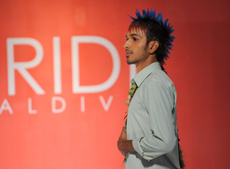
Grooms had mohican hair styles
Runway Brides
The highlight of the fair however seems to be the runway show, with photographers jostling for a good view alongside spectators throng to the catwalk podium once it starts.
Shamla is easily the most famous wedding gown designer in Maldives, and showcases her collection first. It’s impossible to get a good view of it.
The crowd settles a bit. Next, Aishath Roza’s collection, modeled to the theme song of Bride Fair ‘Forever bride to be’ by singer Unoosha.
Her collection diverges from the classic white gown, to include a maroon gown with a crunched skirt. An off shoulder gown with a chequered bodice of black, white and maroon and a golden gown with a ruffled skirt, and of course one white gown.
Saadha Ali’s collection is colourful, bright orange and blue wedding gowns give way to light pink and purple ones, a row of red flowers snaking down the bodice of the white gown gives it a pop of colour. Men make an appearance in shirts with pleating details on the front, however its their hair cut in a Mohican fashion, with blue colourings and a pony tail at the back that grab attention. Screams of appreciation fill the air when child models appear on the runway, the boys with the Mohican cut while the little girls sports flowers.
Colours give way to white gowns for the collection titled Venus by Naisha Ibrahim. The gowns are sleek, with detailing like silver bow ties on the bodice, ruffled full skirts, and flowers of earthy colours. Complimenting the gowns is the hair, pulled back and in a bun, with hers a slight re-working of the classic white gown. The models are breathtakingly beautiful and carry the wedding dresses well.
“All the designs showcased on the runway are made locally by Maldivian designers,” says Nuha.
The sheer variety of the gowns would leave a bride-to-be spoiled for choice. The Bride Fair seemed to be a success both in terms of showcasing local talents and providing a place for would be brides to get help in planning the big day.
The Maldives welcomes Chinese investment in the country’s resort industry, Maldives Ambassador to China Ahmed Latheef has told the Chinese newspaper Global Times.
Chinese visitors have eclipsed European arrivals as the country’s major tourism market this year, according to figures from the Maldives Tourism Ministry.
Latheef told the Global Times he welcomed investment from China in resorts to boost the development of local tourism, explaining that “the difficulty we have at the moment is that we do not have enough hotels or beds to cater to the growing market in China.”
“The Maldives and China have enjoyed excellent bilateral relations, and there are many areas that can be developed through Chinese involvement and engagement in the Maldives,” Latheef said. “We would welcome initiatives from Chinese investors in the development of tourist resorts.”
Malnutrition is the biggest impediment to the healthy growth of children here, the Health Ministry has said.
A 2009 survey by the Community Health and Disease Control Unit showed substantial percentages of children not achieving the expected height, strength or weight for their ages, reports Haveeru.
A programme was launched in seven atolls four years ago to monitor the growth of children who could not achieve the desired height as a result of malnutrition. The programme also includes teaching parents to make nutritious meals from locally sourced products.
Haveeru sources, however, noted that the programme had not had much impact.
Twenty five new houses are to be built on Naifaru under the government housing scheme. President Mohamed Nasheed launched the project on the island yesterday.
The government had pledged to build 10,000 housing units under the scheme.
Agreements were signed between the government and A Man Maldives Pvt Ltd, Amin Construction Pvt Ltd and Swift Engineering Pvt Ltd at a special ceremony yesterday. Under the terms of their contract, the builders are obliged to start work on their sites within 21 days.
All the new houses on Naifaru will be three-bedroom houses with two floors.
 (0)Dislikes
 (0)
(0)