Former President Mohamed Nasheed returned to the campaign trail yesterday (November 12) in Alif Dhaal atoll – where Jumhooree Party (JP) candidate Gasim Ibrahim secured 50 percent of the vote – stressing the Maldivian Democratic Party’s (MDP’s) track record on Islamic affairs.
Addressing the people of Thohdoo in Alif Alif atoll in his first stop, Nasheed slammed opponents for “using Islam to play with people’s hearts” and reiterated that other religions will not be allowed under an MDP government.
“When they make false allegations against us and create doubt and suspicion in the hearts of the people, in my view it is not damaging to me but damaging to the Maldives and our future,” he said.
Rival parties have persistently accused the MDP of being “irreligious” and pursuing a “secularisation agenda,” contending that the country’s independence, sovereignty and 100 percent Muslim status would be threatened by a Nasheed presidency.
Highlighting the previous administration’s track record, Nasheed meanwhile noted that an Islamic Ministry was formed, scholars were offered unprecedented freedom to preach, and a Shariah-compliant Islamic Bank was established.
In contrast, Nasheed said, religious scholars were persecuted and jailed during former President Maumoon Abdul Gayoom’s 30-year reign.
The MDP government secured an investment of MVR127 million (US$8.2 million) to set up the Islamic Bank, he added, while repeated calls for Islamic finance were unheeded by President Gayoom.
Nasheed also noted that a Fiqh academy was set up in 2009: “This was never done in President Gayoom’s government. He kept saying no one would know religion better than me, so we don’t need a Fiqh academy here. But we saw that there should be discussions about Islamic matters and scholars should be able to give moral advice.”
In addition, Nasheed continued, a first-ever symposium of local scholars took place, foreign financial assistance was secured to upgrade the Faculty of Shariah and Law, a new building was constructed for the Arabiyya School, Islam and Quran teachers were trained for 150 schools, and 42 new mosques were built.
Three days after assuming office in November 2008, Nasheed said the government authorised preachers to deliver their own Friday sermons.
“It was [previously] prohibited to preach anything other than the sermon that [the government] wrote and gave and if they did they would be arrested,” he said.
Courting Gasim
Nasheed emerged the frontrunner in the November 9 revote with 46.93 percent while Progressive Party of Maldives (PPM) candidate Abdulla Yameen polled 29.73 percent. Gasim finished third with 23.34 percent of the vote.
As neither reached the required 50 percent plus one vote, Nasheed will face Yameen in a run-off election on Saturday, November 16.
Although Gasim announced that the JP council had decided not to back either candidate, both parties have been seeking the business tycoon’s endorsement this week. Following a visit by former President Gayoom yesterday, Gasim told the press that he would ask the JP’s national executive council to reconsider its decision.
A council meeting is scheduled for 4:00pm today.
Following his meeting with Speaker of Parliament Abdulla Shahid and MDP MP Ibrahim Mohamed Solih on Monday night, Gasim told reporters that Nasheed had “cleared up” doubts concerning the MDP’s stance on religion.
Gasim referred to Nasheed’s appearance on the state broadcaster the same night, during which he vowed that “nothing will happen under our government that could weaken Maldivians’ Islamic faith”.
“I don’t like to posture as a religious person, but I am also an ordinary Maldivian raised by loving parents with religious instruction just like any other person,” he said.
Nasheed also said that only Islamic Minister Dr Abdul Majeed Abdul Bari had “veto power” in his cabinet.
The former president apologised for Gasim’s arrest in 2010 on charges of bribery and treason and appealed for his support in the run-off election.
Maamigili
 Following visits to Thohdoo and Mahibadhoo, Nasheed went to Maamigili for a campaign rally in Gasim’s native island and parliament constituency.
The JP candidate won 862 votes from the island while Nasheed received 334 votes. PPM candidate Yameen trailed behind with 45 votes.
Alif Dhaal atoll was also one of two atolls where the MDP failed to garner the most number of votes. Gasim secured 3,234 votes from the atoll to Nasheed’s 2,060 votes.
Speaking in last night’s rally, Nasheed alleged that former President Gayoom “did nothing” to instil Islamic values in younger generations.
Nasheed pledged to build more than 100 smaller “neighbourhood mosques” for the elderly, who were unable to walk long distances five times a day.
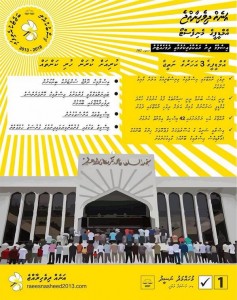
Nasheed also referred to the MDP’s 2013 “costed and budgeted“manifesto, which included the construction of an “Islamic Knowledge Centre” for MVR 200 million (US$13 million) with a library, lecture halls and a mosque with a capacity of 5,000 worshippers.
Other pledges include conducting an international Islamic conference at an estimated cost of MVR 25 million (US$1.6 million) with the participation of renowned foreign scholars, training 300 Quran teachers to first degree level, and allocating MVR 36 million (US$2.3 million) for renovating mosques across the country.
Likes (0)Dislikes
 (0)
(0)
