More than MVR500,000 stolen from Faafu atoll council safe

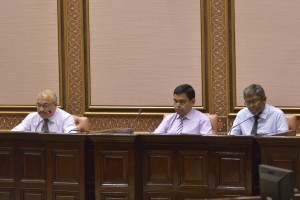
Police are investigating the theft of more than MVR500,000 from the safe at the Faafu atoll council office in Nilandhoo today.

The robbery was reported to police at 7:56am this morning, according to police media. The thieves are believed to have broken the safe after entering the atoll council office through a window.

Police are currently trying to locate a suspect while investigation and forensic teams from the Nilandhoo and Dhaal Kudahuvadhoo police stations are active in the island.

Likes(0)Dislikes(0)

Maradhoo magistrate court declares alive voter considered deceased by Supreme Court

The magistrate court in the Maradhoo ward of Addu City has declared living a voter considered deceased by the Supreme Court in its judgment annulling the September 7 presidential election.

According to local media reports, the magistrate court made an announcement yesterday (October 30) after Mohamed Ahmed, of Muskuraanage, filed a complaint.

The Maradhoo resident was among three names provided as examples by Elections Commission (EC) Chair Fuwad Thowfeek of voters falsely deemed dead by the apex court.

Speaking to Maldives Broadcasting Corporation’s Raajje Miadhu (Maldives Today) programme this week, Thowfeek said the commission had discovered that at least four of the eighteen people deemed to be dead in the Supreme Court verdict were in fact alive.

In addition to Ahmed Mohamed, the EC had found that Ahmed Naseem from Male’, Fathmath Didi of Addu Atoll Hithadhoo Island and Khadeeja Gasim of Laamu Atoll Fonadhoo Island were alive.

“Like this, many people who are alive and had voted have been deemed by the Supreme court as votes cast by dead people, and based on that, they have annulled the election,” Fuwad said.

The EC and the Human Rights Commission have criticised the evidence used by the Supreme Court to annul the vote.

Likes(0)Dislikes(0)

Suspect in Afrasheem murder case transferred to house arrest

The Criminal Court has reportedly transferred Azleef Rauf, a former Maldives National Defence Force officer suspected of involvement in the murder of MP Afrasheem Ali in October 2012, to house arrest.

In May this year, Rauf was detained on charges of terrorism, extortion, and involvement in criminal gang activities, after which the court extended his remand detention.

While a case against Rauf over alleged involvement in the murder of the moderate religious scholar was sent to the Prosecutor General’s Office in September, the case has yet to be filed at court.

Rauf is also facing separate charges of extortion, theft, and damaging public property along with former Judicial Service Commission member Mohamed ‘Reynis’ Saleem.

Likes(1)Dislikes(0)

Ambassadors warned of international restrictions if no president by November 11: Nasheed

Foreign ambassadors have warned of international restrictions on trade and financial transactions if there is no president-elect by the end of the current presidential term on November 11, former President Mohamed Nasheed said at a press briefing yesterday (October 30).

To avert such a scenario, the opposition Maldivian Democratic Party (MDP) presidential candidate suggested two solutions: the Supreme Court should review its judgment to annul the September 7 presidential election, or one of the two rival candidates should withdraw his candidacy “for the sake of the nation and Islam” ahead of the fresh polls scheduled for November 9.

“Ambassadors of foreign nations that I meet are now saying very openly that if there is no president-elect by November 11 they would have to take action under their normal rules or procedures,” Nasheed said.

A nation without an elected president is considered a dictatorship and prone to instability and unrest by the international community, he added.

Nasheed referred to financial sanctions imposed by the United States and Europe on troubled states such as Sudan and Myanmar.

If similar sanctions are imposed on the Maldives, Nasheed said the country would face difficulties in both importing essential goods, such as oil, medicine and foodstuffs, and continuing to export fish to Europe.

“If we cannot hold an election, we will be forced to conduct all business transactions overseas with cash,” he continued, as restrictions would apply to transactions through foreign financial institutions and banks.

“We are concerned because we can see Maldivians having to bear this burden. We are concerned that our rivals, even under these circumstances, are trying to stop the election and maintain the coup government,” said Nasheed.

The European Parliament in Strasbourg this week heard calls from UK MEP Charles Tannock to apply “maximum pressure”  to reverse what he described as a “judicial coup” in the Maldives.

Rival candidates only considered discussions to conclude the presidential election before November 11 after parliament “with a comfortable majority” passed the MDP’s proposal for the speaker of parliament to assume the presidency in the absence of a president-elect, Nasheed contended.

On the day parliament adopted the MDP resolution, he continued, the PPM and JP “realised that the coup government cannot be maintained even if they obstruct the election.”

“Even when we went to the Elections Commission, we all knew very clearly that it was unlikely that both rounds of the election could be held before November 11 while abiding by the Supreme Court guidelines,” Nasheed said.

Two options

Nasheed stressed that either a Supreme Court review or a candidate’s withdrawal was necessary to ensure a victor in one round to conclude the election by November 11.

As it was the Jumhooree Party that sought annulment of the September 7 election, Nasheed urged the party’s candidate Gasim Ibrahim to file a case at the apex court requesting a review of its decision.

“We are now at the mouth of a pit, on the edge of a razor blade,” said Nasheed, describing the consequences of repeated election delays.

Asked if either candidate had responded to his appeal for one of the pair to withdraw, Nasheed said he was hopeful but could not say he got “a clear answer.”

“I am certain that Gasim’s question will be, ‘why me?’ The answer is because you are the most sincere,” he said.

In lieu of a candidate dropping out of the race, Nasheed said the second option was for the Supreme Court to review its judgment and allow the second round to take place on November 9.

If none of the two scenarios came to pass, Nasheed expressed confidence of winning the election on November 9 “in one round” against the PPM and JP candidates.

“In my view, the Maldivian people’s patience has run out because of the efforts to stop the election from taking place. Fishermen can’t go fishing. People can’t leave on a holiday or for medical treatment overseas. And the campaign activists do not want in the slightest for their lives to return to normalcy,” he said.

Nasheed questioned the sincerity of the JP and PPM’s request for the Elections Commission to conclude the election before November 11 as both parties were insisting on following the Supreme Court guidelines whilst calling for Dr Waheed to remain in office.

Nasheed emerged the front-runner in the annulled September 7 election with 45.45 percent of the vote followed by Progressive Party of Maldives candidate Abdulla Yameen who polled 25.35 percent, necessitating a second round run-off.

Business tycoon Gasim narrowly missed out in a place in the run-off election with 24.07 percent of the vote and contested the results at the Supreme Court alleging widespread electoral fraud.

Meanwhile, at a press conference yesterday, JP Deputy Leader Ilham Ahmed emphatically dismissed Nasheed’s calls for Gasim to withdraw, calling instead for Nasheed to step back for the good of the nation.

“There is a fear that Islam will disappear if you [come to power]. There is a fear that there will be bloodshed here caused by introduction of other religions. There is a fear that you will sell of the nation’s assets,” he said.

Likes(0)Dislikes(0)

Man arrested for vandalism of Indian High Commissioner’s Car

The police have arrested a 22 year-old suspect in connection with the vandalism of the Indian High Commissioner’s Car on Monday (October 28).

The police obtained a warrant from the Criminal Court to arrest the man, but have not provided any further details on the case. The case is being investigated by the Serious and Organised Crime Department.

The rear window of High Commissioner Rajeeve Shahare’s car was smashed on Monday evening whilst parked outside of the High Commission in Male’.

A statement released by the Indian High Commission described the attack, noting that a police officer was observed by High Commission security staff as witnessing the attack but failing to react.

“The Indian High Commission security guards observed on the close circuit TV that the culprit purposefully approached the Indian flag car, pelted two metallic objects at the car one of which smashed the rear windshield, and ran away thereafter,” said the statement.

“It is evident that there was malicious intention to cause damage to the property and perhaps to the occupant of the car. Importantly, the High Commissioner was in the car just a few minutes before the attack,” it continued.

The President’s Office on October 29 assured that such “cowardly” attacks against foreign diplomatic personnel and property would not be tolerated.

“The close and friendly relation that exists between the Maldives and India is based on mutual respect, understanding and reinforced by a shared vision of a better future for our people,” it said.

The Ministry of Foreign Affairs has also expressed concern over the attack on the diplomatic vehicle.

“The Ministry wishes to call on all members of the public to refrain from activities that might undermine the close friendly relations that exist between Maldives and its close and friendly neighbours,” the ministry said in a statement on Tuesday (October 29).

The Maldives’ traditionally close ties with India have come under increasing strain under the current government, with the cancellation of a deal to develop Ibrahim Nasir International Airport  in December 2012 the most contentious issue.

The 25-year, US$500million, lease signed with Indian infrastructure company GMR was terminated after a long and at times xenophobic campaign from government-aligned parties.

The campaign sparked a diplomatic row after President’s Office spokesman Abbas Adil Riza accused Indian High Commissioner D.M. Mulay of being a “traitor and enemy of the Maldives and the Maldivian people”.

The President’s Office quickly distanced itself from these remarks. Both men have since left their posts.

GMR is currently seeking US$1.4billion in compensation in a Singaporean court of arbitration – a figure greater than the Maldives’ annual state budget.

On February 15 this year, the Indian government revoked a special quota afforded to the Maldives for the import of aggregate and river sand, resulting in a weakening of the construction sector in 2013.

The Indian High Commission itself became the scene of political drama as former President Nasheed temporarily sought refuge inside the diplomatic mission after police attempted to arrest him to ensure his appearance in court.

Following Monday’s attack, the Maldivian Democratic Party described the rhetoric of the past few months as “hate mongering targeting Indian officials.”

Likes(0)Dislikes(0)

Police seize 48 bottles of alcohol

Police have seized 48 bottles and four packets of alcohol from a dhoni (traditional boat) docked in the Male’ harbour and arrested three individuals last night.

According to police media, the suspects taken into custody were a Maldivian male aged 41 and two foreigners aged 33. The arrests were made following a tip-off to the police Drug Enforcement Department (DED).

Likes(0)Dislikes(0)

Reporters Without Borders blasts “persecution” of Raajje TV

Reporters Without Borders (RSF) has released a statement further criticising the “persecution” of Raajje TV, after the recent initiation of a Supreme Court ordered investigation into its content.

The station is currently under investigation by police after the court ordered they look into an October 19 news report which is alleged to have defamed the institution.

“Not only is the accusation spurious but the investigation has been assigned to the police, which has no competence in such a matter,” RSF said.

“As the Maldives Media Council, the Maldives Broadcasting Commission [MBC] and the opposition Maldivian Democratic Party have all said, such an investigation is the Council’s responsibility.”

Raajje TV CEO Yamin Rasheed told Minivan News yesterday that, whilst both himself and the station’s News Head Asward Ibrahim had been summoned to police, he was only only willing to cooperate with the MBC.

“I won’t co-operate with police, but if the police and broadcasting commission get together and find a solution, I am willing to cooperate – if the broadcasting commission direct us to do so,” said Yamin.

Yesterday’s RSF statement sought to remind the Maldives police of its duty to guarantee freedom of information and media independence.

“The police should concentrate on identifying and arresting the perpetrators and instigators of the arson attack that gutted the station’s premises on 7 October instead of worrying about the quality of its programmes,” read the RSF statement.

Following the destruction of the station’s main studios by masked men earlier this month, RSF strongly condemned the attitude of police who failed to prevent the premeditated attack.

The day after the attack, Chief Superintendent of Police Abdulla Nawaz suggested that protests conducted nearby by the Maldivian Democratic Party – with whom Raajje TV is aligned – had diverted police resources on the night of the attack, before arguing that Raajje TV staff had been negligent in not protecting the premises.

Police have today revealed that seven men and one minor have been arrested in relation to the attack.

“This unconstitutional order follows a failure on the part of the police to protect Raajje TV’s headquarters although they had been informed about the threats it had received, and it shows that the authorities are endorsing an offensive designed to silence Raajje TV by any means necessary,” read this week’s RSF statement.

After receiving fresh threats against its premises this week, Raajje TV has been advised by police to hire additional private security.

“The Police also responded to RaajjeTV’s request of Police security stating that there are difficulties in placing Officers for security but the building and the area will be specially patrolled,” read a police statement yesterday.

Since the controversial transfer of power on February 7, 2012, Raajje TV has faced increasing threats. In July 2012, the police and the President’s Office had said it would not cooperate with the TV station, blocking the station from President’s Office’s press conferences and police protection at protests.

The Civil Court has since ruled that the police and President’s Office’s decisions to ostracize the station were both unconstitutional.

In August 2012, critical cables in the station’s control room were cut, terminating the station’s broadcast. Several Raajje TV journalists have also reported arbitrary arrests and assaults.

In February 2013, men wielding iron rods on motorbikes assaulted Asward leaving him with near near-fatal head injuries.

“The same political alliance is behind the fresh threat, which says Raajje TV should be gone from the scene to meet their political needs,” Yamin told Minivan News this week.

The Maldives plummeted to 103rd in the RSF Press Freedom Index this year – a fall of 30 places and a return to pre-2008 levels.

Likes(0)Dislikes(0)

Pronounced dead: ‘Deceased’ voters found to be alive

When Ahmed Naseem, 48, attempted to verify his information on the voter registry for the new presidential elections scheduled for November 9, he found he had been taken off the list.

The Supreme Court in its verdict annulling the first round of presidential election held on September 7 had deemed him dead and had counted his vote as fraudulent.

“I am saddened and quite fed up. I have been deprived of my right to vote,” Naseem told Minivan News. “Now I have to go to court to regain my identity.”

The Supreme Court annulled the September 7 vote, citing widespread electoral fraud despite unanimous international and domestic praise of a free and fair electoral process.

The apex court claims 5623 ineligible votes were cast – a number that could have altered the narrow margin between the second and third placed candidates.

These votes include votes allegedly cast by 18 dead people, 7 minors, 225 people without authentic identity cards, 773 people with discrepancies in their national identification numbers, 2830 people with discrepancies in their addresses, 952 people with discrepancies in their names, 7 people who did not exist, and 819 people whose national identification numbers were written down wrong by election officials at the time of voting.

Naseem said the Elections Commission had told him he will not be allowed to vote unless he obtains a court document confirming that he is in fact still alive.

“Now, I will not be able to use my identity card for anything,” he said.

Naseem’s wife, Mariyam Zubair, has written to the Supreme Court’s Chief Justice Ahmed Faiz today informing the apex court that her husband is alive.

“The Supreme Court’s verdict no 2013/SC-C/42 has deemed me to be a widow by law,” the letter shared on Twitter said. “I request you to annul [the Supreme Court] decision that my husband is dead and remove my widowhood.”

Back from the dead

Speaking to Maldives Broadcasting Corporation’s Raajje Miadhu (Maldives Today) program, EC President Fuwad Thowfeek said the commission had discovered that at least four of the eighteen people deemed to be dead in the Supreme Court verdict were in fact alive.

In addition to Naseem, the EC had found that Mohamed Ahmed of Addu Atoll Maradhoo Island, Fathmath Didi of Addu Atoll Hithadhoo Island and Khadeeja Gasim of Laamu Atoll Fonadhoo Island were alive.

“Like this, many people who are alive and had voted have been deemed by the Supreme court as votes cast by dead people, and based on that, they have annulled the election,” Fuwad said.

The EC and the Human Rights Commission have criticized the evidence used by the Supreme Court to annul the vote.

In an interview on October 19, Fuwad suggested the Supreme Court was disenfranchising individuals by invalidating votes of those who had address or name mismatches between their identity cards and the voter registry.

“For example, a person called Mohamed Waheed Hassan, may have his name on ID card as Mohamed Waheed. When we gave him the right to vote, they counted it as a fraudulent vote. But the ID card number, address, date of birth and photo is the same … We know it is the same person, the date of birth is exact, the ID card number is the same, photo shows it is the right person,” said Fuwad.

“When we give these people the right to vote, [the Supreme Court] has said that is giving the right to vote to a person who doesn’t have the right to vote,” Fuwad said.

The HRCM, in a leaked report, conducted an analysis of the Supreme Court’s evidence, finding only 1033 of the 5623 votes could be considered irregular.

The commission said the EC may have given 952 individuals with differences in the spelling of their names the right to vote to ensure an eligible voter is not disenfranchised, especially in cases where all other information and picture on the identification documents match.

Further, the commission notes that the 2830 cases of address mismatch should only be counted as evidence if any individual has used the discrepancy to violate another person’s right to vote.

“We do not believe address mismatches can influence the result of this election as this is not constituency specific,” the report said.

Dissenting judges in the Supreme Court verdict said it is the High Court, not the Supreme Court who has jurisdiction over the case. Further, Chief Justice Ahmed Faiz and Justice Abdulla Areef only noted 473 cases of possible fraud.

A new presidential election has been set for November 9. The Supreme Court ordered the EC to discard its voter registry and compile a new one based on the Department of National Registration’s database.

Likes(0)Dislikes(0)

“Supreme Court is subverting the democratic process”: UN High Commissioner for Human Rights

United Nations High Commissioner for Human Rights Navi Pillay has released a statement on Wednesday expressing concern about “the dangerous drift in the democratic process in the Maldives largely as a result of the Supreme Court’s repeated interventions in the presidential election process”.

“I am alarmed that the Supreme Court of the Maldives is interfering excessively in the Presidential elections, and in so doing is subverting the democratic process and violating the right of Maldivians to freely elect their representatives,” the statement read.

The Supreme Court immediately hit back today, with Chief Justice Ahmed Faiz describing Pillay’s comments as “poorly researched” and  “irresponsible”.

“The Supreme Court nullified the first round of the Presidential Election of 7 September 2013 on the basis of irregularities in the process, despite the general conclusions by national and international observers that the election was free and fair,” read Pillay’s statement.

Pillay also described the court’s election guidelines as “onerous” and “difficult to satisfy”.

“There have been longstanding concerns about the independence and impartiality of the judiciary in the Maldives, which both the High Commissioner and the Special Rapporteur on Independence of Judges and Lawyers, Gabriela Knaul, addressed during official visits to the country in 2011 and 2013,” added Pillay

“I am normally the first to defend the independence of the judiciary, but this also carries responsibilities. Judges should act in accordance with the principles of impartiality, propriety, equality and due diligence, as reflected in the UN Basic Principles on the Independence of Judiciary, the Bangalore Principles of Judicial Conduct, and Maldives’ own code of conduct,” Pillay stated.

The statement further also expressed concern regarding the court’s threats to charge lawyers, media and civil society groups for challenging its decisions, as well as “the reactivation of old cases to arrest opposition MPs or bar them from Parliament.”

“The Supreme Court appears set on undermining other independent institutions, stifling criticism and public debate, and depriving litigants of the legal representation of their choice,” Pillay stated.

Chief Justice’s response

“I harshly condemn UN High Commissioner for Human Rights Navi Pillay’s  false allegations regarding the Maldives Supreme Court’s work to uphold its constitutional duties and responsibilities. I do not believe she has any authority to speak in such terms,” responded Chief Justice Faiz today.

Defending the court’s neutrality, Faiz argued that Pillay’s statement was unacceptable for an official operating under the UN’s mandate to protect the rights of large and small states alike.

“False allegations by any party on the Supreme Court’s work does not aid strengthening democracy, administration of justice in the Maldives or uphold the rule of law. It does not encourage the promotion of democracy, rule of law or protection of human rights,” read Faiz’s statement.

The first round of the Maldives presidential election – held on September 7 was annulled by the Supreme Court earlier this month, with a fresh round of elections arranged to be held on October 19.

The re-scheduled vote, however, was also cancelled after police obstructed the Elections Commission, citing the Supreme Court’s issued 16 regulation as justification.

As well as condemning the police for the delay, the Human Rights Commission of the Maldives has also condemned the police for “acting beyond its mandate”, while a leaked report by the commission questions the credibility of the evidence used by the apex court in its annulment of the first round of elections.

A joint statement by the International Federation for Human Rights and local NGO Maldives Democracy Network has described the court’s verdict as being founded on “materially baseless arguments”, after the first round was “applauded as a success by the international community.”

A new first round is now scheduled for November 9, with the EC President Fuwad Thowfeek maintaining it will not be changed despite requests to expedite the polling date from both the current government and the contesting presidential candidates.

Government-aligned parties go to SC for political solutions

Progressive Party of Maldives lawyer Ibrahim ‘Wadde’ Waheed submitted a case to the Supreme Court on Tuesday seeking a ruling on the motion passed by the parliament to appoint Speaker Abdulla Shahid as interim head of state in the instance that an elected president cannot be installed by the constitutionally mandated date, November 11.

Waheed is quoted in local media as saying the parliamentary motion has been passed against the constitution and the verdicts of the Supreme Court.

On the same day, Wadde has also submitted another case to the court asking it to rule that the MDP MP Ahmed Hamza’s appointment to the judicial watchdog – the Judicial Services Commission (JSC) – was conducted in breach of the constitution.

In this case, Wadde argued that Hamza is a person who works “against the judiciary” and so he finds it “unacceptable that such a man can serve in the JSC”.

Earlier this month Wadde, alongside Jumhooree Coalition member ‘Madhanee Ihthihaadh’ (Civil Alliance) President Sheikh Mohamed Didi, filed a case in the apex court challenging opposition Maldivian Democratic Party candidate and former President Mohamed Nasheed’s candidacy.

The petition gave as grounds Nasheed’s criticism of the judiciary, as well as his “outright criticism towards Islam and iposing Islamic Sharia’ in the Maldives”.

Jumhooree Coalition’s Presidential Candidate Gasim Ibrahim has also this week called on President Dr Mohamed Waheed to seek advice from the apex court on the course of action he should take should there not be an elected leader by November 11.

Speaking at a party rally, Gasim stated that as Waheed has previously written to the parliament for advice, he believes the president should also seek the opinion of the Supreme Court.

Likes(0)Dislikes(0)