Maldivian Democratic Party (MDP) MP Abdulla Jabir filed a complaint in parliament against the Prosecutor General (PG) for not taking action against the Maldives Police Service after he was assaulted by arresting officers last year.
Jabir requested on Wednesday (October 2) that parliament’s Independent Institutions Committee investigate the matter and take action against the PG as necessary.
Jabir was presented to the Criminal Court by police September 12, after being kept in custody for two days ahead of his trial for alleged possession of alcohol and cannabis.
Despite a complaint filed by Jabir’s brother, Ibrahim Shiham, which claimed that there is sufficient evidence proving that police beat Jabir during the arrest, the PIC decided that the case could not be sent to the PG office for criminal prosecution, local media reported.
The Supreme Court of Maldives has delayed its ruling on the potential annulment of the presidential election for the second time today.
Originally scheduled for 2:30pm today, the ruling was moved to 5:00pm, before court officials announced the decision to move the ruling back to 8:00pm.
“The Supreme Court can say whatever they want to say. But the constitution must be upheld,” Maldivian Democratic Party (MDP) presidential candidate Mohamed Nasheed told a crowd of supporters gathered near the courthouse.
The case filed by the Jumhooree Party, alleges systemic fraud in the first round of the presidential election, despite the overwhelmingly positive assessments of all observer missions present.
The concluding arguments in the case were heard on September 25, two days after the court had issued an injunction calling upon all state institutions to halt election preparations until the case had been completed.
MDP Imthiyaz Fahmy called for an investigation of the police’s role in the arson attack.
“[Police Commissioner] Abdulla Riyaz publicly announced previously that police will not provide protection to Raajje TV. Look how it has been absolutely burned down today,” said Fahmy.
Former President – and first-placed candidate in the initial poll – Mohamed Nasheed addressed a crowd of around 300 just before midday.
“The Supreme Court may say anything at two thirty today. Do listen to their verdict, it will make no sense at all.”
“The letters in the constitution cannot dissolve and protect itself, it cannot come out to war to protect itself. It won’t come to life unless we get strength from it and come out to protect it.”
“We are not here to ascertain presidency for Galolhu Kenereege Mohamed Nasheed. We are here to get people’s rights. Not for the MDP, but for all citizens,” he added.
The area – close to the Supreme Court – has been the focal point of MDP protests for 10 consecutive nights following the Election Commission’s decision to abandon preparations for the September 28 run-off, in the face of government and judicial intransigence.
The integrity of the Supreme Court was a persistent theme during early protests, with frequent – often visual – references to the Justice Ali Hameed’s purported role in a series of sex tapes.
“We are demonstrating here and won’t stop until we hear a verdict,” Nasheed’s running-mate Dr Mustafa Lutfi told the crowd.
Police have reported “no tensions and no arrests” during today’s demonstration.
The Supreme Court hearing to give the verdict in the Jumhooree Party’s bid to annul the first round of elections has been delayed to 5:00pm today.
The hearing was initially due to be held today at 2:30pm.
Despite widespread local and international election praise of the credibility of the polls, the third-placed JP alleged the vote was flawed due to electoral discrepancies and irregularities amounting to a “systematic failures”.
The delay in polls prompted global and domestic outcry, and has led to unrest in Male’.
Maldivian Democratic Party (MDP) supporters have taken to the streets in protest, officers in the military have been suspended for allegedly “sowing discord” and air traffic controllers, customs officials, ground handling services and port workers have staged strikes.
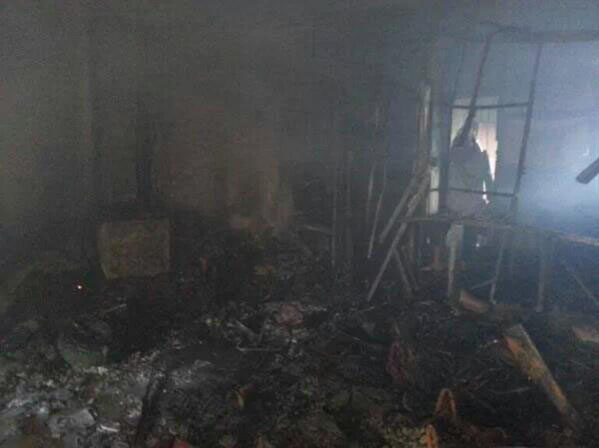
A group of masked men armed with machetes, iron rods and petrol set fire to opposition aligned TV station Raajje TV shortly before 4:45am today, destroying its offices and control room as well as cameras, computer systems, broadcasting and transmission equipment.
The attack comes days after Raajje TV broadcast a report titled “Forum 15” detailing a plan, including arson, to destroy the station.
According to Raajje TV’s Head of News, Ibrahim ‘Asward’ Waheed, six men forcefully entered the seven story building after stabbing the security guard with a machete.
The guard has been hospitalised and is receiving care for two stab wounds to his back.
The men then damaged the elevator and cut off the building’s electricity. The group continued to break through a reinforced steel door to access station’s offices on the second floor of the building, before covering all equipment in the building with petrol and setting it alight.
A crew member from the airport ferry – docked opposite the building – said he witnessed a group of masked men leaving the building, and the bleeding security guard run to police officers on the corner of the block.
“We were docking at around 4:40 am when I saw about eight masked and gloved men leaving the building. They were wearing jeans and t-shirts. I saw the security guard run out, he had blood on his back,” he said.
“There were policemen on the corner, he ran to them and it looked like they did not help. I say this because he ran back to the building and then ran back to them when people gathered there started shouting,” he told Minivan News.
“At the time there was smoke coming from the offices. Many people there told me they called the police when they saw what was happening. But the police did not answer the phone. and only answered once the whole place was ablaze,” he said.
Station staff were unharmed, although the Maldives National Defense Forces’ (MNDF) Fire and Rescue Services said they had rescued one woman who was trapped on the terrace.
According to the MNDF, the fire was reported at 4:45 am and was put out at 7:00 am. A computer store on the ground floor was also completely destroyed in the blaze.
The station was destroyed on the same day as the Supreme Court’s much-anticipated ruling on whether to allow elections to go ahead.
Station had requested police protection
The station’s reporters had all gone home by 4:00am after providing live coverage of the Maldivian Democratic Party’s (MDP) ongoing protests against the indefinite suspension of elections by the country’s Supreme Court. Eyewitnesses had reported that the license plates of the arsonist’s motorbikes had been concealed, Asward said.
Raajje TV CEO Yamin Rasheed said the station had received reports at 8:00pm on the previous evening that it was in danger of being attacked that same evening, warnings which forwarded to police along with a written request for police protection.
“[The report] was very suspicious, and did not look like a joke. I wrote a letter to police asking for security and requested them to protect us from this attack. But there was no response,” he said.
Police Spokesperson Chief Inspector Hassan Haneef confirmed to Minivan News this morning that police had received Yamin’s letter “and took action by patrolling the area.”
Yamin said Raajje TV has extensive CCTV footage of the arson attack: “It will be very easy to investigate. But we’ve handed it over in past attacks and nothing has happened,” he said.
“We will resume our service as soon as possible. Our directors are very courageous and are willing to try again,” he added.
Vice President of the Maldives Broadcasting Commission (MBC) Mohamed Shaheeb has harshly condemned the torching of Raajje TV.
“This is a cowardly act that violates vital democratic principles of freedom of expression and press. This commission calls for an investigation and prosecution of those involved,” he said.
Former President Mohamed Nasheed said in a tweet that he strongly condemns the attack on Raajje TV, asking the “Raajje TV team not to worry and come back on air as soon as possible.”
Maldives Media Council President Mohamed Husham spoke out against lack of protection to the media in a tweet: “We have not seen any results from the discussions to provide protection equally to all media.”
The Maldives Post Services has suspended services from its main office, which is located next door.
Since the controversial transfer of power on February 7, 2012, Raajje TV has faced increasing threats. In July 2012, the police and the President’s Office had said it would not cooperate with the TV station, blocking the station from President’s Office’s press conferences and police protection at protests.
The Civil Court has since ruled that the police and president’s office’s decisions to ostracize the station were both unconstitutional.
In August 2012, critical cables in the station’s control room were cut, terminating the station’s broadcast. Several Raajje TV journalists have also reported arbitrary arrests and assaults.
In February 2013, men wielding iron rods on motorbikes assaulted Asward leaving him with near near-fatal head injuries.
According to Raajje TV the station had an audience of at least 95,000 people, one of the largest shares of Maldivian media. It reached India and Sri Lanka, and is also streamed online.
Government finances “further deteriorated in the first six months of 2013” due to a sizeable shortfall in expected revenue coupled with a marked increase in recurrent expenditure, according to the Quarterly Economic Bulletin of the Maldives Monetary Authority (MMA) released last week.
The central bank observed that the government’s target of reducing the budget deficit to 3.6 percent of gross domestic product (GDP) this year from 12.6 percent in 2012 “now seems rather challenging.”
“These developments have resulted in a widening of the budget deficit as indicated by the large financing requirement of the government during the first six months of 2013. The difficulties in accessing long-term foreign funds to finance the budget deficit resulted in the government resorting to the Maldives Monetary Authority (MMA) and other domestic sources to finance its growing deficit,” the report stated.
The economic bulletin explained that around 15 percent of total revenue budgeted for 2013 – MVR1.8 billion (US$116.7 million ) – was to be raised from new revenue measures, “which so far have not materialised.”
The revenue raising measures proposed in the 2013 budget included hiking Tourism Goods and Services Tax (T-GST) to 15 percent from July 2013 onward, raising airport service charge to US$30, leasing 14 islands for resort development, raising tariffs on oil, introducing GST for telecom services, and “selectively” reversing import duty reductions.
In April, parliament rejected government-sponsored legislation to raise the departure tax on outgoing passengers, prompting Finance Minister Abdulla Jihad to seek parliamentary approval to divert MVR 650 million (US$42 million) allocated for infrastructure projects in the budget to cover recurrent expenditure.
The economic bulletin meanwhile revealed that total revenue in the first half of this year (MVR5.9 billion or US$382 million) increased by 22 percent compared to 2012 on the back of a 35 percent increase in tax revenue.
Tax revenue was “boosted by favourable receipts from GST [Goods and Service Tax] and Business Profit Tax (BPT).”
While GST receipts rose by 46 percent, “contributed by the increase in the rate of GST on the tourism sector (T-GST), from 6% to 8% on 1 January 2013,” BPT receipts increased by 83 percent.
The MMA report explained that BPT collection this year was “based on financial returns for the twelve months ending June 2012, while the BPT collections made in 2012 were based on the financial returns of for the six months ending August 2011.”
Growing government spending
The economic bulletin also revealed that the total government expenditure of MVR6.7 billion (US$435 million) in the first half of 2013 was 8 percent higher than the same period in 2012.
The growth of government spending was “entirely due to the 21 percent (MVR965.3 million) growth in recurrent expenditure, which was partly offset by the 26 percent (MVR440.6 million) decline in capital expenditure during the period.”
Capital expenditure declined due to the government’s decision to suspend infrastructure projects financed out of the budget “in the face of significant shortfalls in revenue due to the inability to implement new revenue measures.”
The increase of recurrent expenditure was meanwhile “driven by the increase in spending on wages and salaries and government pension contributions, both of which largely reflects the transfer of employees in health corporations to civil service commission and employees in Aviation Security Service to Ministry of Defence and National Security starting from January 2013.”
In its professional opinion on the budget proposed for 2013, the Auditor General’s Office had suggested “major changes” to right-size the public sector and “control the salary of state employees and expenditure related to employees” to rein in the budget deficit.
The Auditor General observed that, compared to 2012, the number of state employees was set to increase from 32,868 to 40,333 – resulting in MVR 1.3 billion (US$84.3 million) of additional expenditure in 2013.
This anticipated increase included 864 new staff to be hired by the Maldives Police Service (MPS) and Maldives National Defence Force (MNDF).
Deficit financing
The budget deficit forecast for 2013 was MVR 2.33 billion (US$149 million) – to be financed by MVR 1.15 billion (US$74.5 million) in foreign loans and MVR 1.17 billion (US$75.8 million) in domestic finance.
The MMA’s economic bulletin noted that the budget deficit was largely financed from domestic sources, including the issuance of treasury bills (T-bills) to banks and non-bank sectors.
“At the end of June 2013 the total outstanding debt stock of government securities (T-bills and T-bonds) rose to MVR11,702.3 million which reflects a net issuance of MVR586.9 million in the first half of 2013 compared with MVR615.8 million in the same period of 2012,” it stated.
“Meanwhile, with the increasing challenges faced by the government in financing its growing deficit through domestic sources, the government at times had to resort to the MMA, to finance its deficit. During the first six months of 2013, the change in MMA net credit to government increased to MVR781.0 million from MVR131.2 million in the first six months of 2012.”
The country’s trade deficit also widened in 2013 compared to the same period last year due to higher level of imports, which “reflects the increase in domestic demand driven by economic recovery and the increase in government expenditure.”
While gross international reserves increased in the first six months of 2013 due to the “accumulation of foreign assets by the commercial banks,” the bulletin noted that, “in terms of import cover, gross reserves remained unchanged at 2.5 months in June 2013 reflecting the acceleration in import growth.”
The Supreme Court has scheduled a verdict in Jumhooree Party’s complaint seeking to annul the first round of the presidential election held on September 7 for Moday at 2:30 pm.
Despite widespread local and international election praise of the credibility of the polls, the third-placed JP had alleged the vote was flawed due to electoral discrepancies and irregularities amounting to a “systematic failures”.
After hearing witness statement, the Supreme Court ordered the Elections Commission (EC) to halt preparations for the run off scheduled for September 28. However, on September 26, Elections Commissioner Fuad Thaufeeq announced the run off would proceed as planned. The Supreme Court then issued a second injunction ordering the security forces to ensure compliance with its first order.
The police then surrounded the EC secretariat and brought elections preparations to a halt.
The delay in polls prompted a global and domestic outcry, and has led to unrest in Male’. Several Maldivian Democratic Party (MDP) supporters have taken to the streets in protest. Further, several officers in the military have been suspended for allegedly “sowing discord” in the army.
The Maldivian Democratic Party (MDP) held a large protest on Saturday night calling for immediate elections, with thousands of participants in several locations in the capital city Male’.
The rally – which started from the party’s rally grounds near the Tsunami monument – split up into three different groups while walking down the main road of Majeedhee Magu.
The leading group, with several MPs in attendance, was stopped near the parliament building by police and Maldives National Defence Force (MNDF) lines. The second group, consisting of mainly female protesters, was blocked near the National Library by SO police officers, while the third group went to the Chandhanee Magu-Fareedhee Magu junction where the MDP has been holding protests for over a week.
Protest one – near the parliament
The protest near the parliament – with over a thousand in attendance – was headed by MDP Vice Presidential candidate Dr Mustafa Lutfi, Chairperson ‘Reeko’ Moosa Manik and MPs Imthiyaz Fahmy, Ahmed Rasheed, Ahmed Sameer, Mohamed Shifaz, Mohamed Gasam and Ahmed Easa among others. Several MPs addressed the crowd via sound systems on one of the many campaign lorries that accompanied protesters, constantly playing party-themed campaign songs.
While a line of regular police officers, referred to as ‘Blues’, in riot gear formed the first security line behind the barricades, about 12 Special Operations (SO) officers in full riot gear and holding shields lined up about 10 feet behind them, with yet another security line behind them formed by over a dozen MNDF soldiers, also in riot gear.
The protest continued at the area until just after midnight, though numbers at the location decreased to a few hundred by then. The protesters then marched to join the main cell of protesters who were by then at the Majeedhee Magu-Chandhanee Magu junction. Police barricaded off Majeedhee Magu near the Agora Superstore, which led to the loudly chanting protesters taking a detour through side roads to join the main group, reaching the junction despite police hurrying to block off side roads.
The second group of protesters marched down Chandhanee Magu to the party’s protest site of previous nights, which have followed the Supreme Court’s indefinite delay of the presidential election run-off.
Minivan News observed a number of protesters wearing helmets and dive masks, with one protester saying “this gear is protection against the police’s random attacks with batons and pepper-spray every night”.
SO officers worked to disperse crowds and bring back order after alleged violence incidents took place, including a CCTV camera at the junction smashed to pieces by a man with a large piece of wood. MNDF officers formed a security line between media and the police and protesters.
Police have since announced a manhunt for the person allegedly responsible for smashing the camera, identifying him as Kamil Ibrahim of Beach House from the island of Ukulhas in Alif Alif Atoll.
Police ordered media to remain on the pavement behind police and MNDF lines while the SO officers took possession of the alleged “weapons of violence”, arresting offenders and dispersing crowds, warning media that “if you get off the pavement, you will be removed”. Asked what they meant by “removed”, one officer stated that media “will find out if you step off that pavement”.
Media were however allowed to take photos once police had finished gathering up the ‘weapons’ that were allegedly gathered from the protest site.
One protester claimed to have seen a police vehicle unload bits of wood on Fareedhee Magu, which police allege were collected from the crowd. Minivan News could not confirm these reports as media was ordered to stay behind security lines during the time.
Protesters were pushed off the site, which caused the crowd to split into groups in three different locations: near Maldives Monetary Authority (MMA) offices, near Fantasy Store on Fareedhee Magu and near the National Museum on Chandhanee Magu.
After police pushed backed the crowd, the SO loudly chanted their oath, after which Minivan News heard the commander on duty ask the officers to “without much ado, just arrest anyone in any area in Male’ who you think has consumed alcohol”.
Police then went into the crowds and searched a number of protesters and smelled their breath, allegedly checking for the smell of alcohol.
Protest three: near National Library
The final group consisted of over a thousand protesters, mainly female. They marched through the first set of barricades, with protesters voicing intentions to reach Republican Square.
The protest was brought to a halt just in front of Medhuziyaaraiy Magu on the street around the corner from the National Museum by scores of SO officers in full riot gear, wielding batons.
Protesters remained in the location for approximately an hour before police attempted to disperse the crowd, leading them to regroup and join protests on Chandhanee Magu, where police lined up barricades a few feet away from the National Museum.
Sitdown at Chandhanee Junction
At around midnight, protesters in different locations started joining the majority of protesters who were at the Majeedhee Magu-Chandhanee Magu junction.
With a few thousand protesters at the site at around 1:00am, still chanting and asking for immediate elections, a police truck with several SO officers rode through the crowd, taking photos and videos of the protesters.
Protesters initiated a sit down in the middle of the junction at around 2:00 am, with MDP Vice Presidential candidate Dr Mustafa Lutfi and a number of MPs still active in the site.
At 2:40 am, two trucks with over 20 SO officers arrived at the protest site. Minivan News observed at least two people being taken into custody.
An hour later, the SO dispersed the hundreds of protesters still left at the site, arresting additional protesters after frisking many.
Response
“The October 5 protest was an unconstitutional gathering,” a police media official told Minivan News on Sunday.
“Twelve people were brought under police custody at last night’s protests, all of whom were arrested on charges of assaulting police officers, disobeying police orders and obstructing police duties. We are currently working to find the man who is accused of breaking the security camera on the Chandhanee Magu – Fareedhee Magu junction,” he said.
Police said eight out of the 12 arrestees have had their detentions extended by a week by the court today, with one person detained for an 15 days.
Police also confirmed that two persons have been arrested this afternoon on a fishing vessel from Ukulhas – the island of origin of the man police are looking for in relation to the smashing of the security camera – which was docked in Male’ harbour.
Meanwhile, the Human Rights Commission of Maldives (HRCM) has released a statement noting that during its protest monitoring “some people gathered at the Chandhanee Magu – Fareedhee Magu junction at last night’s protests used wooden bats in a manner which was not peaceful and has conducted unlawful activities. We condemn this act and call on all to exercise the right to freedom of expression in a peaceful manner.”
The statement also said that the commission is receiving a number of complaints about the ongoing protests disturbing the studies of students preparing for their GCE O’Level exams, and called on protesters to not obstruct the students’ right to learn.
The Maldives Police Services has said it will file complaints against the MDP with the relevant authorities for conducting “violent” and “illegal” protests.
Police footage of a protester smashing a CCTV camera and threatening officers
The following is a translation of a leaked “letter of concern” circulating on social media, submitted by senior officers of the Maldives National Defence Force (MNDF) to Chief of Defence Force Major-General Ali Shiyam on September 28. Following the release of the letter the MNDF amended its regulations to punish officers who promoted “upheaval and chaos”. Brigadier General Abdulla Shamaal was subsequently removed from his position as the Commandant of Training and Doctrine,while First Lieutenant Abdulla Shareef (Marine Corp), Sergeant First Class Ali Waheed and Lance Corporal Sharhaab Rashid were dismissed from service. First Lieutenant Mohamed Haleem resigned, stating “For the last 23 years [of my military service]; I have served this country under a solemn oath taken in the name of Allah, I do not see any way that I can carry out my duties as prescribed in the constitution and the military act, while in this position, therefore I request you to relieve me from my duties.”
To Chief of Defence Force Major General Ali Shiyam:
Whereas Article 236 in Chapter 9 of the Republic of Maldives’ Constitution states the Maldivian security services, consisting of the Military Service and the Police Service, is established to enable all persons in the Maldives to live in peace, security and freedom,
Whereas Article 237 states the security services shall protect the nation’s sovereignty, maintain its territorial integrity defend the constitution and democratic institutions, maintain and enforce law and order, and render assistance in emergencies,
And whereas Article 238 states that the actions of the security services must be exercised in accordance with the Constitution and the law, and operate on the basis of accountability,
And whereas Article 111 states that if no candidate wins by over fifty percent of the votes in a presidential election, a run-off election must be held within twenty one days of the first election,
And whereas Article 142 states judges must comply with the constitution and the law,
On 7 September 2013, a presidential election was held as per Article 110 of the Constitution. The Elections Commission announced a second round of election on 28 September 2013 as per Article 111 of the constitution.
According to Article 111 of the constitution, a second round of election must be held within 21 days after the first election, and that date is 28 September 2013. We believe, given Article 8 of the Constitution states that the powers of the state shall be exercised in accordance with the constitution, and as 28 September 2013 is the last date on which the second round of the presidential elections can be held, the Supreme Court order to delay the election is one that creates dangers for the nation and its citizens and creates challenges from a national security point of view, and may impede the military from carrying out is constitutionally mandated duties.
As per Article 237 the security forces are mandated with defending democratic institutions, and maintaining and enforcing law and order.
Given the shifting national security atmosphere in the country, and as the Maldivian state’s independent institutions and the international community are repeatedly calling for all parties to respect the constitution, we believe any military act that violates constitutional rules and democratic norms, will destroy the sovereign state established in the Maldives, destroy law and order in the country, and allow for a military state to be established in the Maldives.
This is due to influential actors who may abuse the turmoil and constitutional void following the delay in presidential elections. We are concerned that the chain of command established in the military as per the laws will be lost, and will allow for the military to be used as a tool to hand over administration of the state to a certain group of people.
Article 245 states that no one is allowed to issue an illegal order to a member of the security services and that members of the security services should not obey such an order. Hence, due to orders issued in the above mentioned situation, this institution [military] may fall into a deep pit, and we fear that subordinate commanders and lower ranks may be legally locked into a dark cell and may be criminally charged at a later date.
Hence, we express grave concern, and appeal for this institution not to be propelled into a deep pit, and state that we will steadfastly remain with good military behavior and good order against any illegal order.
28 September 2013
Signed:
Brigadier General Shamal
Colonel Abdul Raheem
Brigadier General Ahmed Jihad
Brigadier General Ahmed Nilam
Colonel Hamid Shareef
Lt. Colonel Nasrulla Majdhee
Captain Abdul Muizz
Lt. Colonel Ibrahim Hilmee
Sergeant Major Hassan Fawaz
Sergeant Major Naushad Ali
First Lieutenant Abdulla Shareef
First Lieutenant Mutholib [unclear]
Sergeant Major [first name unclear] Vaseem
[name unclear]
[name unclear]
Captain Hassan Amir
 (0)Dislikes
 (0)
(0)
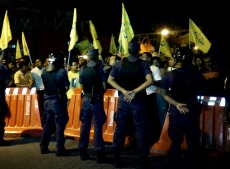 The protest near the parliament – with over a thousand in attendance – was headed by MDP Vice Presidential candidate Dr Mustafa Lutfi, Chairperson ‘Reeko’ Moosa Manik and MPs Imthiyaz Fahmy, Ahmed Rasheed, Ahmed Sameer, Mohamed Shifaz, Mohamed Gasam and Ahmed Easa among others. Several MPs addressed the crowd via sound systems on one of the many campaign lorries that accompanied protesters, constantly playing party-themed campaign songs.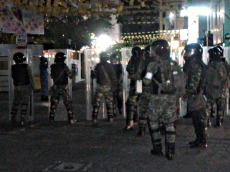
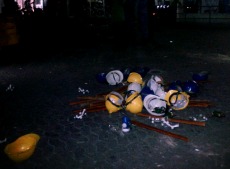 gathering up the ‘weapons’ that were allegedly gathered from the protest site.
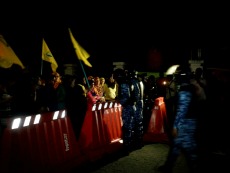 marched through the first set of barricades, with protesters voicing intentions to reach Republican Square.
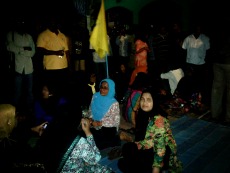 Protesters initiated a sit down in the middle of the junction at around 2:00 am, with MDP Vice Presidential candidate Dr Mustafa Lutfi and a number of MPs still active in the site.