Maldives expects flooding due to storm surges

The Maldives Meteorological Service (MET) has warned that high storm surges due to current poor weather conditions could cause flooding nationwide, reports local media.

Flooding due to storm surges during high tides, as well as heavy rain accompanied by strong wind and thunder, can be expected throughout the atolls, said a MET weather forecaster, according to local media.

“Flooding has not yet been reported from any region, but it can be expected in this bad weather,” he said.

The northern and central atolls can expect the worst weather, however heavy rain, thunder and rough seas will likely be experienced in all regions.

Likes(0)Dislikes(0)

‘Fisherman’s Community Centre’ established

A Fisherman’s Community Centre has been established on Gan Island in Laamu Atoll to provide information on the location of schools of fish and bait.

The Maldives Fishermen’s Association and Maizan Electronics established the centre, which was inaugurated by Fisheries Minister Ahmed Shafeeu May 1, reports local media.

Chairman of Fishermen’s Association Maizan Ahmed Manik told local media that the centre will help reduce the cost of fuel for fishermen, however the information provided via satellite requires a daily fee of MVR 116.66 (US$7.57) or MVR 3,500 monthly (US$ 226.98).

The centre will also offer training programs for vessels that travel outside Maldivian territorial waters, and seek solutions for the challenges those fishing boats, Manik said.

He also announced that a similar centre will be established in Huvadhoo Atoll, on a still to be determined island with the largest population of fishermen.

Likes(0)Dislikes(0)

Local NGO launches child abuse prevention website

Maldivian NGO Advocating the Rights of Children (ARC) launched the website for HOPE Campaign against Child Abuse and announced its partnership with telecommunications company Dhiraagu for an upcoming fundraising road race event on May 7.

The website will provide “easy access” to information in four key HOPE Campaign areas in both Dhivehi and English. The campaign is focused on helping children ‘heal’, the importance of ‘outreach’, ways to ‘prevent’ abuse, and how to ‘empower’ children against abuse.

To support the NGO’s advocacy and awareness efforts, ARC will hold a “run to make a difference road race” in partnership with Dhiraagu, with 100 percent of the proceeds used for child protection programs.

Likes(0)Dislikes(0)

Government to review doctor salaries

The government is to review that salaries of doctors in the Maldives after reviewing a paper submitted to cabinet by the Ministry of Health.

According to the President’s Office the cabinet advised the president to amend the salary structure from 2014, to address some of the difficulties the country is facing in attracting foreign doctors.

Minivan News reported in September 2012 that expatriate medical professionals working in the Maldives regularly face intimidation, fraud and “substandard” treatment from patients, health authorities, local staff and the country’s courts.

One expatriate medical professional, who has worked in several posts across the country since 2009, revealed that along with widespread reneging on contracts and failing to deal with intimidation of expatriate medical staff, health officials had, in certain cases, not even checked whether foreign doctors were registered to practice medicine.

Likes(0)Dislikes(0)

President abolishes gender department

The Department of Gender and Family Protection Services has been abolished by President Mohamed Waheed Hassan Manik.

The department, formerly administered under the Ministry of Gender, Family and Human Rights asits activities related to children, women, people with special needs, and families, are now conducted by the Gender Ministry, according to the President’s Office.

The announcement of the department’s elimination (May 6) comes a day after Waheed met with the United Nation’s Special Representative of the Secretary-General on Violence against Children Marta Santos Pais.

During the meeting Waheed emphasised his commitment to promoting and protecting children’s rights as well as ending all forms of violence against children.

He said a special committee has been established to “reform and strengthen” the government’s framework for protecting and advancing the rights of women, children, special needs individuals, and senior citizens, as well as promoting gender equality.

Likes(0)Dislikes(0)

Hospital infested with rats and cockroaches: IGMH staff

A rat and cockroach infestation are the latest in a series of problems faced by the state-run Indira Gandhi Memorial Hospital (IGMH), reports local media.

The hospital has become infested with rats, which are seen “scurrying about the wards”, a doctor working at IGMH told Haveeru on condition of anonymity.

“There are a lot of rats in the wards. We see them scurrying about. That has become a common sight, especially in the evening,” said the doctor.

“The pantry room is a rat nest, [but] it’s not only the rats. We’ve got a big cockroach problem too,” an IGMH nurse told local media.

“People come to tackle the plague of rats. But we don’t see the numbers receding,” she added.

A nurse recently found a live rat inside a plastic bag containing her breakfast, which was delivered from the hospital canteen. The incident was reported to the Health Protection Agency.

Despite numerous customer complaints about the canteen’s hygiene standards, a top official from the canteen denied any rats ever being present in the eatery, while speaking to Haveeru.

Due to severe budgetary constraints IGMH has faced numerous operational challenges. Major grievances have included overcrowding, as well as a lack of medicine, medical equipment, and maintenance.

IGMH Media Coordinator Zeenath Ali acknowledged the mounting complaints while speaking to local media and made assurances that the hospital was “on top of the problem”.

Likes(0)Dislikes(0)

India hosts Maldivian delegations to ensure “free, fair and credible” elections

India’s Elections Commission (ECI) and parliament are hosting respective delegations from the Maldives’ Elections Commission (ECM) and Majlis in an effort to ensure September’s presidential elections are conducted in a “free, fair and credible manner”.

A seven member delegation from the Elections Commission of the Maldives (ECM) is in India for six days as part of a cooperative program with the Elections Commission of India (ECI) to enhance the Maldives’ capacity to hold the upcoming presidential and local council elections.

While in India, the ECM has the opportunity to acquire first-hand experience during the Karnataka state assembly elections. The ECI is also organising a special election-related training module for the ECM in Mysore.

ECM President Fuad Taufeeq is leading the delegation, which includes other ECM senior officials. Prior to departing for India on May 4 the Maldives’ delegation met with the High Commissioner of India Rajeev Shahare to discuss the visit and other election related issues.

The ECM delegation is expected to return May 9.

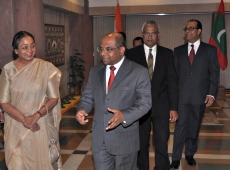
Meanwhile, a Maldivian parliamentary delegation led by Parliament Speaker MP Abdulla Shahid is also in India and met with Indian Parliamentary Speaker Lok Sabha Smt. Meira Kumar yesterday (May 6).

Kumar assured the visiting delegation that India would extend “all possible assistance” – in close coordination with the ECM – to ensure the September presidential elections are conducted smoothly and peacefully.

She expressed her hope that elections may be held in a free, fair and credible manner.

Kumar said that India and Maldives enjoy “special and time ­tested relations” and reiterated India’s continued commitment to further strengthen and diversify the bilateral relationship. Along those lines, she emphasised the collective task both nations have to create an atmosphere of “strong understanding and interdependencies” in the region to achieve collective progress and prosperity.

Kumar also stressed the need to further strengthen bilateral parliamentary linkages, with the first meeting of the India–Maldives Parliamentary Friendship Group being held during the Maldives delegation visit, acting as a “step in the right direction”.

The Maldivian government was urged to take measures for establishing investor confidence in the country as well as conduct structural reforms to prevent harassment and improve living conditions for the nearly 30,000 strong Indian expatriate workforce.

Shahid assured Kumar that the Maldives would work closely with India for the mutual benefit of both nations and extended an invitation for the India’s parliamentary speaker to visit the Maldives.

“Electoral background discouraging”: Transparency report

The 2013 presidential elections are set to unfold “against a context of uncertainty, crises of political legitimacy and unprecedented levels of political polarisation,” Transparency Maldives has stated, in an extensive pre-election assessment published on March 28.

The detailed report identifies key challenges in the lead up to the election, such as the candidacy of former President Mohamed Nasheed, lack of monitoring of campaign financing, an extensive and entrenched culture of vote buying, and a media establishment set on fueling personality politics and further polarisation.

The ECM said in mid-March it had noticed a surge of discrepancies on membership forms submitted by certain political parties including forged documents, forms with false information and even forms filed under the names of dead people.

“Buy-offs and civic education” challenges: ECI

The current ECM visit to India is part of a joint assistance project agreed upon in early-March during ECI’s eight day visit to the Maldives to study the electoral environment in an effort to enable free and fair elections.

During the ECI’s visit, they identified areas the ECM needs to develop and improve. These included: staff shortages, training needs, and the lack of information technology software. Vote buying is another important issue being addressed, the ECM’s President Fuad Thaufeeq previously explained to Minivan News.

Speaking to Minivan News at the time, India’s Deputy Election Commissioner Dr Alok Shukla said that preventing voter “buy-offs” and improving civic education were two “big” challenges about which the ECM was “extremely concerned”.

Likes(0)Dislikes(0)

Maldives included in United Nations’ US$2 million anti-piracy project

United Nations Trust Fund for the Fight against Piracy has approved a US$2 million package of projects for affected nations, including the Maldives.

The aim of the five projects, approved April 30, is to ensure ongoing piracy trials are conducted in a fair and efficient manner and that the human rights, health and safety of individuals suspected of piracy are protected. This includes facilitating the repatriation of detainees suspected of piracy from the Maldives to Somalia.

Other initiatives involve providing support to law enforcement authorities and prosecutors in “front-line States” to investigate illicit financial flows from piracy. Biometrics-based fishermen database systems will also be implemented to support monitoring and surveillance of fisheries resources, while also providing important information to counter-piracy forces. Projects have been approved for Somalia, Djibouti, Ethiopia, Kenya, the Seychelles, and the Maldives.

United Nations Assistant-Secretary-General for Political Affairs Tayé-Brook Zerihoun acknowledged the gains made in controlling piracy, but stressed that the international community “should not be under any illusion that piracy has been conclusively brought under control” during the announcement of the projects in New York.

“The dramatic decline in pirate attacks is clear evidence of years of hard work by United Nations Member States, international and regional organizations, and actors in the shipping industry,” said Zerihoun.

“The international community should continue to support the efforts of Somalia and States in the region to strengthen their maritime law enforcement capacities and their rule of law sector.

“With the Trust Fund’s resources largely spent, now is the time to replenish the Fund to bridge critical gaps in counter-piracy efforts,” he added.

The United Nations Trust Fund for the Fight against Piracy was established in 2010 and have received approximately US$17 million in contributions from member states and the maritime industry. The funds have been used for 31 projects, totalling approximately US$16 million, and “short-term needs related to unforeseen expenditures”.

The purpose of the trust fund is to “defray expenses” associated with prosecuting suspected pirates and undertaking other activities to fight piracy.

The trust fund’s Board is comprised of 10 voting member States – Germany, Italy, Kenya, Republic of Korea, Norway, Qatar, Seychelles, Somalia, Turkey, and the United Kingdom – and three non-voting entities, the International Maritime Organization (IMO), the United Nations Office on Drugs and Crime (UNODC), and the United Nations Political Office for Somalia (UNPOS).

Piracy threat

The Maldives is situated at a strategic intersection of sea trade routes, and a significant amount of global maritime traffic passes through or near the country’s northern atolls.

Due to increasing pirate attacks in the Indian Ocean and the frequent encounters with Somali castaways in Maldivian territory, maritime experts have speculated that the piracy threat is growing in Maldives.

“We are very concerned about piracy in the Maldives since we are located in the Indian Ocean, one of the major areas [at risk],” Foreign Ministry Spokesperson Ibrahim Muaz Ali told Minivan News today (May 6).

“The Maldives has already raised these issues with international organisations and international media,” he added.

Ali confirmed that although recent joint military exercises with neighboring SAARC countries, such as India and Pakistan, were not solely for anti-piracy purposes, that issue was included.

“We are seeking protection [from pirate attacks] from SAARC countries,” said Ali.

In an effort to address the growing threat of piracy and rising concerns over the security within Maldivian territorial waters and the wider Indian Ocean, the Government proposed an anti-Piracy bill in January 2013.

The stated purpose of the bill is to establish a legal framework to deal with piracy within the territorial waters of the Maldives amidst concerns at the growing risk of maritime crime in the Indian Ocean over the last few years.

The bill also seeks to outline legal procedures to deal with individuals suspected of committing acts of piracy within Maldivian territorial waters, give that such procedures do not presently exist in the country’s legal system.

Pirate attacks

The Maldives experienced the first confirmed case of piracy within its waters back in March 2012, when a Bolivian-flagged vessel headed for Iran was hijacked by Somali pirates. The vessel was released a few days later.

The Maldives’ government first expressed concern over the growing piracy threat in 2010 after small vessels containing Somali nationals began washing up on local islands.

In March 2012, 40 Somali castaways in the custody of Maldives authorities refused to return home despite arrangements that were made for their safe repatriation.

“Some of the Somali refugees are not in the Maldives. I can’t say exactly how many have been repatriated. The process has been ongoing. The Home Ministry and so many others are involved,” explained Ali.

In January 2012, an American luxury passenger line en route to the Seychelles was stranded in the Maldivian waters due to an alleged “piracy risk”, while the passengers departed to the Seychelles through airline flights.

Likes(0)Dislikes(0)

Presidential candidates’ policy pledges threaten the environment: Environment Ministry

The Environment Ministry has ‘called out’ presidential candidates for making election pledges that threaten the environment, amidst civil society calls for government authorities to support NGOs’ sustainable development initiatives.

Environment Minister Dr Mariyam Shakeela noted that no policy on environmental protection has been articulated by candidates despite their numerous election pledges during her speech at the “NGO Forum on Environment and Sustainable Development 2013” held by the Environment Ministry and NGO Federation yesterday (May 5).

“Although all political parties are currently talking about their plans to govern the country for the next five years, none of their manifestos include policies on protecting the environment,” local media reported Shakeela saying.

“When you deeply consider these policies, I certainly haven’t heard of any plans to protect the environment. But on the other hand, we keep hearing of plans that can seriously threaten the environment of the Maldives,” she added.

Shakeela stated that despite the economic benefits which could be gained from finding oil or establishing a mariculture industry, these policies could pose grave threats to the environment, according to local media.

“Sometimes, although these plans gain a short-term gain, or some amount of money, they may cause great damages in the long run. It is very important that we give this due consideration,” said Shakeela.

Shakeela emphasised that civil society must hold the Maldivian government and policy-makers accountable when they “veer off course” and endanger the environment.

“Regardless of who prepares it, if the plans are such that they may harm the environment, it is the role of the civil society organizations to be vigilant over such matters and try to stop them,” declared Shakeela.

She also stressed that civil society organisations must identify the environmental threats posed by such policies on the behalf of Maldivian people.

The opposition Maldivian Democratic Party (MDP) has pledged to develop a mariculture industry in the country should former President Mohamed Nasheed be reelected in September 2013.

The potential for developing a domestic oil industry was launched as a campaign issue during a January 14 speech by Progressive Party of the Maldives (PPM) presidential prospect, MP Abdulla Yameen.

Leader of the government-aligned Jumhoree Party (JP), business tycoon MP Gasim Ibrahim, has also vowed to find oil in the Maldives should he be elected president.

NGOs issue government recommendations

The NGO forum was held to facilitate environmental protection discussions between civil society organisations, as well as implementation of sustainable development methodologies and policies.

“This is the only forum of this kind. Civil society did not previously get the opportunity to come together and discuss these issues,” NGO Federation President Ahmed Nizam told Minivan News yesterday (May 6).

Many NGOs work on environmental issues at the island and national level – particularly conducting advocacy and awareness programs – however they do not conduct adequate work on environment and sustainable development, according to forum participants.

Participants highlighted ongoing issues that narrow the opportunities available for Maldivian NGOs, which include legal challenges as well as government administrative procedures. NGOs also lack access to resources, such as well educated people and finance.

Given these limitations, the 15 participating civil society organisations presented a list of recommendations to the government, in line with the forum’s theme of enhancing NGO engagement in environmental governance and management.

The forum recommended the government provide NGOs with equal opportunities and “reveal their stand” to the organisations.

Participants also recommended the Environment Ministry establish a separate focal point to engage with NGOs and provide a common room for civil society organisations within the “green building” currently under construction for the ministry. Research grants for NGOs and environmental studies students should also be provided.

Organisations further recommended the government include NGO representatives in all delegations from the Maldives attending environmental and sustainable development meetings. These organisations also requested the government provide Maldivian NGOs opportunities to participate in environmental and sustainable development projects.

“Minister Shakeela’s response to the recommendations was very positive. She pledged to do everything possible to implement the recommendations,” said Nizam.

“However, she also said certain things might not be possible to implement immediately due to budget and planning constraints,” he added.

Nizam explained that the NGO Federation plans to take the discussion forum to a “different level” by ensuring dialogue and collaboration on environmental protection and sustainable protection continues.

He emphasised that the NGO Federation aims to hold conferences annually or biannually and will continuously seek improvement and additional NGO participation.

The Maldivian NGO Federation held a follow-up workshop today on NGO capacity building for advocating environmentally sustainable development, a project funded by UNDP’s Global Environment Facility, Small Grants Programme.

Likes(0)Dislikes(0)