MPs and Police respond to intel chiefs’ Nasheed assassination attempt allegations

Former Head of Intelligence Chief Superintendent ‘MC’ Mohamed Hameed has stated in his January 9 testimony to the parliament’s Executive Oversight Committee that the police intelligence department received information about two separate assassination plans against former President Mohamed Nasheed.

Hameed further alleged that MP ‘RedWave’ Ahmed Saleem had stored a “poisonous chemical” in his company warehouse in 2011 and that the intelligence department learned of plans to use this deadly chemical to assassinate the then president.

Speaking in the same committee, former military intelligence head Brigadier General Ahmed Nilam also claimed to have received information about an assassination attempt planned to have been carried out during an MNDF live-fire event.

Former Minister of Human Rights of the current administration Fathimath Dhiyana Saeed has also spoken in December 2012 of assassination plans made against Nasheed by politicians she had then referred to as X and Y. She has since revealed X to be Deputy Speaker of Parliament People’s Alliance (PA) MP Ahmed Nazim and Y to be independent MP Mohamed Nasheed.

Following the public release of these allegations, MP Nasheed, MP Saleem and the police institution have responded denying the allegations.

Not involved in any assassination plans: MP Nasheed

Independent MP Nasheed has published an article on his personal blog denying involvement in any assassination plans.

Nasheed wrote that he had never spoken with former Gender Minister Dhiyana of any plans to assassinate Nasheed.

Questioning whether Dhiyana had indeed stated that MP Nasheed had spoken to her of involvement in orchestrating a coup d’etat to topple the former administration, he denied having ever brought up such a subject with her. He furthermore stated that he did not believe Dhiyana would have made such a statement.

Dhiyana’s account, released as a booklet titled “Silent Enquiry: A Personal Memoir on the issue of the Transfer of Powers on the 7th of February 2012” does not accuse person “Y”, later identified as MP Nasheed, of having partaken in assassination plans.

It however stated that through conversation with MP Nasheed she had learnt that he had pledged support to then Vice President, current President Mohamed Waheed Hassan, while he had refused the offer of the post of Vice President “should Waheed ascend to power in the coming week.”

“A week before the now disputed resignation of President Nasheed, his Vice President had invited ‘Y’ to his residence for dinner. After dinner, when he was about to leave, when he was bending over to put on his shoes, the Vice President had bent over and whispered into his ears that things would be difficult in the coming week and whether ‘Y’ would help him. ‘Y’, not suspecting that anything out of the ordinary would happen in the coming week had assured the Vice President that he would indeed help him,” Dhiyana wrote.

Deputy Speaker of Parliament Ahmed Nazim has so far not responded publicly to the allegations made against him.

Will take the matter to court: MP Saleem

Progressive Party of Maldives (PPM) MP ‘RedWave’ Ahmed Saleem released a statement on Monday claiming the public release of statements given by intelligence chiefs of police and the defence forces had caused losses worth millions to businesses in which he holds a stake.

In response to the allegations of his involvement in an assassination plan against Nasheed, Saleem stated that he intends to take legal action against a number of persons he perceives as being responsible for the loss caused to him.

Saleem stated that the parliament, MDP and individual persons were included in the entities against whom he would be filing cases in the Civil Court. He furthermore states his intention to lodge a complaint with police asking them to look into the “criminal activity of the committing of unlawful activities to destroy [his] business.”

Saleem denied ever having involvement in any plans to take the life of any person.

No records of assassination plans found: PC Riyaz

Commissioner of Police Abdulla Riyaz was reported in local media as saying that there were no records of investigations having been undertaken into any suspected assassination attempts against Nasheed.

Riyaz stated that police had looked into the matter after the former police intelligence head gave his testimony to the parliament.

“We found no records of such an assassination attempt, and no indication that any investigation had been carried out on the matter. As a norm, if such serious intelligence information had been received, an investigation would definitely be undertaken,” Riyaz is reported to have said.

Riyaz further stated that the police had now been instructed to look into the matter further and to determine why no official records had been lodged if such critical information had indeed been uncovered by the police.

Likes(0)Dislikes(0)

Cabinet Ministers attend parliament committee despite President’s orders “to shun”

Minister of Defence and National Security Mohamed Nazim and Minister of Education Ahmed Asim have attended Parliament’s Executive Oversight Committee despite President Mohamed Waheed Hassan’s orders to “shun” committees.

The committee summoned the two ministers to attend its meeting at 10:00am on Tuesday over a decision to construct an airport in the island of Maafaru in Noonu Atoll, and the ongoing protests in the same island since December 30, 2012 due to a lack of basic services.

The committee, in its meeting on Monday, had also agreed to send out an official parliamentary order summoning them if ministers refused to attend the committee meeting as they were initially asked to.

Meanwhile, President Waheed had informed Parliament Speaker Abdulla Shahid through a letter on Sunday that cabinet members, government officials and members of the security forces will “shun” the committee. Waheed had stated then that this “shun” would be in place until Shahid is able to ensure parliament actions are “in line” with the Constitution of the Maldives and the parliament’s Rules of Procedure.

Speaking at the committee meeting today, Nazim said the government would very soon be announcing openings for bidding to construct the island’s airport.

Nazim is reported as saying that since the project is not included in the state budget, it could only be carried out through corporate social responsibility projects. He stated that the government is willing to give “one or two” islands to persons willing to take on the project.

Maafaru Councillor Anwar Abdul Ghani, who was also present at today’s committee meeting, responded that they did not want the airport if it would not come with a sewerage system and jetty as per the initial plans.

Minister of Defence Mohamed Nazim and Minister of Education Ahmed Asim were not responding to calls at the time of press.

Likes(0)Dislikes(0)

Parliament fails to pass critical child protection bills: report

A study recently published by the Human Rights Commission of the Maldives (HRCM) highlights numerous participation and protection policy deficiencies putting Maldivian children at serious risk of harm.

The report, Child participation in the Maldives: An assessment of knowledge analyses how much the Maldives – as a fledgling democratic state and society – knows of children’s rights to participation, and assesses the mechanisms in place to protect their fundamental human rights.

The UNICEF-backed report, which was finished in 2011 but only published in January 2013, discusses children’s rights in regard to situations of violence, healthcare, family, media, and play. Children consulted were primarily from Male’ and various alternative care facilities located near Male’.

Ultimately the report recommends government and civil society organisations “push for a radical change in the traditional thinking which dominates Maldivian perceptions of children: children should be seen and not heard,” as this study states.

“If children are not heard today, who will speak for the Maldivian democracy tomorrow?”

The wide gaps between policies, legislative instruments, and their actual implementation are limiting the realisation of “progressive” measures that have been developed to enable and protect children’s rights, according to the report.

These shortcomings occur as a result of a lack of resources, political will, qualified professionals, and deliberate obstruction due to political polarisation.

In one example the report highlights the lack of a tracking system for the Ministry of Education to monitor nationwide attendance records. Thus, without the cooperation of the parliament, education cannot be made compulsory.

“The Ministry of Education is concerned with the remarkably long period of time it is taking for the parliament to pass the education bill (pending from 2009 onwards),” the report states.

The Juvenile Justice Act is another piece of legislation parliament has yet to be enacted, despite the establishment of a Juvenile Justice Court.

“This has meant that minors who commit offences, however major or minor, enter into the country’s criminal justice system, and have to be dealt with as adults.”

In practice this has led to sentencing being delayed until the child has reached 18 years of age, despite “substantial changes in behavior”. There are no separate detention centers for adults and minors, and “reformatories” are only available for boys.

“This is a form of gender discrimination at the state level that should not be occurring, and which the state should address as a matter of urgency,” the report added.

“We feel that we don’t have any rights to speak”

Focus group consultations with children as well as interviews with youth in “alternative care” facilities demonstrated how these policy shortcomings are harming Maldivian children.

The political polarisation paralysing parliament has prevented concepts of “democracy, human rights, and active citizenship,” as well as current affairs, from being discussed in schools, the report states. As a result many children are unaware of their legal rights and try to seek information outside of school.

“When we ask about issues that are talked about in parliament, we don’t really get an explanation. Also, if we become unruly and loud in the class, we are seen as ‘becoming the Majlis’,” said one child.

In a related issue, school administrations are preventing children’s participation in civil society organisations by either banning it outright or requiring school permission.

“Please let me go” – 13 year-old ETCC Maafushi resident

Government alternative care institutions intended to provide shelter, rehabilitation, or “restorative justice” suffer from the “large gaps between policy and reality,” the report stated.

Acute staffing and budget shortfalls combined with the lack of children’s rights education and the exclusion of children’s feedback have “deprived [residents] of their liberty”. Staff caring for the children are often excluded from important decisions impacting children’s quality of life at the facilities, the report said.

It cites the conditions at the Maafushi island Education and Training Centre for Children (ETCC) run by the Ministry of Education as an example.

“None of [the children] are properly informed of the reasons why they are at the centre, nor are they given any clear indications as to why they have been detained, how long they can expect to be there, and what the procedures are for leaving.

“Many were left completely in the dark by their families about their intentions to send them to Maafushi—some children only found out en route or once they arrived at the centre,” the report added.

Similar circumstances exist at the Kudakudhinge Hiyaa (Children’s Shelter) on Villingili island. The limited access to resources creates a gulf between the government’s Minimum Standards for Alternative Care Institutions and actual quality of life at the centre, the report found.

Feydhoo Finolhu Detention Centre

“A fundamental problem with the facility” exists at the Correctional Training Centre for Children on Feydhoo Finolhu island – run by the Juvenile Justice Unit (JJU) of the Ministry of Home Affairs and the Maldives Police Service’s Child Protection Unit.

“None of the children who are at the facility have been charged with a crime, let alone convicted of one,” stated the report.

The children held in “administrative detention” at Feydhoo Finolhu are identified by police as “dangerous to the wider society and themselves… because they possess the potential for committing serious offenses,” the report added.

Police officers in civilian clothes care for, guard, and teach the children. The centre reports that its success rate for correcting antisocial behavior is 80 percent.

However, sources familiar with the facility alleged to Minivan News that two juveniles detained at the facility were beaten by police officers and chose to swim to Male’ rather than stay in the facility.

Children’s rights marginalised

No state or independent institutions are mandated solely to protect children’s rights, and no coordinating body exists for the various government agencies to address different children’s issues. “Lumping” children’s rights with issues pertaining to other vulnerable groups has marginalised them, according to the report.

“[This] reinforces the general perception of children as no more than another segment of society that needs protection… thus children at large – not just their views and opinions – are very often neglected or pushed to the bottom of the state’s list of priorities.”

Few policy and legislative mechanisms exist that “formally require” children participate in decisions that will affect their lives. Both the 2008 constitution and the Law on the Protection of the Rights of the Child (91/9) lack such a provision.

Instead there is a tendency to focus on protections while excluding “positive” rights, such as children’s right to be heard, to information, and participation in political and social affairs, the report notes.

Likes(1)Dislikes(0)

Male’ City Council to appeal following court order to hand MDP protest site to government

Male’ City Council (MCC) has appealed to the High Court asking for it suspend a Civil Court ruling to hand over the Usfasgandu area to the Ministry of Housing and Infrastructure.

The Maldivian Democratic Party (MDP) has been using the area as a protest camp after it was allocated the land by MCC. According to a Civil Court order, the MCC violated the government’s land use plan because it lacks the authority to hand over the land to other parties.

MCC Mayor ‘Maizan’ Ali Manik told Minivan News that the city council allocated the Usfasgandu area to the MDP in order to keep them from protesting on the streets around Male’, and that a letter had been sent to High Court today (January 21) asking it to suspend the Civil Court’s ruling.

“Usfasgandu is not only for the MDP but for the whole of Male’. Without it (the MDP) would be on the streets. To prevent this we gave them the area.

“The government want the MDP to go onto the streets, that way they can say there is no stability in the county and prevent early elections from being held,” Manik alleged.

Asked if the MDP would be allocated another area should they be removed from Usfasgandu, Manik answered “If they request for it, we will reply”.

Home Minister Mohamed Jameel Ahmed was not responding to calls from Minivan News at time of press.

The area has been used for protests by the MDP since their former site near the tsunami monument was forcibly dismantled by police and military on March 19, 2012.

Maldivian Democratic Party (MDP) Spokesman Hamid Abdul Ghafoor said the threat of eviction is not an issue for the party who, if removed, “will simply have to find a new space”.

“Occasionally there are efforts made by the government to go to great lengths in order to restrict freedom of expression and assembly and this is one of them. This should not impact the MDP, we have grown in the past without space,” Ghafoor added.

“MDP are thinking in a nutshell”

Responding to allegations that the government is attempting to limit freedom assembly, President’s Office Spokesman Masood Imad told Minivan News that “if anything [the Usfasgandu handover] is facilitating freedom of assembly for everyone else”.

“By constantly being at Ufasgandu, are the MDP not limiting other people’s freedom of assembly and expression? If the Home Ministry is to take the site accessible for other parties to use the space as well as the MDP, it is not a restriction of assembly.

“They could make it like the artificial beach area so it can be used by all parties based on request, I am sure the MDP will be given the chance to use it,” Imad said.

Regarding Mayor Manik’s comments, Masood claimed the mayor needs to be more “Male’ mayor” than “MDP mayor”.

“Who is to say the MDP will start protesting on the streets if Usfasgandu is handed over? Why do some people think the [MDP] always protest?

“Contrary to what Mayor Manik thinks, I don’t think they go around making protests, I think the MDP are good guys,” Imad said.

Should MCC’s appeal to High Court fail to suspend the Civil Court’s order, MDP Spokesman Ghafoor stated it would be up to the National Executive Committee or the National Council to take the matter further.

“The reason for this would be because the MDP is being denied a constitutional right and cornerstone of the human rights based democracy we achieved through peaceful assembly,” he added.

The civil court’s ruling, which orders the area to be handed over within the next seven days, states that MMC’s current use of the area is in contradiction to the agreement made between the council, Ministry of Housing and Infrastructure, and Ministry of Finance and Treasury.

According to the agreement, the land “shall be kept empty for public use and that the land shall be developed in manner accessible to the public all times.”

Ghafoor further claimed the government has become “very adamant” in taking back control of land from local councils, alleging that the ultimate aim is to prevent freedom assembly.

Condoms and black magic: Previous Usfasgandu raid

In May 2012, Maldives’ cabinet announced its decision to hand over the Usfasgandu area to the Ministry of Housing and Environment.

Following the “non-compliance” of MCC in handing over the area, police were asked to intervene and “take over”.

Police raided the MDP protest camp at Usfasgandu on the morning of May 29, 2012, after obtaining a search warrant from the Criminal Court and cordoning off the area from MDP demonstrators.

Reasons for the search as stated on the warrant included: “suspected criminal activity”, “damage to public property”, and “suspected black magic performed in the area”.

Under evidence, the warrant alleged that people in the Usfasgandu area verbally abused police officers and damaged a police vehicle on April 20, obstructed a Maldives National Defence Force (MNDF) exercise of May 9, and on May 25 “MDP protesters threw a cursed rooster at MNDF officers.”

Likes(0)Dislikes(0)

Declined foreign intervention on February 7: former President Nasheed

“There is no government worth maintaining at the cost of the death of any citizens,” former President Nasheed told supporters at a rally on Saturday night, explaining that he had rejected offers made by foreign allies to intervene during the controversial transfer of power on February 7, 2012.

Speaking at a rally of the Maldivian Democratic Party (MDP), the party’s presidential candidate Nasheed stated, “We are hearing many versions of what brought about my resignation on February 7. I am certain that the huge number of citizens who were watching that days events on TV would know very well that the events that unfolded then were unlawful. The question that remains in our minds is, what caused these events to unfold as they did?”

Nasheed said the country’s parliament, although it had existed for over 70 years, had only begun functioning in the active manner presently seen following the killing of Evan Naseem, a 19 year-old who was tortured and killed in prison on September 19, 2003.

“On that day, we can see how violence was utilised just to hold on to power. After the shootings in the Maafushi jail. After shooting at civilians and killing many unarmed people. After staining the sand of Maldives with the blood of the sons of Maldives,” Nasheed continued, “I, for one, certainly would never support clinging to power at the cost of violence against our people.”

He alleged that if the commanding officers in the Maldives National Defence Forces (MNDF) who were on the scene on February 7, 2012 had made a genuine effort to control the mutineering police and army officials, they would have succeeded.

“After things escalated to the worst levels, some among the soldiers requested access to the armory. I realized it would come to that, and that it was a decision I would need to make,” he said.

Nasheed, who had denied authorising access to the armory on that day, continued, “Maintaining power through violent measures is not something we would ever do. This party, from upon formation, always promotes human rights of our citizens and stands against violence.”

“Many friendly states did offer to make an intervention on February 7. Some even said they could make interventions without the use of any weapons. However, I believe that what we have at hand is a Maldivian problem. How I see it, even the events of November 3 was a problem for Maldivians. An undesirable act, yes, but nevertheless a Maldivian problem.

“I did not think it would be a wise move for any foreign country to make an intervention to solve a defence issue of the country, which is why I declined the offers,” Nasheed said.

Nasheed spoke of the moment he had resigned on the state broadcaster, which had earlier been stormed and taken over by the mutinying police and demonstrators. He stated that current Minister of Defence and National Security Mohamed Nazim had strongly cautioned him against saying anything that might create public panic, and had ordered him to ask senior officials of MDP to remain calm.

“On that day at 1:00pm in the afternoon, I talked of both these points I have just shared with you here. My statement that day included what I wanted to say, as well as what ‘Baaghee’ (traitor) Nazim wanted me to say,” Nasheed said.

Referring to the defamation case filed by Nazim against Nasheed for having referred to him as “baaghee” (traitor), Nasheed said he would prove to the people the court proceedings that Nazim was indeed a traitor to the state.

“I wonder if he [Nazim] intends to go ahead with the defamation case? I certainly hope he does. With the help of my lawyers we will prove that he has actively taken part in a coup and is, without a doubt, a ‘baaghee’,” Nasheed said at last night’s rally.

Nasheed then spoke of the testimony given by Brigadier General Ahmed Nilam to the parliament’s Executive Oversight Committee, saying he had always held Nilam in the highest respect, and even more so after reading the testimony.

Brigadier General Nilam was suspended from his duties at MNDF on January 19, after providing testimony to the parliament committee. The official MNDF statement read that the former intelligence head had been relieved of his duties as an investigation into the officer was being being carried out.

Nasheed stated that according to the laws of the state, the term “baghawaiy” (coup) was only used in the Defence Forces Act.

“In this country, a coup can only be orchestrated with the participation of military force. The current constitution does not define any ‘acts against the state’. The word ‘baghawaiy’ can only be found in the Defence Forces Act. Hence, only the defence personnel will be guilty of partaking in a coup. Everyone else would have committed unlawful acts,” he said.

Nasheed said that he believed only about 5-10 people from the defence forces had willfully participated in the coup, adding the same was true of the police forces.

“I understand that the law stipulates both police and army personnel to refuse to obey unlawful commands. However, I do not believe that every time an officer issues a command, each soldier should have to decide in their individual capacity whether or not the given command is lawful,” Nasheed said.

In conclusion of his public address, Nasheed referred to the elections which are scheduled for the last quarter of the year.

“We have been calling for early elections since the day of the coup, in vain to date. Some people might now say that the elections are very close, and suggest that we just wait for it. Well, I say that that simply cannot be done. We cannot go into an election while we are in the midst of a coup d’etat,” Nasheed stated.

“Elections are a very modern concept which is done in a modern manner. We cannot enter elections while the country is run by coup orchestrators. We must first rise out of this coup,” Nasheed said, in conclusion, pledging to his supporters that the party would work to achieve the goal and to cleanse the country’s reputation in international circles.

Defence Minister Nazim was not responding at time of press.

Likes(0)Dislikes(0)

Maldives denies diplomatic snub by India, as High Commission issues list of consular grievances

The Indian government has rejected an official request from Maldivian Foreign Minister Abdul Samad Abdulla to visit the country, Indian media has reported.

According to the Indian Express newspaper, Samad sought to set up an official visit for Maldivian President Dr Mohamed Waheed Hassan Manik through formal channels but was rebuffed.  He then reportedly visited Delhi in a personal capacity to try and arrange meetings.

“With elections expected in the next three to six months, [the Prime Minister’s Office] was wary about Waheed or his foreign minister wrongly projecting a meeting for domestic political gains in the name of rapprochement with India,” the Indian Express reported.

The Maldives’ relationship with India has been strained since the Waheed government evicted Indian infrastructure giant GMR from the country with seven days notice, declaring its US$511 concession agreement ‘void from the start’.

“Waheed has lost all credibility with Prime Minister Manmohan Singh as he had specifically assured Singh during his visit to India last May that Malé will not rescind on the GMR contract despite political pressure,” the Express added.

However Foreign Minister Samad told local media that the Maldives had not been snubbed by India, and had last met the Indian Foreign Minister in November.

“I did not request a meeting in an official capacity. They facilitated our request for a meeting in a personal capacity,’ Samad told Haveeru. “So why would they snub a request for an official meeting? They facilitated it.”

The foreign relations between the two countries were “quite strong”, Samad insisted: “The Foreign Minister told me that he was reachable 24 hours.”

“Issues will arise diplomatically. But the ties between India and Maldives are strong. The relations won’t be affected as it remains cordial,” Samad added.

Whatever impact the government’s sudden eviction of the Indian investor had on foreign relations, it did not appear on a full list of 11 grievances handed to all senior Maldivian reporters by the Indian High Commission earlier this week:

Consular issues affecting the India-Maldives relationship

1. Discrimination against Indian expatriates

In recent past, several cases have come to the notice of the High Commission of India regarding the arrest of Indian nationals on various charges. In most of these cases, the Indian High Commission was not even officially informed.

In a recent case, an Indian national was arrested and kept in detention for several weeks, but we did not receive any official intimation despite a letter sent by the High Commissioner to the Home Minister.

2. Keeping passports of Indian nationals by employers

It is unfortunate that despite many references and high level meetings with Indian delegations, no progress has been made to eliminate this illegal practice which effectively results in the restriction of movement of Indian nationals. In several cases Indian nationals are not able to reach India in times of extreme emergency such as critical illness of family members and relatives, due to these practices.

It is unfortunate that even government authorities such as the Ministry of Education and Ministry of Health keep the passports of Indian teachers and medical personnel in their custody.

It is also reported that deposits and original certificates are kept illegally by the Ministry of Education before returning the passports of Indian teachers needing to visit India in emergency situations.

3. Exploitation of Indian workers

In the past 12 months there have been more than 500 cases regarding the suffering of Indian workers due to various acts of their employers. These include non-payment of visa fees, non-payment of salaries, keeping workers in inhumane conditions, and not allowing workers to go to India even for medical emergencies or after the death of their relatives.

While so many Indians suffered – including one who died waiting for his return to India – there is no information of any action taken against employers/agents. Furthermore, the salaries of many workers who have left India still needs to be recovered from employer/agents.

In another recent case, several nurses working out in the islands had to finally cancel their scheduled weddings because their permit and visa were not renewed by the Ministry of Health even after three weeks of waiting in Male.

4. Repatriation of mortal remains

While the departments of the Maldivian government such as the Ministry of Education do repatriate the mortal remains of Indian teachers at their cost, some private employers refuse to do so resulting in serious difficulty repatriating the bodies of Indian expatriates who die while in the Maldives.

5. Issue of dependent visa for old parents of Indian employees

While India readily provides dependent visas for the parents of children, the Maldivian government requires a request letter from the Indian High Commission to entertain such a visa request from an Indian expatriate.

6. Visa fee

While all visas for Maldivian nationals to travel to India are free, there are steep fees for visas for Indians in the Maldives, including newly born babies. There are very high penalties of MVR 15,000 (US$1000) even for a one day delay in the return or renewal of a visa.

7. Repatriation of salary

Indian professionals are complaining that they are not allowed to repatriate salaries of more than US$1000 a month, putting them at great disadvantage and difficulty.

8. Threat calls to diplomats

Threat calls have been received by the First Secretary. Authorities have given no feedback despite the lapse of one month.

9. Reopening of cases relating to sentenced Indian prisoners

Three Indians who have been convicted on murder charges have represented against their conviction based on forced confessions and requested reopening of their cases or presidential pardon.

10. Payment of deduction of salary

Fifteen percent of salaries and allowances were deducted [for some workers] during the economic recess. We have received representation for payment of the amount.

11. Pension contribution

Pension/contribution entitlement for Indians who have died, retired or returned to India should be paid to them.

President’s Office Spokesperson Masood Imad was not responding at time of press.

Likes(0)Dislikes(0)

Government issues MVR 62.7 million compensation claim for stranded ship reef damage

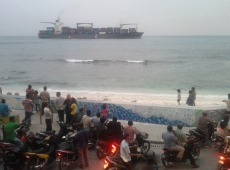
The government has issued a MVR 62.7 million (US$ 4 million) compensation claim for damages caused to the coral reef on Male’s east coast by a stranded cargo ship.

Earlier this month (January 7) a 27,000-ton vessel called ‘Auguste Schulte’ became stranded in shallow water while attempting to make a turn near the coast of the Raalhugandu area in Male’.

Tug boats, assisted by the Maldives National Defence Force, were able to refloat the 213 metre long ship after a three-hour effort, local media reported.

A subsequent investigation by the Environment Protection Agency (EPA) calculated the damage to the reef to be worth MVR 62,733,800, Chairman of the Transport Authority Abdul Rasheed Nafiz told Minivan News.

“[Auguste Schulte’s local operator] Silver Company can either pay the fine to the government so the ship can continue its voyage or pay a bank guarantee should they wish to carry out their own investigation and let the ship leave.

“From what I understand, [Silver Company] intend to carry out their own survey and through that they will try negotiate the compensation claim cost,” Nafiz added.

The Transport Authority Chairman said that the Attorney General had stated under the Environment Protection Law that the government has the right to assess the damage to reef and calculate the cost of such damage.

The Transport Authority earlier stated that the government could impose a fine of MVR 85,000 (US$ 5,508) per square metre of damage caused to the reef.

Mohammed Nabeel, Managing Director of Silver Company, told local media that the company had begun efforts to try and secure the bank guarantee that currently stood at $4 million.

“We are trying to make sure that the ship departs as soon as possible. We do believe that there must be a fine in this matter, but the government has also said that there is room for negotiation,” he was quoted as saying by Sun Online.

Nabeel added that the company was also trying to assess the damages caused by the stranded vessel, and that negotiations will be based on their findings, local media reported.

Previously, a ship operated by Delmas – the same company local media reported to have owned Auguste Schulte – became stranded in the same area for 20 days.

Nabeel told local media that the compensation claim for that previous ship was set at MVR 4.5 million (US$ 291,828), adding that the contrast between the two figures is “remarkable”.

Responding to these comments, Nafiz said that the EPA has produced a report on the latest damage and Silver Company will be able to compare the two incidents as the conclusion is based on “the same formula”.

Environment Protection Agency were not responding to calls from Minivan News at time of press.

Likes(0)Dislikes(0)

Abdulla ‘Jaa’ Javid released from custody, brother detained by police

Abdulla ‘Jaa’ Javid has been released from custody following his 45-day detention in connection with the murder of MP Dr Afrasheem Ali last year.

On the day of his release (January 17) however, Javid’s brother Shahin Mohamed was taken away by police whilst waiting with Javid’s family outside of the court.

Chairperson of Maldivian Democratic Party (MDP) ‘Reeko’ Moosa Manik – Javid’s father-in-law – told Minivan News on Thursday that the police “took away” Mohamed without any warning.

“He was waiting for his brother to come out of court and the police came along and took him away. He was waiting silently and they took him without giving a reason,” Manik claimed.

Regarding Mohamed being held by police, Maldives Police Service (MPS) Spokesperson Sub-Inspector Hassan Haneef said that police would not be releasing any information of the Afrasheem murder case due to the “sensitivity” of the investigation.

Minivan News has since learned that Mohamed was released from police custody three hours after he was taken away by police.

Local media reported that Javid was released after he was brought to court to extend his detention period following the expiry of his previous term.

Javid’s lawyer, according to Manik, said the judge stated there was “no way” Javid could be kept in custody any longer.

“If they had any evidence they would have kept him there,” Manik added.

Former Deputy Prosecutor General Hussain Shameem said that Javid’s 45-day detention was “unreasonable” given that two people had already been charged of the crime.

“As for the arrest it is a constitutional right of the accused – and detained – for his case to be processed through the criminal justice system within a ‘reasonable time’,” Shameem added.

Javid had previously attempted to file a case to High Court claiming that the extension of detention order issued against him by the Criminal Court was unlawful.

However, the High Court ruled that there was no reasonable ground to support this adding that police claimed to have a phone call recording that supported their accusations of Javid’s involvement in the murder.

In December last year the MDP accused the police of attempting to pin Afrasheem’s murder of MDP members instead of going after those guilty of the crime, a statement seen by local media has read.

The party further reportedly stated that police had detained two of its members Mariyam Naifa and Alli ‘Smith’ Hashim for an extended period of time before releasing them without any charges.

Minivan News is awaiting for additional information from Director Department of Judicial Administration Ahmed Maajid regarding the release of Javid.

‘A desperate plea to help free my husband’

In a letter obtained by Minivan News, Javid’s wife Mida Moosa pleaded for the release of her husband claiming that the family were “very confused” regarding the information they had received about his detention.

The letter claims that Javid’s arrest took place hours before parliament was scheduled to finalise a decision on whether the proposed no-confidence vote against President Mohamed Waheed Hassan Manik should be held via secret votes.

Upon Javid’s initial extension of custodial detention, the letter alleges that Javid was kept in solitary confinement and that this matter was taken to the High Court.

“At the High Court hearing on December 13, MPS stated that Javid was kept in solitary confinement most likely because of an error made by the prison he was kept in,” the letter claims.

After the first 14 days of Javid’s detention the letter notes that he was brought back to court and on December 19 he was given another 15 day extension on his detention.

According to the letter, the prosecutors had brought a request form to court by the MPS stating that Javid was being kept in prison “for his own safety and to interrogate him on some evidence they had regarding the case.”

Afrasheem’s murder

Commissioner of Police Abdulla Riyaz has claimed that the murder of MP for Ungoofaaru constituency Dr Afrasheem Ali was a well-planned murder and insisted it was politically motivated.

The Commissioner alleged that the assassins were offered MVR 4 million (US$260,000) and that 200 items were collected as forensic and digital evidence.

“Over 500 hours of CCTV footage have been analysed, more than 100 people have been interviewed and about 13,000 phone call recordings have been analysed out of which 12,000 were from one single tower,” Riyaz said.

Afrasheem was killed on October 1. His wife discovered the body lying on the staircase of their home.

Dr Afrasheem was elected to parliament in 2009 as a member of the then-opposition Dhivehi Rayithunge Party (DRP).

Following the opposition’s split, Afrasheem sided with the Progressive Party of the Maldives (PPM) of former President Maumoon Abdul Gayoom, and faded into the political background.

Widely considered an Islamic moderate, Dr Afrasheem took outspoken and controversial positions on issues such as allowing the playing of music, and praying next to the deceased.

Likes(0)Dislikes(0)

Human traffickers sabotaging border control deal: Nexbis

The Malaysian IT company at the center of legal wrangling over a deal to provide a border control system (BCS) to the Maldivian government has alleged “criminal elements” could be behind efforts to scupper the agreement.

Vice President for Nexbis Nafies Aziz told Minivan News that “intelligence” received by the company suggested groups backing the country’s lucrative human trafficking industry could be seeking to stymie the introduction of its BCS to undermine national security controls.

The comments were made following an appeal hearing held at the country’s Supreme Court on January 9 to block an unanimous vote by parliament to terminate Nexbis’ agreement with the government over allegations of “foul play”.

The country’s Anti-Corruption Commission (ACC) said that regardless of its concerns about human trafficking in the Maldives, a case regarding the Nexbis’ deal had been submitted to the Prosecutor General (PG’s) Office under the previous government.

Meanwhile, a source with knowledge of the present immigration and border control system said that should parliament’s termination decision be upheld, the Immigration Department would be returning to “a pen and paper system” for monitoring arrivals to the country.

The Maldives has come under strong criticism internationally in recent years for the prevalence of people trafficking, and the  country has appeared on the US State Department’s Tier Two Watch List for Human Trafficking for three years in a row.

In a statement to Minivan News, Nexbis Vice President Aziz said that the company was now awaiting the Supreme Court’s decision concerning its appeal hearing on January 9.

“The ACC in the previous Supreme Court hearing submitted that there was no implication on Nexbis or any corruption whatsoever in the contracting state of the Border Control System project,” he said. “The Border Control System is fully implemented and is operational in Male’ International Airport.”

Responding to allegations of wrong-doing in its signing of a border control agreement with the Maldives government, Aziz alleged that “criminal elements supporting human trafficking” had been identified through its “intelligence” as potentially funding a campaign to halt its agreement.

“Stakeholders across the political spectrum have in the recent past all highlighted the growth of human trafficking in the Maldives and pointed out to hundreds of millions of dollars of illegal gains made by the criminal elements behind the growth of human trafficking in the Maldives who stand to lose out the most from the full implementation of the Maldives Immigration Border Control System,” he claimed. “To that end, as the public can clearly see, there is an elaborate amount of money that is being spent to campaign against the Border Control System and the security it will bring to the country.”

Aziz also contended that any attempts to weaken border controls in the country would only serve detrimental to the nation due to not only an “influx of illegal immigrants to the country,” but also the nation’s international standing.

“In addition to this, the Maldives has been on the US State Department’s Tier 2 Watch List for Human Trafficking for three years running now and may possibly be re-classified this year into Tier 3, which is the worst category, if proper controls and systems are not put in place,” he said.

“The implications are far reaching and would again impact the people of Maldives as countries around the world begin imposing stringent visa requirements on Maldivians.”

Aziz said it had become “imperative” for Maldives’ national security that supposed efforts by human traffickers to sabotage its agreement did not succeed.

“The full implementation and operation of the Nexbis BCS will undoubtedly help curb issues of human trafficking, identity fraud as well as weak enforcement controls. The Border Control System encompasses a total end-to-end solution for a Build, Operate, Transfer (BOT) contract term as stipulated by the National Planning Council,” he said.

“This is a proven and internationally certified system, and shall provide the required border control capabilities including foreign worker management and mobile enforcement features, which will increase the efficiency of the current immigration processes. The biometric capabilities of the system are certified to be of the highest performance worldwide for speed and accuracy,” he said.

Immigration Controller Dr Mohamed Ali was not responding to calls at the time of press.

However, a source with knowledge of the current immigration and emigration system – who asked not to be identified – told Minivan News that border control authorities were facing “lots of problems” in performing their function. These problems were said to have arisen due to ongoing wrangling over the Nexbis deal.

While not wishing to comment on Nexbis’ allegations of possible criminal involvement in efforts to halt the project, the source claimed that a failure to implement a BCS like that being offered by the Malaysia-based firm would “strengthen the hand” of human traffickers operating in and out of the country.

The source said that the biometric systems included within Nexbis’ system were a step towards curbing a common practice of returning illegal immigrants – in some cases with criminal convictions – to the Maldives under new identities.

With the Supreme Court yet to decide on the legality of parliament’s decision to terminate the Nexbis agreement, Minivan News understands the company’s BCS is still being used at Ibrahim Nasir International Airport (INIA) to screen arrivals.

However, the source said that Nexbis technical staff who had implemented the border system had been removed from the project, meaning that any bugs or issues with the technology were unable to be resolved.

“We need the system to capture biometric details from passengers in cases where people are changing names. This would make it impossible to create false passport under separate names as people are doing right now,” the source said.

The same source also said the automated system would allow authorities to run background checks on passengers on incoming flights.

A decision to uphold parliament’s decision to cancel the Nexbis agreement – a stance the government has said it will honour – would see immigration officials having to use “a pen and paper system” for monitoring immigration, the source claimed.

ACC view

The MVR 500 million (US$39 million) BCS project moved ahead last year after a series of high-profile court battles and delays that led Nexbis to last year threaten legal action against the Maldivian government should it incur losses for the work already done on the project.

The Malaysia-based mobile security provider has come under scrutiny by political parties who claim that the project is detrimental to the state, while the Anti-Corruption Committee (ACC) has alleged corruption in the bidding process.

Despite Nexbis’ claims that “no implication” of corruption had been registered by the ACC, the corruption commission’s President Hassan Luthfee said his department would only have previously sent a case to the PG’s Office if it held concerns with the agreement.

However, Luthfee also conceded his department had been made aware of issues regarding human trafficking in and out of the country.

“We have received complaints about people smuggling to the country, but we have not been able to start an investigation as the size of such a case is beyond our capacity,” he claimed, adding that the ACC was not tasked to investigate such matters.

“This is just too big a case. [For example] there have been some claims that ships from Sri Lanka and India are travelling to the Maldives around 20 kilometres from Male’ and transferring people to fishing vessels, and from there they are distributed as laborers across the country. These are reports I have received.”

Migrant concerns

Speaking on January 13 at a ceremony to celebrate National Day, President Dr Mohamed Waheed Hassan Manik stated the Maldives was being “forced” to take measures against changes to the “national character” due to the rising number of migrant workers in the country.

The Ministry of Foreign Affairs earlier this month inaugurated an initiative targeted at raising awareness of the human trafficking issue in the Maldives.

The strategy, entitled ‘Blue Ribbon Campaign Against Human Trafficking’ is expected to include activities to try and raise awareness among students and the business community.

The Foreign Ministry announced that it had signed a memorandum of understanding (MOU) with multiple local media outlets in the country as part of the campaign’s aim to raising awareness of human trafficking and other related issues.

Meanwhile, late last year, Indian authorities told Minivan News that tightened restrictions on providing medical visas to Maldivians was a “signal” for the country’s government to address a number of concerns about the nation’s treatment of migrant workers.

Likes(0)Dislikes(0)