All-party talks fail again with “no consensus”

The political leaders emerged out of the three day All Party Talks without reaching a consensus on the six point-agenda, failing again to achieve a compromise on breaking the political deadlock following the controversial ousting of the Maldivian Democratic Party (MDP) on February 7.

Despite stalling several times due to disagreements over the subject and order of the agenda, the talks began at the Vice President’s Bandos Island Resort with expectation of reaching a consensus on the six-point agenda.

Six items on the agenda are, in order: 1) Discussion on how to solve the problem of public disturbances carried out in the country; 2) Discussion on assessing the state budget situation; 3) Discussion on identifying reforms needed for institutions and independent posts; 4) Discussion on assessing the laws to be amends and new laws to be enacted; 5) Discussion on amendments to the constitution; and 6) Discussion on determining a date for a presidential election.

However after a third day of failed talks with political representatives, Convener Ahmed Mujthaba told media that despite 15 hours of talks split into four meetings, they were only able to discuss the first item of the six-point agenda.

Although 30 points were outlined as measures to end the political disturbances, Mujthaba confirmed that the parties came to “no consensus” during the discussion.

Reportedly, amid heated arguments and intense debates between the pro government and former ruling MDP representatives, discussions ended without progressing to a cross-party agreement on any of the points. Convener Mujthaba reportedly came under verbal attacks as well.

According to newspaper Haveeru, 30 measures proposed by parties to end public disturbances included; “no attacks on public and private property, no attacks on political figures, no sexual transgressions in public parks where a party’s flag is hoisted, no keeping crows or other animals in public places, not hanging swings that block the pavements, not prevent anyone from coming ashore on any island, not holding political activities on roads and pavements, not participating in protests while intoxicated, not stymieing the work of the parliament, not using children or logos of a foreign body in a political protest, not spreading exaggerated or false reports through media outlets, not using loud speakers during peaceful and street protests, obeying court orders and not holding street rallies.”

MDP spokesperson Hamid Abdul Ghafoor  told Minivan News that the party was requested to cease practicing black magic and other malicious forms of sorcery against other parties at the talks.

“I think that some people involved are now playing a hoax. It is hard to believe that the regime is lowering itself to this level. It is both pointless and irrelevant,” he claimed. “It is notable that figures such as former President Maumoon Abdul Gayoom are very superstitious.”

At a press conference held this afternoon police displayed what they alleged to be items used for black magic by MDP protesters at the  party camp site Usfasgandu. A female activist was also arrested on suspicion of sorcery.

The President Office and pro government party representatives have not responded to calls from Minivan News at the time of press.

However, representative of the coalition Jumhooree Party and President’s Office Spokesperson Abbas Adil Riza blamed MDP for the outcome of the talks in local media.

“We proposed against stymieing of political activities and visits to the islands. But MDP was unwilling to agree. If they had done so, the outcome could have been much different,” Riza told Haveeru.

However, Riza stopped short from calling the talks a failure stating that the drafting and discussion on the 30 points itself is a “major achievement”.

Mujthaba noted that the “results are not bad considering the current political climate.”

The next round of talks will be scheduled after discussions with the parties and will continue from the first point ofnthe agenda.

Likes(0)Dislikes(0)

MDP activist arrested for sorcery; party alleges “witch hunt”

Police have allegedly arrested an opposition Maldivian Democratic Party (MDP) activist on charges of practicing black magic.

Activist Jennifer Aishath was arrested on Friday night near the ‘Aa Saharaa’ cemetery while she was attending a funeral. She was released at around 2:45am in the morning.

Police Sub-Inspector Hassan Haneef confirmed that police had followed Aishath “because she was up to something”, but did not disclose what this was.

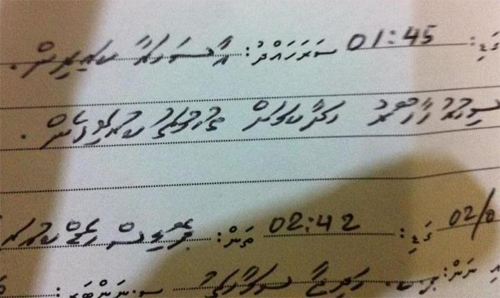
However following her release Aishath produced a police note stating that the reason for her summoning was for questioning over allegations she was using “black magic and sorcery”.

Maldivian Democratic Party (MDP) spokesperson MP Imthiyaz Fahmy has alleged the government was now using charges of black magic and sorcery as an “excuse” to go on a literal witch hunt for MDP activists.

Fahmy, who was present at the time of the Aishath’ arrest, told Minivan News that she had been followed by a police car and a police officer in plain clothes. Aishath raised concerns that a car had been following her every move to the cemetery, where she was attending a funeral.

“She said that a police car had been following her from home. I walked out of the cemetery with her and saw the car which she had mentioned, and it really was following her. The car stopped every time she stopped, it was very obvious,” Fahmy said.

After becoming concerned that Aishath was being followed, he claimed that he went towards the car and asked the driver what was going on.

“I went to the car and said that the lady has told me that she was being followed. They were silent for some time and then they questioned me, asking if I wanted to know what is going on,” Fahmy continued.

Fahmy stated that after the questioning, the driver made a call from their phone and within minutes, a police van of about 25 to 30 police officers in full gear arrived to the area and asked Aishath to get into their van.

“When the van came and the police asked her to get into the van, I intervened saying that you can’t arrest someone like that,” said Fahmy.

“I asked on what grounds was she being arrested and they said they’d tell her after they reached police headquarters.  I resisted and said that such an arrest could only be made after letting the arrestee know what the charges against her were. The arresting officers didn’t even have name tags.”

Fahmy said that a female officer came out of the van and forced Aishath into the van before taiking her away.

Fahmy alleged that the government was running out of excuses to arrest MDP members and were now resorting to charges of black magic and sorcery.

“This is definitely something that Gayoom is behind. He was the first person to say that black magic was being used to try and oust him from the presidency.  This occured during the 1998 presidential referendum by his brother in law Ilyas Ibrahim,” Fahmy claimed.

“ This is hilarious, the coup regime is becoming a laughing stock. Why are they arresting people over allegations of black magic, while the country has greater issues to address such as gang violence and drugs?  For God’s sake, people are being murdered,” said Fahmy.

President’s Office Spokesperson Abbas Adil Riza and Media Secretary Masood Imad were not responding at time of press.

The document issued to Aishath by police, describing the reasons for her summoning as alleged practice of black magic

Police raiding MDP protest camp ‘Usfasgandu’ for alleged “black magic and sorcery”

Earlier this week, police raided the opposition MDP protest camp at Usfasgandu on Tuesday morning, after obtaining a search warrant from the Criminal Court and cordoning off the area from MDP demonstrators.

One of the reasons for the search as stated on the warrant included: “suspected black magic performed in the area.”

Under evidence, the warrant alleged that people in the Usfasgandu area had on May 25 thrown a “cursed rooster” at MNDF officers.

Shortly after the raid, the Civil Court ordered to halt the raid in a temporary court injunction after the MDP challenged the legality of the operation.

However, the government appealed the Civil Court decision in the High Court. The High Court issued a temporary injunction suspending the Civil Court’s injunction.

Police issued a statement right after the High Court injunction stating that there were no more legal obstructions to raiding the camp, but said the police were “thinking on the matter”.

Black magic to be debated in all party talks

With a weekend-long set of all party talks held at Bandos Island Resort concluding today without agreement, MDP spokesperson Hamid Abdul Ghafoor said that discussions had not progressed past the first point of agenda. Among the main sticking points during the talks, Ghafoor claimed that allegations of black magic were among 30 points of contention raised by government-aligned parties.

“Right now nothing has been accepted [in term of the talk’s agreed agenda],” he said. “We are still at step one.”

Ghafoor said that the first agreed agenda item on the talks – the role of the MDP in causing “public disturbances” through protests and other actions – had been discussed, but few agreements had been reached.

The MDP claimed that it had been requested to “voluntarily stand down” from disturbing the public peace through actions like its ongoing demonstrations. Ghafoor said that a total of thirty other concerns were raised by government-aligned parties that were linked to the first of the the talk’s agenda.

Among these thirty points of concern, the MDP was requested to cease practicing black magic and other malicious forms of sorcery against other parties at the talks, according to Ghafoor.

“I think that some people involved are now playing a hoax. It is hard to believe that the regime is lowering itself to this level. It is both pointless and irrelevant,” he claimed. “It is notable that figures such as former President Maumoon Abdul Gayoom are very superstitious.”

Ghafoor said the MDP had agreed to address four out of the thirty points of concern raised relating over the issue of “public disturbances” during the talks, including concerns from some political parties about the use of the word “coup” in relation to February’s transfer of power.

He added that some parties in the talks did not appreciate the use of the word, with the MDP agreeing to refer to the issue as a ‘questionable’ transfer of power in line with issues raised by the Commonwealth Ministerial Action Group’s (CMAG) concerns.

Ghafoor claimed that MDP representatives proposed three agreements to United Nations Development Programme (UNDP) mediation expert Pierre-Yves Monette to try and move the talks forward. These agreements were that the party would accept four of the thirty points of contention raised by government-aligned parties. They also wished to see the end of the use of “abusive” language used by representatives during the talks.

Finally, Ghafoor claimed that an independent monitor had also been requested to rule on allegations raised about certain representatives during the ongoing talks.

“Right now they are alleging we are terrorists. We need an independent monitor to rule on these accusations and verify the truth of such claims,” he said.

Of the other parties represented during the talks, Progressive Party of the Maldives (PPM) Vice President Umar Naseer and MP Ilham Ahmed were not responding to calls from Minivan News at the time of press.

Ahmed Thasmeen Ali and Dr Abdulla Mausoom, the respective leader and Deputy Parliamentary Group Leader of the largest government coalition member, the Dhivehi Rayyithunge Party (DRP), were also not answering calls.

Likes(0)Dislikes(0)

Comment: HRCM “deaf and blind” to abuses of coup perpetrators

Independent institutions play a pivotal role in a democracy. Their independence from political influences is one of the key reasons such institutions remain a vital part of democracy and a functional mechanism for check and balances of a democratic system.

One such institution established by the Maldivian constitution was the Human Rights Commission of the Maldives (HRCM). An institution set up under the article 189 of the constitution to ensure that the Maldives has made the much needed necessary transition from the days of police brutality and human rights violations during the ‘Gayoom era’ to the present day, and to protect and uphold the values of human rights of all citizens.

But the tale seems to be going in the wrong way. It is going to be almost four months after the country’s first democratically elected president was ousted in what was an obvious coup d’etat. It is going to be four months from the day where a few petty politicians, with the financial backing of a few self-centered business tycoons and mendacious preachings of deceitful sheikhs, led to disillusioned patriots within the security forces make an absolute mockery of the people’s rule.

With the coup came not only a change of a regime, but a return to the nightmares of Gayoom’s 30 year long dictatorship that the Maldivians never ever wanted to see again. Nepotism has come back in full swing. Police brutality once again has become abundant. Reports of human rights violations are slowly re-surfacing.

On February 6, the night before Nasheed was forced out of office, a police platoon broke the chain of command and came storming into the Maldivian Democratic Party (MDP) ‘Haruge’ and ran riot in the premises, beating down anyone that unfortunately came into their way – a direct violation of the article 246 of the Constitution of the Maldives. The HRCM failed to come up with anything substantial.

On February 8, the day after the toppling of Nasheed’s administration, the ousted president and senior officials of his administration and several MPs, along thousands of citizens who were convinced that their vote had been ‘robbed’ by ousting their elected leader, took to the streets exercising the constitutional rights of freedom of expression and freedom assembly entitled in the articles 27 and 32.

The protesters were met with one of the most violent crackdowns in the history of the country. But the HRCM merely concluded with a condemnation statement and the publishing of a report.

But alas, they found it an utmost priority to investigate the matter of the arresting of the chief Judge of the Criminal Court, the notorious man who is the root of the problems of our crippled judiciary. Yes, I do not disagree that arresting of a Judge was indeed a controversial move, given how flawed the check and balance mechanism is in our system is.

But when one protecting a notorious Judge with a history of ‘bending justice’ for his own personal interest becomes more of a priority than to looking into the human rights violations of hundreds of ordinary people beaten down ruthlessly by the police and the military, who were supposed to serve and protect them?

On March 6, a country that boasts of working to empower and uphold the rights of women and advocate against gender disparity, suddenly forgot what they had been preaching, and found the respect and dignity of the women they advocated for blasted by saltwater cannons. A group of female protesters went to the president’s office with an innocent intention of delivering a petition to the regime leader. Despite having a female in the presidency of HRCM, what a shame it was when it barely made a move. Where were the rights of women that day?

On May 29, another wave of police brutality struck again, as the coup regime’s unprecedented sudden nightmares over a ‘cursed rooster’ lead to police sieging into the MDP protest camp at ‘Usfasgandu’ under the excuse of alleged practice of black magic and sorcery, only to find no substantial evidence that gave rise to any criminal activities going on in the camp.

Furious protesters again began protesting in front of the barricades and yet again the police barged into the crowds with batons and pepper spray, beat down protesters and even pepper sprayed a cameramen of a local TV station who had tried to film the violent arrests.

But it seemed that the officials of HRCM present during the police takeover of the camp were either not in sane mind, or blinded and deafened as the commission issued a statement applauding the actions of police for their ‘professional handling’ the situation. What a fantastic way to mock the people again as the video footages revealed the extent of barbarity of the police. When did violent brutality become professionalism?

The Human Rights Commission is bitterly failing. They are far behind in following up with the police brutality and human rights violations of the coup regime. They have become a deaf and blind toady of Gayoom, Waheed and the senior officials of the coup regime instead of being the lions of the throne. They ought to have been defending and upholding the rights and liberties of the Maldivian constitution. Indeed a disheartening story to tell.

All comment pieces are the sole view of the author and do not reflect the editorial policy of Minivan News. If you would like to write an opinion piece, please send proposals to [email protected]

Likes(0)Dislikes(0)

“Thuggery will not push us back”, Nasheed tells thousands of supporters in ruins of Usfasgandu

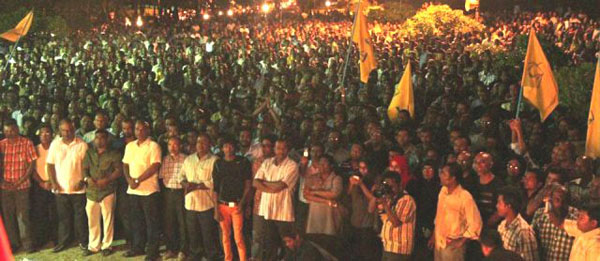
Twenty four hours after police began dismantling the Maldivian Democratic Party’s (MDP) protest area – for the second time since February 7 – the party’s supporters returned to the area to hear former President Mohamed Nasheed speak.

Nasheed arrived at Usfasgandu straight from the airport, after attending a an executive meeting of the International Democratic Union (IDU) in New Zealand. Thousands of MDP supporters gathered in the remains of the camp at around 11:30pm to hear the ousted President speak.

Nasheed told his throngs of supporters that the government was now witnessing the determination of the people to regain their constitutional freedoms.

“What we are witnessing today is that the Maldivian people are not ready to give up the freedoms gained through the hard work of a lot of people,” he said.

“Maldivian people will not let go of freedom of expression, freedom of assembly and the freedom to hold peaceful political activities,” he added.

Police Sub Inspector Hassan Haneef said that the police had vacated the area at around 2:00pm yesterday. The warrant issued by the Criminal Court at 3:00pm on Monday gave the police 48 hours to complete their search of the site.

Haneef said that there had been no reported incidents following Nasheed’s speech, although he did day that two officers patrolling the area at around 3:30pm had their walkie-talkies taken from them and smashed.

The search warrant granted to police did not grant any permission to dismantle the camp, an issue that was brought to the attention of the Civil Court by the MDP. At 10:15pm, the Civil Court ordered that the dismantling be halted until it made a decision on the issue.

A police statement acknowledged receipt of the Civil Court order but added that most of the dismantling work had been carried out. An MDP statement alleged that by this time “the out-of-control police had already finished its work, leaving only a few chairs and a flagpole.”
The MDP have alleged that the police and Maldives National Defence Force (MNDF) continued their work after the court order to cease was given.

A police statement acknowledged receipt of the Civil Court order but added that most of the dismantling work had been carried out. An MDP statement alleged that by this time “the out-of-control police had already finished its work, leaving only a few chairs and a flagpole.”

The MDP have alleged that the police and Maldives National Defence Force (MNDF) continued their work after the court order to cease was given.

Speaking atop a pile of debris left after the police and MNDF had partially excavated the site as part of their search, Nasheed told the crowd: “The reality that the police and military officers who perpetrated the coup should know is that whether you smash us or stomp on us, we will not back down.”

“Trained in thuggery, in iron armor, carrying pepper spray and batons on the streets – this will not stop our resistance. Thuggery will not push us back.”

“Maldivian people had long been voicing against the torture they suffered, that’s why the new constitution [ratified in 2008] was the people’s constitution, and the fundamental rights that the citizens of this country found in that constitution are not something they are willing to let go of,” he exorted.

Nasheed then went on to express his confidence that 2012 would see fresh presidential elections and that the Committee of National Inquiry (CNI)’s investigations would result “in the arrest of the perpetrators of the coup”.

MDP MP Mariya Didi, party Interim Chairman Moosa ‘Reeko’ Manik, and former Spokesman for Nasheed’s Presidential Commission, Abdulla Haseen, also addressed the crowd.

Nasheed arrived at Ibrahim Nasir International Airport (INIA ) at around 10:00pm, walking to the Usfasgandu area from the harbour after briefly speaking to reporters at the airport.

Haveeru reported Nasheed as telling the press that all parties present in the Wellington talks were supportive of early elections in the Maldives.

Asked about the Usfasgandu issue, Nasheed reportedly responded: “desperate times call for desperate measures.”

“Humans tend to resort to heavy handed tactics when times are desperate. It is a flaw which is quite disappointing,” he lamented.

“I hope that civilised measures would be restored where issues would be resolved by peaceful means,” he said.

Nasheed spoke to the IDU’s executive committee about the current political situation in the Maldives. He also met with the IDU member group the Asian Pacific Democratic Union (APDU).

The Commonwealth’s Special envoy to the Maldives, Sir Donald McKinnon, was also present at the IDU meeting.

During the visit, Nasheed also discussed the Maldives’ political situation with officials from New Zealand’s Ministry of Foreign Affairs.

Likes(0)Dislikes(0)

HRCM “blind and deaf” over police brutality, claims MDP

Maldivian Democratic Party (MDP) Spokesperson and MP Imthiyaz Fahmy ‘Inthi’ has condemned the Human Rights Commission of the Maldives (HRCM) for being “deaf and blind” to police brutality against MDP supporters.

Speaking to the press today at the MDP Secretariat, Inthi said that the MDP was deeply concerned that while there was a human rights commission to investigate rights violations, it had failed to notice these and instead accepted the police’s actions with their silence.

Inthi alleged that police had attacked MDP protesters as well as journalist during the recent protests over the dismantling of the Usfasgandu protest sight, and provided pictures.

He alleged that many MDP activists had been injured during police crackdowns and that some activists were beaten after being taken into police custody.

‘’They also forced the 56 arrested MDP supporters to give their urine samples to test for drugs, but they were all arrested for a political unrest on not on a drug related offence,’’ he said. Inthi himself was arrested the previous day during the crackdown.

“’I was arrested at the MDP protest campsite and the court released me, after the police told the judge that I had assaulted a female officer at the Usfasgandu,’’ he told the journalist. “Human rights organisations far away from the Maldives have expressed concern over rights violations here, but the Human Rights Commission in the Maldives has not seen or noticed anything.’’

HRCM had also failed to notice that the police had dismantled MDP protest campsite as Usgandu without a court warrant, he added.

‘’Today the police are operating as a gang, they are not police but are a group thugs,” he claimed. “The former commissioner of police has said they are now operating like a gang,’’ Inthi added.

HRCM Presdient Maryam Azra did not respond to Minivan News at time of press.

Police and army officers dismantled the MDP protest camp after the Criminal Court issued a search warrant following the police allegations of sorcery and other criminal offences being carried out at the campsite.

The Civil Court later ordered a halt to the dismantling of the camp, however police had by then destroyed most of the area.

The Civil Court order came following a case filed in court by the MDP which is still ongoing.

Likes(0)Dislikes(0)

Civil Court to order police to bring historian Shafeeg to Court

Civil Court Judge Abdullah Adheeb has said today that he would order police to summon 82 year-old historian Ahmed Shafeeg.

Shafeeg is being sued by former President Maumoon Abdul Gayyoom after Shafeeg publicly alleged that 111 custodial deaths occurred during Gayoom’s 30 year regime.

Shafeeg made the allegations in his book, “A Day in the Life of Ahmed Shafeeg”, and had failed to be present to the court due to poor health.

Judge Adheeb today said that after Shafeeg had failed to attend the hearings, the civil court staff had to ‘stick’ the summoning order at the front door of his residence. The judge added that when the summoning order was sent to Shafeeg, his son had said that he had been unable to attend to the court due to his old age and poor health.

The judge also said that he had asked Shafeeg to appoint someone to represent him at the court, but Shafeeg responded saying that he would attend to the court after he had recovered from his illness.

During today’s hearings, the judge handed over some medical documents highlighting Shafeeg’s medical conditions to Gayoom’s lawyer, Mohamed ‘Wadde’ Waheed Ibrahim.

Gayoom’s lawyer then requested the judge send the police to summon Shafeeg to court.

A similar request was made by Gayoom’s lawyer during president Nasheed’s presidency, which the judge acknowledged but today replied “We all know how things were at that time.”

Adjourning today’s hearings, Judge Adheeb stated that he would once again order police to summon Shafeeg to the court.

Earlier during President Nasheed’s presidency, he promised that the Maldives Police Service would investigate claims made by local historian Ahmed Shafeeg in his book, that 111 Maldivian citizens were held in custody and tortured by the former administration.

The claims led Gayoom to declare that he would file a court case against Shafeeg for politically-motivated slander.

The former president’s lawyer, Mohamed Waheed Ibrahim, at the time was cited in newspaper Miadhu as saying that lawsuits would be filed “against anyone who writes anything untrue and unfounded against Gayoom”, and noted that all such cases so far had been won.

During a ceremony at the Nasandhura Palace Hotel to launch Shafeeg’s book, titled “A Day in the Life of Ahmed Shafeeg”, Nasheed observed that the former President was not solely to blame for human rights violations.

“The [human rights] violations were not committed by Gayoom alone. A whole system committed them. The whole culture of the Maldives committed them,” Nasheed said at the time.

Shafeeg, now 82, was held in solitary confinement for 83 days in 1995 together with three other writers, including Hassan Ahmed Maniku, Ali Moosa Didi and Mohamed Latheef.

Shafeeg contends that 50 of his diaries containing evidence relating to the deaths of the 111 Maldivians were confiscated during a raid by 15 armed men. He was ultimately released by Gayoom with without charge, and was told by the investigating officer to write a letter of appreciation to the then-President for the pardon.

Last September, Civil Court Judge ordered that the passport of 82 year-old historian Ahmed Shafeeg be held.

The judge said the court would seize Shafeeg’s passport after Gayoom’s lawyer at the time alleged that he had information that Shafeeg was about to leave the country.

A medical certificate was produced to the court at the time by Shafeeg, which Gayoom’s lawyer said was against procedure and that Shafeeg would have to fill in a form stating that he could not appear at court due to his medical condition.

Gayoom’s lawyer told the judge that Shafeeg was intentionally dismissing the summons, “while he has been attending other functions.”

Given the current state of the Maldives judiciary, sensitivity of the issue and extreme political polarisation of the country, it is likely that any verdict with even a remote chance of being accepted by both sides would need to come from an international court. Shafeeg’s family had indicated that they are prepared for this course of action should legal proceedings falter in the Maldives.

Likes(1)Dislikes(0)

Civil Court intervenes to stop dismantling of Usfasgandu

Security forces last night began the dismantling the ousted Maldivian Democratic Party (MDP)’s camp at Usfasgandu in Male’, shortly before being ordered to halt by the Civil Court after the MDP challenged the legality of the operation.

The police search of the area, which began at around 9:00am, was performed after police obtained a search warrant from the Criminal Court on the grounds that the MDP had been using the area as a hub for criminal activity and black magic.

The warrant alleged that people in the Usfasgandu area verbally abused police officers and damaged a police vehicle on April 20, obstructed a Maldives National Defence Force (MNDF) exercise of May 9, and that, on May 25 “MDP protesters threw a cursed rooster at MNDF officers.”

The order did not, however, provide legal basis for the dismantling of the demonstration area, a point made by the MDP to the Civil Court.

“We submitted a case against the Maldives Police Service saying that they cannot ask the MDP to stop any political activities and they cannot act to evacuate the place,” said MDP lawyer Hisaan Hussain.

Deputy Mayor of Male’ City Council (MCC) Ahmed Falah said he had seen the court order and that it did not give the police scope to dismantle the area. Minivan News also saw the warrant and can confirm Falah’s assertions.

“This proves that they don’t care about what the court says. The police didn’t go to the Civil Courts because they knew they would lose,” said Falah.

Both the MCC and the Criminal Court had referred the government’s previous complaints to the Civil Court.

“The new [Civil] court order says neither the police, nor any other parties, can dismantle the area,” he continued.

Police announced on Tuesday that they would begin to dismantle the camp at 10:00pm in order to preserve public order.

Hisaan reported that, at 10:15pm, the Civil Court instructed the Attorney General (AG) to tell the government forces to halt their activities.

Hisaan said that this instruction was given in order to allow the judge time to consider the MDP’s complaint. Subsequently, the judge issued an injunction at 10:40pm, halting the polices activities until the Civil Court reacheda verdict on the case, she explained.

In a statement released late last night,  police confirmed the receipt of the Civil Court order and announced they  had ceased its activities. The statement did say that that the operation was close to being completed by the time the warrant to desist was received.

Minivan News witnessed Maldives National Defence Force (MNDF) personnel working in the area at around 11:30pm, although they seemed only to be moving benches around the site. Nothing that could be described as dismantling was witnessed at this time.

Hisaan said that although the case was submitted against the police, it stipulated that all parties cease dismantling activities in the area.

Sun Online has reported that some items were returned to the camp after the Civil Court order was received. All the seating had been removed from the raised area and the stage had been fully dismantled.

Hisaan claimed that the dismantling of the camp continued after the court had ordered it to cease “in violation of the court order”, and that police were in contempt of court. She said that the MDP intended to make the courts aware of this.

The police statement said that it would take the 48 hours granted to it by the Criminal Court in order to complete its investigations. The area remained sealed off to the public at

The original Criminal Court order was shown to MDP MP Mariya Didi before the search commenced yesterday morning.

Members of Male’ City Council (MCC) were left furious, having themselves received no court order, nor any notification of the impending search.

When approached for comment during the police’s search, MCC Mayor Ali Manik said that he was “too angry to talk”.

Hisaan said that Mariya had asked to see the court order, but that legally speaking this did not amount to the warrant being officially served to the MDP.

The Usfasgandu area was one of 32 plots of public land handed over to the MCC as part of the decentralisation act in 2010. Recent months have seen a running feud between the council and the national government, which has made repeated attempts to reclaim a number of these plots.’

The leasing of the area to the MDP for its political activities has been used by the government as justification for its attempts to reclaim the area, alleging violation of the decentralisation statutes.

After having had a request for a warrant to clear the site turned down by the Criminal Court, the Home Minister Dr Mohamed Jameel Ahmed told local media on May 27 that, in the period since the court had rejected the police’s request for a warrant on May 20, he had received several complaints regarding criminal activity in the area.

A Criminal Court order was obtained by the next afternoon – May 28 – and the search conducted early on May 29.

The details of the warrant, however, included incidents which allegedly occurred before the original request for a court order was made. Jameel told Haveeru on May 27 that no “No complaints of any criminal activities had been raised with us at the time [the police were asked to take the area – May 20].”

At a meeting of the MDP’s legal team today, the decision was made to send a letter to the police, asking them to respect the court order and to return any property removed from the site by 10:00pm tonight.

Hisaan added that the MDP, despite its requests, had still not received the items confiscated from the Rahlugandu camp on March 19.

Likes(0)Dislikes(0)

No nominee agreed for Commission of National Inquiry, clarifies Commonwealth

The Commonwealth has issued a statement clarifying that neither the government or former President Mohamed Nasheed have  yet agreed on a nominee to the Commission on National Inquiry (CNI).

The CNI was former by President Mohamed Waheed to investigate the controversial circumstances which brought him to power on February 7. Former President Nasheed resigned, allegedly under duress, after elements of the police and military joined opposition demonstrators in an assault on the main military base in Male’.

Nasheed and the Maldivian Democratic Party (MDP) – and subsequently the Commonwealth – criticised the independence of the three-member CNI, which is presently chaired by former President Maumoon Abdul Gayoom’s Defence Minister.

Pressured by the Commonwealth, the government agreed to allow a retired foreign judge and a representative for Nasheed sit on the panel, but imposed conditions on this nominee:

  1. “Be a person of integrity with high ethical, moral and professional standards with at least an undergraduate degree from a recognised university”
  2. Not have been politically active during the past two years;
  3. “Not have held a Cabinet post or served as a member of the People’s Majlis during the past two years”
  4. “Not have taken a public stand on the events of 7 February 2012.”

The government as of Monday had rejected all nominees put forward by Nasheed – who is currently attending the Executive Meeting of International Democrat Union (IDU) in New Zealand – however yesterday afternoon President’s Office spokesperson Abbas Adil Riza confirmed its acceptance of Mariyam Manaal Shihab. Local media subsequently reported that the nominee had been withdrawn.

The circumstances of Shihab’s nomination appeared further confused after Nasheed issued a press release today expressed “disappointment and concerns over leak of the nominee from him to the Commission of National Inquiry established to look into the events that led to the forceful resignation of President Nasheed on February 7 after a military and police-backed coup.”

“The understanding between the Commonwealth’s special envoy and President Nasheed was that the names proposed by him would not be revealed without discussing with him,” said MDP Spokesperson Hamid Abdul Ghafoor.

“However, the administration had publicly announced one of the nominees without consulting President Nasheed and this is unacceptable. The President has expressed disappointment and concern over the leak to the Commonwealth and we certainly hope such unprofessionalism would not continue in this process,” Ghafoor said.

The government meanwhile issued a statement condemning Ghafoor’s “misleading” statement, claiming that while “Nasheed’s latest nominee, Ms Mairyam Manal Shihab is an active member of the MDP and could have been rejected on these grounds, due to the nominee meeting all the other objective criteria, as set out by the Special Envoy of the Commonwealth, the Government accepted the nominee because they are committed to moving forward with the CNI.”

“The Government accepted Ms Manal Shihab and informed Sir Don McKinnon of this. Immediately after, Mr Nasheed withdrew Ms Manal Shihab as his nominee,” the government claimed.

“The Government is concerned by Mr Nasheed’s attempts to stall the work of the CNI by repeatedly proposing nominees who do not meet the criteria agreed between the Commonwealth and the Maldives Government. By withdrawing Ms Manal Shihab, his own nominee accepted by the Commonwealth and the Maldives Government, Mr Nasheed is showing contempt for the CNI.

“Mr Nasheed has claimed that the Government leaked Ms Manal Shihab’s name to the media – an accusation which is completely false. The Government conducts all of its communication with the Commonwealth to the highest standard, and does not release information to the media unless there is agreement with the Commonwealth to do so. As soon as the Government accepted Mr Nasheed’s nominee, they notified the Special Envoy of the Commonwealth.

“After withdrawing Ms Manal Shihab – his own nominee – Mr Nasheed has insisted that his uncle, Lieutenant Colonel Zubair Ahmed Manik should be appointed to the CNI which highlights Mr Nasheed’s disregard for the CNI. The Government urges Mr Nasheed to act immediately in accordance with the four point criteria agreed between the Commonwealth and the Government so that the CNI can continue with its important work,” it added.

The President’s Office further issued a list of all proposed candidates and their reason for rejection:

  1. Mr Mohamed Aslam (Minister of Housing and Environment in Mr Nasheed’s Cabinet at the time of the resignation);
  2. Ms Shifa Mohamed (Minister of Education in Mr Nasheed’s Cabinet at the time of the resignation and MDP activist);
  3. Mr Hassan Latheef (Minister of Human Resources, Youth and Sports in Mr Nasheed’s Cabinet at the time of the resignation and MDP activist);
  4. Hudha Ahmed (a cousin of Mr Nasheed and MDP activist)
  5. Aishath Velezinee (a State Minister in Mr Nasheed’s Government at the time of the resignation and MDP activist)
  6. Mr Bandhu Ibrahim Saleem (former Managing Director of Maldives Airport Company Limited, who is married to a close relative of Mr Nasheed),
  7. Ms Fareesha Abdulla (former Under Secretary, Legal Affairs, at the President’s Office at the time of the resignation)
  8. Ms Hisaan Hussain (former legal affairs Secretary at the President Nasheed administration and MDP activist)
  9. Ms Mariya Didi- (former MDP Chairperson, current contender for the MDP President and MDP activist)
  10. Lieutenant Colonel Zubair Ahmed Manik (uncle of Mr Nasheed and serving member of Maldives National Defense Force)

The Commonwealth Secretariat said in a statement today: “We would like to point out that the discussions between the Commonwealth Special Envoy, Hon Sir Donald McKinnon, the Government of Maldives and former President Nasheed on the appointment of a representative of Mr Nasheed to the Commission are still ongoing. No nominee has as yet been agreed upon between these parties.”

“Sir Donald is continuing his efforts to facilitate agreement between the Government and former President Nasheed on a suitable nominee,” the statement added.

Sir Donald said: “It is imperative that confidentiality is preserved while these sensitive discussions are ongoing in order to provide space for the parties to reach a desirable outcome.”

Likes(1)Dislikes(0)

Fresh protests erupt after police dismantle MDP camp at Usfasgandu

Police cracked down on a fresh wave of demonstrations that erupted in Male’ on Tuesday, after police raided the Maldivian Democratic Party (MDP)’s protest camp ‘Usfasgandu’ and later began dismantling it.

The demonstrations were sparked following a MDP National Council meeting held right next to the police barricades near the swimming tracks. The clustered meeting of 43 members of the council took the stand that “enough was enough” and that party should take  to the streets to get their constitutional rights.

Immediately, 400 protesters gathered in the area to challenge the legitimacy of police and demand the return of Usfasgandu, saying that they had not done anything violent. Minivan News observed objects thrown at police barricades, which triggered a brutal police crackdown leading to arrests and injuries.

Minivan News observed one protester sustain a head injury after he was hit in the head by a police baton, and was taken to the hospital in a pickup truck refueling at the nearby petrol shed.

Minivan News also observed a cameraman from local TV station Raajje TV being pepper-sprayed by police while he was attempting to film police arresting a protester.

The confrontations between the police and the protesters continued up until around 6:45pm whereupon the protesters made several attempts to cross the police barricades towards Usfasgandu. The frustrated protesters threw two police barricades into the swimming tracks.

At around 8:45 pm the protesters left the area and headed towards the junction of Majeedhee Magu and Chaandhanee Magu in the centre of Male’.

Protesters gathered in the intersection calling for an end to police brutality and for the resignation of President Mohamed Waheed Hassan and senior officials of the government, including Home Minister Mohamed Jameel and Defence Minister Mohamed Nazim, claiming that that the government came to power by a coup d’état. The protesters also called for early elections.

Soon after the protesters gathered, a lorry arrived with a sound system and participants began chanting over a mega phone.

The protesters said they had gathered in the area because the police had taken over their protest camp at Usfasgandu, and called on police to leave the camp.

At about 10:00pm, two vehicles containing police in riot gear arrived at the protesting area and began dispersing the crowd, which lead to heated confrontations between the police and the protesters. The police resorted to tear gas and pepper spray, and more protesters were arrested.

During the confrontations, the window of a shop in Majeedhee Magu was smashed after it was hit by an by an object thrown during the confrontations.

During the crackdown, police were seen using pepper spray on several bystanders who were standing in front of their houses on Majeedhee Magu who had not taken part in the protest.

At about 11:30pm, an injured young protester was taken into a nearby house, and then to hospital.

At the same time, some protesters again began gathering near the swimming track and the petrol sheds on Boduthakurufaanu Magu, where the protests earlier began.

Earlier at about 9:30 pm, the Civil Court issued a temporary injunction ordering the police and the military to stop dismantling the protest camp at Usfasgandu. The Criminal Court had earlier issued police only a search warrant.

The police let two protesters inside the police barricades near Usfasgandu after they produced a copy of the court order.

At about 12:10am, a group of pro-government supporters arrived and confronted the protesters, leading to heated arguments.

The protests ended at about 12:40am in the morning. Police revealed that 56 arrests had been made during the clashes, out of which two had been released at time of press. Those arrested included MDP MP and Spokesperson Imthiyaz Fahmy, the wife of former Foreign Minister Ahmed Naseem, and two MDP councilors.

Confronted on twitter about the arrest of Naseem’s wife, President Mohamed Waheed tweeted back: “I am sorry to hear about Mana. I did all I can to expedite her release.”

Speaking to Minivan News, Police Media Official Sub Inspector Hassan Haneef confirmed that a total of 56 protesters were arrested. He confirmed that out of the 56 arrestees, two had been released.

During the skirmishes, Minivan News observed a 17 year-old boy being arrested by police. Police Spokesperson Sub-Inspector Hassan Haneef said that police had no record of the arrest of a minor.

“Even though it is not on our records, there may have been an arrest made, but he was not taken into custody,” said Haneef.

Minivan News understands the boy’s name is Hamdhaan Mohamed, who is at time of press was summoned to Criminal Court for extension of his detention period.

When Minivan News asked about the pepper spraying of Raajje TV Journalist, Haneef said that police would not have done it deliberately, and the cameraman may have been the unfortunate recipient of a pepper spraying that targeted at protesters.

“The police during such a time would not be able to distinguish between innocent observers and violent protesters. So there are chances that even someone who was observing might get pepper sprayed,” he explained.

“That is why we issue a warning before we begin dismantling the crowds. No one is supposed to stay after the warning is issued,” he added.

A photo of the incident on Sun Online appeared to show the cameraman was wearing a media pass and was directly targeted with the spray. Haneef maintained that it was difficult to identify a person.

“How can we see whether he had a MDP pass or DRP pass or a DhiTV pass?” he questioned.

He maintained that he was certain that the “boys” would not do such a thing deliberately, but he said if such a thing had happened, there was a mechanism to file a complaint.

“I am not saying such a thing happened but if it did, the person can lodge a complaint with Human Rights Commission of the Maldives (HRCM), the Police Intergrity Commission or even us, we would then look into it,” he added.

Not a good sign: MDP

Speaking to Minivan News, MDP Spokesperson MP Hamid Abdul Ghafoor alleged that the police were cooperating with “thugs from the Progressive Party of the Maldives (PPM)”, accusing them of infiltrating the peaceful protests to incite violent responses from the police.

“We have experienced all this in 2005, we have dealt with this mentality before, but now a large section of the population is aware of their rights and the stage is huge,” he warned.

“Tensions are high because of frustrations around the party talks and the commission of national inquiry, and that the administration is fragmented and not in control – this could be headed to a fist fight,” he added.

Ghafoor claimed in addition that a number of people in the national council had decided that they would no longer recognise the authority of the police as they had mutinied, and that some people had walked through the barricades.

“Lots of people were very angry [over the police actions],” he remarked.

He said that the police were “not acting like police”.

“The institution has broken down so much that people are having trouble believing there are innocent police out there on the street. Police are acting with impunity and clearly breaking the law, by sealing off the Usfasgandu area,” he said.

“People are talking about standing up to police and this is not a good sign.”

A female protester told Minivan News that the actions of the police were “animalistic” and “barbarian”.

“They were like animals at that time. Brutality has gone way out of control. They would stay at a distance and then they would barge in like barbarians and take away those that even were not a part of the protests,” she said.

The protester alleged that police had pre-identified political targets and sought to arrest them in the chaos.

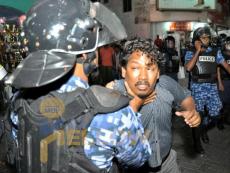
Police crackdown on demonstrators near the Usfasgandu barricades:

Likes(0)Dislikes(0)