MDP protest turns violent outside Gayoom’s residence

A protest launched by the ruling Maldivian Democratic Party (MDP) turned violent today after party activists clashed with supporters of former President Maumoon Abdul Gayoom in front of his residence Enderimaage, in the Maafanu ward of Male’.

MDP MPs and activists gathered outside the Supreme Court at 3pm this afternoon in anticipation of a verdict in a case filed by Umar Naseer – an interim council member of Gayoom’s Progressive Party of Maldives (PPM) – challenging the legitimacy of Thimarafushi MP Mohamed Musthafa’s candidacy on the grounds that he had a decreed debt.

Earlier in the day, the MDP national council conducted an emergency meeting and approved a resolution to launch a protest against the judiciary, claiming judges were unduly influenced by the former President and his half-brother MP Abdulla Yameen.

However a verdict was not delivered by the Supreme Court today, which said the hearing was called “to clarify a few points after reviewing the case.”

After Musthafa emerged from the hearing, the protesters marched towards Endherimaage, where violent clashes erupted between MDP activists and a few Gayoom supporters blocking the entrance to his residence.
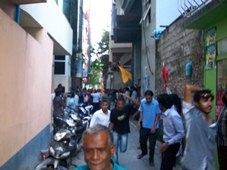
The clashes occurred after a large piece of wood allegedly thrown from Endherimaage struck a 17-year-old demonstrator or bystander, who was immediately rushed to hospital on a passing pick-up.

Minivan News journalists at the scene observed gravel, rocks, hot water and sharp metal raining down on protesters from the top floors or terrace of Endherimaage.

Several activists claimed they saw Gassan Maumoon, former President Gayoom’s son, throw stones and pour boiling hot water on the protesters.

MDP activists meanwhile threw large stones at Endhirmaage and attempted to break down the door.

Some windows of the house were smashed while a car parked outside was damaged.

The 17-year-old is currently undergoing surgery at the Intensive Care Unit (ICU) at the Indira Gandhi Memorial Hospital (IGMH). A number of MDP MPs and senior members are waiting at the hospital.

MP Ali Waheed told state broadcaster MNBC that the boy was behind MP Alhan Fahmy when the piece of wood struck him straight on the head.

MNBC One showed blood stains on the MPs’ shirt, which Ali Waheed said resulted from the injury to the boy. The state broadcaster also reported that other people at the area were hurt from falling objects.

Speaking to Minivan News outside IGMH, the brother of the injured boy said that according to doctors “his skull was damaged and parts of the skull have gone inside his brain.”

“He was hit in the right side of his head and the left side of his body is now paralysed,” the relative said.

Doctors could not predict how long the surgery would take, he added.

”The doctors said the surgery was to remove the particles from inside his brain,” he said.

Some of the MDP supporters outside the hospital claimed the boy was hit by a wooden door hurled from the terrace of Endherimaage by Gassan Maumoom.

Police spokesman Sub-Inspector Ahmed Shiyam confirmed to Minivan News that police were investigating reports that the object was thrown from the Endherimaage building.

“We are questioning the witnesses to try and determine how this happened,” Shiyam said.

“This is a very serious issue. Because of this there might be other problems and we do not want there to be political violence.”

Meanwhile in an interview with private broadcaster DhiTV this evening, Gayoom condemned the protest and claimed the violence was organised by the government.

Gayoom said he saw senior MDP members such as Male’ City Mayor ‘Maizan’ Ali Manik and Executive Services Secretary at the President’s Office Mohamed Ziyad. Minivan News also observed Ziyad and Maizan Alibe at the protest.

“They came with their activists and attacked my home,” Gayoom said. “They attacked nearby houses as well.”

As riot police were not at the scene to intercede, said Gayoom, Chief of Defence Forces Moosa Jaleel and Police Commissioner Ahmed Faseeh should “personally bear responsibility” for the damage.

Gayoom said he would inform foreign governments of today’s events.

Likes(0)Dislikes(0)

Velezinee appointed Deputy Home Minister

President Mohamed Nasheed has appointed his former member on the Judicial Services Commission (JSC), Aishath Velezinee, to the position of Deputy Home Minister.

As a member of the JSC, Velezinee was an outspoken whistle-blower who campaigned against the reappointment of sitting judges in what she contended was a violation of article 285 of the Constitution and part of a “silent coup” to seize control of the judiciary.

In early 2010, she set about publicly exposing the independent institution she claimed was operating “like a secret society” and serving as a “shield” for a judiciary that was “independent in name only”, and had tabled only several of the hundreds of complaints submitted against judges.

Using her access to court documents, Velezinee revealed that almost a quarter of the sitting judges had criminal records – ranging from theft to terrorism – and that an even greater number had not even completed grade 7 education. The only qualification of many was a ‘Diploma in Judging’ presenting to them by the former Ministry of Justice, Velezinee contested.

For the past 30 years judges effectively worked as the employees of those “hand-picked” by the former government, Velezinee explained – to the extent that failures to extend a particular ruling as required by the Ministry of Justice resulted in a black mark on the judge’s file.

“The only qualification it appears was a willingness to submit to the will of the government at the time – to follow orders,” Velezinee told Minivan News in a previous interview.

“Not everyone has the mindset to follow orders and serve in that kind of capacity. I believe it has excluded people with independent thinking, or the necessary legal knowledge – such people would take it as an insult for someone to order them how to decide a case.”

She also presented documents and recordings that implied the JSC had forged documents for a hearing over High Court appointments, accused the commission of embezzling state funds by awarding itself a ‘committee allowance’ contrary to Article 164 of the Constitution, and criticised it for abolishing its Complaints Committee in the name of “efficiency”. The previous year the JSC received 143 complaints concerning the conduct of judges, none of which were even tabled at the commission.

In January this year Velezinee was hospitalised after she was stabbed three times in the back in broad daylight on the main tourist street of Male’, “right outside the Home Minister’s door.”

Many international organisations, including Transparency International and the International Commission of Jurists (ICJ), at the time expressed “grave concern that the attack may be politically motivated.”

Velezinee told Minivan News today that her new role at the Home Ministry will see her focusing on “international affairs and projects in planning and development, and monitoring of agencies.”

“Many international conventions were signed in 2005 but were not incorporated into the domestic system,” she noted. “The Home Ministry should be a very strong Ministry, as it has a huge mandate, and should ensure it complies with the conventions the Maldives has signed.”

The remit of the Home Ministry includes police and the Department of Penitentiary and Rehabilitation Services (DPRS), as well as juvenile justice, civil society and decentralisation.

Velezinee speculated that one of the reasons she may have been offered the role was because of her focus on justice, as “the Home Ministry is very much concerned with justice and the rule of law.”

She expressed surprise and delight at the welcome she received from her team at the Ministry, observing that it was “completely unlike the experience of the JSC where I felt I was unwanted the entire time.”

Likes(0)Dislikes(0)

Maldives holds regional record as malaria-free zone

The Maldives holds South-East Asia’s record for being malaria-free. Meanwhile, the region is falling behind as one-third of affected countries show signs of eliminating the vector-borne disease over the next ten years.

Dr Robert Newman, director of the Global Malaria Program of World Health Organisation (WHO) said malaria control has improved significantly. “The world has made remarkable progress with malaria control. Better diagnostic testing and surveillance has shown that there are countries eliminating malaria in all endemic regions of the world.”

Malaria affects 40 percent of the world population. While the Maldives had a volatile track record in the 1970s, peaking at 1100 cases in 1976, virtually no cases of local origins have been reported since 1984.

Director General of Health Services Dr. Ibrahim Yasir said the only malaria cases have involved foreigners or Maldivians who have traveled to regions where the disease is endemic.

“A few times a year a foreigner might come who has been infected elsewhere, or in a recent case a Maldivian boat capsized near Africa and those on board contracted malaria and were treated here,” he said.

Yasir noted that the interiors of transport vehicles coming from malaria-infected locations are sprayed with a disinfectant to prevent accidental importing of the bug.

Certain countries that share regular traffic with the Maldives are showing worrisome resistance to malaria elimination.

According to an article published by Times of India today, Roll Back Malaria Partnership (RBM)’s latest report says that high rates in India, Indonesia and Myanmar have kept South East Asia’s malaria report rate stable while other regions see a declining report rate.

RBM’s report compares 5,200,000 probable and confirmed cases of malaria in 2000 in India against 5,000,000 in 2010. A WHO fact sheet, however, notes that 2 million fewer cases of death due to malaria were reported for the same time period.

Sri Lanka and Korea are in the pre-elimination phase.

Malaria elimination – the deliberate prevention of mosquito-borne malaria transmission resulting in zero incidence of infection in a defined geographical area – was first attempted at large scale during the Global Malaria Eradication Program from 1955 to 1972.

WHO certified 20 countries as malaria-free during this time, however in the 30 years that followed efforts to control the disease deteriorated and only four countries were certified.

During the 1970s, the Maldives successfully eliminated the malaria-carrying mosquito. It continues to combat the dengue-carrying mosquito, however, and several outbreaks have claimed 11 lives this year, making 2011 the worst year on record for dengue fatalities.

Among the factors that prevent the elimination of malaria, dengue and other viral diseases is the over-use of antibiotics. At the 64th meeting of the Regional Committee for South-East Asia in September, members suggested that overuse of antibiotics was making diseases harder to treat.

In 2010, WHO introduced a program combatting the reflexive practice of prescribing anti-malarials to any child with a fever. “Anti-malarial treatment without diagnostic confirmation means poor care for patients. It masks other deadly childhood illnesses, wastes precious medicines, hastens the inevitable emergence of drug-resistant parasites and makes it impossible to know the actual burden of malaria.”

In a previous interview with Minivan News, ADK Chief Operating Officer Ahmed Jamsheed called antibiotics “the most misused drug in the Maldives,” and warned that the trend could put Maldivians more at risk for dengue fever and chikungunya, as well as viral diseases.

Likes(0)Dislikes(0)

Styrofoam incubator “an alternative method”, says atoll hospital

Manager of Noonu Atoll hospital Mohamed Najeeb has said that carrying a baby inside a styrofoam box in certain circumstances was not a big issue, and had been used in the previous years as an alternative method to transfer babies in critical conditions when an incubator was unavailable.

Last week some doctors criticised Noonu Atoll Hospital after doctors at the hospital transferred a newborn baby in a critical medical condition to Male’ inside a styrofoam box, because the hospital did not have an incubator.

“In past years in several workshops they taught us this method and said it could be used as an alternative when an incubator was unavailable,” Najeeb said. “We know of two methods that could be used in situations like this: one is to wrap the baby with cloth while transferring him, or to carry him inside a box,’’ Najeeb told Minivan News. ‘’The towel method was not fit for the baby’s situation because the baby was having seizures.’’

He said the baby was sent to Male’ with oxygen and nurses from Noonu Atoll Hospital, and the hospital decided to use the box method to maintain the infant’s temperature because they were travelling a speedboat and the winds would be high.

He also said that when dealing with such cases the method has been proven to be suitable, adding that the baby was transferred to Male’ without his condition deteriorating.

“The latest I heard about the baby was that Indira Gandi Memorial Hospital (IGMH) had asked the baby’s parents to take him abroad for more treatment,’’ Najeeb said.

Director General of Health Services Dr Ibrahim Yasir meanwhile said the Health Ministry was investigating the case.

“The situation does not appear to be abnormal, the doctor has even advised that a styrofoam box can be a suitable substitute for an incubator,” Dr Yasir said.

“There is shortage of incubators, which is being considered in the investigation. We are trying to find out if the doctor’s recommendation can be approved.”

Likes(0)Dislikes(0)

Mother of abandoned milk can infant sentenced to one year imprisonment

The Criminal Court has sentenced the mother of a prematurely born baby found inside a milk can in ViliMale’ on May 19 to one year imprisonment.

Aminath Shaira, 30 of Manadhoo in Noonu Atoll, was charged with disobedience to an order under article 88(a) of the 1968 penal code as well as violations under the Child Protection Act.

Her accomplice in the crime, Mariyam Rizna, 18, of Guraidhoo in Kaafu Atoll, was sentenced to six months for assisting Shaira in delivering the baby. Rizna’s fingerprints were found on the Coast Milk can.

The third suspect however, Aishath Aniya, 24, of Huraa in Kaafu Atoll, was released after the court determined that there was not enough evidence to prove that she provided abortion pills to the defendant.

Police Sub-Inspector Ahmed Shiyam told Minivan News at the time that the dead child, believed by forensic examiners to have been born three months premature, was discovered in the discarded container near the powerhouse area of the residential island.

In the same month, a dead infant was been found in a plastic bag in the swimming track area of Male’. A medical examination later concluded that the baby’s had sustained cuts, bruises and other wounds.

In November 2010, another abandoned newborn was discovered alive in bushes near the Wataniya telecommunications tower in Hulhumale’.

Abortion is illegal in the Maldives except to save a mother’s life, or if a child suffers from a congenital defect such as thalassemia. Several studies on HIV in the Maldives have identified risk factors, including high levels of promiscuity and little use of contraception. Anecdotal evidence points overwhelmingly to a high rate of abortion.

In January 2010, Minivan News reported that many women unable to travel to Sri Lanka resort to illegal abortions performed by unskilled individuals in unhygienic settings.

Abortion-inducing pills and injections administered by amateur abortionists are one recourse while others turn to harmful vaginal preparations, containing chemicals such as bleach or kerosene. Although infrequent, some insert objects into their uterus or induce abdominal trauma, such is the stigma of having a child out of wedlock.

Likes(0)Dislikes(0)

CSC suspends five senior DPRS officials for disclosing information

The Civil Service Commission (CSC) has suspended five high-ranking officials of the Department of Penitentiary and Rehabilitation (DPRS), pending an investigation into alleged multiple violations of the Civil Service Act by disclosing official information at a press conference.

CSC Chair Mohamed Fahmy Hassan confirmed that the Home Ministry was informed of the decision today.

DPRS Director Saud Abdul Kareem, Deputy Director Hassan Waheed, Assistant Superintendent Mohamed Asif, Asseyri Jail Senior Prison Officer Mohamed Tholal and Maafushi Jail Senior Prison Officer Ibrahim Nashid organised a press conference in their “personal capacity” on Sunday at the Trader’s Hotel.

The senior officials reportedly defended State Minister for Home Affairs Mohamed ‘Monaza’ Naeem, who is currently in charge of the department. The DRPS officials refuted claims in a petition submitted to the Home Minister alleging misconduct and abuses of power by Naeem.

In the petition, which was not signed ostensibly over fears of job security, Naeem was accused of using state vehicles for personal use and accompanying government officials and MPs on visits to jails.

The DPRS senior staff however claimed that department employees were not involved in drafting or submitting the petition, suggesting a hidden agenda behind the petition.

Local media reported this week that a complaint had been filed at the Anti-Corruption Commission (ACC) alleging that Naeem did not sign the attendance books either during his time at North Central Province Office or currently at the DPRS.

Meanwhile at Sunday’s press conference, DPRS Director Saud also defended Naeem from serious issues flagged in a compliance audit report recently made public by the CSC. Saud argued that the problems identified in the report dated from before Naeem took over from former Director General Mohamed Rasheed.

Based on the findings of the compliance audit, Rasheed was given a three-month notice and suspended by the CSC pending an investigation.

The senior officials revealed at the press conference that complaints of corruption under Rasheed were lodged at the Human Rights Commission, CSC and ACC.

A day after the press conference, the CSC issued a press statement noting that according to article 28(b) of the Civil Service Act a civil servant could not disclose information about the office or its employees learned in his or her official capacity.

The statement noted that civil service regulations specified procedures for civil servants to file complaints of legal violations or abuse of authority at the CSC.

Moreover, clause 17(a) of the regulations “stated in clear language that employees could not attend to personal matters during official hours.”

“If an employee is dissatisfied regarding a matter in his area of work, it must be solved in the way the regulations specify,” the CSC statement reads.

In addition, clause 26(g) of the regulations states that civil servants shall not defend the interests of a political appointee.

The statement contended that the press conference, which took place during official hours, was held in violation of both the Civil Service Act and civil servant’s code of conduct as well as “principles of a democratic society”.

Likes(0)Dislikes(0)

Iran secretly executing hundreds of prisoners: Dr Ahmed Shaheed

The Iranian government has secretly executed hundreds of prisoners at the notorious Vakilabad prison in Mashhad, according to an interim report to the UN by Special Rapporteur on Iran, Dr Ahmed Shaheed.

Dr Shaheed was the former Maldivian Foreign Minister under both the current and former Presidents. As the Iranian government refused to allow him to visit the country in his capacity as UN Special Rapporteur, the report relies heavily on first-hand testimonies, “the preponderance of which presents a pattern of systemic violations of fundamental human rights.”

“The most urgent issues that have been brought to the attention of the Special Rapporteur include multifarious deficits in relation to the administration of justice, certain practices that amount to torture, cruel, or degrading treatment of detainees, the imposition of the death penalty in the absence of proper judicial safeguards, the status of women, the persecution of religious and ethnic minorities, and the erosion of civil and political rights, in particular, the harassment and intimidation of human rights defenders and civil society actors,” writes Dr Shaheed.

“Several personal interviews revealed that individuals were often held in solitary confinement for long periods during the investigative phases of their cases. All of those interviewed with regard to their detention reported the consistent use of blindfolds when being transferred from solitary confinement, as well as during their interrogations.”

Human rights defenders, civil society organisations and religious actors had been charged with offences including acting against national security, insulting the Supreme Leader and “spreading propaganda against the regime”, Dr Shaheed noted.

“The majority of reports also highlight exorbitant bail requirements, reportedly totalling between US$10,000 and US$500,000, to guarantee the appearance before the court of those arrested for activities pertaining to civil, political or human rights.”

The report goes on to detail interviews with dozens of victims of the Iranian regime, including lawyers, students, artists, journalists and environmentalists as well as political activists.

In his report, Dr Shaheed raises particular concern over the use of the death penalty in cases where due process was denied to the accused, especially within the prison system.

“Secret group executions inside prisons, which reportedly occur in alarmingly high numbers, are often carried out without the knowledge and presence of families and lawyers,” Dr Shaheed notes.

“Capital punishment was also applied to cases regarding Mohareb or ‘enmity against God’, rape, murder, immoral acts or acts against chastity and kidnapping,” he added.

The report concludes with an appeal to the Iranian government to allow Dr Shaheed to visit the country so as to “develop dialogue with the authorities and either substantiate or lay
to rest allegations of human rights violations committed within its sovereign territory.”

In July, Iran’s secretary general of the country’s ‘High Council for Human Rights dismissed “the western-engineered appointment” of Dr Shaheed as Special Rapporteur as ”an illegal measure,” according to the Tehran Times.

“Iran has no problem with the individual who has been appointed as the special rapporteur, but the appointment of a rapporteur on the human rights situation in Iran is unacceptable and Iran will not accept the decision,” Mohammad Javad Larijani was quoted as saying.

Dr Shaheed is to present his findings to the UN General Assembly on October 19.

Read Minivan News’ Q&A with Dr Shaheed following his appointment as Special Rapporteur

Likes(0)Dislikes(0)

Compliance audit report flags corruption at DPRS

The Civil Service Commission (CSC) has flagged corrupt practices and a poor working environment in the compliance audit report of the Department of Penitentiary and Rehabilitation Services (DPRS) released last week.

The report was compiled between December 22, 2010 and January 10 this year to ascertain the level of compliance with civil service laws and regulations as well as the code of conduct. The DPRS report is the second compliance audit report to be made public following the Islamic Ministry’s report.

The report identified 46 problems in 16 areas that needed to be reformed, including alleged abuse of lower-ranked employees by senior officials, use of office vessels for personal use and salaries paid out to staff on holiday.

“We note that the department’s vehicles and sea vessels are used for personal purposes,” it reads. “The speedboat used at Maafushi jail sometimes comes to Male’, is not sent back for a whole day and is used to carry employees’ goods.”

Some employees meanwhile complained of sexual abuse, the report noted, “however nothing of the sort can be seen from the records. And we note that a mechanism to record such matters has not been established.”

Due to a lack of coordination between the human resources section and the budget section, the report found that salary payments were made to dismissed staff, employees on no-pay leave and employees with poor attendance.

The CSC noted that additional amounts paid out with the salary were deducted without “revealing details of the accounts and making the required amendments to the documents.”

“As a result, it is not possible to determine for what reason the amounts were deducted,” it states.

The report found that on occasion employees were not paid for overtime hours while senior employees filled out a slip to show that they arrived at the office on time after coming late.

Moreover, some employees at Maafushi jail were paid risk allowance after they were transferred to the main office at Male’. Conversely, employees transferred to the jail were not paid a risk allowance.

Employees also took longer than the one-hour lunch break during working hours and “going out to tea during official hours was common.” Some employees were paid salaries during official leave in violation of civil service regulations, it added.

The department “did not make adequate use” of over Rf400,000 allocated in the budget for training purposes.

“We note that employees are discriminated against in taking disciplinary measures,” the report observed, noting that records were not properly maintained.

The report also found that “a safe environment for staff has not been established at the Male’ jail.”

“The ladder that leads to the staff office is also used by inmates,” it noted.

DPRS staff and their responsibilities did not fit the administrative structure approved by the commission, it continued, and staff at Maafushi jail were also taking care of “administrative tasks, HR tasks, maintaining security at the jail, maintaining the jail office and cafeteria, carrying food, providing health treatment and performing as Imams at the staff mosque.”

Likes(0)Dislikes(0)

VVIP airport lounge opens after four month project period

“Tourism begins here. The resort begins here.”

Plaza Premium Lounge Executive Director Linda Song described the newly-opened Koimala Executive Lounge at Ibrahim Nasir International Airport (INIA) as “everyone’s apartment” during today’s inaugural event, which included a ribbon-cutting ceremony, speeches and a reception.

The lounge, which includes three sitting rooms, two verandas, a kitchen and a presidential sitting room, is part of GMR Infrastructure Ltd.’s project to expand and upgrade INIA by June 2014. GMR shares the venture with Malaysian Airports Holdings Berhad in a 77 to 33 percent relationship.

The Presidential Lounge offers privacy to government officials.

During a tour of the facility, Mrs Song commented on the facility of working with GMR. “I think its international experience has shaped GMR as a very flexible, open-minded company,” she said.

Tourism Minister Dr Mariyam Zulfa made a similar observation during the opening ceremony, reinforcing her praise of GMR from the earlier opening of INIA’s Plaza Premium Lounge.

“GMR is a company that listens to the stakeholders in the tourism industry, and that pleases the government to no end. I’m always delighted to come to the airport with stakeholders from the industry to open the dialogue for tourism,” she said.

Noting that Plaza Premium was invited to undertake the project only four months ago and with the caveat that the area is due for demolition in two years’ time, Zulfa said the lounge was an impressive and valuable accomplishment.

“Everything to do with the socioeconomic development of the Maldives should center arround tourism,” she said. “Because tourism, of course, is our number one industry, and everything we do should center around making the product even more perfect than it is today.”

The common area features television, wi-fi, and a variety of seating areas.

For a reservation of US$150, VVIP lounge guests are relieved of their luggage at a private security screening while their flights are monitored and their schedules arranged by the lounge concierge. Meanwhile, guests can enjoy an open kitchen and cafe, wi-fi, plasma screen televisions, and spacious seating arrangements.

Plaza Premium Lounge Management Ltd currently services 17 international airports and 60 locations with infrastructural development. The Hong Kong-based company is the world’s first ‘pay-in’ lounge.

Several people noted that the lounge’s opening was well-timed with the SAARC summit, which will bring heads of state from across the region to the Maldives.

Plaza Premium Founder and Chief Executive Officer, Song Hoi See said he did not agree with the project’s constraints but appreciated the challenge.

“Airports and tourism don’t always work together. But the Maldives is a special place, and the airport is the first and last place to impress the tourists,” he said, adding that he anticipated the new airport’s design.

Mrs Song attributed the success to Plaza Premium’s high level of preparation to overcome constraints of the Maldives’ industry. “We are well planned, and we shipped most interior design materials here pre-made. There aren’t many resources here for interior design development, so it would have been difficult otherwise.”

Designer Kinney Chan said the project was enjoyable in spite of the short notice. “It’s great to do something for comfort here, to blend with the resort feel, without getting too heavy.”

GMR CEO Andrew Harrison noted that the design had improved a formerly low-ceiling, dark room by bringing in natural light and creating “a home feel, supported by the excellent service that staff provides.”

“It’s a beautiful country full of beautiful people, and now we’ve delivered a beautiful lounge to match that,” Harrison concluded.

Likes(0)Dislikes(0)