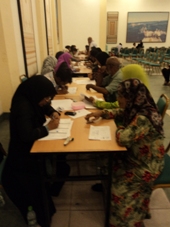
The Progressive Party of Maldives (PPM) has submitted 3600 forms to the Elections Commission, 600 more more than the amount required to register a political party.
Media Coordinator of PPM and MP Ahmed Nihan said there were many more party registration forms filled which had not been submitted today, so as to hasten the registration procedure.
“If too many registration forms are submitted at once it will take a long time for the Elections Commission to approve all the forms. We just want to hasten the registration procedure and finish it soon so we can get on with our next steps,’’ Nihan said.
Nihan claimed that “many Maldivian Democratic Party (MDP) members” and members from other parties have signed up for former President Maumoon Abdul Gayoom’s new party, PPM.
‘’The additional 600 forms were because sometimes due to information errors or other errors forms get rejected, so as a backup to replace any form that might get rejected,’’ Nihan said adding that he believes that “all forms are genuine”.
Nihan said today at the Elections Commission building none of the commission members showed up to meet the senior PPM figures, and said he regretted the incident.
‘’When some particular persons go to register a political party, the commission members take them to the hall and serves food and juice with a warm welcome. It is very unfair,’’ He said. ‘’It is we who appointed them for the commission and today the commission members were like a selfish soothsayer who pops his head out from the window when a normal person goes to see him.’’
He said that several parliamentarians and other senior figures in the PPM went today to the parliament to submit the relevant forms. Currently there were 14 MPs in the party and “very soon” the number would reach 20 or 21, he added.
President of the Elections Commisison Fuad Thaufeeq today told Minivan News that it was true that no commission member met with the PPM delegation.
‘’The commission has always treated all political parties equally and has applied the same procedure on all the parties, we always meet with senior officials of parties when the first 50 forms are submitted to the commission, and we met with senior officials from the PPM when they submitted the first 50 forms,’’ Fuad said.
Fuad explained that the forms will always be received by the staffs at the reception.
‘’The next time commission members meet with senior officials will be the day when the registration process is concluded and the 3000 forms are approved,’’ he said. ‘’That is the procedure we apply for all the political parties.’’
He said that the commission was free from influence and pressure and could not be pressured or influenced.
Sri Lankan police are investigating a large-scale money laundering case based in Colombo, that reportedly extends to the Maldives.
Local police representatives say no significant case has been filed with Maldivian authorities so far.
According to local media, money was being transferred from the Maldives to various illegal money transfer agents in neighboring Sri Lanka. The money is suspected to be used for such criminal activities as purchasing and distributing narcotics and other contraband.
Last week, Rs. 81.76 million (Rf11.4 million) was seized at Sri Lanka Customs, the largest amount of foreign currency to be detected at Bandaranaike International Airport (BIA). Haveeru reports that dollars from Australia, Canada and the US, as well as sterling pounds, Kuwaiti dinars, UAE Dirhams, Saudi Riyals, Swiss Francs and Euros were included in the stash.
Local police reported no case being lodged regarding the money laundering circuit in Colombo, and cautioned that the information that was given to local media regarding the transport of finances from the Maldives might not be reliable.
Officials did say that money laundering has been a problem in the Maldives. Police Sub-Inspector Ahmed Shiyam said that “the issue of money laundering in the Maldives is growing, and credit cards are being abused more.”
An official from the Fraud and Financial Branch said there have been suspicions of money laundering, but charges can not be pressed for that alone. “Individuals have been charged for drug possession, which might be related to money laundering, but we are currently unable to prosecute someone for money laundering alone. We plan to work on that in the future,” he said.
International Monetary Fund (IMF) reports state that money laundering became a bigger concern internationally post-9/11, when it became heavily linked to terrorism. Although many countries have since adopted IMF anti-money laundering (AML) policies, few have developed legislation to enforce these guidelines.
The latest IMF review of Sri Lanka, dated 2008, indicated that AML standards were adopted by signature but that legislation was not in place. A 2011 review of the IMF program found that international organizations were cooperative, but did not indicate that individual governments and banks had adopted AML procedures.
Sri Lankan police have conducted raids on unauthorized money transfer agencies in the past few weeks, reports Haveeru. Earlier this month the Colombo Fraud Bureau, an arm of the Sri Lankan police force, arrested several suspects and seized approximately Rs. 9 million (Rf1.25 million) in foreign currency, Haveeru reports. Four key Maldivian narcotics peddlers who were busted by Maldivian authorities in June for their involvement in the smuggling of narcotics via Colombo to Male since 2005 had allegedly used a prominent money transfer agency in Colombo, reports Haveeru.
Opposition Dhivehi Rayyithunge Party (DRP) leader and MP for Kendhoo constituency Ahmed Thasmeen Ali has sent a letter to Foreign Minister Ahmed Naseem, urging him to support UN recognition of Palestine as a state at the UN.
Thasmeen asked the Minister to fully participate in all the discussions held at the UN concerning the issue, and to vote in favor of Palestine in all votes regarding the issue.
Ending the letter, Thasmeen urged Minister Naseem to seek the support of friendly countries, saying it was “what the citizens of the Maldives would want to see.”
Meanwhile, the Foreign Ministry has stated that the Maldives strongly supports UN recognition of Palestinian statehood, with Naseem advocating the position before the UN Human Rights Council following the announcement by Palestinian Authority President Mahmoud Abbas that he will apply to the UN Security Council for full UN membership.
“Let us be clear, the Palestinian people have, like everyone else, the right to self determination – the right to a state of their own. They have waited long enough for that most basic of rights. When the Palestinians present their case to the UN, the Maldives will stand shoulder-to-shoulder with them, and we call on all others to do likewise,’’ Naseem told the UN Human Rights Council.
Naseem has said the Maldives does not believe that UN recognition of Palestinian statehood will would narrow the chances of a negotiated peace.
‘’We believe that rather it will help those chances by creating a situation in which two state partners can negotiate as equals,” Naseem said. “We hope the US will maintain its historical support for the right of all peoples to self-determination and we believe that the recognition of Palestinian statehood will help secure a negotiated peace in the future.”
President of the Elections Commission (EC) Fuad Thaufeeq has said that the commission does not believe that the Kaashidhoo seat in parliament is vacant following the Criminal Court’s sentencing of Kaashidhoo MP Ismail Abdul Hameed for corruption, as it had been notified by Hameed that he would appeal the decision at the High Court and would wait until the judicial procedure was concluded.
‘’The Commission does not believe that the Kaashidhoo constituency seat in parliament is vacant because MP Ismail Abdul Hameed has sent a letter to the parliament saying that he will appeal at the High Court,’’ Fuad told Minivan News. ‘’He requested the commission delay the by-elections until the judicial procedure was over.’’
On August 29, the Criminal Court sentenced Independent MP Ismail Abdul Hameed to one year and six months banishment after he was found guilty of corruption.
The Prosecutor General pressed corruption charges against Hameed alleging that he had abused his authority as the former Director of Waste Management at the Male’ municipality to financially benefit a Singaporean company named Island Logistics in a deal to purchase a barge.
Under article 73(c)(3) of the constitution, MPs found guilty of a criminal offence “and sentenced to a term of more than twelve months” are to be stripped of their seat.
Meanwhile, the Elections Commission has asked the Parliament to inform the commission if any seat of the parliament was vacant, as the commission required confirmation from parliament before holding a by-election.
In a statement the commission said that it had asked the parliament to send a stamped official document mentioning why the seat became vacant, and if it was due to a court verdict, to submit the court verdict as well.
Fuad told Minivan News that the statement was not issued following the verdict against MP Ismail, but was rather a general statement to inform society that there was “no official way we can confirm that a seat is vacant unless the concerned institution informs the commission.”
‘’It was not in connection to the court ruling on MP Ismail Abdul Hameed, it was a general statement,” he said. “We have also informed island councils and atoll councils to tell us if any seat in the council becomes vacant.’’
“Surprisingly more people than expected” have signed up to the former President’s Progressive Party of the Maldives (PPM), the party’s spokesperson and MP Ahmed Nihan told Minivan News today, adding that the required number of 3000 had been reached.
The PPM has been conducted a recruitment drive to obtain the 3000 signatures needed to officially form the party before the Elections Commission. Signatories are legally required to withdraw their membership from other political parties, such as the Dhivehi Rayithunge Party (DRP), for the new membership to be valid.
“Currently we are doing the work of arranging the forms in order, re-checking the filled forms to see whether all the forms are filled correctly and entering the data and filing the forms in our office,’’ Nihan said. ‘’It will not take long before we submit the forms to the Elections Commission (EC), but because the commission will dismiss any form filled incorrectly or forms with missing information, we are just double checking and preparing them for submission.”
Nihan said the party expected to submit the forms tomorrow or Tuesday.
“On the 8th of this month the commission authorised us to commence work to find the 3000 signatures, and the next day was supposed to be the day we officially began recruitment,” he explained, “but then the Hiriya incident occurred and we took four days to mourn and postponed all the work.’’
Nihan said the number of people signing up for the PPM was so many “because there are figures in the party who have gained the confidence of citizens.”
“We have former President Maumoon Abdul Gayoom and other senior figures of the former government who have served the nation for 30 years, and they have brought much development to the country and there are many people who love them,” he said, adding that all such people were joining PPM.
Nihan said that PPM’s policy was to allow youth to progress, and to “always give high priority to the voice of the citizens.”
“In this battle we will bring forward the citizens and all we will give opportunities for the young persons in our party to progress,’’ he said. ‘’We are knocking on the doors of people who think it is time to bring a change in their lives.’’
When former President Gayoom announced that he was about to register a new party in the name of Progressive Party of the Maldives, Press Secretary for the President Mohamed Zuhair said that he would doubted whether Gayoom’s party would attracted enough people form a Friday prayer group – minimum of 40.
Seven MPs in the main opposition Dhivehi Rayyithunge Party (DRP) resigned to form the new party after claiming disillusionment with the party’s leadership.
A group of concerned citizens protesting a controversial Rf20,000-a-month (US$1,290) committee allowance, approved by MPs for themselves in December 2010, have filed a case at Civil Court seeking a court order to stop the Finance Ministry from releasing the funds to parliament.
Speaking to press outside the court building, lawyer Mohamed Shafaz explained that the grounds for the claim were constitutional provisions on non-discrimination (article 17) and equal protection and benefit of the law (article 20).
“For example, the reduced amount from civil servant’s salaries was in the 2010 budget [to be paid back] and in the 2011 budget as well if you look at it properly,” he said, arguing that Finance Ministry could not release funds for MPs’ committee allowance, which was approved in December 2010, without paying back civil servants.
“The money is coming from the same place,” Shafaz continued. “If something the civil servants have not received is going to be given to others, which was approved much later, the chance of civil servants receiving the reduced amount will be very slim.”
A court order was sought to halt the release of the funds until a court of law delivers a ruling on the issue, Shafaz said.
Shafaz also referred to article 43 of the constitution, which states that “Everyone has the right to administrative action that is lawful, procedurally fair, and expeditious.”
Austerity or bust
In October 2009 – almost a year into the new administration – unpopular pay cuts of up to 15 percent for civil servants were enforced as part of austerity measures to alleviate the country’s ballooning budget deficit – among the highest in the world at 26 percent of GDP in 2009 (the International Monetary Fund had refused financing to Sri Lanka because the country’s fiscal deficit reached 10.5 percent).
However the austerity measures were met with a severe political backlash. In December 2009, the opposition-controlled parliament added Rf800 million (US$62 million) to the 2010 state budget, including the restoration of civil servant salaries to previous levels and subsidies for sectors ranging from fishing and agriculture to private media.
“One of the primary drivers of the large fiscal deficit has been government spending on public wages, which has more than doubled between 2007 and 2009, and is now one of the highest in the world relative to the size of the economy,” Rodrigo Cubero, IMF mission chief for the Maldives, said in January 2010.
“Measures that would substantially raise the budget deficit, such as a reversal of previously announced wage adjustments, would also put the [IMF-backed structural adjustment] programme off track, jeopardising prospects for multilateral and bilateral international financing,” Cubero warned at the time.
After weeks of legal wrangling over restoring civil servants salaries, the Ministry of Finance accused the Civil Service Commission (CSC) of hiding “a political agenda”, and in February 2010 filed a case with the police asking them to investigate it on suspicion of trying to topple the government “and plunge the Maldives into chaos.”
In April 2010, the Civil Court ruled that Finance Ministry did not have the legal authority to overrule the CSC. Although the government contested the ruling and refused to restore salaries to previous levels, the High Court upheld the lower court ruling in May this year.
Consequently in November 2010, the IMF delayed its third disbursement under the US$92.5 million programme, citing “fiscal slippages” caused by insufficient progress towards reducing the wage bill and passing tax legislation.
In March this year, Cubero told Minivan News that the IMF saw “bringing the fiscal deficit down as the key macroeconomic priority for the Maldives.”
“A large fiscal deficit pushes up interest rates, thereby undermining private investment and growth, and also drives up imports, putting pressure on the exchange rate and inflation, all of which hurts the Maldivian people, particularly the poor,” he said.
“With the government borrowing at the rate it has [to plug the deficit], it reduces the amount of credit available to the private sector, and that constrains the ability of the private sector to provide jobs and employment,” Cubero explained. “That then constrains economic growth. Furthermore, by spending more than it earns, the government is putting pressure on imports and the exchange rate.”
An internal report by the World Bank obtained by Minivan News observed that the Maldives was “facing the most challenging macroeconomic situation of any democratic transitions that has occurred since 1956.”
Civic action
Volunteers for the civic campaign meanwhile distributed information leaflets at bus stops in Male’ yesterday.
“Two of our group went on the bus and talked to passengers,” said Badr Naseer, a senior activist in the effort. “Ninety-nine percent of people support [the cause].”
Badr said he had personally filed a complaint at the Anti-Corruption Commission (ACC) requesting an inquiry into claims by some MPs that they functioned as “welfare officers” for their constituents.
Earlier this month, Transparency Maldives (TM) condemned remarks by MPs justifying the inflated allowance, noting that “such actions fall under article 3 of of the anti-corruption law and article 13 of the Anti-Corruption Commission Act regarding bribery.”
Badr revealed that the group had met MP Ibrahim Mohamed Solih, parliamentary group leader of the ruling Maldivian Democratic Party (MDP) and MP Ahmed Thasmeen Ali, leader of the opposition Dhivehi Rayyithunge Party (DRP) as part of diplomatic efforts alongside the street activism.
He added that the citizens group also hoped to meet former President Maumoon Abdul Gayoom – who is in the process of forming a new party with a number of MPs previously in the DRP – to discuss the committee allowance issue.
The awareness raising campaign is set to continue from 4:30pm to 6:00pm today at bus stops and ferry terminals in Male’.
The incipient Progressive Party of Maldives (PPM) began a recruitment drive at Dharubaaruge convention centre this morning to collect 3,000 signatures needed to officially register the party.
The Elections Commission (EC) approved the request to form the party last week after verifying an initial 50 application forms and authorised the fledgling party to begin recruiting members.
Briefing press at the convention centre today, Dunya Maumoon, eldest child of party figurehead and former President Maumoon Abdul Gayoom, said that the party’s target for the first day of official recruitment was to sign up 3,000 members by 12:00am.
“The registration will go ahead until 12 tonight. Everyone is invited to come and sign for the party,” she said. “Our hope is that the party will become a good and strong party.”
MP Ahmed Mahlouf – one of seven MPs who quit the main opposition Dhivehi Rayyithunge Party (DRP) to form the Progressive Party after months of factional strife – said that the registration process was delayed due to the tragic drowning incident of four school children and the principal of Hiriya School on Friday.
“In the days that followed, the government did not provide us any building or facility,” he claimed. “We were able to get [Dharubaaruge] after a lot of work. And we have this place only for the day.”
The registration forms will be submitted to the EC at the beginning of next week, he said, adding that his “personal target” was to sign up 40,000 members to the party.
The MP for Galolhu South claimed that senior members of the ruling Maldivian Democratic Party (MDP) had joined the party.
The recruitment drive is going ahead at present only in Male’, Vili-Male’ and Hulhumale’, Mahlouf said.
Dunya added that the party would establish a mechanism to collect registration forms from the atolls in the coming days.
The DRP has meanwhile informed the party’s former ‘Zaeem’ or ‘Honorary Leader’ Gayoom that his name has been omitted from the registry upon request. Gayoom announced last week that he had left the party he had formed in July, 2005.
Corruption allegations
Reports meanwhile surfaced in local media today that allegations of corruption had been lodged at the Anti-Corruption Commission (ACC) against MPs Mahlouf, Ahmed Ilham and Ahmed Nihan Hussein Manik.
Haveeru reported that Mahlouf was accused of owning the “Jeans Shop” in Male’, issuing cheques to take large sums from politicians, and falsifying his annual financial statement.
Ilham was meanwhile accused of involvement in illegal businesses in Sri Lanka owned by MP Abdulla Yameen, who has announced his intention to contest in the party’s presidential primary.
Nihan was accused of purchasing a Demio brand car and 8181 vanity plate or domain.
Mahlouf and Ilham however dismissed the allegations as completely unfounded and an effort to bring the MPs to disrepute and undermine the PPM’s recruitment drive.
The three MPs played a prominent part in the breakaway Z-faction in its struggle against the DRP leadership.
“I want to say that I will definitely try to get some money from the person who is trying to defame me,” said Mahlouf. “If I was greedy for money, I would be at MDP now. I have said in the media before that we have been repeatedly offered large sums to join the MDP.”
The allegations were “a joke”, said Mahlouf, as accusing Nihan of owning a car and Ilham of traveling to Sri Lanka did not amount to corruption.
Mahlouf claimed that according to information he received the complaint was filed at the ACC by former DRP MPs Ali Waheed, Alhan Fahmy and Abdulla Abdul Raheem. All three had defected to the ruling party.
“We’re talking about people who have been sold,” he said. “In addition, there is a hand of [DRP Leader Ahmed] Thasmeen [Ali] in this.”
The “Jeans Shop” was a family business owned jointly by his mother, father and two siblings, Mahlouf said, and that “it is not owned by me.”
Ilham meanwhile said that his family lived in Sri Lanka and he visited regularly for holidays and medical treatment.
“I don’t do business and have never done any business in the past,” he said, claiming that the person who filed the case at the ACC had apologised to him and admitted to “doing it for money.”
Former President of the Adhaalath Party Sheikh Hussain Rasheed Ahmed has strongly criticised the new leadership of “acting dictatorially” and issuing press releases without consulting either the heads of party organs or Islamic Minister Dr Abdul Majeed Abdul Bari.
In a statement published on his official website this week, Sheikh Rasheed wrote that “the biggest change” he brought to the Islamic Ministry’s functions after being appointed State Minister in December was to “change the dictatorial policy of the ministry’s former senior officials” to ensure that important decisions were not made without “direct instruction from the minister.”
“The rule of granting permission to make sermons based on a person’s face was abolished. Work being done that conflicted with government regulations and policy in a way that could facilitate corruption was reformed and brought into line,” he said.
Sheikh Rasheed, a founding member of Adhaalath, condemned a press statement issued by the party on September 5 regarding the controversy surrounding Qunooth (an invocation recited during prayers) and reciting Bismillah out loud as “very irresponsible.”
The press statement argued that the invocation was not compulsory except during periods of adversity.
Rasheed claimed that a letter sent to the Addu City Council regarding Qunooth was based on Dr Bari’s advice: “Therefore I can’t believe that Dr Majeed would talk to Adhaalath members differently about the issue of saying Bismillah [out loud] during prayers,” he said.
“Adhaalath Party’s Scholars Council Chair [Dr Bari] told me that he had informed [the party] not to issue the press release like that,” he continued. “And the deputy chair apparently knows nothing about the press release. The party’s charter states that when dealing with religious issues, a statement could only be issued after a meeting of the religious scholars council and with the consensus of its members.”
Rasheed went on to say that there were “know-it-all scholars” and a culture of attacking anyone who opposes their statements or ideology, adding that the scholars in question believe the country’s policy should be based on their thinking.
Statements made on foreign policy by some Adhaalath senior members reminded Sheikh Rasheed of “thoughts that come and goes quickly to a person suffering from a mental illness.”
“Anyone who disagrees with their religious opinion turns into a criminal [in their minds],” he wrote, referring to the Adhaalath’s public antagonism to NGOs Jamiyyathul Salaf and Islamic Foundation of the Maldives (IFM).
Sheikh Rasheed called on officials in senior leadership positions to adhere to the party’s charter or governing rules.
He also urged Dr Bari to be consistent in statements made in his capacity as Islamic Minister and chair of the religious scholars council.
Rasheed said he was moved to publicly criticise the new leadership because of the extent to which “the dictatorial [tendency] of some Adhaalath party members” has grown.
Islamic Minister Dr Bari told Minivan News he did not wish to comment on the matter.
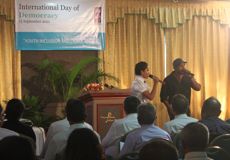
The UNDP International Day of Democracy was celebrated today under the theme “Youth Inclusion and Democracy” at the Nasandhura Palace Hotel. Representatives from the government, UNDP, and the Human Rights Commission spoke on democratic progress in the Maldives.
Youth in civil society were widely recognised as a key factor for democratic growth in the Maldives.
UN Advisor on Social Cohesion and Governance, Ferdinand von Habsburg-Lothringen, delivered the opening speech.
“Civil society in the Maldives is impressive. It is an important avenue for young people to engage with their community and to hold leaders accountable,” he said.
Habsburg-Lothringen noted that “democracy is still a new concept in the Maldives, and will take many years to mature,” and encouraged the Maldivian government to enact “crucial” laws, such as the penal code.
Gender equality remains one of the biggest issues in the Maldives, said Habsburg-Lothringen. He noted that only 5 of the 77 MPs are female.
“Gender equality is an area in which the Maldives is lagging behind most countries in achieving the Millennium Development Goals (MDGs),” he said. “Democracy is dependent on not just 50 percent of the people. With only half of the eligible work force participating, growth will not flourish in the Maldives.”
Home Minister Hassan Afeef called this year’s theme “relevant to the country – a majority of our population are young people.”
The ceremony featured a presentation of the report, “Comprehensive Study on Maldivian Civil Society” by FJS Consulting.
Managing Director Fareeha Shareef summarised the report’s findings on CSOs in the Maldives. Among the issues addressed was the disorganised categorisation of CSOs.
“The government is trying to provide aid but the structure of how to do it is not specified,” said Shareef. “Some sports clubs and organisations didn’t even engage in sports activities,” she said.
Shareef also commented on the CSO sector’s unique work force. According to the report, only 0.7 percent of employees are paid, and the average employee is age 25 with an education ranging between grades 6 and 10. There are 1100 CSOs registered in the Maldives.
Funding is also a struggle. The report found that donors were the least common source of funding, and many CSOs organise events to generate income. One example was a CSO that went fishing to generate program funding. The report notes that these events only cover about 30 percent of the total program cost.
The report recognises that the Maldives has the resources to support a strong civil society, but recommends bringing in older employees to provide guidance. “Imagine the potential of the sector if the resources were channeled in an effective manner,” said Shareef.
Chief Guest speaker Mariyam Azra Ahmed, Chair of the Human Rights Commission, said “a vibrant civil sector and independent media, among others” were essential for growth. She also advised a stronger dialogue between citizens and the government. “Lifestyles incorporating compromise, cooperation, and consensus building should be a consistent, recurring feature in a democratic society,” she said.
The event included a performance by musician Yes-e and singer Grey, for whom the performance was her debut. “I was a bit nervous, and the audience wasn’t very lively, but it was a good event,” she said.
Following a tea break, a vigorous student debate was widely attended by members of civil society, UNDP, and the government. Gesticulating throughout the debate, the students of Aminiya and Dharumavatha schools demonstrated passion and ambition for democracy in the Maldives.
 (0)Dislikes
 (0)
(0)