Dissenting Supreme Court justices challenge court’s jurisdiction to hear annulment case, evidence

The three dissenting justices in the Supreme Court’s verdict to annul the vote have challenged the apex court’s constitutional jurisdiction over the case, and the credibility of the evidence submitted by the plaintiffs.

Chief Justice Ahmed Faiz, Justice Abdulla Areef and Justice Muthasim Adnan in their verdict stated that the High Court has initial jurisdiction over election petitions as per Article 172 (a) of the Constitution.

They also challenged the credibility of statements provided by the Jumhoree Party (JP)’s 14 anonymised witnesses, and dismissed a secret police document submitted by the Attorney General Azima Shakoor as invalid evidence, since the Elections Commission (EC) was not provided a right of response to the document.

The Jumhoree Party asked the SC to annul the vote held on September 7, after its candidate Gasim Ibrahim narrowly placed third with 50,422 votes, behind Yameen Abdul Gayoom of the Progressive Party of the Maldives (PPM) who gained 53,099 votes. Maldivian Democartic Party’s Mohamed Nasheed gained 45.45 percent of the vote with 95,224 votes, while incumbent president Mohamed Waheed received just 5.13 percent.

The Supreme Court delayed the runoff scheduled for September 28 until it issued a verdict in the case, and on Monday four of the seven SC Justices invalidated the first round and ordered a revote by October 20.

The majority decision appears to have drawn on the secret police document, as they cite 5623 irregular votes, whereas Faiz and Areef note only 473 cases of irregular votes – 0.2 percent of total votes polled.

Faiz and Areef depended on a comparison between the EC’s list of those who voted and the Jumhooree Party’s seven lists alleged of dead, underage, and repeated voters, which was conducted by a police team consisting of forensic document examiners, computer forensic analysts and technical staff.

Faiz and Areef also stated that election laws do not allow for annulling the entire election in instances of fraud, but only in ballot boxes in the specific geographic area where fraud was found to have occurred.

Irregular votes

The four judges making the majority decision contended that 5623 irregular votes were cast. According to the verdict, these included:

  • 773 people with discrepancies in their national identification numbers,
  • 18 dead people,
  • 7 minors,
  • 225 people without national identification numbers,
  • three people who voted twice,
  • 2830 people with discrepancies in their addresses,
  • 952 people with discrepancies in their names,
  • 7 people who were not registered in the Department of National Registration’s (DNR) database,
  • 819 people whose national identification numbers had been written down wrong by elections officials at the time of voting

Of the 473 irregular votes noted by Faiz and Areef, 12 were votes cast by minors, 14 cast by dead people, and 207 cast by people without authentic ID cards. According to Faiz and Areef, there were cases of no repeated voting.

“We have not referred to the secret Maldives Police Service document submitted by the Attorney General’s Office as the defendant did not have a right of response,” the judges stated.

Neither did they consider valid the testimony of the 14 anonymised witnesses, “as they were unable to clarify their statements because such questions may have violated the anonymity of the witnesses.”

In his dissenting opinion, Adnan said he did not accept the evidence submitted in the case.

“I do not accept the evidence submitted in this case. A secret document that the defendant could not respond to was submitted. The complainant was not able to submit any credible evidence that allows for the election to be annulled,” he said.

Adnan also said the Elections Commission had followed all procedures laid out in the Constitution and the Elections Act in compiling, publishing and revising the voter registry.

Jurisdiction

The three dissenting judges noted that the Supreme Court does not have jurisdiction on initial election complaints, as Article 172 (a) of the Constitution states that a person “may challenge a decision of the Election Commission concerning an election or a public referendum, or may challenge the results of an election, or contest the legality of any other matter related to an election, by means of an election petition presented to the High Court.”

Although the majority bench cites Article 113 of the Constitution which states that the Supreme Court, sitting together in session, shall have sole and final jurisdiction to determine all disputes concerning the qualification or disqualification, election, status, of a presidential candidate or running mate or removal of the President by the People’s Majlis, the three dissenting judges note the JP’s complaint was to do with the electoral registry and should have been submitted to the High Court.

Faiz and Areef also cited Article 65 (a) of the Elections Act, which states that a vote may be annulled only in a certain geographical area in instances of fraud.

“The Majlis has passed a statutory elections law (Act 11/2008) as per Article 172 (b) of the constitution which states the manner for dealing with any challenge shall be provided for in a statute on elections, and as Article 65 (a) of Act 11/2008 with reference to Article 64 states a vote in a specific area may be annulled and a revote ordered in that area if the court decides there is undue influence in an election in that specific area.

“Hence, official results of an election can only be annulled only in the specific area, specific ballot box or boxes, in which undue influence has occurred as per Article 65 of Act 11/2008 (Elections Act), there is no room to annul the votes of the 211,890 people who voted in the 2013 Presidential Election held on 7 September 2013,” they said.

Likes(0)Dislikes(0)

Court’s argument for annulling election “materially baseless”: Maldives Democracy Network

The International Federation of Human Rights (FIDH) and the Maldives Democracy Network (MDN) have issued a joint statement expressing concern over the Supreme Court’s 4:3 decision to annul the first round of the 2013 presidential election.

“The unjustifiable delay and judicially forceful suspension of the second round of the election, due on 28 September, indicates an encroachment of the judiciary over the powers of the Elections Commission, an independent constitutional body answerable to the Parliament of the Maldives,” read the statement.

The statement described the court’s verdict as being founded on “materially baseless arguments”, after the first round was “applauded as a success by the international community.”

“Maldivian authorities must swiftly bring the electoral process to an end, in a free and fair manner”, said FIDH President Karim Lahidji.

The 4:3 verdict hinged on a confidential police report supposedly claiming that 5,600 votes were ineligible due to errors such as address mismatches. The report has not been made public and was not shown to the Election Commission’s defence lawyers.

The court issued the verdict 13 days after it heard the concluding statements, issuing an injunction halting the election and missing the constitutionally-mandated deadline for the run-off.

International reaction

European Union High Representative Catherine Ashton said the EU had noted the verdict, and expressed continued faith in the EC.

“The international community recognised the outcome of the first round on September 7 as inclusive and credible. Under these circumstances, I urge that elections planned for October [19] take place in full compliance with national and international standards and that the Maldives democratic institutions are safeguarded and the will of the people respected,” Ashton stated.

“I urge that elections… take place in full compliance with national and international standards and that the Maldives democratic institutions are safeguarded and the will of the people respected. The EU restates its confidence in the ability of the Election Commission to ensure this [and] remains ready to support a democratically-elected government in confronting the major challenges that the country is facing.”

UN Secretary General Ban Ki-Moon also “noted” the Supreme Court’s decision, in  a statement reiterating calls for a “peaceful, inclusive and credible process” for the re-scheduled vote.

“The first round of the presidential election was widely recognised as a success by international and domestic election observers,” the UN statement read, adding that Ki-moon “acknowledges the continuing efforts by the Elections Commission of the Maldives.”

“The election had been seen as an important step in the country’s democratic transition,” the UN stated, referring to the “contested circumstances” of 2012’s change of government.

UN Assistant Secretary-General for Political Affairs Oscar Fernandez-Taranco last week briefed the UN Security Council on the situation in the Maldives.

Local concern

MDN is the first local NGO to comment upon the verdict, expressing alarm at the conduct of the country’s highest court as well as the escalating tensions in the country.

“We call upon the Supreme Court and the judiciary to uphold the supremacy of the Constitution and the democratic will of Maldivian people, at all times,” said Shahindha Ismail, Executive Director of MDN.

“The elections must absolutely take place as soon as possible, given the arbitrary and unconstitutional deadline set by the Supreme Court, which ruled yesterday that the current government would remain in place should the elections not be held by early November,” she added.

Global criticism accompanied the Supreme Court’s initial decision to to delay polls on September 23, including statements of concern from the UN, Commonwealth, and the EU.

Local NGO Transparency Maldives (TM) – also the group behind the single largest observer mission conducted during the first round – expressed doubts over the integrity of the Supreme Court in late August, urging it to “maintain its actions in such a fashion that the court does not allow further diminishing of its integrity and to be transparent in its functioning and sharing of information to strengthen the public trust towards the institution.”

The Home Ministry this month announced that it would be investigating TM for its challenging of the Supreme Court, prompting the NGO’s international affiliate – Transparency International – to express its concern “grave concern” over potential intimidation of the Maldivian chapter.

Likes(0)Dislikes(0)

Elections Commission consults with government over re-scheduled presidential election

Elections Commission (EC) members met with the government today in compliance with the Supreme Court’s order to consult relevant authorities within 72 hours of its verdict, regarding the re-scheduling fresh presidential elections by its October 20 deadline.

The Supreme Court late last night annulled the first round of the election in a 4:3 decision. Citing a secret police report on alleged electoral irregularities, the court ordered fresh elections by October 20 with enhanced police and government involvement.

After the Majlis meeting today, Independent Institutions Committee member Hamid Abdul Ghafoor described the verdict as “incomprehensible”, and as “technically and logistically not possible”.

The Supreme Court verdict was issued despite unanimous positive assessment of the polling by more than a thousand local and international election observers, while the police report on which it was supposedly based has not been made public and was not shown to the EC’s defence lawyers.

The EC was forced to postpone the presidential election’s second round, citing a lack of state cooperation that prevented the commission from holding a “free and fair vote without intimidation, aggression, undue influence or corruption” on September 28.

The announcement was made September 27, shortly before the EC secretariat was surrounded by Special Operations police with orders from Police Commissioner Abdulla Riyaz to take over the building and ballot papers should it proceed with election preparations.

Parliament

EC officials met with parliament’s Independent Institutions Committee at 12:30pm today, Maldivian Democratic Party (MDP) MP Ghafoor told Minivan News today.

Although committee meetings are normally closed to the public, with the EC’s consent the committee agreed to talk to the media openly about today’s proceedings, Ghafoor explained.

“EC officials refused to leave the Supreme Court last night until they were given a copy of the verdict, which wasn’t provided until 1:30am,” said Ghafoor.

“The Supreme Court totally changed the EC’s mandate in their verdict,” he continued. “They have created a mandate that is totally different from what the law requires.”

Ghafoor highlighted some of the inconsistencies and “constitutional contradictions” within the verdict.

“It requires one new staff member to be hired for each ballot box to conduct ‘new functions’, although it’s not clear what those functions will be,” explained Ghafoor. “That’s 470 new people that have to be hired and trained in the next 12 days.”

“Additionally, the constitution stipulates the final voter list is the EC’s responsibility, but the Supreme Court verdict requires that the commission consider the list provided by the Department of National Registration (DNR) as their primary source,” said Ghafoor.

“The problem with the DNR is that because of bad management there are various errors with their list, which is why the EC should be the final arbiter of the voter registry. The sole authority of the list is up to them according to the constitution,” he continued. “The Supreme Court verdict contradicts the constitution.”

By law it is up to the EC to decide election dates, however the constitutionally-mandated timeline “has been squashed”, noted Ghafoor. “The Supreme Court did not consult with the EC about the new timeline prior to issuing the verdict.”

In a previous meeting with the Independent Institutions Committee, the EC had said that the commission would require 19 to 21 days to conduct the election in a matter that was satisfactory and does justice to free and fair elections, Ghafoor explained.

“The more sinister aspect of this forced timeline, is that it opens up the process to corruption and vote rigging,” he highlighted.

The Supreme Court has made “a right royal mess of this”, he lamented.

The EC also told the parliamentary committee that they had requested to meet Supreme Court Chief Justice Ahmed Faiz Hussain today, as they wanted to consult all three branches of government, the executive, legislature, and judiciary, Ghafoor explained.

However, the Chief Justice instead agreed to meet the EC at his convenience tomorrow (October 9) at 9:00am.

“They are very professional in their approach, doing it by the book,” said Ghafoor. “We are very happy to have such a strong Elections Commission.”

State-funded programs to be sacrificed for elections

Meanwhile, Minister of Finance and Treasury Abdulla Jihad told local media today that the department was “legally obligated” to provide election funds, despite the lack of these available.

“We will arrange the funds even if it is from the contingency budget. But it will be an extremely difficult process. But we will provide funds for the elections. However, sacrifices will have to be made. We will have to stop some state-funded programs,” said Jihad.

He noted that the EC had not yet discussed the budget needed to re-hold the presidential election with the Finance Ministry.

In a previous interview with Minivan News, when asked what the EC would do if the Supreme Court annulled the first round results, EC Chair Fuwad Thowfeek noted: “The government has spent over MVR30 million (US$1,949,310) on the first round, there is no budget remaining [to hold both rounds again].”

“If it’s difficult for the government to provide the additional budget for the second round, there will be so many difficulties if the [results are annulled and] voting rounds are held again,” said Thowfeek.

The estimated cost of the presidential election was MVR96 million (US$6,213,600) – the now-annulled first round cost MVR69 million (US$4,466,025) and MVR27 million (US$1,747,575) was allotted for the second round, according to local media.

However, re-holding the election has reportedly increased the total estimated cost to over MVR 100million (US$6,472,500).

The government is currently relying on short-term treasury bills (T-bills) to “roll over” debts on a monthly basis to address the budgetary shortfall, as recurrent expenditures for 2013 were exceeded in April.

To supplement the state budget President Dr Mohamed Waheed has been seeking to secure multi-million dollar foreign loans from financial authorities in Sri Lanka, Saudi Arabia, India and China.

President’s Office

Thowfeek and EC Vice Chair Ahmed Fayaz met with President Waheed this morning (October 8 ) in the President’s Office. Local media reported that Vice President Mohamed Waheed Deen and Attorney General Azima Shakoor also attended.

During the meeting, President Waheed called upon the EC to carry out the Supreme Court’s order to hold the presidential election’s first round in accordance with the verdict.

Waheed assured the commissioners that the government would “give all its support and cooperation” to the EC, including budgetary, security, human resources and infrastructure assistance as required.

“It is especially important that the integrity of the entire elections process is enhanced and maintained,” Waheed emphasised.

He noted that ensuring the presidential election is held in a smooth and peaceful manner is the government’s priority and that it is important “everyone puts forward national interests ahead of everything else”.

The  government is meanwhile preparing to shut down for the Eid al-Adha holidays, which commence on October 11 through to October 19, a day before the Supreme Court’s election deadline.

Likes(1)Dislikes(0)

Party Island: Sun Island resort employees allege purge of MDP staff

Employees at Sun Island Resort and Spa have accused its management of firing a large number of staff based solely on their political affiliation and suspected support for the Maldivian Democratic Party (MDP).

Sources from the resort allege that over 30 staff members have been fired following the announcement of the results of the first round of the presidential elections, held on September 7.

Sun Island is owned by resort tycoon and Jumhooree Party (JP) leader Gasim Ibrahim, who contested in the first round, finishing third with 24.07 percent of the vote. Gasim subsequently submitted a case to the Supreme Court alleging fraudulent voting, which eventually resulted in the decision to annul the first round on October 7.

According to the results of the ballot box placed on Sun Island in first round, the JP received 206 votes and the MDP 60 votes. Meanwhile, the Progressive Party of Maldives got a total of eight votes while independently contesting incumbent President Dr Mohamed Waheed did not receive any votes.

Staff at Irufushi Beach and Spa resort have also recently expressed concern over a “firing spree” affecting staff members professing to support the MDP.

Yellow T-shirt leads to multiple dismissals

Eighteen year old Zamin Abdul Raheem told Minivan News of the circumstances under which he was dismissed without notice from his post at Sun Island, after almost a year of service.

“We were doing some community cleaning work in the staff area after my duty hours, and I happened to be wearing a yellow T-shirt on the day. While a supervisor and I were having a chat, the general manager (GM) walked up and angrily asked me why I was wearing a T-shirt of this colour and said very angrily and accusingly ‘finally your political views and the candidate you voted for are being revealed’,” Zamin explained.

“I replied, saying the colour of my attire reveals nothing, that I wear various colours. I said I had cast a secret vote, as is in the law, which made the GM angrier. He retorted ‘we’ll see about that’ and stormed off. By 6:00pm that day I got a call from the Human Resources Department (HR) asking me not to report to duty. Three hours later, they called again and informed me that I’d been fired, though they couldn’t specify a reason for it,” he said.

According to multiple sources at the resort, the supervisor was also fired on the same day, after management questioned him as to why he had been “standing so care-freely with a man who dared to wear yellow”.

Two other staff members claimed that they were fired for going to the jetty to see off the dismissed staff, with whom they had worked closely.

“The constitution of the Maldives clearly guarantees us the right to support any political party we prefer. I told the management too that I will not be enslaved by anyone, just because Gasim gave us a job he thinks he is entitled to have the management force us to vote for him and go to his rallies. I’ve seen what he is like. By running for presidency, he is trying to enslave the citizens of this country,” Zamin said.

“Thirty fired, thirty to go”: firing spree worries staff

Mohamed Ali, a cashier who was fired on September 27, says he received a call from HR informing him of his dismissal and ordering him to leave the resort premises on the first available transfer.

“They said it was a staff cut-down as an official reason. I asked them why then they couldn’t follow procedure, and give me due notice, to which the reply was that they ‘Didn’t know, it’s orders from the management’.”

“Another colleague was also fired at the same time, and obviously the whole team from our department got frustrated. We went together to the HR to ask questions, and this resulted in the immediate dismissal of the five others who accompanied us there to raise concerns,” Ali said.

“Although they said we’d be given air transfer as is the norm, at the last minute they tried to pile us into a small supply boat, which would take seven hours to reach Male’. We refused, and ended up having to pay our own airfares.

“We were so afraid of losing our jobs that we had to just agree with whatever political opinions the management voiced. They forced us to do political things to the point where even someone who might have initially supported Gasim would change his mind.”

“The GM himself said the 60 staff members who voted for MDP will be thrown out. They just dismiss whomever they suspect. One guy who worked on the resort’s fishing vessel was among the first dismissed as he is from Kulhudhuhfushi which had lots of support for MDP. Even the official reason they gave was ridiculous: that the guy had refused to cut his hair on time,” Ali alleged.

“The resort has previously taken action against staff who refused to re-register to vote in the resort, and those who refused to vote for Gasim.”

Ahmed Ikram, another dismissed staff member, claimed that workers were forced to sign up for JP, to register to vote in the resort, and that people who complained had action taken against them.

“I wouldn’t call it a tourist resort anymore. It’s nothing but a campaign hub,” Ikram said.

Ahmed Naushad, among the cashiers fired, claimed that between dismissal and transfer out of the resort, the management sent security guards, claiming they were to “watch over the dismissed staff as [they] might damage resort property. Naushad said it was similar to “adding salt to a wound” after they had loyally served the resort for long periods of time.

Naushad further said that they were asked by their employers to attend all JP rallies, adding that some staff had even been given some form of payment in return for attending the large rally held in capital city Male’ on August 16.

Fired for going to the jetty to see off his fired friends, Ahmed Sammahu expressed concerns about how there was no line between what was expected from a person’s job and what the management wanted them to do in the owner’s political interests.

“I’ll be frank. Politically, I support MDP. However, when at Sun Island, they forced me and others to display support to Gasim. We even have to participate in all his campaign activities, or else risk termination. I’ve done all that. And yet, they can’t digest the vote I cast.”

Political threat to the company

Ahmed Sirhan stated that he had handed in his resignation after many of his colleagues working in the same department had been terminated “unfairly and under discrimination based on political views”.

“I resigned as a termination was inevitable, and I wasn’t going to stay around and let them do as they pleased. Do you know the management’s tactics when votes near? We had awesome meals in the staff quarters for exactly three days ahead of elections. There were foods like biryani, sausages and corn flakes – things we’ve never been given in the staff kitchen before.”

“We were even treated to free coffee from the staff coffee shop during these three days. And right after voting day, the food quality went way below even what we were used to before,” said Sirhan, whose allegations were repeated by many of his colleagues.

“I’d liken the management’s actions to having patted us on the back as the vote approached, and then trying to strangle us once the votes had been cast,” Mohamed Ali said.

Another staff member who had submitted his resignation was asked to stop coming to work before the period of notice he had given was up. He was informed that unless he left immediately it would be recorded as a dismissal and not a voluntary resignation.

“When asked for a reason, the management said that there is a difference in political ideologies and that I may prove to be a threat to the company. While my monthly salary of MVR 4000 (US$259) was due, they deducted MVR 3000 (US$195) and claimed it was because I had chosen to resign instead of waiting for dismissal,” he claimed.

Trepidation in the resort

A staff member still employed at the resort – who spoke to Minivan News on condition of anonymity – shared the general feeling amongst other MDP supporting staff members remaining in the resort.

“It’s not easy to find jobs in this sector. Everyone’s scared, not sure which one of us will get fired first. There’s about 30 still left and the GM has said to various colleagues that he will fire all 60 who voted for MDP.”

“No one complains about anything, regardless of how unfair it is. For example, we aren’t even allowed to watch Raajje TV in this resort. And all these dismissals are against the Employment Act, not to mention the individual civic rights guaranteed in the constitution,” he said.

Article 4 of the Employment Act prohibits discrimination against any employee based on their political beliefs or affiliation with any political party.

Article 21(b) of the same Act states that political affiliation is not a reasonable cause for dismissal of an employee.

“No knowledge of such incidents”: HR

Minivan News was unable to get in touch with Sun Island Resort and Spa General Manager Mohamed Saeed.

The front office stated that they are not allowed to share the GM’s number or his assistant’s number, or even pass the call to his extension.

When asked if there was any other staff at the resort who could respond to media queries, the Front Desk Officer replied “I suppose it is only the GM who can respond to those queries, but we aren’t allowed to share his number or pass any calls to him”.

A Human Resources official from the resort – who declined to identify himself – refused to comment on the matter besides saying that he was unaware of politically motivated dismissals, saying he has “no knowledge of such incidents”.

JP leader and Sun Island owner Gasim Ibrahim was not responding to calls at the time of press.

Likes(0)Dislikes(0)

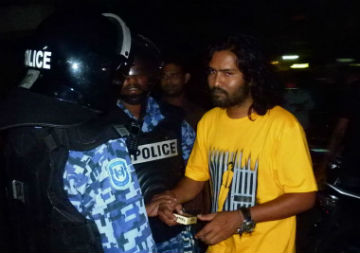
65 persons arrested in 11 nights of MDP protest

Police have today said that a total of 65 persons have been arrested in the series of protests held by Maldivian Democratic Party (MDP), criticising the delayed – now annulled – presidential election.

Beginning as part of a pre-election rally on September 27, the protests continued over the following 11 nights after the Supreme Court ordered security forces to stop preparations for the presidential run-off by force if necessary.

In a statement issued today the police said that all of the persons were arrested on charges of objection to order and obstructing police duty.

Police said that the investigation into the cases of 29 persons were concluded and have been forwarded to the Prosecutor General’s office to put them on trial.

Allegations of arbitrary and frequent use of pepper spray, beating, strip-searching, frisking, handcuffing and drug testing of MDP supporters were heard during the Parliamentary Privileges Subcommittee last week.

The Human Rights Commission of Maldives (HRCM) also met with the police after being made aware of allegations that strip searches were being used in an unnecessary and discriminatory manner following the arrest of protesters.

During the HRCM’s meeting with police, it stressed its belief that strip searches were a “degrading and inhuman treatement” that was to be avoided whenever possible.

In a statement issued last Wednesday (October 2) police said they were authorised to frisk and conduct strip-searches under Articles 32-36 of the the Police Powers Act.

According to police 12 persons were released without being taken to the court to extend their detention period, and nine were released by the court when brought before judges for a potential extended detention period.

Police said that 11 persons were released by the court on different conditions.

Police are investigating the cases of 30 persons currently held in custody, whose detention period was extended by the court.

Last night MDP supporters gathered again in front of police barricades at the FDI photo studio, the nearest point protesters could get to the Supreme Court, calling for justice and early elections.

Three persons were taken into custody – also on charges of obstruction of police duty and objection to order.

Following the Supreme Court ruling to cancel the first round of presidential elections and to hold the election again, the MDP has commenced its campaign and ceased the ongoing protests.

Likes(0)Dislikes(0)

RSF “deplore attitude of police” in Raajje TV attack

Reporters Without Borders (RSF) has condemned an arson attack that destroyed the headquarters of private broadcaster Raajje TV and has criticized the Maldives Police Services’ failure to defend the station despite repeated requests for police protection.

“This criminal act is a direct blow to freedom of information and we deplore the attitude of the police, who failed to do what was necessary to prevent the attack although the head of TV station requested protection a few hours before it took place,” RSF said in a statement on Monday.

CCTV footage of the attack shows six masked men armed with machetes and iron bars breaking into and entering the station’s headquarters and dousing its offices in gasoline before setting it alight.

Speaking to the press on Monday, Chief Superintendent of Police Abdulla Nawaz said the police had been unable to station officers at Raajje TV as many were being utilised at the Maldivian Democratic Party’s (MDP) protests following a Supreme Court order to suspend presidential elections.

“Our human resources are too limited to have police stationed there. So we get the police to check the area when they are out on patrol,” he said. Nawaz also said the owners of Raajje TV were negligent in protecting their property given that they had heard of an impending attack.

“What I am saying is we are utilizing a lot of police officers in the current situation in Malé [the protests], this is not to say that we are not overseeing security on the streets of Malé. We would not do that. What I am saying is when something like this happens, Maldives Police Services gives the best service we can to everyone,” Nawaz said.

The police have received CCTV footage of the attack, but have not made any arrests yet. Nawaz appealed to the public to forward any information

“It is not just those people who carried out the act who are responsible and involved in this. We believe others are involved in this,” Nawaz added.

RSF have called on the police to launch an investigation immediately and urged the government to provide Raajje TV with proper equipment to help the station resume broadcast.

Broadcasting resumed

CCTV footage shows six masked men breaking the lock on a reinforced steel grill and the main wooden door, before dousing the station’s control room with gasoline and setting it alight. Further footage shows a fireball blowing the door of the station off its hinges as a massive explosion engulfed the control room.

The building’s security guard was held hostage during the attack and was later stabbed. He is currently receiving treatment for two stab wounds to his back. A woman who was trapped on the terrace of the building was rescued by the Maldivian National Defense Forces (MNDF).

“The police must immediately launch an investigation so that those who started this fire are arrested and brought to justice. We also call on the Maldivian authorities and the international community to help Raajje TV to resume providing news and information as soon as possible,” the RSF has said.

Reporters Without Borders added: “The national authorities have a duty to provide Raajje TV with proper equipment so that it can function in the same way as it did before the fire.”

Despite the fire destroying all of the station’s equipment, it started broadcasting a few hours after the attack – 12:40pm on Monday – with donated equipment.

The attack is the second raid on the station’s building by masked assailants. In the first attack, in August 2012, the attackers sabotaged equipment in the station and cut critical cabling.

Several Raajje TV journalists have also reported arbitrary arrests and assaults. In February 2013, men wielding iron rods on motorbikes assaulted Ibrahim ‘Asward’ Waheed leaving him with near near-fatal head injuries.

According to Raajje TV the station had an audience of at least 95,000 people, one of the largest shares of Maldivian media.

Likes(0)Dislikes(0)

President Waheed complains to Canada over Foreign Minister’s “inappropriate remarks”, “harshly worded questions”

President Mohamed Waheed has written a letter of complaint to Canadian Prime Minister Stephen Harper, accusing Canada’s Foreign Minister John Baird of making “inappropriate and derogatory remarks” towards Acting Foreign Minister Mariyam Shakeela during the Commonwealth Ministerial Action Group (CMAG)’s meeting on September 27.

The Commonwealth’s human rights and democracy arm had “expressed concern at developments” in the Maldives following the Supreme Court’s delay of the run-off elections, noting the Commonwealth election observation team’s assessment that “this was a credible electoral process and met the standards for democratic elections to which Maldives has committed itself.”

The Supreme Court meanwhile last night annulled the election in a 4:3 decision, citing a secret police report on alleged electoral irregularities and ordering fresh elections on October 20 with enhanced police and government involvement.

In his letter to Prime Minister Harper, Waheed complained that Baird “posed several harshly worded questions… concerning domestic politics in the Maldives”, and said these “put unnecessary pressure on an otherwise excellent relationship” between the Maldives and Canada.

Shakeela represented the Maldives at the CMAG meeting, “and advocated on the need for reforming the Group in order to make the body a more effective and credible one that can help, not hamper, democracy consolidation in the Commonwealth member countries,” according to a Foreign Ministry statement.

“The Minister also highlighted on the need for the CMAG to take matters in proper context, and not to over-react on delicate situations in member countries,” it said.

The diplomatic spat has been widely reported by a bemused Canadian media.

Baird’s office responded to Waheed’s complaint by pointing out “the irony of the Acting Foreign Minister of the Maldives representing that country at CMAG, when her President received five percent of the vote in the first round of the election. Perhaps that is where President Waheed took offence.”

“It might have also been when Minister Baird pointed out to CMAG members that the second round of elections were ‘suspended’ under mysterious circumstances and called on Maldivian officials to proceed with the second round of elections without delay,” said Baird’s Spokesperson Rick Roth, in a statement.

“We believe that this delay is troublesome and can only lead to more instability; which is exactly what we have seen in recent days. The Minister believes that countries within the Commonwealth should adhere to a certain standard of values and principles which is clearly lacking in the Maldives,” the statement read.

“Canada supports the people of the Maldives, and that judicial authorities and security forces must not unduly delay the expression of their democratic will,” it concluded.

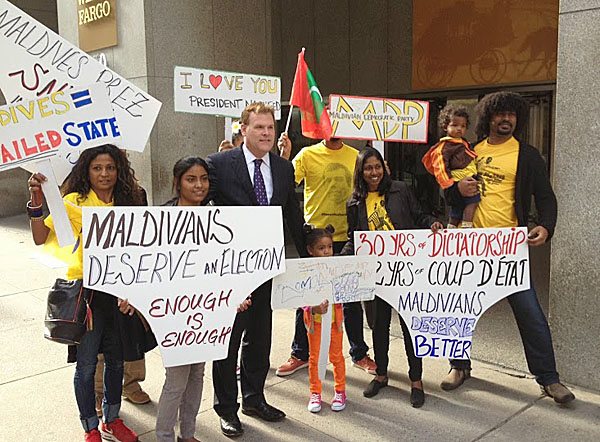
Baird has pushed for the Maldives to be placed on CMAG’s formal agenda. Following the group’s meeting in New York, Baird joined Maldivian pro-democracy demonstrators for a photo outside the Australian consulate.

Canadian Foreign Minister John Baird with Maldivian demonstrators
Likes(3)Dislikes(0)

Comment: Eight reasons why MACL’s share sale either doesn’t make sense, or is a giant scam

Mohamed Waheed’s government has been eyeing Ibrahim Nasir International Airport (INIA) just like a hawk circles around its prey before going for the kill.

Ever since MACL took over the airport from GMR, Waheed has been coming up with one scheme after the other to somehow move assets and ownership of INIA. Whenever such changes in ownership of valuable assets occur, a number of people invariably end up making a lot of money during the process.

First, he changed the MACL board and filled it with his political cronies in order to gain total control over the goings-on at INIA. Then, he tried to move all the assets of MACL into another company created through a secret Presidential decree so that it became a shell company, with all the value pulled into the new company.

This failed due to a number of legal issues. But now Waheed has now decided to sell shares in MACL to ‘Maldivian individuals and companies’ directly.

I will count eight reasons why I believe this proposed sale of MACL shares to ‘Maldivian companies and Maldivian individuals’ makes no sense and may potentially be a big scam-in-the-making.

1. Maintaining economic sovereignty or undermining it?

One reason Waheed’s spokesperson gave for this action was to “prevent foreigners from owning the airport in the future and protect the sovereignty of the airport”.

Essentially, rather than keeping control of MACL’s shares with it and hence ensuring the stated objective, it wants to sell these shares to third parties who can then go ahead and sell their holdings to foreigners. You can see the irony in the very argument that Waheed government is making for selling shares in MACL and wants us to lap up. Clearly, they believe that an average Maldivian on the street is silly and will happily agree to anything thrown his way as long as its wrapped with terms like ‘foreigner’, ‘sovereignty’ or ‘enslavement’.

On the contrary, by selling shares to Maldivian individuals and companies Waheed’s government is in fact opening doors for foreigners to actually go ahead and own INIA in the future.

Currently, the secondary financial markets in the Maldives are practically non-existent and it is easy for shares to change hands in off-market transactions. The regulatory framework for share sale & purchase is rudimentary and fails to ensure that equity shares of a company are not effectively transferred to a foreign entity. In fact, Waheed hailed the sale of two sea plane operators to American investment firm Blackstone as a shining example of how he has been able to bring investments into the Maldives. However, these transactions were an equity share sale of two businesses that are at the centre of Maldivian tourism, to foreign companies.

As a result of this share sale, significant control over Maldivian air space as well as businesses that are central to the health of Maldives tourism was given to an American investor. We have already heard of the problems most resorts are facing with the two sea plane operators and how they are being arm-twisted into signing long term agreements on unfavourable terms.

What will stop a foreign investor like Blackstone buying equity shares in MACL from a bunch of individual or large investors, and ultimately becoming the owner of INIA? In reality, it is this proposed sale of shares in MACL that is the start of potential ‘economic enslavement’ rather than a measure to stop the same in the future!

2. An economic necessity?

One argument that could have possibly been put forward by more aware and informed politicians would have been that this share sale is intended to plug the huge gap in the country’s financial position.

All of us know very well about the grave financial situation that the country and the government is in right now. After exhausting all of the recurrent expenditure budget for the year in the first four months, Waheed’s government has been relying on rolling over T-bills to finance its day-to-day expenses. However, it has already ruled out a supplementary budget for finance these expenditures and stated that it would continue to roll-over these T-bills in the short term. In this context, such a significant decision on divestment of state asset to private individuals is clearly neither a part of the government’s strategy to finance its projects and daily expenditures, nor an economic necessity in the current context.

3. All in the course of seven days

When Nasheed’s government privatised the airport, it put up the airport through an international bidding process managed by the World Bank’s International Finance Corporation (IFC). Work on the privatisation started in July 2009 and finished through announcement of the winning bidder in June 2010. Hence, it took 11 months for the previous government to complete a financial transaction related to the airport.

There were many allegations of corruption around the way the process was managed, which were later ridiculed by the Anti-Corruption Commission (ACC). Now, we have a situation where those who alleged financial irregularities in an 11-month long international bid process are looking to sell shares in the same company over the course of one week!

Even if one were to not compare this plan of share sale to local companies and individuals with the previous bidding process, a share sale like this typically takes more than a year for most companies to complete. Planning and execution of a public offering in most cases is a 6 to 12 month process at the minimum in most countries with well-developed regulations and mature financial markets.

However, here we have a case where an outgoing government wants to complete a public sale of shares of the most valuable national asset in a week. Quite clearly, there is much more to this share sale than meets the eye, which is why it may be important to finish the whole process in the blink of an eye.

4. Eerie silence on the valuation of shares or lack of it

Waheed’s government has given no indication at all of the proposed valuation of MACL and the price at which it is planning to sell the shares. Fair valuation of a share is a matter of opinion and a matter of sound professional judgement of bankers who typically assist with share sales. There are no investment banks in the Maldives who could assist with the sale of shares and no research houses which could come out with an investment report for the public to determine whether the determined price of MACL shares is fair value or not. If a share sale has to be conducted, such experts would typically have to be brought in from other countries such as India, Singapore and Malaysia which have developed financial markets.

GMR made a claim of US$1.4 billion for the loss of profits that it would have earned in the next 10 years, which it couldn’t due to the alleged illegal termination of its contract by Waheed government. Equity shares in MACL would entitle one to profits from INIA for the course of eternity. Hence, what we are looking at is a multi-billion dollar financial transaction – 40 percent of this is also going to represent hundreds of millions of dollars, if not billions.

In this context, the fact that no one in the government has made any statement about engaging an international bank or an expert to help determine the fair value of MACL shares is a clear giveaway. There has been no attempt to find out what would be the fair value of MACL shares, and the intention is to sell these to Maldivian companies and individuals in the matter of a week. One can only deduce from all this that the price (likely to be peanuts) and the buyers of MACL shares have already been decided, and what is proposed to be undertaken over the course of next is a likely to be big sham.

5. Waheed’s moral and constitutional authority to make this decision

Waheed’s term is coming to an end on  November 11 and as this column goes to press, efforts are still ongoing to ensure that a new President is put in power by then. Clearly, this is a significant economic policy decision which must be taken by the new President in line with his announced economic policy, based on which he would have been voted into power. Waheed was never voted into power and his manifesto was given a big thumbs-down in the first round election where he received only 5.13 percent of the votes. Clearly, he doesn’t have the moral authority to make such a significant economic policy decision one month before he is scheduled to hand over power to his successor.

As far as constitutional authority is concerned, your guess is as good as mine. With much larger constitutional questions open for debate today, I wouldn’t dare comment on this but I would certainly be surprised if it allows an outgoing President to make such significant economic decisions that have long term economic impact on the state of the nation.

6. A thick cloud of secrecy

What is most important is to understand whether he plans to bypass the Majlis for undertaking this transaction. It was Waheed and his current and former allies who raised their voices against how the GMR concession was awarded without Majlis approval. In fact, this is the legal reason that Azima Shakoor cited as the basis for declaring the GMR contract void ab-initio.

Now that the Waheed government wants to go ahead with share sale in MACL, has he sought or planned to seek Majlis approval for this? He doesn’t have majority in the Majlis now since DRP and MDP have joined hands and this proposal is likely to be shot down given the lack of any ground work as well as his own unpopularity with majority of the Majlis.

Leaving aside Majlis approval, it is not even clear if the majority of the MACL board has passed a resolution authorising any such sale or shares. There are only two statements made by members of the government till now in this regard – by Finance Minister Abdulla Jihad confirming that “40 percent of the shares will be sold to Maldivian public and Maldivian companies as soon as possible” and by the President’s Office confirming the intent of this sale in the next seven days.

MACL CEO Bandhu Saleem has deflected all questions to the Minister of Finance, who has in turn deflected all the detail related questions to the Attorney General. The Attorney General has not spoken on this in public till date, let alone answered any questions in this regard.

7. An ill-timed transaction that suits vested interests

The Maldives is burning today – literally so with Monday morning’s arson attack on the pro-opposition media house Raajje TV. Protests are taking place every day and every night on the streets of Male’ calling for elections as scheduled and for restoration of the basic constitutional right to vote. Credibility of the Supreme Court and other state institutions is under the scanner and the country is almost in a state of constitutional void.

Whichever way one looks, the political environment couldn’t have been more ill-suited for carrying out one of the most significant multi-million dollar economic transaction, of a public asset, in the history of the Maldives.

However, this is also the reason why it is the most suited for a malafide transaction since the national agenda is dominated by fears for the future of democracy. This provides the perfect opportunity for undertaking the most outrageous looting of a national asset and sweeping it under the carpet. Public memory is too short to remember this for long and too preoccupied right now to notice anything else.

8. More of the same game that has been played a few times over the last one and a half years

During Waheed’s tenure over the last 1.5 years, his Transport Minister signed a 99-year lease extension for Mamigili Airport in favour of his political boss Gasim Ibrahim. On the face of it, the minister was fired but the decision was never reversed. The loss that this ad-hoc extension may have caused to the exchequer was never quantified and never spoken about in public.

Under Waheed’s tenure, KASA Holdings owned by ‘Champa’ Afeef bought 30 percent of Addu International Airport for ~US$4 million, thereby valuing Gan Airport at close to US$13 million. This was a private transaction of a public asset and was done under utmost secrecy with news of the sale  given only afterwards in a press briefing by STO’s Managing Director Shahid Ali. There was no justification, no clarification and no questions asked or answered with respect to this private sale of a public asset. It is not even known till date whether the company was even valued higher than the scrap value of its assets.

A very rushed-up transaction, no discussion or record of economic merit, bypassing the Majlis and an eerie silence about the transaction until it is completed have all been fundamental to the modus-operandi till date.

Clearly, this sale of shares in MACL is more of the same game that has been played again and again under Waheed government.

Summing up, this is about to be the biggest looting ever done in the Maldives and it is happening right now in front our very own eyes, orchestrated by a man  none of us ever elected and 95 percent have rejected less than a month ago.

All comment pieces are the sole view of the author and do not reflect the editorial policy of Minivan News. If you would like to write an opinion piece, please send proposals to [email protected]

Likes(0)Dislikes(0)

Supreme Court annuls first round of presidential elections

Additional reporting by Mohamed Naahii, Neil Merrett and Zaheena Rasheed

Read the verdict (Dhivehi)

The Supreme Court has annulled the first round of the 2013 presidential elections citing electoral irregularities, despite unanimous positive assessment of the polling by more than a thousand local and international election observers.

The 4:3 verdict cited a confidential police report submitted to the court allegedly claiming that 5600 votes were ineligible. The report has not been made public and was not shown to the Election Commission’s defence lawyers.

Former President Mohamed Nasheed emerged the front-runner with 45.45 percent of September 7’s vote, while half-brother of former President Gayoom, Abdulla Yameen, came second with 25.35 percent.

Gasim Ibrahim, resort tycoon and member of the Judicial Services Commission (JSC) until his candidacy, came third with 24.07 percent of the vote, and filed a case demanding the result be annulled after declaring “God willing, Gasim will be President on November 11”.

Incumbent President Mohamed Waheed, who ran in coalition with the Dhivehi Rayithunge Party (DRP), received just 5.13 percent of the vote. The DRP subsequently allied with the MDP. It is uncertain if Waheed will run independently again, or form a coalition with Yameen.

The Supreme Court indefinitely suspended the second round on September 23, issuing a supplementary midnight ruling on September 26 ordering the police and military to forcibly prevent the Elections Commission from holding the second round.

The EC had said it intended to comply with the constitutionally-mandated deadline for the run-off of September 28, but was forced to capitulate after it was surrounded by special operations police with orders to storm the building, arrest officials and confiscate ballot papers.

The court’s annulment of the result follows two weeks of street protests, strikes, travel warnings and rumblings of concern from top ranks in the military.

The verdict

Gasim’s legal team, led by his running mate Dr Hassan Saeed, sought to annul the poll on the grounds that it was a “systematic failure”. Yameen’s Progressive Party of the Maldives (PPM) and Attorney General Azima Shukoor – Yameen’s former lawyer – sided with Gasim in court against the Elections Commission.

The EC disputed the credibility of the evidence presented against the polls, which besides the secret police report, included hearsay and speculative testimony from 14 anonymised witnesses. It also noted that even if factual the evidence was not sufficient to impact the results of the first round. The EC’s head lawyer, former Attorney General Husnu Suood, was subsequently ejected for contempt of court.

The majority ruling to annul the election was given by Justices Dr Ahmed Abdulla Didi, Abdulla Saeed, Adam Mohamed – also Chair of the Judicial Services Commission (JSC) – and Ali Hameed, currently under investigation by police and the JSC for his appearance in multiple leaked sex tapes involving unidentified foreign women in a Colombo hotel room. While on the JSC, Gasim had voted against the JSC’s investigating subcommittee’s own recommendation to suspend the judge, and labelled the tapes “fake”.

In the verdict, Chief Justice Ahmed Faiz Hussain, Justice Abdulla Areef and Justice Muthasim Adnan argued that Gasim’s Jumhoree Party (JP) had failed to show sufficient grounds to annul the poll.

In issuing the majority ruling, Justice Abdulla Didi said the Supreme Court had sought the assistance of Forensic Investigations Directorate of the Maldives Police Service in carrying out a documentary analysis and comparison of the documents submitted by the JP as evidence, against the original voter list used by the EC officials at the polling booths.

Justice Didi noted that the report by the police investigation team – which according to him consisted of technical experts – had produced a report that claimed 5,623 ineligible votes had been cast during the poll.

The ineligible votes, as per Justice Didi, had included: votes cast under the name of dead people, votes cast by underage children, double voting and votes cast under unregistered National Identification Cards.

Didi in the ruling claimed that the figure quoted in the police report exceeded the narrow margin between the Progressive Party of Maldives (PPM) and JP Candidate Gasim Ibrahim, who finished the race in second and third position respectively.

Didi also said that EC’s actions amounted to undermining of the people’s right to vote and conflicted with the concept of Universal Suffrage which had been acknowledged in the constitution.

He also noted although a new president is unable to be sworn in on November 11 – the date on which the current presidential term expires – the country would not go into a state of constitutional limbo as the principle of continuity of legitimate government would override any repercussions faced by failure to adhere to constitutional deadlines.

Therefore, the first round of presidential election held on September 7 lacked any legal grounds to be considered legitimate, Justice Didi declared.

With the declaration, the four Justices who had formed the majority ruling laid down an interim schedule for the holding of fresh elections.

According to the schedule, the fresh presidential elections are to be scheduled by October 20, and a second round – if required – is to be held on November 3.

The Supreme Court also laid down guidelines which the EC was ordered to follow, including giving the police a substantive role in handling the logistics and security of the election and ballot papers.

The court also ordered the EC to collaborate with the National Center for Information Technology (NCIT) and other government institutions to enhance the security of its database and network server.

Reaction

MDP protesters gathered near the Supreme Court as the verdict was given greeted the announcement of the October 20 deadline with cautious optimism, noting the second chance for a first round victory.

“We will win in a first round with 150,000 votes. We will beat them down with votes. We will beat the Supreme Court judges,” said MDP MP Imthiyaz Fahmy, while the party’s running mate Mustafa Lutfi called for a ‘celebratory march’.

Not all in the crowd were as enthused. There was an air of latent anger, disappointment and determination.

One woman shouted at the police monitoring the protest: “Traitors! You facilitated one coup, now a second coup, you will do it again. But we will beat you down with votes.”

Yameen’s running mate and Gayoom’s former Justice Minister, Dr Mohamed Jameel, welcomed the Supreme Court’s ruling.

“This time around there will be a certain guideline which Elections Commission (EC) must follow,” he said. “I think based on the judgement of the Supreme Court, the head of the EC must resign as a moral and legal step.”

88 percent of the country’s 240,000-odd eligible voters cast their ballots in the first round, many of them for the first time.

First-time voter Mohamed Haisham, 19, said today’s Supreme Court ruling had only been a victory for the country’s rich elite, keen to keep resort profits to themselves.

“In my opinion, [JP candidate] Gasim did this. He used his wealth and power to buy the election. However, people are aware of this now, he will not get as many votes this time around.”

Correction: An earlier version of this article incorrectly stated that the fresh election was scheduled on Oct 20 with run-offs on Nov 3. According to the court, elections are to be held BY Oct 20 with run-offs BY Nov 3. A written verdict had yet to be released as of 3:00pm Tuesday.

Likes(3)Dislikes(0)