Waheed and Nasheed hold first meeting since power transfer

Former President Mohamed Nasheed met with his successor Dr Mohamed Waheed Hassan yesterday evening for the first time since the former’s controversial resignation in February last year.

Meeting at the president’s official residence – Muleeage – at 9pm, the encounter lasted around fifteen minutes before Nasheed left without speaking to the press.

A subsequent Maldivian Democratic Party (MDP) statement said that the discussion had included Nasheed’s concern at the delayed run-off election following the Supreme Court rulings ordering the cessation of preparations – by force if necessary.

The court is reported to be working around the clock to reach a conclusion in the Jumhooree Party’s (JP) case, which has requested an annulment due to what it allegs were systemic failings during the first poll.

Despite President Waheed’s hopes that the court reach a decision as soon as possible, none has been forthcoming since the concluding statements were heard one week ago.

A President’s Office statement today noted Waheed’s desire to see a smooth transfer of power to the eventual winner of the election.

Addressing the nation earlier in the day, Waheed said that verification of election related complaints was vital.

“Presidential candidates, political parties, individual citizens, foreign organisations and nations are all waiting to see the election being held as quickly as possible and to see the new president take oath on November 11,” said President Waheed.

The constitution mandates that a new president take office by November 11, a schedule the Elections Commissioner has said cannot now be met.

Both MDP and President’s Office statements claimed that the meeting had been requested by the other attendee.

Waheed assumed office within hours of Nasheed’s unexpected resignation, in what Waheed has insisted was a constitutionally prescribed procedure.

Nasheed would soon claim that his resignation had come under duress, publicly labelling Waheed as a conspirator in his demise and a ‘baghee’ (‘traitor’).

Whilst Nasheed topped the first round of polling on September 7 with 45.45% of the vote, Waheed’s ‘Forward with the Nation’ coalition gained just 5%.

The final result was due to be followed by a run-off on September 28 between Nasheed’s MDP and second-placed candidate Abdulla Yameen of the Progressive Party of Maldives before third-placed candidate Gasim Ibrahim’s JP took his complaints to the Supreme Court.

Gasim – who himself met with Nasheed two weeks ago to discuss the maintenance of national interest and maintaining stability and public order – missed out on the run-off by less than three thousand votes.

Supporters of Nasheed have protested for six consecutive nights following the decision to indefinitely delay the run-off.

Likes(0)Dislikes(0)

Defence and prosecution call the same witnesses as MP’s alcohol trial continues

The Prosecutor General’s (PG) Office has today told the Criminal Court that it has 11 witnesses against Maldivian Democratic Party (MDP) MP Hamid Abdul Ghafoor, proving that he was in possession of – and under the influence of – alcohol when arrested on the island of Hondaidhoo last November.

During today’s hearing the PG’s lawyers said that the 11 witnesses were police officers in the team that raided Hondaidhoo, and that in addition to the 11 witnesses there were two experts that examined the alcohol found on the island and the related documents showing the test results.

Meanwhile, MP Hamid also submitted eight police officers as witnesses in his defence as well as the two experts that examined the alcohol.

The presiding judge told Hamid that some of the police officers that he had submitted as witnesses in his defence were police officers has been named as witnesses for the prosecution, meaning that he would he would have to change witnesses.

Hamid submitted the witnesses to prove to the court that the alcohol found on Hondaidhoo island did not belong to him and that police had illegally arrested him.

The hearing into MDP MP Abdulla Jabir’s case – also concerning the possession and use of alcohol – was scheduled for today but was cancelled due to the defendant being out of the country.

The trial of the third person charged – Jadhulla Jameel – trial was conducted in the Criminal Court today with state lawyers read out the charges against him, before his lawyers were asked to respond to the charges.

His lawyer said that the charges did not specify that Jadhulla had consumed or possessed alcohol.

A total of 10 people were taken into police custody on November 16 after police raided and searched Hondaidhoo with a court warrant. Officers alleged they found large amounts of suspected drugs and alcohol upon searching the island.

Senior MDP members – who had held top portfolios in the the government of former President Mohamed Nasheed – were arrested in the case, including former Press Secretary Mohamed Zuhair and his wife Mariyam Faiza, as well as Nasheed’s Special Envoy Ibrahim Hussain Zaki and his son.

The state is also pursuing separate charges against MP Hamid in relation to his subsequent failure to provide a urine test.

According to the Drug Act, Sections 123(a), 161(a) and 161(b), any person arrested on suspicion of having abused alcohol or narcotics has an obligation to comply with police requests for routine urine examination by promptly providing urine samples, and failure to comply is a criminal offence punishable with a one-year jail sentence.

Likes(0)Dislikes(0)

MNDF introduces regulations against officers inciting ‘upheaval and chaos’

The Maldives National Defense Force (MNDF) has amended its regulations to impose punishments on officers found guilty of inciting ‘upheaval and chaos’, as rumours of possible disgruntlement among military personnel spreads across social media.

The Military Act amendment, which focuses on conduct by officers to support a coup or “chaos” in the armed forces, comes shortly after the MNDF issued a statement of condemnation, claiming that some media outlets had been “sowing discord and disorder in the military.”

Within hours of the amendment coming into force, First Lieutenant Abdulla Shareef was handed an ‘indefinite suspension’ from the service on the grounds that he was found guilty of attempting to cause upheaval and chaos within the military rank.

The new amendment, which came into force on Wednesday (October 3) will be included as the 22nd chapter of the Military Regulation. The document was quickly leaked onto twitter.

The introductory provision of the amendment (Page 1 and Page 2) states: “This is the chapter that defines the ‘upheaval and chaos’ mentioned in the Section 33 of the Military Act which states upheavals and chaos that are incited through speech, writing, action or gesture amongst members of the military.”

Section 33 of the Military Act states – “Any officer who orchestrates a coup, or incites upheaval and chaos within the military, or attempts to commit such an act, or supports such an act, or remains silent whilst having knowledge of such attempts, or delays in informing of such an attempt, is held liable under this act.

The new definition of incitement of ‘upheaval and chaos’ laid down in the new amendment includes:

  • Making demands through petitions drawn among two or more officers
  • Displaying content that could sow discord and disorder amongst military flanks through speech, writing, graphical depictions, photographs or any other means
  • Speech or conduct that amounts to doubts and questions being raised about the legality of an order given to the officers or a group of officers and
  • Incitement of hatred and false allegations towards the upper ranks of the military.

The amendment also states that any officer whose actions or attempts to incite action fall within the ambit of the definition laid down would face administrative action and penalties.

snapshot of the announcement obtained by Minivan News stated that accusations levied against First Lieutenant Shareef had been confirmed by statements from other MNDF officials questioned during an internal investigation.

Therefore First Lieutenant Shareef had been suspended under the section 4(a) of the MNDF Employment Regulation, read the announcement.

MNDF Spokesperson Colonel Abdul Raheem confirmed to Minivan News that the amendment to the regulations had been enforced, as well the suspension of First Lieutenant Shareef.

Letter of concern and resignation of First Lieutenant Mohamed Haleem

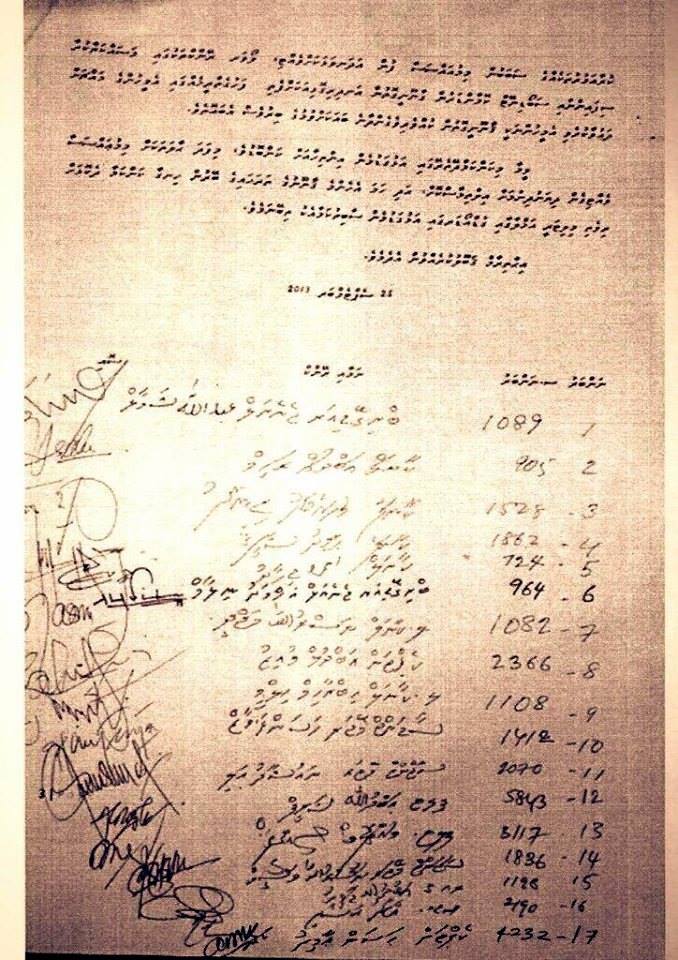
On Monday (October 3), senior officers in the MNDF sent a “letter of concern” to Chief of Defence Force Major-General Ahmed Shiyam, following the failure of the country to hold scheduled elections on September 28.

Colonel Raheem – a signatory of the letter himself – has confirmed the authenticity of the letter, telling Minivan News earlier this week that the letter had been intended to inform the MNDF leadership of their “concerns about political turbulence in the country right now and how the military should plan and prepare for it”.

Another officer who signed the letter told Minivan News on condition of anonymity:

“This is not a petition. It is a letter of concern over the Supreme Court’s order to delay elections, the failure of state institutions, and the possible politicisation of the military, and asking that unconstitutional orders not be issued.”

The officer also said that the letter had been signed by ranks including Generals, Colonels, Lieutenant Colonels, Captains, First Lieutenants, Sergeant Majors and Warrant Officers.

A copy of the letter obtained by Minivan News showed that the suspended First Lieutenant Shareef was also a signatory of the letter.

Other signatories included Brigadier General Abdulla Shamaal, Colonel Hamid Shafeeq, Colonel Ahmed Jihad, Lance Colonel Nasrulla Majdee, Captain Abdul Muizz, Lance Colonel Ibrahim Hilmy, Sergeant Major Hassan Fawaz, Sergeant Major Naushad Ali, and Captain Hassan Amir.

Colonel Mohamed Ziyad – who is also facing criminal prosecution for his alleged role in controversial detention of Chief Judge of Criminal Court Abdulla Mohamed – is also a signatory to the document.

The signature of former Military Intelligence Head Brigadier General Ahmed Nilam– who testified in parliament stating that controversial ousting of former President Mohamed Nasheed on February 2012 had all the essentials of a coup d’etat – is also on the document. Nilam remains under suspension after being relieved of his duties in January.

The first letter – which preceded an internal shuffle, including a marine commander being switched to another unit – was followed by a second piece of correspondence in which First Lieutenant Mohamed Haleem requested resignation from the defense force over “difficulties in executing his duties”.

“I do not believe the security services are currently adhering to the constitutional provisions stated in articles 237 and 238. Also, while the spirit of article 246 of the constitution is, to refrain from political affiliations and to treat equally among the people and different groups, respecting the principles of Islam and human dignity, I do not see this currently happening [within the security services],” First Lieutenant Haleem stated in the letter.

“For the last 23 years [of my military service], I have served this country under a solemn oath taken in the name of Allah, I do not see any way that I can carry out my duties as prescribed in the constitution and the military act, while in this position, therefore I request you to relieve me from my duties,” he concluded.

General Didi appeals the MNDF to uphold the law

Former Brigadier General Ibrahim Mohamed Didi – regarded as a hero for his exploits during the 1988 Tamil coup attempt – also issued a letter over social media earlier this week.

“Given the sad state of affairs this country has fallen to, as a person who came out to sacrifice my life to protect holy Islam and this nation when required, as a person who would still take any action required in the best interest of this country, people and religion and as a person who has been trained and acquired military expertise at the expense of the public funds, I could not remain silent today. I believe it is a national and a religious duty to say something on the issue,” he wrote.

“My advice to the military officers is: ‘Do not give the opportunity to anyone who plans to rule this country by taking the laws to their own hands and override the constitution and undermine the constitutional framework of this country’,” wrote Didi, who was the Male’ Area Commander during the 7 February 2012 controversial power transfer before resigning “prematurely” from his 32 year career on July 16, 2012.

similar plea was also made by President Dr Mohamed Waheed Hassan in an address to the nation this week, during which he called upon security services to “prioritise the greater interest of this state”.

Likes(1)Dislikes(0)

Comment: Yameen the Meek

So much for ‘Yameen The Strong’, the tough, gunda boss: alleged purveyor of illegal oil to the Burmese Junta and other illegal substances to Male’s youth. Instead, he should be known as Yameen The Chicken, or Yameen The Meek.

For Abdulla Yameen is clearly scared of the Maldivian electorate, and afraid of losing the second round presidential polls. Why else would he conspire with half-brother Gayoom to get the Supreme Court to indefinitely postpone the vote? There can only be one explanation for PPM’s delaying tactics: Yameen knows that in a second round fight, the MDP’s Mohamed Nasheed will kick his ass.

Yameen’s election campaign has been lacklustre at best. He rarely campaigns, his policies sound as if they are made up as he goes along and, as I pointed out in my previous column, Yameen seems incapable of dropping his semi-permanent and voter-off-putting sneer.

Yameen barely scraped second place in the first round on 7 September, despite inheriting the second largest political operation in the country: the PPM. Yameen acquired a paltry 25.35 percent of the vote, to Nasheed’s 45.45 percent. Since then, the DRP has joined forces with Nasheed, likely pushing his vote above 50 percent and leaving Yameen’s campaign in big trouble.

And so, rather than choosing to man-up and fight Nasheed head-on, Yameen has hidden behind a bench of thieves, porn-stars and illiterates otherwise known as the Supreme Court of the Republic of Maldives.

The Supreme Court has entertained a ludicrous case about voter irregularities by third-placed Gasim Ibrahim – another Gayoom stooge. This farcical trial, involving witnesses “who heard from someone there was voter fraud”, has been used by the court to delay the second round indefinitely, despite numerous foreign and local election observers praising the vote for being free and fair.

Yameen’s gambit appears to be to delay the second round for as long as possible – perhaps until the New Year – so, in the words of his lawyer, PPM has “time to campaign.” Or maybe his game-plan is to get rid of the Elections Commission, so his mate Abdulla Riyaz – Police Commissioner and coup d’état perpetrator extraordinaire – can take over the voting process and rig it in Yameen’s favour.

Yameen’s running mate, Mohamed ‘Angry Bird’ Jameel has even muttered dark thoughts about disqualifying Nasheed from the race entirely, by re-starting the politicised trial against him over his decision, when president, to detain a corrupt judge.

Yameen’s undemocratic (and unconstitutional) behaviour might not be surprising. He is, after all, the little brother of a vicious dictator. But it does smack of cowardice. Because leaders – real leaders, that is – don’t hide. They don’t cower. And they don’t duck out of a fight, and get big brother to fight it for them.

Yameen has been accused of many things since the start of the election campaign. Hassan Saeed vowed to put Yameen on trial for the theft of US$800 million of state-owned oil, which Yameen allegedly stole while head of STO. Umar Naseer claimed Yameen peddles drugs, and pays street gangs to attack his political opponents. Mohamed Nasheed has called on people to be “mindful” of Yameen’s dark past and dodgy character.

But now the PPM candidate faces a new charge. One that, for an aspiring Head of State, is perhaps most damaging of all: that he is a chicken and a coward. He is Yameen The Meek.

All comment pieces are the sole view of the author and do not reflect the editorial policy of Minivan News. If you would like to write an opinion piece, please send proposals to [email protected]

Likes(0)Dislikes(0)

Former fisheries minister faces corruption charges over lease of Thun’bafushi to Champa Moosa

The Anti-Corruption Commission (ACC) has asked the Prosecutor General’s Office (PGO) to press corruption charges against former Fisheries and Agriculture Minister Abdulla Kamalludheen for alleged abuse of power to unduly benefit a third party.

The ACC said in a press statement on Wednesday (October 2) that Kamalludheen renewed the lease for Kaafu Thun’bafushi in November 2006 despite multiple violations of the agreement by the leaseholder – business magnate ‘Champa’ Mohamed Moosa.

Based on documents from the fisheries ministry and the former minister’s testimony, the ACC found that Kamalludheen was aware that dredging, construction of a seawall, and reclamation work was done in Thun’bafushi without either conducting an Environment Impact Assessment (EIA) or seeking authorisation from the government.

Moreover, the island was used without a lease agreement from August 2004 to November 2006, the ACC noted, after the agreement expired.

The initial agreement signed in August 1999 authorised the government to reclaim the island with 15 day’s notice if any clauses were violated.

The ACC found that Kamalludheen informed the President’s Office in 2004 that the ministry did not invoke the clause to terminate the agreement as the illegal actions could not be undone.

The former fisheries minister told ACC investigators that, as senior officials and staff from the ministry frequently visited the island, “it cannot be said that the work carried out in Thun’bafushi was done without the ministry’s knowledge”.

While Kamalludheen claimed that the decision to renew the lease was made following consultation with the President’s Office, the ACC contended that the minister had to bear responsibility for “losses to the state” due to his culpability or negligence.

Abdulla Kamalludheen served as fisheries minister and home minister in the cabinet of former President Maumoon Abdul Gayoom. He is currently a senior member of the Jumhooree Party (JP) and was involved in campaigning for JP presidential candidate, business tycoon Gasim Ibrahim.

“Environmental criminal”

In June 2011, the Environment Protection Agency (EPA) labelled Champa Moosa “an environmental criminal” and fined him the maximum penalty of MVR100 million (US$6.5 million) for irreversibly damaging the marine ecosystem around Thun’bafushi.

“This was originally a reef ecosystem with a small sand bank in the middle, but he has been dredging the island without any clearance and the changes are now irreversible,” EPA Director Ibrahim Naeem told Minivan News at the time.

After three surveys of the area, the EPA had assessed the damage as amounting to MVR2.2 billion (US$144.6 million), not including the impact of sedimentation from the dredging which can smother coral kilometres from the site.

A foreign consultant who was involved in surveying the island told Minivan News that the area “seems to have been used as a dumping ground.”

“There were what looked like hundreds of used car batteries, waste metals and oil drums leeching into the marine environment,” the consultant said.

Fine overturned

In November 2011, the Civil Court overturned the EPA’s MVR100 million fine on the grounds that the administrative action was not “lawful, procedurally fair, and expeditious” as required by article 43 of the constitution.

The judge ruled that the EPA had not given Champa Moosa adequate opportunities to respond to the allegations, which made the administrative procedure “unfair.”

Naeem however insisted that the EPA had given all necessary documents to Champa and that he had been given “more than enough time to prepare his appeal.”

Several days after Champa was issued the fine in June 2011, the then-Director General of the EPA Mohamed Zuhair suddenly resigned from the post, publicly stating on DhiTV – a private broadcaster owned by Champa – that his departure was due to “political interference” in the EPA’s fining of the tycoon.

Environment Minister Mohamed Aslam however claimed that Zuhair had decided to take a voluntary redundancy package three weeks before his sudden departure, which rendered him ineligible for the lump sum pay out.

“This is Champa building his court case by attempting to question the independence of the EPA,” Aslam alleged at the time, noting that as the EPA’s Director General, Zuhair’s signature was on all the correspondence with Champa, including the notice informing him of the fine.

Champa Mohamed Moosa with former President Gayoom

Naeem meanwhile expressed surprise at Zuhair’s DhiTV appearance, noting that “[Zuhair] was the guy who signed the letter [fining Champa]. Why would he have done so if he was not happy about it?”

Zuhair’s sudden resignation following the fining meant he had forfeited his entitlement to the redundancy package he had applied for, Aslam noted.

“Thun’bafushi has been an issue long before we took office,” Aslam said, explaining that the previous administration had initially rented the island to Champa for MVR100 a year (US$6.40) under an agreement that stipulated that he “not do anything detrimental to the environment – he was allowed to grow trees and monitor the shifting of the islands. He was not allowed to reclaim or extend the island.”

Likes(0)Dislikes(0)

Protesters adopt new tactics during fifth night of calls for elections

Additional reporting by Leah Malone

Multiple arrests and pepper spraying marked the fifth consecutive night of protests on Tuesday evening, as supporters of the Maldivian Democratic Party (MDP) demonstrated near the Supreme Court in Male’.

Both regular police officers and Special Operations branches of the Maldives Police Service (MPS) were present at yesterday’s demonstrations, as well as Maldives National Defence Force (MNDF) officers who were manning barricades.

The Supreme Court has been the focus of protests after its order to indefinitely delay the second round of the presidential elections forced the Elections Commission (EC) to concede that the September 28 run-off could not go ahead.

Thirty female protesters gathered near the Supreme Court in the early evening and were met by Special Operations police in riot gear and MNDF officers. MDP MP Eva Abdulla and former Education Minister Shifa Mohamed were among those detained by police during the demonstration.

By 11:00pm approximately a thousand protesters had gathered near the FDI Station on Fareedhee Magu – the closest protesters can go to the Supreme Court building, as the area remains cordoned off by police and military forces.

Following a series of speeches by MDP MPs – including Eva Abdulla who was released from police custody in time to address the crowd – the demonstrators altered their strategy. Instead of remaining in a single location, the protesters divided their numbers between multiple locations on the north side of the capital.

Hundreds peacefully walked the back roads behind the Supreme Court calling for elections, and were met by MNDF officers in riot gear guarding the alleys leading to government buildings. A group of protesters were met by approximately 30 Special Operations police in riot gear near Republic Square, which prompted the crowd to continue their march.

After regrouping near the FDI building the protesters staged another march down Chandanee Magu, to Majeedhee Magu, and back up Orchid Magu – all main thoroughfares in the capital city. Groups of onlookers were seen gathered in front of private businesses and homes, some of whom joined the protest.

The seemingly spontaneous marches were to intended to disorient the smaller numbers of Special Operations police, an MDP activist and former government official told Minivan News during the demonstration.

Minivan News observed MNDF in riot gear blocking protesters from approaching government buildings, however they deferred to police once fresh squads arrived at the various intersections.

Standard police officer’s – ‘blues’ – were observers using pepper spray on protesters, while Special Operations officers sent in snatch teams to pluck people from the crowd once numbers had dwindled to around 400.

Although the police website reported 10 people arrested, Minivan News witnessed up to 20 people taken into police custody before the protest ended around 2:30am.

Picture by Ranreendhoo Maldives

Following criticism of police arrest procedures at the Parliamentary Privileges Subcommittee yesterday, the police today released a series of statements stating that strip-searching, testing for drugs and handcuffing were legal, and “not inhumane.”

The MDP has alleged arbitrary and frequent use of pepper spray, beating, strip-searching, frisking, handcuffing and drug tests of their supporters arrested at protests.

Arrests “not inhumane”

In a statement today, the police said they were authorised to frisk and strip-searches under Articles 32-36 of the the Police Powers Act. The articles state that police are authorised to frisk and carry out strip searches if the police have reasonable grounds to believe the detainee may hold an object to harm themselves or another, or an object for intoxication, or an object to commit an illegal object.

In a separate statement today, the police said that handcuffing is not an “inhumane act” saying the police are authorised under Article 57 of the police powers act to handcuff detainees while they are being transported.

The police said they are also authorised to ask for urine samples to do drug tests if there were reasonable grounds to suspect the detainee was intoxicated, even if the individual was not detained on suspicion of drug use.

Prosecutor General Ahmed Muizz meanwhile told the Parliamentary Privileges Committee that police could only carry out drug tests if the detainee was arrested for suspected drug abuse, or if police had reasonable grounds to suspect detainees arrested on different charges have used drugs.

Police carried out a drug test on Haveeru journalist during one of this week’s earlier protests, and requested a urine sample from MP Ali Azim.

Police also expressed concern about media taking photographs of the operations.

“Who is taking these photos? She’s snapping pictures of everything we do,” one SO officer objected to a colleague.

“Let her take photos, what can she do with them, right?” the second officer remarked.

“We should just take her in,” said a third.

The Supreme Court has yet to make a decision on Gasim Ibrahim’s bid to annul the first round of results after he placed third, despite the court concluding the hearings last week.

Earlier this week, court media officials offered assurances that the case was being worked on “around the clock”.

Speaking at a Progressive Party of Maldives (PPM) event on the island of Maafushi yesterday, presidential candidate Abdulla Yameen suggested that street protests would not influence the outcome.

“The Maldives will obey the rulings of the judicial courts. Street rulings will not work in the Maldives,” local media reported Yameen as saying.

Likes(0)Dislikes(0)

Don’t interfere in Maldives’ internal affairs, acting Foreign Minister tells UN General Assembly

The Maldivian government has called on the UN to ensure “non-interference in internal affairs of sovereign states.”

In her address to the UN General Assembly on October 1, Acting Foreign Minister Dr Mariyam Shakeela referred to “concerted efforts by external forces to prevent the emergence of an indigenous democratic system of governance in the Maldives [by] attempting to shape the outcome of, what is, an internal issue”.

Dr Shakeela’s comments follow global concern over the Supreme Court’s indefinite suspension of a constitutionally-mandated run-off election scheduled for September 28. Police enforced the order on Saturday by surrounding the Elections Commission with orders to storm the building and seize the ballot papers unless the commission capitulated.

“Democracy consolidation is not just about holding elections. Nor is it about having a democratically sound Constitution. In the Maldives too, we quickly found that changing the Constitution, or having a multi-party election, did not instill democratic values within our society,” Dr Shakeela told the UN.

“For democracy to be cultivated and consolidated, the supremacy of the constitution must be upheld above all. The institutional deficiencies we face, must be addressed within constitutional provisions. And the political leadership must sustain an unshakable commitment to the principles and values of states.”

Presidential candidate Gasim Ibrahim, who placed third in the first round with 24.07 percent of the vote, went to the Supreme Court seeking to annul the vote alleging widespread electoral fraud and declaring “God Willing, Gasim will be President on November 11”.

He was swiftly joined in court by second-placed Abdulla Yameen, who received 25.35 percent of the vote, and Attorney General Azima Shukoor, Yameen’s former lawyer. Siding against the Elections Commission, the three alleged electoral irregularities despite the unanimous positive assessments of local and international election observers, including the UN itself.

In a statement, UN Secretary General Bai Ki-moon said he was concerned about the Supreme Court’s postponement of the second round, given that the first round was “widely recognised as a success by international and domestic election observers.”

“It is of the utmost importance that the will of the people be respected in deciding the future of the country. These are pivotal elections for reaffirming the democratic process in the Maldives,” stated the UN Secretary General.

Dr Shakeela meanwhile told the UN that “Some of the parties that competed in the election have identified serious issues with the conduct of the elections, and have asked the Supreme Court of the Maldives for a ruling. We are expecting the Court to come out with a ruling in the coming days. The integrity of the second round of our Presidential election cannot be maintained without ensuring the integrity of the first round through Constitutional means. We await the Supreme Court’s verdict to continue the electoral process.”

Dr Shakeela went on to accuse “some external forces” of “attempting to shape the outcome of, what in effect is, an internal issue. The Maldives is small. Our democracy is at an infant stage. Our institutions are young. That does not, however, mean that larger countries have a right to intervene and attempt to dictate outcomes in domestic affairs of the Maldives.”

Protests resulting from the suspension of the election have meanwhile led to other countries including the UK, China, Canada and Australia to upgrade their travel advisories.

Likes(1)Dislikes(0)

Foreign parties may take advantage if we undermine our own institutions: President Waheed

President Dr Mohamed Waheed Hassan today vowed to reject any external attempts to intervene in the country’s affairs, which he argued could be avoided if the national interest was put first.

He appealed to the public, state institutions, and the security services to remain calm and patient until the Supreme Court decides the fate of the presidential election.

Waheed said that the greatest right of the people in a democratic society was the right to freely cast their ballot to elect their ruler. He noted that it was an obligation of the state to ensure each vote was counted as valid, and to not allow more than one vote to be cast under the name of any one person.

President Waheed made the call during an address to the state today (October 2) – his first address since being defeated in the presidential polls, finishing with just 5.13 percent of the popular vote.

Finding a quick solution to the problems regarding the elections through the Supreme Court is of utmost importance in cooling down the already heated-up political environment of the country, he noted.

“If we undermine and discredit these institutions, it is always possible that foreign parties may try to enforce alternative ways. Therefore, in deciding Maldivian matters, Maldivians can make decisions only by defending our constitution and the institutions formed under it – by supporting one institution to the other. Not by attempting to destroy one another,” said the president.

Third placed Jumhooree Party (JP) candiate – resort tycoon Gasim Ibrahim – filed a petition at the Supreme Court requesting the apex court annul the election, alleging “systematic” voter fraud despite unanimous positive assessments by local and international election observers.

The Supreme Court ordered the Elections Commission (EC) to suspend all efforts to hold a run-off election until it concludes the case.

The EC initially contested the constitutionality of the order, attempting to proceed with the election, before a second court order demanding the security services obstruct the run-off led the commission to declare the current political environment not conducive to free and fair elections.

Following the decision fears that the country was heading into a constitutional void increased, while international organisations and nation states called for the holding of run-off elections as soon as possible.

“If the claims of electoral discrepancies hold any truth, verifying those claims is of utmost importance in calming the situation. Presidential candidates, political parties, individual citizens, foreign organisations and nations are all waiting to see the election being held as quickly as possible and to see the new president take oath on November 11,” said President Waheed.

“Today, our nascent democracy is experiencing a new wave of efforts to strengthen it.  The vote of every individual citizen is his most sacrosanct right. In every election held so far, we have heard of discrepancies in the voting process. So in this election, and those that are to come in the future, taking into account the fact that ensuring that every citizen’s vote is a valid vote is fundamental to strengthening democracy,”  he added.

Foreign intervention and security services

President Waheed also responded indirectly to recent remarks made by the former Foreign Minister Dr Ahmed Shaheed. Shaheed tweeted stating that India should enforce Right to Protect (R2P) Protocol in resolving the current political crisis.

Shaheed claimed that he did not believe that the “constitutional and political crisis in the Maldives will be resolved without international assistance”.

“I strongly condemn those people who are calling for foreign military intervention into our country and requesting foreign assistance in attempts to topple the government. We are not afraid of such calls. We are also prepared to defend our country from those who are to take over the government of the Maldives,” Waheed said.

“We can solve our own problems. Maldivian people are people who had resolved far more complicated issues on their own in the past. However, if issues are not resolved quickly and get lengthened, it would lead to foreign parties wanting to intervene into our domestic problems.

“The reason is, we will have to appeal for foreign assistance to help establish peace and order, in case the situation gets worse and goes out of our own hands. Also, some of those among us are already appealing for the assistance of foreign parties,” he added.

Waheed also noted that “every time our country falls into a situation of chaos, it is door of opportunity opened to foreign parties to intervene and meddle with our domestic affairs”.

“I call upon the police and the MNDF to prioritise the greater interest of this state, to support and assist institutions formed to maintain rule of law, to remain sincere in upholding the law and the constitution,” Waheed urged.

“If we undermine and discredit these institutions, it is always possible that foreign parties may try to enforce alternative ways. Therefore, in deciding Maldivian matters, Maldivians can make decisions only by defending our constitution and the institutions formed under it – by supporting one institution to the other. Not by attempting to destroy one another,” said the president.

He also said that this is not the time for three powers of the state to attack each other and called on them to find a solution through dialogue and discourse.

“This is the time, where we should prioritise the safety and security of our people; this the time, where we should prioritize the national interest over individual political ambitions,” Waheed noted. “This country is not just the country of one person, or one [political] group. This country belongs to all of us. Any damage we incur as a state is a damage incurred by all the people,”

President Waheed also called on all political parties, presidential candidates and the public to accept any decision made by the Supreme Court regarding the elections.

“A president elected through a free and fair election is a president of all of us. I assure you all that I would give all the assistance needed for the presidential elect. Likewise, I am certain that all other state institutions would give us the support to him in that respect,” he said.

Likes(1)Dislikes(0)

MACL denies imminent strike action by air traffic controllers, as staff allege pay and safety concerns

Air traffic controllers in the Maldives say they are building up to a full work stoppage over ongoing grievances and safety concerns left unaddressed by the current government.

Such strikes could lead to delays and disruption of flights to the luxury tourism destination, that welcomes almost one million tourists a year.

Several controllers responsible for organising the strike explained to Minivan News that they have been raising safety concerns with all relevant government authorities following the restructuring of the state-owned Maldives Airports Company Limited (MACL). Despite countless promises, no action had been taken, they said.

“For the last six months we’ve been ‘going by the book’, following all the procedures which causes a lot of delays. In the aviation industry that is considered a mild strike,” the air traffic controllers explained.

The air traffic controllers are now “building towards a full strike”, and many are even now calling in sick to work, the sources said.

A full strike would involve notifying all the relevant regional and international agencies, airlines, and all relevant government agencies in the Maldives, because no planes will be able to land except for hospital and humanitarian aircraft.

“This strike affects everyone, sea planes as well. Whatever happens at Ibrahim Nasir International Airport (INIA) will cause delays at the domestic airports as well,” they added.

Six air traffic controllers should be on duty at all times, three in the control tower and three in area control, the sources said.

“Last night only two people showed up to work,” they confirmed.

“The [MACL] management and Maldives National Defence Force (MNDF) had to run the system last night,” the air traffic controllers claimed. “Management is totally stressed.”

“This morning only one person was working area control, so management has had to fill in and today at 1:00pm nobody one went into work,” the controllers stated.

As a result, MACL management is also trying to close the area control centre and combine all operations in the control tower, the sources said.

“A pilot from a domestic carrier called me today to say he’s hesitant to fly because the guy currently in the tower doesn’t know what he’s doing – it’s a big safety issue,” one of the controllers alleged.

Ground staff at Kaadedhdhoo domestic airport in Gaaf Dhaal Atoll told Minivan News that since strike activity began many domestic flights had been delayed “three or four hours” while a number of international flights coming into Male’ “have been diverted to Colombo”.

CEO of the Maldives Airports Corporation Limited (MACL), Ibrahim ‘Bandhu’ Saleem, told Minivan News no such strikes were occurring.

“As far as I’m concerned there is no strike – you are wrong,” said Saleem.

He explained that there have been no flight cancellations or delays at INIA and that “only Male’ international [airport], not domestic airports, are under my control.”

While Saleem insisted there is no strike, he noted “there are contingency plans in place [in the event of a strike].” He declined to answer further questions.

The air traffic controllers told Minivan News that while they were not aware of flights being cancelled as of early this afternoon, a flight from Dharavandhoo airport in Baa Atoll was one-and-a-half hours delayed this morning “because INIA couldn’t handle the air traffic.”

Safety and standards

The air traffic controllers claimed strike action was supported by 75 controllers – over 95 percent of the country’s qualified staff.  They are demanding the reinstatement of a professional grading system, adherence to International Civil Aviation Organisation (ICAO), and the holding of the presidential run-off election that remains suspended by the Supreme Court.

“This was not a political issue,” they emphasised. “But now because we’ve lost trust in and cannot negotiate with the current government, [the strike has taken a political direction],” the air traffic controller sources told Minivan News.

“We were counting on a new election and government so we could bring our problems to them. If there’s no election our grievances will be exacerbated. [Now] we don’t know when we’ll be able to vote and elect a new government,” the sources continued.

The controllers repeatedly emphasised that the Maldivian Air Traffic Controllers Association (MATCA) was not involved [in organising the strike], “because they don’t want this to appear a politically motivated thing.”

Concerns and demands

The air traffic controllers said staff were not getting proper breaks, domestic airports are understaffed, the radar system – installed at INIA in 2008 – does not meet ICAO standards, and the professional grading system for controllers had been abolished.

“Everyone got knocked down to the same grade one position, there have been no promotions or pay raises in four years,” the sources explained.

The professional grading system ranks experience level and qualifications, with four levels: 1) basic air traffic, 2) aerodrome (tower) controller, 3) approach controller, and 4) area controller. While the same task is performed at each level, the airspace area each controller is responsible for increases.

“If air traffic controllers are continuously stressed out they might get into trouble by losing a picture [on radar],” the sources warned. “More fatigue means more mistakes, but we can’t makes mistakes is this job.”

The sources said MACL staff from Male’ are sent to work the domestic airports. However, the majority of domestic airports are understaffed, with only one or two air traffic controllers. At least three people should be running the control tower at any given time, the sources explained.

“Where there is only one person working the tower – like in Forvumulah’s airport – that individual has to stay awake. He only gets four hours of sleep a day and has to work 30 days continuously without a day off,” they continued.

“If you are the only person on duty you cannot leave the room, it’s a safety issue,” the controllers explained.

Thimarafushi airport in Thaa Atoll has no air traffic controller, however the Civil Aviation Authority gave authorisation for the airport to operate anyway, the sources alleged.

“That’s totally fine by us, even in the US there is uncontrolled airspace. It’s not a big issue as long as the pilots feel that they can land and take off,” the sources added.

“No one to trust” in government

“The government is trying to say everything is running smoothly, while trying to buy us out,” alleged the air traffic controllers. “We also gave an interview to Haveeru yesterday but they nothing has been posted about it.”

“Minister Adheeb called us today asking us if we were on strike. He’s pretending he didn’t know that our concerns hadn’t been addressed, even though we met with him earlier this year,” the sources noted.

“Three supervisors – of eight total – went to the MACL Managing Director’s meeting today. He’s asking them to talk to us to bring us back to work,” the sources continued.

“We are professionals and don’t want to create chaos in the Maldives, but with the current situation there is no one to talk to,” they explained. “We’ve tried to do it in a democratic way and did every single thing [to resolve our grievances]. We’ve exhausted all resources. There is no one to trust,” they added.

“We have been trying to raise these problems – again – since 7 February  2012 with the current government run by [President Mohamed] Waheed, [Jumhooree Party Presidential Candidate and MP] Gasim [Ibrahim], and [Progressive Party of the Maldives Presidential Candidate and MP Abdulla] Yameen,” the sources continued. “They promised us action but didn’t take it.”

The air traffic controllers have additionally met with Vice President Waheed Dean, Defence Minister Mohamed Nazim, Tourism Minister Ahmed Adheeb, Transport Minister Ameen Ibrahim, MACL, the Civil Aviation Authority, and the Labour Relations Authority, “but nothing happened,” they explained.

Over a year ago air traffic controllers submitted a case to the Labour Tribunal signed by more than 40 individuals, the sources noted.

“On December 21, 2012, over 60 air traffic controllers signed a petition that gave notice that we would be going on strike. We were promised that by January 1 our grievances would be addressed, the grading structure would be re-implemented and we would receive proper raises,” the sources added.

The controllers agreed to withdraw the case when promised the reforms and did, however  the promised action was still not forthcoming.

“We met with MDP’s Mohamed Nasheed and he pledged that under his government he would correct the mistakes and try to get us better pay,” the controllers noted. “We [also recently] met with the other political parties, but so far nothing.”

“Some [of us] are waiting for confirmation in writing [that our demands will be met], but many are waiting for the Supreme Court to rule so we can have an election,” the sources continued. “We’ve heard that MACL ground services employees are also planning to strike.”

Likes(1)Dislikes(0)