No US base says Blake, as US, UN diplomats visit Male

The US has reiterated that it has no intention to establish a base or military presence in the Maldives, after a leaked Status of Forces Agreement (SOFA) between the two countries’ militaries sparked local speculation in April.

Former US Ambassador to Sri Lanka and the Maldives, now Assistant Secretary of State for South and Central Asia Robert Blake, told the Press Trust of India that the agreement referred to joint military exercises and not a future base-building endeavor.

“We do not have any plans to have a military presence in Maldives,” Blake said, echoing an earlier statement from the US Embassy in Colombo.

“As I said, we have exercise programs very frequently and we anticipate that those would continue. But we do not anticipate any permanent military presence. Absolutely no bases of any kind,” Blake said.

“I want to reassure everybody that this SOFA does not imply some new uptick in military co-operation or certainly does not apply any new military presence. It would just be to support our ongoing activities,” he said.

A recently leaked draft of the SOFA, obtained by Maldivian current affairs blog DhivehiSitee, extensively outlines  provisions and immunities for US personnel and contractors in the Maldives, and mentions both ‘Agreed Facilities and Areas’ – detailed in a separate and unreleased ‘annex A’ – and all rights “that are necessary for their use, operation, defense or control, including the right to undertake new construction works and make alterations and improvements.”

However Blake and the US Embassy in Colombo maintained that the SOFA was a standard agreement for joint military exercises of which the US had signed more than 100 with countries around the world.

“I haven’t seen the draft agreement. So I can’t comment. But we are in the process of negotiating one now. These are standard text round the world, nothing very secret about them,” Blake told PTI.

We have status of forces agreements with more than 100 nations around the world. And these are basically agreements we have with partners where we have significant military activities, typically exercises,” he said.

“So for example, with Maldives we have Coconut Grove, which is an annual marine exercise. So the status of forces agreement helps to provides framework for those kinds of cooperative activities. They are desirable things to have. But it does not in any way signify an expansion of our military presence or some major new development in US-Maldivian military co-operation. It’s simply more of a framework to provide for [ongoing] co-operation,” Blake said.

He also revealed the US would be announcing a “quite substantial program” to help provide for free and fair elections in September.

“For example, we will be implementing civic and broader education program in several of the voter areas, we would helping with the dispute resolution, training for community leaders, we would be training staff at the election complaint bureaus, we will be doing training on social media and how to do social media to encourage voter registration,” Blake said.
“We would be doing some training for the Maldivian police service on election law and we would be doing capacity building for community based organizations, particularly about voter education and voter registration,” he added.

US, UN diplomats visit Male

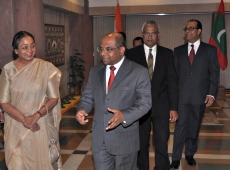
US Ambassador Michele Sison and UN Assistant Secretary-General for Political Affairs Oscar Fernandez Taranco are currently visiting the Maldives and have met with key political and civil society leaders ahead of the September 7 elections.

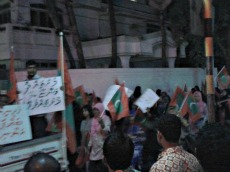
Speaking at an opposition Maldivian Democratic Party (MDP) rally, former President Mohamed Nasheed declared that he had met with both, who “agreed that foregoing an investigation of the senior officers among the police and military who were involved in the events of February 7, 2012 would not be a good thing either for Maldivian democracy, rule of law or the upcoming election,” Nasheed told the crowd of MDP supporters.

He added that progress towards stability and fair elections would be forestalled by the lack of such an investigation.

“We are not asking for an investigation of all police and army officers. We are talking about a few people. About 10 or 12 people,” he said.

Nasheed expressed confidence that “criminal investigations” would take place into unlawful acts or criminal offences committed by mutinying police and military officers on February 7, 2012.

A US Embassy Spokesperson confirmed to Minivan News that Ambassador Sison was visit the Maldives and had met with Nasheed “as part of our normal bilateral relationship, to meet with government and civil society leaders as well as visit US Embassy initiatives such as our Access English language microscholarship program. She arrived yesterday and will depart today.”

During her meeting with Nasheed, “Ambassador Sison reiterated her support for the implementation of the Commission of National Inquiry (CNI) report and its recommendations, including investigations into allegations of abuse.”

Nasheed informed a previous US delegation on January 31, consisting of Deputy Assistant Secretary of State James Moore, Deputy Assistant Secretary of Defense Vikram Singh and Deputy Assistant Secretary of State Jane Zimmerman, that the government had made no move towards acting on the recommendations made in the report, which included holding police accountable for widely videoed brutality surrounding what it termed a legitimate transfer of power in February 2012.

Meanwhile yesterday (May 8, 2013) the Prosecutor General filed the first charges against two police officers for allegedly assaulting MDP MPs ‘Reeko’ Moosa Manik and Mariya Ahmed Didi on February 8, 2012 during the brutal police crackdown.

Local media identified the accused as Mohamed Waheed from the island of Thinadhoo in Gaafu Dhaalu Atoll and Ibrahim Faisal from Machangolhi Rausha of Male’.

Likes(0)Dislikes(0)

Maldives launches US$3.38 million eco-tourism wetland conservation project

With the launch of a US$ 3.83 million eco-tourism wetland conservation project, the Maldives continues to push forward with climate change mitigation and adaptation initiatives, aiming to serve as a model for small island states.

The Environment Ministry eco-tourism initiative will create wetland conservation areas and enhance drainage systems on Hithadhoo Island – an administrative district of Addu City – and on Fuvahmulah Island, in the far south of the Maldives.

The project aims to address climate change impacts by mitigating flooding and erosion due to storm surge, enhance fresh water security, as well as create economic benefits from these sustainable conservation initiatives. Additional mitigation and adaptation components of this Climate Change Trust Fund (CCTF) supported project include coral reef monitoring in Kaafu Atoll, and rainwater harvesting on Ukulhas Island in Ari Atoll.

“This is the first such project in the Maldives with a conservation plan to develop eco-tourism on an inhabited island. Developing a firm and systematic plan to manage and gain economic benefits from these wetland areas could play a vital role in changing the interpretation of the people regarding them,” Environment Minister Dr Mariyam Shakeela told local media during the project’s inauguration ceremony yesterday (May 7).

“We strongly believe that the environment is the only asset that the Maldives has to market ourselves to the international community,” Vice President Mohamed Waheed Deen said while speaking at the project launch.

“Our beauty, whether it is underwater, above water, or wetlands, these are all God’s blessings, nature’s blessings. Unless we know how to look after God’s blessings they will disappear,” he added.

The Vice President also thanked the international community and project donors for recognising that the Maldives has been a minor contributor to global pollution, particularly greenhouse gas emissions, but has “quite unfortunately become a victim” of the resulting climate change impacts.

“I sincerely support the world community for lending support to the Maldives because we believe this is the only way we can make our land, our assets economically viable, and sustainable,” stated Deen.

He emphasised that once the environment has been degraded, it is not possible to restore to its original pristine state, therefore properly implemented environmental conservation can also develop the Maldives’ economy.

Deen noted that the Maldives’ environmental policies have “never changed” and the current government are also “strong environmentalists”, akin to former President Maumoon Gayoom and former President Mohamed Nasheed.

“The Government of Maldives will assure you that the environmental policy maintained by the last two presidents is still maintained,” he stated.

Community-based conservation

The Wetlands Conservation and Coral Reef Monitoring for Adaptation to Climate Change (WCCM) project will be implemented in three phases over 18 months, to be completed in September 2014.

Phase one consists of developing a conservation plan, designing an eco-tourism methodology, and improving water drainage systems. During phase two, eco-tourism facilities will be established in addition to continued water drainage “system rehabilitation”. Phase three includes commissioning a RAMSAR (convention) wetland and national park with eco-tourism.

“The idea is that these are terrestrial wetlands, in the vicinity of the community, so we are trying to manage these protected areas with the help of the community,” Environmental Protection Agency (EPA) Environment and Social Safeguards Coordinator Ibrahim Mohamed told Minivan News yesterday.

Mohamed explained that the nearby communities will be the main implementing partners managing the wetland areas and local NGOs are hoped to contribute as well. A “pool of people” will be trained to manage the areas and act as tour guides.

“There will be a visitor centre and a fee and go into the area accompanied by tour guides, it’s going to be like a national park,” said Mohamed.

“These are very beautiful places, that you will immediately sense are very different from the rest of the Maldives, given the [large] size of the islands and the unique way they are connected.

“In Fuvahmulah there are huge fresh water bodies, swampy areas in the depressions of the islands. While the Hithadhoo wetlands are a huge area with mangroves. There are so many birds here, you will always see so many,” he added.

Spanish company Hidra has been hired to prepare the phase one components over the next five months, including the community-based wetland management plan, for which extensive public consultations – including students – are being conducted.

“Then we will start the civil works, such as making the nature trails, visitors center, and bird watching areas,” said Mohamed.

Public private partnerships

The coral reef monitoring component of this conservation project will involve partnering with resorts in Kaafu Atoll, explained Mohamed. They will be trained by the Environment Ministry to monitor water surface temperatures, erosion, biodiversity, bleaching, impacts on fish, as well as “fish landings” to determine where fish being brought to the resorts are caught.

The goal is long-term monitoring of reefs nationwide, however this project will begin by looking atfive. Currently coral reef monitoring is limited, because it primarily focuses on bleaching and is only conducted twice annually, in accordance with the monsoon and dry seasons, according to Mohamed.

“We have started developing the database and the [monitoring] protocols, which have been peerreviewed by international reef ecologists,” said Mohamed.

“The idea is that over 10 to 15 years we will know what is happening to the coral reefs, so that we can determine the impacts from climate change,” he added.

“Exemplary example for small island states”

Mohamed stated that the overall goal is for these wetland and coral reef areas – and the entire nation – to be protected and developed sustainably to become biosphere reserves.

He further explained that the idea behind this CCTF project is for the Maldives to become an exemplary example for other small island states.

“This project can be replicated anywhere in the world, all small island countries can utilize [what the Maldives has developed],” he added.

The holistic approach to wetland and coral reef conservation is necessary because the components are “so interrelated”.

“If you don’t properly manage waste there will be impacts on coral reefs, etc.,” noted Mohamed.

The CCTF serves as the “main umbrella” under which there are three projects in the Maldives: the WCCM, clean energy for climate mitigation, and solid waste management. The WCCM in particular is supported with donated funds from the European Union and Australian Aid, and managed by the World Bank.

Likes(2)Dislikes(0)

Sheikh Ilyas again summoned to Parliament Committee; says MPs “ignorant of Islamic ways”

Parliament’s Penal Code draft committee has once again decided to summon Chair of Adhaalath Party Religious Council and member of Maldives Fiqh Acadamy Sheikh Ilyas Hussain, after he failed to attend the committee’s previous summons.

The committee stated that it has asked Sheikh Ilyas to attend a committee meeting on May 15 regarding a sermon he gave at the Furugan Mosque in March titled “The Purpose of Islamic Shariah”.

In the sermon, Ilyas swore to God that the Penal Code was intended to destroy the religion of Islam. Calling the penal code “a trap made by the West” to eradicate Islam in the name of Muslims, Ilyas alleged that it did not have penalties for fornication, theft, corruption, forgery, or robbery. He further claimed the code stipulated that if a person claimed they were intoxicated when committing a crime, then they would not be subjected to punishment.

After the initial decision to summon Ilyas, Penal Code Committee Chair Maldivian Democratic Party (MDP) MP Ahmed Hamza rejected the Sheikh’s claims and stated that “[Sheikh Ilyas] has told the public that there are some provisions in the Penal Code that are not in it. We want to bring him and have a chat and inform him about the provisions that are there in the Penal Code.”

“MPs summon me as they are ignorant of the ways of Islam”: Ilyas

Upon being summoned to parliament again, Sheikh Ilyas told local media that the committee continued to summon him only because they were ignorant of the Islamic way regarding the matters he had raised.

Ilyas stated that the parliament members who sat in the committee had insisted that the Penal Code did not have any clauses against Islamic principles, but only because none of them possessed sufficient religious education to understand the reality. He added that he will would explain the matter to the MPs through verses of the Quran and the sayings of the Prophet when he attends the committee meeting.

Ilyas further stated that the bill has a number of clauses which contradicted the penalties defined in Islamic Sharia, and that it had many “deceptive clauses”.

“I will strip the MPs naked”: Ilyas

Sheikh Ilyas was also reported in local media as stating that he would “strip the MPs naked” if he is summoned to the Penal Code Committee.

“I am willing to attend the committee. I will not be called Sheikh Ilyas if I fail to strip them naked. What will they prove? Who gave these people the right to take out the penalties defined in the Quran and categorise them into Part 1 and Part 2?” Ilyas stated.

Ilyas also called on all Maldivian media to broadcast the committee meeting which he is to attend live on TV.

Ilyas made the comments at the gathering held by Adhaalath Party and the National Movement at the Artificial Beach on April 30.

The Adhaalath Party has previously alleged that the parliament committee had added a clause to the Penal Code after Sheikh Ilyas gave the sermon in the Furugan Mosque, and accused the committee of orchestrating a cover up.

Likes(0)Dislikes(0)

Nasheed contests JSC’s claim that Supreme Court ‘ruling’ and ‘counsel’ carry equal legal weight

The High Court has granted former President Mohamed Nasheed additional time to respond to procedural matters raised by the Judicial Services Commission (JSC) in the case submitted by his defense counsel, challenging the legitimacy of the three-member bench appointed by the JSC to his trial at the Hulhumale’ Magistrate Court.

The JSC, raising procedural issues, stated that the High Court does not have the jurisdiction to preside over the case submitted by the former president’s legal team.

Nasheed and his counsel stated several times during today’s hearing that the JSC’s procedural points were not completely clear.

The High Court judges panel gave Nasheed’s lawyers the opportunity to ask the JSC’s legal representation for clarifications, while posing additional questions regarding the same issue themselves.

They then stated that it was unclear why the JSC had asked for the counsel of the Supreme Court in deciding the composition of the bench, and the justification under which the JSC considered the Supreme Court’s counsel to be of the same legal weight as a ruling of the court.

In responding to the questions posed to them, the JSC revealed that the names of the magistrates they had sent to the Supreme Court for their counsel were not the names nominated by the Hulhumale Magistrate Court.

The High Court bench questioned JSC if there it is a procedure in place which allows the assignment of judges for specific cases.

The JSC responded that there were certain circumstances in which judges can be assigned for specific cases, adding that the commission had done so previously in certain cases.

The bench further asked the JSC several times as to whether they considered the Supreme Court’s ‘counsel’ a ‘ruling’. The JSC’s legal team confirmed that they did.

The JSC’s legal representation stated that the Hulhumale’ Court Bench had been established under the counsel of the Supreme Court, and that this held the weight of a Supreme Court ruling.

Nasheed’s legal team contested this, stating that ‘counsel’ and a ‘ruling’ of the Supreme Court cannot be considered to hold the same strength.

Upon receiving answers for some of the questions posed, Nasheed’s lawyers requested for more time to prepare a response, which the bench granted.

In concluding the hearing, the High Court judge’s bench stated that the next hearing of the case would be arranged in the near future, at which Nasheed’s legal team is expected to respond to the procedural matters raised by JSC.

The bench added that in an additional hearing which will be held closely following the next one, the High Court will reveal its ruling on the same matters.

JSC’s request to expedite case

In April, the JSC sent a letter to the High Court requesting that the case be expedited.

The letter was signed by JSC Vice Chair Criminal Court Judge Abdulla Didi, and it was later revealed that it had been sent without consultation with other members of the commission.

JSC member appointed from among the public, Sheikh Shuaib Abdul Rahman, told media that he believed the letter was sent under orders of JSC Chair Adam Mohamed, adding that the Chair did not have the authority to make such decisions without consulting the commission members.

“I believe that whoever advised for this letter to be sent has done so with the intention of influencing Nasheed’s case to be concluded in a particular way,” he had said at the time.

Shuaib’s contention was later backed by Speaker of Parliament Abdulla Shahid, who also sits on the commission.

However, JSC media official Hassan Zaheen stated that he did not believe that sending the letter would exert any undue influence or pressure, even though the JSC is currently looking into disciplinary matters concerning the Chief Judge of the High Court. He added that similar letters had been sent in the past at the discretion of the JSC Chair.

The case in question is one filed by the defense counsel of Nasheed, challenging the legitimacy of the panel of judges presiding over the case against him for the arbitrary detention during his administration of Criminal Court Chief Judge Abdulla Mohamed.

Nasheed and his party contend the case is a politically motivated attempt to convict and prevent him from contesting in the upcoming September 7 presidential elections.

Lawyers representing the JSC has even previously requested the High Court dismiss the case, contending the court did not have the jurisdiction to preside on the matter.

Upon accepting the case, the HIgh Court issued a stay order on Hulhumale’ Magistrate Court to suspend all criminal trials concerning the arrest of the judge until a ruling on the legitimacy of the bench is issued.

Likes(1)Dislikes(0)

Two police officers charged over attack on MDP MPs Mariya, ‘Reeko’ Moosa in February 2012

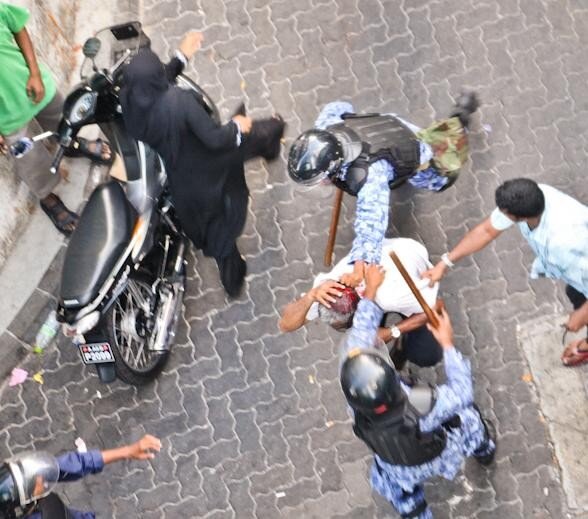
The Prosecutor General’s Office (PGO) has pressed charges against two police officers for allegedly assaulting Maldivian Democratic Party (MDP) MPs ‘Reeko’ Moosa Manik and Mariya Ahmed Didi on February 8, 2012 during a brutal police crackdown.

Local media identified the accused as Mohamed Waheed from the island of Thinadhoo in Gaafu Dhaalu Atoll and Ibrahim Faisal from Machangolhi Rausha of Male’.

Mohamed Waheed was charged with hitting ‘Reeko’ Moosa in the head with a metal canister while Ibrahim Faisal was accused of assaulting MP Mariya Didi while she was inside a shop in Male’.

Faisal is also accused of hitting Mariya Didi in the face while police officers dragged her from the shop.

On February 8, thousands of MDP supporters took to the streets after former President Mohamed Nasheed declared that his resignation the previous day was made “under duress” in a “coup d’etat” instigated by mutinying Special Operations (SO) police officers.

On August 22, 2012, the Human Rights Commission of Maldives (HRCM) released an investigative report (Dhivehi) which concluded that the police crackdown on the MDP march, which left dozens of demonstrators injured, was “brutal” and “without prior warning.”

Thirty-two people filed complaints with the HRCM concerning the varying degrees of injuries they sustained in the crackdown, while 20 people also submitted medical documents pertaining to the treatment of those wounds.

Among the injuries caused by the police baton charge, the HRCM report noted that several people were bruised and battered, one person had a fractured leg bone, another person’s arm was broken, and six people sustained head wounds.

February 8Two fingers on the left hand of one demonstrator were crushed, the report also noted, and the victim had to undergo a corrective operation.

Meanwhile, the former ruling party informed the HRCM that their march across Male’ was spontaneous and that the party had not planned to stage any protests on February 8.

The crackdown

While riot police baton-charged the front line of protestors on February 8, Minivan News observed riot police also charging the crowd from a narrow alley leading to the Maldives Monetary Authority (MMA) area.

The SO police officers used obscene language, pointed to and chased after individual MDP activists and severely beat unarmed civilians.

Al Jazeera news filmed parts of the attack from the rear and reported that on February 8 “police and military charged, beating demonstrators as they ran – women, the elderly, [with] dozens left nursing their wounds.”

Amid the clashes, a group of opposition demonstrators infiltrated the crowds, attacking MDP supporters, according to witnesses.

Former President Nasheed was reported among the injured, having received head injuries during the clashes. He was briefly taken under police custody before being released back into the crowd.

Minivan News also observed several youth with head injuries queuing up for x-rays in the waiting area outside the reception area of Indira Gandhi Memorial Hospital (IGMH).

One young woman who went IGMH with her sister was being treated for a head wound. The gauze wrapped around her head was spotted with blood, and she claimed the wound was still bleeding as she went in for an X-ray.

“The police were just standing there and suddenly we were being beaten with batons and pepper spray was thrown in our face. They threw us to the ground and kept beating us,” she said.

The BBC meanwhile reported “a baton charge by police on crowds gathered outside one of the main hospitals.”

“People scattered as officers sprinted towards them silhouetted against the lights of passing traffic,” the BBC’s Andrew North reported from Male’.

An injured protester

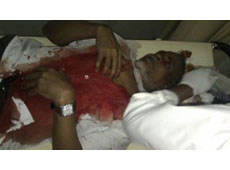
“Inside the hospital, dozens of Mr Nasheed’s supporters are still being treated for injuries, following earlier scuffles in the main square. Among them is Reeko Moosa Maniku, chairman of Mr Nasheed’s Maldives Democratic Party – who was with the former president when the clashes broke out. With a large head bandage and his shirt bloodied, he regained consciousness as we arrived. The police said they would kill me, he told us, as they beat me. Another MP was still unconscious in another ward.”

Likes(0)Dislikes(0)

Spray-painting “irreligious” on people’s homes risks sparking hate crimes: former police intelligence chief

Former Police Intelligence Chief Mohamed Hameed has expressed concern that a recent outbreak of graffiti, in which dozens of homes and public buildings have been spray-painted ‘laadheenee’ (‘irreligious’), could trigger hate crimes in the capital.

Hameed said the “highly provocative act”  required precautionary action from the police.

“The ‘laadheenee’ graffiti on many walls in Male’ is a serious issue, possibly leading to hate crimes. This has come up at a time when politicians are often speaking of religion, and [former President] Gayoom has himself just recently said that there are two ideologies in the country: religious and anti-religious,” Hameed stated, referring to a recent speech by the autocratic leader of 30 years.

“The graffiti came up shortly after that, and is mostly in yellow paint. It can be said it is targeting a specific group of people. This can lead to retaliatory acts from the target groups,” Hameed contended.

“With the looming elections, this might be an act deliberately orchestrated by a particular group of people to attempt to create chaos and delay elections, saying the country does not have a conducive environment in which a free and fair election can be carried out,” he said.

“It seems like the graffiti was put up late at night. Now, since there are no shops or cafe’s open 24/7, there are only a minimal amount of people out late. The police are out patrolling the streets at all hours so it should not be too much of a task for them to find out who is responsible for this. I think they probably already have an idea. I believe it’s very important the police investigate this matter and take precautionary measures,” Hameed stated.

The graffiti has since been altered to form a variety of other phrases ranging from “MullahDheen” (‘Mullah religion’) to “BinLaadheenTha?” (‘Is it Bin Laden?’).

“Political activism doesn’t strip me of religion”

Minivan News spoke to people living in some of the houses who woke up to see the label “Laadheenee” scrawled over their walls.

“We are not a high profile family, and usually just stay to ourselves, so I was very surprised to see this derogatory word on our wall. Perhaps it is because one of my sisters is very active in the anti-coup protests,” said the eldest son of one such house.

“None of us, even my sister, is intimidated by this. Why can’t people with opposing political views be like us? That’s what my Dad said too. We don’t run around vandalising the property of those sheikhs who preach hate, or their followers.”

A small street in Maafannu ward had the graffiti on a quarter of the houses along it.

“This street definitely has a lot of people living on it who support the MDP, but that doesn’t make us anti-religious in any sense,” said one resident, a 53 year-old housewife. “Political activism doesn’t strip me of my religion. This just displays their lack of maturity and political ineptitude.”

Another resident, a 24 year-old man, called the act ‘childish’, adding, “Seeing the graffiti, it was mostly anger I felt. This is obviously politically motivated. What right do they have to go around damaging the property of people they do not know at all?”

A 38 year-old man who lives alone in a house in Henveiru said he felt the graffiti was the start of something “larger and more menacing.”

“It’s like they have marked down the houses of people they mean to attack. The saddest thing is, although the word refers to religion, I doubt their intentions are anything but political. I hope the police look into this and ensure that none of us come to physical harm.”

“‘Laadheeneee’ is an old song, no one’s interested”: MDP MP

MDP Spokesperson Imthiyaz Fahmy described the painting of the graffiti as “a desperate political move” and “an old song that  people simply are no longer interested in listening to.”

“All this talk of religion and being anti-religious is a politically-motivated ploy used by a handful of politicians who have nothing else to come to the public with. They have no pledges, no manifesto, no policies: and because they have nothing to speak of, they resort to labelling those who do with derogatory terms,” Fahmy said.

“This particular instance is a crime according to both international law and the local law; I refer to the ICCPR (International Covenant on Civil and Political Rights) and the Religious Unity Act respectively. Because of the state our law enforcement system is in at the moment, we see no action being taken against crimes like this,” Fahmy said.

“It is this failure to act that led to the February 7 coup d’etat. The sad thing is that both the law enforcement forces and the judiciary are not working to deal with serious matters like this,” he continued.

“Religion does not belong to any man. It is between God and oneself. There is no justification for abusing religion in the competitiveness of politics,” he said.

Police Media Official Chief Inspector Hassan Haneef was not responding to calls at time of press.

Religion and politics

During an address given in Denmark, former President and MDP presidential candidate Mohamed Nasheed stated that the Maldivian people had largely rejected Islamic extremism, and, in a veiled reference to the Adhaalath Party – the only local political party which claims to be based on a religious ideology – noted that “the Islamists were never a credible electoral threat.”

“The Islamic extremists also didn’t like the Maldives’ new democracy because they were unpopular. They failed to win the presidential elections in 2008, they failed to win local government elections – in 2011 they won less than four percent of the vote. But now, after the coup, extremists have been rewarded with three cabinet positions in government, and in many ways set the tone of the government communications. They are busy trying to indoctrinate people with a misguided version of Islam,” Nasheed said.

“There is idea of wanting to return to Hejaz as it was in the 7th century. This is Wahhabism in principle. And it is difficult and worrying,” he had said at the time.

The religion based political party condemned Nasheed’s comments, alleging that “Nasheed misled them about the party he fears and envies most: the Adhaalath Party.”

The next night, the National Movement – comprising of Adhaalath Party and a number of NGOs – organised a several hundred strong march around Male’ calling on authorities to penalise Nasheed, with some calling for him to be hanged. They alleged that Nasheed had mocked Islam, the Sunnah of the Prophet and verses of the Quran.

Meanwhile, the MDP has released a statement condemning the use of “irresponsible and misleading” political rhetoric against Nasheed over his remarks on Islamic radicalism.

The party said “misleading” statements were made in the media by political parties and “those wearing the hats of sheikhs to use religion as a weapon.”

Likes(0)Dislikes(0)

India hosts Maldivian delegations to ensure “free, fair and credible” elections

India’s Elections Commission (ECI) and parliament are hosting respective delegations from the Maldives’ Elections Commission (ECM) and Majlis in an effort to ensure September’s presidential elections are conducted in a “free, fair and credible manner”.

A seven member delegation from the Elections Commission of the Maldives (ECM) is in India for six days as part of a cooperative program with the Elections Commission of India (ECI) to enhance the Maldives’ capacity to hold the upcoming presidential and local council elections.

While in India, the ECM has the opportunity to acquire first-hand experience during the Karnataka state assembly elections. The ECI is also organising a special election-related training module for the ECM in Mysore.

ECM President Fuad Taufeeq is leading the delegation, which includes other ECM senior officials. Prior to departing for India on May 4 the Maldives’ delegation met with the High Commissioner of India Rajeev Shahare to discuss the visit and other election related issues.

The ECM delegation is expected to return May 9.

Meanwhile, a Maldivian parliamentary delegation led by Parliament Speaker MP Abdulla Shahid is also in India and met with Indian Parliamentary Speaker Lok Sabha Smt. Meira Kumar yesterday (May 6).

Kumar assured the visiting delegation that India would extend “all possible assistance” – in close coordination with the ECM – to ensure the September presidential elections are conducted smoothly and peacefully.

She expressed her hope that elections may be held in a free, fair and credible manner.

Kumar said that India and Maldives enjoy “special and time ­tested relations” and reiterated India’s continued commitment to further strengthen and diversify the bilateral relationship. Along those lines, she emphasised the collective task both nations have to create an atmosphere of “strong understanding and interdependencies” in the region to achieve collective progress and prosperity.

Kumar also stressed the need to further strengthen bilateral parliamentary linkages, with the first meeting of the India–Maldives Parliamentary Friendship Group being held during the Maldives delegation visit, acting as a “step in the right direction”.

The Maldivian government was urged to take measures for establishing investor confidence in the country as well as conduct structural reforms to prevent harassment and improve living conditions for the nearly 30,000 strong Indian expatriate workforce.

Shahid assured Kumar that the Maldives would work closely with India for the mutual benefit of both nations and extended an invitation for the India’s parliamentary speaker to visit the Maldives.

“Electoral background discouraging”: Transparency report

The 2013 presidential elections are set to unfold “against a context of uncertainty, crises of political legitimacy and unprecedented levels of political polarisation,” Transparency Maldives has stated, in an extensive pre-election assessment published on March 28.

The detailed report identifies key challenges in the lead up to the election, such as the candidacy of former President Mohamed Nasheed, lack of monitoring of campaign financing, an extensive and entrenched culture of vote buying, and a media establishment set on fueling personality politics and further polarisation.

The ECM said in mid-March it had noticed a surge of discrepancies on membership forms submitted by certain political parties including forged documents, forms with false information and even forms filed under the names of dead people.

“Buy-offs and civic education” challenges: ECI

The current ECM visit to India is part of a joint assistance project agreed upon in early-March during ECI’s eight day visit to the Maldives to study the electoral environment in an effort to enable free and fair elections.

During the ECI’s visit, they identified areas the ECM needs to develop and improve. These included: staff shortages, training needs, and the lack of information technology software. Vote buying is another important issue being addressed, the ECM’s President Fuad Thaufeeq previously explained to Minivan News.

Speaking to Minivan News at the time, India’s Deputy Election Commissioner Dr Alok Shukla said that preventing voter “buy-offs” and improving civic education were two “big” challenges about which the ECM was “extremely concerned”.

Likes(0)Dislikes(0)

President ratifies fiscal responsibility bill to limit govt spending and public debt

President Dr Mohamed Waheed Hassan Manik ratified the fiscal responsibility bill on Monday (May 6) and issued a decree to delay the enforcement of 22 provisions that require specific guidelines for implementation.

The legislation submitted in 2011 by the previous administration was passed 42-10 by parliament on April 15 this year.

“The Act ensures accountable, transparent and sustainable government implementation of the state fiscal policy,” according to the President’s Office website.

Following ratification and publication of the Act in the government gazette, President Waheed issued a decree in accordance with article 39 of the Act (Dhivehi), which authorises the president to delay enforcement of any provision of the law by one year if it requires rules or a mechanism to be set up before implementation.

The executive decree issued on Monday delayed the enforcement of articles 10 to 28 and 32 to 34 of the Act.

The new law sets limits on government spending and public debt based on proportion of GDP, stipulating that public debt must not exceed 60 percent of GDP from January 1, 2014.

Moreover, borrowing from the central bank or Maldives Monetary Authority (MMA) to manage the government’s cash flow should not exceed one percent of the average revenue for the past three years, while such loans would have to be paid back in 91 days at the market interest rate.

The provision was however among the 22 postponed for the next 12 months, which also included sections requiring the government to submit statements or reports to parliament outlining its fiscal strategy, debt repayment plans and budget position.

The ratification of a law on fiscal responsibility comes amidst concern over soaring levels of public debt, which is projected to reach MVR 31 billion (US$2 billion) or 82 percent of GDP by the end of 2013.

Nominal GDP in 2012 was MVR 34 billion (US$2.2 billion).

Economic growth in 2013 is meanwhile forecast at 4.3 percent, down from 7.1 percent growth in 2010 and 7 percent in 2011.

An International Monetary Fund (IMF) mission in November 2012 explained in a statement that economic growth slowed to 3.5 percent last year on the back of “depressed tourist arrivals earlier in the year and weak global conditions,” which have been “only partially offset by strong performance in construction and fisheries-related manufacturing.”

The original forecast for economic growth in 2012 was 5.5 percent.

Debt

According to figures revealed by the Finance Ministry in December 2012, nominal GDP in 2011 was MVR31,447 million (US$2 billion) while the estimate for 2012 was MVR34,148 million (US$2.2 billion).

Real GDP in 2011 was MVR20,461 million (US$1.3 billion). Nominal GDP per capita in 2012 was estimated to be MVR 80,260 (US$5,206) per annum.

Real GDP measures the value of all goods and services produced in a country expressed in the prices of a base year – 2003 in the Maldives.

The Finance Ministry also revealed that the ‘total external public and public guaranteed debt’ was estimated to reach MVR 13.7 billion (US$888 million) in 2012.

Of the MVR 4.1 billion (US$330 million) of the loan assistance spent in 2012, more than 50 percent was from multilateral financial institutions and 28 percent from bilateral donors.

A total of MVR 1.9 billion (US$123 million) from loan assistance has been spent for various projects in 2012 while the rest was spent for budget support.

As of September 2012, MVR 561 million (US$36.4 million) was received as budget support – US$16 million from the Asian Development Bank and US$20 million from a standby credit facility extended by the Indian government.

Moreover, the government spent more than MVR 1 billion (US$64.8 million) in 2011 and MVR 1.1 billion (US$71.3 million) in 2012 to service foreign debts as interest and repayments.

The figure was expected to remain the same in 2013.

In addition, the government spent MVR 660.5 million (US$42.8 million) in 2011 and MVR 2 billion (US$129.7 million) in 2012 to service domestic debts.

Government spending on loan repayment and interest payments was expected to reach MVR 3.1 billion (US$201 million) in 2012.

Including an estimated MVR 13 billion (US$843 million) in domestic debt, the total public debt is expected to reach MVR 27 billion (US$1.7 billion) in 2012 and MVR 31 billion (US$2 billion) in 2013 – 82 percent of GDP.

Likes(0)Dislikes(0)

Seven people charged in Sheesha Brothers MVR 18 million fraud case

The Prosecutor General’s Office (PGO) has pressed charges against seven people in a case involving MVR 18 million (US$1.2 million) that went missing from the State Bank of India (SBI) account of the owners of local motorcycle retailer Sheesha.

On November 24, 2011, the Sheesha owners discovered that several unauthorised transfers had been made from their joint personal savings account to an unidentified recipient.

The PGO pressed charges today against Maldives National Defense Force (MNDF) Retired Colonel Shaukath Ibrahim and two female staff from SBI, Sulthana Hussain of H Miureksand Aishath Hussain from Kelaa Island in Haa Alif Atoll. Additionally, Ibrahim Shaheed from Thulhaadhoo Island in Baa Atoll, Mohamed Musthafa and Mohamed Musthaumid from Lhaimagu Island in Lhaviyani Atoll, and Ali Ashraf of Rasmaadhoo Island in Raa Atoll were also charged.

Retired Colonel Shaukath Ibrahim’s bank account was used to transfer the money and withdraw it, according to local newspaper Haveeru.

Following the Sheesha brothers’ – Ahmed Hassan Manik, Hussain Husham and Ibrahim Husham – discovery, they told local media the SBI transfer had been made to a Bank of Maldives account with a forged document faxed to SBI with Manik’s name and signature. The brothers said they would sue SBI and requested the bank take full responsibility for the theft.

In November 2011, Hussain Husham told local media that the total amount of MVR 18 million was taken in two transactions.

The first transaction was made on November 9, 2011, with the amount of MVR 8.5 million (US$551,000) withdrawn. On December 20, the culprits withdrew an additional MVR 9.5 million (US$616,000) from the Sheesha brothers’ account.

Likes(0)Dislikes(0)