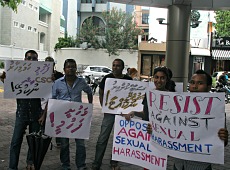
Women’s rights group protest against impunity of Civil Service Commission President following sexual harassment allegations

Local NGO Voice of Women (VoW) held a protest outside the Maldivian Civil Service Commission (CSC) on Friday (March 28) to oppose the return CSC President Mohamed Fahmy, after the Supreme Court dismissed parliamentary findings in a sexual harassment matter and permitted him to return to work.

Fahmy returned to work on March 17 following a Supreme Court ruling three days earlier, stating that Fahmy’s removal from his position by parliament was unconstitutional. According to the judgment, Fahmy was to be reinstated and compensated for lost wages since December 2012.

The 6-1 majority opinion of the Supreme Court bench held that Parliament’s Independent Institutions Committee violated due process and criminal justice procedures in its sexual harassment inquiry, and that Fahmy would receive two punishments for the same crime if he was convicted at court following his dismissal by parliament – double jeopardy).

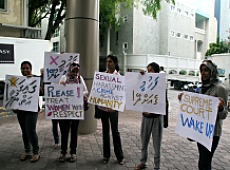
The group of a dozen vocal protesters marched in the rain from parliament to the CSC, where they waited with placards for Fahmy to emerge. Some of these messages read: “sos save the csc from Fahmy,” “zero tolerance for sexual harassment,” “supreme court wake up,” “no more excuses, no more abuses,” “my body my rights,” “the workplace should be safe and free from oppression.”

VoW President Haifa Naeem explained to Minivan News that sexual harassment in the workplace is an endemic issue and that “victims are being re-victimised by the state”. VoW is urging parliament to fast track the sexual harassment bill.

“Once Fahmy’s integrity was lost, he should not be at the CSC. We are standing here with enough evidence that he has been sexually harassing people,” stated Naeem.

“Most women are afraid to come out because they are not protect by law or the state, but we are behind them,” she said.

VoW founding member Dr Abdul Malik echoed these sentiments.

“Systems are not in place to give necessary protection if women come out and voice these kinds of incidents,” Malik stated.

“We will back the victims to the extent civil society can, but its the responsibility of the state, judiciary and law makers who can do something, do more,” he added.

It is important to recognize what’s happening “all around” the government and throughout the nation, VoW Treasurer Aminath Saeed told Minivan News.

Re-victimisation

The CSC employee who filed the complaint against Fahmy, Shahuma ‘Shahu’ Haleem, spoke with Minivan News about her experience.

“He’s been doing this for quite some time now. This was the first thing I heard when I came to office, but I never thought he was ever going to touch me.

She explained that whenever she hears her friends talking about being sexually harassed she urges them to “speak up”.

“They are afraid of being fired, because he’s the ultimate boss [of the civil service]. Anyone cannot come out here today and do this. I can be fired and still survive, but not many people have that option,” Haleem stated.

Haleem explained that she filed complaints with parliament, the Human Rights Commission of the Maldives (HRCM), and the Ministry of Gender, Family and Human Rights. She claims the Gender Ministry did not even call her back.

The HRCM claimed that they had not received enough evidence to prove whether or not Fahmy had harassed the employee. In late November 2012, parliament dismissed Fahmy in a 38-32 vote after the Independent Institutions Committee investigated the complaint.

“Women are getting the wrong message, that some people are in fact untouchable,” stated Haleem.

“It’s been proven over again that he has lied and has in fact done it, but then the [Supreme] court rules in favor of him,” she added.

Government employee reactions

An long-term government employee in the crowd who asked not to be identified said workplace sexual harassment was a systemic problem throughout every government institution.

“That kind of harassment is totally accepted throughout our society. It has been tolerated for a long time and has become part of the Maldivian culture. People think that it is bound to happen when men and women are together,” she said.

“It’s because of the way women are perceived in society. We are see more as sexual objects, our productive role is less prominent, but our reproductive role is more [valued].

“Today’s protest is an important milestone because it has sparked debate. Even if you only see a few people here it speaks a lot for a country that has been suppressed for a long time. It is very brave for Shahu to bring this issue out into the open,” she added.

Other employees, both from the CSC and various government ministries, also spoke to Minivan News as they passed through the protest while leaving work.

Many said they do not know much about the issue, Fahmy or the allegations against him.

Others claimed sexual harassment “is a pretty big issue, but no one talks about it”.

A Ministry of Fisheries and Agriculture employee said he was aware of rumors that a lot of women faced sexual harassment and said he supported their cause.

“I also want women’s rights, but by protesting like this nothing will happen,” one woman declared.

A CSC employee told Minivan News that sexual harassment is a “problem” but said that “women are weak”.

“People don’t believe it is happening. They need to be more aware. Even in Shahu’s case most people didn’t find it a big deal,” another woman stated.

“People have to go to extreme lengths to show it’s actually sexual harassment,” she added.

Likes(1)Dislikes(0)

Vote-buying, political polarisation, credibility critical challenges for 2013 elections: Transparency Maldives report

The 2013 presidential elections are set to unfold “against a context of uncertainty, crises of political legitimacy and unprecedented levels of political polarisation,” Transparency Maldives has stated, in an extensive pre-election assessment published on Thursday.

“The latter is characterised by mistrust, categorical negative framing of one another and by the lack of self-accountability of institutions, politicians and their parties for their role in the existing political crises. The electoral background is therefore discouraging,” Transparency noted.

The detailed report identifies key challenges in the lead up to the election, such as the candidacy of former President Mohamed Nasheed, lack of monitoring of campaign financing, an extensive and entrenched culture of vote buying, and a media establishment set on fueling personality politics and further polarisation.

“The upcoming Presidential Elections are currently headed to unfold against this political context of crisis of legitimation, uncertainty of democratic transition, existing polarisations and other challenges that have been aggravated by the controversial transfer of power on 7 February 2012,” Transparency states.

“Bitter zero-sum game”

Political polarisation in the Maldives has grown in the wake of the failed all-party talks and events of February 7, leading to bitter mistrust between political factions and the pervading sense among parties that the loss of the upcoming elections “could amount to losing everything”.

“Political polarisation is characterised by mutual mistrust and radical negative categorisation of people, politicians, political parties and, sometimes, entire institutions,” Transparency notes.

“It’s characterised by the lack of self-reflective criticism, by the failures to hold one’s own self and party to account, and the inability to listen to and compromise for the callings of the other side. It’s also characterised by an apparent struggle for political power as a bitter zero-sum game.”

As a result of this polarisation, the limited space for public debate on urgently-required public policies and programs continue to be “colonised by demagogic appeals to religio-nationalist sentiments, empty motifs, and outlandish electoral promises never intended to be delivered,” Transparency stated.

“Similarly, as the polarisation is symbolised by political personalities, political debate is likely to center on personalities as opposed to issue-based discourse.”

Particular challenges around polarisation include a “lack of cooperation and dialogue among major political parties, opening up space for intolerance and violence”, “a possibility of contestation of elections results, especially if the victory is through a narrow margin”, and the risk that even if the election results are respected, “a significant segment of the polity might reject the incoming president as the representative for all the people in the true democratic spirit required in defeat.”

Transparency called for restraint among parties, appealed for policy debates, and extensive and long term observation on behalf of the international community.

Nasheed’s candidacy

Transparency stated that most of the people and institutions interviewed for the report, “irrespective of their political affiliations”, saw the potential disqualification of Nasheed from the presidential race through the ongoing court proceedings as “a major challenge” for the elections.

“None of the major political actors Transparency Maldives met was eager for disqualification of President Nasheed, although some qualified their position saying that rule of law must apply equally for all and he must face justice.

“A few major stakeholders believed it was politically motivated. A politician of a major political party saw any election victory for them without President Nasheed as a rival candidate as just a “hollow victory”.”

Should Nasheed be prevented from contesting on behalf of the Maldivian Democratic Party (MDP), Transparency predicted political violence in the run up to the elections marring the electoral environment, boycott of the elections by the MDP, outright rejection of elections results and the incoming president by the MDP, and widespread disruptions to the elections themselves: “Transparency Maldives heard suggestions it would be altogether impossible to hold elections in some parts of the country.”

In light of controversy surrounding the judicial legitimacy of the proceedings against Nasheed, Transparency backed international calls for an inclusive election.

“As an elections-observing NGO, Transparency Maldives is of the view that if any potential presidential candidate is prevented from the Presidential Elections through a controversial process, the credibility and democratic representativeness of the elections will be called into question.

“Several international bodies, including most recently the UN Special Rapporteur on Independence of Judges and Lawyers, have criticised the state of the judiciary. There are deep disagreements as to the legitimacy of the Hulhumale’ Magistrate Court and the special bench of judges appointed to oversee President Nasheed’s trial. Some of the members of the Judicial Service Commission have openly questioned the legality of appointing a special bench. All these reasons give room to doubt the judicial processes,” Transparency stated.

“Crucially, even if elections can be held [without Nasheed], the incoming president will face immense legitimacy challenges, as is the case with the current government. Democracy consolidation is impossible under a context where legitimacy [of the government] is contested by a substantial segment of the population. Thus, key to successfully addressing the ongoing legitimation crisis is holding elections in which candidates of all major political parties are free to contest,” Transparency added, calling for the government, the elections commission, prosecutor general, judicial services commission, judiciary and human rights commission to ensure no presidential candidate is prevented from contesting.

Buy-election fears

Transparency identified vote buying as key issue in the lead up to the election.

“The issues of vote buying and influencing voters through patronage seem to have had a long history in the country,” the report notes.

Transparency enlisted focus groups to study the issue on Fuvahmulah, Kaashidhoo, and Hulhudhuffaar to try and identify why the practice was so accepted.

“A crisis of confidence in candidates’ sincerity to deliver on their electoral promises could be one of the main reasons why many people take offers. Almost all the participants in the discussions thought the candidates would not bother about them or their community post-elections, or after winning the elections. ‘They would not even answer their phones’ was a common retort,” Transparency noted.

“There are particularly vulnerable groups of people who are targets of vote buying. Youth groups who are victims of drug addiction, for example, could be offered drugs, money to buy drugs, or drugs at discounted rates, in exchange of their votes. Similarly, the less disadvantaged people, people in need of medical treatment, or the more elderly, seem to be particularly vulnerable to vote buying.

A weak elections complaints system and loopholes in the electoral legal framework “mean there is no effective deterrence against vote buying. Criminalisation of taking bribery in exchange of votes in the Penal Code also hinders reporting.”

“Finally, civil society or the EC has so far failed to even successfully thematise and problematise vote buying in the public sphere, and therefore there is a need for greater awareness on the issue among the people.”

Transparency studied the Kaashidhoo by-election, during which “vote buying reached new highs”.

“We were told by campaign agents involved in the respective campaigns that the two main candidates spent more than MVR7 million (US$454,000) an amount double the total spending limit under the law for Kaashidhoo constituency of 2231 voters.”

“In contrast, the much less populated Hulhudhufaar, vote buying took place more sparingly and discreetly. In Fuvahmulah, we were told, one candidate did not even have to campaign, but visited the island a week or so before the election and just distributed cash to his constituency.”

At the same time, most participants of the focus groups – particularly women – said that people did not necessarily vote for the candidates from whom they took money.

“There are two possible reasons why people might not vote for the candidates even if they receive offers from them: there is a general confidence in the secrecy of vote since 2008 Presidential Elections, and there is little or no fear of post-election reprisals from candidates,” Transparency stated.

“Some of the few people, who thought people vote as they take offers, ironically cited religious reasons in keeping a promise. However, some participants reported that candidates/agents influence people to show proof of their vote. Thus, some smuggle mobile phones with cameras into voting booths to take photos of their voted ballot papers or some even showed their ballot papers to representatives of candidates at the polling stations.”

Transparency suggested decriminalisation of acceptance of offers to increase people’s willingness to come forward and report the practice, while calling on the elections commission and other authorities to create an interagency task force to tackle the problem and prosecute those making offers. It also called for greater voter education, particularly surrounding vote buying and the practice of assisted voting.

Elections commission

The Transparency report details some concerns about the capacity of the elections commission, in particular the relationship between the commission members and the technical staff.

At the same time, “No major political party or key stakeholder questioned the independence or impartiality of the EC as an institution. No such allegation was also made against any Commission members with regard to any election.”

“A few interlocutors, however, questioned the impartiality of some of the members of the EC and some staff, and cited instances. Several interlocutors also expressed concern there existed such allegations, especially made by the staff, against some members.”

“There could be challenges to the EC to act impartially and independently in a highly polarised political environment, as members are likely subjected to external pressures. This could be aggravated by the fact that a simple majority of those present and voting in a parliamentary sitting could remove a member of the EC. While some interlocutors believed there was a possibility of removal of some members in the run up to the elections, the fact that no political party has a majority in the People’s Majlis means that removal requires cross-party cooperation, which might not be forthcoming.”

Given the charged nature of the election, training and recruitment of non-partisan polling staff was emerging as a challenge, Transparency noted.

“Another common concern by several of the interlocutors we met was that some polling workers acted in partisan manner. Transparency Maldives’ own observation, however, found polling workers were largely unbiased in the last Local Council, Parliamentary and the Presidential Elections.

“Nonetheless, with the current levels of political polarisation and shortcomings of the legal framework that allows politicisation of civil servants, the EC will find it extremely challenging to recruit nonpartisan polling staff for the upcoming elections,” Transparency stated.

Despite the many challenges outlined in the report, Transparency noted that the success and credibility of past elections – including by-elections held subsequent to the events of February 7, 2012 – gave cause for hope.

“Maldivians have in the past shown they do respect the outcomes of free, fair and inclusive elections. The upcoming elections therefore give hope. Yet to convert hope into reality requires realisation of the tri-values of freedom, fairness, and inclusiveness for the upcoming elections.

“Assuring freedom for the upcoming elections requires sustaining an electoral environment for voters to freely choose a president without fear, intimidation, and undue influence, but through the opportunities to fully exercise freedom of expression, association and assembly.

“Fairness at a minimum requires a level playing field. Thus, the existing culture of misuse of public resources by the incumbency to their electoral advantage must stop.

“Inclusiveness requires ensuring an electoral context for all to participate in elections, and ensuring that no potential presidential candidate is prevented from contesting the Presidential Elections through any questionable processes.”

Read the 2013 pre-elections assessment

Likes(0)Dislikes(0)

“We met Brigadier General Didi at MNDF Headquarters the night the judge was arrested”, police tell court

Two police witnesses presented to court by the prosecution against retired Brigadier General Ibrahim Mohamed Didi have said they met Didi inside the Maldives National Defense Force (MNDF) Headquarters the night Chief Judge of the Criminal Court Abdulla Mohamed was taken into military detention.

Ibrahim Didi is charged for the controversial military detention of Chief Judge of Criminal Court Abdulla Mohamed in January 2012.

Along with Didi, former President Mohamed Nasheed, his Defense Minister Tholhath Ibrahim Kaleyfaanu, former Chief of Defense Force retired Major General Moosa Ali Jaleel and Colonel Mohamed Ziyad are all facing the same charges, of arbitrarily detaining an innocent individual as stipulated in article 81 of the Penal Code.

Article 81 of the Maldives Penal Code states: “It shall be an offense for any public servant by reason of the authority of office he is in to detain to arrest or detain in a manner contrary to Law innocent persons. Persons guilty of this offense shall be subjected to exile or imprisonment for a period not exceeding 3 years or a fine not exceeding MVR 2,000.00.”

Didi however denied the charges levied against him during the first hearing of the trial, contending that he should not be facing charges as an individual for an act carried out by the then Defence Ministry.

The former Brigadier General claimed that the charges levied against him by the state were unfair and raised question over the credibility of the witnesses presented by the state against him. He also argued that the arrest was made by the Defence Minister under the direct orders of the president, and that he had no role to play in it.

During the hearing of the trial held at Hulhumale Magistrate Court on Wednesday, two witnesses, Police Sergeant Hassan Irash and Police Lance Corporal Ibrahim Hameed, told the court that they had met the former Male Area Commander at Bandaara Koshi together with a group of police officers.

Sergeant Irash claimed that he and the group of police officers including Lance Corporal Hameed went to the MNDF headquarters on the order of former Police Superintendent Mohamed Jinah. He added that Didi met the group and had asked whether they were the police.

However, Lance Corporal Hameed claimed that he did not know whose order the group of police officers were following, when they were on their way to the MNDF headquarters on the night of February 6, 2012.

State prosecutors did not disclose what they were trying to prove through the witness statements given by the two police officers.

Prior to the witness statements, Didi’s defence lawyer Ismail Wisham took a procedural point contending that the two police officers was not required to be brought before the court to give evidence.

This, he said, was because neither of the two statements given by the two officers had anything to do with the arrest of the judge and therefore, their statements did not carry any weight.

Dismissing the point, State Prosecutor Aishath Fazna Ahmed contended that the defendant’s lawyer had not objected to the list of witnesses presented to the court during the first hearing.

She also argued that debate on witness statements would take place after all the witness statements had been made in court and added that the state wished to prove certain elements through a combination of multiple witness statements.

Deciding on the matter, the panel of judges concluded that every party under the constitution was entitled to submit as much evidences as they could, and that therefore the court had decided to take evidences from the two police officers in a bid to respect that constitutional right.

The court concluded the hearings announcing that another would be scheduled on March 31 (Sunday).

Judge Abdulla Mohamed was taken into military custody in January 2012 after the former Home Minister Hassan Afeef wrote to Defense Minister Tholhath asking him arrest the judge, stating that he posed a threat to both the national security of the country and a threat to the country’s criminal justice system.

Minister Afeef at the time of the judge’s arrest accused him of “taking the entire criminal justice system in his fist”, listing 14 cases of obstruction of police duty, including withholding warrants for up to four days, ordering police to conduct unlawful investigations and disregarding decisions by higher courts.

Didi was the Male Area Commander at the time the arrest took place.

Likes(0)Dislikes(0)

President Waheed calls on Maldivians to improve conditions of expatriate workers

President Mohamed Waheed Hassan Manik has called upon Maldivians to “do everything possible” in order to improve the working conditions of Bangladeshi expatriate workers in the Maldives.

Speaking at a function to mark the Bangladesh Independence and National Day on Tuesday (March 26), Waheed stated that Bangladeshi expatriate workers make a huge contribution to the economic growth and development of the Maldives.

Acknowledging to the fact that Bangladesh accounts for the largest group of expatriate workers in the Maldives, President Waheed stated the importance of reflecting on the conditions of foreign workers in the country.

“Let me reiterate here the government’s unfailing commitment to ensure the rights of the expatriate workers in the Maldives are fully protected in accordance with the relevant laws of the Maldives.

“I take this opportunity to appeal to my compatriots in the Maldives to reflect on this current condition and do everything possible to improve the working conditions of our brothers and sisters and to ensure that their rights are always guaranteed,” said Waheed.

In 2010, it was claimed that the exploitation of foreign workers in the Maldives rivals fishing as the most profitable sector in the Maldivian economy after tourism.

High Commissioner of Bangladesh Rear Admiral Abu Saeed Mohamed Abdul Awal said that the commission was working closely with the Maldives government to address the issue.

Awal stated that the commission is dedicated to ensuring the treatment of expatriate workers by Maldivian employers, adding that the working conditions and rights of the employees need to be protected.

Last month, the head of Maldives Association of Construction Industry Mohamed Ali Janah alleged that almost half of all foreign employees in the construction industry were thought not to be legally registered.

A report on human trafficking in the Maldives saw the country remain on Tier 2 of the US State Department’s Watch List for Human Trafficking for the third year in a row, only narrowly avoiding a decent to Tier 3 – the most severe category.

Various government ministries claim to have stepped up efforts to address the problem in the past few months in the build up to this year’s human trafficking categorisation by the US State Department.

In January, President Waheed expressed concern about the rising number immigrants in the Maldives, claiming that the “foreign influence” threatens the country’s “Maldivianness”.

In regard to a potential decent to Tier 3 of the US State Department’s human-trafficking watch list this year, Waheed warned that the Maldives would face difficulties in seeking foreign assistance should it slip to the most severe category.

Speaking at the function on Tuesday night, President Waheed said that in order to become a modern democracy, Maldives must follow the “democratic experience” of Bangladesh and other developing countries in order to learn from their experience.

Likes(0)Dislikes(0)

Police assist with sea turtle rescue

Local police assisted with the collection and release of hatchling sea turtles by putting them in a freshwater pond and feeding them biscuits and rice.

The baby sea turtles were found in January on Nilandhoo island in Faafu Atoll.

A source involved in the rescue spoke to Minivan News about the incident.

“When there is too much light on an island, the baby turtles become confused and head inland instead of towards the sea [after being hatched]. People found the baby turtles all around and in the interior of the island,” the source explained.

“The Maldivian mentality is to keep the turtles as pets. They completely lack awareness. The police know this is illegal, so they collected all the turtles and put them in a freshwater pond.

“They also fed them biscuits and rice, because they were unaware of the proper diet for sea turtles.

Some of the turtles were injured and shrank, given their change of habitat and irregular diet, claimed the source.

“The police don’t know the proper conditions to keep sea turtles and lacked the facilities. A few died,” the source stated. “We don’t blame the police. At least they tried to save them.”

“They were very efficient and checked with the proper government authorities [regarding where they could be transferred for rehabilitation],” the source added.

Police Spokesperson Chief Inspector Hassan Haneef confirmed that many hatchling sea turtles were found on Nilandhoo and the local police intervened.

“The local police identified who had them, where they were located and then they were collected and released,” stated Haneef.

“At the time the local police were briefed and they coordinated with the Marine Research Centre in Male’,” he added.

Haneef was unaware of what the turtles were fed or if they were transferred anywhere to be rehabilitated.

Captive sea turtles

In late 2012, 104 hatchling turtles were taken from the uninhabited island Kakaaeriyadhoo in Shaviyani Atoll and sold to islanders on Kan’ditheemu.

“These baby turtles were kept in cooking pots with freshwater or small freshwater ponds and tanks,” a resident of Kan’ditheemu and conservationist Hassan Solah told Minivan News.

“This is very detrimental because they develop fungal infections and they cannot regulate their buoyancy since salt water is denser than fresh.

“The turtles become severely weakened and cannot survive in captivity or even in the ocean, assuming they are eventually released,” Solah added.

Kakaaeriyadhoo was previously leased by the island council to a local from Kan’ditheemu.

“I spoke with him and he agreed not to take any more baby turtles and sell them as pets. Now no one is caring for Kakaaeriyadhoo, it is under the care of the Atoll Council,” said Solah.

Likes(0)Dislikes(0)

Attorney general appeals 15 year-old girl’s flogging sentence as authorities contemplate legal reforms

Attorney General (AG) Azima Shukoor has appealed a court decision to sentence a 15 year-old girl alleged to be the victim of multiple cases of sexual abuse to 100 lashes on charges of fornication, the government confirmed today.

The Juvenile Court sentenced the girl after she confessed to authorities of having consensual sex with an unknown man during investigations into a separate case of abuse against the minor.  The abuse was alleged to have been carried out by her stepfather.

President Mohamed Waheed’s government has previously criticised the verdict, pledging back  in January to review the use of flogging as a punishment for sexual offences – a practice it has alleged in some cases actually serves to punish victims of rape and abuse.

Sources on Feydhoo in Shaviyani Atoll, where the 15 year-old girl originates from, last week told Minivan News that concerns had been raised by islanders since 2009 that the minor had allegedly been the victim of sexual abuse not just by her stepfather, but by a number of other unidentified men on the island.

The case has brought international attention to the country’s legal system, including the launch of an online Avaaz.org petition signed by 1.3 million people that threatens to boycott Maldivian tourism, as well as public criticism from British multi-billionaire Sir Richard Branson, founder of the Virgin group of companies.

In a statement posted on his website yesterday (March 26), Branson spoke of the “enormous damage” he believed the verdict was causing the country. As a result, Branson said he had written to President Waheed, who in turn claimed he had pledged to review the case through a ministerial committee.

“The attorney general has now appealed the case on behalf of the child,” Branson wrote.

Speaking to Minivan News today, President’s Office Spokesperson Masood Imad confirmed that the attorney general had now appealed the court’s ruling, but that he was still waiting on the exact details from the AG’s Office. Massod added that further details would be provided on the appeal later this week.

He was also unable to confirm if a time-line had yet been established for consultations between various state bodies to oversee any proposed reforms to the legal system.

Legal reform

The Maldives Constitution does not allow any law that contradicts the tenets of Islam, with the criminal charge of fornication outlined under Islamic Sharia.

However, Masood has previously noted that the Maldives had a tradition of turning away from practices such as the death sentence and corporal punishment that form part of Sharia law.

According to Masood, punishments such as removing the hand of a suspect in the case of theft had not been used since back in the 1960′s.

He maintained that there was a history of reviewing the country’s relationship with Sharia law in the past and that a similar process could be had with the debate about flogging.

Masood said that all authorities involved in proposed legal reforms would have to tread “a very fine line” in order to tackle long standing “traditions” and beliefs in the country.

Avoiding prosecution

A senior legal expert with experience of working under both the present and former governments has told Minivan News that that while the Maldives Constitution requires that laws in the country do not contradict Islamic Sharia, there were ways of avoiding prosecuting suspects on charges of fornication.

“There are many Islamic legal interpretations that place several conditions to fulfill before a prosecution on fornication be brought forward. Some scholars even go further and argue that hudood offences cannot be practiced in the legal justice systems at the current time,” claimed the legal source, who spoke on condition of anonymity.

“Their argument is that Islamic Sharia is a way of life and you cannot pick and choose which areas you need to implement. Basically, you cannot implement Islamic criminal justice system in its original form when Islamic commercial system or Islamic governance is not observed.”

Addressing the wider issues of how minors were identified and viewed in the eyes of Maldivian law, the legal source added that the culpability of children was identified in a regulation called ‘Kuda kudhin kuraa kushuge masala thah balai, thahugeegu koh, insaafu koh, adhabu dhinumugai amalu kuraane gothuge gavaidu’

The legal source said that the culpability of minors is specifically dealt with in section five of the regulations.

“According to section five, children above the age of 10 and below the age of 15 are criminally responsible for five offences, which are apostasy, treason, fornication, falsely accusing fornication and consumption of alcohol,” the source said.

“Children above 15 years are criminally responsible for their actions. With children who are below 10, parents are required to make good any damage because of a criminal act. There is no criminal liability for below 10.”

Minister of Islamic Affairs Sheikh Mohamed Shaheem Ali had his phone switched off at time of press.

Likes(0)Dislikes(0)

No-confidence vote against defence, home ministers scheduled for April 8

Parliament has scheduled a vote of no-confidence against Defence Minister Mohamed Nazim and Minister of Home Affairs Dr Mohamed Jameel Ahmed for April 8.

A vote to dismiss Jumhoree Party (JP) presidential candidate Gasim Ibrahim from his position within the Judicial Service Commission (JSC) has also been scheduled for April 9 during a parliament session held today (March 27).

Deputy Speaker of Parliament Ahmed Nazim told Minivan News that all three motions had been submitted by the Maldivian Democratic Party (MDP).

“On the day of the vote, parliament will give the floor to the MDP to present its case. The ministers will then be given the opportunity to respond before parliament then opens the debate and votes on a decision.

“The MDP currently holds 29 seats in parliament, but it will require another ten for the ministers and Gasim to be removed from their positions. This has been undertaken before, a precedent has been previously set,” Nazim said.

The deputy speaker said that parliament had spoken to each of the party leaders in order to ask for all of their MPs to be present during the vote.

MDP Spokesperson Hamid Abdul Ghafoor stated that the party was confident both Nazim and Jameel would be removed from their posts.

In regard to the possibility of conducting no confidence votes through a secret ballot, Hamid said that he did not believe the votes would be submitted anonymously following the supreme court ruling the practice unconstitutional.

On December 3, 2012, parliament voted 41-34 to approve amendments to the parliamentary rules of procedure to conduct no-confidence votes to impeach the President and remove cabinet members through secret ballot.

However, earlier in March, the Supreme Court ruled 6-1 to strike down the amendment to parliament’s standing orders as unconstitutional.

Local media reported on Wednesday that the MDP had asked for a vote to dismiss Gasim from the JSC under the reasoning that an individual campaigning for the presidential elections, should not be permitted to sit in the commission.

Last week, parliament sent a letter to Gasim notifying him of a submitted case to remove him from his post within the JSC.

The JSC formed the Hulhumale’ Magistrate Court bench that is currently presiding over the trial against former President and MDP presidential candidate Mohamed Nasheed.

Jameel failed to control peace and order in the country: MDP

In October last year, the MDP submitted its first motion against Home Minister Jameel over concerns from the party of what it called an “unprecedented” increase in murders and assault in the Maldives since the transfer of power.

Despite the MDP withdrawing the no-confidence motion against the home minister a month later in November for an unexplained reason, a second no-confidence vote was submitted by the party in December.

A statement issued by the MDP accused Jameel of failing to control civil peace and order in the country, which it said had led to the loss of eight lives.

The MDP further referred to an incident in which a man on a motorcycle was killed after a police officer struck a second motorcyclist with his baton, causing him to collide with the first.

The MDP alleged that Home Minister Jameel had tried to cover up police involvement in the death.

Speaking to Minivan News in December last year, Dr Jameel claimed he expected to successfully defend himself from the motion, as would other senior government representatives.

“[The no-confidence motion] is part of a democratic process that the government of the day must always be prepared to face. I feel it’s equally vital for those of us sitting in the government to inform the public and People’s Majlis of our performance and decisions.”

“I am sure once our side of the story is heard by the Majlis, the concerns and charges raised in the motion will become clearer and will be seen as baseless. It’s important in such a motion, in my opinion, to appear in the Majlis and fully cooperate with this democratic exercise,” he added.

Nazim misused his authority: MDP

In December 2012, the MDP filed no-confidence motions against Defence Minister Nazim, alleging that he had misused his authority as the Acting Transport Minister to influence the termination of civil contracts outside of due legal procedure.

The motion followed the government’s decision to void the agreement between itself and Indian infrastructure giant GMR over developing Ibrahim Nasir International Airport (INIA).

Defence Minister Nazim, who temporarily took over the transport ministry following the sacking of former Transport Minister Dr Ahmed Shamheed, played a pivotal role in the eviction of GMR.

In a brief interview given to local media in December following the MDP’s decision to push a no-confidence motion against him, Nazim stated that move was a “desperate” attempt to weaken the government of President Mohamed Waheed Hassan Manik.

Likes(0)Dislikes(0)

Comment: Appointment of Supreme Court bench a grave blunder

This article recounts the appointment of the Supreme Court bench on August 10, 2013, and was first published on Dhivehi Sitee. Republished with permission.

On 7 August 2010, the two-year Constitutional period for transition and the setting up of first-ever democratic State ended without a Supreme Court, Chief Justice or Civil Service Commission in place. The Human Rights Commission, too, was up for reappointment.

The Judicial Service Commission continued, technically, with some members still being valid, but remained in suspension without leadership or full membership.  The JSC Secretariat, which often carried out functions of the Commission as directed by the Chair, without knowledge or advice of the Commission, carried on as usual. It was fashioned upon the dissolved Ministry of Justice by the first Chair of JSC and former Minister of Justice, Seena Ahmed Zahir, and continued to handle- the Courts and administration of justice much like it did prior to the 2008 Constitution.

The Secretary General at JSC, Muna Mohamed, had resigned on 2 August 2010. Muna left after it became known that she had, at the urging of JSC Chair Mujthaz Fahmy and members Criminal Court Judge Abdulla Didi and MP (DRP) Dr. Afraashim Ali, altered records on Article 285 proceedings at JSC forwarded to the Parliamentary oversight Committee.

Interim Supreme Court, which was to be dissolved with the appointment of the first Supreme Court remained in office, with no Supreme Court yet appointed. The nomination of Ahmed Faiz Hussain for Chief Justice remained pending in parliament, the Speaker refusing to table the matter as a stand alone appointment, and parliament majority insisting on full bench being approved en masse.

The President was insisting on parliament deciding numbers on bench for nominations to be made. The Judicial Service Commission embroiled in the battle against Article 285, had not had time to discuss names for the Supreme Court despite the topic being frequently raised by the judges on the Commission. The judges had names they wanted to forward to the President.

Did locking the Supreme Court prevent a coup?

On 7 August 2010, President Mohamed Nasheed ordered the Maldives National Defence Force (MNDF) to lock up the Supreme Court. At 6pm, they did. There was no Supreme Court appointed.

I do not know on what information or what basis President Nasheed acted, and I have my own opinion on what ensued, but still I would defend the the lock up of the Supreme Court on 7 August 2010 was a pre-emptive act; and, I have good reason to believe, it successfully prevented the final act of the silent coup, at least for then.

If “intelligence” I had from the inside is correct, the Interim Supreme Court had drafted a ruling, and the plan was for the bench to convene that evening to declare themselves permanent by the power of their self-declared permanency earlier and by virtue of sitting on the bench at the end of the Constitutional two-year period. Concurrently, I was informed, the newly self-appointed Supreme Court would also declare President Nasheed unconstitutional for his failure to appoint the Supreme Court in the period provided. I cannot explain the reasoning, nor confirm the information as 100 percent accurate. I can only relate here the information I had from sources I found reliable. What I know for a fact is the Interim Supreme Court had been busy, lights often burning well into early hours of the morning.

As with the “lock up” of Abdulla Mohamed in January 2012, no one probed why the Supreme Court was locked up.

The Prosecutor General (PG), having listened to interim Chief Justice Abdulla Saeed appealed to the Civil Court to order MNDF/President Nasheed to unlock the Supreme Court. My request to meet the PG was swept aside with an “I will call you.” It did not happen. We were too familiar with each other as former colleagues and friends. Despite my constant reminders that I spoke to him as a sitting JSC member, he could not see me as any other but his “friend Vel”.

The sleeping Law Society, too, roused itself. The Secretary, Dheena Hussain, issued a public statement condemning the “president’s interference in the Judiciary”. Dheena Hussain had worked on the Constitution drafting Committee and is noted as the translator of the Constitution (2008) from Dhivehi to English. What schocked me is the fact that neither Dheena nor Law Society President Shaheen Hameed, who had been a member of the Constitutional Assembly, spoke up on JSC’s politics and high treason or the loss of an Independent Judiciary. I had personally shared all related documentation forwarded to President Nasheed with the Law Society, which has since been dissolved. It was the only professional organization of lawyers in existence.

The country was tense.

The international community, as wary as it is of domestic politics, urged a peaceful resolution through political talks. The fact that the Maldives was in a Constitutional crisis without a domestic remedy given that it was the judiciary in question; it was the the Judicial Service Commission  committing acts against the Constitution and State; and it was the parliament that stood accused of a cover-up, all went unobserved, or was deliberately ignored.

The pressure was on for a quick resolution, and President Nasheed was in a corner.

Appointing the Supreme Court

On the morning of 10 August 2010, I received an SMS from the President’s Office. President Nasheed wanted to meet the Judicial Service Commission (JSC) at a meeting to be held in his office at 1:00pm. On the agenda was the Supreme Court.

Parliament, meanwhile, was at work, adopting the Judges Bill and Judicature Bill which had been left out of agenda for months of political bickering. That morning, it had adopted a proposal by DRP member Abdul Raheem to grant a 7-year period for judges not meeting required educational qualifications to get their degrees.

I was the first to arrive for the meeting with President Nasheed. As I sat down in the waiting lounge, Speaker Abdulla Shahid, who also doubles as ex-officio member of the JSC under Constitution Article 158(a) walked in. Shahid tensed upon seeing me and protested against my “naming him” in an interview to Minivan News. I responded I couldn’t help who is named. Shahid then announced to me that the amendment proposed to the Judges’ Act by MP Abdul Raheem that morning was a proposal he made.

I did not comment. Both he and I knew it contradicted a Constitutional provision and was in fact a political move to alter the Constitution and manipulate the courts without changing a single letter of the constitution. The same modus operandi, majority by any means (with the majority decision standing above Constitution) had effectively nullified Article 285. Article 8 on the supremacy of the constitution leaves no room for majority decisions. When objections were raised, the majority drowned it in the collective claim that democracy works on majority. Respect of constitution, due procedure and rule of law were all to be by majority agreement.

The Judicial Service Commission: Who were they?

By 1:00pm, all sitting JSC members except for member elected by the lower Courts, Judge Abdulla Didi of Criminal Court, had arrived.  Member appointed from the general public, Sheikh Shuaib Abdul Rahman was on leave, gone on Umrah.

Seat of JSC Member 158(i), the Attorney General, was vacant. Husnu Al-Suood resigned on 8 August 2010 immediately after the “end of transition”. Media reported Suood saying he’d resigned to take responsibility for State’s failure to take responsibility.

I resigned… There are a lot pending matters. I believe that all state bodies have failed (to take their responsibilities). So I believe that at least someone should take the responsibility,’ Suood said in an interview with Haveeru. “Suood said he resigned to take responsibility of the constitutional void triggered after the transition period deadline.”

Seats of Member 158(b) from Supreme Court and 158(g) President of the Civil Service Commission were vacant following the dissolution of both those bodies with the end of the interim period on 7 August 2010.

It can be argued that the JSC as a legal body, did not exist on 10 August 2010 for the President to consult. Neither had the JSC discussed the Supreme Court prior to it going defunct on 7 August 2010.

The JSC was bereft of a Chair or Vice Chair when interim Supreme Court judge Mujthaaz Fahmy lost his seat on 7 August 2010. Mujthaz, the Vice Chair, took over as Chair after High Court Chief Judge Abdul Ghani was stripped of his JSC membership in the High Court mutiny of 21 January 2010. Mujthaz had refused to agenda elections until 11 March 2010 when he elected himself Chair and refused to elect anyone to the Vice Chair post he had just vacated. From 11 March 2010 till Mujthaz Fahmy was forced to depart on 7 August 2010, he remained Chair, and never allowed the appointment of a Vice Chair thaty would have allowed for the Commission to continue.

Meeting President Nasheed were six individual members of the Commission, giving the 50 plus 1 majority quorum required for a JSC sitting:

  1. Member  158(a), Speaker Abdulla Shahid (DRP)
  2. Member 158(c), Judge Adam Mohamed Abdulla of the High Court of Maldives
  3. Member 158(d), Judge Abdulla Didi of the Criminal Court
  4. Member 158(e), MP Dr. Afraasheem Ali (DRP)
  5. Myself, Member 158(h) Aishath Velezinee, and
  6. Member 158(j), Lawyer Ahmed Rasheed.

President Nasheed chaired. No one except for the six members of the Judicial Service Commission, the President and his Secretary, Rugiyya Ahmed Didi (who was taking notes) was present in the closed meeting. Before us was a dossier prepared by the JSC earlier for the selection of the Chief Justice, listing 17 names and giving their curriculum vitae and other records.

A name for the Chief Justice had been been decided by President Nasheed following a similar exercise carried out earlier in July. President Nasheed had invited the JSC, and in a meeting chaired by himself consulted the JSC, asking members to inform if there was any reason any one whose name was on the list must not sit on the Supreme Court bench. Much was told by JSC members, each member drawing upon their long-time and in-depth knowledge of the individuals to relate stories and anecdotes.  Then Attorney General Husnu Al-Suood who knew the interim Chief Judge Abdulla Saeed, as well as having had the long experience of working with the Courts as a lawyer, was adamant Abdulla Saeed was not to continue.

A significant difference between these two meetings, the first to nominate a Chief Justice and this one to nominate full Supreme Court bench was, that unlike on 10 August 2010, the JSC was then a functional body with an elected Chair. Further, JSC had had a preparatory meeting before meeting with the President when selecting a Chief Justice.

The nomination of Ahmed Faiz Hussain for the post of Chief Justice was submitted for Parliamentary approval before the 7 August 2010 deadline but remained unattended, neglected in a parliamentary tug of war.  The Speaker refused to agenda approval of the Chief Justice in isolation, and Parliament majority demanded names for the full bench before tabling the matter.

Naming mames

President Nasheed began the meeting of 10 August 2010, explaining the purpose of the meeting was to consult the JSC on the appointment of the Supreme Court and requested names. He then invited JSC members to speak.

Article 148(a) of the Constitution states:

The President as the Head of State shall appoint the Judges of the Supreme Court, after consulting the Judicial Service Commission and confirmation of the appointees by a majority of the members of the People’s Majlis present and voting.

This was the first step.

If I recall correctly, Member 158(c) Adam Mohamed Abdulla of the High Court was the first to speak. He declared his concerns about being in the sitting when his name is discussed.  I cannot sit when you’re discussing my name, he raised his concern noting  the meeting would lose quorum were he to leave the room. No one had yet mentioned any names.

MP Dr. Afraashim Ali protested at President Nasheed chairing the meeting, but only for the record, as the same protests had been made and dismissed earlier, on the day a nominee for Chief Justice was discussed.

Member 158(a), Speaker Abdulla Shahid intervened, and inquired of Chair President Nasheed if names proposed were to be limited to the list. President Nasheed responded in the negative, and repeated it was up to the Commission.

Abdulla Shahid, having given the opening to name names, nominated Muththasim Adnan for the Supreme Court. It was a name included in the dossier before us.

Member 158(e) MP Dr. Afraashim Ali immediately followed with a list of names he recommended, some outside the dossier. They  included Parliament Secretary General Ahmed Mohamed; Parliament Legal Counsel Dr. Ahmed Abdulla Didi;  Interim Supreme Court Justice and former JSC Chair Mujuthaz Fahmy;  self-declared Chief Justice, head of interim Supreme Court, Abdulla Saeed;  High Court Justices Ali Hameed and Adam Mohamed Abdulla and other “old friends”.  I do not recall today the full list of names he proposed.

Dr. Afraashim immediately added an apology for having proposed two names from Parliament, and gave his reasons for their nomination.

They are good people. I know them both very well. Because I am in Parliament, and work very closely, I am very familiar with both Usthaaz Ahmed Mohamed and Usthaaz Dr. Ahmed Abdulla Didi; very suitable people for Supreme Court.

Afraashim also gave eloquent speeches praising former JSC Chair and interim Supreme Court Justice Mujthaz Fahmy, and urged his nomination to the Supreme Court.

In my turn, I noted the task before us was to appoint the Supreme Court of the country, and that it was important to include a woman on the bench as the Supreme Court bench would sit for life, and appointment of another Supreme Court judge may not happen for the next 30 years.

Further, I objected to JSC members nominating friends, colleagues and acquaintances to the bench just because the member is familiar with them and knows them to be ‘perfect for the Supreme Court’. None of us knew all eligible candidates for the Supreme Court. In my opinion, it was abuse of office to give an unfair advantage to our friends by naming them for Supreme Court. Many, more worthy candidates, may miss out just because none of us sitting JSC members know them personally.  Then, I raised my objections to some names floated.

Mujuthaz Fahmy did not have the educational qualifications nor the good character required. Further, the Anti Corruption Board had found him guilty of embezzling State funds in 1998. And there were other allegations against him pending investigation. Mujthaz Fahmy was not fit to sit Judge.

Abdulla Saeed, though having the required educational qualifications, had lost all moral authority to sit.  He made a public spectacle of himself and in an interview on DhiTV following the lock-up of interim Supreme Court on 7 August 2010. He publicly demonstrated then that he does not possess the good character required of a Judge.  We all watched him scream, plea, threaten and cajole, calling for the return of “Supreme Court powers”.

Earlier in the year, Abdulla Saeed had taken advantage of political fighting between the parliament and executive to declare himself Chief Justice, and the interim Supreme Court the permanent bench. He abused trust and attempted to usurp for himself the constitutional powers vested in the president and parliament to appoint the Supreme Court. While this was a silent coup in itself, a betrayal of trust, and an attempt by trusted caretakers at the interim Supreme Court to take over the Supreme Court, neither the parliament nor president held the interim Supreme Court to account.

The JSC, headed then by interim Supreme Court Justice Mujthaz Fahmy, ignored and denied repeated requests to agenda the matter of interim Supreme Court’s self declared permanency in the Commission as a matter of serious breach and misconduct. Media reported on Interim Chief Justice Abdulla Saeed’s letter but failed to do follow-ups, allowing the matter to remain buried. Neither State nor the law community noted anything amiss.

I also stated that Ali Hameed and Adam Mohamed Abdulla of the High Court were signatories to the High Court declaration of 21 Jan 2010 and that their misconduct was pending investigation in the JSC. So was the complaint of misconduct against Abdul Ghani Mohamed, Chief Judge of the High Court, based on allegations publicly raised by three of the five High Court justices on 21 January 2010.

While at the meeting I received information, via SMS, that Dr. Ahmed Abdulla Didi did not meet the qualifications required of a Supreme Court judge. I raised the concern, and noted no one had checked Dr. Ahmed Abdulla Didi’s qualifications. I, a member JSC, had never seen even a CV of his.

President Nasheed himself spoke of Abdulla Saeed as unfit, giving good reason why he was not fit to sit judge.  Former Attorney General, Husnu Al-Suood had earlier, on the day of deciding a nominee for Chief Justice, shared till then unknown information and anecdotes on Abdulla Saeed’s character. This included information about how he divorced his wife in a rage one Ramazan for not having his shirt ironed and ready when he wanted. All of this was known fully to the President and the Commission.

The meeting ended on the dot, at 1:00pm, without further happening. It was a one-hour meeting and President Nasheed is excellent at time management. JSC never finishes a sitting in the allotted one hour, thirty minutes. Often, sitting time has to be extended before the Commission even reaches items on the agenda.

As we stood up and were taking leave, I heard Shahid request a word with President Nasheed. As I walked out of the room, I saw President Nasheed in the corner of the room, Shahid before him.

Parliament approves full bench without question

Rumour round town was that Parliament would reconvene at 2:00pm the same day to approve the Supreme Court. People waited in anticipation but nothing happened at 2pm. Parliament was delayed as committees worked and parties talked behind closed doors. After another delay at 4:00pm the Majlis finally sat that evening.

The list of nominees for the Supreme Court, when it was announced in Parliament, came personally as a shock to me. I had heard President Nasheed’s objections to Abdulla Saeed’s name, with good reason. It was very clear that Saeed was not fit to sit on the bench. Yet, his name was on the list. Also included were Ali Hameed and Adam Mohamed Abdulla, both with serious misconduct allegations uninvestigated at JSC.

In another unusual development, perhaps unprecedented in parliamentary history anywhere in the world, Parliament amended the Judges’ Act just before the names were approved. The amendment specified that the 7-years experience required to qualify for a judge may include legal experience outside the Maldives, a redundant change as nothing elsewhere prevented the interpretation of the clause to include outside experience. Clearly, it was meant to mislead the public and cover the fact that Dr. Ahmed Abdulla Didi did not meet required experience.

The Supreme Court bench was approved without question or query. No one noticed anything amiss.

I observed it all closely, from my seat on the Judicial service Commission, said what I must, and kept silent. This wasn’t just the Judicial Service Commission in breach. The President, Parliament and the proposed bench for the Supreme Court were all violating the Constitution, all in the name of peace and national security. The international community, ignorant of the realities or not interested in domestic politics, were urging political negotiations, ignoring the fact that negotiations between unequal parties invariably turns out skewed. Not only was MDP (Maldivian Democratic Party) the minority  in Parliament, MDP itself did not have agreement within the Party leadership on executing the Constitution and building a democratic State. Individual MPs had their own notions and interests which preceded the Constitution, an independent Judiciary, or democratic government. Of utmost importance to certain influential MPs was control. Control information. Control dissent. Control judges. Control verdicts.

Of course, for some, it is nothing but madness to suggest the whole State is entangled in a web of deception. But that is the fact of the matter.  Maldives lost an independent judiciary, and with it the constitution and democratic government, by the failure of us all to watch the politics and respect the Constitution.

Not even President Nasheed’s own announcement that the Supreme Court is in fact a political deal is taken note of.  Still, even today, the goal is a political deal to reorganise the bench when it is very clear that there is no legitimate Supreme Court. The politicians, Party leaders and MPs are, understandably reluctant to own up to a deal gone bad. At stake, is the Constitution, democracy and justice the people of Maldives  stood up for.

Maldives must respect the Constitution and re-appoint the judiciary across all three tiers if it is to free the judges of suspicion and begin anew on the path of constitutional democracy.

All comment pieces are the sole view of the author and do not reflect the editorial policy of Minivan News. If you would like to write an opinion piece, please send proposals to [email protected]
Likes(0)Dislikes(0)

Parliament committee to probe Sheikh Ilyas Hussain’s “false preaching” over draft penal code

Parliament’s committee responsible for drafting the new penal code has slammed the “false preaching” of the Chair of Adhaalath Party’s Scholars Council Sheikh Ilyas Hussain over the bill.

In a sermon given on Friday evening at the Furugaan Mosque, under the title “Purpose of Islamic Sharia”, Sheikh Ilyas declared that the new penal code does not recognise fornication with mutual consent as an offence, said committee’s member MP Nazim Rashaad.

During the parliamentary committee’s meeting held on Tuesday, Thulhaadhoo Constituency MP rejected the claim stating that no such stipulation was included in the draft penal code.

Rashaad said that section 130 of the draft bill states that sexual intercourse with another person without consent is categorised as “rape” under the new bill.

The existing penal code does not explicitly recognise “rape” as a crime, and cases are handled under provisions for sexual offences.

Rashaad contended that whether sheikh or not, nobody could misinterpret the clause and claim that the bill did not recognise “mutually consented sexual intercourse” as an offence, and accused the Sheikh of lying to discredit the bill and parliament.

Briefing committee members on the sections concerning sexual offenses, Rashaad stated that under the draft penal code, both fornication and rape are offences under section 411 of the draft bill.

“These people are deliberately making misleading comments regarding the draft bill without doing proper research.  They are attempting to discredit the bill and incite hatred among people towards the parliament and the members of this committee,” the opposition Maldivian Democratic Party (MDP) MP alleged.

Following Rashaad’s comments, Chair of the Committee MP Ahmed Hamza stated that the committee will look into the case.

The committee also decided to send a written request to local radio station Atoll Radio seeking recordings of the sermon which was broadcast.

Amendments to bill

The parliamentary committee’s decision follows its rejection of all but one amendment to the bill suggested by the Fiqh Academy of the Maldives.

Speaking to local media on Monday, Hamza said  the committee had decided to accept only a suggestion concerning the offence of theft.  Other amendments, he said, were merely changes to the wordings of the bill and carried little legal weight.

“They have submitted amendments to abolish certain sections. These include certain legal defences. When we looked into removing those defences, we found this impacted fundamental principles embedded to the draft penal code. So we decided to reject their suggestions,” he said.

Following the decision, Vice President of the Fiqh Academy Sheikh Iyas Abdul Latheef told local newspaper Haveeru that the academy had informed parliament that current draft penal code should not be enforced in the country.

Speaking of amendments proposed by the Fiqh Academy, Latheef claimed that the defence of intoxication included in the bill, if proven in court, could lead to the acquittal of a convict, but said the academy’s proposal to remove the defence had been rejected by the parliament.

“The current draft does not include the Hadds established under Islamic Sharia. There is no mention of the death penalty for murder, the punishment of stoning for fornication, the punishment of amputation for theft and the punishment for apostasy. We proposed amendments to include these punishments,” he said.

Iyas also echoed the remarks made by Sheikh Ilyas Hussain in which he too claimed that the current draft implied that fornication with mutual consent was not an offence.

He also added that the bill stating that a convict should be able to use voluntary intoxication as a defense conflicted with the rules and principles of Islamic Sharia.

Furthermore the vice president of the Fiqh Academy said the draft penal code bill was drafted in such a fashion that it would encourage criminals to commit crimes and disregard the principles behind punishments prescribed under Islamic Sharia.

Along with the Fiqh Academy, the religiously conservative Adhaalath Party has also sent a letter claiming that the bill as a whole contrasts with Article 10(b) of the Constitution which states: “No law contrary to any tenet of Islam shall be enacted in the Maldives.”

Responding to the criticism, Chair of the Committee Ahmed Hamza claimed that even though the committee had decided to reject the suggestions, amendments could be brought to the bill when the committee sends the bill to parliamentary floor.

US assistance with draft

The initial draft of the penal code was prepared by legal expert Professor Paul H Robinson and the University of Pennsylvania Law School of the United States, upon the request of the Attorney General in January, 2006. The project was supported by the United Nations Development Program (UNDP).

Professor Robinson’s team have published two volumes (Volume 1 and Volume 2) consisting of commentaries on sections of the draft bill.

In an interview given to Times Higher Education UK, Professor Robinson was quoted as stating that the draft bill strictly adhered to the principles of Islamic Sharia and Islamic law as the “law in the Maldives is based on Sharia”.

“The cultural norms are quite different,” He said. “What the Maldives will want to criminalise and the ranking of the seriousness of offences will be different in many ways (from the US system). They criminalise adultery, for example, whereas most American jurisdictions have dropped it.”

“Some of these provisions have symbolic religious significance more than practical importance. I’ve never actually heard of anybody who has more than one wife, though it may well be that there are some somewhere,” he was quoted saying.

Likes(1)Dislikes(0)