Maldives minister slams “dubious” motives behind Avaaz boycott campaign

Deputy Tourism Minister Mohamed Maleeh Jamal has slammed what he calls the “dubious” motivations behind an Avaaz.org petition calling for tourists to boycott the Maldives in protest over the sentencing of a 15 year-old rape victim to flogging, alleging the campaign is “politically motivated”.

While accepting a need for “capacity building” in parliament and other institutions, Maleeh said tourism had been a key driver in ensuring national development and democratic reforms for the last 40 years, granting the industry “sacred” importance in the Maldives.

“People should not be doing anything to damage the industry. In Switzerland, you would not see a campaign designed to damage Swiss chocolate. Likewise you would not see a German campaign to damage their automobile industry,” he said.

The comments were made as over 1.7 million people worldwide have signed a petition on the Avaaz site aiming to target the “reputation” of the Maldives tourism industry and encourage the dropping of charges against the 15 year-old rape victim, as well as wider legal reforms to prevent similar cases.

The girl was sentenced on charges of fornication after confessing to having consensual sex with an unknown man during investigations into her alleged abuse by her stepfather. The girl is also alleged to have been abused by a number of unidentified men on her island dating back to 2009, according to sources on the local council.

The government of President Dr Mohamed Waheed has pledged to appeal the sentence given to the minor by the country’s Juvenile Court, while also reviewing local laws to enact potential reforms of the use of flogging. No time-line for such reforms has yet been set beyond the commitment to hold talks.

Democratic path

In an interview with Minivan News today, Deputy Minister Maleeh argued that over the last 40 years, the tourism industry has been an intrinsic part of not only relieving poverty nationally, but also driving the country’s democratic transition process – leading eventually to elections in 2008.

Presidential elections are now scheduled for later this year in a highly-polarised political environment that follows a controversial transfer of power in February 2012 that saw President Waheed come to power following a mutiny by sections of the police and military.

Former President Mohamed Nasheed and his opposition Maldivian Democratic Party (MDP) have alleged that his government was ousted in a “coup d’etat”.  Nasheed has maintained these claims despite the findings of a Commonwealth-backed Commission of National Inquiry (CNI).

“Chaos and anarchy”

Considering the present political landscape, Maleeh claimed Avaaz.org had been deliberately “misinformed” in a politically motivated attempt to destabilise the government and tourism industry through negative media headlines.

“By misinformed, I mean that I don’t think they have taken the government’s stand into account, the president has already spoke on the issue , as has the attorney general,” he said. “I think that in time, Avaaz will be informed of this and will even be our partners.”

Maleeh criticised the intentions behind the campaign, alleging the petition was being used for political gain, rather than focusing on the welfare of the 15 year-old girl at the centre of the sexual abuse allegations.

“I would say the motivation [behind the campaign] is dubious. The problem ultimately needs to be addressed by the judiciary and parliament, not the tourism ministry,” he said. “We are in the middle of a successful democratic transition. Killing the most important industry in the country will not give way for reforms, but chaos and anarchy.”

Maleeh claimed that when accounting for the economic significance and societal benefits of tourism to the Maldives, the industry was very fragile.

He added that the tourism industry has ensured continued national developments in “the right direction” that had helped to alleviate general poverty and improve the quality of life in the country. Maleeh pointed to the availability of consumer goods such as like branded coffees and other foods and produce as an example of the quality of life.

Maleeh added it had been tourism that helped drive democratic developments in the nation, with international parties encouraging former president Maumoon Abdul Gayoom, who served as the country’s autocratic leader for 30 years, to undertake a path towards democratic reforms.

“In the last 40 years [since the introduction of tourism]. we have listened to groups like the World Bank and the United Nations World Tourism Organization (UNWTO),” he said.

Pointing specifically to reforms that had brought a new constitution to the Maldives in 2008, Maleeh said that rather than seeking a damaging boycott, international partners like the EU, the US and Australia had in the past engaged in dialogue instead.

“We have western-educated people here. We know there are issues in parliament and with capacity building that needs to happen. But we cannot be compared to a Middle Eastern country for example,” he said. “ We are a successful transitional democracy.”

“Concerted effort”

Maleeh said that after facing the impact of negative international and domestic headlines following the controversial transfer of power last year, the country had undertaken a “concerted effort” to promote the Maldives.

“Negative news needs to be minimised as I believe that tourism should be sacred here in the Maldives. In recent years, the democratic system has helped tourism, so we encourage openness and are not afraid of media.  What we want to see is correct information being out there. There needs to be more accountability with stories proven with facts,” he said.

“As far as the tourism ministry is concerned we don’t discriminate against any media. It is only those channels who call to boycott [the industry] that we would hesitate to speak to.”

The government last year agreed a US$250,000 (MVR 3.8million) advertising deal to promote the country’s tourism industry on the BBC through sponsorship of its weather services, as well as signing a £93,000 per month (US$150,000) contract with public relations group Ruder Finn to try and improve the country’s image internationally.

For the coming year, Maleeh added that the Maldives was again seeking similar support from private groups to engage in high-profile marketing efforts with media organisations like CNN and the BBC to try and push the Maldives unique selling points – namely “sun, sea, sand and spa”.

He added that with the expected introduction of new high-profile hotel chains to the country’s resort industry, including Louis Vuitton Moët Hennessy (LVMH), there was strong potential for positive international headlines in the media.

With a reduced promotional budget available for the coming year, Maleeh added that regardless of the allegiance of the next government, consistency needed to be seen in the country’s promotional budget to better plan future campaigns.

Accepting the potential budgetary challenges ahead, Maleeh said he believed that the Maldives tourism industry had become adept at promoting itself even with limitations, pointing to the growing importance of social media services like Twitter and Facebook to destination marketing – especially in terms of photo sharing.

“The Maldives stands at an advantage in that no one can take a bad picture here,” he said.

Addendum: Avaaz Executive Director Ricken Patel sought to justify the organisation’s petition in a subsequent comment piece published in Minivan News.

Likes(0)Dislikes(0)

British government must “acknowledge what is really happening in the Maldives”: Salisbury MP John Glen to UK parliament

The international community “will not find it tenable” if former President Mohamed Nasheed is excluded from elections in the Maldives later this year, Deputy Leader of the UK’s House of Commons Tom Brake has stated.

Brake was responding to a speech in British parliament on March 27 by UK MP for Salisbury, John Glen, who called for the British government to “acknowledge what is really happening” in the Maldives “and stand firm later this year”.

“The [Maldives] is now in a critical state. The free and fair elections that should happen later this year are in the balance. It is difficult to get clarity from the international community, and even from the British Government, on how assertive it is prepared to be to deal with the country,” Glen stated.

“There is systematic corruption among the judiciary, and almost every week new stories of human rights violations reach the press. Although the ousted [former President] Nasheed is expected to run in the forthcoming elections, it is difficult to say that he will have a clear pathway to the elections, given the legal machinations put up against him almost every week.

“As I have mentioned, there are the most vile human rights abuses in the Maldives. A 15-year-old girl has been sentenced to 100 lashes in public when she turns 18, and to eight months of house arrest. It is appalling that the international community can apparently do nothing about the situation. I stand today to generate some publicity, I hope, so that people are aware of the direness of the situation in the country,” he stated.

“We will only get changes in the Maldives if there is public awareness of what is going on. Similar things are happening in many countries across the globe, but I am not prepared to just stand back and let these things happen.”

Glen added that, “people often ask why the Member of Parliament for Salisbury is so concerned about the smallest Asian country.”

“I am concerned because the ousted President of the Maldives has a strong association with my constituency,” he said. “He was educated just outside it and has spent a lot of time in exile there. Since I came to the house, I have taken a great interest in the Maldives. The situation there is dire and appalling, and it deeply concerns me. I am also very worried by the reaction of the international community.’

http://www.youtube.com/watch?v=WaIPCH92cmQ&feature=youtu.be

The European Union (EU) has also earlier this month declared that it would be “difficult” to consider the Maldives’ upcoming presidential elections credible unless former President Mohamed Nasheed is allowed to contest.

Following the EU’s comments, President’s Office Spokesperson Masood Imad tweeted on March 16 that “it’s not proper for governments to discredit the independence and integrity of our judiciary. Doing so is undermining Democracy in Maldives.”

Masood added that the 2013 elections would be free, fair and exclusive, but would be “exclusive” of individuals who did not meet the legal criteria.

The Salisbury connection

Glen’s predecessor in the Salisbury seat, UK Conservative Party MP Robert Key, first brought the Maldives to the attention of British parliament prior to the country’s first democratic elections in 2008.

In an interview with Minivan News in 2010, Key described his first encounter with the self-exiled Maldivian activists, including Nasheed, who had established the Maldivian Democratic Party “in a room above a shop in Millford street in Salisbury.”

“[Nasheed] walked in through the door with his school-friend David Hardingham (Nasheed attended Dauntsey’s school with the founder of the Salisbury-based Friends of Maldives NGO), and said: ‘I have problems. I have problems with visas, I have problems with police, I need some advice from police about how to protect my little office in Salisbury’ – all these sorts of issues.”

“There were bigger problems: such as how to engage the British government ministers and the Commonwealth with what was happening in the Maldives. He quite rightly, as a good democrat, used the democratic system in the UK to pursue answers to his problems,” Key said at the time.

Unsettled by the political opposition growing overseas, the then Gayoom government in the Maldives commissioned private investigators to investigate Hardingham and the MDP’s Salisbury origins, in a project dubbed ‘Operation Druid’.

“When there was emergency rule here, there were a number of concerns as to who was funding the MDP. The government wanted to know who was behind it, and whether it was a foreign government,” Gayoom’s (and later Nasheed’s) Foreign Minister at the time, Dr Ahmed Shaheed, told Minivan News in an interview in 2011.

“The government may have wanted to see what was going on. What these operations did was try to see who was who. And a lot of the operations the government felt were against it came from Salisbury, and I think the government of the day felt justified in engaging a firm to look into what was going on,” Dr Shaheed said.

“We’re talking about people who they had deported from the Maldives for proselytisation, people involved in all sort of activities. They felt they needed to check on that, and what came out was a clean bill of health. Nothing untoward was happening, and these people were by and large bone-fide.”

After the investigators failed to turn up anything untoward, Hardingham and MP Key were vilified by Gayoom’s government as ‘Christian missionaries’ intent on building a church in the Maldives, on behalf of Salisbury cathedral.

“Well I recognised it as a political ploy. But we had to take it seriously as a threat because that was how it was presented – that Salisbury cathedral might become a target for some kind of activity. It was very specific,” said Key.

“The actual threat was that Salisbury and Salisbury Cathedral were trying to convert the Maldives to Christianity. Which was absolute nonsense but had to be taken seriously, because quite obviously in the Maldives that would be seen as a significant threat in a country that is 100 percent Islamic. I understood that straight away.

“It was not true, and therefore we had to say ‘It is not true.’ The Dean of Salisbury Cathedral understood the issue, she took it at face value, and we sought security advice as necessary. But it was never a serious threat. It was a juvenile political ploy.”

“It was just a mischievous suggestion,” said Dr Shaheed, in the subsequent interview. “At the time everyone was accusing each other of being non-Muslim, and this accusation that the MDP was non-Muslim was getting very loud.”

Meanwhile, following the controversial transfer of power on February 7, 2012 and the resignation of Nasheed, the Salisbury-based Friends of Maldives NGO reverted from health, education and sports development to advocating human rights and democratic restoration.

“FOM’s focus has been forced to revert to protecting human rights and promoting social justice until safety and democracy is restored,” the NGO states on its website.

Likes(0)Dislikes(0)

Deputy Speaker Ahmed Nazim to join PPM “very soon”

People’s Alliance (PA) MP and Parliament Deputy Speaker Ahmed Nazim has revealed he intends to join Progressive Party of Maldives (PPM).

Nazim told local media that despite being PA’s parliamentary group leader, he had always worked closely with the PPM since the party’s inception in October 2011.

PA’s former president, Abdulla Yameen, was elected as PPM’s presidential candidate on Saturday (March 30) ahead of the  2013 presidential elections in September.

“PA was formed for a specific purpose wasn’t it? It was formed for the political future of Yameen as he wanted out of the DRP [Dhivehi Rayyithunge Party] at the time,” Nazim told local newspaper Haveeru.

“So when Yameen chose to further his political career through PPM the result is very clear isn’t it? However, my switch to DRP had to be put off as the political party bill was still in the parliament,” he explained.

PPM is the second largest party in the Maldives with a total of 22,765 members, according to February’s figures. The party is led by former autocratic ruler of the Maldives and half-brother of Yameen, Maumoon Abdul Gayoom.

In regards to the PA, Nazim stated that future progress of the Maldives lies with the functioning of larger parties, hence why he voted in favour of the Political Parties Act to dissolve parties with less than 10,000 members.

The Political Parties Act, ratified by President Mohamed Waheed Hassan Manik on March 12, saw a total of 11 parties removed from the Election Commission’s political parties register – including the PA.

Out of the 16 parties that had existed prior to the bill’s ratification, only the Maldivian Democratic Party (MDP), PPM, Dhivehi Rayyithunge Party, Jumhoree Party and Adhaalath Party remain registered in the Maldives.

“It doesn’t mean we shouldn’t listen to smaller parties. But if so there is a fear that it would lead to a tribal system in the Maldives,” Nazim told local media.

“If we start giving every party a seat in the cabinet and companies, the whole thing will function without a proper system. We can see that from the coalitions we’ve formed so far,” he added.

According to local media, PPM will have secured a total of 19 seats in parliament should Nazim sign to the party.

Although Nazim did not give an exact date for the switch, he told Haveeru that it would take place “very soon”.

Deputy Speaker Ahmed Nazim was not responding to calls from Minivan News at time of press.

Likes(0)Dislikes(0)

Prepared to go “to any depth” to win 2013 presidential elections: PPM presidential candidate

Winner of the Progressive Party of Maldives (PPM)’s presidential primary and now the party’s official Presidential Candidate MP Yameen Abdul Gayoom has said that he is willing “to go any depths” necessary in order to secure a PPM victory in the 2013 Presidential Elections, scheduled for September 7.

The remark was made in a statement released by Yameen following his victory in PPM’s presidential primary.

Former President Maumoon Abdul Gayoom’s half brother was selected as the party’s presidential candidate on Saturday (March 30) in a landslide victory in the party’s presidential primary, securing 63 percent of the vote.  The preliminary results revealed Yameen had won the election with a total of 13,096 votes, while his sole competitor Umar Naseer received just 7,450 votes – a margin of 5,646 votes.

Yameen – who is also the PPM’s parliamentary group leader – in his victory statement said that he would remain “firm and determined” in protecting the “faith and trust” placed in him by the party members.

“The decision that you beloved people have made is a very important decision that concerns the future of both PPM and the Maldivian soil,” read Yameen’s statement. “All of you party members have placed a huge trust and faith in me. By the will of Allah, I am ever more determined to protect that trust and faith you have placed in me. I have rolled up my sleeves and am prepared to serve PPM and this beloved nation.”

The PPM parliamentary group leader also promised to work towards broadening the party in terms of membership through membership drives and campaigns.

He also appealed to  Umar Naseer whom he referred to as “fellow brother”, asking him to “not let down your courage in despair” and to join him side by side to work on establishing a PPM government by winning the presidential elections.

“As you would all know, this is the time in which the PPM should unite as one and start working in spirit to win the upcoming presidential elections. I am with all you party members, prepared to make any sacrifices required to ensure that PPM wins the presidential elections 2013,” the statement added.

Umar Naseer’s team pledge to back Yameen

Following the election results, Yameen’s presidential rival Umar Naseer accepted defeat and congratulated Yameen on his election victory.

“If it’s a free and fair election, I will always accept the final result. I believe so far the election has been fair. As I said we will know how to proceed once we assess the complaints,” Naseer told local newspaper Haveeru.

“The party won’t be divided. I believe this will further strengthen the party as this exercise shows the strength of democracy within this party,” he added.

Speaking to local media outlet CNM, Umar Naseer’s Campaign Manager Ahmed ‘Maaz’ Saleem said that Umar’s team would back Yameen and was prepared to work together with him.

“This is something like a practice match played by two groups of one football team. During the practice match, players will tackle and they will even score goals. However, when you face a tournament, the team comes out as one to compete with other teams. This is something like that,” he said.

Saleem stated that the team had received some complaints during the voting period, and that these complaints were forwarded to those in charge of holding the elections. However, Saleem added that it was no longer an issue and that “the primary is over now”.

Saleem – who is a close aide of Umar Naseer – also earlier claimed that he personally doubted the fairness of the election claiming that Yameen had attempted to create disruptions at the polling stations by sending “groups of thugs”.

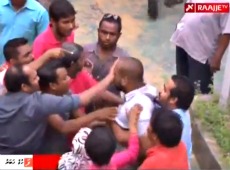
During the time of voting, local TV station Raajje TV captured a brief scuffle on camera between supporters of the two presidential primary candidates.

The footage shows police being brought in to control the crowd, who are dressed in the party’s pink colour scheme.

Yameen told local media shortly after casting his vote outside the Aminiya School in Male’ that despite the minor conflicts, the party would not split.

“Overall, the voting is alright. But people from within the party have entered voting centres and have tried to start fights,” he was quoted as saying in Sun Online.

“They have raised they voices, used foul language, this should not happen in an internal election. It is very sad.”

PPM’s elections committee has said that the party will announce the official results of the election within a week’s time.  Chair of PPM’s Election Committee, Mohamed Tholal said that the election took place in a very peaceful environment and the voting proceeded very swiftly.

Meanwhil,e former President of the Maldives and PPM president Maumoon Abdul Gayoom, called for PPM members to show the world what a “responsible party” the PPM was during Saturday’s primary.

Gayoom also said following the elections that he would work with PPM members to see its candidate win the presidential election.

Likes(0)Dislikes(0)

Yameen elected as PPM presidential candidate

Progressive Party of Maldives (PPM) Parliamentary Group Leader Abdulla Yameen has been elected as the party’s presidential candidate to compete in the upcoming national elections.

The preliminary results of the PPM’s presidential primary reveal that Yameen won with a total of 13,096 votes, beating rival candidate Umar Naseer’s 7,450 votes – a 63 percent majority, according figures quoted by local media.

A total of 31,298 PPM members were eligible to vote in the party’s presidential primary through one of the 167 ballot boxes placed in 140 islands, Sun Online reported.

Umar Naseer accepted defeat: “If it’s a free and fair election, I will always accept the final result. I believe so far the election has been fair. As I said we will know how to proceed once we assess the complaints,” he told Haveeru.

“The party won’t be divided. I believe this will further strengthen the party as this exercise shows the strength of democracy within this party.”

Former President of the Maldives and PPM President Maumoon Abdul Gayoom congratulated his half-brother, Yameen, via Twitter following the announcement of the results.

Gayoom had urged party members to take part in Saturday’s election, despite not casting a vote himself in order to remain “neutral”.

During the voting period on Saturday (March 30), Yameen told local media that certain party members had been seen inside voting centres in Male’ using foul language in an attempt to start fights and create disorder.

Private media outlet Raajje TV captured a brief scuffle on camera between supporters of the two presidential primary candidates Umar Naseer and Abdulla Yameen.

The footage shows police being brought in to control the crowd, who are dressed in the party’s pink colour scheme.

Yameen told local media shortly after casting his vote outside the Aminiya School in Male’, that despite the minor conflicts, the party would not split.

“Overall, the voting is alright. But people from within the party have entered voting centres and have tried to start fights.

“They have raised they voices, used foul language, this should not happen in an internal election. It is very sad,” Yameen was quoted as saying in Sun Online.

On Friday (March 29), Yameen’s half brother, former President of the Maldives and PPM president Maumoon Abdul Gayoom, called for PPM members to show the world what a “responsible party” the PPM is during Saturday’s primary.

Slanderous accusations

The recent internal disorder among rival supporters follows a month of increasingly heated rhetoric between the two presidential candidates.

Earlier this month, Yameen responded to several accusations made against him, claiming the “stories” to be untrue.

“I have been accused of holding large sums of money in different accounts. I’m not responding to these allegations. But the people who work with me need public confidence.

“I want to say to you, that there are several allegations targeted at me. But those allegations are baseless and unfounded. None of those stories are true. Don’t believe them,” Yameen was quoted as saying in local media.

A spokesperson for Abdulla Yameen’s ‘Yageen’ campaign team told local media on March 23 that Umar Naseer had made slanderous and “blatantly untruthful” statements about Yameen during a recent rally.

Speaking at the aforementioned rally, Naseer claimed that Yameen’s campaign team is forced to play “80 percent in defence” in order to denounce the public’s claims against him.

“We heard our brother MP [Ahmed] Nihan speaking at Yameen’s campaign rally. All he did was try to denounce what the public says about Yameen,” Naseer said at a rally held on March 15.

“Nihan said that although people allege Yameen has ties with gangs and gang violence it is not true. He said that although people say Yameen bathes with mineral water, that isn’t true either.”

An MP is trying to frame me: Umar Naseer

Earlier in March, Naseer claimed that he had received “intel” that an attempt would be made to “assassinate” his character by planting illegal substances in his offices.

Following Naseer’s initial claims, he told supporters at a rally on March 15 that an MP involved in the illegal drug business was attempting to “frame him”.

“[The MP] tried to ruin my reputation by sending police to my business offices in the pretence of looking for illegal substances. I do not get involved in such acts.

“I will not name the MP, I do not need to name him here. He is trying to hide the relations he has with gangs and his involvement in the illegal drug business.”

On March 17, a police source told Minivan News that a bottle of alcohol had been found in a car belonging to Naseer’s wife when searched by police.

Despite Umar Naseer’s comments, former President Gayoom tweeted earlier this month that external influences were attempting to split Yameen and Umar apart.

“Some people from outside PPM are trying hard to drive a wedge between Yameen and Umar. All PPM members please be alert to this,” Gayoom tweeted.

Likes(0)Dislikes(0)

President Waheed to form election coalition with religious conservative Adhaalath Party

President Dr Mohamed Waheed has announced plans to form a coalition between his Gaumee Ithihaad Party (GIP) and the religious conservative Adhaalath Party (AP), ahead of presidential elections scheduled for later this year.

Writing on his personal Twitter account Thursday (March 28), President Waheed welcomed the support of the  AP, while expressing hope other undisclosed parties would be making similar announcements at a later date.

The AP tweeted the same day that its council have approved the coalition with the current president ahead of the September this year.

By yesterday (March 29), the AP tweeted that it aimed to “form a large, strong coalition” including other parties in the country to try and provide stability and prosperity in the Maldives following the presidential race.

The AP, one of five parties in the country meeting a recently approved regulation requiring any registered political body to have 10,000 registered members, is part of the coalition government of President Waheed following the controversial transfer of power that brought him into office in February 2012.

Both Adhalaath and GIP do not presently have any elected members in parliament.

The religious conservative party was previously a coalition partner in the government of former President Mohamed Nasheed, later leaving the government citing concerns at what it alleged were the irreligious practices of the administration.

This led the AP in December 2011 to join then fellow opposition parties – now members of Waheed’s unity government – and a number of NGOs to gather in Male’ with thousands of people to “defend Islam”.

During the same day, Nasheed’s MDP held their own rally held at the Artificial Beach area in Male’ claiming his government would continue to practice a “tolerant form” of Islam, reminding listeners that Islam in the Maldives has traditionally been tolerant.

“We can’t achieve development by going backwards to the Stone Age or being ignorant,” Nasheed said at the time.

Shortly after coming to power in February 2012, flanked by members of the new government’s coalition, President Waheed gave a speech calling on supporters to “Be courageous; today you are all mujaheddin”.

GIP Spokesperson Abbas Adil Riza, President’s Office Media Secretary Masood Imad and President of the Adhaalath Party Sheikh Imran Abdulla were not responding to calls regarding the coalition announcement today.

Diverging opinions

Despite the agreement to cooperate between the two parties, Waheed and the AP differ in their reaction to the recent controversial sentencing of a 15 year old rape victim to 100 lashes for fornication with another man.

President Waheed’s  stated on his official Twitter account at the time: “I am saddened by the sentence of flogging handed to a minor. Govt will push for review of this position.”

The Foreign Ministry subsequently expressed “deep concern by the prosecution and the Juvenile Court’s sentence to flog a 15 year-old girl on the charges of pre-marital sex.”

“Though the flogging will be deferred until the girl turns 18, the government believes she is the victim of sexual abuse and should be treated as such by the state and the society and therefore, her rights should be fully protected. The Government is of the view that the case merits appeal. The girl is under state care and the government will facilitate and supervise her appeal of the case, via the girl’s lawyer, to ensure that justice is done and her rights are protected,” the Ministry stated.

The President’s Office also recently announced it was looking at the possibility of bringing about reform to potentially bring an end to the use of punishments like flogging in the country’s justice system.

However the Adhaalath Party has publicly endorsed the sentence, stating that the girl “deserves the punishment”, as outlined under Islamic Sharia.

The party, members of which largely dominate the Maldives’ Ministry of Islamic Affairs, stated that the sentence of flogging had not been passed against the minor for being sexually abused by her stepfather, but rather for the consensual sex to which she had confessed to having to authorities.

“The purpose of penalties like these in Islamic Sharia is to maintain order in society and to save it from sinful acts. It is not at all an act of violence. We must turn a deaf ear to the international organisations which are calling to abolish these penalties, labeling them degrading and inhumane acts or torture,” read a statement from the party.

“If such sinful activities are to become this common, the society will break down and we may become deserving of divine wrath,” the Adhaalath Party stated.

Coalition potential

Of the parties yet to announce candidates to stand during the upcoming presidential elections, Dr Hassan Saeed, Leader of the government-aligned Dhivehi Qaumee Party (DQP) and People’s Alliance MP Ahmed Nazim were not responding to calls regarding President Waheed’s announcement today.

Earlier this month, the government-aligned Dhivehi Rayithunge Party (DRP) ruled out a coalition with the Progressive Party of Maldives (PPM) ahead of elections, despite being open to collaboration with other parties.

Both the PPM and DRP serve within President Waheed’s national unity government.

The DRP has also previously ruled out a collaboration with the opposition Maldivian Democratic Party (MDP).

Likes(0)Dislikes(0)

Nexbis not consulted over US border control deal

Malaysian mobile security firm Nexbis has said it has not been consulted or provided any details regarding a Memorandum of Understanding (MOU) signed Thursday (March 28) by the US government, to provide a border control system to the Maldives.

Representatives for the Malaysian company said it was uncertain what the MOU would mean for the group’s own border control technology that has been in use since September 2012, as part of a troubled concession agreement with the Maldives government.

Nexbis signed a “legally binding” deal in 2010 to provide a customised border control system under a ‘build, operate and transfer’ agreement to Maldivian authorities that still remains in use at present. The deal is presently the subject of legal wrangling over whether the Anti-Corruption Commission (ACC) has the power to demand termination of the contract. Parliament has also voted to cancel the system, but this is subject to a court injunction.

Earlier this week, Immigration Controller Dr Mohamed Ali said it was too early to tell if the new border controls being provided for free by the US would be a direct replacement for the system provided by Nexbis.

Lawyers representing the Malaysian firm have told Minivan News that official enquiries had now been sent to the Department of Immigration and Emigration and the Maldives Ministry of Defence, while attempts were also being made to contact the government over where their agreement now stood.

“We do remain confident that the Maldivian government will honour its obligations under the 2010 concession agreement,” read a statement from lawyers representing the company.

“We are confident also of the support we have received by the Immigration Department in implementing and fully operating the system, but remain cautious of individuals that continue to pose obstacles to prevent the success of this project is stemming the national security issues faced by the Maldives today.”

The border control system project contract was awarded to Nexbis for a period of 22 years by the previous government, however, parliament voted unanimously to terminate the agreement in December 2012 over allegations of “foul play”.

Nexbis has refuted allegations of corruption, later seeking a legal injunction in the country to prevent any cancellation of the agreement while court hearings over the contract were still ongoing.

Under the concession agreement, Nexbis’ lawyers said the company continues to work with the Maldives government and immigration department to personalise the system and its various components.  The company claimed the developments were a result of its own investment in the project, with the implementation taking place at no direct cost to the government.

Under the agreement, Nexbis agreed to levy a fee of US$2 from arriving and departing passengers in exchange for installing, maintaining and upgrading its immigration system, and a fee of US$15 for every work permit card issued.

Lawyers for the company added that it planned to continue working with state officials on developing the system going forward.

“There are more features and functionality of the system that will progressively be rolled out by the Department of Immigration for nationwide enforcement, foreign worker management and automation as well as further enhancements to security that will aid the government to address human trafficking issues and illegal foreign workers,” read a statement from Nexbis representatives.

US agreement

Defence Minister Mohamed Nazim and US Ambassador to Sri Lanka and the Maldives Michele J Sison signed an MOU that will see a US technical team coming to the country next month to begin work on planning and implementing a border system, according to local media.  The system is scheduled to be installed by June this year.

Defence Minister Nazim said during the signing that the system proposed under the MOU would be provided free of charge to the Maldives in a move he estimated would save the country MVR500 million (US$35 million), according to Sun Online.

Minivan News was awaiting a response from Nazim at time of press.

Local media reported that the border controls would be based around the US Personal Identification Secure Comparison and Evaluation System (PISCES).  The same technology is reported to be used not only at US airports, but in a number of other countries including Pakistan, Afghanistan, Iraq and Thailand.

Maldivian staff are also expected to receive training on using the biometric-based system, as well as assistance with any expansion to the system in future, Sun Online has reported.

Immigration sources had told Minivan News earlier this month that the country faced a potential return to “pen and paper” border controls should the government be made to cancel its agreement with Nexbis without an adequate replacement.

Nexbis has meanwhile refuted allegations of any corruption or wrong-doing in the awarding of the contract, and said it would not rule out criminal involvement behind attempts to “sabotage” the deal.

Likes(0)Dislikes(0)

Amputation for theft added to draft penal code

The draft penal code bill has been amended to include punishments as prescribed in the Quran, such as amputation for theft.

The new article added during a parliamentary committee meeting Thursday (March 28) states that if someone convicted of a crime requires legal punishment, as specified in the penal code, that person will face punishment as stated in the Quran.

MP Imthiyaz Fahmy clarified the amendment to the draft penal code is about hadd punishments only and “not at all” about all Sharia offences, speaking with Minivan News today.

“Hadd offenses are already crimes in the draft penal code. However the prescribed punishments in Sharia for those particular crimes are not codified in the draft penal code, but instead they are left up to the interpretation of Sharia,” stated Fahmy.

“But to completely evade making a reference to hadd punishments or to mention that no hadd punishment at all should be imposed is impossible to the the fact that Sharia shall be one of the basis of all the laws of the Maldives,” he added.

Criminal punishments are detailed for murder, fornication, thievery and drinking alcohol.

The committee’s chairperson, MP Ahmed Hamza, told Sun Online the new draft penal code will require amputating persons convicted of theft, while a person convicted of apostasy (renouncing Islam) will also face punishment.

The bill does not include apostasy as a crime, therefore someone found guilty of this offense cannot be subjected to Quranic punishment, committee member MP Ahmed Mohamed clarified.

Gambling is also not criminalised, according to committee member MP Abdul Azeez Jamaal Aboobakuru. He told local media that the bill does not “state a manner in which such crimes can be convicted”.

Fahmy explained that Sharia law does not prescribe a hadd punishment for gambling.

The penal code draft bill does include factors that must be considered before convicting a person of murder; for example, any contradictory evidence would prevent such a conviction.

Imposing the death penalty cannot be subject only to the confession of the accused.

“Sharia does not run headlong into death penalties, amputation or stoning to death. Therefore depending on the circumstances, Sharia may avoid capital punishments,” said Fahmy.

He further clarified that Sharia punishments may be interpreted according to any of the schools of Sunni Muslims.

While interpretation of Sharia law punishments are within the purview of Maldivian judges, Fahmy believes that the current judicial system is incapable of providing Maldivian people justice, even with the new penal code.

“I do not believe the judiciary and the criminal justice system in the Maldives is capable of doing justice or able to take care of the new penal code. The judiciary is unable to ‘keep up with the Jonses’,” Fahmy stated.

The parliamentary committee’s additions to the bill follow its rejection of all but one amendment suggested by the Fiqh Academy of the Maldives.

Speaking to local media on Monday (March 25), Hamza said the committee had decided to accept only a suggestion concerning the offence of theft. Other amendments, he said, were merely changes to the wordings of the bill and carried little legal weight.

“They have submitted amendments to abolish certain sections. These include certain legal defences. When we looked into removing those defences, we found this impacted fundamental principles embedded to the draft penal code. So we decided to reject their suggestions,” he stated.

Following the decision, Vice President of the Fiqh Academy Sheikh Iyas Abdul Latheef told local newspaper Haveeru that the academy had informed parliament that current draft penal code should not be enforced in the country.

“The current draft does not include the Hadds established under Islamic Sharia. There is no mention of the death penalty for murder, the punishment of stoning for fornication, the punishment of amputation for theft and the punishment for apostasy. We proposed amendments to include these punishments,” Latheef stated.

Comments submitted by the United Nation agencies in the Maldives, Human Rights Commission of the Maldives (HRCM), and Attorney General are being considered and incorporated into the draft text.

The initial draft of the penal code was prepared by legal expert Professor Paul H Robinson and the University of Pennsylvania Law School of the United States, upon the request of the Attorney General in January, 2006. The project was supported by the United Nations Development Program (UNDP).

Professor Robinson’s team have published two volumes (Volume 1 and Volume 2) consisting of commentaries on sections of the draft bill.

The bill was first sent to the Majlis (parliament) in 2006 and will replace the 1961 penal code.

The penal code bill is being forwarded to the parliament floor this upcoming week, according to local media.

False preaching regarding rape and fornication

The parliamentary committee slammed the “false preaching” of the Chair of Adhaalath Party’s Scholars Council Sheikh Ilyas Hussain over the bill earlier this week.

Sheikh Ilyas declared that the new penal code does not recognise fornication with mutual consent as an offence.

MP Nazim Rashaad contended that whether sheikh or not, nobody could misinterpret the clause and claim that the bill did not recognise “mutually consented sexual intercourse” as an offence, and accused the Sheikh of lying to discredit the bill and parliament.

Briefing committee members on the sections concerning sexual offenses, Rashaad stated that under the draft penal code, both fornication and rape are offences under section 411 of the draft bill.

The existing penal code does not explicitly recognise “rape” as a crime, and cases are handled under provisions for sexual offences.

Likes(0)Dislikes(0)

US invites Maldives delegation aboard USS John C Stennis aircraft carrier

Senior government officials were invited aboard a United States aircraft carrier on Wednesday (March 27) as it passed by the Maldives.

The visit was followed by the signing of a Memorandum of Understanding (MOU) between the Maldives and the US government on Thursday to install a free border control system in the country.

Tourism Minister Ahmed Adheeb, Defence Minister Mohamed Nazim, Home Minister Mohamed Jameel Ahmed, Police Commissioner Abdulla Riyaz and Vice President Mohamed Waheed Deen, were flown to the USS John C Stennis aircraft carrier as part of an arrangement between the US embassy and Maldives Defence Ministry.

The visit was documented by the ministers, who posted photographs on social media site Twitter.

Likes(1)Dislikes(1)