Dhiraagu shares to sell on Maldives stock exchange

Local telecommunications provider Dhiraagu will sell shares to the public via the Maldives Stock Exchange (MSE) starting next Thursday.

Government shares have meanwhile been sold to all applicants.

Of its 11.4 million shares, Dhiraagu has sold 41 percent under the Initial Public Offering (IPO) at a rate of Rf80 (US$5.2). The IPO became effective on December 25, 2011.

The government lately released 48 percent of its shares, which had a value of approximately Rf376 million (US$24 million). Of those shares, 15 percent were set to be sold and 4.7 million have been sold, reports Haveeru.

Most government shares were purchased by the Pension Administration Office, the State Trading Organisation (STO) and Allied Insurance.

Foreign investors may also purchase Dhiraagu shares.

Likes(0)Dislikes(0)

Police push back protesters with tear gas

A third night of protests in the capital Male’ forced the government to deploy defence forces to guard the residence of President Mohamed Nasheed, as hundreds of demonstrators clashed with police following the arrest of Dr Mohamed Jameel, Deputy Leader of minority opposition Dhivehi Qaumee Party (DQP) and Criminal Court Cheif Judge Abdulla Mohamed.

The protesters gathered outside police headquarters following the arrest of Jameel last night, for the second time this week.

At last night’s demonstration began around 9:00pm, as protesters led by opposition MPs yelled for the release of Jameel and Chief Judge Mohamed, who was detained by the military.

Minivan News reporters witnessed protesters continue to penetrate the line of shielded police patrolling the headquarters – ignoring repeated warnings by police. They yelled for the  resignation of President Nasheed, Police Commissioner Ahmed Faseeh and Home Minister Hassan Afeef.

Police responded with tear gas and marched forward, pushing back the crowd to the Maldives Monetary Authority (MMA), where they continued to protest.

A policeman, who was reportedly injured after being pushed by some protestors, was rushed to hospital.

Minivan News also witnessed crowds apprehend and smash up a pickup registered to Male City Council, which has a ruling Maldivian Democratic Party (MDP) majority.

Meanwhile, around 15 or so Maldivian Democratic Party (MDP) activists faced the crowd of opposition protester, leading to direct confrontation between the two groups.

As some ran away from crowd, a few were seen falling to the ground. Police meanwhile intervened to control the violence and arrested some protesters. Crowds dispersed shortly afterwards.

However, pockets of demonstrators continued to roamed around the streets, uprooting the coconut palms planted by the city council.

DQP member Didi was reportedly attacked by MDP activists and suffered cigarette burn marks to his neck. He was treated at the ADK hospital.

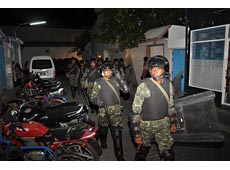
MNDF officers guarding Muleaage

Meanwhile opposition protestors marched towards President Nasheed’s residence Muleaage, which was guarded by the defence forces.

Protestors faced the guards, yelled for President’s resignation calling him a “dictator”. However, they turned back after repeated attempts to break the defence line of defence guards failed.

Few gathered near Home Minister’s house, which was also guarded by police and defence.

The protests slowly receded into the morning.

Police media official Sub-inspector Hassan Haneef confirmed eight were arrested last night, including a woman, and all were released afterwards.

As political parties’ vowed to continue protests as long as the government pursue actions against the opposition leaders, Haneef said that “to ensure stability, police will continue to take measures according to the constitution and laws”.

Likes(0)Dislikes(0)

Sri Lankan tourism model could benefit local industry and exposure

While Maldives niche market continues to draw elite dollars, Sri Lanka’s tourism industry earned more money in 2011 than its island neighbor, statistics suggest. However, the Maldives’ move into the mid-market sector could expand horizons for budget travelers and Maldivians alike.

On January 6, Reuters reported that Sri Lanka’s tourist arrivals hit a record high in 2011 with a 30.8 percent jump to 855, 975; in 2010, the country experienced a 64.8 percent jump. Sri Lanka’s state revenue from tourism also rose by 46.7 percent to US$735.7 million in the first 11 months of last year.

Meanwhile, the Maldives has seen its own tourist arrivals jump to a record high of 1 million in 2011 – triple the country’s population.

The elite level of a Maldives vacation would suggest an elite revenue; use of the airport alone costs the 1 millions tourists approximately US$18 apiece, bringing US$21 million to the State last year. Yet in spite of the higher arrival rate, Maldives Inland Revenue Authority (MIRA) statistics estimate state revenue from tourism in 2011 at US$374 million–half its neighbor’s intake.

MIRA’s statistics are subject to two wild cards–the newly implemented Goods and Services Tax (GST) which left many items undeclared, and the possibility that some yachts aren’t declaring their total profits. Corruption is also a concern across the region, in which many countries have developing government infrastructure. “In the old days, there was no tax or GST,” said Managing Director of Maldives Marketing and PR Corporation (MMPRC) Simon Hawkins. “But now we have an accounts footprint from the GST, which will be available by 2013, so we will have a better idea of how money is being spent and where it’s going,” he added.

In addition, Sri Lankan nationals have more options for travel within their own country than the average Maldivian does among the islands. Even for Maldivians who could afford a resort trip, the un-Islamic stigma of the resorts is socially prohibitive and limits domestic tourism.

While Finance Ministry officials have been unable to clarify the discrepancy, Sri Lankan officials have pointed to the grassroots nature of their own tourism industry.

Listing the variety of vacations available in Sri Lanka, one official noted that the tourism industry is integrated into the local culture, and money paid to guest houses, restaurants and cultural and entertainment services goes directly into the economy.

By contrast, a Maldivian vacation typically happens on an island isolated from local culture and economy, feeding chunks of revenue to the expatriate workers and foreign investors who dominate resort operations.

While both countries compliment each other, Maldives is hard to beat, said Hawkins.

“Most people who go to Sri Lanka are backpackers. The beaches are okay, but people go for the cultural experience,” he said. “The most common package is the honeymooners who want to spend a week in Sri Lanka and a week in the Maldives. The general consensus is its more expensive in the Maldives but its worth it.”

According to State Minister of Tourism Thoyyib Waheed, the Maldives elite niche is a product of high-stakes bidding.

“In the last five years the government has given away many islands to the highest bidder. Because of that process, the winning bidder cannot develop a resort for the mid-market. To earn a return on the investment, the bidder has to aim for the high-end market,” he said.

Pointing to the dwindling arrivals from Europe, Waheed explained that during the global recession tourism operators have more Europeans requesting budget vacations.

“They’re looking for those rooms, especially the UK market, but we don’t have them. We need to provide for that charter market.”

While Sri Lanka may attract more budget backpackers, statistics suggest it is also pulling more of the Maldives’ main markets – flush Europeans and curious, recession-proof Asians.

In 2011, Western European arrivals jumped 22.7 percent, accounting for over ⅓ of tourist arrivals that year. South Asian arrivals jumped 35.3 percent, rivaling their Western European counterparts, government data suggests.

As a result, “the government is targeting annual revenue of $2.75 billion by 2016 from 2.5 million expected visitors attracted by Sri Lanka’s beaches, hills and religious and historic sites, while aiming for $3 billion in foreign direct investment,” Reuters reports.

Looking ahead to 2012, Sri Lanka is expecting a revenue in excess of US$1 billion – a 20 percent increase from 2011.

Deeper in the Indian Ocean, the Maldives appears to be edging into the mid-market sector.

According to State Minister Waheed, land lease rates have dropped from previous levels to encourage more mid-market tourism projects–and benefit the local economy. “The President’s view is, why can’t tourists come and stay in an empty room of a local home? There are so many empty rooms on the islands, everyone shouldn’t come and stay in a resort. In Germany tourists can stay in bed & breakfasts. In Maldives, it doesn’t have to be five-star.”

According to MMPRC, 88 percent of Maldives hotels are four star and above, giving it the highest propensity of hotels in terms of the high-end market anywhere in world. It also enjoys the highest occupancy rate (75 percent) world-wide.

While Maldives will maintain its one island, one resort image, it is aiming for more variety. Two projects in Laamu Atoll Gan are actively moving in that direction.

J Hotels and Resorts is expected to bring two 300-bed hotels and 69 guest houses to the 25 hectare area along with recreation activities, water sports and restaurants. Tourism Minister Dr Maryam Zulfa has said the Ministry is keen to see the Asseyri Project succeed.

“Right now we can’t cater to the mid-market tourists who want to have options when they make a trip to or within the Maldives,” Zulfa explained. “This will give them that opportunity. And the basis of the project will be the natural beauty – the beach, lagoon and reef are absolutely fantastic.”

She added that commercial components of the area would be rented out to different parties, thus involving more local entrepreneurs in the Maldives tourism-based economy.

In February, Reveries Boutique will become the first resort to open on a local island. Offering rooms available for under US$200 and the option of strolling into town for fish curry or mashuni, management aims to “explore the idea that parts of the Maldives are open for people of all types.”

Locals stand to gain in both income and experience.

Allowing guest houses in local islands would bring more jobs and new businesses to those areas while raising the rate of interaction between locals and tourists. Waheed added that the government is taking steps to help tourists navigate the country, rather than remain stationary on resort islands.

The same rule applies to Maldivians.

While Maldivians don’t normally go for vacation in the Maldives, they do spend high amounts abroad, “although vacations are often combined with medical treatments”, Waheed pointed out. High domestic costs also make international travel an attractive alternative–a return flight to Addu can cost more than the airfare to Colombo and back.

Although inter-island transport has improved in recent years, “locals don’t really know where to go or where to stay,” said Waheed. “The steps we are taking now will give locals more opportunities to travel around the Maldives.”

In August 2011, Sri Lanka’s “The Sunday Times” advised the nation to follow the Maldives’ lead.

“Resorts in the Maldives charge rates from US$200-300 upwards to over $1000 per night, and the authorities are now looking to attract the mid-market clientele which is also Sri Lanka’s market – though the two markets have different attractions”, read the article.

While Sri Lanka’s product is less luxe its method appears to bring more to the government, and theoretically the people working in the tourism industry. Moving into the mid-market sector could open opportunities for Maldivians seeking to gain a slice of the nation’s highest-earning industry, as well as offer them more exposure to their own country.

Likes(1)Dislikes(0)

Islamic Minister to investigate “Christian missionary” allegations against the State

Minister of Islamic Affairs Dr Abdul Majeed Abdul Bari has consulted with President Mohamed Nasheed on allegations that the government has cooperated with Christian missionaries in an effort “to wipe out Islam”.

“The President is now considering the best way forward,” said Press Secretary Mohamed Zuhair. “He will either form an independent commission to address the issue, or allow the Islamic Minister to consult with his colleagues. The Islamic Minister will advise the President in the matter.”

The consultation is in keeping with the government’s commitment to share decisions of religious matters with Islamic scholars.

Speaking to local media today, Dr Bari said “The President called very late yesterday and said he would request the Ministry to look into the allegations to understand the truth.” At the time, Bari had not received a formal letter stating the request but said he would cooperate with the request upon receiving such a document.

The Minister and officials at the Islamic Ministry could not be reached at time of press.

Over the past week, members of minority opposition Dhivehi Quamee Party (DQP) Dr Mohamed Jameel Ahmed and ‘Sandhaanu’ Ahmed Ibrahim Didi have accused the government of cooperating with “Christian missionaries” and “Jewish parties” against the state religion of Islam- Didi claimed the President was “a madman and a Christian”- and of spreading undue fear with the claim that the islands are sinking.

Both men have been repeatedly summoned for police interrogations, prompting protests outside police headquarters and the Presidential Palace.

Speaking today with Minivan News, Zuhair called the allegations “a big lie that has been repeated since 2003, when Maldivian Democratic Party (MDP) began to work abroad.”

He added that the claims were also raised in the run-up to the 2008 presidential election, in which currently ruling MDP won the election over the 30-year administration of Maumoon Abdul Gayoom.

“At that time Dr Hassan Saeed had made these allegations and the government carried out a full-scale, professional investigation in the United Kingdom. The ‘Operation Druid’ found no substance to any of the allegations. There was no evidence of any contact with Christian missionaries or priests. So it is surprising that members of Saeed’s party are again repeating these allegations,” Zuhair observed.

Operation Druid

In 2007, Maumoon Abdul Gayoom’s government contracted UK security and private investigation firm Sion Resources for a surveillance operation dubbed ‘Operation Druid’. According to the former Foreign Minister Dr Ahmed Shaheed, Gayoom “had concerns” about the origins of the Maldivian Democratic Party (MDP), exiles from which had fled to Salisbury where they had been sheltered by Nasheed’s high school alumni, David Hardingham.

Hardingham, founder of the Friends of Maldives NGO, and Sarah Mahir had previously ambushed Gayoom in the UN building in Geneva in May 2005, accusing him of complicity in human rights abuses.

“I think Gayoom was quite shaken by that, and afterwards he was not as complacent over the security given to him by his hosts, be that by the UK or UN,” Dr Shaheed told Minivan News, in an interview in June 2011.

Subsequently, “The government may have wanted to see what was going on [in Salisbury],” Dr Shaheed said.

“What these operations did was try to see who was who. And a lot of the operations the government felt were against it came from Salisbury, and I think the government of the day felt justified in engaging a firm to look into what was going on,” he said. “They felt they needed to check on that, and what came out was a clean bill of health. Nothing untoward was happening, and these people were by and large bone-fide.”

Back in the Maldives, Gayoom’s government released a leaflet accusing Hardingham and Salisbury Cathedral of conspiring to blow up the Islamic Centre and build a church.

It was just a mischievous suggestion, a very mischievous suggestion,” Dr Shaheed acknowledged. “At the time everyone was accusing each other of being non-Muslim, and this accusation that the MDP was non-Muslim was getting very loud.

“There is this very, very deep reaction to anything un-Islamic in this country, and you can use Islam as a political tool quite easily. Therefore these allegations become political charges.”

Former Conservative Party MP for Salisbury, Robert Key, who had been instrumental in getting Nasheed an audience in British parliament, told Minivan News in February 2011 that Salisbury Cathedral had taken the accusation “at face value” .

“It was not true, and therefore we had to say ‘It is not true,'” he said. “The Dean of Salisbury Cathedral understood the issue, she took it at face value, and we sought security advice as necessary. But it was never a serious threat. It was a juvenile political ploy.”

For his part, Hardingham has dismissed the allegations that he is a Christian missionary as “absolute nonsense – I have never been a priest or anything associated with any church, and I challenge the people making the allegations to provide a shred of evidence to support their case.

“I was refused entry into the Maldives in April 2005. Government spokesperson at the time, Mohamed Hussein ‘Mundhu’ Shareef, told Associated Press that this was due to my involvement with an Islamic extremist group. So I have been accused of being an Islamic extremist and a Christian missionary – probably the fastest and most radical conversion in history.”

Government respects religion

Citing the Maldives’ commitment to be an Islamic state, Zuhair today pointed out that it was the government’s public responsibility to clarify that the allegations against it were baseless.

“Not only do these statements refer to the government, they also refer to our members and supporters and their respect for our religion”, he said, adding that the allegations involving Jewish parties came close to anti-Semitism – “and we don’t want to spread that image.”

In its efforts to staunch DQP’s “hate speech”, the government has drawn criticism from main opposition Dhivehi Rayyithunge Party (DRP) and Progressive Party of Maldives (PPM) for “suppression of the constitutional right to free expression”.

Speaking previously at a press conference held in response to the allegations, which were broadcast on DhiTV news on January 8, Zuhair called “spreading baseless and demonstrably false claims” about the government a “criminal offence”, and the coverage of demonstrably false allegations of foreign religious influence a “violation of journalism ethics”–statements which drew prompt criticism from media associations and opposition parties.

“The government will not allow anybody to be influenced by the crime of incitement,” Zuhair clarified today, explaining that the opposition had put the media in a position of defending the general freedom of expression in order to promote their own agenda.

“It is very easy for any Maldivian or journalist to find out about the Druid operation or to see if we have been accepting payments from a Christian priest. Ask us. What is surprising is that this story has been going on for a week and yet none of the media have found out or reported what the grounds for the allegations are,” Zuhair said. “It’s part of journalistic integrity to at least get the five W’s right: who, what, where, when and why. Why are they being fooled?”

According to Zuhair, the findings of the Ministry of Islamic Affairs and the court will be necessary to resolve the matter.

The matter continues to be investigated by the police, who have now summoned Didi and Jameel for four consecutive nights. Meanwhile, a protest supporting the freedom of expression has been scheduled for the Artificial Beach this evening.

Likes(0)Dislikes(0)

Maldivian Air drops three flights from weekly schedule

Maldivian flights to Fuvahmulah have been reduced to four days a week due to a decrease in demand for passage to the single-island atoll.

Maldivian previously operated daily flights due to an increased demand during the holiday season of October through December.

The new airline officially began operating scheduled flights to Fuvah Mulah’s newly opened airport in November 2011.

Flights are now scheduled for Saturday, Sunday, Tuesday and Thursday, Haveeru reports. Additional flights may be added according to passenger demand.

Likes(0)Dislikes(0)

Ferry services accomodate medical staff shortage

Ferry services in Raa Atoll are helping the Rasgetheem community cope with dwindling medical staff.

With the island’s only doctor on a four-day leave, medical services beyond simple blood pressure tests have been suspended. Meanwhile, the clinic’s nurse remains on duty to provide basic services to Rasgetheem’s 952 residents.

Although the lack of a doctor would seem insupportable for any community, a Rasgetheem council member said new ferry services have accommodated the inconvenience.

“Since the ferry opened people are choosing to go to Ungoofaru, it’s only one-and-a-half hours by ferry”, she pointed out.

The council member said a second doctor had been requested, however the council understood that none were available.

Of Raa Atoll’s 15 inhabited islands, none have more than one doctor and there is no back-up physician to fill in when doctors go on leave. In most cases, island doctors are limited by skill set and technology.

Ungoofaru Regional Hospital Assistant Manager Hussain Shiham said medical staffing was one of the atoll’s biggest concerns.

“Staffing here is very weak, especially doctors. Right now Raa atoll, Noonu atoll and Baa atoll don’t have gynecologists. Raa atoll doesn’t have a dentist or an orthopedist. We have applied for over 19 medical personnel, but the medical council hasn’t approved any,” said Shiham.

Shiham explained that the regional hospital has requested staff, even submitting applications for positions received from medical professionals in Italy, Russia and the Ukraine. “But the medical council won’t accept Russian graduates because their school system isn’t registered internationally,” he said.

When asked about the Atoll’s relationship with the medical council, Shiham said he was unclear about the election process and supposed that council members had political motivations.

Assistant Director of the Ministry of Health and Family, Fathimath Lamiya, said new hires had been delayed by flaws in the recruitment process which exposed communities to medical malpractice, but corrected that the changes had not created the current staff shortage.

Previously, she explained, members of the health sector assumed that approval to recruit staff members was equivalent to approval to practice medicine.

“The councils are mandated to regulate health professionals and ensure that they meet certain standards,” Lamiya said. “In most countries you have to be registered with a board or council to certify that you are able to practice. Many weren’t, but now they are being registered.”

New regulations under the Health Ministry aim at reducing the time, cost and risk of hiring foreign medical staff.

“All candidates will submit qualifications to get approval, but now they can use photocopies rather than original documents,” Lamiya said, adding that the previous system requiring original documents involved candidates coming into the Maldives and, if not approved, receiving a paid flight home at the Maldivian employer’s expense.

“Now, candidates will get their recruitment approval before they arrive, the Human Resources Ministry will require that approval to issue a visa, and upon arrival they can register with their original documents in the island councils,” Lamiya said.

She observed that the shortage of medical staff was a concern, but hoped the new process would ensure that good doctors are hired.

Meanwhile, Shiham said, health professionals on Raa Atoll make ends meet.

“Ferry rates have dropped significantly, so people are coming more and more to the regional hospital,” he said, acknowledging that the service has boosted cooperative efforts among the islands.

“If a person has a serious health condition [when the doctor is away], then people will get a launch to take him to a nearby island. The nearest is only three minutes away. A nurse is usually in a health center nearby, and I think we can provide services”, he said.

For services beyond the capacity of the regional hospital, Shiham said a four hour ferry to Male’ was available for Rf 580 (US$35).

Likes(1)Dislikes(0)

Kanditheemu islanders suspect sorcery at remote site

An area believed to be a sorcery site has been found in Shaviyani Atoll Kanditheemu, raising the islanders’ level of speculation of sorcery practices.

Kanditheemu Island Council has told local media that an old man found a suspect area on the island jungle’s south side.

Council officials confirmed that the area had been found, but said no official report had been made to the council.

Officials noted that curious islanders found flowers supposedly used to cast spells at the site.

Although the council maintained that fear of sorcery was not a serious issue on the island, it noted that a Facebook group alleging that six people had had spells cast on them had been created to counter the spread of sorcery, local media reports.

Likes(0)Dislikes(0)

Protests to continue as DQP vows to sue government, police

The recent arrest of Dhivehi Qaumee Party (DQP) council members over “slanderous allegations” have increased political tensions in Male’, prompting a series of opposition led protests.

The Vice President of Dhivehi Qaumee Party (DQP) Dr Mohamed Jameel and council member Sandhaanu’ Ahmed Ibrahim Didi was repeatedly summoned to the police headquarters and interrogated in the past four nights, after the President’s Office requested a police investigation into “slanderous” statements made by the pair, alleging the government was working under the influence of “Jews” and “Christian priests” to weaken Islam in the Maldives.

Following the arrest of Jameel lastnight, the DQP supporters gathered outside the police headquarters around 8:00pm calling for his immediate release.

Similar confrontations took place when DQP council member Sandhaanu’ Ahmed Ibrahim Didi was briefly detained on Thursday. Didi was released shortly after the Criminal court instructed the police to bring him to the court.

Former Justice Minister was transferred to Dhoonidhoo detention center located on a nearby island, but later brought ahead of the Criminal court where his lawyers team contested the legality of the arrest and won his release.

Meanwhile, verbal and sometimes physical confrontations continued till midnight near the Justice Building, where criminal court is located.

Crowds also gathered outside the residence of Home Minister Hassan Afeef, threw eggs and called for the minister’s resignation on allegations of influencing the police to take measures against DQP members.

Roads leading to President Mohamed Nasheed’s residence Muleaage meanwhile was blocked by the security forces to stop the protestors from moving any closer.

However, the protest outside the Justice Building heated up when a group of pro government or ruling Maldivian Democratic Party (MDP) activists gathered, directly resulting in clashes with opposition protesters and police officers attempting to control the crowds.

While MDP activist called for the arrest of Jameel and other opposition members making “slanderous” claims about the government, opposition continued to hail DQP members as “heroes”, and calling for their immediate release.

Police dispersed the crowds with tear gas and detained couple of protestors, who were later released.

DQP vows to sue

Meanwhile, DQP has announced that the party will sue the government and the police over the “unlawful” detention of its council members.

However, speaking to the press on Monday, Dr Hassan Saeed, DQP president and lawyer representing Didi and Dr Jameel, claimed the party has “evidence to prove they were arrested and treated unlawfully”.

He said the party intends to sue “everyone” involved in the arrest, including Home Minister Hassan Afeef and individual police officers who signed off the arrest warrant.

“We will sue [them] in big numbers,” said Dr Saeed, who left the Maldivian Democratic Party (MDP) coalition shortly after it came to power in 2008.

Referring to the Home Minister Afee’s interview to the media outlets regarding the police investigations, Dr Saeed argued that Afeef is acting outside the legal boundaries by interfering with the police investigations.

“The Home Minister is only supposed to answer the parliament on behalf of the police. [He] does not have any power besides policy making. [He] cannot say which cases must be investigated, who must be arrested or whose detention should be increased,” Dr Saeed asserted.

Dr Saeed claimed the investigating officers have confided that they were “pressured by the government” to interrogate and arrest DQP lead members.

“They [police officers] even apologised to us repeatedly,” Dr Saeed claimed, adding that the government is “destroying a young educated police force for personal gain”.

He also alleged President Mohamed Nasheed of using “police, defence force numbers and weapons” to maintain power and enforce policies.

Press Secretary Mohamed Zuhair meanwhile told Minivan News on Monday that “we welcome any court action against the government”.

Zuhair insisted that the government wants to clear its name from the “slanderous” claims before the next election in 2013.

“We are saying it’s enough now,” Zuhair asserted. “All they need to do is tell the police who the Christian priest is. How much he is getting from the government. Under which account the money is deposited. And where they are getting this information from”.

Defend Article 27

Meanwhile, the opposition parties have decided to hold a rally on Monday night, to “defend article 27 “which states “everyone has the right to freedom of thought and the freedom to communicate opinions and expression in a manner that is not contrary to any tenet of Islam”.

DRP official was quoted in the local media saying that the rally is organised because the government is “sabotaging the freedom of expression granted under the constitution by arresting opposition leaders and threatening the media”.

Press Secretary however insists that the “government will be patient to the right freedom of expression and freedom of assembly”.

He also refuted claims of government influence over the police, saying that the “police are absolutely impartial”.

Likes(0)Dislikes(0)

Police summon Chief Criminal Court Judge Abdulla Mohamed for questioning

Police have summoned Chief Judge of the Criminal Court, Abdulla Mohamed, for questioning at 8.30pm in an “ongoing investigation.”

According to the Criminal Court, the summons was delivered at 12.30pm today. Judge Abdulla had ordered the immediate release of minority opposition Dhivehi Qaumee Party (DQP) Deputy Leader Dr Mohamed Jameel Ahmed from police custody last night.

A police media official confirmed the summons but could not divulge details of “an ongoing investigation.”

Judge Abdulla’s lawyer and Independent MP for Guraidhoo, Ibrahim Riza, told local daily Haveeru that the chief judge would comply with the summons but was “unaware that police are investigating a case involving him.”

He added that the news “came as a shock” to the judge.

On October 26, Judge Abdulla had ruled that the arrest of Gassan Maumoon – son of former President Maumoon Abdul Gayoom – on suspicion of hurling a wooden block at protesters was unlawful, establishing a precedent that police could not arrest suspects without an arrest warrant “unless the arresting officer observes the offence being committed”.

The contentious ruling led police to release 11 suspects while the Prosecutor General’s Office (PGO) sought legal clarification on criminal justice procedures.

Ethical misconduct

In 2005, then Attorney General Dr Hassan Saeed forwarded to the President’s Office concerns about the conduct of Abdulla Mohamed after he allegedly requested that an underage victim of sexual abuse reenact her abuse for the court.

In 2009 following the election of the current government, those documents were sent to the oversight body Judicial Service Commission (JSC), which was requested to launch an investigation into the outstanding complaints as well as alleged obstruction of “high-profile corruption investigations”.

The JSC decided not to proceed with the investigation on July 30, 2009. However in November last year, the JSC completed an investigation into a complaint of ethical misconduct against the judge.

The case was presented to the JSC in January 2010 by former President’s member of the JSC, Aishath Velezinee, after Abdulla Mohamed appeared on private network DhiTV and expressed “biased political views”.

Velezinee observed at the time that it was the first time the JSC had ever completed an investigation into a judge’s misconduct.

“There are many allegations against Abdulla Mohamed, but one is enough,” she said.

“If the JSC decides, all investigation reports, documents and oral statements will be submitted to parliament, which can then decide to remove him with a simple two-thirds majority.”

In October 2011, the ruling Maldivian Democratic Party (MDP) appealed for assistance from the international community over the “increasingly blatant collusion between politicians loyal to the former autocratic President, Maumoon Abdul Gayoom, and senior members of the judiciary – most of whom were appointed by Gayoom during his thirty years of power.”

The MDP statement also referred to the corruption trial of Deputy Speaker of Parliament Ahmed Nazim, charged with multiple counts of defrauding the former Atolls Ministry, which remains “indefinitely delayed.”

Likes(0)Dislikes(0)