Government exploring options for Hulhumalé reclamation project

The government is exploring options to commence the second phase of the Hulhumalé development project in the near future with Netherland’s Royal Boskalis Westminster a possible partner for the land reclamation component, Housing Development Corporation (HDC) Managing Director Suhail Ahmed has said.

Speaking to reporters yesterday (May 12) following activities to celebrate the 10th anniversary of Hulhumalé being declared an inhabited island, Suhail noted that a Boskalis dredger was currently in the Maldives.

“So that is also an option the government is considering that I know of. We are considering all options. [But] at the moment it is difficult to give a date,” Suhail said.

Boskalis has recently been accused of committing “serious environmental crimes” in the Maldives by a local environmental NGO after the Environment Protection Agency (EPA) found that regulations were violated in the Baa Eydhafushi reclamation work.

Boskalis was awarded a US$37 million four-island reclamation project by the government this year. The company has reclaimed 20 hectares in Dhaalu Atoll Meedhoo in March and 33 hectares in Baa Atoll Eydhafushi last week.

Work is ongoing on Kaafu Atoll Thulusdhoo while a date for reclamation in Dhaalu Atoll Kudahuvadhoo has not yet been announced.

Meanwhile, in January, HDC accepted bids from six companies – including Boskalis – for the second phase of the Hulhumalé development project, which involves reclaiming 230 hectares of land for development of further residential and commercial properties.

While the population of the artificial island is presently 30,000, Hulhumalé’s capacity is expected to increase to 100,000 with the completion of the second phase.

In July last year, HDC “conditionally awarded” the US$60 million reclamation project to Belgium-based Dredging International. The company however withdrew due to financial constraints.

Housing Minister Dr Mohamed Muiz told local media this week that the government hoped the reclamation project could commence in July with a decision by the Economic Council expected in the next two weeks.

“Youth village”

Developing a “youth village” in Hulhumalé with a population of 50,000 was a key campaign pledge of President Abdulla Yameen.

Speaking at an inauguration ceremony for the land reclamation project in Thulusdhoo earlier this week, President Yameen said the government’s objective was to relocate people from small islands in the atolls to Hulhumalé.

Economic opportunities in small islands were limited due to their size and isolation, he added.

The government hoped youth from smaller islands would migrate to Hulhumalé as well as other islands selected for land reclamation, Yameen said.

In April, Yameen said the HDC’s development plans were being revised to achieve the new administration’s goals.

The vision for the youth city includes a “technopolis park” as well as entertainment and sports facilities, he said, in addition to facilities for the tourism and fisheries industries.

“The youth village will not involve only housing [projects]. It will also include other projects related to the youth village such as the creation of light industries to provide job opportunities, as well as arrangements for food and beverages required by modern youth and restaurant facilities for [fast food],” he said.

HDC meanwhile organised an informal function yesterday to celebrate the 10th anniversary of Hulhumalé’s habitation with a parade and children’s activities.

Hulhumalé schools and service providers participated in the activities.

HDC MD Suhail told the press that a formal event is being planned for a late date, which would recognise the contribution of various parties to the island’s development.

Likes(1)Dislikes(0)

Supreme Court orders prosecutors to resume work “without any further excuse”

Invoking its powers as the highest authority for administration of justice, the Supreme Court has today ordered state prosecutors to return to work “without any further excuse.”

Lawyers at the Prosecutor General’s (PG) Office have been on strike since acting PG Hussein Shameem’s resignation on May 6, forcing the Criminal Court to cancel all criminal hearings.

However the apex court in a ruling today ordered prosecutors to attend trials, stating “[T]here is no legal basis to allow any actions that violate societal rights and disrupt the peace in a democratic society under sovereign rule, and it is essential that the criminal justice system continues to function, for as long as the Maldivian state continues, to uphold the rule of law and protect state and citizens’ rights.”

The ruling comes a day after prosecutors sent a letter to President Abdulla Yameen expressing concern over lack of accountability mechanisms in the PG’s absence, and disagreeing with the Attorney General’s (AG) opinion that the senior most official in the office must take over the PG’s constitutional obligations.

AG Mohamed Anil had claimed the leadership vacuum had caused a “state of necessity” where extra legal actions committed by the state to restore order could be deemed constitutional.

The Supreme Court concurred with Anil’s advise and added state prosecutors must resume work to ensure the criminal justice system functions without stop under the principle of continuity of government.

However, former AG and President of the Bar Association Husnu Suood said the apex court’s ruling might allow the status quo to continue indefinitely.

“I am saddened the Supreme Court did not allocate a time period in which the president and parliament must appoint a new PG. The way to uphold the constitution, the real solution to this problem, is to appoint a new PG as soon as possible,” he said.

President Yameen has said he is waiting until the new parliament, in which ruling coalition holds a majority, convenes on May 28 to submit a new nominee.

The current Majlis – in recess before the end of its term – rejected the president’s nephew Maumoon Hameed for the position in March.

The Supreme Court had invoked both the state of necessity and continuity of government principles to legalise former President Dr Mohamed Waheed’s decision to stay on as president despite the end of his term on 11 November 2013.

Critics including Drug Court Judge Mahaz Ali have previously claimed the state of necessity argument to be invalid as long as the responsible authorities—president and parliament—are able to carry out their duties.

“A state of necessity is faced only when all legal avenues have been exhausted. In the current situation, the solution is to appoint a new prosecutor general. The current People’s Majlis is not in a situation where it cannot carry out its duties,” wrote the judge on his personal blog.

“The authority that must nominate a candidate [the President] is able to do so. Unless these two parties are in a state in which they cannot carry out their constitutional duties, a state of necessity will not be faced in the prosecutor general’s case.”

State prosecutors’ failure to follow the Supreme Court’s ruling may result in disobedience to order and contempt of court charges.

The Supreme Court in March stripped Elections Commission (EC) President Fuwad Thowfeek and Vice President Ahmed Fayaz of their membership for alleged contempt of court and disobeying the court’s rulings.

The EC was brought to trial under new regulations that allow the Supreme Court to initiate proceedings, prosecute and pass judgment.

Shameem had resigned citing the Criminal Court’s “obstruction” of criminal justice by failing to prosecute foreigners involved in drug trafficking, delaying rulings on drug related offenses and presenting“unreasonable obstacles” in filing cases at the court.

Likes(0)Dislikes(0)

MMA denies US suggestion it has knowledge of terrorist funding

The Maldives Monetary Authority (MMA) has rejected claims by the US State Department that it has any knowledge of funds being used to finance terrorist activities abroad (May 11).

The MMA’s statement came in response to a report from the US government that the authority believed funds from the Maldives were being used to sponsor terrorist activities.

“The MMA has neither received nor communicated any information regarding confirmed operation of terrorist financing activities,” said the MMA.

The US Country Reports on Terrorism 2013 claimed that criminal proceeds were coming from hawala systems (informal money transfer networks) to transfer money between islands.

“Maldivian authorities believe that funds are currently being raised in Maldives to support terrorism abroad; however, there is no reliable information regarding the amounts involved,” read the US report.

“While no official studies yet have been conducted, the Maldivian Central Bank believes that criminal proceeds mainly come from domestic sources, as a large percentage of Suspicious Transaction Reports (STRs) are related to Maldivians,” it continued.

The Maldivian Democratic Party (MDP) has today cited the US report as evidence that the government is not doing enough to combat terrorism.

“The Maldivian Democratic Party strongly condemns the government’s failure to bring an end to terrorist and extremist activities as funds are raised in the Maldives to fund terrorism abroad,” read a press release today.

The party suggested that examples of Maldivians engaging in extremism and terrorism was on the rise, suggesting the government was not doing enough to resolve organised criminal activity in the country.

In response to the US report, the MMA has contended they have not received any confirmed suspicious transaction reports related to terrorist financing in the Maldives through formal or informal money transfer networks.

The authority also expressed confidence in the industry’s framework for preventing such operations, adding that any companies that are under their supervision are subject to the Anti-Money Laundering and Combatting the Financing of Terrorism (AML/CFT) obligations.

AML/CFT legislation drafted by the MMA was passed by the People’s Majlis last month and ratified by President Abdulla Yameen on April 13.

The new law introduced rules governing financial transactions and the inflow and outflow of money from the Maldives.

“We are pleased to note that most of these financial institutions have internal policies, procedures and programs to implement those obligations,” the MMA statement added.

The US State Department had further noted growing concern since 2010 “about the activities of a small number of local violent extremists involved with transnational terrorist groups”.

“There has been particular concern that young Maldivians, including those within the penal system, may be at risk of becoming radicalized and joining violent Islamist extremist groups. Links have been made between Maldivians and violent extremists throughout the world,” the report stated.

The department also suggested that the Maldives has few laws which effectively control the movement of people and money into and out of the country, adding that due to its “sprawling island geography and insufficient technological capabilities” the coastguard could not effectively patrol the territory.

Likes(0)Dislikes(0)

Slippages in revenue or expenditure will undermine debt sustainability: MMA macroeconomic report

Shortfalls in revenue or overruns in expenditure in 2014 “will undermine medium-term debt sustainability” and adversely affect the exchange rate and prices, the Maldives Monetary Authority (MMA) has cautioned in a report on macroeconomic developments in 2013.

On the outlook for the economy in 2014, the report released this week noted that the fiscal deficit was projected to decline to 3.2 percent this year from 4.7 percent in 2013 on the back of higher revenue from tourism-related taxes and payments for resort lease extensions as well as rationalisation of subsidies.

Despite this positive outlook, there is a considerable amount of uncertainty surrounding the 2014 budget. Overruns in current expenditure will most likely lead to financing difficulties for the government or further crowding out of the private sector,” the central bank warned.

“Any setback to fiscal consolidation either due to slippages in revenue or current expenditure will undermine medium-term debt sustainability and will have adverse implications for exchange rate and prices.”

Outlook for 2014

Economic growth in 2014 is projected at 4.5 percent, an increase of 0.8 percent from the previous year.

Growth will be driven by the continued expansion of tourism activity which is to be mainly supported by the robust growth of Chinese tourists,” the report explained.

“In 2014, growth is also expected to benefit from the recovery of construction sector which registered declines in the past two years. Activity in the construction sector is expected to recover due to the easing of material shortages and the continued expansion of residential construction projects amid improved bank credit to the sector.”

While the transport and communication sectors are expected to grow “in tandem with better prospects for the tourism industry,” the report noted that primary fishing activity is projected to decline slightly.

Inflation is expected to “remain moderate” in 2014, which “largely reflects the weaker outlook for global commodity prices”.

However, lower commodity prices were expected to “offset the upward impact of one-off factors such as the introduction of GST on communication services and reversal of import duty for certain goods during the year.”

The current account deficit is expected to widen by 16 percent to US$269.9 million this year as “improved receipts from tourism is insufficient to off set the increase in imports, interest payments and remittance outflows.”

While imports are expected to grow “in line with the projected increase in economic activity from tourism, construction and government sectors,” exports are expected to decline on account of a projected decrease in fish catch and global tuna prices.

Meanwhile, gross international reserves are projected to improve in 2014 mainly due to inflows from the planned new revenue measures stemming from the tourism sector. In line with this improvement, reserves in terms of months of imports, are also projected to increase slightly,” the report stated.

Revenue and expenditure

While total revenue excluding grants reached MVR11.5 billion (US$745 million) last year – an increase of 18 percent from the previous year – revenue collection was lower than anticipated “owing to delays in the implementation of the planned new revenue raising measures as envisaged under the budget.”

Tax revenue accounted for 75 percent of total revenue in 2013 while non-tax revenue “declined marginally” to MVR2.8 billion (US$181 million).

Total government expenditure in 2013 was MVR13.5 billion (US$875 million), which was four percent below the target.

The report explained that capital expenditure was significantly lower than expect, “which offset sizeable overruns in current expenditure.”

Meanwhile, although the government repaid some of the unpaid bills from previous years, a further build-up of arrears took place in 2013 as well and if these are considered total expenditure for 2013 will be much higher than estimated,” the report stated.

Current expenditure accounted for 84 percent of total government spending in 2013, reaching MVR11.4 billion (US$739 million), which was 11 percent in excess of the budgeted amount.

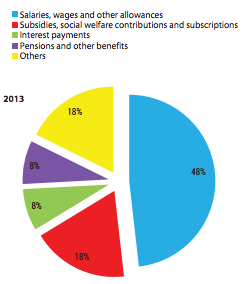
Salaries and allowances contributed the largest share at 48 percent of current expenditure, “reflecting the bulky public sector,” followed by subsidies and social welfare contributions at 18 percent, administrative costs at 13 percent, and interest payments at eight percent.

As large debt repayments were made between December 2012 and February 2013, interest payments in 2013 declined by 19 percent compared to the previous year and stood at MVR893.6 million (US$57.9 million).

Debt and deficit

As a result of “slippages in both revenue and expenditure” in 2013, the fiscal deficit is currently estimated at 4.7 percent of GDP, down from 9.2 percent in 2012.

The budgeted target for 2013 was however 3.6 percent.

The report noted that total debt of the government reached 78 percent of GDP at the end of 2013 as a consequence of “the sustained high budget deficit” over the past years.

Domestic debt accounted for 58 percent of total public and publicly-guaranteed debt.

In 2013, the financing requirement of the government was met almost entirely through domestic sources: mainly through the issuance of Treasury bills (T-bills) to the domestic market and monetisation,” the report explained.

Net credit to the government by the MMA “increased from MVR4.7 billion at the end of 2012 to MVR6.0 billion at the end of 2013,” the report revealed.

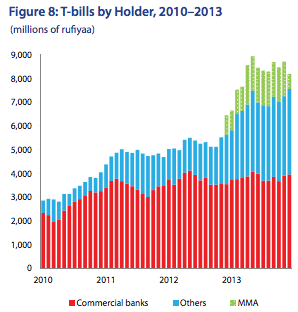
The total outstanding stock of T-bills meanwhile reached MVR8.2 billion by the end of 2013.

“A large part of this increase was attributable to the increase in investments by other financial corporations and public non-financial corporations, which can be seen from the increase in their share of holdings (as a percent of total outstanding T-bills) from 28% at the end of 2012 to 44% at the end of 2013,” the report stated.

Likes(0)Dislikes(0)

Maldives must ensure it does not become hub for people smuggling: Defence minister

With additional reporting by Lucy Lovell

The Maldives should take precautionary steps to ensure that it does not become a hub for people smuggling, Minister of Defence and National Security Mohamed Nazim said on Sunday.

“This smuggling of people is done by garnering a lot of financial aid. People smuggling has become a huge business globally.”

“We must do all necessary to inhibit people smuggling through the Maldives,” said the minister.

Despite the recent introduction of legislation to address the country’s longstanding problems with human trafficking, doubts persist over implementation, as well as the law’s capacity to prosecute human smuggling – different to trafficking in that individuals give a measure of consent to be transported illegally.

Speaking at the inauguration of a workshop titled ‘Capacity Building for Front line Investigation and Border Control Officers to Combat People Smuggling’ – which started in Kurumba Island Resort on Sunday – Nazim spoke of the important role that can be played by immigration and police officers to prevent people smuggling.

He further stated that the immigration cell established at the Immigration Department needs to further develop and function more strongly in the future.

“We in the Maldives do not want anyone to use our borders to illegally cross into other countries. Even quite recently, we came across some Syrians who used the Maldives as an intermediary to travel onto another country.”

“We must ensure that the Maldivian border is one which is safe and protected, and that people are aware of this security,” added Nazim during the event organised by the International Organisation for Migration, and the Department of Immigration and Emigration.

Smuggling concerns

The defence minister – also in charge of the immigration department – announced plans to apprehend and deport all undocumented foreign workers from the capital Malé within four months.

Local NGO Transparency Maldives recently estimated that the number of migrant workers in the country could number as many as 200,000 – a figure that amounts to two thirds of the country’s population.

The Maldives’ first anti trafficking legislation was ratified by President Abdulla Yameen in December last year, receiving a mixed responses from the Human Rights Commission Maldives (HRCM).

Assistant Controller Ali Ashraf from the HRCM described the new legislation at the time as “an excellent piece of work”, though he noted that the failure to include the category of smuggling in the act made it very likely that offenders would be able to evade prosecution.

“The definition of trafficking can be twisted so easily,” warned Ashraf.

The HRCM has also raised the issue of Syrian refugees – mentioned by the defence minister today – using the Maldives as a transit point back in November 2013.

A leaked document from the immigration department, obtained by Minivan News last year, that the Maldives status as a tourist hub granting free visas upon arrival to over one million tourists a year, made it increasingly attractive as a transit destination

Previous case studies on several refugees appeared to reveal inconsistencies with the immigration department’s decisions, with similar refugee cases receiving different verdicts from Maldivian authorities.

HRCM member Jeehan Mahmood argued that the government’s inconsistencies resulted in discriminatory practices inappropriate to a country aspiring to uphold its human rights obligations.

Likes(1)Dislikes(0)

MACL can sue former chairman over GMR airport charge decision, says Civil Court

The Civil Court has ruled the Maldives Airports Company (MACL) can sue its former chairman for allowing the disputed Airport Development Charge (ADC) to be deducted from Indian infrastructure giant GMR’s concession payments during it’s ill-fated agreement.

MACL alleges ‘Kuda Bandhey’ Ibrahim Saleem’s decision to be an act of ‘Ultra Vires’ – meaning that Saleem had acted beyond his permitted authority.

The ruling came following a procedural issue taken by Saleem said he was being wrongfully charged claiming the lawsuit was filed in violation to Article 18 (c) of the Contract Act and Article 74 Company Act.

The Contract Act states a clause requiring a party to refer to arbitration any dispute arising from the contract shall be valid, while the Company Act says the court has a right to issue orders holding personally liable the directors of the company to commit an offense in the name of the company.

But the Civil Court ruling stated that the Company Act does not prohibit the company chairman from being sued personally.

The airports company sued Saleem after he signed a letter sent to GMR on January 5 2012 stating that the ADC and the insurance surcharge fee had been deducted from GMR’s concession payments.

In late 2011, the then-opposition Dhivehi Qaumee Party (DQP) had filed a successful Civil Court case blocking GMR from charging US$25 charge for outgoing passengers – stipulated in its agreement with the government – on the grounds that it was a tax not authorised by parliament.

Former President Mohamed Nasheed’s administration subsequently chose to honour the original contract, instructing GMR to deduct the ADC revenues from the concession fees due to the state-owned MACL while it sought to appeal the Civil Court ruling.

However, with the Nasheed’s controversial resignation coming just one month later, the opposition soon inherited the contractual problem.

Dr Mohamed Waheed’s government then received a succession of bills from the airport developer throughout 2012, despite its insistence that the January 5 letter from MACL outlining the new arrangement was no longer valid.

In December 2012, the Anti-Corruption Commission (ACC) filed a case with the Prosecutor General’s Office over Saleem’s decision to allow GMR to deduct the ADC from concession fees owed to the state.

As part of the filed case (Dhivehi), the ACC was seeking reimbursement of MVR 353.8 million (US$22.9 million) from Saleem and former Finance Minister Mohamed Shihab over the alleged misuse of authority it claimed had led to significant financial loses for the state.

These losses were used as justification for the contract’s eventual termination in December 2012, for which GMR is currently seeking compensation via a Singapore court of arbitration.

According to the case filed by the ACC, former Finance Minister Shihab stands accused of misusing his ministerial authority to benefit a third party by allowing GMR to deduct the charges between October 2011 and September 2012.

The ACC has also accused Saleem violating the company’s rules. According to the ACC’s case, normal procedure for MACL would be to have the company’s board of directors pass a resolution allowing for consent to be given to deduct the ADC.

Likes(1)Dislikes(0)

Boskalis committing “environmental crimes” in UNESCO biosphere reserve, says Ecocare

Netherlands based maritime infrastructure company Royal Boskalis Westminster is committing “serious environmental crimes” in the Maldives, a local environmental group has said.

The company – claimed to have the world’s largest dredging fleet –  has come under fire for mining sand from the country’s only UNESCO biosphere reserve in Baa Atoll.

It also failed to build a barrier to prevent excess dredge soil from spilling onto the reef in Baa Atoll Eydhaushi Island – a move that could cause serious damage to the fragile ecosystem.

“Boskalis has to leave the Maldives now,” Ecocare founder Maeed M. Zahir told Minivan News.

The US$ 37 million four-island reclamation project has reclaimed 20 hectares in Dhaalu Atoll Meedhoo Island in March and 33 hectares in Baa Atoll Eydhafushi Island last week. Work is ongoing on Kaafu Atoll Thulusdhoo Island while a date for reclamation in Dhaalu Atoll Kudahuvadhoo Island has not yet been set.

In the two islands where reclamation was completed houses and vegetation on the shorelines were also covered in fine mixture of sand and salt due to the use of the “rainbow technique” which propels soil into the air.

The Health Protection Agency (HPA) has previously said fine sand particles thrust into the air by the rainbow technique could cause lung and respiratory issues.

Housing Ministry complicit

Maeed accused the Housing Ministry of being complicit in Bosaklis’ violation of environmental regulations, noting the Environmental Protection Authority (EPA) had issued several warnings ordering the company to stop unsafe dredging.

“The Housing Ministry’s failure to stop the project means the ministry is pushing Boskalis. By the time, the EPA warnings arrive, the damage is already done,” he said.

Minister of Environment and Energy Thoriq Ibrahim told Minivan News the EPA is investigating the case.

According to Maeed, the EPA had said it will impose a fine on Boskalis, but the agency has failed to do so. He called for the EPA to be removed from the Environment Ministry’s remit and given greater powers as an independent body to prevent violations in the future.

Boskalis began dredging in Meedhoo in March, but the EPA halted the project temporarily for failure to follow procedures recommended in an environmental impact assessment report.

Instead of using pipelines to transport dredged sand to the shore, Bosaklis dredgers propelled sand and salt through the air covering houses and vegetation on the shoreline in debris.

Housing Minister Mohamed Muizz told local media at the time that safety measures would be followed in the future.

However, Boskalis used the same techniques in Baa Atoll Eydhafushi Island, and furthermore, dredged sand from the UNESCO biosphere reserve and transported it to Thulusdhoo Island in Kaafu Atoll for ongoing land reclamation.

Eydhafushi residents spotted a Boskalis dredger carrying sand away from the island this weekend, and raised the issue with the EPA.

Eydhafushi Island Councillor Mohamed Riza said the company had not sought permission from the local government to mine sand from the atoll.

Baa Atoll was declared a biosphere reserve in June 2011. It is the first of it’s kind in the Maldives.

President Abdulla Yameen inaugurated the Thuludhoo reclamation project this morning.

Likes(1)Dislikes(0)

President Yameen urges ACC to expedite investigations involving government projects

President Abdulla Yameen has urged the Anti-Corruption Commission (ACC) to expedite investigations involving infrastructure projects worth “hundreds of millions of rufiyaa” as the government is facing losses due to delays.

Speaking at the inauguration ceremony for a land reclamation project in the island of Thulusdhoo in Kaafu atoll this morning, President Yameen appealed to the ACC to complete investigations as soon as possible in order to enable the government to resume projects halted at the commission’s orders.

“When these big projects are halted, the preliminary investigation or assessment should be completed within a certain period,” he said.

“For example, if work on the IGMH [Indira Gandhi Memorial Hospital] building is stopped more than once because of problems involving corruption, it is our request for the Anti-Corruption Commission to do it in a way that does not [stall the project].”

He added that the new building was necessary for the government to provide better services from the main tertiary hospital in the capital.

“Doubtless there might be matters that could facilitate corruption in that project. But that is not something our government would encourage or do,” he said.

If the commission suspected corruption, Yameen said that his administration would comply with ACC instructions to halt projects pending an investigation and welcome the findings.

Yameen stressed the importance of the commission’s determining a “timeline” for investigations.

The ACC has told the state broadcaster, however, that the commission has always endeavoured to complete investigations as quickly as possible in order to avoid losses to the public and the government.

The commission noted that recurring problems hindering investigations included having to provide a legally-mandated period for accused parties to respond to allegations after seeking legal counsel, as well as difficulties in obtaining relevant documents from state institutions.

The commission also insisted that it has always shown a way to continue with halted projects, which was also the case with the new IGMH building.

In March, the ACC ordered a halt to the construction of the new IGMH building by Amin Construction Pvt Ltd for a second time following complaints alleging that the renegotiated contract was MVR16 million in excess of the budgeted amount.

President Yameen has meanwhile said that his administration would not pursue corruption investigations against officials of the previous government.

He added, however that the government would not interfere with the work of the auditor general or the ACC.

On the project launched today to reclaim 33 hectares of land in Thulusdhoo, Yameen noted that island would double in size at the completion of the project.

“We are creating an asset. An asset is something you have to make full use of. If not, it could be lost and become worthless,” he said.

The new land would create economic opportunities and allow the government to provide housing for residents of Thulusdhoo, he said.

Projects for the construction of a harbour as well as water and sewerage in Thulusdhoo will begin this year, the president pledged.

Yameen also reiterated his call to both the public and local councils to put aside political differences and cooperate with the government’s implementation of development projects.

Likes(1)Dislikes(0)

State prosecutors push president for action on criminal justice crisis

State prosecutors today urged President Abdulla Yameen to bring an end to the criminal justice crisis caused by the leadership vacuum at the Prosecutor General’s (PG) Office.

The ongoing work stoppage at the office has brought the criminal justice system to a halt and prosecutors have refused to attend court following acting PG Hussein Shameem’s resignation last week.

In a letter to the president, prosecutors called for the immediate appointment of a new PG, arguing “[J]ust because we are the PG office’s staff, we do not believe we are authorised to perform the constitutional obligations of the prosecutor general.”

Yameen had previously said he would only submit a new nominee for parliamentary approval when the newly elected People’s Majlis convenes on May 28.

The president’s previous choice for the role—his nephew Maumoon Hameed—failed to gain the required number of votes in parliament last month. In contrast to the current Majlis, pro-government parties will enjoy a health majority in the 18th Majlis.

In their letter, prosecutors disagreed with Attorney General Mohamed Anil’s advice that the most senior official at the office must now take over the PG’s responsibilities. Anil had justified his opinion claiming the country was in a “state of necessity”—a situation where extra-legal actions by state actors, designed to restore order, are deemed constitutional.

However, prosecutors said the state of necessity argument was not valid as long as the Majlis and the president were capable of performing their constitutional duties.

“If there is a state of necessity, the [state] must appoint a prosecutor general according to the law, instead of appointing a party, whose legal status will be questionable, to the job” the letter noted.

“We do not believe we can be forced to act outside established laws,” the prosecutors went on, claiming the constitution and the PG Act does not allow a third party to take over the PG’s responsibilities.

Questionable legal status

Quoting the PG Act, the prosecutors said the only party authorised to carry out the office’s responsibilities was the Deputy PG, while any other work can only be carried out to the extent stated by the leadership.

If a third party were to take over, there were no legal provisions to hold them accountable or ensure their work is impartial, they noted.

“The public must have the assurance that a third party will work without bias, and that accountability mechanisms are in place. This is because the PG’s work is directly connected to public rights,” the letter stated.

Prosecutors also stressed that there must be no question regarding the legal status of PG office representatives in the courtroom given the serious nature of criminal cases.

“Any case the prosecutor general files involves the legal rights of the defendant and their families. It further involves the rights of those who have been physically, psychologically, and financially harmed, victims of sexual and inhumane crimes, and rights of their families. It involves the public interest,” the letter said.

Although the Supreme Court has said criminal trials can continue in the absence of a PG, Druge Court Judge Mahaz Ali has said such trials would be unconstitutional.

Meanwhile, the Bar Association and the opposition Maldivian Democratic Party (MDP) have called for the immediate appointment of a prosecutor general through the current Majlis to end the crisis.

Shameem resigned on May 6 citing the Criminal Court’s “obstruction” of criminal justice.

In his resignation statement, he said he was unable to fulfill his duties due to the Criminal Court’s failure to prosecute foreigners involved in drug trafficking, delays in issuing rulings on drug related offenses, and “unreasonable obstacles” in filing cases at the court.

The President’s Office put out a third call for names this week, claiming the previous number of applicants had been low during the second call. Shameem had expressed interest in the position both times, while local media has speculated that a third call will allow Hameed to resubmit his application.

Office spokesman Ibrahim Muaz told Minivan News that there was, as yet, no official response to the letter sent by state prosecutors.

Likes(0)Dislikes(0)