Police operate under “law of the land”, not the orders of individuals: Commissioner Riyaz

Additional reporting by Mariyath Mohamed

Police Commissioner Abdulla Riyaz has dismissed opposition allegations of the possible politicisation of officers during the presidential election, scheduled for September 7, maintaining that the institution is bound by the “law of the land” and not any one individual.

In the lead up to this month’s polling, the opposition Maldivian Democratic Party (MDP) has continued to accuse the chief of police of conducting “overtly political” actions, while also being a key player in the controversial transfer of power on February 7, 2012 – which it maintains was a “coup d’etat”.

Commissioner Riyaz is currently under investigation by the Police Integrity Commission (PIC) over the temporary publication of a letter on Twitter that was allegedly written by a third party urging officers to vote against MDP candidate and former President Mohamed Nasheed.

Article 69 of the Police Act states, “It shall be illegal for any police officer to commit any of the following acts even in his or her personal capacity, a) Committing any act or participating in any activity that obstructs the performance of his or her duty without bias or partiality b) Committing any act or participating in any activity that could create doubts in the minds of citizens/the public concerning the performance of his duty without bias or partiality c) Becoming a member of any political party, or participating in any activity organised by a political party, or providing financial assistance to a political party.”

Nasheed resigned from office last year following a police and military mutiny that led to Riyaz being appointed as chief of police.

While the investigation over the Twitter case is pending, the PIC yesterday ruled that the commissioner had been appointed to his position in compliance with the Police Act, and that his appointment was lawful.

Meanwhile, Riyaz stressed in July this year the police service will continue to refuse any orders it decides are “unconstitutional” after expressing concerns over leaked proposals allegedly devised by the MDP to reform the country’s security forces should it win the upcoming election.

Committed to transparency

Speaking to media in Male’ today, the police commissioner said the institution was committed to transparency in providing election security.

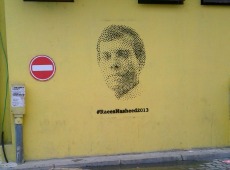
However, he declined to discuss the investigation into the content of a previous controversial post on his official Twitter page, or the issue of why officers were today seen by local media removing campaign posters and images posted on private property, depicting a violent crackdown against MDP supporters by authorities directly following the change in government last year.

The commissioner said he could only answer questions on matters relating to Saturday’s election, while also rejecting accusations that the Maldives Police Service favoured any specific candidate during voting.

“The Maldives Police Service is an institution and not an individual. We are bound by the constitution to make sure officers operate with the laws of the land,” he said. “Yes, there have been some allegations [of politicisation among senior officers including himself] from one party out of several, but we do our best to be transparent.”

Riyaz told Minivan News that the MDP – as the country’s sole opposition – has been invited to four separate meetings held for political parties to discuss any concerns regarding the police strategy to produce election security on polling day.

He added that the party had declined to attend on all occasions.

“My message would be is that all officers must act in accordance to the law and human rights,” Riyaz said.

Electoral security plans

The commissioner also today updated local media on the police service’s election security plans that will see officers stationed on all inhabited islands by this evening under the name ‘Operation Blue Waves‘.

Riyaz said he was calling on all “political actors and their supporters”, as well as the general public to ensure officers were provided with maximum cooperation to officers involved in providing security during the election.

“I also urge everyone to maintain peace, and should they have any concerns, to address them within due process,” he advised.

“We must set an example to the world by showing that we can get through this elections while maintaining absolute peace and stability.”

In comparison to the country’s first multi-party election held in 2008, Riyaz described the present election campaign period as being generally peaceful despite a “few incidents” occurring, arguing he had received no complaints of any presidential candidate being refused entry to islands.

“I have personally observed how ready our teams are to deal with any situation that may arise. Each officer knows their role and responsibility. We are working closely with the Elections Commission (EC) under an MOU we signed, and are also working with the Maldives National Defence Force (MNDF). I am certain that this election day will proceed peacefully, without incident,” he continued.

Despite anticipating a peaceful vote, Riyaz added that SWAT teams and Special Operations (SO) Officers had been provided with election-related training, but would only deployed as a “last resort”.

“Here is the thing, we will only be using the ‘Blues’ [general police officers] for election security purposes. Only if things escalate, and special response teams need to be deployed will we use the SO and SWAT teams. They will only be used as a last and final resort when we absolutely have to. We will try our best to avoid deploying them,” he responded.

The commissioner said that UN human rights experts had also held training with both the SO and SWAT teams on overseeing polling efficiently.

“The team they trained then held wider sessions for the rest of the police force. Our aim is to protect all citizens of Maldives, and all officers are trained to do so,” he said.

As part of the police’s election security strategy, Riyaz added that the Commonwealth had also provided a technical expert who was continuing to assist the institution and provide feedback on their plans for the election day.

The technical consultant, Eldred de Klerk, today met with officers from the country’s South Police Division based in Addu to try to get an understanding of their work and technical capabilities available on the ground during polling.

Likes(1)Dislikes(0)

Carnival atmosphere in Male’ as capital prepares for polls

Votes on Male are divided for Saturday’s presidential election, however ‘Nasheed’ and ‘Yameen’ are the two names on people’s minds as they look forward to a resolution of the 18-month campaign season.

Forty-eight year-old shop owner Ahmed asserts that former president and Maldivian Democratic Party (MDP) candidate Mohamed Nasheed, and Progressive Party of the Maldives (PPM) candidate Abdulla Yameen, are the two most likely winners of Saturday’s election, but believes that the final decision will be made in a second round.

“The candidates are equal right now,” he said, suggesting that Yameen and Jumhoree Party candidate Gasim Ibrahim had conducted the most effective campaigns “because they have the money… to spend on traveling to the islands.”

To the Maldives’ 350,000 citizens, the four presidential candidates’ personal and political histories are familiar tales. For one middle-aged man surveyed on Majeedhee Magu, the present campaign cannot undo past experiences.

“Anni’s [Nasheed] campaign is most effective, he is good for campaigning but not for the presidency,” he said. He firmly believes that the MDP executed the most effective campaign, but feels that Nasheed’s actions during his presidency have lost him the vote to PPM’s Yameen.

“We have seen 30 years [under PPM president and former president Maumoon Gayoom, Yameen’s half brother]. And then we saw Nasheed’s three years. In these last three years we didn’t see development,” he said. “Giving my mom MVR 2,000 (US$130) is not development. Giving insurance to buy Panadol pills for my mom is not development either. I do believe Nasheed is the one who can bring the development we desire, but the way his Aasandha [health insurance] program and other policies are organised is not helping the most needy.”

The man explained that his request for then-president Nasheed’s help for his dying 18-year-old son elicited only a letter from the party stating that “the Attorney General has instructed them not to spend on anything beside state expenses.”

Across town, 49-year-old Asfari anticipates a 70 percent win for Nasheed in the first round, but allows that Yameen was the likely runner up. “He is the second-best man to be president,” she said.

For some, familiarity generates confidence; for others, apathy.

“Politics gives me a headache,” declared a middle-aged female shop owner.

Some youth surveyed were similarly apathetic.

“In my thinking there is no candidate that is suitable for the election,” said Naushad, age 22, adding that alienation of the young generation was a key factor. “Politics will destroy the country, 100 percent.”

Twenty-three year-old voter Ahamed said the campaigns “were really good, but some of them have been using money and buying people’s vote.”

Although he intends to vote, he expressed frustration with the way that voters we reacting towards free handouts.

“Most of the people just take it. If they’re given money, they don’t see the disadvantages of it… but the campaign will affect the votes, obviously. Some will even feel guilty when they vote.”

Ahamed pointed out that party manifestos have become another means of buying votes.

“One of my friends is voting just because one candidate promised to give a salary to all the national chess players,” he explained.

Of surveyed youth who said they will vote, most self-identified as MDP supporters who anticipated a sweeping win on Saturday.

Rhombus employee Ibrahim, age 23, expects MDP “will win 100 percent”. In a nearby shop Ahmed Ibrahim, age 19, declared “this is the young generation voting for Anni [Nasheed].”

Ahmed works on a safari boat that was recently chartered for President Waheed’s campaign tour in Gaaf Dhaal Atoll. He said he is tired of “chaos and fighting” and that if Nasheed is elected “everything will go back to normal and the Maldives will [progress].”

While many youth surveyed cited general hopes for calm and progress, a few highlighted the importance of a manifesto.

“I wouldn’t vote if there wasn’t a manifesto,” said Ahamed, noting that MDP’s manifesto was a “very different, good and cost-effective manifesto.”

Shauna Rashid, age 18, said that as a student she sides with MDP for its position on education.

Peaceful polls, but “we had a coup”

Security preparations for the election have been a concern since the February 2012, when forces clashed with protesting citizens over the change in government.

With the security forces on red alert all week, Male residents surveyed expect a peaceful election but were hesitant offer predictions beyond close of polls.

Several people, ages 20-50, said they expect the roads to be crowded with excited voters and are wary of possible trouble.

Naushad and Ahmed Ibrahim expect Male’ to be calm on Saturday. “But after the election something will happen,” Naushad surmised.

“There are a lot of concerns because we had a coup, so there is a possibility that there will be a fight,” Shafa said.

Others dismissed concerns of violence. “It will be normal,” said shop-owner Ahmed.

A Commonwealth-appointed security expert will oversee security activities this weekend.

Some observed that rainy forecasts may temper election enthusiasm- forecasts show a 40-60 percent chance of rain through Sunday.

Race to the finish line

Candidates are squeezing Male’ for votes prior to Friday’s 6:00pm campaigning deadline. Party camps were partially closed on Thursday while candidates and volunteers conducted door-to-door campaigns, representatives said. All parties will be holding rallies between Thursday evening and Friday afternoon; MDP, JP and GIP will hold marches on Friday afternoon.

MDP and GIP alleged that they are targeting all demographics, although JP hopes for a strong turnout from the elderly in response to the party’s welfare proposal. PPM and JP representatives were unavailable for comment.

Party representatives interviewed all said they are hoping to reach the winning minimum 51 percent vote on Saturday; one ambitious MDP activist said they anticipated more than 80 percent.

Likes(0)Dislikes(0)

MDP requests Prosecutor General investigate “coup agreement”

The opposition Maldivian Democratic Party (MDP) has requested the Prosecutor General’s (PG) Office launch an investigation into the “coup agreement” that was recently leaked on social media.

MDP Spokesperson Imthiyaz Fahmy told local media today (September 5) that the request was filed at the PG’s Office along with supporting evidence that backed the authenticity of the document.

After toppling former President Nasheed’s government, the plan according to the document was for then Vice President Mohamed Waheed to take charge and form a “national unity government” that represented all the opposition parties.  It also outlined plans to dismantle and factionalise then ruling party MDP.

Despite denial from the parties implicated in the agreement, Fahmy – also MP for the Maafannu Dhekunu constituency, argued that the Prosecutor General Ahmed Muizz had the power to order investigations into such cases.

Fahmy claimed that the reason the MDP had not submitted the case to police was that senior officers “had a direct involvement in the coup and therefore they would not investigate” the case.

“The agreement, which plots to carry out acts that violate the constitution and the laws, reveals that certain members of police and the military were prepared to pledge their support to the anti-government movement. After plotting to carry out several criminal offences, they had toppled a government elected by the people using force and violence,” Fahmy claimed.

Fahmy furthermore claimed that the MDP would be closely monitoring whether the PG exercises the duty vested in him by the constitution. Former President Nasheed earlier this week questioned the PG’s ability to act impartially.

Previously, the PG Muizz had ignored a solicitation petitioned to him by former MDP Chairperson and MP Mariya Didi arguing that President Waheed had played a “pivotal” role in the “unlawful overthrow” of his predecessor on February 7, 2012,  thereby committing the offence of plotting to remove the president or topple the government by the use of an unlawful weapon, as mentioned under section 30 of penal code.

However, no decision from the PG has been made on the solicitation to this date. The media official at the PG’s Office was not responding to calls at time of press.

Authenticity denied

The leaked “coup agreement” mentions a detailed step by step manual to oust Nasheed’s government that was to commence from a nation-wide Islamic symposium on February 24, 2012 – 17 days earlier than the day Nasheed felt forced to resign from office.

The document surfaced on social media on Tuesday (September 3). According to the document, the plot included forcing Nasheed to resign the presidency, and having the Supreme Court order him to remain away from politics for the rest of his life.

The document, dated December 29, 2011, featured seals resembling those of the then-opposition parties Progressive Party of Maldives (PPM), religious conservative Adhaalath Party (AP), Dhivehi Qaumee Party (DQP), Jumhoree Party (JP), Dhivehi Rayythunge Party (DRP), People’s Alliance (PA) and the Civil Alliance.

However, all parties to the alleged agreement denied the document’s authenticity, arguing that their signatures had been forged.

Speaking to Minivan News last Wednesday, Vice President of the Civil Alliance coalition of NGOs, Abdulla Mohamed – named in the agreement – dismissed the document: “I swear by Allah, that I have never signed an agreement with any political parties both in my personal capacity and in my capacity as the Vice President of the Civil Alliance.”

“Any agreement, had we made one, would have been live on television. I even have the minutes of meetings held with political parties and I will reveal them soon,” Abdulla Mohamed said.

The unauthenticated signatures in the document appeared to include those of PPM Vice President Umar Naseer, Islamic Minister Sheikh Shaheem Ali Saeed (on behalf of the AP), Leader of the DQP Dr Hassan Saeed, Leader of the JP Gasim Ibrahim, DRP Leader Ahmed Thasmeen Ali, and Deputy Speaker of Parliament Ahmed Nazim on behalf of the PA.

Read an English translation of the document

Download the original document in Dhivehi

Likes(1)Dislikes(0)

Over two hundred prisoners allegedly unable to register for Saturday’s election

As the Elections Commission (EC) today announced details of their plans for Saturday’s presidential election, Minivan News has learned that many inmates of Maafushi Prison will be unable to take part in the poll, despite their legal right to do so.

A source within the Maafushi Prison has told Minivan News that more than 200 inmates were not registered to vote because they do not have national identity cards. The source claimed that inmates have to pay the prison department to renew their ID cards but that there are inmates in the cells who have no way to get money.

“Many of the inmates in the cells have no connection with their family or anyone to help them, so they can’t afford to deposit money to their prison account to make ID cards,” he said. “We talked to the senior prison officers about this and their reply was that inmates have to find their own ways to get money and pay for the ID card.”

He said that inmates have contacted politicians and have been told it is  the responsibility of the Home Ministry to make ID cards for all the inmates who don’t have them.

The source also claimed that inmates have complained about either the Prison Department or the Home Ministry stealing the money the government had given them to get ID cards for inmates.

Election plans

Meanwhile, the EC has announced that the preliminary results of the presidential elections will be revealed on Saturday night at 11pm in a press conference held by the commission.

The EC also said that it would have four press conferences on Saturday – one in the morning from 9 until 9:30 pm, one in the afternoon at 2:30pm, another at 5:30pm to 6pm, before a final press conference at 11pm. Voting begins at 7:30am.

Polling stations based in Trivandrum, New Dehli, and SriLanka will begin voting at 8am and end at 4:30pm. The ballot box in London will be open for voting at 9:am until 5:30 pm UK time.

Ballot boxes in Malaysia and Singapore will be open for voting from 10:30 pm until 7pm local time.

The EC’s  national complaints bureaus will be online from 8am to 4pm and then 8pm to 10pm, except for Friday. On Friday the complaints bureaus will be working from 2:30 pm to 5:30 pm and then from 8pm to 10pm.

The national complaints bureaus can be contacted at 3004489, 3004492, 9901051, 7986942 – or complaints can be faxed to 3004495 or 3004497. Complaints can also be mailed to [email protected].

Meanwhile, President Dr Waheed Hassan has decided that the day following polling (8 September) will be a public holiday.

Giving further information about the decision, the President’s Office issued a statement saying that the decision had been made in compliance with a request made by the Elections Commission.

Furthermore, the President’s Office has said that President Waheed will address the nation tonight at 8:30pm through the media and will give his message to the people regarding the election.

Likes(0)Dislikes(0)

PPM manifesto released to criticism over economic plans

President Dr Mohamed Waheed’s running mate Ahmed Thasmeen Ali has said the Progressive Party of Maldives’ (PPM) “concerning” proposal to slash the state budget by MVR 4 billion ($259.9 million) lacks critical detail.

PPM released its three-part manifesto on Tuesday (September 3) – just four days before the presidential election.

Cautioning that such a large reduction required careful adjustments, Thasmeen said that the proposed cut would have a negative impact on development projects and subsidies, reported Haveeru.

Thasmeen added that minimizing waste and promoting operational efficiency in the government would not yield sufficient funds.

His critique echoed concerns voiced by other MPs, including PPM presidential candidate Abdulla Yameen, over last year’s budget cutbacks.

Yameen has promoted himself as being strong on economic policy, with posters across Male’ touting him as the electorate’s best choice for an economic recovery.

Budget cutbacks attracted sharp responses from political parties in December 2012, after Parliament’s Budgetary Review Committee reduced the state budget by MVR2.4 million ($1.5 million).

Government-aligned Dhivehi Rayyithunge Party (DRP) Deputy Leader and MP Abdullah Mausoom tweeted at the time that the cutbacks were “a deliberate attempt by MDP and PPM to ‘choke’ government and institutions by 2013”.

Yameen – then PPM’s Parliamentary Group Leader and a member of the review committee – observed that, based on the proposed budget cuts, the government’s policies were unclear.

Minivan News was unable to obtain comments from PPM spokespersons at time of press.

PPM Manifesto

The PPM’s ambitious proposals target legislation, administration and infrastructure in multiple areas. The party’s plans include a youth, a sports, and a ‘Yageen’ manifesto – the latter derived from the party’s campaign slogan ‘Yameen Yageen’, or ‘Yameen for Sure’.

The ‘Yageen’  manifesto outlines programmes targeting health, fisheries, decentralization, women’s rights, national security, agriculture, transport and tourism.

According the sports manifesto, athletic programs would receive new facilities and equipment, complemented by legislation to develop young talent. Sports administration would be facilitated by a Sports Act and a Maldives Sports PLC in partnership with all national sports associations, which would draft agreements to pay professional players.

The manifesto also states that all islands would receive a sports arena and Hulhumale’ would be developed as a youth entertainment city, including a National Aquatic Centre of olympic scale. Taxes on sports materials would be reduced from 25 to 5 percent.

According to the ‘Yageen’ manifesto, policies on education would expand teaching of the Quran and arabic language throughout the curriculum, and offer both expanded vocational and higher education opportunities. Educational centers would benefit from teacher training, expanded space, improved counseling services, and “modern libraries” equipped with digital facilities.

On the subject of women’s rights, the manifesto proposes subsidized childcare system, allowing women to work from home through the internet, and connecting them to employers. Gender quotas in the political arena and leadership skills courses for girls are also included, intended to equalize the workplace gender balance.

Other proposals include reviewing national legislation on women, particularly in the areas of marriage and divorce, property, and crime.

To build connectivity within and between atolls, the PPM “ensures” that every island will have access to air transport through regional airports, to be complemented by a ferry network. The party states that, in addition to expanding the services of Maldives Transport and Contracting Company (MTCC) and Island Aviation, it will invite private companies to operate transport facilities.

The manifesto did not detail budgetary provisions for these proposals.

Download the manifestos in Dhivehi.

Likes(1)Dislikes(0)

Q&A: Former President Mohamed Nasheed

Former President and Maldivian Democratic Party (MDP) presidential candidate Mohamed Nasheed is signing 1400 letters an hour in an attempt to mail a personalised letter to every single one of the Maldives’ 239,593 voters before Saturday’s election.

“He insisted on signing each one personally,” sighed a party official.

Nasheed continued this feat during a series of ‘one on one’ interviews with local and international media on Wednesday afternoon.

JJ Robinson: What’s with the letters?

Mohamed Nasheed: Our whole campaign has been very personal. I’m trying to reach out to the normal Maldives person. I’ve met them, I’ve touched them, I’ve visited their homes, and finally I want to write them a letter. When I’m signing them, I’m looking at the homes. I know who I am signing it to. I like that. I don’t think a printed version is appropriate.

I think the whole democratic idea is built on very Roman principles: individuals getting together and talking about things. When you go into mass media and mass organisation you lose the sense of doing something for a person. I think in good politics you do things for individuals.

JJR: The last time you came to power you were magnanimous in victory. You’ve since said this was a romantic idea that did not work in practice. How will you approach it this time if elected?

MN: I don’t think I can change overnight. I’ll still be the same person. I think it’s not viciousness that will bring justice. It is a process. We must strengthen the institutions, especially the Judicial Services Commission (JSC), the judiciary, especially the institutions associated with rule of law. We must increase their capacity to do things and reform them.

I would not come between any investigation of suspected wrongdoing. I think the main perpetrators must be brought to justice. Then again, it is very difficult to do these things to your political opponents. You are always mindful that if you stultify your position, that is not a good recipe for a vibrant democratic society.

Now it is getting very obvious that these opposing parties will come out with new leadership after these elections. I hope that the wrong-doers are brought to justice.

JJR: Given the immediate state of the police and judiciary, how do you propose such an investigation would be conducted?

MN: Well I’ve written to all the policemen and MNDF personally. The vast majority of them seem to believe that the coup was very, very wrong, and that their institutions got a very bad name out of it and they need to salvage their [institutions].

I feel there are enough people within these institutions who are of this view and want to investigate the wrongdoing. Previously when we were in government there was nobody [in the police or military] who wanted to reform this vigorously. But if you look at the top brass of the police, they may be out now, but I don’t think they should be outside. We will bring them in. I think they are very clear in their minds about what needs to be done.

JJR: Observers are asking how, even if you do return to power and given how swiftly your government fell on February 7, you propose preventing that from happening again?

MN: One thing is – the international community should not so be so naive or short-sighted. Please don’t fund coups. Please don’t encourage forceful change of government.

What we saw was a lot of evidence that the UN was busy at it. Instability comes because outsiders side with one faction or another. Just don’t do that.

JJR: What do you mean when you say the UN was ‘busy at it’?

MN: The [now reassigned] UN Resident Coordinator’s safety address in case of an issue on February 7 was the Vice President’s residence. I was shocked to learn that.

I felt the UN specifically wanted to recognise the new regime instead of conducting a proper investigation. They dragged the investigation out until they could cover it up. From the evidence we saw afterwards, especially from the government accountability committee in parliament, it is obvious it was a coup, and it is obvious that anyone should have seen it as a coup.

We should have gone for an early election instantly. We should not legitimise any forceful transfer of power. Right now the situation is that everyone believes ‘winner takes all’. [The impression is that] if you are the ruler, the UN and international community won’t give two thoughts about that and simply recognise whoever is holding power. That kind of attitude doesn’t help.

JJR: If you had the whole February 7 period again, on reflection is there anything you would have done differently?

MN: On the 7th? No. If you’re specifically talking about that day, no. In the lead up to it, yes. We have learned a lot of lessons from what led to this, the political nature of the police and military, and elements of the international community taking sides.

JJR: Many MDP supporters privately profess a sense of doom should you not win. Are the stakes really that high, and what sort of challenges do you think you would have in opposition?

MN: There is no doubt [we will not not win]. Not even entertaining that thought.

JJR: Given the high stakes then, what kind of concerns then do you have for the transition period of nearly two months?

MN: About a month back I had some concerns. But now I think there is enough inertia among the people so that this can be brought into proper alignment. There’s not a lot [the government] could do. I don’t see the military being able to do anything. There is enough support for us within the military, there is enough support for us within the police, it’s just the top brass [of concern], and they won’t have support among the rank and file. So we are fairly confident.

JJR: A lot of young Maldivians, particularly those aged between 18-25, those perhaps without direct experience of Gayoom’s rule in the 80s and 90s, give the impression of being politically apathetic. What kind of message would you give to these politically disengaged?

MN: Get involved. If you are not involved, you better not complain.

This is a multi-party participatory democracy, and there is room for everyone to make their views heard and get involved. I’m very encouraged that during these elections the bulk of the MDP’s campaign machinery has been run by young people. There’s a lot of people who are very involved.

Very often when your own personal viewpoint does not have resonance, you tend to become apathetic. It is not that you are politically apathetic, just that you sense that your viewpoint is not represented, so you go home.

We suggest – don’t do that. Come to us. We have room, and your voice is very, very necessary. And we need it.

JJR: Given that your government’s detention of the Criminal Court judge and efforts toward judicial reform were used to justify the protests in the lead up to February 7, how can you reform the judiciary from the position of the executive without risking this happening again, or without compromising the integrity of the three arms of state?

MN: We must reform the JSC. The police must have enough leverage to investigate wrongdoing. The police were aware of the brewing coup but were not able to investigate it. The Criminal Court was always obstructing that investigation. Primarily that was why the police felt that Abdulla Mohamed was a threat to national security.

In hindsight it was easy to understand why police were saying that, because left alone they felt there would be a coup. If the investigation was not done, and if these people were not apprehended, then police felt there would be a military coup. That is why they wanted to restrain certain elements.

Likes(0)Dislikes(0)

Police summon white magic practitioner to investigate possible cursed coconut

Police summoned a white magic practitioner to evaluate a young coconut believed to have been cursed by a black magic spell, after it was found near the Guraidhoo Island presidential election polling station in Kaafu Atoll.

Police told local media they took the coconut into their possession around 7:05am yesterday (September 3) after receiving a report that the suspicious ‘kihah’ (immature coconut) was located near the Guraidhoo Island School – the island’s polling station for the September 7 presidential election.

The coconut was discovered near the school where the polling station is to be set up, Island Council Vice President Abdul Latheef Ahmed confirmed to local media.

“The police brought a ‘ruqyah’ practitioner (white magician) to examine the coconut, who said it was a fake,” a police source told Minivan News today. “Because it’s a fake the police are not worried,” the source added.

No arrests have been made in the case, according to CNM.

“The four-inch coconut had a Sura [Qur’anic verse] written in Arabic and was lying on the ground near the school, easy for the public to see,” said a source from Guraidhoo with knowledge of the incident.

“When school students saw the coconut they called the principal, who then contacted the police,” he continued.

“It was not really ‘fanditha’ (black magic) on the coconut. If it was fanditha, there would have been Arabic letters and numbers written, not a Sura,” he explained.

“It seems like it was a joke, just a prank, so that people will become aware, learn the moral, and not do it again,” he noted, suggesting the coconut was a lesson for islanders not to practice black magic in an attempt to influence voting, and that the polling area would be closely monitored to prevent such activities from occurring.

“Now the police and school officials are more aware and police are patrolling the school at night, so magicians can’t practice real black magic at the school,” said the Guraidhoo source.

Currently nine police are stationed on Guraidhoo for the upcoming election. Normally only five officers are present.

Election fanditha

Using black magic to either prevent people from voting or influence them to vote for a particular party or candidate is common practice on Guraidhoo.

“Here for most of the elections people use  black magic to win [elections],” said a source from Guraidhoo on condition of anonymity.

He recalled an incident where a black magic practitioner predicted a man would die because of the election.

“Then on the election day the 45 year-old man died and people said it was because of black magic,” said the source.

In July, parents at Guraidhoo Island School refused to allow a polling station in the school for the upcoming presidential elections, due to concerns over black magic practiced by a local witch.

The parents alleged there was a witch on the island who, during previous elections, had cast spells to influence the outcome in favour of the Progressive Party of the Maldives (PPM) which had affected children after targeting the school premises.

“Girls in the school were getting headaches and having been fainting school for years,” the island source explained.

The Elections Commission ultimately decided to place the ballot box inside Guraidhoo School despite parents’ concerns, reported CNM.

Elections Commissioner Fuwad Thowfeek reassured the parents that the commission would take full responsibility if any black magic incidents occurred.

Likes(2)Dislikes(0)

Loyalty, support, money: The motivation behind Male’s political decoration

In the months leading to the September 7 presidential election, the streets of Maldives have erupted into a mosaic of party banners, with posters, flags, banners, and graffiti decorating every street corner.

While it may seem to an onlooker that the amount of material each party has placed around the country represents the amount of public support they enjoy, some volunteers putting up the decorations suggest another side to the story.

Party supporters are largely responsible for the colourful displays, but some parties are accused of spending thousands on hiring groups to help them keep up with the campaign craze, oftentimes spending large funds on the process.

“Doing it for democracy”

“We’re doing this for democracy. We don’t want any money or incentives for this. All we want is an elected government that cares about the people”, one group of young graffiti artists painting Maldivian Democratic Party (MDP) themed artwork in their neighbourhood told Minivan News.
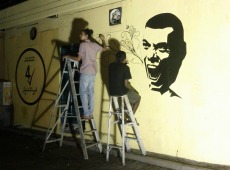
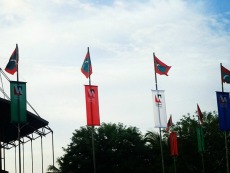
“The thing is, if we don’t get involved and try to guarantee a better life for ourselves, why would anyone else bother? I’m all for MDP, especially after the rest of the political lot brought about the coup d’etat. That is the ultimate shove of their boot against the people, a blatant admission from the ‘baaghees’ that they have no respect or concern for the common man,” said Ahmed Affan, a 26 year old man, an accountant who volunteers in his free time with a team hoisting MDP flags across the streets of Male’.

Another 23 year old volunteer who frequents MDP campaign offices during his free time to help out with banner and t-shirt printing explained his own motivations: “With the best manifesto and policies, I want MDP to win of course, I volunteer to help as I believe our artwork and ideas would get the message across in additional ways to the public and help gather more support.”

Progressive Party of Maldives (PPM) teams also told Minivan News that they were voluntarily engaging in campaign decorating.

“It’s ‘Zaeem’ [Supreme leader – referring to former President and Leader of PPM Maumoon Abdul Gayoom] who has done the most for our poor country. We will do whatever he wants of us. We are determined to have our candidate [Abdulla Yameen – half brother of Gayoom] have a clear win in the election, and we are spreading this message to as many people as possible,” said a 37 year old man hoisting PPM flags and putting up posters down a street in Galolhu.

One team of PPM volunteers refused to speak with Minivan News, stating, “Our leadership refuses to speak to you, and that means we have nothing to say to you either.”

“Heartfelt support” vs “just for the money”

Aishath Zubaira, a 63 year old supporter of President Dr Mohamed Waheed, who has posters of her preferred candidate on the walls of her residence, says she supports him “with heart and soul”.
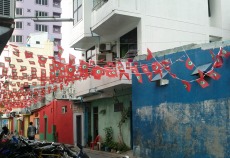
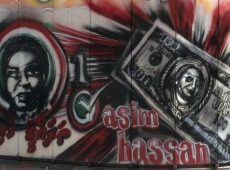
While Minivan News spoke with two different groups streaming the streets with strings of small ‘Forward with the Nation’ coalition flags, they had contradicting reasons for doing so.

“Waheed’s a capable man, and the majority of his supporters are mature and, well, kind of elderly to be honest. There are few young people like us who are aware of just how much Waheed can do for this country, so we need to come out and help make him more popular,” said a 43 year old volunteer, holding a dozen or so rolled up posters sporting photos of Waheed with his running mate, Dhivehi Rayyithunge Party (DRP) Ahmed Thasmeen Ali.

Another man who appeared to be in his late twenties, who introduced himself as “Issey”, put up posters and distributed copies of the coalition’s manifesto. “It doesn’t matter which candidate’s campaigning I am doing, it’s not even like these ugly flags and photos will make a difference for any party,” he said.

“I sometimes even go with the Jumhooree Party guys. Point is, this is an excellent time to make some money on the side and I’m going to make the best use of it. But then, I know who I’m voting for and no one’s got any business asking me who it is.”

“They spend like crazy, we earn like crazy”

A 31 year-old man working at Ibrahim Nasir International Airport (INIA) told Minivan News – on condition of anonymity – that he works in one of Jumhooree Party (JP) coalition’s campaign teams of six to ten persons each.

“When we finish putting up the strings of flags across a street, we need to ring a number that the party has given us. Then a party official will turn up with a file which has information on when and where the teams are active. They will put a tick confirming the job is done and pay us in cash on the spot. We get about MVR 3000 (US$195) a night on average,” he explained.

“Some teams wait a while after the official has left and then cut off the recently hung flags, thereby allowing some other team to earn from the same street a few days later. It’s probably not right, but well, the politicians spend like crazy when elections near, and so us lucky folks earn like crazy.”

Another young volunteer laughed when asked for his reason for being so actively involved in campaign activity, “Every JP graffiti artwork that goes up is a job done for about MVR 10,000 (US$650). We’re economizing the situation when there is a demand for skills like ours. Nothing wrong with that, eh?”

According to local media reports, Police have arrested at least eight people for cutting off lines of flags of various political parties in late August, though police media officials were not responding to calls at the time of press for confirmation.

Visit our facebook page for more pictures as Male’ dresses for the election

Likes(0)Dislikes(0)

Prosecutor General prioritises his job security over the law, says former President Nasheed

Opposition Maldivian Democratic Party (MDP) Presidential Candidate and former President Mohamed Nasheed has claimed that the Prosecutor General (PG) Ahmed Muizz is sacrificing his impartiality in return for job security.

The former president made the remarks during an interview given to local media outlet CNM yesterday.

Nasheed claimed that the PG had fashioned criminal charges against people in such a fashion as to appease government-aligned groups in the parliament, thus ensuring he can remain in his position.

By law, the Prosecutor General’s Office is an institution operationally independent from the executive, but one that is required to follow the guidelines laid down by the Attorney General.

The PG is appointed by parliament for a term of five years and can be removed through a vote of no-confidence by a simple majority.

Referring to the recent prosecution of parliamentary members of his party, Nasheed claimed that the Muizz was failing to maintain impartiality.

“For an example, Hamid Abdul Ghafoor, the MP for Henveiru Dhekunu constituency, is facing charges for possessing alcohol and narcotics. Similarly, a similar kind of thing was found from the suit case of Ahmed ‘Sun travel’ Shiyam [Leader of Maldivian Development Alliance (MDA) currently supporting Yameen Abdul Gayoom],” he said.

“But the Prosecutor General did not notice that both cases had the same offence,” Nasheed continued.

However, Nasheed said that he did not believe that this was happening because of political affiliation, but rather due to a flaw within the constitutional mechanism, wherein a dominant political group in a parliament can easily decide upon the fate of an appointee such as the PG.

“Therefore, this is not about deciding legal matters. In my view, if decisions are being made based on who controls the parliament majority, I think it is rather more of a people’s decision. But still, people from the legal fraternity would maintain that matters such as prosecution and sentencing is independent of parliamentary majority,” he said.

Senior MDP figures facing charges

Nasheed’s remarks come at a time where several senior MDP  figures including members of its parliamentary group are facing criminal charges and police investigations.

Nasheed himself was also charged for his decision to arrest Chief Judge of Criminal Court Abdulla Mohamed, but the case is currently on hold after Nasheed’s legal team appealed a series of procedural discrepancies and sought a stay order from High Court to withhold the proceedings until it had ruled on the matter.

The High Court, however, is yet to hold a hearing of the case following the sudden suspension of the court’s Chief Judge Ahmed Shareef.

Currently MDP MPs, Ali Waheed, Hamid Abdul Ghafoor, Abdulla Jabir, and Imthiyaz Fahmy are all facing criminal prosecutions while MDP MP Alhan Fahmy is being investigated by police over the leaked sex-tape of Supreme Court Justice Ali Hameed.

MP Ali Waheed and members of his family– including his mother, father and wife – were also summoned to police in August as part of an investigation into a corruption case concerning the buying of a house in Male.

Last Sunday, Criminal Court conducted the first hearing into the case of MPs Hamid Abdul Ghafoor and Abdulla Jabir allegedly being caught in possession of alcohol last November.

Criminal Court Media Official Ahmed Mohamed Manik told Minivan News in August that Jabir and Ghafoor  were charged with the offence of smuggling alcohol into the country and consuming it, as well as possession of cannabis and objecting to urine testing.

Former President Mohamed Nasheed’s Press Secretary Mohamed Zuhair and his wife Mariyam Faiza Have also also charged for objecting to take urine tests, said Manik at the time.

Additionally, the son of Nasheed’s former special envoy, Mohamed Hamdhoon Zaki, has been charged for trafficking illegal drugs into the country – the penalty for which is 25 years imprisonment and a fine of up to MVR10 million (US$650,000).

In a statement released by the party last week, the MDP alleged that recent police summons and prosecution of its senior figures – including parliamentary group members – were part of the government’s plan to obstruct its presidential campaign.

An official from the Prosecutor General’s Office declined to make a comment on the matter.

Likes(1)Dislikes(0)