Police summon Supreme Court Justice Ali Hameed for questioning over sex tape scandal

Police have summoned Supreme Court Justice Ali Hameed for questioning over his alleged appearance in a leaked sex tape.

According newspaper Haveeru, Justice Hameed was summoned to police headquarters in Male about 8:00pm in the evening and left at around 1:30am after spending more than five hours in the building.

Police however did not confirm the summoning but said only that the case is currently being investigated.

Last Thursday police formally notified the Judicial Service Commission (JSC), the Prosecutor General and President Mohamed Waheed Hassan regarding their investigation into the case.

The existence of a video footage allegedly involving Justice Hameed indulging in adultery came into media limelight following the arrest of Ahmed Faiz – a senior Council Member of President Waheed’s Gaumee Ihthihaad Party (GIP) and former Project Advisor at the Housing Ministry.

Following the arrest, Faiz was dismissed from his government position and the Spokesperson of President’s Office Masood Imad – who is also a GIP council member – denounced any links with the government regarding the video.

Still images from the sex tape, allegedly showing the judge committing adultery with an unidentified foreign woman, are meanwhile circulating on social media networks.

A police media official told Minivan News that individuals believed to be involved in the scandal had been either summoned to the police for questioning or had been arrested with a court warrant.

“We are currently investigating two cases concerning the video. One is the case of those who had been using the video to blackmail the people in it, and the other concerns the content of the video,” the spokesperson said at the time.

The video also prompted the JSC to establish a five-member committee to look into the matter upon receiving a letter from police. Local media reported that the committee included commission members Latheefa Gasim, Ahmed Rasheed and Abdulla Didi, and two external lawyers: Hussain Siraj and Mohamed Anil.

A second video also surfaced on social media networks apparently depicting Hameed and a local businessman discussing political influence in the judiciary. Local media identified the businessman as Mohamed Saeed, the director of local business firm ‘Golden Lane’.

Justice Hameed in the video also goes on to reveal his political ‘hook-up’ with Abdulla Yameen Abdul Gayoom – the current Progressive Party of Maldives (PPM) presidential candidate – claiming that he was one of Yameen’s “back-ups” and that his stand was “to do things the way Yameen wants”.

Following Sunday evening’s police questioning, local media reported that Hameed had avoided the usual exit doors at the police headquarters in order to avoid the media.

“Senior figures of the state such as Ali Hameed often use the police main entrance, however Hameed knowing that media was present at that entrance, ran to the exit doors located in Boduthakurufaanu Magu. Hameed had also rushed to get into a white car waiting for him at the door after media followed him,” reported Haveeru.

Local media reports claimed that this was the second time Hameed was summoned to the police for questioning. However, a source close to Hameed denied the reports claiming that police had not summoned Hameed at the time.

Police have also searched the house of Mohamed Saeed on the same night at around 7:45pm. The police claimed that they searched the house after obtaining a search warrant.

The raid was allegedly carried out to find if Saeed had been withholding any material related to the sex tape.

The police have previously summoned Saeed twice for investigation but details of the case or the topic of questioning have yet to be revealed.

Saeed’s lawyer Noorban Fahmy told media earlier that Saeed opted to remain silent in the later session after he was first questioned without the presence of a lawyer.

Likes(0)Dislikes(0)

President opens Maldives’ first Burger King

President Mohamed Waheed has opened the Maldives’ first Burger King, one of four international restaurant chains in Ibrahim Nasir International Airport (INIA)’s new food court.

Besides Burger King’s there are two restaurants on either side of the departure gates.  The new restaurants include ‘casual’ Thai eatery Thai Express, a Australian cafe chain selling mixed drinks and snacks called Coffee Club, and Swensen’s ice creamery, which has already been operating in the airport for several months.

The chains were introduced by the Minor Food Group, a Thai-based subsidiary of the Minor International hospitality and restaurant brands conglomerate that also operates six resort properties in the Maldives, including Anantara, Naladhu and the Per Aquum brands.

The new food court was originally planned as part of the temporary refurbishment of INIA during the construction of a new terminal by Indian infrastructure giant GMR, prior to the government’s controversial eviction of the firm in December 2012. The company recently claimed it is seeking compensation in a Singapore court of US$1.4 billion, an amount four times the size of the Maldives’ state reserves.

The official opening of Burger King and the other restaurants began this morning with the recitation of the Holy Quran, followed by speeches, ribbon cutting, and the serving of food to the many assembled government dignitaries and school students brought across from Male’ for the event.

A company spokesperson told Minivan News that the reception and performance of the burger chain in its first two days of operation had surpassed expectation, perhaps unsurprising given the anecdotal practice by some Male’ families of bringing McDonalds and KFC takeaway back with them on weekend flights from Colombo. Certainly Burger King was extremely popular with the assembled school students, who steadily worked their way through mountains of whopper burgers.

Minor International Chairman and CEO William Heinecke meanwhile noted that the food court improved the quality of the airport by providing a variety of international food demanded by tourists.

“President Waheed told me earlier that this airport is very special to him because as a student he helped carry the stones to make the runway,” Heinecke said.

President Waheed expressed confidence that food court was a sign the airport was developing into a “world class facility”, “and all this under the leadership of our Maldivian colleagues”.

“This is the first big project since the new management took over the airport,” the president said. “Inshallah soon we shall see major investment such as a new runway, which we are currently seeking financing for.”

The manager of one outlet meanwhile identified “consistency of supply” as a key operational challenge in the Maldives for strict branded outlets, noting that chains such as Burger King in particular had extremely high standards of brand consistency.

Employment culture

Several speakers predicted that the introduction of the Maldives’ first major multinational fast food chain could usher in the concept of part-time employment to the Maldives, particularly for students, and help combat widespread youth unemployment.

Of the food court’s initial 53 employees eight were Maldivians who had been sent to Thailand for training, Heinecke said, stating that one of the company’s goals would be to increase the extent of Maldivian employment, particularly part-time students.

Minor Food Group CEO Paul Kenny observed that the firm had success introducing the concept 20 years ago in Thailand. Part-time work, he said, could contribute greatly to an individual’s development.

President Waheed urged young Maldivians to seek work in the fast food outlets, noting that during his tenure as a student he had worked as a tutor “as my parents could not afford to pay me an allowance.”

He also expressed hope that an outlet would open in Male’, and that the price of burgers would eventually come down (regular value meals were around the US$10-12 mark at time of press).

Likes(0)Dislikes(0)

Comment: Egypt, the Maldives and the democracy experiment

As in the Maldives the Egyptian people lived under a 30 year dictatorship which favored the few against the wishes of the majority.

This dictatorship nurtured and helped build a military industrial complex which in turn helped the dictatorship to remain unchallenged. until the internet revolution that brought President Nasheed and the voice of the majority to power through the ballot box.

In Egypt President Morsi was ousted and arrested by the military, the Muslim Brotherhood targeted, its media outlets closed; policemen with Kalashinkovs dancing on the street.

In the Maldives, the ‘deep state’ nurtured by Gayyoom bought key figures in the military. A 30 million dollar cheque signed by the magnate Gasim Ibrahim was supposedly the key that unlocked whatever inhibitions the military or anyone else may have had against the popular policies of the then democratically-elected government of President Nasheed.

Nasheed was forced to resign but managed to keep himself from getting arrested. However, his party supporters and activists were getting picked up by the police on various charges as happened with Egypt’s Muslim brotherhood.

The future of the democracy experiment is yet to unfold. In Egypt it seems to be heading towards violent confrontations. In the Maldives, some may think a peaceful transition back to a democratically elected government is possible but these very same people should ask themselves the question: would those who would be charged with treason which carries the death penalty in Islamic Shariah be willing to face the consequences for their crimes?

The top brass of the military and the police are peopled by pro-dictatorship Gayyoom forces and the only guns in town belong to them. The only way to ensure that the military do not revert to the use of force on some trumped up terrorism charge – the fact Defence Minister Nazim recently alluded that terrorist elements trained in different war zones are in the country should be taken as a hint of what these renegades plan to do – is to ensure a timely visit by a naval presence by a country friendly to the Maldivian peoples’ will. Then – and only then, can the outcome of the ballot box be fully realised.

The Egyptian democracy experiment is unlikely to favor the Muslim brotherhood anytime soon despite the fact they reflect the will of the majority. The armed forces are far too organised and well entrenched and unless a massive bloodbath ensues the present status quo is unlikely to change.

Unlike the Egyptian military, the Maldives military is not strong enough to circumvent the will of the people should they be prepared to make the sacrifices that the challenges will bring. Only a few die-hard figures from the Gayoom era does not carry the necessary moral weight – especially since the fact that they were paid off have come to the fore – to push the armed forces to align with their thinking.

The biggest miscalculation by the ousted President Nasheed was his failure to cleanse the system of the Gayoom era viruses. The same corrupt forces of the ‘deep state’ put in place by Gayoom. He did get the opportunity but he failed to act until too late. President Morsi too made the same miscalculation.To build up a loyal following one needs to catch them while young and then groom them and place them in key positions.

All comment pieces are the sole view of the author and do not reflect the editorial policy of Minivan News. If you would like to write an opinion piece, please send proposals to [email protected]

Likes(0)Dislikes(0)

US government pledges US$9.7 million for Maldives climate change adaptation, election preparations

The United States government has pledged US$9.7 million (MVR 149 million) to the Maldives as technical assistance for climate change adaptation and election preparations.

The memorandum of understanding (MoU) between the two nations was signed yesterday afternoon (July 7) by the Maldives Ministry of Foreign Affairs Ambassador-at-large Abdul Azeez Yoosuf and U.S. Agency for International Development (USAID) Acting Mission Director Todd Sorenson.

The United States Ambassador to Sri Lanka and the Maldives Michele J Sison highlighted the importance of the agreement during the American Embassy’s Independence Day reception held last night (July 7) in Male’.

“The MoU will allow us to expand and enhance our bilateral cooperation, it is a truly special day… [it is my] sincere hope that the many ties that bind our two nations will grow ever stronger,” Sison stated.

Under the MoU, USAID will provide US$7.2 million for a global climate change adaptation project, and US$2.5 million as technical assistance for election preparations.

The Ambassador highlighted the importance of consolidating democracy and promoting the integrity of the electoral process prior to the September 7 presidential elections as the impetus for the US working with Maldivian partners to prepare for elections. One of the new programs covered under the MOU, through USAID, was launched by the U.S.-based International Foundation for Electoral Systems (IFES).

“These efforts will promote the integrity of the electoral process in Maldives in advance of the September 2013 presidential elections, but also support efforts aimed at the local council and parliamentary elections which are to follow [in 2014],” said Sison.

“The US has urged all parties all actors here to work together to chart a positive way forward that respects the Maldivian constitution, Maldivian democratic institutions, human rights and the will of the Maldivian people,” she continued.

“As such, we’ve called on all sides here to work closely together to ensure the elections in Maldives are free, fair, transparent, credible and inclusive and that the results are accepted by all stakeholders,” she added.

The US government in partnership with the UN is also “actively supporting” a small grants program for Maldivian civil society.

“Democracy – good governance – is not just about elections it’s about the process of governance and the interaction between the government and the people,” noted Sison. “Which is why… we are looking to support projects to enhance the democratic space and to effectively engage civil society organisations in promoting good governance.”

“The US is proud to be supporting Maldivian efforts to strengthen civil society and consolidate the democratic transition,” she added.

The Ambassador also reflected on the founding of the United States, the evolution of democracy within the country over the last 237 years, and the democratisation process in the Maldives. She noted the personal responsibility of citizens to strive toward a more perfect union by pushing forward, speaking out when there is injustice, and advocating for those who cannot advocate for themselves, as President Barack Obama noted in a 2008 presidential campaign speech.

“I thought of those words – both of our founding fathers and of President Obama – as I thought about the Maldives, because in the coming weeks and months ahead, reflecting the vibrancy of Maldivian institutions, the Maldivian people will once again make their voices heard in a democratic process,” said Sison.

The American Embassy’s other current initiatives include “robust USAID projects” aimed at increasing Maldivian capacity to cope with the impact of climate change and improving water security. USAID is also working with the Maldivian government to identify additional areas of cooperation related to climate change adaptation.

The US is also becoming “increasingly active” in the Maldivian economic and commercial sector.

“I’m happy to report that a number of other US companies are looking to expand their operations here, their presence and investment in the Maldivian economy,” noted Sison.

Furthermore, US initiatives have also been extend to the education sector with the “Access English Language” teaching program – with programs in Male’, Addu City, and Kulhudhuffushi in Haa Dhaal Atoll – and “Access Microscholarship”.

“The goal of these english language enrichment microschoarlips is to enable Maldivian secondary school students to pursue higher education and to increase their employment opportunities – we hope – in the job market,” Sison explained.

She also noted that US is “very proud” that the cooperation, joint exercises, and training endeavours conducted with the Maldives National Defence Force (MNDF) and the Maldives Police Service remain “very strong and robust”.

“The US knows that all of you are as committed as we are to the prosperity of Maldives, to the democracy of Maldives, and to the well being of Maldives. We hope to work together with you in a way that will inspire and benefit future generations of young Maldivians,” the ambassador concluded.

Maldives’ Minister of Defence Mohamed Nazim assured the attendees of the US Embassy’s independence day event – who included the Indian High Commissioner Rajeev Shahare, various UN agency officials, and Maldivian government ministers – that the government of Maldives was committed to ensuring elections were “free, fair and competitive”.

“Exactly two months from today maldives will vote in a historic election to elect a president,” said Nazim.

“Free and fair elections are the strongest and most visible manifestations of a country’s democratic development. The Maldives remains committed to moving forward to consolidating democracy,” he stated. “We are continuing to further strengthen our democratic institutions.”

“We are grateful to the United States for the Maldives election program 2013-14 which will contribute profoundly to strengthen the capacity of state institutions and civil society organisations in preparing for the presidential elections,” he added.

Nazim also highlighted other “key global issues of mutual concern” both governments and working closely on, particularly in the areas of national defence, promoting democracy and the respect of fundamental human rights, as well as climate change adaptation.

“The Maldives-US defence cooperation which has been vital in enhancing our national defence capabilities,” he noted.

“Climate change is an existential threat to the Maldives. As a low-lying state, no country is more vulnerable and none is more committed to increasing investments in renewable energy,” said Nazim. “I salute President Obama for his recent initiative aimed at finding a global solution to the question of climate change.”

“Climate change is too critical an issue to be left unaddressed. We need to find solutions and be ready to make hard decisions and hard choices,” he added.

“The relationship is based on a solid foundation of friendship, shared beliefs, and mutual respect. The US continues to be a close partner of Maldives through diverse spheres and greatly contributes toward the socio-economic development of the country,” Nazim concluded.

Likes(3)Dislikes(0)

Deadline for voter re-registration to expire August 7

Voters registered for this year’s presidential election have one month left to notify the Election’s Commission (EC) of any change to their permanent residence on the official registry, or else face having to travel to that address to cast their ballot.

The deadline for eligible voters to re-register their current permanent residence on the registry will expire at 16:00pm on August 7 – a month to the day before polling is scheduled to take place.

Local NGO Transparency Maldives told Minivan News today that the process for re-registration was “pretty straightforward”, but vital to ensure that any voter expected to be in a different country or island on polling day would not have to travel potentially significant distances to cast their ballot.

Members of the public wishing to re-register are required to fill a form that can be downloaded here.

Once completed and signed, the form must be submitted at a specially designated area at several locations across the country.

These locations are:

  • Addu City – Addu City Council office
  • Male’ – EC office
  • Hulhumale’ – Gazee school common room
  • Vilimale’ – Fishermen Training Centre

For all other islands in the country, re-registration forms must be submitted to the local island council office.

According to Transparency Maldives, the completed re-registration form must be signed and submitted along with a copy of either a valid national ID card, a passport or license card with a photo. The original form of ID must also be shown when submitting the form, according to EC requirements.

For anyone wishing to re-register for another person, the EC requires the signed form to be submitted with both the voter’s own valid ID, as well as a copy of the ID of the individual submitting the form on their behalf.

Re-registration process

Transparency Maldives told Minivan News in May that the issue of voters wishing to re-register their permanent place of residence with the EC had been a key concern in the build up to September’s election.

Taking the case of a Maldives national living abroad in Malaysia or Sri Lanka, the NGO previously said that unless a voter re-registered their details with the EC to use a ballot box in that country, they would need to return to their place of permanent residence on polling day.

Transparency Maldives has said that the EC had since been travelling to islands across the country to try and raise awareness over the issue, which reflected what it claimed were “progressive improvements” in the commission’s work to keep voters informed.

Transparency Project Director Aiman Rasheed today said that re-registration had been a “huge issue” during the 2008 presidential election – the first multi-party democratic poll ever held in the Maldives at the time.

However, Rasheed expressed optimism that the EC had this year been given much more time to clean up and amend errors and out of date information in the present voter registry.

“After the constitution was passed in August 2008, there was a truncated period of time before voting was able to take place,” he said, referring to voting that took place just two months later in October of the same year.

Rasheed added that having since held several democratic elections, including voting on local councils back in February 2011, the EC had since had a lot of experience in updating the voter registry.

Likes(0)Dislikes(0)

MDP launches youth policy: ‘Entertainment without fear’

The Maldivian Democratic Party (MDP) on Friday launched its youth, sports and entertainment policy, dubbed ‘Majaa Kurun Birakaa Nula’: ‘entertainment without fear’.

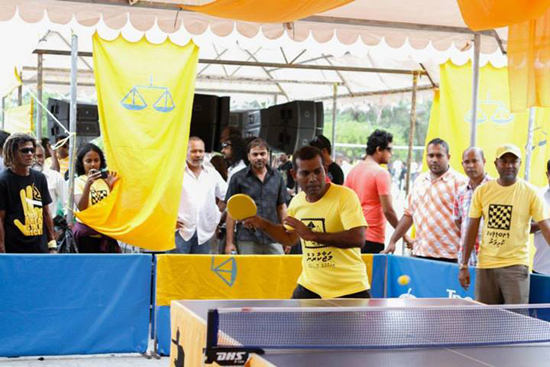
Despite the wet weather, the party’s presidential candidate Mohamed Nasheed along with senior party members and hundreds of supporters gathered at the Raalhugandu area Male in yellow athletic attire.

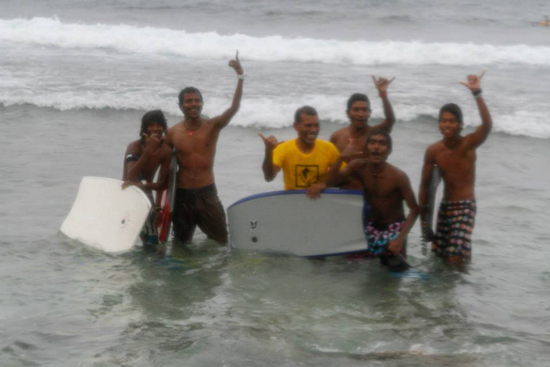
Senior party members followed Nasheed’s lead in taking part in several sport activities organised in the area, including futsal, volleyball, table tennis, baton racing and bodyboarding.

Speaking at the function to inaugurate the policy, the former President promised more sports facilities and technical assistance for athletes in a future MDP-led government, while also promising that during his five year term the government would facilitate more public participation in sports.

According to Nasheed, the policy also includes the renovation and maintenance of football grounds in the Maldives.

Young people represent a potential election-swinging demographic in the September 7 Presidential Election. With 65 percent of the population were already aged under 30 at the time of the 2006 census, the number of eligible voters have 15 percent since 2008’s presidential election. The MDP has traditionally enjoyed strong support from young people, although prior to its February 7 ousting was challenged by rising political apathy among younger voters.
“We need to put our efforts into empowering the young people of this country. If we isolate them and let them fall apart, there is no way we can bring about much needed development of the country,” Nasheed said at the policy launch, promising “renewed-hope” for the young generation: “This is not simply a sports policy, it is also an entertainment policy.”

The MDP’s entertainment election promises include developing 40 turf stadiums throughout the country, development of high standard stadiums with modern-day training facilities, netball courts and courts for ‘Bashi’ – a traditional sport played by many women – across 60 islands.

“We will also develop the current national sports building as an ‘associations’ house’. In this Associations House, local sports associations will be given space to set up their administrative offices, while accommodation and boarding facilities will also be developed for international athletes and teams who visit the country,” he said.

Nasheed – who heads the country’s single largest political party both in terms of membership and parliamentary representation – also announced the development of a ‘sports resort’ – a sports-themed holiday resort specially designed to host famous international football clubs and other sports personalities who wish spend their off-season vacation in the country.

The said resort, Nasheed promised, would have quality in-house training facilities, practice grounds and gymnasiums for such teams.

Other plans include investment in youth development and skills development under the guidance of a National Sports Institute, and the establishment of a sports school.

“We will open the opportunity to develop a sports school through public-private partnership (PPP). We would also establish a special pension scheme for athletes who represent the country abroad as part of their retirement support,” Nasheed promised.

Responding to sarcastic remarks over the policy from his political opponents, Nasheed assured young people that the Special Operations (SO) officers of the police – known for their rough handling of MDP protests – would not be allowed to barge in and “ruin the fun”.

“Young people will decide what songs they wish to dance to,” Nasheed told the ecstatic young crowd.
Nasheed “a monster”, MDP “promoting homosexuality”: rival parties

The announcement of the MDP’s youth policy fueled harsh criticism from Nasheed’s opponents. Government-aligned parties currently backing the government of President Mohamed Waheed Hassan were quick to launch attacks on the policy.

While addressing a small campaign rally, the business tycoon and presidential hopeful Gasim Ibrahim – who also heads the Jumhoree Party (JP) – described Nasheed as a “monster” who had gone “crazy” with his “crazy talks to fool the people”.

Dismissing the MDP’s youth policy, Gasim challenged Nasheed’s academic qualifications and described him a ‘Jaahil’ (ignorant) who could not read the cover of the constitution.

“He doesn’t understand what the law says, so a crazy person like him may say that he would give the opportunity for people to limitlessly entertain themselves. Look, it is not something Allah has given us human beings,” Gasim said.

The business tycoon – who finished the last presidential election in fourth place – claimed Nasheed had done every “despicable act ever to be found in the world”.

“He thinks we, the people, are fools to believe such rubbish. Actually, he seriously may think that we are fools. He has now got the mindset of a monster,” said the resort owner.

Former Spokesperson for President Waheed and current spokesperson for his Gaumee Ithihaad Party (GIP), Abbas Adil Riza, joined Gasim in denouncing the policy but had a different interpretation.

Speaking on the government-aligned television station DhiTV, Riza alleged the MDP was trying to “promote illicit activities such as homosexuality and sodomy” under the façade of its youth policy.

The current state minister of finance – who formally worked with the MDP but left after failing to win a party ticket to contest in 2009 parliamentary elections – said Maldivians had long been having “fun without fear” and claimed MDP re-emphasising the concept could be interpreted as pledging to “facilitate such devious acts”.

Meanwhile, the Progressive Party of Maldives (PPM) – headed by Maldives’ former autocratic ruler Maumoon Abdul Gayoom – claimed the youth policy was a tactic by the MDP to “win the votes of 15,000 or so drug addicts”.

PPM Spokesperson MP Ahmed Mahloof told local media authorities should take serious concern over what Nasheed was planning to do should he come to power.

“Our society is facing huge problems due to narcotic abuse, and then Nasheed comes out and says that in his government the young people can ‘enjoy without fear’,” Mahloof said.

He also said that policies such as ‘entertainment without fear’ gave the impression the party was trying to promote drugs and substance abuse.

“That is why we need to seriously think what type of entertainment or enjoyment they are allowing in the country,” he said.

Mahloof promised that his party would provide “better solutions” for youth.

Enjoy responsibly

Responding to the criticism, former Minister of Youth and Sports during Nasheed’s presidency, Hassan Latheef, told Minivan News that MDP’s policy did not promote breaking laws and anti-Islamic behavior.

“Maybe for Abbas Adil Riza having fun is simply a group of men getting together for a dance wearing excessively thin white sarongs. We are saying that entertainment can be carried out within the boundaries of the law and Islam. We are not promoting drug abuse or homosexuality at all,” Latheef said.

He explained that a seven year old who goes to play with others among their age and interacts with society produces better results at school than a boy who is not allowed to go out but is given video games at home.

Latheef said young people were subjected to derogatory treatment by police simply because of their appearance, and that the MDP was trying to remove the fear that had been cast upon youth during the 30 year reign of Gayoom.

“Like the President said, we will not let the police ruin the fun for young people. We will not let the young people be discriminated against like that. What we are saying is that the government should facilitate development and entertainment for young people,” he added. “This is a solution to a lot of problems we now face in the society.”

“Entertainment without fear does not mean letting our kids smoke or allow them to take drugs. It is simply freeing them from fear, and that doesn’t mean we are giving them the chance to break the law,” he added.

Despite the criticism, the policy has received strong support across social media networks such as Twitter and Facebook, with the hash tags #BirakaNula and #Majakurun associated with the title of the policy quickly gaining popularity among the Maldivian twitter community.

Likes(0)Dislikes(0)

MP Abdulla Abdul Raheem quits Jumhoree Party

Government-aligned Jumhoree Party (JP) MP Abdulla Abdul Raheem has announced that he has left the party after having a falling out with the party’s leader and presidential candidate, Gasim Ibrahim.

The Maafannu-West MP, who switched parties twice last year, left the Dhivehi Rayyithunge Party (DRP) to join JP in June 2012.

Raheem at the time claimed that he had been restricted from speaking in the parliament floor after going against the party’s official whip line.

Raheem was originally elected to parliament in 2009 under the ticket of DRP, but later left the party in May 2011 to join then ruling Maldivian Democratic Party (MDP), following the footsteps of former DRP MPs Ali Waheed and Alhan Fahmy.

However, he left the MDP to rejoin the DRP again shortly after the fall of former President Mohamed Nasheed’s government claiming that his views did not match those of the MDP leadership.  He again switched parties a month later and joined the JP.

Explaining his reasons to quit the party led by business tycoon Gasim, Raheem said that he was forced to leave the party because Gasim “did not know how to talk politics” and that he was attempting to “defame other political leaders”.

Referring to the speech given by Gasim during campaign rally at Vaavu Atoll last Friday evening, Raheem said that such hate speeches would only lower the support that Gasim had among the public.

Gasim during the rally described Nasheed as a “monster” who had gone “crazy” with his “crazy talks to fool the people” while dismissing the MDP’s new youth policy.

The Jumhoree Party (JP) leader went onto challenge Nasheed’s academic qualifications and described him a ‘Jaahil’ (ignorant) who could not read the cover of the constitution.

“He doesn’t understand what the law says, so a crazy person like him may say that he would give the opportunity for people to limitlessly entertain themselves. Look, it is not something Allah has given us human beings,” Gasim said.

The business tycoon – who finished the last presidential election in fourth place – claimed Nasheed had done every “despicable act ever to be found in the world”.

“He thinks we, the people, are fools to believe such rubbish. Actually, he seriously may think that we are fools. He has now got the mindset of a monster,” said the resort owner.

Speaking to local newspaper Haveeru, Raheem said that making “irresponsible statements while being emotionally charged would not be accepted by the people”.

Raheem added that he had sent letters to both the Elections Commission and the JP office informing his decision to quit the party. He also said that he would join a party after all the presidential candidates announce their running mates.

Likes(0)Dislikes(0)

Maldives being used as a transit point by illegal recruiters: Philippines

The Philippines’ Bureau of Immigration has declared it is tightening monitoring of Filipino nationals traveling to the Maldives, over fears the country is being used as a transit point for labour trafficking of its citizens.

The government of the Philippines, which depends heavily on remitted income from its massive expatriate workforce, restricts its nationals from working in countries with a record of poor treatment of low-wage foreign workers, such as Lebanon and Jordan.

However the Bureau’s Immigration Minister Ricardo David Jr issued a statement revealing traffickers were circumventing this restriction by obtaining ‘legitimate’ employment papers for workers in Dubai and the Maldives, and routing workers to restricted countries through these destinations.

David revealed 17 Filipino workers were victimised in such a fashion by illegal recruitment agencies in June, noting that none of the workers had employment contracts and had instead only been ‘promised’ salaries of US$300-$1500 a month once they reach their destination.

The Maldives is recognised as a destination country for labour trafficking, and to a lesser extent, sex trafficking. Various reports into the practice have identified key appeals to traffickers in the form of poor oversight and monitoring of work permit requests, and a near-total lack of enforcement or investigation of traffickers in favour of swiftly deporting victims – many of whom go into substantial debt paying bogus ‘recruitment fees’ of up to US$4000.

However the statement from the Philippines suggests the country’s lack of oversight of foreign worker employment is also being exploited by traffickers to transit victims.

Domestically, “Recruitment agents in source countries collude with employers and agents in Maldives to facilitate fraudulent recruitment and forced labor of migrant workers”, read a recent report from the US State Department’s human trafficking monitoring office.

Despite widespread acknowledgement of the practice and the government’s submission of a draft anti-trafficking bill to parliament in December 2012, the Maldives still has no specific laws prohibiting human trafficking and “the government of the Maldives made minimal anti-trafficking enforcement efforts during the year.”

While forced labour was prohibited under the 2009 Employment Act, it was not penalised, the report noted.

“The government reported investigating four and prosecuting two sex trafficking cases in 2012, compared to no prosecutions recorded in 2011,” the report stated.

However “the government did not report any prosecutions of government employees for alleged complicity in trafficking-related offenses [and] the absence of government translators prevented foreign trafficking victims from pursuing recourse through the Maldivian legal system.”

The Maldives was placed on the US State Department’s Tier Two Watch List for Human Trafficking for the fourth consecutive year, and faces mandatory downgrading to Tier 3 next year along with Afghanistan, Barbados, Chad, Malaysia, Thailand unless it addresses the problem.

Tier 3 countries are defined by the State Department as those which “neither satisfy the minimum standards for the elimination of trafficking nor demonstrate a significant effort to do so”, and are open to non-humanitarian and non-trade international sanctions.

Likes(0)Dislikes(0)

Transparency Maldives deploying 42 long term elections observers nationwide

Transparency Maldives (TM) has begun training 42 long term elections observers to be posted throughout every atoll nationwide to monitor the campaign landscape and misuse of public resources, and ensure elections are fair and credible.

The long term observers have been appointed  addition to 200 observers who will be present on election day.

TM staff began a three day training program for the long term observers on Saturday (July 6), with the assistance of experts and representatives from relevant state institutions including the Elections Commission (EC), Anti-Corruption Commission (ACC), and the Maldives Police Service (MPS).

Long term observers will be responsible for meeting regularly with all key stakeholders and monitoring activities including campaigning, pre-election electoral processes, voter education, vote buying and misuse of state resources in the run up to the September 7 presidential election.

This TM program marks the first time an NGO will conduct long term elections observations in the Maldives.

“We are excited to experiment the first ever systematic long-term domestic election observation in the Maldives. We are preparing for a comprehensive election day observation, recruiting up to 200 observers who will be assigned to randomly selected ballot boxes,” said TM’s Executive Director Ilham Mohamed.

“We thank and recognise the contributions of domestic elections observers towards a credible elections,” she added.

EC President Fuwad Thowfeek highlighted the need for domestic observers and the positive role they play in strengthening the electoral system, while addressing participants during the training program’s launch.

Long term elections observations will be conducted in order to increase confidence in electoral processes and civil society participation in the democratic process. Observers will also identify areas related to the democratic electoral process that require further improvement.

The long term observations will begin July 15 – the date presidential hopefuls can file their formal candidacy with the EC – and continue beyond the 2013 presidential election to the 2014 local council and parliamentary elections, noted TM Communication Manager Aiman Rasheed.

As part of TM’s elections program, the NGO will also implement a comprehensive voter education program, upgrade their online complaints system, and conduct media monitoring.

Election environment

Transparency also conducted domestic election monitoring during the 2008-2011 cycle of elections, including the country’s first multi-party presidential, parliamentary and local council elections. The results of these elections were widely accepted both locally and internationally – a notable outcome given the high temperature of the country’s politics.

“However, the current political polarisation and the tense, sometimes violent, political environment have strained and continue to further threaten the democratic gains of the previous election processes,” Transparency Maldives warned.

The 2013 presidential elections are set to unfold “against a context of uncertainty, crises of political legitimacy and unprecedented levels of political polarisation,” Transparency Maldives has stated, in an extensive pre-election assessment published in March.

“The latter is characterised by mistrust, categorical negative framing of one another and by the lack of self-accountability of institutions, politicians and their parties for their role in the existing political crises. The electoral background is therefore discouraging,” Transparency noted.

The detailed report identifies key challenges in the lead up to the election, such as the candidacy of former President Mohamed Nasheed, lack of monitoring of campaign financing, an extensive and entrenched culture of vote buying, and a media establishment set on fueling personality politics and further polarisation.

“The upcoming Presidential Elections are currently headed to unfold against this political context of crisis of legitimation, uncertainty of democratic transition, existing polarisations and other challenges that have been aggravated by the controversial transfer of power on 7 February 2012,” Transparency stated.

Likes(3)Dislikes(0)