Comment: On the ‘Vaudhuge Dhathuru’ campaign trail

I spent the past two weeks traveling with the Maldivian Democratic Party (MDP) on its Vaudhuge Dhathuru (‘Journey of Pledges’) campaign, all the way from Kolamaafushi Island in Gaaf Alif Atoll to Addu City. We visited more than 20 islands, including Addu City.

I was born and raised in the capital city of Male’. I am 19 years-old, but except for brief vacations with my family I have not traveled very much in the Maldives. Hence, I have not been able to experience “island life” and by this I do not mean the white sandy beaches or crystal clear waters of the Maldivian islands, but the daily lives of the residents who spend their whole lives on these isolated islands.

The trip was an absolute adventure; one that made me realise my own privilege in growing up in Male’, and the huge discrepancies between the urban centers and the rural islands. I have lived all my life in a bubble created by my parents. Can you believe I’ve never had to make my own bed? To live in a kanneli dhoni for 12 days was a huge challenge for me.

I was on Reyva Dhoni, known as ‘Media Odi’, along with 52 others. Everyone else wanted to be on Reyva Dhoani. We had all the photographers, media and the young and energetic ‘Yellow Force’ on board, so you can imagine how much fun it was. And really, you could actually see how prepared MDP was for this trip. They had thought of everything; there was a kitchen boat that came along with us, and a small launch, in case we may had a need for it.

Meals were prepared and we’d enjoy them in the middle of the ocean. There would always be someone singing a classic bodu beru song, or at times, a couple of guys getting together for Lava Baazee. It was never silent, it was so happening, and it would always turn out to be something exciting. As for the toilet arrangements, there was one toilet and usually 52 people on board, so you do the math. It was so small, you wouldn’t believe. Someone would always be knocking on the door, and as you can guess, it was always an emergency.

I would very much like to tell you about the first 24 hours of the trip. We left Male’ at around 5:00PM and it soon got dark. And all of a sudden, without warning, out of nowhere the boat started to wobble and it suddenly hit me, I’m going to have to stay put for 22 hours or perhaps even longer.

I started to miss my family and my bed… and mostly the toilet. I thought to myself, ‘I couldn’t survive in this place, why the hell did I even come…’ I was on the rooftop all night, inside my sleeping bag, because it was so cold, trying so hard not to puke (you don’t want to be the one who pukes, believe me!). I was not able to lift my head, because I didn’t want to pop like a puke-filled balloon.

After 22 hours we arrived at our first stop, Kolamaafushi Island in Gaaf Alif Atoll. I got myself together and took a shower, changed my clothes and set foot on the harbour, and the first thing I saw was the beautiful monument that was built for fishermen’s day.

On top there was a banner stating: ‘Welcome to the first democratically-elected President, Mohamed Nasheed’.

After become acquainted with the friendly, welcoming people of Kolamaafushi, MDP Youth Wing Leader Aminath Shauna and I went to the island’s MDP office, and we arranged our policy workshop. A handful of people joined us for the workshop, mostly people who’ve previously worked in the island’s health post or utilities company, people who’ve lost their jobs due to political reasons.

I was really glad to see a couple of elders and single mothers in this small crowd, it was what you would call ‘A little bit of everything.’ Shauna explained to them what the MDP had achieved in government during the past three years, and how many lives have been changed over the few years we were able to serve in government. For instance, in Kolamaafushi alone 889 people were covered by some sort of social protection program, and Shauna explained that Nasheed’s administration had spent about 4.2 million rufiya (US$272,000) for that.

That was just Kolamaafushi. We discussed housing projects, infrastructure and education, we were told by someone from the group that the pass percentage had increased to 62 percent in 2011, which I thought was remarkable. And it elated me to see how fired up they were and how determined they were to increase the pass percentage to even higher in the coming years.

When Shauna concluded her presentation, the islanders began to express their thoughts. They told us they haven’t seen a single laari of the ‘Disability & Single Parent’ benefit for the past three months. They said they had not been able to purchase medicine from the local pharmacy. The island’s Women’s Development Committee had set up the pharmacy, but the health corporation acquired the place and had decided to stop services.

They expressed anger at having to travel to a neighboring island for shopping and for medicine. I thought to myself, why are they complaining about that? The neighboring island isn’t that far, and then there’s the nation-wide state transport system, introduced by the MDP during President Nasheed’s administration. But then I got a ‘slap in the face’ from the locals: apparently the state transport service has not been consistent at all. What really made me upset was seeing so many young people without a job or education. I thought to myself, the ‘Skill [Hunaru] program’ could have changed the lives of a few of these youngsters, maybe a whole bunch in five years.

That day I realised it is not that these kids want to live off their parents. They want to earn a honest living. They just want opportunity, for someone to believe in them and to give them the chance, to change their lives. Someone to take an interest in them, someone or even a program to drive them to where they need to be.

After hearing all that, it suddenly didn’t matter that I had to shower in a small cube, or that I had to sleep on a mat most nights. It was a small price to pay to see what I saw in person, and of course the islands were so beautiful. It is true what Anni said, even if you’ve lived your whole life here, you can’t fail to be impressed by the beauty of these islands.

The trip made me realise that there’s so much we could do to change the lives of the hopeful people of this country, from the youngster who has just finished his A-levels to the diabetic single mother with three kids who needs constant medication.

Waheed and the government coalition boast about making tough decisions, but never took them. They seem to lack the confidence and guts to take risks. I personally believe we were on the right track.

It was so comforting to learn that the things that mattered the most for the people of these islands were health care, transport, social security, and anything that would help their daily lives. I believe that these were the kind of real, concrete, lasting changes President Mohamed Nasheed and MDP government brought, and I am convinced that they are the kind of radical changes that Kolamaafushi and the rest of the country desperately needs.

We must link the great divides in this country – and where better to start than the gap between the islands and the capital?

I have learned a lot. I had no idea what I was getting into, but I’m so glad that I went.

All comment pieces are the sole view of the author and do not reflect the editorial policy of Minivan News. If you would like to write an opinion piece, please send proposals to [email protected]

Likes(0)Dislikes(2)

Finance Committee approves guidelines for MVR 100 million in fuel subsidies for fishermen

Parliament’s Finance Committee yesterday approved guidelines for issuing MVR 100 million (US$6.4 million) worth of fuel subsidies for fishermen following consideration of revisions proposed by the fisheries ministry.

At a press briefing today, Finance Committee Chair MP Ahmed Nazim said that the guidelines were finalised in July but the committee had been unable to vote it through until now due to the reworking of committee composition and the suspension of parliament.

“Today we have informed the fisheries ministry of our decision,” Nazim said. “The sub-committee’s decision states that after deducting MVR 1 million for administrative costs, the remaining MVR 99 million should be used to subsidise the cost of fuel for each [fishing] trip based on engine horsepower.”

The People’s Alliance (PA) MP for Meemu Dhiggaru explained that the fuel subsidies would be released based on fuel consumption or engine horsepower (hp) instead of the size of the fishing vessel as was done previously.

Fishing boats would be divided into three categories based on engine horsepower, Nazim said, ranging from 2hp to 829hp and higher.

The rationale for the decision was to ensure that “as many fishermen as possible receives the subsidy,” he said.

Some 1,053 vessels eligible for the subsidy have been registered at the fisheries ministry, Nazim revealed.

Unlike the past two years, said Nazim, the Finance Committee has instructed the fisheries ministry to directly deposit the subsidy to the boat owner’s bank account and post details of the subsidy and recipient on a special website.

The new mechanism would allow crewmembers to calculate the portion of subsidy owed to them, he added.

Although only two months remained of 2012, Nazim suggested that the fisheries ministry could disburse the total amount before the end of the year.

The Finance Committee had calculated that the MVR 100 million annually would cover 20 percent of fuel costs for each fishing trip, Nazim explained, but the fisheries ministry could now provide a higher percentage of the cost.

The newly approved mechanism would have safeguards in place to avoid fraud, Nazim observed, as the subsidy would only be issued when the boat owner presents the fuel bill along with other documentation.

Asked if the state budget could bear the brunt of MVR 100 million as subsidies, Nazim conceded that the expenditure would strain the budget but argued that increased productivity in the fisheries sector would boost the flagging economy.

“I believe that if fishing improves through such a stimulus or incentive, the benefits to the economy would be felt broadly,” he said.

Concurring with the committee’s chair, Maldivian Democratic Party (MDP) MP Mohamed ‘Colonel’ Nasheed argued that the state should assist workers in the primary sector at a time of economic slowdown.

Noting that the MDP government pledged to make the Maldives carbon neutral in a decade, Nasheed said the previous administration had conducted research in collaboration with international universities into alternative sources of energy to replace marine diesel.

“I still believe that the permanent solution for this would be finding an alternative source of energy, for us to be able to use renewable energy for fishing,” the MP for Haa Dhaal Nolhivaram said.

“Incentivising”

Speaking at a press conference in June, Fisheries Minister Ahmed Shafeeu said the subsidy would “incentivise” many fishermen who were unable to fish due to high fuel prices.

“A lot of fishermen now use larger fishing boats which require more fuel. So they opt not to make trips if they can’t get a good catch after burning so much fuel. The fuel subsidy will encourage more people to go fishing,” said the minister.

Shafeeu said fishing in the Maldives has declined from approximately 185,000 tonnes of fish caught in 2006 to about 70,000 tonnes in 2011.

Meanwhile, in 2011, the MDP administration withheld releasing the subsidy citing insufficient funds in the state budget. Former Finance Minister Ahmed Inaz told parliament in October 2011 that the state would have to reduce other subsidies to release MVR100 million as oil subsidies for fishermen.

In the same month, the then-opposition Dhivehi Qaumee Party (DQP) sued the finance and fisheries ministries for withholding the budget allocated for fuel subsidies.

Former CEO of the Maldives Industry of Fisheries Corporation (MIFCO) Adil Saleem, who also held the position of Transport Minister in the former government, told Minivan News in June this year that encouraging a subsidised industry “completely reverses” the former government’s policies, although he said it was important for fishermen “in the current situation.”

“Subsidising is wrong,” Saleem contended, arguing that it did not address the core problems in the industry and was “not the solution for a sustainable industry.”

“Coup financiers are shaping the industry so that the fishermen act as their staff, going fishing everyday on subsidised fuel,” said Saleem.

However, he noted that fishermen were currently in “desperate need” of assistance due to the low prices they get for the fish, and said the subsidies should be released as a short-term measure.

Likes(0)Dislikes(0)

Four arrested in connection with Fuvamulak stabbings

Three men and a minor have been arrested in connection with a gang fight that occurred in Fuvamulah yesterday.

According to police, an 18 year-old, 21 year-old, and 23 year old man and a minor were arrested in connection with the stabbing.

Police said the incident occurred at around 7:40pm, withtwo men aged 21 and 22 years-old stabbed on the island of Fuvamulah in Gnaviyani Atoll.

Police said the 21 year-old man was stabbed in the neck and was brought Male’ after Fuvamulah Atoll Hospital declared his condition was critical.

The man was brought Male’ this morning and was admitted to Indira Gandi Memorial Hospital (IGMH)’s Intensive Care Unit.

The injured pair were identified the police as Ahmed Muslim, 21 and Ibrahim Shifaz, 22 both from the island of Fuvamulah.

Shifaz was stabbed three times. According to doctors police said blood was leaking inside Muslim’s body from the cut in his neck.

Police officers attended the scene and carried the pair to Fuvamulah Hospital.

Fuvamulak Police Station is now investigating the case, police said.

Likes(0)Dislikes(0)

MDP’s Ali Waheed “confident” Majlis will remove President and Home Minister

Deputy Leader of Maldivian Democratic Party’s Parliamentary Group Ali Waheed has expressed his confidence that his party will get the votes it needs to secure no-confidence motions against the President and the Home Minister.

“We have full confidence in this. That is why we proposed it in the first place,” he said. “We want things to go in a democratic way and we accept the decision of the Maldivian people.”

The opposition MDP announced its intentions to submit the motions earlier this month.

Regarding President Dr Mohamed Waheed Hassan, the MDP alleged that he had destroyed the sensitive economy of the nation and that his handling of the economy had destroyed foreign investor confidence in the Maldives.

Justifying the move against Home Minister Dr Mohamed Jameel Ahmed, MDP members have criticised what they see as Jameel’s failure to probe human rights abuses surrounding the February 7 transfer of presidential power.

The party also cited this year’s increase in murders and assault as the reason behind the move.

Majlis regulations state that 26 votes are needed to get a no-confidence motion onto the floor of the house, with a two-thirds majority of the full assembly (52 of 77) required to impeach the president.

Ali Waheed said that he was unable to reveal the stage at which negotiations with other parties had reached, saying instead.

“I’m not in a state to disclose that. However, we believe that the truth will be revealed in time. Let’s work with the positive things and success will follow.”

An official from the Majlis confirmed today that the necessary votes had been received and that the Counsel General had advised the Speaker of the Majlis that the motion can be tabled.

Figures received from the Majlis show that the MDP currently holds 30 seats in the Majlis, with government-aligned parties holding 39 seats and 7 independents remaining.

One seat in the Majlis is currently empty after the murder of Dr Afrasheem Ali earlier this month. A by-election for his Ungoofaru constituency has been scheduled for December.

Speaking at a press conference outside the Majlis yesterday, Ali Waheed said that discussions within the Majlis had indicated potential divisions within the governing coalition, reported local media.

Nasheed’s Allowances

At the same press conference Ali Waheed expressed his concern over the withholding of office allowances to President Nasheed, suggesting that Finance Minister Abdulla Jihad may be summoned before the Majlis if these privileges continue to be withheld.

“This is just another obstacle put up in front of us and we will tackle it accordingly,” he told Minivan News today.

Local media this week gave conflicting statements regarding the reasons for the withholding of Nasheed’s office allowance.

Sun Online reported Jihad as saying that the issue was related to the unknown location of Nasheed’s office whereas Haveeru said that the suspension of privileges was related to a disagreement over whether former presidents were required to conduct charitable activities.

“In reality, the office should be involved in holding social activities. However, the concern of these members is that there is no social work to be seen by the (Nasheed’s) office,” Jihad was quoted by Haveeru.

“It has to be clarified. Hence the financial allowances have been halted for the time being. We still haven’t been provided with the information we sought in relation to the office,” Jihad told the paper.

Jihad was not responding to calls at the time of press when contacted for clarification.

Article 8 of the Protection and Privileges for Former Presidents Act (Dhivehi) states, “In the event that a former president wishes to conduct social work beneficial to the community, the state shall provide up to MVR175,000 a month to arrange for an office, employees and other matters.”

Article 128 of the constitution states that a former president “serving his term of office lawfully without committing any offence, shall be entitled to the highest honour dignity, protection, financial privileges and other privileges entitled to a person who has served in the highest office of the land.”

Nasheed is currently on trial for the alleged illegal detention of Chief Judge Abdulla Mohamed shortly before his controversial resignation in February this year.

However, Jihad was reported as saying earlier this week that  Nasheed would be provided any allowances forthcoming from the 2009 Former Presidents’ Privileges and Protection Act .

Likes(0)Dislikes(0)

MDP MP Ibrahim Rasheed charged with assaulting police officer

The trial of Maldivian Democratic Party (MDP) MP Ibrahim Rasheed ‘Bonda’, charged with assaulting a police officer, commenced at the Criminal Court on Wednesday.

According to local media reports, the prosecution claimed that MP Rasheed obstructed police duty during an MDP protest on July 30, 2012 when police officers stopped a group of activists on motorbikes.

The MP for Maafanu South allegedly attempted to push the police back and struck an officer on the chest.

Three police officers at the scene witnessed the assault, the prosecuting attorney said.

At yesterday’s hearing, MP Rasheed pleaded not guilty and contended that the charge was politically motivated.

The MP also criticised the criminal justice system as flawed and requested permission to hire a foreign lawyer.

The judge reportedly assented and informed Rasheed to be present at the next trial date in three days with his lawyer.

Once bitten

Following the incident on July 30, MP Rasheed was arrested and placed under house arrest for five days in early August.

According to a statement by the MDP at the time, MP Rasheed was taken into custody at 12.30am from a popular cafe in the capital Male’ by “20 militarised police.”

“MP Ibrahim Rasheed was arrested under a warrant obtained by the police relating to an incident two days back on 30 July when it was reported that the MP was ‘bitten’ on his back by a policeman in the process of being arrested while participating in a protest rally,” the statement explained.

“The MP was released within a few hours on that day with two other MPs who were also ‘picked up’ with Hon Rasheed.”

Video footage meanwhile emerged on social media showing MP Rasheed’s arrest. A riot police officer appears to bite the MP behind his shoulders during the arrest.

Police however released a statement on July 31 denying that any injuries were caused during the arrest of the three MPs.

The police statement insisted that MP Rasheed’s claim to MDP-aligned private broadcaster Raajje TV that he was bitten by a police officer was “a false allegation.”

Police further claimed that the three MDP MPs resisted arrest, used obscene language and caused varying degrees of injury to police officers. Aside from MP Rasheed, MDP MPs Ahmed Easa and Mohamed Gasam were also taken into custody on July 30.

The statement also accused MP Rasheed of attempting to mislead the public regarding his arrest to bring the Maldives Police Service into disrepute, condemning the MDP MP’s remarks to the media.

The MDP statement meanwhile noted that MP Rasheed was severely beaten by riot police officers on February 8 during a violent crackdown on an MDP march across Male’.

“Hon Rasheed is among 10 MPs who have been the subject of police brutality that have gone unaddressed for the last six months in spite of repeated appeals by the Inter Parliamentary Union to investigate the matter,” the MDP statement added.

While no charges have been brought against the Special Operations (SO) officers caught on camera beating MP Rasheed on February 8, the People’s Majlis secretariat sent a letter to the Police Integrity Commission (PIC) requesting the police watchdog body to “speed up its investigation into the cases of violence against MPs on 8 February 2012.”

Last week, former chair of the PIC, Shahinda Ismail, resigned from the commission citing failure to hold the police accountable for acts of brutality.

Shahindha’s resignation followed the release of the second of three reports looking into incidents of police misconduct that surrounded February’s transfer of presidential power.

Likes(0)Dislikes(0)

State expenditure rises 13.5 percent for first eight months of 2012

State expenditure for January to August this year increased 13.5 percent on the same period last year, according to figures from the Department of Planning.

According to statistics from the Finance Ministry, the Maldives is facing a budget deficit of MVR 2.1 billion (US$136 million) on the back of revenue of MVR 7.7 billion (US$499 million), and expenditure of MVR 9.8 billion (US$635 million).

Meanwhile, revenue figures published by the Maldives Inland Revenue Authority (MIRA) for September showed an increase in revenue of 16 percent compared to the same month in 2011, however this was 2 percent less that expected.

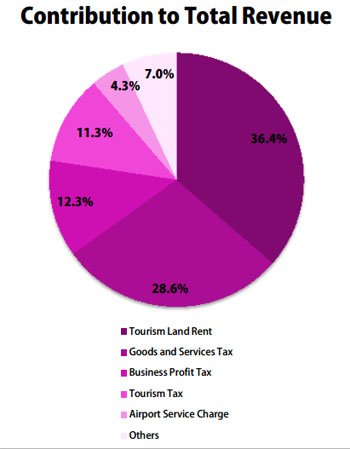
More than a third of total revenue (36.4 percent) came from tourism land rent, an increase of US$1.8 million on the previous year to 14.6 million, followed by the Goods and Services Tax (GST) which increased US$2.6 million to US$7.2 million – representing 28.6 percent of total revenue for the month.

Source: MIRA

The MIRA figures do not include import duties which are received by customs.

The Maldives Monetary Authority (MMA)’s September review observed that while an increase in tourism arrivals had registered improvements in both monthly and annual terms, real GDP growth was expected to fall to 5.5 percent in 2012, a fall of two percent on 2011.

“As per the latest government cashflow statement, the overall fiscal deficit of the government
worsened during Jan-Aug 2012 compared to the same period of 2011,” the MMA observed, predicting a higher than expected budget deficit for the year.

Fishing – the Maldives’ second largest industry after tourism and responsible for almost 40 percent of the country’s employment, has steadily declined in terms of both catch and export earnings. MIRA’s figures for US dollar earnings highlight the country’s near total-dependency on tourism as a means of earning foreign exchange.

Likes(0)Dislikes(0)

“Make them accountable”: young Maldivians talk democracy at documentary launch

Six local students – part of a nine person delegation that earlier this year visited key political institutions in the UK – were today invited to share their experiences and views of challenges facing the Maldives’ parliamentary system when compared to its counterparts around the world.

“In many other countries, if there is a hint of a scandal about an MP they will resign or find themselves pressured out,” said one of the female delegates. “Here, many take the attitude of ‘I don’t care’. We need to make [politicians] accountable.”

It was a response met with genial laughter during a discussion event held in the conference room of the Trader’s Hotel in Male’ this afternoon – a good natured meeting that at times seemed to belie the frank concerns raised by the young delegates.

Accountability was just one of the issues concerning democratic development noted by the six-person panel, who all spoke at the launch of a new documentary of their experiences at the ‘UK Youth Exchange’.

The project – run in conjunction with Democracy House and the British High Commission in Colombo – saw delegates travel to major UK cities to meet senior political figures and NGOs in order to better understand issues of democratic development across the Commonwealth.

The participants included Mohamed Axam Maumoon, Aishath Loona Moosa, Shahaadha Ahmed, Sharoona Adil, Shinah Saeed and Abdulla Shahid. The trip was also attended by Ibrahim Nawaf, Hassan Qassan and Muhaisina Hassan, who were not present at today’s launch.

The corresponding documentary titled ‘A study tour to London’, which is aimed to be aired and local television as well as across social media platforms at a later date, detailed a ten day visit to the UK cities of Bristol and London to experience UK and Commonwealth democratic institutions.

Participants also took part in workshops with the British Youth council, Young Muslims Advisory Group and the Commonwealth parliamentary association, as well as joining in “parliamentary-style” debates with UK school children.

Having since returned to the Maldives, the delegates raised concerns over the lack of a sense of ownership of the country, the limited educational opportunities outside of Male’, and gender inequality.

Another issue raised concerned civic education in areas such as privatisation, taxation, and public healthcare with the launch of Aasandha scheme earlier this year.

One of the participants highlighted problems with infrastructure development, bemoaning a seeming lack of public ownership among Maldivian people. He believed this had resulted from a lack of discussions and opportunities for the public to have their say in advocating how state developments were being decided.

“The youth here also have no dialogue with authorities,” he said. “No one feels the country belongs to us, be it land or infrastructure. There needs to be greater sense of ownership and responsibility.”

Other delegates raised fears over discrimination, particularly towards women working at the country’s resorts.

“There is a lot of discrimination here. It is seen as unacceptable for women to work at resorts. Why? Why should this be the case? There are lots of opportunities here,” she added.

Another delegate noted the need for reform of the country’s curriculum during the event, especially in order to take into account the changes the country had undergone since its first democratic elections were held back in 2008.

“All Maldivians should know about democracy. We need civic education,” he said.

The delegate queried how the entire country was being educated, criticising a lack of focus on critical thinking in areas such as privatisation, taxation and healthcare.

“Many people still don’t know what taxes are. What benefits there are from tax. What universal healthcare is. I could go on,” he added, to the amusement of the audience made up partly of dignitaries representing both the government and key civil society organisations including the UN and local media.

As part of the UK visit, two other participants talked of their experiences “shadowing” UK parliamentarians, claiming the country appeared to have a much stronger level of youth involvement within local governance.

“Here in the Maldives there is no youth involvement. The youth is seen as representing 18 to 35 year olds,” said one of the delegates.

“In other countries, youth are seen as representing the ages between 12 and 21, but here our parents require us to concentrate only on our studies, they do not see us as being mature enough [for politics],” they added.

The participants also spoke of the custom UK MPs had of visiting their constituencies to meet with the people they represent.

“I highly doubt MPs are visiting their constituencies here,” one of the delegates added.

“Different cultures and religions”

Among the dignitaries at the launch was Vice President Mohamed Waheed Deen, a resort owner and philanthropist, who thanked the British High Commission project for allowing the Maldivian delegates to “explore different cultures and religions in the cosmopolitan city of London.”

“You would be great teachers to our politicians,” he claimed in a speech addressing the concerns raised by the six delegates.

“These messages should go to our real politicians. I’m not a real politician. But I wish today that more MPs were here. I’m informed they were invited. It’s important to listen to people. The government are the servants of the people.”

Deen claimed that politicians in the country were failing to listen to the voting public, while he also bemoaned the attitudes in the country that blamed young people and gangs for crime and murder without considering factors leading them to commit such acts.

“The problem with leaders is we try too hard to stay in power, but we often forget about our successors,” he said. “We don’t create leaders for tomorrow.”

The vice president said he aimed to do his utmost to take each of the delegates’ concerns and address them in the cabinet, pointing especially to the need for political sciences, civic education programmes and an understanding of the country’s constitution.

“Otherwise, what are we teaching?” Deen asked, this time without laughter from the gathered audience.

Likes(0)Dislikes(0)

Government conducting financial survey, and census in 2014

The government has decided to conduct a national census in 2014 while the Department for National Planning is currently conducting an economic survey to gauge the country’s productivity.

The last census was conducted in 2006 by the Ministry of Planning and Development after the 2005 census had been delayed after the previous year’s tsunami.

The first modern census in the Maldives was said to have been carried out in 1977.  Following this, the government conducted the survey once every five years from 1985.

The 2006 census required just under 3000 staff to conduct and collected data relating to the size, geographical distribution, and socio-economic characteristics of the population including age, sex, educational attainments, marital status, and employment.

Data relating to size, geographical distribution, and socioeconomic characteristics of the population such as age, sex, educational attainments, marital status, and employment. will be collected.

The 2006 census found the population to be 298,968 although the most recent statistics from the department give a figure of 330,652.

The Department of National Planning also revealed yesterday that the Planning Ministry’s five-yearly economic study has commenced.

The information gathered from establishments involved in economic activities, between now and next May, will be used to determine the country’s productivity as well as to re-base GDP, local media has reported.

Real GDP – which uses a base year to measure the growth of an economy, in order to take account of price changes – currently takes 2003 as the base year, although the last economic survey was conducted in 2007.

Nominal GDP suggests that the Maldivian economy has grown by 261 percent since 2003, while real GDP shows that the rate is just 174 percent.

The 2007 report suggested that the retail, manufacturing and hospitality were the country’s largest employers, provided jobs for 19, 18, 16, percent of the working age population, respectively.

Fishing, traditionally one of the country’s largest employers, only accounted for 7 percent of the workforce according to 2007’s data.

In financial terms, tourism continues to be the economy’s greatest source of income this year, with the most recent figures predicting that over 30 percent of real GDP will come directly from this sector in 2012.

The service sector as a whole is expected to account for just over 80 percent of 2012’s real GDP.

The Minister of Finance and Treasury Abdulla Jihad told the Majlis last month that this year’s budget deficit can be expected to be double the original estimate of MVR3billion (US$195million) – over 18 percent of nominal GDP.

Likes(0)Dislikes(0)

JP MP Jabir to file complaint against MP Muthalib over allegations of alcohol use

Jumhoree Party (JP) MP Abdulla Jabir has said he intends to file a complaint against MP Ibrahim Muthalib at parliament’s Privileges Committee for accusing him of carrying a bottle of alcohol.

During yesterday’s sitting of parliament, MP Muthalib, who joined the religious conservative Adhaalath Party last year, alleged that he had seen MP Jabir walking out of the Hilton Hotel “with a bottle of alcohol in one hand and his wife in the other.”

MP Jabir’s wife is Minister of Gender, Family and Human Rights, Dhiyana Saeed.

The Fares-Maathoda MP made the allegation during a debate on problems facing the fisheries industry.

MPs have immunity from prosecution or defamation suits for remarks made during parliamentary debates.

Muthalib accused Jabir, chairman of resort company Yacht Tours, of using his time during parliamentary debates to “mock” the Islamic Ministry, the Adhaalath Party, and Islam.

In response, MP Jabir raised a point of order and said he regretted that “the Fares-Maathoda MP, who will see his own face and shape when he stands in front of a mirror and know he looks like someone who has committed theft after being elected as an MP [and] just told a blatant lie about us.”

The MP for Kaafu Kaashidhoo also remarked that MP Muthalib lacked “any education for someone who pretends to be a religious scholar.”

Jabir alleged that MP Muthalib was once banished for forging a signature, calling him a “big thief”.

Muthalib has meanwhile denied the allegations in local media today. Both the JP and Adhaalath are part of the current ruling coalition led by President Dr Mohamed Waheed.

In the 2008 presidential election, Adhaalath Party backed JP presidential candidate and business magnate Gasim Ibrahim and formed a coalition with the Republican party.

Likes(0)Dislikes(0)