High Court to decide on injunction for Nasheed trial

The High Court will decide on a request by former President Mohamed Nasheed’s legal team for an injunction halting his trial over the detention of Criminal Court Chief Judge Abdulla Mohamed at a hearing on November 4, the same day the trial at the Hulhumale’ Magistrate Court is set to resume.

Concluding today’s hearing of an appeal lodged by Nasheed’s legal team, challenging the Hulhumale’ Magistrate Court’s ruling on three procedural issues raised at the magistrate court’s first hearing on October 9, High Court Judge Shuaib Hussain Zakariya said the three-judge panel would issue a ruling on the injunction at the next hearing on the morning of November 4.

Speaking to press after the hearing, Nasheed’s lead attorney Hisaan Hussain explained that a request was made for a temporary injunction to suspend the criminal trial pending a ruling by the High Court on the procedural points.

“Today we submitted in detail the reasons we are seeking a temporary injunction,” she said. “In response, the Prosecutor General’s Office said they did not have anything further to say about issuing the injunction and to proceed in the way the court decides. That is, they do not object to [the court] issuing the injunction.”

On the High Court scheduling its next hearing for November 4, Hisaan noted that the next hearing at the Hulhumale’ Magistrate Court was scheduled for 4:00pm on the same day.

“We believe seeking an injunction is by its nature a matter of urgency,” she said. “So we have requested that the court expedite its decision on the injunction. We hope the court would make a decision before [November 4]. We will make such a request to the court in writing as well.”

At today’s hearing, Nasheed’s legal team raised the three procedural points dismissed by the Hulhumale’ Magistrate Court: a magistrate court holding a trial on a different island to where it was based; the constitutional legitimacy of the Hulhumale’ Magistrate Court; and the legality of the arrest warrant issued by the Hulhumale’ Magistrate Court, as such orders could only be issued by a court in the locality of the defendant’s permanent address.

At the October 9 hearing, the Hulhumale’ Magistrate Court summarily dismissed the first two points and agreed to hear the last issue. The court however ruled that the warrant was issued legally as it was following a precedent established by the High Court.

Meanwhile, the High Court today allowed the Attorney General’s Office (AGO) and Judicial Service Commission (JSC) to enter into the appeal case as third parties on the issue of the legitimacy of the Hulhumale’ Magistrate Court.

Lawyers from both institutions were present at today’s hearing. The state was represented by lawyers from the Prosecutor General’s Office (PGO).

Requesting the injunction, Hisaan reportedly argued that failure to do so could cause irreparable injury to the rights of the defendant as the Hulhumale’ Magistrate Court could conclude its trial and sentence the former President before the High Court ruled on the appeal.

While Deputy Solicitor General Ahmed Usham asked for an opportunity to respond to the request for an injunction, Judge Shuaib said that the three-judge panel had decided that the AGO attorney could not be allowed to argue regarding the injunction.

Former President Mohamed Nasheed also attended the hearing along with MPs, senior members and supporters of the formerly ruling Maldivian Democratic Party (MDP).

Almost an hour before the beginning of the hearing, police assisted by officers of the Maldives National Defence Force (MNDF) cordoned off the area surrounding the High Court at the former presidential palace.

“Unfair and unjust”

The MDP secretariat meanwhile issued a statement in the wake of the hearing expressing concern with the High Court’s scheduling of its next hearing for November 4.

“The party believes that the result of conducting both hearings on the same day will be the defence attorneys losing the opportunity to prepare for the original case at the ‘Hulhumale’ Magistrate Court’,” the statement read.

The MDP statement contended that the defence attorneys could only prepare for the trial based on the decision on the procedural processes.

The party also noted that the High Court has in the past conducted hearings at night and on public holidays to issue temporary injunctions.

“However, while a week has passed since the appeal and request for an injunction on behalf of President Nasheed has been filed at the High Court when the hearing was held today, the party believes that the decision to issue a ruling on the injunction on the same day the original case is to be conducted at the ‘Hulhumale’ Magistrate Court’ is neither fair nor just,” the party said.

Likes(1)Dislikes(0)

“We will celebrate liberation of airport on February 7”: Sheikh Imran

Adhaalath Party President Sheikh Imran Adbulla has said that the people of the Maldives will celebrate the liberation of Ibrahim Nasir International Airport (INIA) on the first anniversary of the resignation of the previous government – February 7, 2013, local media has reported.

The comments were made at a press conference held by a coalition of NGOs and political parties opposed to the deal with the Indian infrastructure company GMR – signed by former President Mohamed Nasheed’s administration – to develop and manage the country’s international airport.

Imran predicted there would be “some unrest and damage” on the day the deal is annulled, but urged people to come out and support the calls for nationalisation  – although the GMR deal is actually a 25 year lease arrangement and the airport still belongs to the government.

Minivan News was unable to gain further comment from the Adhaalath Party members at the time of press.

Imran said the Maldivian population would be able to endure economic hardship should the deal be annulled, before threatening “a completely different activity” should the government fail to resolve the issue to the coalition’s satisfaction.

“February 7 this year should suffice to make this clear [to the government],” Imran was quoted as saying by Haveeru.

“We were talking about a particular thing and a particular person completed it. Therefore, when the Maldivian people carry out these activities, too, in a certain way, the people who completes it will decide it a certain way. I hope the President has the courage, ability and steadfastness to take such a measure on behalf of the people,” he continued.

Imran’s comments are symptomatic of the incendiary rhetoric surrounding the airport, the nationalisation of which the Adhaalath Party has previously described as a “national jihad”.

The Civil Coalition of NGOs joined with the seven now-government aligned parties to campaign against the former Maldivian Democratic Party (MDP) led administration, most famously gathering on December 23 last year to defend Islam against what it perceived as irreligious tendencies in the Nasheed government.

The Coalition explained that it was to conduct a week of activities between November 3 – 9 in opposition to the deal, referred to as “airport week”, rather than the mass protest that had previously been planned.

Sun Online reported that the decision had been made owing to clashes with school exams and the government’s plans to celebrate the anniversary of 1988’s attempted coup on November 3.

The paper also reported that the week would be accompanied by the launching of songs and a special logo in support of the movement.

A large balloon has appeared in recent days over the skies of Male’ reading “GMR go home.”

However, previous attempts to organise demonstrations in opposition to the development met with disappointing results when a September protest was poorly attended.

One government-aligned party, the Dhivehi Rayyithunge Party (DRP), refused to join the September protest, arguing that the dispute ought to be resolved through the courts.

DRP leader Ahmed Thasmeen Ali has previously expressed his concerns that reneging on the GMR deal might have detrimental effects on investor confidence in what is already a perilous financial situation for the Maldives.

Abdulla Jabir, Deputy Leader of the Jumhoree Party (JP), has also been vocal about the economic impact of politicising the deal, criticising the Adhaalath Party.

“Sometimes they are religious experts, sometimes they are financial experts. But everyone loves Islam here. Right now, foreign investors are finding it difficult to understand the climate here,” Jabir told Minivan News earlier this month.

“This is not a perfect time for this issue to be happening with GMR,” he added. “I think these protests [against GMR] are unrealistic.”

The JP were, however, represented at the press conference, with State Minister for Fisheries and Agriculture Fuad Gasim reportedly suggesting that senior government figures were being pressured into silence over the deal.

Official government opposition to the deal is currently taking the form of investigations of the $511million deal via the country’s Anti Corruption Commission (ACC) as well as through a Singapore court of arbitration as agreed in the original contract.

However, the Attorney General has asked the Supreme Court to rule on whether the matter might be dealt with within the Maldivian court system.

Earlier this month, INIA CEO Andrew Harrison told Indian media that the company had received no official word from the Maldivian government concerning a resolution to the dispute.

Likes(0)Dislikes(0)

“Worst fears over HIV coming true”: Health Minister

Minister of Health Dr Ahmed Jamsheed Mohamed has expressed concern about the risks of HIV spreading rapidly in the Maldives, stating that “our worst fears seem to be coming true.”

Jamsheed said that although the Maldives had remained on the HIV less-prevalent category since the first HIV positive case was found in 1991, “all the habits that may lead to the spread of HIV is excessively in practice here,” stating that it was only through “incredible luck” that the disease had not already spread widely throughout the country.

At the press conference on Sunday, Jamsheed said: “What has always worried me most is that there is a large drug community, and that the virus might find its way into this group, especially the IV drug users. Once it does, it will spread like wild fire.”

“I don’t think this is too far off now. We have already identified one IV drug user who has been infected with HIV. What’s left is to see how much this has spread,” Jamsheed revealed.

Jamsheed further cautioned against assuming that the HIV virus would stay within the injecting drug user circle, pointing out that some drug users do so in secret, and that many are married to non-drug users who could just as easily be infected with the virus.

Minister of State for Health Lubna Zahir Hussain, who heads the National Drug Agency (NDA) and Centre for Community Health and Disease Control (CCHDC) Director Maimoona Abu Bakr said that both their departments were taking preventive measures against the spread of HIV.

Jamsheed, too, said the NDA’s efforts to help drug users out of their addiction is a preventive measure against HIV as drug users are most at risk.

Meanwhile, the CCHDC is working with civil society groups like Journey, Society for Women Against Drugs (SWAD) and regional NGOs to spread awareness about STIs and HIV, and to encourage the public to change their habits to ways that present less risk of contraction.

Practical action or the moral highground?

Jamsheed said that he believed there were issues which needed to be opened to a “national debate” in order to move forward and take stronger preventive measures.

“We can simply stay inactive and keep talking for any amount of time by assuming the moral highground,’ Jamsheed said at Sunday’s press conference.

“That is to claim that we are Muslims, and by living in a Muslim state in Muslim ways we are doubtless protected from this disease. But that is never the reality anywhere in the world,” he said.

Jamsheed said it was unrealistic to assume all Muslims to live as “perfect Muslims”, and that even if they were, there was still a chance of infection. He stated that HIV is not transferred through sexual activity or visits to prostitutes alone.

“This is an argument I do not accept,” he said. “I presume that those among us who are already infected are also Muslims, being Maldivians. Of course, there are certain protections that being in a Muslim community affords us. For example, all of us men have been circumcised, which is proven to provide protection against STIs. To put it short, we need to work on more practical forms to prevent the spread of HIV.”

Sexual promiscuity elevating risks

The minister further spoke of the risks of promiscuity in the society, referring to the 2010 case where police arrested an HIV positive prostitute. He stated that the same prostitute had been identified in the Maldives as being HIV positive in the year 2009 as well, emphasising the risks to the spreading of HIV that such events presented.

Prior to his appointment as Minister of Health, Jamsheed had written about his concerns regarding the spreading of HIV in his personal blog, speaking about the “sexually active” lifestyle of the Maldivian people, which created a higher risk of infection.

“Maldivians have always been a sexually very active and promiscuous community. We have a very high divorce and remarriage rate, which increases the number of sexual partners any individual has over their lifetime. It is also a known fact that despite being a Muslim community, a lot of Maldivians have multiple extramarital relationships,” he had written then.

CCHDC’s Maimoona Abu Bakr also highlighted that “undesired sexual acts”, prostitution, injecting drug users and homosexuality proved to be some of the greatest challenges to preventing the spread of HIV.

In 2011, a total of 18 HIV positive cases were reported, out of which one was of a local. Between 1991 and 2011, 15 HIV cases were reported among Maldivians, while 168 cases of expatriate workers were also filed. Two out of the 15 cases were female, and all patients cited heterosexual transmission as the cause of infection.

Likes(1)Dislikes(0)

DRP MP Rozaina leaks invoices exposing extravagant spending of former President Gayoom’s family

Dhivehi Rayyithunge Party (DRP) MP Rozaina Adam leaked invoices and bills through Twitter on Friday, exposing the extravagant expenses of former President Maumoon Abdul Gayoom’s family out of the former presidential palace Theemuge’s budget allocated for helping the poor.

Responding to allegations of corruption against her father by supporters of former President Gayoom’s Progressive Party of Maldives (PPM), which were backed by PPM MP Ahmed Mahloof, MP Rozaina claimed that Mahloof was given SGD$28,000 out of the Theemuge budget for a “nose job”.

After suggesting that the MP for Thulusdhoo was “possessed by jinns,” MP Mahloof replied that he received assistance from the Theemuge budget for “a serious surgery,” adding, “it was not theft.”

Rozaina however went on to post photos of invoices from Theemuge for purchases of jewelry and other items as well as hotel bills from Singapore for Gayoom’s family and associates, challenging the PPM MP to defend the lavish expenses.

According to Rozaina, the invoices were sent to parliament’s Finance Committee this year attached to the Theemuge audit report for 2007 and 2008. Reviewing audit reports of state institutions is part of the powerful public accounts oversight committee’s mandate.

Among the invoices made public by the DRP MP was a US$30,698 bill for tickets to London for former First Lady Nasreena Ibrahim and five others.

MP Rozaina alleged that the tickets were for “a shopping trip to London by Madam Nasreena and friends at the state’s expense.”

Other expenses included SGD$2,254 for the former President’s son’s spectacles and US$4,284 for fabrics bought in India.

An invoice dated March 31, 2008 showed SGD$14,977 spent for trouser material (polyester viscose), which was authorised and signed by former Executive Director of the Presidential Palace Ismail Faiz.

On December 20, 2006, a purple gold diamond pendant for SGD$824 and purple gold diamond bracelet for SGD$1,510 were bought using Nasreena’s credit card.

Yet another invoice showed over SGD$28,000 paid out of the Theemuge account to the Grand Hyatt in Singapore.

“Yumna’s [Abdul Gayoom] hotel bill from the funds allocated to the Theemuge budget to help impoverished citizens,” MP Rozaina explained.

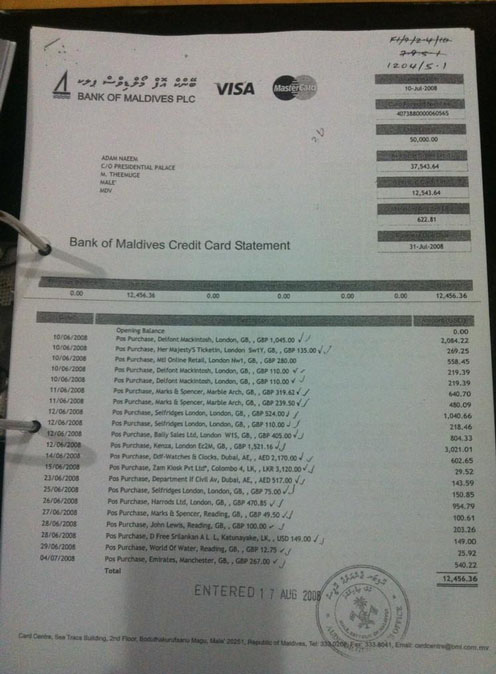
MP Rozaina also uploaded a credit card statement amounting to US$12,456 dated July 31, 2008 of a shopping spree in London.

“Documentary evidence”

Pressed by Twitter users as to why she had not spoken about the Theemuge expenses before, Rozaina tweeted, “I thought auditor general was politicising. He sent all the bills this year.”

“Previously it was just a report,” she added. “Documentary evidence was sent to the Majlis only this year.”

The MP for Thulusdhoo revealed that parliament’s Finance Committee was reviewing the Theemuge audit report.

MP Rozaina’s husband and DRP MP for Raa Atoll Alifushi, Mohamed Nashiz, is the deputy chair of the committee.

Speaking in parliament last week, MP Rozaina alleged that the Maldivian embassy in the UK spent funds out of its budget to hold a birthday party for Gassan Maumoon, youngest son of former President Gayoom.

Replying to former Transport Minister Adhil Saleem on Twitter, who encouraged her to “tell the world” as there was “no going back,” Rozaina tweeted: “I would never even think of going back. These people are criminals. Specially MAG’s [Maumoon Abdul Gayoom’s] good for nothing kids spending ppls [people’s] money.”

In September 2011, former President Gayoom left the DRP to form the PPM following an acrimonious split within the DRP and a public spat with his successor and former vice-presidential candidate, DRP Leader and MP for Baa Atoll Kendhoo Ahmed Thasmeen Ali, brother-in-law of MP Rozaina.

One of the leaked credit card statements

“In accordance with rules and regulations”

Meanwhile, the former President’s attorney, Ibrahim Waheed, released a press statement today countering Rozaina’s allegations. Waheed insisted that all expenditure out of Theemuge was “in accordance with the rules and regulations” and in line with the former presidential palace’s budget approved by parliament.

Waheed added that all records and documentation of expenditure were left at the palace files when the former president left office in November 2008. After President Mohamed Nasheed assumed the presidency, he moved the official presidential residence to Muleeage and relocated the Supreme Court and High Court to the former palace.

The statement from Gayoom’s lawyer went on to dismiss Rozaina’s allegations as “baseless” and “bald-faced lies.”

Waheed suggested that the DRP MPs’ accusations were motivated “out of jealousy” caused by the loss of support for her party and the growing strength of PPM, which was “as evident as the noon-day sun.”

The statement further claimed that the Presidential Commission formed by former President Nasheed to investigate corruption and misappropriation of funds – uncovered in over 30 audit reports – failed to find any wrongdoing by Gayoom.

Responding to the statement on Twitter today, Rozaina argued that although Gayoom was the highest authority in the land under the old “blue constitution,” public funds were “misused” when it was spent on the former President’s family and associates.

Cronyism

In April 2009, former Auditor General Ibrahim Naeem – the country’s first independent auditor general, who was appointed by Gayoom in January 2008 – released a damning audit report (English) of the presidential palace’s finances, revealing that over US$ 3 million earmarked for helping the poor was spent on “the president’s relatives, ministers and their families, senior government officials and some MPs.”

The report stated that 49 percent of the palace’s budget, equivalent to MVR 48.2 million (US$3,750,000 at the time), was diverted from the budget for the poor in 2007 and 52 percent, MVR 44.9 million (US$3,500,000), in 2008.

“We believe this is corruption and misappropriation of public funds,” the former Auditor General stated.

An examination of invoices revealed that funds intended for the poor were instead spent on medical trips to Singapore by “influential senior officials”.

This included their travel expenses, stay in expensive hotels, food, taxi fare, long-term apartment rental and medical check-ups.

More than SGD$ 2.3 million (US$1,500,000) was spent on one of Gayoom’s relatives and his family on trips to Singapore throughout 2007 and SGD$ 1.4 million (US$930,000) for another relative and his family for multiple trips to Singapore.

In March 2008, SGD$23,756 (US$16,000) was spent for a minister’s grandson to stay in a hotel in Singapore for 21 days; in April, SGD$50,022 (US$33,000) was spent on medical expenses for a friend of the president’s; and in July 2008, SGD$6,905 (US$4,600) was spent on two pairs of glasses for a minister and his wife.

US$13,000 in cash was given to the leader of an unnamed political party on different occasions throughout 2008.

The funds, spent by the Maldives Government Trade Centre (MGTC) in Singapore, were to be reimbursed by Theemuge.

Invoices and statements of the expenses revealed that most of the trips were arranged via a note or telephone call from Theemuge rather than through a formal procedure.

The invoices leaked by Rozaina showed that “verbal authorisation” was given by Theemuge senior officials.

“Therefore, as these expenses were made to gain the love, loyalty and support of the recipients, and since these expenses were not made for state purposes or for the benefit of all citizens, we note that these expenses were made unlawfully from the budget for personal benefit and gain,” the audit report stated.

The audit report further revealed that funds were unaccounted for in the construction of the presidential palace, which exceeded its budget by US$1.7 million. The total cost of the project amounted to MVR 207 million (US$17 million).

Moreover, an average of MVR 5,500 (US$430) a day was spent on food for the former President and his family – equivalent to one month’s wages for an employee working at the palace at the time.

Likes(0)Dislikes(0)

Teachers routinely bullied by pupils with no support from schools, say staff

Education in the Maldives is being held back by a lack of institutional support and too much student power, report teachers currently working within the system.

Anecdotal evidence from teachers working in the Male’ area suggests poor support from senior staff and insufficient pay, leading many teachers to consider leaving the profession.

Following last week’s annual Teachers Awards ceremony, President Dr Mohamed Waheed Hassan told local media that allowances and privileges for teachers would be reviewed in order to improve educational standards.

“The basic action to take, in order to improve the level of education, is to improve the standard of teachers. And increase the assistance provided to teachers. In order to encourage teachers, I will revise and work towards improving the allowances given to them,” Waheed told Sun Online.

In response to this, one teacher told Minivan News: “It’s about time they got reviewed. Teachers are badly paid and badly treated. Many teachers I know are leaving or looking to leave the profession.”

Former Education Minister under the previous government Shifa Mohamed explained that efforts had been made in the past to raise the standard of teachers by introducing a licensing system for better qualified teachers which would have become mandatory over time.

“We tried to establish a system with licensing for better qualified teachers,” said Shifa, arguing that teachers were motivated not just by wages, but the opportunity to develop.

Teachers – some of whom have experience working abroad – reported particular problems with a results orientated system, producing pupils without the appropriate life skills.

“Students have far too much power. If they don’t like the marks they have been given in an exam, they bully teachers into changing the marks,” one teacher said. “Teachers are marking up all students so that they appease them and the parents.

“The students are spoon-fed and don’t learn any of the life skills they’ll need, for example basic revision skills, how to read an article and summarise it, or how to take the key points from it,” the teacher told Minivan News.

The teachers also described problems caused by teachers being forced to supplement their income with additional tuition, often teaching children from within their own school – prompting a conflict of interests.

“It is known that a lot of the teachers only teach half the syllabus in class, forcing students to take on extra tuition,” commented one teacher.

“However, this is an error on both the government/schools side and the teacher’s side. The teachers aren’t getting paid enough so they have to supplement their salary with tuition,” the teacher explained.

Shilfa said the tuition issue was a long-term problem which had concerned the ministry for some time.

“It is a norm because it is a system based on marks, and we were trying to change that – there is pressure from parents [on teachers] to give good marks,” she said.

While one teacher explained that schools still offered opportunities for further training to staff via the Continuing Professional Development (CPD) scheme, at the time of press Minivan News was unable to obtain comment from the government on current policy.

Four different education officials, including senior appointments, failed to respond or referred Minivan News to other officials, who likewise failed to respond. One education official demanded Minivan News submit a request for comment in writing.

Wider impact

After last week’s award ceremony at Dharubaaruge, President Waheed said the implementation of a new curriculum as well as further training for teachers was needed to improve the education system.

Waheed also pointed to a gap in the system affecting school leavers.

“One of the biggest problems for youth today is that they have to stop studying when they reach Grade 10. They finish school at the age of 16,” said the President.

“My hope is that the education system is changed, such that every child gets to go to school until they are 18, and that they become productive and useful individuals,” he added.

This particular issue was highlighted by a recent report into gang culture in the country, produced by the Asia Foundation.

The report linked this so called ‘lost age group’ to unemployment and subsequent involvement in gang activities as a source of income.

State Minister of Education Imad Solih told the media last month that the country’s education system had failed, with detrimental repercussions for society as a whole.

He stated that, with the government’s annual investment of MVR 2.4 billion (US$156 million) on education, the outcome was unacceptable.

An Organisation for Economic Cooperation and Development (OECD)  report released last December ranked the Maldives as number one in the Asia Pacific region on education spending as a percentage of GDP.

According to the report, Maldives spends the highest proportion of GDP on public education (8.1 percent) across the Asia/Pacific region, four times higher than countries such as Cambodia and Myanmar.

Despite the expenditure, Solih argued that the countrywide results of O’level and A’level examinations did not reflect the financial input to the education system, and that changes had to be brought to the sector including new plans and targets.

Solih also stated that the failure of the education system should not only remain a concern of the education sector alone, but political leaders, parliamentarians and the general public should also share the concerns.

“I urge everyone to set aside our political differences and to take a minute to think about the current education system,” he said.

Likes(0)Dislikes(0)

Court releases opposition MDP activist Naifa with conditions

The Criminal Court has released Maldivian Democratic Party (MDP) activist Mariyam Naifa, who was arrested in connection with the brutal murder of MP Dr Afrasheem Ali.

Naifa, who was presented to court along with two other suspects, was given a conditional release while the detention of the latter two was extended another 15 days.

Local media identified the pair as Ali ‘Smith’ Hashim and Hassan Humaam, however the authorities declined to officially confirm the identities.

Conditions imposed by the Criminal Court on Naifa’s release include a travel ban restricting her from leaving the capital Male’, an order not to talk about the questions posed to her during the police investigation, and a requirement that she cooperate with the ongoing police investigation.

All the detainees were brought to court with their faces covered to conceal their identity from the media.

When the detainees were brought to court, minor confrontations and verbal arguments took place between a group of MDP supporters gathered near the court building and the police cordoning the area, but the gathering was largely peaceful.

Speaking to Minivan News, a family member of Naifa, Aishath Jennifer, said that they were extremely surprised to hear about her arrest especially in relation with such a “heinous crime”.

“We did not at all know what was going on initially. A friend who was with her at the café where she was arrested called and told me that police had taken Naifa into custody. The whole family was very surprised to learn about the arrest, especially in connection with such a heinous crime,” Jennifer said.

Jennifer also claimed that she and Naifa had met the night she was arrested and said she did not have a clue about what happened with the murder, or why police had decided she was connected to it.

“We used to hang out together all the time. After the change of government on February 7, we regularly meet in Usfasgandu. Even the night she was taken into police custody, we met earlier. She did not even give a slight hint or impression about such a thing. Since we are so close, if she was up to something, we would have had at least had a clue or a hint. But we didn’t,” she said.

Speaking about the arrest, Jennifer claimed the police did not give Naifa the chance to read the court warrant before she was taken into the police jeep.

“She only got to know the reason for her arrest when they took her into the jeep,” she added.

Jennifer also said that Naifa was initially not allowed to contact her family and was barred from her right to an attorney.

She also said she doubted the grounds for her sister’s arrest and contended that police did not have any reason for taking her into custody, alleging her arrest was “politically motivated”.

“People know her because of her involvement in MDP rallies. Before that, she was not publicly as well known as she is today. During both court hearings she was presented, neither the police nor the judges were able to inform her of any evidence that police produced against her. They said that it was highly confidential,” Jennifer explained.

“How come they did not reveal the evidence or the details about the charges she was arrested? I think the court had to place conditions on her release because they did a really stupid thing – arrest her in the first place. She is now being barred from her right to freedom of expression because they know that without such a condition, she would definitely talk about it,” she continued.

“This arrest can’t have anything other than political motivation behind it. They know she is an MDP activist and vocal critic of the current government. They would not have noticed her if not for her political identity. This is definitely a politically-motivated arrest,” Jennifer concluded.

Naifa, who is an supporter of former President Mohamed Nasheed and a regular attendee at protests and rallies organised by the MDP, was arrested on October 2 while she was in a local café Dolphin Café’.

According to Naifa’s lawyers, the arrest was made following intelligence received by police in the murder case of MP Afrasheem.

She was later brought before court and her detention was extended to 15 days.

The MDP in a press statement condemned the arrest of Naifa claiming that the arrest was politically motivated and a deliberate attempt by the government of President Waheed Hassan to “instill fear among its supporters.”

Meanwhile, former President Mohamed Nasheed said the arrest gave the opportunity for the real culprits to escape from the law, as the arrest implied that the government was more focused on destroying its political rivals.

Police denied claims the arrests were made based on political affiliation and declined to officially reveal the identities of the detained, claiming that it could hinder the investigation.

On October 3, just a day after Naifa’s arrest, police conducted a search of the MDP’s protest camp at Usfasgandu.

Police did not confirm if the search of the site with metal detectors was related to the murder of Dr Afrasheem.

However MDP MP Eva Abdulla, who was at the site when police arrived, claimed an officer had informed her that the area was being searched in connection with the Afrasheem homicide case.

Several MDP supporters celebrated Naifa’s release on social media, including Twitter and Facebook.

In one of the tweets, former MP and Chair of the Drafting Committee of the Constitutional Assembly Ibrahim ‘Ibra’ Ismail wrote: “Welcome back Nai. We must now seek compensation for your ordeal. Even courts do not have the power to detain [people] arbitrarily.”

“This is a victory. They just tried their best to frame our gal and failed miserably,” another supporter tweeted.

Likes(0)Dislikes(0)

MDP activist ‘Nazaki’ Zaki appointed as Deputy Leader of GIP

The Gaumee Ithihaadh Party (GIP) led by current President Dr Waheed Hassan Manik has appointed former Maldivian Democratic Party (MDP) activist and current Ambassador to Malaysia Mohamed ‘Nazaki’ Zaki as the party’s Deputy Leader.

Secretary General of GIP Mohamed Mushrif told local media that ‘Nazaki’ Zaki was appointed with the full majority of 11 council members that were at the council meeting held last night.

The party decided to appoint a Deputy Leader before its National Congress because it was difficult for Dr Waheed to run the party while performing his duties as the President at the same time.

The position was previously filled by the former government’s Education Minister and Chancellor of the Maldives National University (MNU) Dr Musthafa Luthfy, who was appointed to the then-cabinet as a GIP member. He later shifted to MDP and remains a member of the party, after its acrimonious 2010 split from the MDP coalition.

Online newspaper ‘Sun’ quoted Zaki as saying that he had been a member of GIP since May this year after resigning from the MDP in April.

He told the paper that he had joined GIP because he found it easy to work with Dr Waheed and said it was possible that he might very soon resign from the position of ambassador and focus solely on running the party.

He also said that his reason for departing the MDP was because of the influence of “several people” within the party, and claimed that then-President of MDP Dr Ibrahim Didi was unable to run the party.

The President’s party had 2508 members by the end of September 2012 according to the Elections Commission. It has no representation in parliament or local councils.

Likes(0)Dislikes(0)

Auditor General accuses senior officials of negligence in embezzlement of MVR 24 million from DMC

The Auditor General’s Office has accused senior government officials of negligence in the alleged embezzlement of MVR 24 million (US$1.6 million) through the Disaster Management Center (DMC) in 2009 and 2010.

In a presentation to parliament’s Finance Committee on Wednesday, Director General Ibrahim Aimon reportedly revealed that the Auditor General’s Office suspected former State Minister Abdulla Shahid, who was in charge of the DMC at the time, along with DMC Director General Mohamed Shahid and Deputy Director General Moosa Ali Kaleyfan as well as former State Minister for Finance Ahmed Assad and Finance Controller Ahmed Mohamed, were culpable in the scam or guilty of gross negligence.

Auditor General Niyaz Ibrahim told members of the Finance Committee that the negligence of the DMC and Finance Ministry in the embezzlement of funds was “very serious.”

Minivan News is seeking comment from the accused senior officials.

ABCs

On October 11, the Auditor General’s Office made public a special audit report (Dhivehi) of an investigation into misappropriation of MVR 24 million from the DMC, uncovered in the centre’s 2010 audit.

In the 2010 audit of the DMC, auditors discovered that payments were made for “hundreds of invoices from 2005”. As the DMC refused to comply with a request for all documentation relating to the transactions, the report noted that the files were eventually obtained from the Finance Ministry.

In 2005, the report explained, the DMC bought construction material for tsunami-related reconstruction from local businesses with “credit purchase order forms.”

The Finance Ministry paid the bills for credit purchases from the “tsunami recovery fund (TFR).”

A company named Allocate Business Company (ABC) was issued “a large number of purchase orders in 2005,” the report found, noting that the company was about a year-old and was not an importer or seller of construction material.

“Therefore invoices for all the purchase order forms released to ABC were submitted under the names of ‘Apollo Hardware Store’ and ‘Apollo Holdings Pvt Ltd,” the report stated, adding that the payments were made to Apollo in 2005 for the ABC purchase order forms.

The invoices submitted by Apollo Hardware and Apollo Holdings included references to the purchase order forms released to ABC, the report noted.

“Therefore it is believed that these two companies are strongly linked,” the report stated.

The scam

Meanwhile, in 2009 and 2010, ABC submitted over 700 new invoices to seek payments from the state with photocopies of the original purchase orders taken from the Apollo invoices.

The audit found that MVR 24,008,503.75 was paid out for 571 of the invoices.

The Finance Ministry prepared payment vouchers for the DMC and made the payments in four cheques between August 2009 and April 2010.

The fourth and final payment of MVR 13 million (US$843,060) was issued on April 27, 2010 for 193 fraudulent invoices.

While over 700 invoices were sent over by the DMC, the report noted that the Finance Ministry rejected 140 invoices worth over MVR 10 million (US$648,508) after the public accounting system showed that payments had already been made.

“Therefore, this showed that ABC attempted to obtain funds using invoices for which payments had been made [to the company],” the report noted.

“From one perspective, ABC was offered the opportunity to embezzle funds so openly because the company knew of the faulty arrangement between the Disaster Management Centre and and Ministry of Finance for issuing funds and took advantage of it. Or [it is because] the scam was carried out with the collaboration of senior officials of the Disaster Management Centre and Ministry of Finance and Treasury.”

Negligence or involvement of senior officials

The report added that the issuing of funds for forged invoices accepted by the public accounting system “raises serious questions regarding the integrity and capability of those entrusted with spending public funds.”

Moreover, the case demonstrated “extreme irresponsibility” on the part of the public officials, the report stated.

Among the reasons listed for suspecting either involvement or gross negligence of senior government officials, the report noted that as a rule public funds were released only for original documents, whereas the invoices in the DMC case contained photocopies of purchase order forms.

The Auditor General’s Office therefore believed that “this was done deliberately and with a plan rather than out of ignorance or because of mistakes.”

The report also noted that it was highly unlikely that either the state would have held payments owed to a private company without any reason or that the company would have waited four or five years to demand payment with no record of complaint or a court case.

The audit further discovered that officials from the DMC met with the state minister for finance regarding the payments to ABC, “however neither minutes nor any documentation of the discussion was maintained for any of these meetings.”

Moreover, the audit found that the Finance Ministry had rejected some invoices forwarded by the DMC that lacked purchase order forms. However, the audit investigation found that a Director General at the DMC instructed an employee to photocopy purchase order forms and attach the bill to the invoices, which were then sent again to the Finance Ministry.

In conclusion, the Auditor General recommended further investigations by the Anti-Corruption Commission (ACC) and Maldives Police Service (MPS) for prosecuting the directors of ABC Pvt Ltd as well as the culpable government officials.

According to local media reports, police have since arrested two individuals in connection with the ongoing investigation into the DMC scam. Police have however not revealed the identity of the suspects in custody.

At a press briefing on Thursday, parliament’s Finance Committee Chair MP Ahmed Nazim said that the committee has decided to summon Prosecutor General Ahmed Muiz and members of the ACC along with Finance Minister Abdulla Jihad and Finance Controller Ahmed Mohamed next week to discuss measures to prevent corruption and misappropriation of public funds.

Finance Controller Ahmed Mohamed is among the officials named by the Auditor General’s Office at the Finance Committee meeting last week.

Likes(0)Dislikes(0)

Comment: Extremism affecting the daily lives of every Maldivian

This article originally appeared on DhivehiSitee. Republished with permission.

Islamic extremism is very real in the Maldives. It affects the daily lives of every Maldivian, and is gaining in scope, intensity and violence every day with the pseudo-democratic government that came to power on 7 February.

This is not to say that Islamic extremism did not exist during the three short years in which the Maldives was a democracy. On the contrary, it was during democratic rule that extremism gained its strongest foothold in Maldivian society.  It is a myth that democracy is an antidote to extremism, as is widely proposed in much of the existing anti-radicalisation literature. Democracy, with its many freedoms, provides a much more conducive environment for radicalisation than does an authoritarian regime, as has been seen in the Maldives.

When Islamic extremism began to be imported into the Maldives in the late 1990s with the advent of the so-called international ‘religious terrorism’; and when the export of extremist ideologies intensified globally with the War on Terror, the Maldives was under the dictatorial regime of Maumoon Abdul Gayoom.

Although in recent times Gayoom has aligned himself with the ideologies of the hardline Islamist Adhaalath Party, during his rule, he presented himself as a moderate Muslim who believed in freedom of religion and advocated religious pluralism in the Maldives.

What he did not tolerate was extremist ideologies spread in the name of Islam. His methods of suppressing such beliefs – imprisonment and torture – cannot be condoned, nor are they compatible with the values of democracy. It cannot be denied, however, that they held Islamic extremism in check in the Maldives for over a decade.

The transition to democracy in November 2008 opened the door for Maldivian Islamists to push their agenda forward.

A confluence of events had helped them consolidate support even under Gayoom’s repressive policies: the 2004 tsunami which literally put the fear of God into many a Maldivian living on remote islands, and which the Islamists exploited as a means of spreading their ideology by depicting it as punishment from God for man’s ungodliness; and the War on Terror, which was used by Islamist states and movements to intensify their efforts to fund and spread their ideology to Muslim populations across the world.

Despite a tourism industry worth billions of dollars, three decades of authoritarian rule in the Maldives left behind a population that was mostly on the poverty line, had extremely low levels of education, and contained tens of thousands of disaffected youth with few prospects for social mobility or economic success. All are factors that have been shown to facilitate the spread of extremist ideologies.

Added to this was the supposedly inescapable need for the newly democratic government to form a political alliance with the Islamists, and a democratic president who believed in freedom of expression in absolutist terms, and who failed to fully appreciate that such freedoms are not always exercised with responsibility by those who enjoy them.

While during the War on Terror most democratic governments everywhere sought to find a balance between freedom of expression and the need to curb incitement to violence in the name of religion, under Mohamed Nasheed’s government Maldivian extremists enjoyed absolute freedom of expression.

Bookshops came to be laden with publications that spread their teachings; their message was constantly transmitted in mosques, on air, and on the Internet. The success of their efforts are now there for all to see.

Of course, under Nasheed’s government it was not just the extremists who had the freedom to express their views. Those who disagreed with their ideology, too, enjoyed the same freedom. This was, in fact, Nasheed’s strategy and hope: that the civil society would counter extremism without requiring any intervention from the government.

It was a huge mistake. The civil society was not strong enough to take on the Islamists, especially in the face of the institutional support that the Islamists enjoyed under the MDP (Maldivian Democratic Party) government with its politically expedient alliance with the Islamist Adhaalath Party. Nasheed also underestimated the power of the label of ‘un-Islamic’ or anti-Islam as a tool for suppressing dissent.

The fight against extremists was thus left to individuals who worked alone or in very small groups. Their discourse was easily slapped down and condemned by the extremists using the ‘anti-Islam/un-Islamic/heretic’ label. As it turned out, this label was also the most powerful tool used against Nasheed himself to help facilitate the downfall of the MDP government, demonstrating just how much power such a designation wields in a rapidly radicalising society.

Despite the knowledge that Nasheed was a firm believer in freedom of expression, few dared to take on the extremists openly then, or now. When they did, the MDP government utterly failed to support them. The lack of any assistance or support for Mohamed Nazim, who in May 2010 dared to publicly declare his disbelief in Islam, and of Ismail Mohamed Didi in July 2010 who felt persecuted for his lack of belief and committed suicide at the age of 25, brought into sharp relief the absence of any serious commitment by the MDP government to fighting extremism.

Instead of tackling the oppression that the Islamists were imposing on Maldivians, the MDP – beleaguered by continuous authoritarian attempts at a reversal – often chose to ignore the problem, or worse, sided with the Islamists.

With the regime change of 7 February, the problem has grown acutely worse. Not only did the new caretaker President Dr Waheed enthusiastically demonstrate a previously unknown affinity with Islamists, his Coalition Government has, from the beginning, continued to deny extremism even exists in the country.

This deliberate denial, coupled with the appointment of Islamists to top positions in government and society, has resulted in the opportunity for extremism to grow unchecked. It now has deep roots within all state institutions including the executive, the parliament, the judiciary and most worryingly, within the security forces.

Recent events of extraordinary violence and their aftermath have gone a long way in demonstrating the truth of this claim.

The attempted murder of Hilath Rasheed

Hilath Rasheed is the only openly gay human rights activist in the Maldives. He, along with fellow blogger and writer Yameen Rasheed, were among the very few Maldivians who dared to voice their anti-extremist opinions publicly. Most bloggers and other writers used pseudonyms. Such caution was not without reason. Death threats against such writers were common.

On 4 June 2012 extremists carried out their threats and attempted to murder Hilath. I met Hilath a few weeks after the attack. There was a scar about 10 inches long  running across his throat horizontally. His voice was only just coming back, and his whole being appeared shaken.

Hilath told me that the last words he heard from the man who cut his throat were:

This is a present from Shaheem, Mutthalib and Imran.

The three men referred to are: Sheikh Shaheem Ali Saeed, the current Minister of Islamic Affairs; Ibrahim Muththalib, an MP who is the most ardent advocate of the death penalty in Parliament; and Imran Abdullah, president of the Adhaalath Party and one of the main actors in the Islamists’ contribution to the change of government on 7 February.

Hilath also made the allegations openly on his blog (banned in the Maldives since November 2011), and they were also reported in Minivan News, although the latter stopped short of identifying the politicians by name.

There has been no official response bar an attempt to mislead the international community by portraying Hilath as a violent criminal caught up in gang violence.

While it is a fact, related by Hilath, that the man who cut his throat named the said politicians, it is quite possible the attacker may have been lying about their involvement. It is also possible that the attackers (there were three altogether) decided to act on their own, motivated not by direct orders but by the ideologies perpetrated by the named politicians.

In the absence of a proper investigation by the Maldives Police Services (MPS), it is hard to know for sure.

In the four months since the attack, and despite existing evidence such as CCTV footage of the incident, the MPS has made no progress whatsoever in their investigations. Without police protection and fearing, instead, persecution by them, Hilath now lives in self-imposed exile. And the MPS has, for all intents and purposes, abandoned the investigation.

This failure by the Maldives Police Services to investigate the attempted murder of Hilath is not simply the incompetency one can expect from a heavily politicised police force. It also implies the existence of dangerous connections between law enforcement leaders and Islamists that go to the very heart of the increasing extremism in the country.

This is a proposition I make on the basis not of Hilath’s case alone – a similar failure has plagued the MPS in the most recent attack associated with Islamists: the murder of MP Dr Afrasheem Ali.

The murder of Dr Afrasheem

Dr Afrasheem Ali was among the increasing number of politicians in the Maldives who also act as religious scholars and pundits, blurring further the already thin line between politics and religion. He was a staunch Gayoom loyalist, an MP for Gayoom’s Progressive Party of the Maldives (PPM) who played a key role in the successful authoritarian attempts to hijack judicial independence in the Maldives.

Although some of Dr Afrasheem’s views on women and their role in society was far from liberal, he is reported to have spoken against forcing women to cover-up and also said that a believing Muslim cannot be declared an unbeliever simply for their failure to grow a beard or display other such ‘religious’ trappings – apparently daring statements for a religious scholar and what passes as ‘moderate’ (or ‘un-Islamic’) in the Maldives these days.

Dr Afrasheem’s killing was no random act of violence. It was a targeted assassination, carried out without mercy within the premises of his own home. He had been the victim of previous attacks, targeted for his beliefs that contradicted those of extremists. In conservative religious circles he was often referred to as Dr Iblis (Dr Satan).

The last major activity he participated in before his death was to appear on television, reportedly at his own behest, to “ask for forgiveness from citizens if he had created a misconception in their minds due to his inability to express himself in the right manner.”  The Islamic Ministry has denied reports that it pressured Dr Afrasheem into making the apology. And, Islamic Minister Shaheem has stated that, contrary to reports, there had been no disagreement between them.

And, just as with the attempted murder of Hilath, the government’s immediate response was to mislead the international media. This time it implicated Nasheed, with the President’s Office spokesperson sending an SMS to international news agencies reading:

Nasheed’s strongest critic Dr Afrasheem has been brutally murdered.

And again, just like with Hilath’s attempted murder, the investigation of Dr Afrasheem’s death appears to be going nowhere.

Not only has there been zero progress, the MPS has also been busy making political use of the murder—a trend which started with the murder of a policeman on 22 July 2012.

So far, a total of six people have been arrested in connection with Dr Afrasheem’s murder. Two weeks later, no charges have been brought against any of them, lending much credence to the allegation by MDP and other democrats that some of the arrests are intended more as a means of persecuting MDP/democracy activists rather than solving a murder. One of them, a young MDP activist, Mariyam Naifa, was released without charge, explanation or apology – but with many conditions – just yesterday, after 15 days in jail.

The MPS is not the only institution where murder is regarded as a political opportunity. Within days of Dr Afrasheem’s death, the Islamist-led push for the death penalty has received new vigor in parliament while the government has moved rapidly to revoke licenses for twenty-four hours shops and cafes citing ‘national security’.

The fact of the matter is that extremist ideologies have taken root within the national security apparatus as much as it has in political institutions. This is evident from the role that religion played in motivating the police and army personnel who refused to obey the ‘heretic’ Nasheed’s orders on 7 February.

It appears that crimes committed in the name of Islam are being pushed to the side by law enforcement personnel who are more interested in turning such atrocities into political battlegrounds, and/or see them as religious duties that do not deserve punishment.

If this continues to be the case, there is little doubt that the Maldivian people stand to suffer even more serious civil and political repression in the not too distant future as the Islamists continue to turn their extremist ideologies into government policy.

Is there a solution?

Islamism in the Maldives is a fact. It may not be the sort that blows people up and turn buildings into ash, but it is rapidly changing the Maldivian society into one of religious intolerance, xenophobia, and a place of violent punishments for those who refuse to follow its ideologies.

If extremism and its associated hatred and violence are to be stopped, or at least held in check, the MDP must start standing up to the politicians and ‘religious scholars’ who propagate such views, and it must stop giving into their demands for the sake of political expediency.

Nasheed has promised that MDP would refrain in the future from forming political alliances that require it to sacrifice its ideals. If he keeps his promise, this is indeed good news. Despite the corruption manifest among many members of its upper echelons, MDP is the only political party in the Maldives right now that has shown a strong commitment to reinstating democratic governance in the Maldives. And, Nasheed remains a beacon of hope for most Maldivian democrats who firmly believe in his commitment to democratic governance despite past mistakes.

The MDP is also the only such body in the country with the clout to push for anti-radicalisation measures without losing the support of a majority of its members. Many of MDP’s supporters are secularists and/or those committed to religious tolerance – values of democracy that are said to be universal.

The United Nations Human Rights Committee stated categorically in July 2012 that there should be no reason for the Maldives to cling on to its current reservation on Article 18 of the International Covenant on Civil and Political Rights (ICCPR). Under the circumstances, it makes no sense for MDP officials to back down when confronted with militant beliefs as it has done in the past.

Even if the MDP does find the courage to stand up against extremism, however, the Maldives needs the support of the international community in fighting the phenomenon. It failed miserably in coming to the aid of the Maldivian democracy in its hours of need, choosing instead to support the pseudo-democratic government of Dr Waheed. But, it cannot afford to be so blasé about the growing extremism in the Maldives.  A failure to properly understand the current Maldivian malaise poses a danger not just to the people of the Maldives, but to its neighbours and the world at large.

Even the most realist of international actors should, therefore, pay close attention to the activities of Maldivian Islamists and refuse to take the new government’s word that ‘there is no extremism in the Maldives’ like it accepted the government’s declaration that ‘there was no coup on 7 February.’

Azra Naseem holds a doctorate in International Relations.

All comment pieces are the sole view of the author and do not reflect the editorial policy of Minivan News. If you would like to write an opinion piece, please send proposals to [email protected]

Likes(1)Dislikes(0)