GMR commences two year terminal launch countdown, while coalition calls for nationalisation

Infrastructure giant GMR has said the new terminal at Ibrahim Nasir International Airport (INIA) will open two years as of yesterday (July 1) “irrespective” of outside issues.

The government has meanwhile pledged to back parliament should it decide on re-nationalising the project.

The development of the airport – expected by the company to total US$511m in costs – is the largest foreign investment project undertaken in the Maldives’ history and includes commitments to renovate INIA’s existing terminal by September both in terms of operational efficiency and customer services, according to GMR.

At the same time, work is also under way on an entirely new terminal structure on the Eastern-side of Hulhule’ island that GMR has claimed will completely transform the country’s foremost transfer hub for local people and international visitors alike.
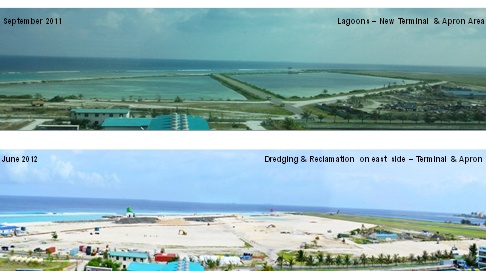
Work conducted by GMR to reclaim the new terminal ground

Local media outlets were on Saturday updated on the redevelopment of the island and shown around the new terminal site which, when completed, will aim to cater for increases in international traffic predicted in the country up to 2035.  The site is also required to bring INIA’s operations in line with international aviation standards.

With contractors already having begun work on the new structure as of last month, the government has stressed that it will not seek to interfere or “disturb” the project that officially commenced back in November 2010 under the administration of former President Mohamed Nasheed.  This government commitment was made despite raising concerns over what it claimed are minor issues relating to business regulations on the site.

However, President’s Office Spokesperson Abbas Adil Riza said the long-term prospects of the construction ultimately depended on GMR validating the legality of their contract – a document that was overseen by the International Finance Corporation (IFC). The IFC is a member of the World Bank group and the largest global institution focused on private sector in developing countries.

Abbas added that should parliament also decide on nationalising the airport in line with the wishes of certain pro-government parties to take back the project from GMR, then the present administration would have to comply with such a decision.

The government of President Dr Mohamed Waheed Hassan comprises a coalition of former opposition parties that represent the majority of elected representatives. The now-opposition Maldivian Democratic Party (MDP) presently has 29 MPs in the Majlis, the largest number of MPs belonging to a single party.

Nationalisation calls

Several pro-government parties – including the Dhivehi Rayithunge Party (DRP), Dhivehi Qaumee Party (DQP), People’s Alliance (PA) and Jumhoree Party (JP) – advised President Waheed last month that they continued to endorse an agreement signed in June 2010 calling for the airport to be taken back from GMR and nationalised.

The agreement endorsed six main points which included taking legal action to prevent the government’s decision to award the contract to GMR.

GMR’s contract is currently under scrutiny by a committee appointed by President Waheed, which includes the Attorney General, the Finance Minister and the CEO of Maldives Airports Company Ltd (MACL). The president has previously pledged during a visit to India that he would protect investment from the country in the Maldives.

A delegation from the IFC, which brokered the deal between GMR and the government of Maldives, recently addressed the government’s concerns over the concession agreement in a meeting with senior government officials.

Coalition concerns

When asked whether he believed GMR’s pledge to present the Maldives with a entirely new airport structure by July 1 2014 – in line with a 25 year concession agreement to develop and manage the site – would be met, Abbas claimed that concerns raised by several former opposition parties would need to be addressed.

“The point to note is that during the agreement’s signing, several unlawful points were raised by [former opposition] parties over why the government could not enter the agreement with GMR,” he claimed. “Under the law of the contract [GMR] did not perform sufficient due diligence and they must validate the legality of the contract. If any court of law rules the contract is illegal, the law must be upheld.”

The claims were made after local media reported that GMR had begun construction last month without a Civil Aviation Authority permit needed for work to begin. GMR responding in newspaper Haveeru said that the terminal construction had been approved in an existing master-plan agreed with the government.

Clarifying the report, Abbas claimed that the permit was “not a huge issue” and was believed to have resulted from an error by contractors presently working on the airport’s construction.

Under the law, he stressed that companies were required to undertake an Environmental Impact assessment (EIA) – which had been completed by GMR – as well as meet all other local business regulations.

Abbas claimed that the permit was an issue likely to have resulted due to a contractor error and could be addressed within the space of a week without major delays.

“Normal procedure would be for the cessation of work on the airport while the permit was awaiting approval. This takes about a week. I don’t see any reason for delays,” he said.

Aside from the permit issue, the government also alleged that it wished to resolve an issue over a duty-free law that outlawed duty-free shops at arrival terminals. With alcohol outlawed for consumption or purchase outside of licensed resort properties under Maldivian law, duty free stores within the airport’s arrival area was raised as a legal issue.

“These issues can easily be resolved, we are not looking to disturb the GMR deal,” he claimed. “Larger corporations need good governance, if one company does not meet its obligations everyone else may start looking for loopholes.”

Disturbance

Abbas said the most pressing issue concerning the INIA construction agreement remained the US$25 Airport Development Charge (ADC) outlined by GMR within its original agreement – a practice the infrastructure group contends is commonly used by airport developers around the world to aid the costs of large-scale renovation projects.

“The law does not allow for deduction of the ADC without parliamentary approval,” Abbas said.

The country’s Civil Court had blocked GMR charging the ADC last year on the grounds that it was a tax not approved by parliament. As the ADC was stipulated in the contract, former President Mohamed Nasheed’s administration had signed with the airport operator, the government at the time agreed that GMR would deduct the charges from the concession fees due the government, pending appeal.

With the present government having contested these deductions, GMR released a statement back in May proposing a compromise agreement whereby Maldivian nationals would be excluded paying the ADC when departing the airport.

While seeking to maintain an open dialogue with the government, GMR said Saturday that there had been no reply so far in regards to the options it had offered the government in order to find a resolution to the ADC matter.

Business politics

Despite the ongoing issues with the ADC, the infrastructure group said it did not pay too much attention to politics in the country, claiming it instead remained focused on the development of INIA.

“We don’t do politics well at all,” said INIA CEO Andrew Harrison, when questioned by local media about the impact politics was potentially having on the construction.

Speaking during a tour of the new airport structure yesterday, Harrison added that the airport construction was on track at present, and already providing improved returns to the state when compared to earnings before the agreement came into place.

He added that although there was no set deadline in order to reach consensus with the government over the resolution of the ADC charge, long-term delays could have “time and cost implications for the project”.

“Additional improvements”

Aside from contractual obligations to improve tourist processing capacity in the existing terminal, Harrison said that GMR was committed to a number of additional improvements not specified in the original concession agreement.

These improvements include an entirely new outdoor food court for the present terminal including Thai Express, Burger King and Coffee Corner restaurants that would be open to the general public as well as visitors.

He also pointed to other high-profile developments such as the refurbishment of the airport’s domestic terminal and toilets, a new executive lounge and behind the scenes modifications to boost capacity at the site as a reflection of the company’s claims it is going beyond its contractual obligations.

The new terminal meanwhile has been devised to include new shopping complexes, increased seaplane capacity via two new water runways and a considerably larger structure built above an large artificial lagoon.

The construction, comprising of a 70 percent glass structure, has been designed architecturally to play up the appeal of the Maldives’ oceans, whilst being four times the size of the terminal presently used to accommodate airline passengers.

Emergency runway

Addressing concerns raised in local media about the development of the existing runway, Harrison said that GMR had sent proposals to the government for possible construction of an emergency runway.

He stressed the the construction, which would require additional funding support either directly through the government or through the concession agreement, could be used only in case of emergencies should the main airport runway be out of action owing to an accident or emergency.

Harrison claimed that if approved by government, the emergency runway, which would not be ready by the opening of the terminal on July 1, 2014, would not be in full compliance to  International Civil Aviation Organisation (ICAO) regulations, due to its distance to grounded aircraft.

With the new terminal in place, aircraft would be grounded 212 metres away from the proposed emergency runway, meaning it would not meet recommended international regulations. However, GMR claimed this distance would still be preferable in terms of regulatory requirements to the current space available between INIA’s runway and aircraft parking area.

Beyond the new terminal aiming to meet full ICAO compliance by the time it is open to tourists, the passenger terminal is also expected to meet LEED Silver Certification environmental standards.

The contruction will also include a new VIP terminal to deal with diplomats, heads of state and other high-profile guests, along with a brand new cargo terminal and a Airport Fire and Rescue Building to deal with any potential on-site emergencies.

GMR said that the terminal had been designed by Singapore-based architect Winston Choo, who had devised a structure making the most of natural ocean surroundings while also playing up garden areas and a lagoon equivalent to two football pitches in size.

As part of the terminals proposed aesthetic, distressed wood, granite and coral like materials designed to emulate the feel of high-end resort properties around the country are expected to be used, the company added.

A virtual walk through of the proposed terminal design can be viewed here.

Discussing the ongoing political backlash against the awarding of the contract to GMR back in 2010 on nationalistic grounds, Harrison contended that INIA would remain a Maldivian owned enterprise that would be continuously developed by the company for the duraction of the tender.

“We are just the caretakers here,” he said.  “The airport remains and has always been owned by Maldivians.”

Harrison contended that to ensure profitability for its investment in the airport, GMR was itself committed to strengthening the wider Maldivian economy by working with local businesses, industry and contractors.

Likes(0)Dislikes(0)

Alliance française celebrates World Music Day in the Maldives

Alliance Française Maldives (AFM) celebrated World Music Day for the fourth time in the Maldives, in a music festival this weekend featuring local artists and a mesmerising performance by Abaji, a multi-talented musician famous for his proficiency in playing wide range of unique instruments.

World Music Day originated in France and through the years it has spread to more than 110 countries which celebrate it every year with amateurs and professionals presenting their music together.

This year’s stage for Fête de la Musique (World Music Day) was set at the Sultan Park on June 29, well attended by both locals and foreigners. From the loud thumps and beat of Bodu Beru group Habeys, to a sizzling performance by all-girls rock band Majenta, the crowd was enjoyed the music in a chilled environment.

Perhaps the most interesting part of the festival was the performance by the French vocalist Abaji. The musician of Greek, Armenian, and Turkish descent presented an array of unique musical instruments with such perfect ease and vocal rendition, that left the crowd gathered near the stage speechless.

“That is so amazing. How does he do that?” asked one spectator as the crowd cheered.

According to the Alliance Française, the event setting gives the original ambiance of Fête de la Musique in France, as during the world music day every musician is free to express their artistic talent in public places such as streets, parks, or squares, creating a festive atmosphere.

Alliance Française is an NGO based in Male’ since 2009, teaching the French language and giving an insight into French culture, and promoting cultural diversity. With over 500 students in the city, the NGO is teaching French in public and private schools, in resorts, and conducts evening French classes for adults in the National Library.

According to the AFM 2012 website, the group has chosen to organise monthly events with a view to maintain coherence within the francophone and francophile groups, to facilitate meetings among like minded individuals and spark creative projects.

Founded in Paris in 1884, Alliance Française is a non-profit association giving the opportunity to anyone to learn French language and enjoy the culture of French speaking-countries worldwide, with over 1000 centres across 136 countries.

More information is available on French lessons and cultural events at the Alliance Française website.

Likes(0)Dislikes(0)

JP will split MDP support in election, says PPM

Progressive Party of Maldives (PPM) Interim Vice President Umar Naseer has welcomed the growth of the Jumhoree Party (JP), stating his belief that the party is likely to split the Maldivian Democratic Party (MDP) vote in future elections.

His comments were said to have been in response to rumours that PPM MPs were considering defecting to the JP.

“Lately rumors have been circulating that some members of PPM’s parliamentary group are planning to switch parties. Many have called me to clarify about the matter. I would like to assure all members of the party that no member of our parliamentary group plan to crossover to another political party, and will never do,” Haveeru reported Naseer as saying.

“JP especially is adding many new members, which is not something of concern to PPM. It’s not like they are removing parts of PPM’s roof to complete theirs – rather, they are removing parts of MDP’s roof to complete their roof,” Naseer was reported to have said.

Feydhoo constituency MP Alhan Fahmy who has recently moved from the MDP to the JP said that he did not wish to respond to these comments. When switching parties, the former Vice President of the MDP was accompanied by the former MDP President, Dr Ibrahim Didi, and former MDP Secretary General Hassan Shah.

The JP – led by prominent Maldivian businessman and MP Ibrahim Gasim – currently has six members in the People’s Majlis, whilst the PPM – led by former President Maumoon Abdul Gayoom – has 18 seats in the house.

The most recent statistics from the Elections Commission (EC) show that the JP has lost six members in the past three weeks, whilst the PPM has gained 322, bringing the official membership figures to 5,914 and 16,565 respectively.

The EC figures also show that the JP has 2,175 forms waiting to be processed. The PPM is shown to have 1,211.

The JP Registrar General Mohamed ‘Inthi’ Imthiyaz told Haveeru earlier this month that the main obstacle increasing the party membership was the speed at which the forms could be processed.

Vice President of the EC Ahmed Fayaz said that the processing of the forms may take a few weeks due to the limited resources available to the commission.

Forms must be checked to ensure the identity of the party member before they can be officially affiliated to one particular party but said it was not common for forms to be rejected.

Should the unprocessed forms be assumed as valid, the membership of the top four parties in terms of popularity would be follows:

  • Maldivian Democratic Party – 48,843 – 29 seats in the Majlis
  • Dhivehi Rayithunge Party (DRP) – 27,706 – 15 seats
  • Progressive Party of Maldives – 17,776 – 18 seats
  • Jumhoree Party – 8,089 – 6 seats

The MDP is currently the sole opposition party in the 77 member chamber. It has lost 35 party members in the past month as well as suffering from a number of defecting MPs since the resignation of former President Mohamed Nasheed on February 7.

Nasheed recently received the support of 66 percent of his party’s members last month to be the party’s nominee for the next presidential elections.

The PPM’s parliamentary group constituency leader Abdullah Yameen told Haveeru yesterday that his party is the most likely to win  a presidential election without having to form a coalition.

“But the PPM must declare a suitable and generally accepted presidential candidate. Then we can certainly avoid a second round, and win the polls in the first round itself,” Yameen said.

The party’s presidential primaries are to be held next February. President Dr Mohamed Waheed Hussein maintains that he can hold fresh elections no earlier than July 2013 without a constitutional amendment.

The largest party, by membership, in the current unity government, the DRP, was keen to stress to Minivan News last week that it had only signed an official coalition agreement with the JP.

“There has been a slight confusion. No coalition agreement was signed – we are part of a national unity government after having accepted an invitation from President Mohamed Waheed Hassan,” explained DRP Spokesperson Ibrahim Shareef.

Shareef’s comments followed the announcement of a joint parliamentary group, including all pro-government parties other than the DRP.

Days earlier, MP for unity government party the Dhivehi Qaumee Party (DQP) declared its cooperation with the DRP to have come to an end following what it perceived to have been DRP support for an MDP proposed motion in the Majlis.

The DRP was founded by former President Gayoom to contest in the country’s first ever multi-party elections in 2008. The party split after internal ructions in 2011 resulting in the formation on the PPM.

The PPM’s official representation in the Majlis was zero until April, when Ahmed Shareef won the party’s first seat in the Thimarafushi by-election.

Since that time, as well as being allowed to add MPs previously registered as ‘independents’ to its parliamentary group, the PPM has benefitted from a number of MPs crossing the floor from other parties.

Former President Gayoom believes that the party’s support will eventually see its official membership figures reach 30,000.

Likes(0)Dislikes(0)

Presidents Office establishes ‘work ethics’ code for political appointees

The President’s Office today announced it had begun implementing a work ethics code for all the political appointees except cabinet ministers.

According to the ethics code published in Dhivehi, those bound by the new ethics code are those appointed under article 115(f) of the constitution, by a letter of appointment from the president or cabinet secretary.

The ethics code dictates the code of conduct of the political appointees, their dress code, work timing and procedures for resignation.

The Section 3(c) states that all appointees ‘should’ accept and respect all policy decisions of the government.

It further includes, “Even if there happens to be a difference of opinion on such a policy, the appointee should refrain from expressing their opinions to individuals, the public and the media, and should refrain from writing about it.”

The Section 3(d) also dictates similar requirements for not expressing views that oppose the policy of the government views that are contrary to the appointee’s responsibilities.

Apart from these restrictions, section 3 also demands that all appointees must maintain government secrets both while employed and after they leave the position.

Section 7 of the ethics code states that all appointees should turn up to work before 8:30 am in the morning except during the month of Ramadan, where the start time is 9:30 am.

Similar to the civil servants, according to the section 8 of the ethics code, appointees are also entitled to a 30 day vacation after one year on the job and 10 days ’emergency’ leave, while female staff are entitled to 60 days maternity leave.

Section 9 of the ethics code demands that all the appointees must dress accordingly and should always be at their best turn out while in public.

The section specifically states that men should wear either short or long sleeve shirts with tie, trousers and shoes for men, while female appointees should be in attire that is acceptable to the government.

The President’s office stated that all the appointees must begin to follow the code from July 1, onwards.

Speaking to Minivan News, President’s Office Spokesperson Abbas Adil Riza said that the government believed that such a work ethics code was important and necessary.

“Political appointees are also paid by the state, so the government believes that there should be some regulations on the work of political appointees,” he said.

He added that there previously there was no regulation regarding the work ethics of the political appointees and that he believed that such regulation would increase the “accountability and public confidence” in the political appointees.

The ethics code is the first of such regulations that has been imposed on political appointees in the country.

The code comes at a time where the government of President Mohamed Waheed Hassan has been under heavy criticism from the Maldivian Democratic Party (MDP), who alleged that the appointees are family members and activists who took part in the “coup that ousted the democratically elected president.”

Speaking to Minivan News previously, MDP Spokesperson Imthiyaz Fahmy said that many appointees were “senior activists in leading the coup d’état.”

“Many of them were present in Republican Square on February 7. They are unqualified and inexperienced,” he said at the time.

However, Riza at the time dismissed the allegations stating that the positions were awarded based on political party affiliation and qualifications, not based on “political activity or their presence at a certain place” which he believed reflected President Waheed’s desire to “formulate a national unity government”.

Likes(1)Dislikes(0)

Comment: Dr Who? Know thy President

This article first appeared on Dhivehisitee. Republished with permission.

Until Dr Mohamed Waheed Hassan Manik took oath of office as President of the Maldives on 7 February, most people did not know much about him, and even more could not care less.

The generally shared impression of Waheed was that he is an educated man who drily stuck to policy, the ex-UNICEF man with a PhD from Stanford. As Vice President he was delegated drugs and environment as focus topics, both issues of great national concern. He seemed to keep well out of the political intrigue and chaos that surrounded him; and, unlike most Members of Parliament and the increasing band of petty politicians, largely managed to stay out of newspaper gossip, and the extremely productive Maldivian grapevine.

He has friends in high places, even if of dubious credentials, like the vacillating British tycoon Sir Richard Branson who first criticised Waheed then admired him then suggested a middle-ground; and the mysterious ‘Malaysian consultant’, Dr Ananda Kumarasiri. Kumarasiri is a best-selling Buddhist author who, when he arrived in Male’ shortly after 7 February, was described as ‘a passing friend.’ But he was allowed to interrupt Waheed during an official press conference, and to speak for him in Sri Lanka.

Abroad, the general impression Waheed seems to have left is that of an affable, likeable man. Even when disagreeing with him, Waheed’s foreign acquaintances make a point of saying they like him.

Branson said, for instance:

It was a real pleasure meeting you and your delightful wife when I was last in the Maldives…

From knowing you, I would assume that you were given no choice and that it was through threats that you have ended up in this position.

And Mike Mason, Nasheed’s Energy Advisor, said this:

I don’t think Dr Waheed is a bad man – actually I like him a lot personally.

Perhaps these men see a side of Waheed that the general Maldivian public do not. Certainly, his interactions with the foreign press are rather jovial and quite the opposite of the dull occasions they are back home.

Truth is, the general Maldivian public did not quite know who Dr Waheed was, and nobody really cared. But, now that he has put himself in the Presidential limelight, it is becoming increasingly clear that there is substantial discord between the image people had constructed of Waheed and the details of his personality emerging since he assumed office on 7 February.

At an early press conference as President, for example, he was asked about allegations of a coup. Waheed replied,”Do I look like a man who would stage a coup d’état?”

Waheed’s belligerence towards those against his presidency came as a shock to most people. A popular recrimination of Waheed among Maldivians is that he is a quitter. In 1989 he ran for Parliament but quit and left the country in 1991 when the going got tough under Gayoom’s repression. He only returned in 2005. People call him ‘Fili Waheed’, ‘Waheed who fled.’

In the last 141 days Waheed has shown that this label no longer applies, if it ever did. He makes his determination to stay President until November 2013 crystal clear. He spelled it out for the BBC earlier this month. Even if CoNI [Commission of National Inquiry] finds that there was a coup on 7 February, unless his direct involvement was proven, he would not leave the post. Even if it means battling it out in court.

If they [the commission] find out that I have had a role in bringing about a coup, then I will definitely resign.

But if I have no role – if somebody else has done it – it doesn’t mean I have to resign, according to the law of the Maldives.

People were properly introduced to this new aspect of Waheed’s personality on 24 February when he gave a rousing speech in ‘Defence of Islam’ to a thousand-strong crowd of supporters. Gone was the refined gentleman of the world, the Westernised academic. Here was an Islamic warrior, calling everyone to join his Jihad and proclaiming Allah had made him President. Again, it wasn’t just words, but his actions; the whole package jarred sharply with the public perception of Waheed.

The previously placid Dr Waheed pumped his fists in the air and addressed his supporters as Mujaheddin. Where did all the rage, the Islamist vocabulary, the sheer bull-headedness, the pelvis-pumping, and the swagger come from?

Waheed’s attempts to deliver his presidential address on 19 March also show his determination to keep his job, and suggest that he quite relishes defeating MDP’s efforts to prove the illegitimacy of his government. Three times he was interrupted mid-sentence during his ‘inaugural address’. Where a less determined man would have crumpled, Waheed battled on and, in a credible impersonation of Arnold Schwarzenneger’s Terminator, told MDP MPs: ‘I’ll be back.’ He was. He delivered the speech.

Since becoming President, he has also shown himself to be remarkably thick-skinned to public humiliation. Led by Maldives Democratic Party (MDP), supporters of Nasheed and reformists have continued to oppose his rule on the streets of Male on a regular basis. When Waheed travels across the country, he has to send ahead armed police and military to line the streets and protect him from protesters.

Waheed has refused to let it get to him. Instead, he seems to have decided on a strategy of ignoring the protesters, claiming – and then sincerely believing – he has 90 percent support among the Maldivian population. He pretends not to hear the calls for early elections, and the public anger against him. When he cannot avoid angry democrats, he waves, smiles, and makes sure at least one smiling child is in the vicinity for a photograph that could be captioned as ‘my supporters love me.’


With time, it has also become clear that although Waheed has set up CoNI to look into the events of 7 February 2012 and Nasheed’s resignation, he remains absolutely convinced that Nasheed was responsible for his own demise. Details of an email exchange between Dr Waheed and Nasheed’s Energy Advisor Mike Mason published by Minivan News this month revealed that in Waheed’s opinion, Nasheed was under the influence of an illegal substance when he decided to resign.

“It would be nice if you listened to something other than Nasheed’s propaganda. He is free to go anywhere he wants and say what ever he wants,” Waheed wrote.

“Have you ever thought that Nasheed could have made a stupid mistake under the influence of what ever he was on and blown everything away? I thought you had more intelligence than to think that I am someone’s puppet and Maldives is another dictatorship,” the President said.

Is Waheed a puppet?

Since the coup, people have come to form a new impression of Waheed: that he is a puppet of political masters above him. In late February, an audio recording was leaked to the local media in which Waheed’s own political advisor was heard describing him as ‘the most incompetent politician in the Maldives.’ From Dr Hassan Saeed’s comments, emerged a Waheed who felt bored and irrelevant within Nasheed’s administration, spending his time playing games on social media networks.

Although it contradicts Waheed’s emerging Hard Man persona, it matches people’s perception of him as a coward and a quitter.

Many incidents have occurred in these 141 days of his presidency to suggest the accusations are not baseless rumours. Waheed’s speech was interrupted live by MP and tourism tycoon Gasim Ibrahim on 24 February. A President who is in command will only be interrupted in public if there is a national emergency (remember this moment?)

or, if someone else is in command.

And then there are the ‘little things.’ Like Waheed paying a courtesy call on Gayoom at Gayoom’s residence after becoming president. Protocol dictates the visit be the other way round. When President Mahmood Abbas of Palestine paid a visit, on invitation from President Nasheed, it was impossible to say who the official host was, Gayoom or Waheed.

Waheed also seems incapable of stopping involvement of the supernatural in law enforcement practices–a hallmark of Gayoom’s thirty-year rule–that have returned to haunt Maldivian politics in the last three months. The general impression of Waheed as the well-travelled ex-UN-official cannot be easily reconciled with a Commander in Chief who lets his armed forces pursue, prosecute, and punish people for ‘practising sorcery.’

Another factor that further indicates Waheed is far from being in control of the government is his relations with the Islamists. Perhaps because he worked in Afghanistan, and saw first hand the dangers of extremist religion in the twenty-first century, countering Islamism in the Maldives seemed to be of some concern to Waheed. In October 2010, for example, he told Indians that ‘rising extremism‘ posed a challenge to the Maldives.

Yet, he gave that 24 February speech about the Mujaheddin, and allowed himself to be criticised for attending a ceremonial service at St Paul’s in London marking the British Queen’s Diamond Jubilee.

In May, convicted terrorist Mohamed Ameen who detonated a bomb in Male’s main tourist thoroughfare was released from prison, while this month Islamists attempted to murder the country’s only openly gay rights activist and campaigner for a secular Maldives, Hilath Rasheed. On 7 February itself, extremists vandalised the National Museum and destroyed age-old Buddhist relics.

Waheed has remained silent on such critical incidents while key members of his cabinet have told the international community that threats from Islamism in the Maldives are exaggerated.

Also, thanks to a purple-prose column published on Haveeru [in Dhivehi] recently commemorating the 25th aniversary of Dr Waheed’s PhD degree, the public has come to know that his dissertation was on the subject of political influence over national education curricula. Yet, he has not made a stand against the Islamist Adhaalath Party’s continuing efforts to meddle with the national curriculum. And he most certainly did not stand up against Adaalath, and key political figures, for their criticism of Nasheed as anti-Islamic when Washington Post reported that:

While he [Nasheed] was in power, he says, he changed the school curriculum to make it “more balanced and not so Islamic” and proposed a new penal code less dependent on Islamic sharia law.

It is surprising that a man so proud of his academic credentials that he thinks its 25th anniversary is an occasion deserving of national attention, fails to stand up for the core arguments of his own work. Such weakness of principles does suggest a corresponding weakness in character, making it very plausible that Waheed is, indeed, a puppet being controlled by an unspecified master or masters.

Despite his many weaknesses in the face of the varying demands and beliefs of the so-called Unity Government, should Waheed really be dismissed as a mere puppet?

It is just as, if not more, plausible that his ‘inability’ to take action is precisely the terms of the deal he agreed to with the so-called Opposition Coalition in the early hours of the morning of 31 January 2012.

The rewards for Waheed the President, even if a very short-term president, are rich. Apart from the usual perks of travelling the country and the world in full national honour, influence and global profile, there are also the many benefits for his nearest and dearest.

Almost all members of his family in Male’ and of working age are now in high-ranking government positions or in lucrative positions as board members of various national and international businesses and associations. His son Jeffery Salim Waheed, was promoted from an Intern at the Maldives Permanent Mission to the UN to First Secretary shortly after Waheed assumed office. Salim Waheed was previously a vocal campaigner for democracy but has now become a crusader for his father’s cause.

Judging from what other key players in the Opposition Coalition have said, Waheed’s deal with them also includes a promise that he will not run for presidency in 2013. Umar Naseer, the outspoken Vice President of Gayoom’s Progressive Party of Maldives (PPM) has told the media several times that he ‘knows’ Waheed will not run in 2013. So far, Gasim Ibrahim from the Jumhooree Party (JP), Thasmeen Ali from Dhivehi Rayyithun ge Party (DRP) and Nasheed have declared their intention to run in 2013. Waheed has stayed silent.

The silence suggests Umar Naseer, as usual, is speaking from first-hand knowledge of the behind the scenes strategising by the Unity Government. Waheed’s share of the pie for helping topple Nasheed seems to be twenty-one months as President, and full immunity from prosecution at the end of his term with full benefits and privileges accorded to former presidents. A life of luxury abroad–preferably in America and desirably inclusive of frequent socialising with the Obamas, and perhaps working the lecture circuits à la Clinton and Blair, is what Waheed is looking forward to once he completes his part of the deal.

This suggests that Waheed is more pragmatist than puppet. Someone who knew exactly what he wanted–the Presidency of the Republic of Maldives–and got it. It mattered little to him how. Dismissing Waheed as a puppet would be a mistake.

All comment pieces are the sole view of the author and do not reflect the editorial policy of Minivan News. If you would like to write an opinion piece, please send proposals to [email protected]

Likes(1)Dislikes(0)

A window to Indian culture, literature and dance

For those interested in exploring the diversity of Indian arts, culture and language, the Indian Cultural Center (ICC) is the place to be. Since its opening in July 2011, the centre has been an important platform, where Indians and Maldivians are building friendships through vibrant cultural and linguistic exchanges.

Hundreds of participants, both locals and foreigners alike are today part of the diverse programs run by the Indian Cultural Center. Many are exploring the world of Indian mother tongue and poetry while others are enjoying the experience of Indian classical dance Kathak or classical drumming, Tabla.

Similarly, to those who wants to take a break from the hustle and bustle of the busy capital Male’, the cultural center offers its best – rejuvenating and relaxing yoga classes.

And, the best part of all, every program is offered free. No charges.

“This is a cultural window to India”, ICC Director Dr.Mishra Amrendhra told Minivan News on Wednesday night, following the launch of a new Hindi learning program at the centre.

Currently over 40 centers are opened worldwide, to provide people to the opportunity to learn Indian culture and language, he observed.

Speaking at the ceremony Indian High Commissioner to the Maldives DM Muley said that “we have lost a lot in our culture and language” and today more than ever people are becoming “more segregated  in domestic and narrow corners”.

“There are invisible walls that divide us,” he pointed out. “But it is absolutely imaginary”, and “a phobia cultivated and encouraged by few with selfish interests.”

Therefore, he streesed that “language of humanity” and “attitude of helping each other” needs to be developed through promoting language and culture.

He praised ICC’s efforts, saying that the objective of opening the center seems to have been partially fulfilled. “I welcome all interested in Indian language and culture to join the centre.”

According to ICC Director Mishra, the centre is already receiving a “tremendous response” from the Maldivians, in addition to Indian expatriates and other foreign nationals working in the Maldives.

He added that several Maldivian students are going for higher studies under the center’s scholarship program and plans are underway to sign a cultural exchange agreement between the two government’s.

Currently 250 students, including several Maldivians, are part of the yoga classes running everyday in four batches.

Yoga teacher Sonika spoke to Minivan News about the keenness among the Maldivian participants in her class and how yoga are changing their lives.

“It is a great stress buster,” Sonika noted. “After regular yoga classes, some local students have found out that the cysts in their uteruses have disappeared. Many had joint and thyroid problems too. But, now they they are also feeling much healthier and energetic,” she continued.

“You should join my class. There are free slots. You will feel much light inside and it be be a journey to self evolution,” she added with a smile.

Meanwhile, Mishra pointed out that there have been some interest from local groups to explore fusions of Tabla and the Maldivian classical drumming, Bodu Beru. Although, Maldivian students participating in the Kathak dancing classes few, the center is hopeful that it will attract more students.

Among the few learning the dance is 20 year-old Naufa Nizam and her sister. At Wednesday night’s ceremony Naufa recited a poem she wrote in Hindi, so eloquently that no one would have guessed she’s a Maldivian until they heard her reciting the poem’s translation in Dhivehi.

Naufa told Minivan News: “I’ve always adored poetry since I was a kid. My mother is in the yoga class that’s how I came to know about the centre. I am participating in the Kathak dancing class too,” she added.

Meanwhile, sitting next to her was her sister, dressed in the highly ornately embroidered and decorated Kathak traditional costume consisting of a sari, with loose ankle-length skirt, and the choli, a tight fitting blouse – ready for the dance performance.

“But I don’t perform in front of a crowd,” said Naufa, who is an A-level student of Arabbiya School and student of Law foundation program at Maldives National University. “You know, it’s because of the burqa (head scarf).”

“But it doesn’t matter. I know myself that I know this dance,” she smiled. “I love this place.”

Note: Indian Cultural Center is opened at H.Vavathi, fourth floor. Those interested to join the centre programs can call 330 6612

Likes(0)Dislikes(0)

Comment: Will early polls end this drift?

At one-level, it is business as usual in Maldives – at another, it is calm before possible storm.

While an element of political stability attaching to the government of President Mohammed Waheed Hassan Manik in recent weeks after the destabilising events of February 7, has ensured that day-to-day business of the Government does not suffer, it has also flagged new issues that could challenge the internals of the uneasy coalition that he has been heading.

Together, they have the potential to create a façade of self-belief, which otherwise boils down to self-illusion and self-destruction of the kind that the MDP predecessor in office had practised while in power.

It took the MDP and President Mohammed Nasheed greater and persistent efforts to arrive at where they did in less than three years in office. Given the composition and contextualisation of the Government coalition after he resigned on that fateful February 7, they would instead have to put in greater efforts and display equal sincerity to make their present scheme work – and well into the future.

In the absence of a commitment about the future, particularly over the presidential polls, whenever held, the ruling coalition is already drifting towards unsure approach not necessarily to administration, but to their politics. At the centre of it all, however, is their individual approach to the presidential polls and individualistic perceptions about their comparative electoral strength, as much within the combine as outside.

In a way, the drift also owes to a creeping underlying yet unmistakable belief of individual Government parties that the ‘common political threat’ from the MDP has receded, and at the same time the presidential polls, due in November 2013, cannot be delayed eternally – even if President Nasheed’s demand for early elections could be scuttled.

They had worked it in the past, when President Maumoon Gayoom was in power. Ushering in multi-party democracy, many now in the Government had joined hands with the MDP to oust the incumbent through the power of the ballot. In contrast, the February 7 exit of President Nasheed might have been controversial but the ‘ganging up’ political adversaries against him within three years of his emerging as the Maldivian mascot for democracy was also owed to the ‘democratic distrust’ that had crept into the political scheme. Today, the talk of presidential polls, whenever held, is the distinguishing and delineating factor, so to say.

For his part, President Nasheed has been travelling overseas increasingly, carrying his message about the ‘coup’ that forced his resignation. The inherent differences within the Government parties, often based on individualist approaches and claims, is coming out in the open – and inevitably so. Ironically, it could be construed as a measure of lessened threat from President Nasheed and the MDP. It is thus that the PPM and PA, owing allegiance respectively to President Gayoom and his half-brother Abdulla Yameen, have formed a parliamentary coalition, excluding the DRP parent of the former and also the Jumbooree Party (JP), identified with billionaire-businessman Gasim Ibrahim.

The PPM has also begun openly accusing DRP leader Thasmeen Ali of colluding with the MDP Opposition, which charge the latter had denied vehemently. Yet, the DRP has been put on the defensive within the ruling combine, and embarrassingly so.

What can a ‘running-mate’ do?

With a substantial showing in the presidential polls of 2008 and recent by-elections to the People’s Majlis or Parliament and local councils, the JP has been ‘poaching’ MPs and other leaders from other parties – including one MP from the DRP partner in Government. The MDP in particular cannot complain, as under the Nasheed presidency in the democracy era, they had started off the game.

The Constitution provides for a run-off, second round polling between the top two scorers, if none of the candidates crossed the mid-way mark in the first phase of presidential polls. The strategy and effort of individual political parties in the Government thus is to be able to get into the second round, and negotiate with the rest from a position of strength. This would precisely be a repeat of the 2008 polls, in their perception, when Gasim Ibrahim, and another runner-up, Dr Hassan Saeed, at present Special Advisor to President Waheed, transferred their first-round votes to Candidate Nasheed, who was the Opposition topper with 25 per cent vote-share against incumbent President Gayoom’s 40 per cent.

Today, the roles have reversed, what with President Nasheed being seen as the potential candidate to top the list. Having nominated him as their presidential nominee already, through a democratic process prescribed under the law, the MDP believes that he would win hands down in the first round. He would have to, given the present alignment of political parties, as there is nothing to suggest that he would be able to fill the gap if pushed into the run-off phase. It is in this context, the PPM charges against DRP colluding with the MDP needs to be viewed. However, the DRP seems to believe that the party’s cadre-base and vote-base are as much anti-Nasheed in their political preferences as they are anti-Gayoom, leaving the leadership with little manoeuvrability in alliance-formation. It is a real threat facing the DRP, particularly after ‘rebel MDPs’, comprising elected but ousted party president Ibrahim Didi and his deputy AlhanFahmy, with whom the party might have shared a common dilemma, chose to join the JP, instead. Didi now heads the JP and party founder Gasim Ibrahim is a sure candidate for the presidency.

The problem with coalition politics of the nature, which has suited experienced and matured presidential democracies as in the US, is that the running-mate to the presidential candidate is expected to bring in additional votes to fill the winning-gap. President Nasheed does not have anyone before him who could be described as such, if the MDP’s calculations about a first-round victory for him need testing on the ground. Individual Government parties are keener on demonstrating their individual vote-share with a second round in mind than forming an alliance for the first round, where political partners could choose their presidential candidate and vice-presidential running-mate through electoral negotiations. It was so in 2008, when Candidate Nasheed chose Waheed, founder of the GaumeeItthihaad Party (GIP) as his running-mate, but his experience since assuming office, flowing from his inability to share power with his Vice-President, might dissuade others of the ilk from attempting some such measure at present.

‘Transitional justice’ and vindictiveness

It does not stop there. In recent days, the Majlis, where the Government parties are in a majority, has passed a resolution for a parliamentary committee to probe certain decisions of President Nasheed while in office. It is unclear if the immunity available to former Presidents, which President Nasheed had underlined after demitting office, would extend to cover parliamentary resolutions of the kind. More importantly, in an impromptu yet immediate effort at national reconciliation after electoral results were known in 2008, President-elect Nasheed announced legal immunity for his predecessor.

He also called on President Gayoom soon after his election, and the latter too facilitated smooth and seamless transfer of power, putting at rest all speculation that he would try to thwart the democratic expression of his people. Though once subsequently, President Gayoom was summoned to a police station for an enquiry regarding a criminal case dating back to his days in office, nothing was allowed to come off such efforts, which were as half-hearted as they were off-handed.

The Government and the parties forming a majority for it in the Majlis have been talking about filing criminal and constitutional cases against President Nasheed and his erstwhile Cabinet members and MDP leaders. Some of it has proceeded on expected lines while no major case has been filed against any top leaders thus far. Indications are that the Government might take its time deciding on whom to target, how, why and when – more in terms of political expediency rather than legal/constitutional accountability.

As and when it happened, the MDP is sure to cry foul, and charge the Government with political vindictiveness. Its political argument might stand vindicated if the higher judiciary, as has been happening since the February 7 change-over, stands in the way. The Waheed leadership, however, has thus far kept its promise of not interfering with the judicial freedom, a charge levelled against the predecessor leadership – and, not without some justification, as the locking up of the Supreme Court by the nation’s armed forces in mid-2010 showed.

Charges and counter-charges of vindictiveness of the nature have their political fallout. The MDP, while in power, had revived such talk by constantly referring to ‘transitional justice’ when President Gayoom failed the party’s expectations by returning to active politics. A catchy phrase nonetheless, ‘transitional justice’ boiled down to legal action against the Gayoom leadership for alleged wrong-doings during its tenure. During the ‘December 23 Movement’ run-up to the February 7 episode and later, MDP hard-liners have not tired of blaming the ‘pacifist’ Nasheed presidency for taking a lenient view of his predecessor’s undemocratic and corrupt actions – including five-time imprisonment for his would-be successor.

Yet, any talk now of reviving ‘transitional justice’ on the MDP’s part if returned to power, or similar ranting by the incumbent Government parties has the potential to make the run-up to the presidential poll more tension-ridden than already.

Tottering economy

Though the MDP’s predictions of a post-resignation steep fall in tourist arrivals have not been proved right, the nation’s economy continues to totter, going beyond concurrent global and regional inconsistencies of the times. JP’s Gasim Ibrahim, a former Finance Minister under the Gayoom dispensation, has begun talking about a ‘bankrupt Government’ while Presidential Advisor Hassan Saeed too has been cautioning the nation that Maldives cannot afford to live beyond its means. Here, they share the perception of the MDP and President Nasheed, when the latter was in office, yet the Waheed Government has revisited some of the IMF-dictate economic reforms policies of the predecessor-administration. Recently, the Government took a Rf 300 million loan from the Maldivian Monetary Authority (MMA), a State institution, and there is an accompanying controversy over approaching Parliament for a post facto endorsement instead of prior clearance.

What could help to bring back political order, which alone would ensure governmental stability at a time when the crying need of the economy seems the same? On political stability alone would depend foreign investments, which would be among the near-permanent sources of economic revitalisation for countries such as Maldives, particularly so in the South Asian neighbourhood, and for a long time to come before they became self-reliant. For instance, the February 8 violence that followed President Nasheed’s resignation, forced or otherwise, while not exactly rattling foreign tourists, who form the backbone of the nation’s economy, however may have make new investors to hold back their decisions, at least until political stability that they can feel and vouchsafe for returns to the Indian Ocean archipelago.

It is not as if early presidential polls would automatically ensure political stability. The problem with the Nasheed presidency was the MDP’s inability to retain its political coalition until after the parliamentary elections six months later. This meant that the Government under the Executive President system did not have a parliamentary majority – it did not have one even at inception – leading to horse-trading on the one hand, and rejection of Government’s initiative on the other. That included a resolution calling upon the Government to obtain Majlis’ approval for every major contractual decision, as with the ‘GMR case’, and refusal to endorse some Cabinet nominees of the President. Similarly, post-poll, the new President would have to ensure peace on the streets, which alone would ensure not only investors’ confidence in the nation but also the people’s confidence in democracy.

For now, all talks of early presidential polls have been shelved after the Government parties made a near-mockery of the All-Party Roadmap Talks by taking up a long list of 30 issues that were not on the original agenda, but included ‘black magic’ as among those needed national priority and hence attention. There is no talk again of reviving the all-party talks, which willy-nilly seems to be getting linked to the progress of the National Commission of Inquiry (NCI), appointed by President Waheed and expanded to include an MDP nominee and an independent member from Singapore, at the instance of the international community.

The expanded NCI has been tasked to submit its report by July-end, but the chances are that they may require extension(s) to be able to come up with anything concrete – which by the nature of things, could at best be recommendatory in character, and not mandatory in nature.

The chances are that whichever side whose arguments the NCI does not buy would not accept the findings and act on the same. And the Government, as is known, would be keen on reviving the Roadmap Talks, whose agenda included early presidential polls, only if the NCI hands down a split-verdict. All this would boil down to only one thing. That the stake-holders in the Roadmap talks could well begin with committing themselves to the findings of the NCI, and also begin taking their job seriously so as to build a national consensus, not only over the presidential polls but equally so on other issues, too. In the absence of such a course, any divergence of opinion between the Executive and the Legislature in the months after fresh presidential poll could bring the nation to a virtual stand-still, or lead to further horse-trading, which would be a mockery of democracy, all the same.

Worse still, between now and the presidential polls, whenever held, the inevitable internal dissensions within the ruling coalition, if it could be called so, could lead to mutual acrimony of the administrative kind and initiative, even as their attempt to cobble together an electoral strategy to keep the MDP adversary at bay could strain the infant democracy, still.

The writer is a Senior Fellow at Observer Research Foundation

All comment pieces are the sole view of the author and do not reflect the editorial policy of Minivan News. If you would like to write an opinion piece, please send proposals to [email protected]

Likes(0)Dislikes(0)

Pro-government parties propose parliament investigation of Nasheed

Proceedings in the Majlis were brought to a premature conclusion for the second time in 10 days after pro-government parties proposed and passed a resolution assembling a temporary committee to investigate the alleged illegal actions of former President Mohamed Nasheed.

The motion to form a seven man committee was passed before the session was halted after vehement protests from the Maldivian Democratic Party’s (MDP) parliamentary caucus.

MDP spokesman Hamed Abdul Ghafoor described the scene within the chamber: “The deputy speaker looked visibly shocked when the MDP started shouting ‘arrest the speaker, arrest the speaker’. Then they began to shout ‘arrest Gasim, arrest Gasim’”.

Ibrahim Gasim is the leader of the Jumhooree Party (JP), one of whose members, Abdulla Jabir, proposed yesterday’s resolution, according to Ghafoor.

Yesterday, MDP members were invited to sit on the proposed committee, with the local media reporting that they had refused the chance.

Ghafoor, however, claims that the PPM had intentionally selected MDP members who were absent from the Majlis.

The two cases against Nasheed, concerning the arrest of Chief Justice Abdullah Mohamed and the alleged discovery of alcohol containers at the former president’s residence are currently with the Prosecutor General’s (PG) office.

The Deputy Prosecutor General Hussein Shameem said that a decision on these two cases was expected by the end of next week.

When asked if he felt the Majlis resolution would encroach on the work of the PG’s office, Shaheem replied: “The procedure is within the Majlis’ regulations – it would not be a criminal investigation. The findings would not come to us but will be for the Majlis.”

Deputy Leader of the Progressive Party of Maldives (PPM) Umar Naseer told local media earlier this week that he was confident the PG would ensure Nasheed would be jailed before the next elections.

Later the same day, speaking before an audience in Washington DC, Nasheed commented that there was always somebody talking about putting him back behind bars.

Ghafoor stated his belief that Nasheed was keen to have his day in court to defend himself over the arrest of Abdulla Mohamed.

“Nasheed is intending to defend himself – he wants to. It will be a landmark case, “ said Ghafoor.

When asked about the utility of such an investigation alongside the work of the PG, Ghafoor suggested the proposition may have been for publicity purposes.

He suggested that pro-government parties may begin to target independent institutions such as the PG’s office, describing this as the “reverberations of the Commission of National Inquiry (CNI)”, which he is confident will find the February transfer of power to have been illegal.

The January 16 arrest of the judge, who had been accused by the Home Minister of “taking the entire criminal justice system in his fist”, raised the intensity of the protests against the Nasheed government

These protests culminated in a police mutiny on February 7 and the resignation of Nasheed.

The judicial crisis was sparked after Abdulla Mohamed filed a case in the Civil Court granting him an injunction halting further investigation by the Juducial Services Commission (JSC) into his alleged misdeeds.

This was followed by a High Court ruling against a police summons on January 16, which prompted police to request that the Maldives National Defence Force (MNDF) take the judge into custody.

The crisis prompted the Foreign Ministry to request international assistance in reforming the judiciary.

The judge was released from detention immediately after Nasheed’s resignation and no

Local media reported that the Deputy Speaker Ahmed Nazim said that the party leaders will have to meet to discuss the failure to assign members to the committee.

At the time of press, spokesmen from the government aligned PPM and Dhivehi Rayithunge Party (DRP) were not responding to calls.

Similarly, Minivan News unable to illicit a response from Dr Ibrahim Didi, President of the JP, whom a JP spokesman had assured would be willing to comment on yesterday’s resolution.

Likes(0)Dislikes(0)

State sues Male’ City Council for repossession of MDP protest camp at Usfasgandu

The state has filed a lawsuit in the Civil Court against Male City Council (MCC) for the repossession of Maldivian Democratic Party (MDP)’s protest camp at ‘Usfasgandu’ today.

During the first hearing, the state argued that the city council had been giving the land to parties against the agreement made between the state and the city council and also against the government’s policies.

The state also claimed that they had previously requested the city council hand over the land to the state in March, but had refused to do so.

State lawyers also said in court that the cabinet had made a similar decision on last May, but despite the cabinet’s decision, the city council had failed to hand back the land to the state.

During the hearing, the state asked the court to order MCC to hand over ‘Usfasgandu’ back to the state.

In response to the case presented, MCC lawyers asked the court for an opportunity to respond to the case in writing.

The judge ended the court session giving MCC lawyers to respond in the next hearing.

Speaking to Minivan News, MCC Councilor Ahmed Falah said that the court has given them the opportunity to respond in writing and the next hearing was scheduled on July 8.

Asked about on what basis the state was suing the MCC, Falah said that they were trying to limit the powers of the city council.

“They say that we were in breach of the agreement that was made between the MCC and the state. But the agreement does not state any specific procedure or rules on how the city council can give the lands to those that request it,” he said.

Falah claimed that the whole case was politically motivated as the council had the opposition majority.

“This is not anything about the agreement, it is all about politics. They know that [government] does not have a majority in City Council so they are trying take all our powers, the land was given in accordance with the decentralization act,” he said.

The case flared up after MCC extended the ‘Usfasgandu’ lease period for another three months after its initial period expired this July.

On March 22, MCC gave ‘Usfasgandu’ to MDP to conduct political activities, after the police dismantled ‘Justice Square’ (the Tsunami Monument area) last march.

Councilor Falah at the time said that they “gave the land because last Monday terrorists attacked the Justice Square at the end of Lonuziyaarai street.’’

However, the cabinet of President Mohamed Waheed Hassan decided to take over the land from MCC and hand it over to Ministry of Housing and Environment.

In a statement, the President’s Office at the time said that during discussions concerning “the breach of agreement by the MCC in utilizing the land plots and other properties handed over to the City Council by the Ministry of Housing and Environment,” the cabinet had decided “to entrust the Minister of Housing and Environment with the authority to reclaim the properties from the City Council when required.”

However, MCC refused to comply with the decision citing that the ministry had no authority over the land.

In a letter informing the ministry of its decision, the council insisted that the ‘Usfasgandu’ area was “temporarily leased” to the former ruling party in accordance with the Decentralisation Act, contending that the ministry did not have legal authority to reclaim council property.

Ministry of Home Affairs, asked police to take over ‘Usfasgandu’ following the non-compliance in handing the area over to the Ministry of Housing and Environment.

The Maldives Police Services (MPS) sought a court order from the Criminal Court but was initially refused after deciding that it was out of its jurisdiction.

The Criminal Court at the time said it had studied the documents presented by the police along with the court warrant request form, and decided that the warrant was not within its capacity to grant.

On May 29, police raided the MDP protest camp at Usfasgandu, after obtaining a search warrant from the Criminal Court and cordoning off the area from MDP demonstrators.

Reasons for the search as stated on the warrant included: “suspected criminal activity”, “damage to public property”, and “suspected black magic performed in the area”.

Under evidence, the warrant alleged that people in the Usfasgandu area verbally abused police officers and damaged a police vehicle on April 20, obstructed a Maldives National Defence Force (MNDF) exercise of May 9, and on May 25, “MDP protesters threw a cursed rooster at MNDF officers.”

The security forces began the dismantling the camp at Usfasgandu, shortly before being ordered to halt by the Civil Court after the MDP challenged the legality of the operation.

The government appealed the Civil Court decision in the High Court, which issued an injunction suspending the Civil Court’s injunction.

Police issued a statement right after the High Court injunction stating that there were no more legal obstructions to raiding the camp, but said the police were “thinking on the matter”.

Likes(1)Dislikes(0)