Candidates from political parties finish signing voter lists

All 188 candidates representing political parties in the upcoming parliamentary elections finished signing voter lists by noon today, Elections Commission (EC) Director General Mohamed Shakeel has confirmed.

Shakeel told Minivan News, however, that some independent candidates have not signed the final eligible voters registry.

Of the 114 independent candidates, the EC media official said 18 candidates have not signed the lists.

Aside from the 18 independent candidates failing to sign, Shakeel said the EC’s “preparations for the election are perfectly on schedule.”

He noted that the EC had decided to extend the period offered for candidates to complete signing the list to 12:00pm today.

The commission has yet to make a decision on a further extension, he added.

Candidates were invited to the Dharubaaruge convention centre during the weekend to sign off on the final lists.

Obtaining signatures of candidates on the voter lists used at polling stations was among the 16-point guideline imposed on the EC by the Supreme Court in its judgment annulling the September 7 presidential polls last year.

The EC was required to ensure that the voter lists are agreed upon as valid by candidates or their representatives ahead of the polls.

However, the local council elections on January 18 took place as scheduled despite candidates signing voter lists for just 81 out of 464 ballot boxes.

Of 543 independent candidates, only 147 candidates had signed the lists.

The 302 candidates contesting the second multi-party parliamentary elections meanwhile include 85 candidates from the opposition Maldivian Democratic Party, 50 candidates from the ruling Progressive Party of Maldives, 28 from the Jumhooree Party, 12 from the religious conservative Adhaalath Party, seven from the Maldives Development Alliance, and six from the Dhivehi Rayyithunge Party.

Quorum

The EC’s capacity to conduct the parliamentary polls as scheduled on March 22 was thrown into doubt last week following the Supreme Court’s controversial removal of EC Chair Fuwad Thowfeek and Deputy Chair Ahmed Fayaz for contempt of court.

Less than two weeks before the election, the dismissals left the EC without the three members required for a legal quorum to hold meetings and approve decisions.

However, on Wednesday (March 12), parliament approved Ismail Habeeb to the commission to replace former member Ibrahim ‘Ogaru’ Waheed, who had resigned in October citing poor health.

Following the vote to approve Habeeb, President Abdulla Yameen presented the letter of appointment to the former EC director on Thursday morning.

Shakeel noted today that the decision to extend the period for signing voter lists after the initial deadline expired at 10:00pm last night was made at a commission meeting.

The President’s Office welcomed parliament’s decision to approve Habeeb to the commission, noting that it “enables the EC to function with the legally required quorum and hold the general elections scheduled for 22 March 2014”.

Likes(0)Dislikes(0)

High Court supports lower court decision to continue Alhan’s lawsuit against MDP

The High Court has today ruled that the Civil Court does have the jurisdiction to preside over a lawsuit filed by Maldivian Democratic Party (MDP) MP Alhan Fahmy against his party.

Feydhoo MP Alhan is seeking the annulment of the opposition party’s primary for the Feydhoo constituency in Addu City.

Speaking to Minivan News today, Alhan said there were two cases related to the lawsuit filed at the Civil Court being reviewed in the High Court, and that the court had today concluded one case while he had withdrawn the other.

The case concluded today was the appeal by the MDP claiming that the Civil Court could not proceed because Alhan had not completed all the internal party procedures, such as appealing at the party’s appeal committee.

”During the hearings held in the Civil Court, I requested the court to issue a warrant to temporarily invalidate the candidacy of the person who won the MDP primary and the court said that it did not have the jurisdiction to do so and that the High Court will have the jurisdiction to issue such an injunction,’’ Alhan said.

“So I filed a case with the High Court on March 6 and 11 days later the court held a hearing and I told the court that now it was too late to issue the injunction and that I wished to withdraw the case.’’

Alhan said that the case going on in the Civil Court has almost reached an end and that during the next hearing the court would deliver a verdict.

Shortly after announcing his decision to contest the primary result, Alhan was stabbed in Malé while at the Breakwater cafe in the artificial beach area. During the attack, Alhan received stab wounds to the back and was quickly flown to Sri Lanka for spinal surgery.

When Minivan News inquired about his condition he said that his left leg was still paralysed and that he now has to use a walking stick.

“Doctors say it will take six or seven months to recover, I have been doing physiotherapy,’’ he said.

Alhan has had a chequered recent past with the MDP, rejoining the party in June last year after an apparently acrimonious departure in April of the previous year.

Then party vice president, Alhan was ejected – alongside then party President Dr Ibrahim Didi – after the pair publicly questioned the party’s official interpretation of the February 7 ousting of President Mohamed Nasheed.

The Feydhoo MP subsequently organised a rally – sparsely attended – calling for the freeing of the MDP from its talismanic leader Nasheed. Alhan’s soon joined the government-aligned Jumhooree Party,

Alhan was initially elected to parliament on a Dhivehi Rayithunge Party (DRP) ticket, making him one of the few MPs to have been a member of almost every major political party represented in parliament, barring the DRP’s splinter party, the Progressive Party of the Maldives (PPM).

He was dismissed from the DRP in 2010 for breaking the party’s whip line in a no-confidence vote against then Foreign Minister, Dr Ahmed Shaheed

Likes(1)Dislikes(0)

Man injured in STO oil tanker fire dies

Local media has reported that the man injured in an STO oil tanker fire incident has died, after receiving treatment in an Indian hospital.

Adam Gasim, 61 of Kulhudhufushi in Haa Dhaalu Atoll is reported to have passed away on Friday (March 14).

Newspaper Sun Online quoted STO Managing Director Adam Azim as saying that the man was admitted to one of the best hospitals in India to treat his injuries, with the STO covering all the costs of his treatment.

Sun had reported that the fire incident occurred while Adam Gasim was welding on the deck of the oil tanker.

MD Azim was reported at the time of the accident as describing the incident as “not very dangerous”.

Likes(0)Dislikes(0)

Comment: EC crisis ends, polls as scheduled

The crisis that sought to engulf the March 22 parliamentary polls has ended as quickly as it appeared, with parliament unanimously filling an existing vacancy in the Election Commission (EC), ensuring the constitutionally-mandated quorum of three after the Supreme Court had disqualified two members – including EC President Fuwad Thowfeek and his deputy Ahamed Fayaz.

Of the three individuals nominated by President Abdulla Yameen to fill three vacancies – including the two ordered vacant by the Supreme Court – parliament cleared Ismail Habeeb to replace Ibrahim Waheed ‘Ogaru’, who resigned last October, citing health reasons.

That parliament was in no mood for any confrontation, either with the judiciary or the executive, became clear early on during the emergency sitting called by Speaker Abdulla Shahid when only 60 of the 77 sitting members turned up. No political party, starting with the the opposition Maldivian Democratic Party (MDP), was known to have issued a whip on any vote that was considered imminent.

With opinion divided within the MDP on the future course of action deriving from the court verdict, as expected, the People’s Majlis took the relatively honourable  rpute of filling the earlier vacancy and leaving the court-ordered vacancies and the attended issues to be taken up possibly by the post-poll parliament. For now, Speaker Shahid announced – based on a decision by all floor leaders – that parliament would convene only after the scheduled polls of 22 March. This would help end speculation and rumours of every kind during the crucial residue of the run-up to the polls.

Second time in a row

Whatever the cause and justification, President Abdulla Yameen’s leadership – despite heading a diverse ‘ruling’ progressive coalition – has proved to be a better floor manager, twice in four months. Earlier, despite the MDP issuing a whip, the government ensured that the house cleared his 13-member cabinet as required under the constitution, without any confrontation – but cross-voting, nonetheless.

Now for a second time, MDP leader and vote-getter, former President Mohammed Nasheed, repeatedly asserted that any judicial intervention in the functioning of the EC could lead to a total boycott of the polls, the post-verdict national council meeting of the party demonstrated that many, if not most, members did not have the stomach for a showdown. It may be reflective of the national mood after the conclusion of the highly-polarised presidential polls, which also divided families in what is otherwise a closely-knit community.

The MDP’s predicament was summed up when party chairperson ‘Reeko’ Moosa Manik declared himself against boycotting the polls. Talking to Haveeru after an inclusive session of the national council, he openly indicated that the national council was divided over the question. Having spent their time, energy, and more importantly their money for the upcoming polls, MDP candidates were obviously in no mood to extend their personal agonies any more than absolutely required. That was also possibly the mood within the governing parties.

Post-poll, however, the MDP leadership may be called upon to address the emerging/evolving internal crisis, which could take some form or the other in the weeks and months to come. Possibly taking a cue from the leadership, Speaker Abdulla Shahid – a relatively recent entrant into the MDP-fold – suo moto wrote to the president, the Supreme Court and others, contesting the content of the sack order against the two EC members.

MDP-controlled parliamentary committees also reacted likewise and even declared that the court-ordered sacking of the EC president and deputy was not on. However, when the matter came up before parliament, the mood was different.

Miscalculated, mistimed?

The crisis may have exposed foreign governments and international organisations for their continued lack of understanding of Maldivian politics and political manoeuvres. While sounding altruistic in the cause of Maldivian democracy – for which some of them tend to claim authorship – they refused to understand that the Maldivian polity and society had enough resilience to address internal issues, without blowing it out of proportions, or taking it to the international arena.

Even before the Supreme Court had pronounced its verdict on its suo moto contempt case against the EC, and coinciding with President Nasheed’s threat of poll-boycott, some western governments and institutions had cautioned the judiciary against such a course. They had followed it up with a more direct and more severe criticism of the judiciary and in defence of an ‘independent EC’ as it existed.

In doing so, some of them also called for ‘inclusive polls’, a term that the international community had used ahead of last year’s presidential polls, when President Nasheed faced possible disqualification flowing from a pending criminal case dating back to his presidency. The peaceful conclusion of the crisis may have now shown that they may have miscued, miscalculated, and definitely mistimed it all.

Indian non-interference

At the height of the global reaction to the judicial verdict – including from UN Secretary-General Ban Ki-Moon – President Yameen and Supreme Court Chief Justice Ahmed Faiz (he had dissented against the majority judgment) criticised the international community for interfering with the internal affairs of Maldives. Faiz, addressing critics both near to home and further afield, also cautioned that challenging verdicts ‘threatens Supreme Court’s existence’.

Yet, both simultaneously acknowledged the need for judicial reform. President Yameen, in a public rally, declaring his government’s decision to abide by the court verdict in this matter as in others also expressed the hope that the MDP would not have a problem working with his leadership on such reforms. Clearly, all this would have to wait until after the parliamentary polls, whose results, could impact on the future course. Whatever that be, the initiative would still lie with President Yameen and his ‘Progressive Coalition’ leadership.

Compared to the West, the post-verdict reaction from the immediate Indian neighbour was not hurried in coming. When it came, it was balanced. Noting “with concerns the removal of the Chairperson and the Deputy Chairperson of the Elections Commission of Maldives”, a statement from India’s Ministry of External Affairs, welcomed the post-verdict “commitment expressed by the Government of Maldives to holding the parliamentary elections” as scheduled on 22 March.

The Indian statement was noticeable for absence of any reference to the Maldivian judiciary, this time as throughout the presidential poll crisis last year. Traditionally, too, the Indian political class and public administrators have been extremely respectful of the judicial processes back in the country, and have been even more wary of commenting on them.

Independent of their private opinion, if any, on judicial behaviour, processes, and pronouncements, successive governments in India – and more importantly, all legislatures across the country – have been known to honour court verdicts. Where a confrontation had looked imminent, particularly between the judiciary and legislature, the habit has been for the latter to honour the final pronouncement of the former, after what initially might have looked like deadlock.

The discourse and debates on such matters have mostly stopped within the court premises, or within the precincts of the legislatures. Court verdicts have rarely been made subject of public debate or discourse in India.

Even where political, journalistic, or academic criticism has been made, the authors have been circumspect to the point of erring on the right side of the public regard for judiciary as the final arbiter of constitutional issues and public morals. A situation like the one that could have evolved in Maldives just now has had the potential to create a constitutional deadlock, which the Indian leaderships at all levels have consistently avoided in the country – and would not wish on any other country, particularly a ‘friendly neighbour’, where such a course could have threatened political stability for a long time to come.

Era of the unknown

Post-poll, Maldivian polity could be expected to slowly but surely re-position itself for the future, targeting the series of presidential, local council and parliamentary polls that are now due in 2018-19. Among the ever-increasing numbers of young voters, including first-time voters, democracy is here to stay, and purported threats to the democratisation process that commenced at the turn of the century, are in their parents’ memory, possibly still fresh.

Developments, such as the one now confronted, could flag concerns in their minds, but such concerns would come to pass as the crises too pass as fast as they emerge. This could set off a sense of democratic complacency that is commonplace in most, if not all, democracies. They could see motives where altruism may still be the only cause. In turn, this could contribute to, and necessitate in political parties and leaderships a realignment of their policy priorities and programmes over the next five years, in preparation for an ‘era of the unknown’.

Immediately, however, after the conclusion of the last of the series of polls this season, individual parties would be tempted to look internally and take stock, to reposition themselves for the future. Figure-head leaders of every party and group and the parties that they are associated with will (have to) take stock.

In helping the transition to the future, where the adversity of the past decade, requires to be tempered by reason and a collective will to make Maldives peace-loving and prosperous all over again, the government will have to initiate legal and political measures that are aimed at institutionalising facilitating mechanisms for the purpose. Again, the initiative would lie with the government and President Yameen – no matter the parliamentary poll results.

The writer is a Senior Fellow at the Observer Research Foundation

All comment pieces are the sole view of the author and do not reflect the editorial policy of Minivan News. If you would like to write an opinion piece, please send proposals to [email protected]

Likes(0)Dislikes(0)

High Court overturns order to release man arrested for child abuse in Kanduhulhudhoo island

The High Court has overturned a decision made by the Villingili Magistrate Court in Gaafu Alifu Atoll to release a 55 year-old man arrested on charges of molesting an 11 year-old girl.

The incident is said to have taken place in the island of Kanduhulhudhoo in Gaafu Alifu Atoll.

“The man was arrested on February 21 at about 6pm and Villingili Magistrate Court first extended his detention period to three days, and when police took him to the court to further extend the detention period the court decided there was no reason to do so,’’ the police statement said.

Police revealed that this decision was later appealed at the High Court which has ordered that the suspect be held in pretrial detention for 15 days.

Police said Villingili Magistrate Court ordered the man’s release at 10:30am on February 25 but that police had tried to extend his detention period.

The Prosecutor General’s Office appealed the case on March 4, telling the High Court there was a possibility the suspect might influence the evidence against him and that he may constitute a threat to society, police stated.

Local newspaper Haveeru quoted the victim’s sister as saying that the girl had been victimised for a long time, and that her family had found out only after she told them about it.

The paper also reported that the man under suspicion was the imam of the island.

Last month, police arrested seven men from the island of Thinadhoo in Gaaf Dhaalu atoll for allegedly forcing a 16-year-old girl into child prostitution.

Police said the seven men – aged between 18 to 30 years of age – were taken into custody with an arrest warrant, after which the Thinadhoo magistrate court extended their remand detention to 15 days.

Likes(3)Dislikes(0)

Chief Justice Faiz previously alleged bribery in interim Supreme Court: Nasheed

Chief Justice Ahmed Faiz alleged in 2010 that judges on the interim Supreme Court “openly accepted bribes”, advising then-President Mohamed Nasheed to “bring the interim court to a halt,” Nasheed has claimed at a campaign rally in Male’ last night.

In 2010, then-interim Supreme Court Justice Faiz requested an audience with the president, Nasheed explained, noting that it was the first time he had met with a sitting judge.

“Faiz came and said the judges on the interim Supreme Court were openly accepting bribes and that Faiz knew of it,” Nasheed said.

He named the judges who were accepting bribes, Nasheed added.

“Faiz told me that the work that went on in the interim Supreme Court was not establishing justice but buying and selling. He said the court must be brought to a halt,” he continued.

Faiz advised the president that he was obliged to rein in the interim court, Nasheed said.

Interim bench

Nasheed referred to the five-member interim Supreme Court – headed by interim Chief Justice Abdulla Saeed – declaring that it was permanent ahead of the constitutional deadline for the interim period on August 7, 2010.

Apart from Faiz, the interim bench sworn in on September 18, 2008 consisted of Justice Abdulla Saeed, Justice Mujthaz Fahmy, Justice Abdulla Areef, and Justice Yousuf Hussain.

Nasheed noted that the then-ruling Maldivian Democratic Party (MDP) did not have a majority in the People’s Majlis, through which the permanent Supreme Court was to be instituted.

Referring to Justice Ali Hameed’s sex tape scandal, the former president revealed that his first seven nominees to the apex court did not include “disgraced judges.”

The original candidates included sitting MPs and a relative of former President Maumoon Abdul Gayoom, he added.

Nasheed alleged that Jumhooree Party Leader Gasim Ibrahim offered an unlimited amount of money to MDP parliamentary group leader Ibrahim Mohamed Solih in exchange for confirming Ali Hameed to the Supreme Court bench.

On August 7, 2010, when the constitutional interim period expired, President Nasheed ordered the military to confiscate the keys of the Supreme Court after the interim court declared itself permanent.

Three days later, parliament hastily passed the Judges Act and approved Nasheed’s nominees to the new Supreme Court bench in a deal reached with the then-opposition parties who controlled parliament.

The president’s member on the Judicial Services Commission (JSC), Aishath Velezinee, described Faiz at the time as “a well-respected man amongst the judges. I have never heard anybody question his independence or impartiality. He is a learned man and amongst all the politicking and hanky-panky going on, he has maintained his integrity.”

Nasheed meanwhile went on to severely criticise Faiz for issuing a harshly worded statement condemning international partners who expressed concern with the Supreme Court’s controversial removal of the Elections Commission’s chair and deputy chair.

The Supreme Court was “destroying the future of generations to come,” he said.

Likes(0)Dislikes(0)

Audit uncovers illegal expenditure by Works Corporation

The audit report of the Works Corporation Ltd (WCL) for 2011 has exposed allegedly corrupt practices at the 100 percent government-owned company.

In a press release issued with the report (Dhivehi), the Auditor General’s Office stated that its audit uncovered numerous violations of the law as well as “problems related to performance and governance.”

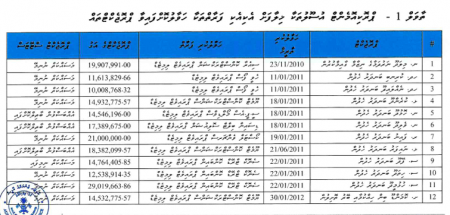
Since the corporation did not compile its financial statement for 2011, as mandated by its charter and the Company’s Act, the press release noted that auditors reviewed selected transactions of the WCL.

The WCL was created by the administration of former President Mohamed Nasheed on March 25, 2009 to facilitate or carry out infrastructure projects.

Of the 34 projects awarded to the company in 2010 and 2011, the audit found that the government canceled 24 after the WCL failed to commence work.

“The government awarded the projects without adequate planning and without assessing the company’s capability to carry out the work,” the press release stated.

As the company had completed only one infrastructure project to date, the Auditor General’s Office suggested that the WCL had not served the purpose for which it was formed.

Managing director

Auditors discovered that the company’s managing director withdrew MVR180,000 (US$11,673), ostensibly to cover expenses for assisting the President’s Office in preparations for a ceremony held in Gulhifalhu.

While the company’s employees actively participated in the preparations, the report noted that the sum was withdrawn without any documentation proving the actual cost borne by the WCL.

Although the audit report did not identify the managing director, local media has revealed that the WCL MD in 2011 was Abdulla Javid ‘Jaa’, son-in-law of the then-ruling Maldivian Democratic Party’s (MDP) Chairperson ‘Reeko’ Moosa Manik.

Auditors also found that MVR146,999 (US$9,533) was transferred to the MD’s personal bank account to purchase a “total station” containing special tools from Singapore’s Tepcon Posting Sales Pvt Ltd.

However, the company had received neither the tools nor the transferred amount as of the report’s publication date.

Moreover, the WCL did not recover 14 sheet piles provided in May 2011 to Heavy Load Maldives Pvt Ltd, which was owned by the MD’s father-in-law MP ‘Reeko’ Moosa.

The WCL’s staff informed auditors that the 40-feet sheet piles were released after the MD called the deputy manager at the company’s Thilafushi site and instructed him to do so.

The audit report revealed that on the orders of the MD the WCL also provided electricity from its Thilafushi site to the Yacht Tours Maldives’ site on the industrial island.

Yacht Tours Maldives – owned by MDP MP Abdulla Jabir – had not paid WCL for 37,376 units of electricity used from December 28, 2010 to October 1, 2012, the audit found.

Violations

The WCL awarded 12 projects worth MVR198.6 million (US$13 million) to various parties in violation of the company’s procurement rules, the audit found.

The company’s procurement procedures manual stated that contracts worth MVR1.5 million (US$97,276) or higher must be awarded through the Finance Ministry’s tender evaluation board.

However, the audit noted, the 12 projects were awarded without either a bidding process or the involvement of the tender evaluation board.

An Indian company – identified as MM Export Pvt Ltd – contracted to supply reinforcement boulders was paid MVR2.7 million (US$175,097) in violation of the procurement rules as well as the WCL’s agreement with the company.

In another instance, a Sri Lankan company named Sri Krithika International was paid in excess of the stipulated amount for supplying construction material after the company imported a higher volume than was agreed upon.

Moreover, the WCL failed to recover MVR1.7 million (US$110,246) paid to Design-built Solutions Pvt Ltd as an advance payment for the Noonu Velidhoo harbour project despite termination of the agreement after the company did not commence work.

In a similar case, a company named Coastal Ventures Pvt Ltd was paid MVR5 million (US$324,254) for the construction of a harbour in Raa Fainu despite the company only completing a portion of the project.

As the portion completed by the company was worth MVR2.9 million (US$188,067), the audit noted that the company was paid MVR2.1 million (US$136,186) for work not done.

The report also contended that the WCL prioritised the interests of subcontractors in drafting agreements to the detriment of the company.

Auditors discovered that the company was owed MVR134,055 (US$8,694) in unpaid rentals and sale of equipment.

The WCL also misused a MVR50 million (US$3.2 million) stand-by credit facility provided by the Indian government to establish a sewerage system in Noonu Miladhoo and to construct a harbour in Noonu Kudafari.

Interest for the loan was rising as a result of the WCL failing to make regular payments, the report noted.

Meanwhile, as a result of poor record keeping, auditors were unable to ascertain the amount of money kept in the WCL safe when it was stolen in 2011.

While the company’s accounting systems showed that it was owed MVR22.5 million (US$1.5 million) from various parties, the audit report noted that the company’s financial book-keeping was too unreliable to establish the validity of the figure.

Similarly, auditors could not verify whether the MVR60.7 million (US$4 million) owed by the WCL for procurements and services was authentic.

The company also paid its chairman more than MVR600,000 (US$38,910) as a “special allowance” from June 2009 to February 2012 against the pay scheme for board members of state-owned enterprises.

Moreover, the company’s hiring and firing practices as well as promotions for staff contravened its “employment, benefits and salary policy.”

Lastly, the WCL had not maintained a registry of its assets since April 14, 2010, auditors found.

Likes(0)Dislikes(0)

Goverment will enforce death penalty, declares President Yameen

President Abdulla Yameen Abdul Gayoom has declared that the Progressive Party of Maldives-led (PPM) coalition government will implement the death penalty despite international pressure.

Speaking at a campaign event for PPM MP Ahmed Mahloof in Male’ last night, President Yameen said his administration’s decision to enforce the death penalty was a “historic day” in the Maldives’ democracy.

“Enforcing the death penalty is not something I will do because I want to. This is a very difficult thing. This is not an easy thing to do for any president or [public] servant. But our society cannot bear the loss of a life as well as the opportunity for further loss of life as a result of not respecting [the value of a human life],” he said.

“For that reason, no matter how much I don’t want to do it or how difficult it is, I have to do this on behalf of the people as they have placed that trust in me.”

President Yameen revealed that the government had formulated regulations implementing capital punishment on Thursday, based on the advice of the cabinet.

The government decided to enforce the regulations to ensure the safety and security of the community, he said, adding that the public wished to see action taken to stop the “slaughter of innocent citizens.”

Moreover, a majority of the Maldivian people were in favour of introducing the death penalty despite opposition from international partners, Yameen contended.

He stressed that a convict would only be put to death in accordance with Islamic Shariah following due process through the courts.

At the final stage, he explained, the Supreme Court would decide whether capital punishment was warranted as qisas (retaliation).

Under the new regulations specifying procedures for enforcing the death penalty, President Yameen said that both the victim’s and the convict’s family would be consulted after the Supreme Court decision to see whether the former demanded the death penalty and not blood money as retaliation.

Following an order issued by Home Minister Umar Naseer in January to the Maldives Correctional Services for implementation of the death penalty through lethal injection, Amnesty International called upon the government to halt any plans to end the current moratorium on the death penalty.

The international human rights organisation described the possible reintroduction of capital punishment as a “retrograde step and a serious setback for human rights in the country”.

Meanwhile, President Yameen – on a state visit to Sri Lanka at the time of Naseer’s announcement – subsequently promised “broad discussions” on the issue in his cabinet.

Death sentences have traditionally been commuted to life sentences by presidential decree since the execution of Hakim Didi in 1954 for the crime of practising black magic.

The Maldives currently has 20 prisoners sentenced to death by the Criminal Court.

Likes(0)Dislikes(0)

MDP meeting hall set on fire in Haa Dhaal Kuribee

A youth meeting hall (jagaha) of the opposition Maldivian Democratic Party (MDP) on the island of Kuribee in Haa Dhaalu atoll was set on fire in the early hours of Friday, local media reports.

Three motorbikes were also set ablaze around 3:30am in what is believed to have been a deliberate act of arson.

One of the motorbikes was reportedly damaged beyond repair while a sound system, two television sets, and two chairs inside the meeting hall were destroyed.

The case is currently under investigation by the police.

Likes(1)Dislikes(0)