MDP MP Imthiyaz to face charges of “disobeying orders” for criticising judiciary

Opposition Maldivian Democratic Party (MDP) MP Imthiyaz ‘Inthi’ Fahmy – who is also one of the party’s spokespersons – is set to face another criminal charge of “disobeying orders” over allegedly contemptuous remarks he made against the judiciary during a television show.

Earlier in April, Fahmy told Minivan News that Police had begun investigation of a case filed by the Department of Judicial Administration against him, over his allegedly “contemptuous remarks” against the Supreme Court and its judges.

Police Media Official Chief Inspector Hassan Haneef told Minivan News at the time he was “unsure” whether police were currently investigating the matter, but said cases concerning contempt of court had previously been investigated and sent for prosecution.

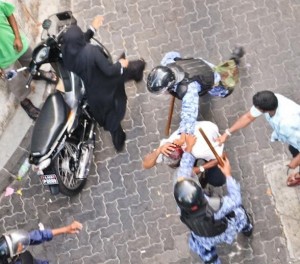
In June 2012, police sent a case concerning Imthiyaz Fahmy for prosecution, requesting he be charged with disobeying orders, obstructing police duty and physically assaulting a female police officer during an MDP demonstration on May 29, which had followed the dismantling of the party’s protest camp at Usfasgandu.

In a subsequent statement condemning “excessive use of force” against demonstrators, Amnesty International stated that according to Fahmy, “police in Dhoonidhoo told him he was arrested for ‘disrupting peace’.”

“The next day in court, police stated that he had been detained for ‘physically attacking a woman police officer.’”

Fahmy denied the charges pressed against him by the prosecution.

In the  latest case, Fahmy will be prosecuted under section 88 of the Penal Code for disobeying legal orders.

Section 88(a) states – “It is an offence to disobey an order issued lawfully within the Shari’ah or Law, person guilty of this offence shall be subjected to a punishment of exile or imprisonment or house detention not exceeding 6 months or fine not exceeding MVR 150.00 (US$9.73)”

Speaking to Minivan News earlier regarding the charges, Fahmy claimed the judiciary was attempting to silence elected members of the public, and that allegations of contempt of court were a facade.

“People elected me to find faults in institutions such as the courts and find ways to reform them, to correct those faults. I have been elected as a member of parliament by the people to talk about such issues and that is my responsibility. It is a duty vested in me by the people and I will remain firm in executing that duty,” Fahmy said at the time.

He further claimed that discrepancies and flaws within the courts were already being widely discussed by the general public.

“The courts themselves do not comprehend the real meaning of the concept of judicial independence,” he claimed.

“They should also understand that dignity and honour is not a one-way train. It goes both ways. Their actions should be of a standard and performed in a transparent fashion so as to have dignity,” he said.

“The first thing is that the judges were wrongfully reappointed. The constitutional provisions indicate that the judges were appointed by the Judicial Service Commission (JSC) wrongly without proper consideration being given to Article 285 of the constitution. That is unconstitutional.”

Fahmy – who is a lawyer himself – claimed that other powers of the state including the legislature and the executive had been set up in accordance with the 2008 constitution and that it was only the courts and the judiciary that had failed to be established in accordance with the new constitution.

“Am I being punished for coming out and speaking the truth? What is so wrong about reiterating the same facts that are being highlighted by several respected international authorities on the same issue?” he questioned.

Apart from Fahmy, cases against several other MDP MPs are either being currently investigated or being heard in the courts including that of MP Ali Waheed (the party’s Deputy Parliamentary Group Leader), MP Hamid Abdul Ghafoor (the party’s spokesperson for international affairs), MP Abdulla Jabir, MP Mohamed ‘Matrix’ Rasheed and MP Ibrahim ‘Bondey’ Rasheed.

Charges faced by the MPs include contempt of court, obstruction of police duty as well as the offence of consumption of alcohol.  According to the constitution, a member of parliament loses his seat should he be convicted of a criminal offense that requires serving a sentence longer than a period of 12 months.

Likes(1)Dislikes(0)

Journalists important for consolidating democracy: Parliament Speaker Shahid

Journalists play an important role in consolidating democracy in the Maldives, said Parliament Speaker MP Abdulla Shahid.

Shahid made the remarks while speaking at the official inauguration of Channel News Maldives (CNM) held last night (June 3) at Trader’s Hotel in Male’.

CNM Chairman Mohamed Ali Janah, senior dignitaries of the state, reporters from various media outlets, as well as members of the Maldives Media Council and Maldives Broadcasting Corporation also attended the launch ceremony.

CNM was registered as a newspaper on 3 May 2011 at the former Department of Information.

“The saddest thing that can happen is for the legislative body to try to tie down the journalists,” said Shahid.

Shahid emphasised that the country needs journalism that adheres to proper ethical standards and conduct. He also stated that journalists must remember they have to present themselves to the public daily and the public will not accept false information.

Likes(0)Dislikes(0)

Two Bangladeshis caught naked, arrested for alleged prostitution

Two people allegedly engaged in prostitution were arrested yesterday (June 3), reports local media.

The 19 year-old male and 25 year-old female Bangladeshi nationals were caught naked, police told local media.

After a supposed tip-off the individuals were arrested at approximately 1:30pm in Male’s Heinveiru ward from Kandufinige house, located opposite the Shaheed Ali Mosque.

Likes(0)Dislikes(0)

Maldives turning into ‘terrorist haven’: Eurasia Review

A Nasheed government would “need external assistance to keep this strategic island nation out of the hands of Islamic extremism Wahabism and Salafism,” writes Bhaskar Roy for the Eurasia Review.

“It is known that an increasing number of youths are going to Saudi Arabia and Pakistan to study in Madrassas, which impart extreme religious education and encourage jihad.

“Finances are also coming in from Saudi, Kuwaiti and other NGOs. This happened in Bangladesh in the 1990s and early 2000, leading to a burst of Islamic terrorism, which continues to haunt the country.

“A new group called the Hifazat-e-Islam, Bangladesh (HIB) recently tried to hold the government hostage, demanding Sharia Law. The Hifazat had backing from the Jamaat-e-Islami (JEI) and the main opposition party. But the government in Bangladesh was strong enough to put down the challenge. This is not over, however.

“What kind of chance do the moderates in Maldives have when the Wahabis and Salafis launch their siege? In Maldives, the women and girls are increasingly taking to burkha/hijab in fear of retribution. With bans on anything remotely seen as un-Islamic, there is no breathing space or food for the mind. The Maldives is a country of around 1,200 islands, reefs and atolls, with barely 400 of them inhabitated. Around 30 per-cent of the country’s foreign exchange comes from tourism. The tourism industry is under attack with alcohol being prohibited in most places, extending gradually to tourist resorts. When dress codes are extended to tourist resorts, this industry will die.

“The strength of religious extremist groups lies in keeping the people poor, uneducated and unenlightened. Men from such backgrounds easily become soldiers of religious jihad as is seen in Pakistan, for example.

“The Maldives, under the current disposition, has all the potential to become a sanctuary for jihadists. If Waheed wins the elections later this year, India will become one of the jihadi targets. People in Maldives have links with the Al Qaeda and Pakistani organisations, like the LeT. Islamic extremism today is no longer handled by individual organisations. They have become an industry with organisations supporting each other. Lone-wolf terrorism that was recently witnessed in UK and France is a new challenge.

Read more

Likes(2)Dislikes(0)

President meets Commonwealth special envoy, US ambassador in Male’ yesterday

The Commonwealth Secretary General’s special envoy Sir Donald McKinnon met President Dr Mohamed Waheed in Male’ yesterday as part of a “courtesy call” to discuss issues including efforts to ensure free and fair elections later this year.

The meeting was held the same day that the president also met with Ambassador of the United States accredited to the Maldives Michele J Sison to discuss political and economic stability, as well as the importance of having international election observers in the country.

According to the President’s Office website, during yesterday’s meeting with McKinnon, Dr Waheed also spoke of the need for “political reform” in the Maldives. The Commonwealth meanwhile said it would look to extend its support to the Maldives’ electoral process.

Likes(0)Dislikes(0)

Military dismisses alleged planner of Afrasheem murder

The Maldives National Defence force (MNDF) has dismissed Corporal Azleef Rauf over his alleged involvement in planning the murder of MP Dr Afrasheem Ali.

Azleef was dismissed for “disorderly conduct”, as well as “repeated actions that would harm the reputation and dignity of the armed forces”, according to the MNDF.

Azleef was arrested in relation to the Afrasheem murder case on May 23, and during a recent court hearing to extend his detention period, police accused him of terrorism, intimidation, gang crimes, operation of gangs, and using gangs to plan crimes, according to local media.

The prime suspect in the Afrasheem case, Hussain Humam Ahmed, accused Azleef of planning the murder of the MP during a recent Criminal Court hearing.

Additionally, Azleef was also previously apprehended for mugging, according to local media.

Likes(0)Dislikes(0)

MDP files motion calling government to address judicial issues highlighted by Special Rapporteur

The opposition Maldivian Democratic Party (MDP) has filed a motion calling the government of President Mohamed Waheed Hassan to address issues highlighted in the report by United Nations Special Rapporteur (UNSR) on Independence of Judges and Lawyers, Gabriela Knaul, concerning the country’s judiciary.

Knaul’s final report to the UN Human Rights Council extensively outlined the political, budgetary and societal challenges facing the judiciary and wider legal community, as well as the politicisation of the Judicial Services Commission (JSC) and its failure to appoint qualified judges under Article 285 of the constitution.

The Special Rapporteur also expressed “deep concern” over the failure of the judicial system to address “serious violations of human rights” during the Maldives’ 30 year dictatorship, warning of “more instability and unrest” should this continue to be neglected.

“It is indeed difficult to understand why one former President is being tried for an act he took outside of his prerogative, while another has not had to answer for any of the alleged human rights violations documented over the years,” Knaul wrote.

The motion, filed by MDP MP Imthiyaz ‘Inthi’ Fahmy, was debated during the parliamentary session held on Monday. The motion was passed by 23 out of 34 members present during the session, while nine members voted against it.

Presenting the motion, Fahmy said the judiciary was impaired after it appointed the judges for life, without considering the constitutional provisions specified in article 285 of the constitution.

He contested that the JSC, instead of ensuring that the judges met the required standards befitting an independent judiciary, had lowered the standards to ensure all existing judges were qualified to sit on the bench for life, plunging the whole judicial system into chaos.

Due to the JSC’s decision to lower the standards, judges accused and in some cases convicted of criminal wrongdoing had been reinstated, he contended.

Fahmy further contested that every citizen of the country was entitled to the right to get a fair hearing and that not even the Supreme Court could undermine such a fundamental right.

He noted that the judiciary disregards any remark made that highlight its own flaws, dismissing them as attempts to tarnish the image of the judiciary and lower its image among the public.

Parliamentary debate

Jumhoree Party (JP) MP Abdul Raheem Abdulla raised doubts over the legitimacy of the current membership of the JSC, highlighting that current Attorney General Aishath Bisham – who by virtue of her position is also a member of JSC – is yet to be endorsed by the parliament.

Local media alleged that Aishath Bisham had taken part in the vote taken during the JSC meeting in which it decided to indefinitely suspend the Chief Judge of High Court over a complaint filed a year ago.

Abdul Raheem Abdulla also questioned the legitimacy of the position of Civil Service Commission (CSC) President Mohamed Fahmy Hassan, who was removed from his post by parliament reinstated after the Supreme Court overturned parliament’s decision.

In March, the Supreme Court ruled 6-1 that Mohamed Fahmy Hassan would receive two punishments for the same crime if he was convicted at court following his dismissal by parliament (double jeopardy).

The doubts surrounding the legality of these people sitting in the JSC posed questions over how just a decision by JSC could be, Abdulla Abdul Raheem said.

He further contended that the JSC had been overpowered by political influence both internal and external, however maintained that no one should meddle with the affairs of the court.

JP’s own leader, resort tycoon and MP Gasim Ibrahim, also sits on the commission.

However, tourism magnate Ahmed ‘Sun Travel’ Shiyam’s Maldivian Development Alliance (MDA) MP Ahmed ‘Aims’ Amir spoke in favour of JSC, stating that he saluted the commission for completing the appointment of judges within the time frame required by the constitution.

Amir claimed that the two parties had agreed with the appointment of the permanent Supreme Court bench, but were now criticising the bench because it did not work to their pleasure.

Government-aligned Dhivehi Rayyithunge Party (DRP) Parliamentary Group Leader, Ahmed Mausoom, said Special Rapporteur Knaul had asked to resolve the issues through dialog between the authorities, and noted that her recommendations included amending the constitution.

Other recommendations, Mausoom said, included changing the composition of the JSC, and calling on political parties to work on creating awareness among the public of the laws of the country and its constitution, and speeding up the legislative process.

Opposition MDP Deputy Parliamentary Group Leader MP Ali Waheed meanwhile accused the JSC Chair Justice Adam Mohamed of being a “gang leader”, and said the only way to reform the judiciary was through direct action by the people.

Another MDP MP, Abdul Ghafoor Moosa, claimed that presidential candidate of the Progressive Party of Maldives (PPM) Abdulla Yameen, and JP MP Gasim Ibrahim were key conspirators behind the sabotage of the judiciary.

Government’s response

Following Knaul’s report, the government of President Waheed responded with a statement that “international actors should not undermine national jurisdiction and the court system of any country”.

The statement was issued on May 28 via Permanent Representative at the UN Human Rights Council in Geneva, Iruthisham Adam, who further said that the Maldivian delegation, in light of the report, “wishes to discuss specific matters contained in the report with the Rapporteur”.

At the same time the statement “welcomed” the UN Rapporteur’s report and “fully acknowledge[s] that the various challenges she has identified and raised in her report are in fact the residue challenges present in a system in the midst of democratic consolidation.The Maldives judicial system continues to be hampered by structural deficiencies and resource constraints in addressing the difficult challenges facing the country in general.”

Likes(0)Dislikes(0)

Police arrest third suspect in connection to Artur brothers investigation

Police in the Maldives have confirmed the arrest of a third suspect linked to ongoing investigations into the alleged criminal activities of two foreign nationals identified as the Artur brothers.

A police media spokesperson confirmed that 28 year-old Maldives national Ahmed Vishal had been taken into custody yesterday (June 2) on suspicion of being connected – in an as yet unspecified way – to the Artur brothers’ operations in the country.  The Arturs have come under scrutiny from Maldives authorities after being linked in local media with alleged drug trafficking, money laundering, raids on media outlets and other serious crimes in Kenya.

Police declined to give more details on the specific charges against Visham, who was reported in local media as having been detained on a sixth floor apartment of a building in Male’.

Visham is the third suspect along with fellow Maldivian Ahmed Nishan and French national Godzine Sargsyan to be detained by police in relation to investigation into the Artur Brother’s presence in the country.

Police issued a statement in April asking for public assistance in locating Godzine, who along with Nishan later surrendered themselves to authorities.  Police officers then proceeded to conduct a search of the Marble Guest House in Male’ where the suspects were alleged to have stayed.

The Criminal Court last month agreed to extend the detention of both Nishan and Godzine, who has been identified by authorities as one of the Artur brothers.

The court stated at the time that police had charged the pair with assault and battery, cases related to fraud, and providing invalid documents to government institutions.

Photos

Photos of the Arturs in the company of the two Maldivian ministers emerged on social media, apparently taken during the Piston Motor Racing Challenge held on Hulhumale’ between January 25 and 26.

A letter from the Tourism Ministry to immigration authorities requesting a residency visa for Margaryan and Sargayan Artur, dated January 27 and signed by Tourism Minister Ahmed Adheeb, was subsequently leaked on social media.

A company named ‘Artur Brothers World Connections’ was registered in the Maldives in October 2012, with the Artur brothers holding an 80 percent share in a 61-19 percent split.

French nationals identified as Godzine Sargsyan and Edga Sargsyan had a 10 and 7 percent share, while a Maldivian national Ismail Waseem of H. Ever Chance was listed as holding the remaining 3 percent.

Waseem’s share was subsequently transferred to Abdulla Shaffath of H. Ever Peace on November 25.

Meanwhile, on April 8, reports in local media suggested that Zaidul Khaleel, General Manager of the Club Faru resort, operated by the state-owned Maldives Tourism Development Corporation (MTDC), had been dismissed after he was found to have paid the brothers’ US$6000 bill.

Likes(0)Dislikes(0)

Low salaries and safety issues keeping foreign doctors away: Health Ministry

The Ministry of Health has identified salaries and staff safety as the key issues driving “shortages” in the number of trained medical staff coming from abroad to work at hospitals in the Maldives.

Permanent Secretary at the Ministry of Health Geela Ali said that authorities were in the process of trying to recruit a number of medical specialists from across the region, adding that efforts were needed to overcome the various “issues” limiting interest from foreign professionals in coming to the Maldives.

The comments were made as Dr Mohamed Habeeb, presently in charge of Indira Gandhi Memorial Hospital (IGMH) in Male’, last week raised concerns in local media about a serious shortage of doctors, which he said was having a major impact on services.

IGMH Media Correspondent Zeenath Ali explained to Minivan News today that although paediatric services had been suspended temporarily at IGMH three months ago due to a lack of qualified staff, the services were now operating as normal.

“Previously, we had an issue with the numbers of doctors due to some resignations and contracts finishing,” she said of the difficulties faced three months ago.

Zeenath added that while the issue of having no paediatric staff had since been resolved, IGMH has requested assistance from the Health Ministry in recruiting additional medical specialists to meet patient demand in the capital.

Despite this high demand for medical services, she said IGMH had not since been forced to terminate entire services at the hospital as a result of staff numbers.

“We have four paediatricians presently working at the hospital. But it remains difficult on the international market to try and attract paediatricians to join us,” she said.

According to Zeenath, IGMH has also requested that additional anaesthesiologists be hired to meet the hospital’s present workload. She added that the Ministry of Health was said to be working on recruiting more staff to cope with patient demand.

Speaking about these recruitment efforts, Health Ministry Permanent Secretary Geela said there was presently a shortage of medical staff at hospitals and health centres across the country as a result of ongoing issues – not least in the basic salary packages offered by the state.

“We have been running adverts to try and find qualified staff across the region, but so far we are not seeing adequate response from other countries,” she said.

Geela claimed that salary was among the most prevalent issues authorities had identified as being responsible for shortages in medical staff, with the government pledging to raise wages from January 2014 should the proposals gain parliamentary approval.

“This will allow us to offer better salaries from 2014 and we hope there will be more interest internationally,” she said.

Staff safety

Another challenge for attracting foreign medical staff was ensuring the safety of staff, particularly in the outer atolls.

Geela said that the Health Ministry could not alone ensure safer working environments for foreign medical staff, with wider support from the government and public needed.

“We need a societal approach to try and combat this problem. When we place staff on islands, community support is required to make sure they are looked after,” she said.

Threats

IGMH’s orthopaedic department temporarily ceased working last month after a group of people allegedly threatened a member of staff who had refused to provide a doctor’s note for overseas treatment through the Maldives’ nationwide health insurance scheme, ‘Aasandha’.

A patient, who asked for the doctor’s recommendation to receive medical treatment abroad, was first told by IGMH that such a recommendation could not be made because his injury could be treated in the hospital, according to a statement issued by IGMH.

The hospital claimed the man then refused treatment from IGMH before coming back to the hospital with a group of 10 men who threatened to attack the doctor, stating that he too would have to seek medical treatment through ‘Aasandha’ if he did not write the recommendation note.

The hospital at the time said it was considering the use of police officers maintain security on site following concerns about threats of violence to staff.

Minivan News reported in September 2012 on the alleged widespread intimidation, fraud and “substandard” treatment by patients, health authorities, local staff and the country’s courts faced by expatriate medical professionals in the Maldives.

Likes(1)Dislikes(0)