Maldives President visits Palestine, snubs Israel: Times of Israel

The president of Maldives arrived for an “official” visit to “Palestine” on Tuesday without planning a stopover in Israel, underlining the loss of one of Israel’s few friends in the Muslim world, writes Raphael Ahren for the Times of Israel.

President Mohammed Waheed Hassan’s four-day visit includes trips to Bethlehem, Hebron and Ramallah, where he met with Palestinian Authority President Mahmoud Abbas and laid a wreath at the grave of late Palestinian leader Yasser Arafat Tuesday. He is not scheduled to meet any Israeli officials.

Foreign Ministry spokesman Paul Hirschson said that Israel has been kept informed of the visit and coordinated with the Maldivians for security needs. “We’re perfectly happy for them to have an active relationship with the Palestinians,” he said.

The Republic of Maldives, a tiny island nation southwest of Sri Lanka, does not have diplomatic relations with Israel, yet until two years ago bilateral ties were growing increasingly cordial.

In February 2012, the government in Malé was deposed in what observers called a political coup. Mohamed Nasheed — the country’s first democratically elected president, known for his pro-Israel stance — was ousted and replaced by Islamist hardliners around Waheed Hassan.

Read more

Likes(0)Dislikes(0)

Registration for 2013 Dhiraagu Maldives Road Race to close June 9

Registration for the seventh annual Dhiraagu Maldives Road Race is to close on Sunday (June 9), with participants and NGOs being encouraged to use the event as a platform for fund raising.

The race, which will see participants running a single lap of the outskirts of Male’, is scheduled to start at 4:00pm on June 28 from the Raalhugandu area in the capital.

Organisers have said that runners will also compete for cash prizes during this years event, which is once again dedicated to raising awareness about child abuse prevention.

Other awards will be presented to the most successful school teams on the day, while special accolades will also be given for the fastest participants aged 45 and over.

An estimated 2,500 participants took part in last year’s race.

Participants can either register in person by submitting their registration form at Dhiraagu customer front offices or online at the event’s official website.

Likes(0)Dislikes(0)

Parliament accepts bill to amend Privileges Act to protect journalist sources

Parliament has accepted a bill to amend clauses in the Parliament Privileges Act potentially requiring journalists to reveal their sources before parliamentary committees.

Article 28 of the constitution states – “Everyone has the right to freedom of the press, and other means of communication, including the right to espouse, disseminate and publish news, information, views and ideas. No person shall be compelled to disclose the source of any information that is espoused, disseminated or published by that person.”

However Section 17(a) of the Parliamentary Privileges Act states: “[Parliament or a Parliamentary Committee has the power to] summon anyone to parliament or one of its committees to give witness or to hand over any information which the parliament wish to seek.”

Penalties for disobeying range between MVR1000-3000, and three to six months imprisonment.

The bill to amend the act was accepted for review by parliament with a 47 vote majority.

Likes(0)Dislikes(0)

Government owes US$35.2 million in unpaid electricity bills: STELCO

The State Electric Company (STELCO) has revealed that the Maldivian government owed MVR 543 million (US$35.2 million) in unpaid electricity bills as of last month.

According to STELCO, most of the money (MVR 281 million/US$18.2 million) is owned by assorted government offices, while Indira Gandhi Memorial Hospital (IGMH) owes MVR 37 million (US$2.4 million) and the National Social Protection Agency (NSPA) owes MVR 224 (US$14.5 million).

The figures were revealed in a letter to Parliament’s Public Accounts Committee, and reported in Sun Online.

In the letter, the company complained that the government’s failure to pay was causing it cash flow problems and harming its ability to roll out projects.

The government has meanwhile sought parliament approval for an extension of its MVR 50 million overdraft with STELCO, prompting the committee to summon STELCO executives to explain the situation.

According to Sun, during the meeting today committee member and Maldivian Democratic Party (MDP) MP Ilyas Labeeb rejected the government’s request for further loans, and questioned why STELCO did not simply shut off the power to government buildings as it did with homeowners who failed to pay their bills.

STELCO, which is wholly owned by the government, is the country’s sole provider of electricity to major urban centres, such as Male’, and many inhabited islands.

Likes(0)Dislikes(0)

PIC concludes investigation into “brutal and inhuman conduct” by police during power transfer

The Police Integrity Commission (PIC) has declared it has concluded its investigation into all cases of police misconduct during the controversial transfer of power that took place on February 6-8, 2012.

On February 7 an anti-government protest led by then-opposition political parties and religious scholars,   led to a mutiny by a segment of both police and military officers against Nasheed, resulting in his premature resignation from office.

The following day, Nasheed along with the MDP and thousands of people, took to the streets in protest claiming that Nasheed was ousted in a bloodless coup d’état.

However the en masse demonstration met a brutal crackdown from both police and military officers during which MDP MPs and members of the public sustained injuries.

During a parliamentary inquiry by the Parliament’s Executive Oversight Committee (EOC), the PIC claimed that actions by police during the mutiny which led to the change in government were  unlawful and amounted to crimes worthy of prosecution by the state.

PIC Vice President Haala Hameed said during the session that the PIC had identified 29 cases of police misconduct, out of which cases concerning six police officers had been sent to the prosecutor general (PG) for prosecution.

The PIC at the time claimed it had urged then-Home Minister Mohamed Jameel to suspend the officers immediately, however the request was not adhered to, and instead at least one of the accused was promoted.

Hameed said the commission had failed to identify the police officers in five of the remaining cases while 11 other cases lacked supporting evidence. She also said the PIC was still investigating seven cases of police misconduct during the transfer of power.

“These are not disciplinary issues, but crimes. Aside from sending cases to the Prosecutor General, we also recommended the Home Minister suspend these officers, because of the delays in prosecution. We believe these officers should not be serving in the police,” Hameed said.

However in an interview with local media on Monday, President of the PIC Abdulla Waheed said the commission had investigated a total of 20 cases of police misconduct that took place on February 6,7 and 8.

Waheed said these included cases initiated by the commission itself, and cases investigated based on complaints filed at the commission, out of which only two are pending at the moment.

Out of the 20 cases, 12 cases concerned police brutality during the crackdown on protests and during the events that unfolded, while eight concerned issuance of unlawful orders, obeying unlawful orders and officers failing to comply with the law while on duty, said Waheed.

“There are very serious issues in these cases. They include brutal and inhuman conduct by police officers,” he said.

Waheed also claimed that it had sent cases of four police officers to Prosecutor General (PG) office for criminal prosecution. He added that out of the four officers, three were commissioned officers however he declined to reveal any names.

The PIC Chair also said that while there remained cases filed on allegations lacking any basis, the cases that needed to be investigated had now been completed and sent to the PG while at the same time the commission would also send recommendations to address issues with the police to Home Ministry.

“We will address the issues highlighted in the recommendations made by independent institutions and the Commission of National Inquiry (CNI) report. There are no cases being investigated regarding the events of February 6 and 7,” Waheed said.

Some police officers are currently facing criminal charges for their misconduct during the events including two police officers who had allegedly assaulted and attacked opposition Maldivian Democratic Party (MDP) MPs Mariya Ahmed Didi and ‘Reeko’ Moosa.

Police Officer Ibrahim Faisal is currently being charged for attacking Mariya Ahmed Didi on February 8 while another officer, Mohamed Waheed, is also facing criminal charges for assaulting MDP Chairperson ‘Reeko’ Moosa, hitting him on the head with a metal canister.

Likes(1)Dislikes(0)

Third man arrested in Arturs brothers case charged with fraud, forgery

The police have charged 28 year-old Mohamed Vishal of Everchance in Henveiru with fraud and forgery, confirmed Criminal Court media official Ahmed Mohamed Manik.

Manik confirmed that Vishal was brought before the judges last night, where his pretrial detention period was extended by 15 days.

Manik said Vishal had been accused of obtaining over US$32,000 from a company called company called ‘King Global Development Private Limited’, owned by a Thai national. It is currently unclear as to how the charges relate to this company or the money.

According to its website, the company deals in seafood, aviation services, dietary supplements and jewelry.

Visham is the third suspect along with fellow Maldivian Ahmed Nishan and French national Godzine Sargsyan to be detained by police in relation to investigation into the Artur Brother’s presence in the country.

A company named ‘Artur Brothers World Connections’ was registered in the Maldives in October 2012, with the Artur brothers holding an 80 percent share in a 61-19 percent split.

French nationals identified as Godzine Sargsyan and Edga Sargsyan had a 10 and 7 percent share, while a Maldivian national Ismail Waseem of H. Ever Chance was listed as holding the remaining 3 percent.

Likes(0)Dislikes(0)

Reports Thasmeen to be appointed Waheed’s running mate unconfirmed

Local media has reported that Dhivehi Rayyithunge Party (DRP) Leader Ahmed Thasmeen Ali will be appointed President Mohamed Waheed’s running mate next Monday, however the parties have yet to confirm the decision.

“We’re getting ready for the day. We will officially begin our campaign that day,” a senior official from one of the coalition parties told Haveeru.

Despite the growing speculation surrounding Thasmeen’s candidacy, Waheed’s Gaumee Ithihaad Party (GIP) and DRP have not made any official announcements.

“So far I have not received confirmation. There is speculation, but these are rumours only, I cannot confirm,” GIP Spokesperson Abbas Adil Riza told Minivan News today (June 4).

DRP Deputy Leader MP Dr Abdulla Mausoom refused to comment on the matter.

Following an inaugural rally of President Waheed’s coalition held May 24, local media reported that Thasmeen was likely to become Dr Waheed’s running mate.

A senior member of the coalition told local news website CNM that Thasmeen’s appointment was “almost finalised” and other coalition parties had no objections.

In May, the government-aligned DRP announced it would be joining the religious conservative Adhaalath Party (AP) and the Dhivehi Qaumee Party (DQP) in a coalition backing President Waheed.

Both the DQP and GIP are small political parties currently facing potential dissolution for lacking the minimum requirement of 10,000 members as stipulated in the recently passed Political Parties Act.

Coup parties consolidating: MDP

“Our concern is the involvement of Waheed and Thasmeen in the coup. That is the disturbing thing for us. We are now seeing the active coup participants come together,” Maldivian Democratic Party (MDP) MP and Spokesperson Hamid Abdul Ghafoor told Minivan News today.

“Thasmeen was at police headquarters [on February 7] seen hugging Gasim [Ibrahim], [Dhivehi Qaumee Party (DQP) leader and current presidential advisor Dr Hassan] Saeed, [recently sacked Home Minister Dr Mohamed] Jameel and other non MPs,” said Ghafoor.

“The coup parties are consolidating themselves into one opposition party to defend themselves,” he continued. “We suspect [Progressive Party of Maldives (PPM) Presidential candidate MP Abdulla] Yameen will have to follow suit.”

“It is disappointing that the alternative to the PPM, which we hoped [would be the DRP], has double crossed their members,” Ghafoor said.

“The cost to the party is that Thasmeen as lost some of the most valuable DRP MPs and there are no guarantees [he and Waheed will win the presidential elections],” he noted. “Thasmeen has really divided a promising party, he has not done them any favors.”

“We always had some hope the DRP would make a coalition with MDP and [in return] we would forget about [their role in] the coup,” he lamented.

“Come next week the situation could change, it’s very fickle,” Ghafoor concluded.

Any two can become a company: PPM

“Most probably [Waheed] may appoint Thasmeen, it’s a foregone conclusion, he has no other choice,” PPM MP and Campaign Media Manager Ahmed Nihan told Minivan News today.

“It will have no impact on the election. Any two people can become a company,” Nihan said.

“In terms of members and political participation PPM and MDP are the only two proven parties,” he added.

Nihan estimated that PPM currently has between 31,000 and 32,000 members, while current DRP members are not active or do not realise they are still registered with the party.

Nihan also refuted Ghafoor’s allegations that “coup parties are consolidating to defend themselves and Yameen will have to follow suit”.

“On 7 February 2012, what has happened, happened. The MDP still believes it was a coup, however PPM does not. The transition was fine, the CoNI was fine,” said Nihan.

“We have been hanging around and giving our strong support to Waheed to better the country and take care of the people,” he explained. “It is still difficult to find basic services on the islands and we want to make things better.”

However, Nihan alleged that Waheed’s administration is now firing PPM members from various government positions – such as former Home Minister Jameel – and appointing his own supporters in their place, as well as giving them high salaries in exchange for votes in the presidential election.

“The PPM has been sidelined. It is a misconception we should have to follow. They should back off because PPM has strength,” declared Nihan.

2012 police headquarters celebration

Local television station Raajje TV aired a video clip on in March 2012 showing senior then-opposition figures inside police headquarters on February 7, prior to the resignation of former President Mohamed Nasheed.

In the video, Jumhooree Party (JP) leader Gasim Ibrahim makes a comment thanking Allah that former president Mohamed Nasheed resigned before the use of military force.

Thasmeen Ali, shown standing directly in front of Gasim at the time, told Minivan News that he does not recollect Gasim’s statement. “It was very loud,” Thasmeen said.

The video clip depicts former opposition leaders at the time celebrating inside the police head quarters, exchanging hugs, and shouting “Allah Akbar” and “Thank Allah” shortly before Nasheed’s public television resignation of February 7.

According to Raaje Tv’s timeline of the video, inside the Police HQ, current Police Commissioner, Abdulla Riyaz tells the gathered group — which includes Thasmeen, Saeed, former Home Minister and current PPM Vice Presidential running mate Dr Mohamed Jameel, current State Minister for Islamic Affairs Mohamed Didi, current Deputy Commissioner of Police Hussein Waheed, current Foreign Minister Dr Abdul Samad, current Minister of State for Tourism, Arts and Culture Ahmed Shameem, Fonadhoo MP Ali Saleem, and the Adhaalath Party’s Asadullah Shafee — that he has now shared the mutinying police’s demands with the opposition leaders and asks them to give the police a response.

Likes(1)Dislikes(0)

Climate institutions in “flux”, consolidation needed for Maldives Green Fund success: leaked Transparency report

The Environment Ministry claims climate mitigation and adaptation projects have not been affected by government instability, however leaked draft Transparency Maldives reports indicate that climate governance institutions are in a state of “flux” and suffer from a lack of accountability, including the proposed Maldives Green Fund.

Currently, the Ministry of Environment and Energy (MEE) is implementing MVR 3.1 billion (US$201,298,810) worth of climate projects, which does not include donor funded programs implemented by “other sectoral agencies” and NGOs, MEE Environment Analyst, and contributor to the MGF’s establishment, Aishath Aileen Niyaz told Minivan News.

In an effort to merge all the currently established trust funds in accordance with the government’s Biosphere Reserve sustainable development policy, President Mohamed Waheed Hassan Manik’s cabinet recently proposed the establishment of a Maldives Green Fund (MGF).

“The Maldives Green Fund is designed to work as a national entity that would comply with international fiduciary standards for enabling, appraising and financing projects,” explained Niyaz.

“The MGF will act as both a funder and guarantor of projects in the areas of renewable energy and energy efficiency, biodiversity conservation, water management, waste management and capacity building and research in these areas,” she continued.

The current US$9.5 million Climate Change Trust Fund (CCTF) and US$138 million the Sustainable Renewable Energy Project (SREP) have been designed to complement the MGF, with both projects allocating resources for MGF capacity building, according to Niyaz.

“It is envisaged that by the time these projects are concluded, the MGF will be in a strong enough position to take manage such funds and take on the lead responsibility for such projects and in the Maldives,” said Niyaz.

She further explained that to protect climate funds from fraudulent practices “checks and balances” are in place, such as government anti-corruption procedures derived from financial laws and regulations, as well as rules of the implementing international organisation.

Niyaz also claims that government instability has not affected climate finance in the Maldives.

“Since most of the [climate change related] projects were ongoing at the time of [the 2012 government] transition, there was no real impact on their implementation. Furthermore, the negotiations for pipeline projects continued on pace,” she stated.

Meanwhile, “It is a general concern from Transparency Maldives’ studies that institutions in the Maldives, including climate institutions, are in a state of flux and not consolidated. New ones are being created and existing ones inactive or ineffective. This results in confusion, waste, delays, and duplications,” states a Transparency Maldives (TM) MGF Policy Brief dated December 17, 2012.

TM estimates that approximately US$160.5 million is being spent on various climate adaptation and mitigation projects through externally funded grants and loans, while an additional US$ 279,480,275 is required for short-medium term (10 years) adaptation and a further US$ 161,500,000 will be needed for long-term (40 years) adaption, states a Transparency Maldives Climate Governance Integrity Mapping of Climate Finance draft report.

“The fact that the state is a transitional democracy, with only emergent institutions of horizontal and vertical accountability, has posed significant challenges to climate change governance. The lack of a legislative framework for the sector also exacerbates the situation,” said the report.

“Moreover, the country is grappling with corruption and lacks effective governance mechanisms to address the issue. In 2010, Maldives was placed at 143rd on Transparency International’s Corruption Perception Index, with an average score of 2.3, indicating that perceived levels of corruption in the country are very high,” it continued.

The Maldives lacks a comprehensible overall institutional framework and comprehensive policy for addressing climate change, which adds to the confusion of the existing climate change mandates, TM identified. Additionally, no comprehensive database of climate projects currently exists.

This has resulted in ad hoc monitoring and evaluation of climate projects and institutional rivalry between ministries, according to TM.

“Another major challenge in climate change governance is the lack of experts in this area. The key climate experts of the country have multiple responsibilities and a very demanding schedule to fulfill their obligations. They are on multiple governing bodies…,” noted the report.

TM also highlighted the challenges that exist for ordinary citizens to gain access to information, including climate change related projects, despite the existence of a regulation on the right to information.

“Given that most official institutions are based in the capital island of Male’, accessing these information is especially challenging for the majority of the population who reside in other islands,” the report stated.

“In principle establishing a ‘green fund’ to consolidate climate change mitigation and adaptation money is ‘ok’ as long as it adheres to international best practices and good governance standards,” Transparency Maldives Climate Governance Senior Project Manager Azim Zahir recently told Minivan News.

Transparency Maldives had not responded to enquiries at time of press.

MGF plan

“One of the aims of the Maldives Green Fund is to roll out the Baa Atoll Conservation Fund – the funding arm supporting the Baa Atoll Biosphere Reserve – model to the entire country,” said Niyaz.

“The MGF will provide access to funds in simpler procedures for the private sector,” she added.

Essentially the MGF will function “largely as a co-financier of projects, and will work diligently to engage the financial support of other sources”, states a December 2012 draft 2 of the MGF triennial spending strategy 2013-2015.

MGF financial support – in the form of direct grants, interest rate subsidies and soft loans – will be available to “public institutions (including schools, hospitals, etc), small and medium sized enterprises, NGOs, government institutions at all levels, and natural persons,” notes the document. However, it “should be additional to other available sources of finance and not a replacement for them”.

The Maldives government is to provide the initial capital for the MGF, totalling MVR 3 million (US$194,805).

“The Fund’s limited resources will not be used to finance projects or activities that should normally be undertaken by government institutions and financed by government budgets, e.g. compensation and salaries of government authorities, trips of governmental officials to conferences, development of laws and policies, etc.,” both the December draft spending strategy and October 2012 draft 1 operational manual specify.

Despite these proposed regulations for project funding, the December 2012 MGF draft 5 legislation, provides MGF board of directors members remuneration in the form of a “fee for their work” and “reimbursement of expenses” to attend board meetings.

“The level of fees for participation in the work of the Board of Directors shall be defined by the Board of Directors itself, taking into account compensation fees for Board of Directors members of similar government companies established in the Republic of Maldives and complying with the provisions of the President’s Decree as regards maximum permissible levels of administrative costs,” as stated in Fund Governence, section 2 article 12 of the MGF draft legislation.

Compensation for board of directors members is also included under administrative costs in the fund spending policy section four, article 12.

The MGF board of directors will be comprised of a chairperson from the MEE and representatives from the Environmental Protection Agency, Ministry of Finance and Treasury, Local Government Authority, Maldives National Chamber of Commerce and Industries, as well as Maldives Association of Tourism Industry and a non-governmental environmental organisation.

The 2013 budget will allocate US$166,320 for personnel compensation and US$7,000 for administrative expenditures.

However, the MGF education and research priority area will receive US$66,690.

As a supervisory mechanism, the MGF will establish an independent integrity unit and redress mechanism that will report to the board of directors, as specified in the draft legislation section 5 article 16.

“In line with the provisions of the President’s Decree, the Ministry of Environment and Energy [providing a chairperson for the MGF board] shall receive full and unrestricted cooperation from the Fund in order to exercise adequate administrative control and supervision of the Fund’s operations,” reads draft legislation section 2 article 43.

The draft legislation, operations manual, and triennial spending strategy documents were prepared by Æquilibrium Consulting for the MEE.

MGF recommendations

MGF documents, including the Operations Manual and Legislation were not provided to stakeholders like Transparency Maldives prior to the stakeholder conference on 11 December finalising MGF documents, TM claimed in their Maldives Green Fund Policy Brief.

Despite being given “insufficient time (a week)… to comment more specifically and comprehensively on documents of such a technical nature,” TM highlighted a number of MGF issues.

They recommend that the MGF be established through People’s Majlis (Parliament) legislation, notPresidential Decree, given that the “MGF is created to handle large sums of public money and projects and programme implemented for the public”, said the policy brief.
TM also identified the potential for MGF board members to have conflicts of interest which would “compromise independence of the directors” and recommended the government reconsider appointing an independent board.

They also “encourage that declarations of financial interests and disclosure of conflicts of interest be made public,” noted the policy brief.

Given that “minimal reference” is made to or incorporated from the Code of Corporate Governance, TM also recommended a code of conduct be established for all MGF employees which elaborates mechanisms, responsibilities, operations, and practices.

“Bringing forward” educational awareness and research activities is also emphasised, to ensure these activities “have the necessary impact during project cycles”.

Likes(3)Dislikes(1)

Comment: Small island state to superpower

“I would like to reassure all our friends in India, what it is and what it isn’t. We have status of forces agreements with more than 100 nations around the world. And these are basically agreements we have with partners where we have significant military activities, typically exercises.

“So for example, with Maldives we have coconut grove, which is an annual marine exercise. So the status of forces agreement helps to provides framework for those kinds of cooperative activities.

“And they are desirable things to have. But it does not in any way signify an expansion of our military presence or some major new development in the US-Maldivian military co-operation. It’s simply more of a framework to provide for (ongoing) co-operation…”

That was the US assistant secretary of state for South and Central Asia, Robert Blake, speaking to the Press Trust of India (PTI) on the question of a SOFA to be signed between the US and the Maldives.

In an interview on May 7, 2013 widely reported around the world, Blake is reported to have said; “I haven’t seen the draft agreement. So I can’t comment,” before confirming that the US is “in the process of negotiating one now”.

“These are standard texts round the world, nothing very secret about them,” Blake is reported to have said, adding; “I do not foresee that this (SOFA) is going to be difficult negotiations (with Maldives). These are the things we do with partners around the world,” he said adding that it might be very well should be able to signed very soon.”

Emphasis, here is my own, to highlight a confounding sentence which appears not only in the Zee News report shared by US @StateDept with Maldivian tweeps, but is reproduced in almost all media reports. Petty as this may be, but really, what does it mean?

(a) Maldives-US SOFA might be signed very soon.
(b) Maldives-US SOFA should be signed very soon.
(c) Maldives-US SOFA might very well be signed very soon.
(d) Maldives-US SOFA might be very well.
(e) Maldives-US SOFA it might be very well should be able to signed very soon.”

It might very well be simply an editor’s miss, reproduced by all.

Of more significance to me, is the fact that Blake could not verify the authenticity of the alleged draft of the SOFA agreement published on www.dhivehisitee.com.

“I haven’t seen the draft agreement. So I can’t comment,” Blake is reported to have said. Yet, instead of stopping at that, Blake went into a detailed explanation quite outside the real questions the leaked draft raises.

The US Embassy in Colombo had earlier confirmed to Minivan News that they are in discussion with the government of Maldives to sign a SOFA, but had not confirmed or denied the leaked draft is the draft under discussion.

The Maldives government has been far more elusive, the Minister for Defence Mohamed Nazim denying it all in an interview to local daily Haveeru published after the US Embassy had confirmed discussions were ongoing. But then Defence Minister Nazim is not known for his forthrightness or honesty in the Maldives or Sandhurst, from where he is reported to have been expelled for dishonesty.

All in all, what we have learnt so far is:

(a) What a SOFA is.
(b) What a SOFA is not.
(c) That there are US plans to sign a SOFA with the Maldives “very soon”.
(d) Maldives government is not comfortable acknowledging plans to sign a SOFA with the US.

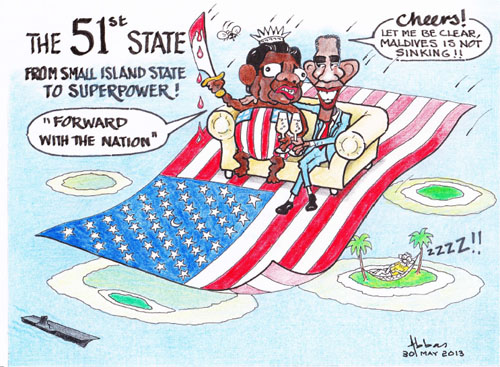
Courtesy Ahmed Abbas (@Qaumuge Mehi on Facebook)

Very little has been said on the real subject of concern – the terms and conditions in the leaked draft SOFA – that gives US absolute access and free run in the Maldives, without check or restraint. The US can place boots on the ground if, when, where and how the US deem necessary at any given time during agreement period.

No?

Does “no boots on the ground” guarantee no boots on the ground in the future? What if America fears the rise of China and the advent of the “nightmare scenario”? How would the Maldives feature in such a scenario? What opportunity does SOFA provide if the US deems it necessary for the US to “be operational” in the Maldives to “watch terrorists,” “protect waters,” ensure regional security or any other such purpose necessary for “reasons of security”?

The United States, together with India, were the first to accept the February 7, 2012 transfer of power in the Maldives. They reacted even before the people of Maldives did, shocked as the public were by the scenes of February 6 and 7, 2012 and the weeks leading up to it, they had witnessed live on local TV. By the time public reacted on February 8, 2013, and the overwhelming public support for President Nasheed became too obvious to be dismissed, the coup had been stamped legitimate by both India and the US.

To their credit, both US and India did step back a bit, but the US has not only continued its support to the government but has worked closely with the coup leaders, strengthening the coup-backing military, bringing in PISCES, the border surveillance system, and now the SOFA.

The US has no diplomatic presence or shoes on the ground in the Maldives, but has been on the ground far more than usual, with diplomats from Colombo flying in regularly and US missions on the ground almost monthly.

So, what could be Dr Waheed’s game plan? Given that it is undeniable that Mohamed Nasheed would win the public vote and there are less than a 100 days to voting, why is Dr Waheed sitting so comfortable? What could be Waheed’s surprise manifesto?

The only thing left now for Dr Waheed to come up with is Green Cards for all!

Dr Waheed, who is himself said to be a US permanent resident or Green Card holder, might very well be planning a bigger surprise with his ‘Forward with the Nation” campaign; taking the Maldives all the way from a small-island-state to a superpower, in less than five years.

A novel strategic pivot for the US as it stands to gain not only the SOFA and retain Coconut Grove, but gets to have its very own 100 percent Islamic State within the United States which would no doubt please the Islamists in the Maldives, the US itself, and outside.

The greening of Male’ initiated just this week by the Maldives Police Services too, all suggest Dr Waheed may go green, and issue Green Cards for all.

Would the people of Maldives vote to be the 51st State?

Aishath Velezinee (@Velezinee on twitter) is an independent democracy activist and writer. She was the Editor of Adduvas Weekly 2005-07 and served on the Maldives’ Judicial Service Commission (2009-11). She claims the Commission she sat on breached constitution in transition; and advocates for redress of Article 285, and a full overhaul of the judiciary as a necessary step for democracy consolidation.

All comment pieces are the sole view of the author and do not reflect the editorial policy of Minivan News. If you would like to write an opinion piece, please send proposals to [email protected]

Likes(0)Dislikes(0)