“Ideology of Adhaalath party and DRP is very close”: Gayoom

The ideology of the main opposition Dhivehi Rayyithunge Party (DRP) and religious conservative Adhaalath party “is very close,” former President Maumoon Abdul Gayoom said at a rally Thursday night.

“Adhaalath party’s ideology and DRP’s ideology is very close,” he said. “That is because Adhaalath party’s main priority is securing Islam in the country, promoting Islam, reviving the spirit of Islam in the Maldives and ensuring that the country remains a 100 percent Muslim nation.”

Addressing supporters at the rally held to launch the Z-faction’s celebratory activities to mark the party’s sixth anniversary, Gayoom congratulated the party’s newly-elected leadership with Sheikh Imran Abdulla as President and Sheikh Mauroof Hussein as Vice-President, which had “embarked on a hopeful new stage.”

Gayoom added that DRP members “always wished Adhaalath party well.”

The Adhaalath party is currently part of the government under a coalition agreement with the ruling Maldivian Democratic Party (MDP), which gives the Islamic Ministry and its functions to the religious conservative party.

In the buildup to the 2008 presidential election, the party supported Jumhooree Party (JP) Leader Gasim Ibrahim’s candidacy and clashed with the DRP and then-President Gayoom over a number of religious issues, including the veiling of women and Gayoom’s treatment of local scholars.
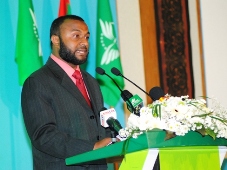
Sheikh Mohamed Shaheem Ali SaeedMeanwhile at the recently concluded Adhaalath party four-day national congress, former State Minister for Islamic Affairs Sheikh Mohamed Shaheem Ali Saeed told members that remaining in a coalition with the ruling party would be “a betrayal of the nation” if the government did not take “reform measures” suggested by Adhaalath.

He added that as the MDP had not honoured the coalition agreement to date, Adhaalath party “would have no choice but to reconsider” the alliance if the situation was not remedied through dialogue and discussion “within a sufficient period of time.”

In the meantime, Adhaalath party should study the “discord and divisions” in the country’s religious and political spheres as well as problems in the health and education sectors, suggested Shaheem, after which “it should officially be brought to the attention of the President and relevant authorities.”

Adhaalath does not support “the loss of the economy’s main gate [Male’ International Airport to Indian infrastructure giant GMR] to influential foreign parties” or alleged interference with the judiciary and disregard of decisions by independent commissions.

Shaheem urged the government to enact new regulations under the Protection of Religious Unity Act of 1994, which had been “agreed upon by 11 religious scholars, a police legal team, the President himself and three Attorneys General.”

Islamic Minister Dr Abdul Majeed Abdul Bari observed that disparaging Islam and “every kind of sinful behaviour forbidden in Islam” had become commonplace while political polarization and social ills multiplied.

Bari claimed that foreign parties were “working tirelessly” to introduce freedom of religion in the Maldives.

“We hear arguments of how non-Muslims should have the freedom to express their disbelief and how everyone should have the right to change religion,” he said.Adhaalath
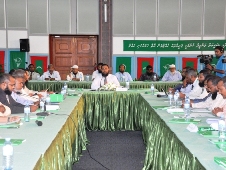
Adhaalath party President Sheikh Imran Abdulla meanwhile stated that the party’s “main objective” would be to reform youth with Islamic teachings.

The incoming president also contended that the government did not honour its coalition agreement with Adhaalath, adding that “it would not be wrong to say that we alone are still with the government.”

Of the allied parties in the MDP-led coalition that defeated Gayoom in October 2008, only Adhaalath party, the Vice-President’s Gaumee Ihthihaad Party (GIP) and the Maldives National Congress (MNC) remain.

Likes(0)Dislikes(0)

Z-DRP raises spectre of British imperialism and loss of Islamic identity

President Mohamed Nasheed was elected in 2008 “with the help of the British conservative party and imperial powers,” the Zaeem-faction of the opposition Dhivehi Rayyithunge Party (DRP) claimed in a video message Thursday night, featured during a rally held to launch the Z-faction’s autonomous activities to celebrate the party’s sixth anniversary.

“In the two years since this government came, 22 people were killed on the street, Islam was challenged and defied,” the video message intoned. “[The government] made drinking alcohol and using drugs commonplace, appointed drug users and convicts to senior posts, sold the country’s assets to foreigners, lost control of the economy, locked down the High Court, and members of the ruling party hijacked the Deputy Speaker of parliament along with opposition MPs.

“Sickness is commonplace and the health system has been demolished. In the meantime, leaders that Zaeem Maumoon [Abdul Gayoom] brought to the political arena have abandoned his ideology and are now trying to chart a new course for their ship away from him.”

Addressing supporters after the video presentation, former President Gayoom said that the DRP’s “greatest national duty” was “to ensure that the Maldives remains a 100 percent Muslim country,” with “full independence and sovereignty.”

“The independence of the country and our faith are very much related,” he said. “The Maldives will only remain a country with complete freedom, independence and sovereignty if it remains a 100 percent Muslim country.”

If that status should change, said Gayoom, “there is no doubt that our independence will be threatened as Maldivian history has taught us the lesson that every time we lost our independence it was because some group tried to turn the Maldivian people to the wrong religion.”

He stressed that allowing freedom of religion “in a tiny country like the Maldives with a small, homogenous population” would create “disagreement and division among the people and lead to bloodshed.”

“Enslavement”

The narrated video presentation – set to black and white reels of British monarchs and ships in the Male’ harbour – sketched a history of the Maldives’ “enslavement” under British colonialism and Indian Borah merchants to independence on July 26, 1965.

“In 1834, [Robert] Morseby came to the country on behalf the British governor in Bombay to draw [maritime] charts of the Maldives,” the narration began. “But the territorial chart wasn’t the only chart the English were drawing.

“They were drawing charts of our internal affairs and the economy, too. [They] connected Maldivians with the Borah traders who upheld the interests of British imperialism, and arranged for them to be permanently settled in Male’.”

The British then proceeded to “divide and rule,” sparking a feud between two royal families led by Athireege Ibrahim Didi and Kakaage Mohamed Rannabadeyri Kilegefaanu, both of whom had “significant political interest in the trade of the Borah.”

In late 1886, Ibrahim Didi or Dhoshimeyna Kilegefaanu deposed the reigning Sultan, who was replaced with Mohamed Mueenudeen III, known as Kuda Bandarain.

“It cannot be believed that the English played no part in the great atrocity that was the coup attempt through arson [Bodu Hulhu] in 1887,” the narrator states. “The leader of the coup, Ibrahim Dhoshimeyna Kilegefaanu, was a British citizen.”

Before heading out to set fires in Male’, the arsonists “performed black magic inside Velaanage” and ate the heart of a 15-year-old boy who had died that day.

“Eventually those who committed [the acts of arson] were found and caught,” the narration continued. “Ibrahim Dhoshimeyna Kilegefaanu and his accomplices were punished and banished. [But] before too long, the English meddled with the investigation and forced the Sultan to free Ibrahim Dhoshimeyna Kilegefaanu.”

The Maldives “became enslaved by the British” on December 16, 1887 when “the Sultan was intimidated and coerced into signing the protection agreement.”

“Empowerment”

The Z-DRP video message observed that the Maldives as a British protectorate was characterised by “poverty and the struggle for the throne by powerful families” as well as political instability and the secession of three southern atolls.

“As a consequence of the country becoming a British protectorate, after 87 years the Maldives was among the poorest five countries in the world,” the narrator explained. “The British could not bring democracy to the Maldives. There was no education system, no health system and no domestic economy. And justice was not served either.”

Former President Ibrahim Nasir secured independence in 1965 but “began his own business using state resources.”

“When Nasir left office in 1978, he owned seven resorts, numerous plots of land in Male’, a shipping line and counted a number of shops among his businesses,” the narrator claimed.

The condition of the Maldivian people “was changed by our national hero and proud Zaeem [beloved leader] of the Dhivehi Rayyithunge Party.”

The video message argued that the ex-President “empowered Maldivians spiritually, intellectually, socially and physiologically.”

“After empowering Maldivians upon these pillars through the service of a golden 30 years, he took the country out of the list of the world’s poorest states,” the narrator stated. “[Gayoom] introduced principles of modern democracy, separated powers of the state, and introduced a multi-party system [in 2005].”

“Now the situation has darkened again,” the Z-DRP warned. “But what the people still want, north and south, and all across the country, is the ideology [of Gayoom’s reign] that empowered them.”

“True independence”

Meanwhile in his speech Gayoom explained that true independence included “freedom of thought, economic freedom and cultural freedom as well.”

“Passing our economic affairs into the hands of foreigners, just saying that we have political freedom, is not ensuring independence at all,” he contended.

Democratic governance “is the best form of governance,” said Gayoom, and the reform agenda launched in 2004 “to bring modern democracy to the Maldives has, by the grace of God, been successful.”

“As a result of [the road map for reform] the Maldives has become a complete democracy,” he said. “A complete and perfect constitution was devised, independent institutions were established, political parties were formed, the fundamental rights of the Maldivian people were protected, justice was established. All this was done and complete before 2008.”

The new constitution was ratified on August 7, 2008, two months before Gayoom was ousted in the country’s first democratic multi-party election.

Gayoom however went on to say that “renewed efforts” were needed “to bring back democracy to the country.”

“I won’t go into too much detail on this,” he said. “However even as the video we just saw explained, the situation is deteriorating on a daily basis. The people are becoming impoverished and their rights are being violated.”

Likes(0)Dislikes(0)

“El Al will be a Trojan horse for Maldives”: George Galloway

The commencement of flights by Israeli national airline El Al to the country will be “a Trojan horse for the Maldives,” warns controversial British politician George Galloway.

In a video message aired at the Adhaalath party national congress that concluded last night, the former MP said that he was “deeply shocked” by the government’s decision to authorise the operation of Israeli national carrier in the Maldives on December 13.

“At a time when Arab doors are closing on Israel as a result of the Arab revolution, the idea that the Maldives, an entirely Muslim country, would open the door for El Al, the Israeli national carrier, and bring the Israeli flag into their country, and bring the Mossad and all the attendants who will come with it, is just absurd to me,” said Galloway.

He added that Israeli flights would be “a Trojan horse for the Maldives.”

“You will be bringing Israel into your country at a time when most civilised people are trying to get Israel out of their country,” he continued.

“So I very much hope the people of the Maldives will rally behind the campaign to stop this infiltration of the country by this Zionist settler state. The blood of the Palestinian people for 63 or 64 years now is on this project and nobody should want to share in this blood.”

In April this year, the religious conservative Adhaalath party threatened to terminate its coalition agreement with the ruling Maldivian Democratic Party (MDP) in protest if Israeli flights are allowed to commence flights to the country.

Transport Minister Adil Saleem however said in June that the airline would allow Maldivians to visit Masjid-al-Aqsa in Jerusalem, the third holiest site for Muslims.

Adil Saleem noted that 500 Maldivians had visited Israel this year and authorising El Al to operate flights to the country would provide a cheaper option for pilgrims.

Official figures meanwhile revealed that 433 Israeli tourists visited the Maldives in 2004, followed by 758 in 2005; 569 in 2006; 838 in 2007; 1307 in 2008; 1588 in 2009 and 1380 in 2010.

Likes(0)Dislikes(0)

MIRA “will not back down” over unpaid resort rents: Commissioner General of Taxation

The Maldives Inland Revenue Authority (MIRA) “will not back down” or hesitate to take legal measures against resorts with outstanding rents and fines.

Commissioner General of Taxation Yazeed Mohamed told newspaper Haveeru today that “even if the Tourism Ministry does not take measures, MIRA will fulfill its legal responsibilities.”

MIRA is currently pursuing cases at the Civil Court against a number of tourist facilities to recover unpaid rents.

The Tourism Ministry last week warned 10 resorts with outstanding rents and fines to settle at least 25 percent of debts to the state by Wednesday this week, or face revoking or withholding of operating licenses.

Following deliberations by the cabinet, the ministry gave a 90-day notice as “a last warning” on July 12 for the tourist facilities to pay the overdue amounts in full.

However according to a press statement issued by the ministry yesterday, the government has decided not to enforce the threat of revoking licenses after the resorts appealed for leniency, citing global economic turmoil and difficulties in paying large sums in a short period.

According to the press statement, the decision was made after the tourist businesses provided a schedule for making the payments in installments over a course of time. Neither the proposed deadline nor the length of the extension was specified in the statement.

Commissioner General Yazeed meanwhile revealed that only three out of the 10 resorts had paid 25 percent of the outstanding rent and fines as of yesterday. The three resorts that complied after the Tourism Ministry’s “last warning” were Park Hyatt, Six Senses Laamu and Huvadhumafushi.

Haveeru reports that resorts with unpaid rent and fines include those owned by Maldivian Democratic Party (MDP) MP Ahmed Hamza and Economic Advisor to the President Ali Shiyam. Other resorts on the list include Zitali Resort and Spa, owned by Hamza’s brother Moosa Shiyam; Giraavaru Tourist Resort, owned by Abdul Rauf, M. Sun Rose; and resorts owned by Yacht Tours, whose chairman and former MP Abdulla Jabir is a candidate for the post of MDP chairperson.

Likes(0)Dislikes(0)

Parliament committees reconstituted with over half the session consumed

MPs have been selected for standing committees today following yesterday’s 61-3 vote to approve a compromise over the reworked composition agreed upon by parliamentary group (PG) leaders.

The three dissenting votes were cast by Independent MPs Ahmed Amir and Ahmed “Redwave” Saleem along with Nolhivaram MP Mohamed Nasheed of the ruling Maldivian Democratic Party (MDP).

MPs of the Dhivehi Rayyithunge Party’s (DRP) Z-faction, Ahmed Mahlouf, Ilham Ahmed and Afrashim Ali, were notably chosen by the split main opposition party for the coveted ‘241’ Security Services Committee – the Z-DRP MPs disrupted last week’s sitting in protest of the previous compromise reached by PG leaders, which would have given the MDP a voting majority on the now-opposition controlled committee.

As a result of the drawn out dispute over committee composition – sparked by the defection of two opposition MPs to the ruling party in May – parliamentary committees have remained stalled since the current session began in June.

The second session of parliament this year is meanwhile due to end next month as Majlis breaks for recess at the end of August.

Apart from authority to summon state officials and conduct inquiries, parliamentary committees are tasked with reviewing and finalising legislation as well as evaluating the President’s nominees to the cabinet, independent institutions and foreign missions.

Four out of 14 bills proposed by the government as part of its economic reform package were sent to committee on Monday while debate on the rest is set to continue next week.

Among the economic reform legislation on the agenda today were proposed laws for business registration, real estate, inheritance, business partnerships and company rules as well as a bill to abolish the Foreign Investment Act of 1979.

Revised committee composition : –

1. Rules Committee five seats for the Maldivian Democratic Party (MDP); five seats for the Dhivehi Rayyithunge Party (DRP); one seat for People’s Alliance (PA); Eydhafushi MP Ahmed “Redwave” Saleem as the Independent MP

2. Public Accounts Committee five seats for MDP; four seats for DRP; one seat for PA; one seat for Dhivehi Qaumee Party (DQP)

3. Economics Committee – five seats for MDP; three seats for DRP; one seat for Jumhooree Party (JP); Meedhoo MP Ahmed “Sun Travel” Shiyam and Eydhafushi MP Ahmed “Redwave” Saleem as the Independent MPs

4. Social Affairs Committee – four seats for MDP; three seats for DRP; two seats for PA; one seat for JP; Velidhoo MP Ali Mohamed as the Independent MP

5. Independent Institutions Committee – five seats for MDP; four seats for DRP; one seat for PA; Kulhudhufushi South MP Mohamed Nasheed as the Independent MP

6. Government Oversight Committee – four seats for MDP; four seats for DRP; one seat PA; one seat for JP; one seat for DQP

7. National Development Committee – five seats for MDP; three seats for DRP; one seat for PA; Kudahuvadhoo MP Ahmed Amir and Kaashdihoo MP Ismail Abdul Hameed as the Independent MP

8. National Security Committee – five seats for MDP; three seats for DRP; one seat for PA; Dhuvafaru MP Mohamed Zubair and Guraidhoo MP Ibrahim Riza as the Independent MPs

9. General Affairs Committee – five seats for MDP; three seats for DRP; one seat for PA; Kudahuvadhoo MP Ahmed Amir and Dhuvafaru MP Mohamed Zubair

10. Petition Committee – five seats for MDP; three seats for DRP; one seat for PA; one seat for JP; Kaashidhoo MP Ismail Abdul Hameed as the Independent MP

11. Privileges Committee – five seats for MDP; three seats for DRP; one seat for PA; one seat for JP; Guraidhoo MP Ibrahim Riza as the Independent MP

12. Ethics Committee – five seats for MDP; four seats for DRP; one seat for PA; Velidhoo MP Ali Mohamed as the Independent MP

13. ‘241’ Security Services Committee * – five seats for MDP; three seats for DRP; one seat for PA; one seat for JP; one seat for DQP; Guraidhoo MP Ibrahim Riza and Kaashidhoo MP Ismail Abdul Hameed as the Independent MP

* Article 241 of the Constitution states, “A committee of the People’s Majlis shall be established to exercise continuing oversight of the operations of the security services. The committee shall include representation from all the different political parties within the People’s Majlis.” Unlike the other 12 standing committees, which has 11 seats, the 241 committee has 13 seats.

Likes(0)Dislikes(0)

High Court orders stay of Thulhaadhoo by-election

The High Court yesterday ordered a stay of the by-election announced by the Elections Commission (EC) for August 20 to replace dismissed Councillor Umaira Abubakur.

The appeal court ordered EC to postpone the by-election until the court ruled on the legality of her dismissal, which was contested by the opposition Dhivehi Rayyithunge Party (DRP) on behalf of its councillor.

Umaira was dismissed for failing to attend ten consecutive council meetings while she was attending a training workshop for newly-elected councillors.

Likes(0)Dislikes(0)

Deputy Speaker Nazim appointed Opposition Parliamentary Group Leader

A new coalition of opposition MPs from the Peoples Alliance (PA), Dhivehi Rayyithunge Party (DRP)’s Z-Faction, Jumhoory Party (JP) and Dhivehi Qaumee Party (DQP) last night appointed the new group’s leader, deputy leaders, spokesperson and whips.

Deputy Speaker of Parliament and PA MP Ahmed Nazim was chosen as the leader of the Opposition Parliamentary Group.

DQP MP Riyaz Rasheed and Z-DRP MP Ilham Ahmed were appointed as deputy leaders of the parliamentary group while Z-DRP MP Ahmed Mahlouf was appointed spokesperson.

Z-DRP MP Hamdhoo Hameed was appointed as the “government watch” and PA MP Abdula Azeez Jamal Abu Bakur, Z-Faction MP Ali Arif, MP Ahmed Nihan, MP Abdul Muhsin, MP Mohamed Rafeeq and independent MP Ibrahim Riza were appointed as whips.

Deputy Leader of DRP Ahmed ‘Mavota’ Shareef meanwhile told Minivan News that the current political situation of the Maldives was very fluid.

“Today everyone needs power and to get that power one might do anything, be it out of the law or within the law,” Shareef said.

Shareef predicted that according to the way things were going, DRP MP Ahmed Thasmeen Ali “will not lose the position of minority leader in parliament.”

“We do not support the policy of the government, that is why DRP is here, and we will only support people that support the policy of DRP.”

Announcing the decision to create the new opposition parliamentary group, MP Mahlouf said Thasmeen was also welcome to join the opposition parliamentary group.

Thasmeen did not respond to Minivan News at time of press.

Likes(0)Dislikes(0)

Alidhoo resort staff on strike over unpaid wages

Maldivian staff working at Alidhoo Resort in Haa Alifu Atoll have declared themselves on strike claiming that the management of the resort had not paid them salary for last month.

The resort is operated by Yacht Tours, owned by local businessman and former MP Abdulla Jabir.

“It is almost the end of this month and Ramadan is coming up – we have to send money to our families back on the islands and we are really broke,” said a staff member working in the resort.

He claimed allowances of the staffs working in the resort had not been paid for the last three months, including service charge and overtime.

“Last week we spoke with the management about our salaries and they said we will be paid today, and today they said they will pay us next Monday,” he said. “Now we are not very confident with this management so we have decided to continue this strike until they pay us.”

The management first told staff that the payments were delayed because the chairman of the company was not in the Maldives, he continued.

“When he came back, they said the banks were not giving money to the resorts – how can we believe them now?” the staff member said.

He claimed that expatriates working on the island had not received their salaries for the past three months.

“They want to join us in the strike but they fear that they might be fired and sent back to their countries,” he said, adding that the expats were supporting the strike although they were not physically involved.

Vice President of Tourism Employees Association of Maldives (TEAM) Mauroof Zakir told Minivan News that TEAM was not officially involved in the strike.

“TEAM has decided not to participate in any strike that is conducted without informing TEAM prior to the commencement of the strike,” Mauroof said. “However, we have given Alidhoo staff instructions.”

Mauroof said TEAM made the decision in a recent meeting because “whenever the strike reaches an uncontrollable status, that’s when the staff see TEAM, and when it reaches that situation it is very hard for us to solve the issues.”

Chairman of Yatch Tours Abdulla Jabir told Minivan News that the delay was caused because he was not in town.

“It will be arranged sometime today,” he said. “The payments were delayed because I was not here.”

Likes(0)Dislikes(0)

Expatriate worker dies of dengue

An expatriate worker has died of dengue haemorrhagic fever, after being infected on Konottaa in Gaaf Dhaal Atoll.

The 37 year-old Indian national died during treatment at Thinadhoo Regional Hospital.

“He died of dengue shock syndrome less than three hours into treatment,” hospital overseer Aminath Abdul Hakeem told Haveeru.

Five more workers from the island tested positive to the disease, and were treated at the hospital.

Meanwhile, a team from Thinadhoo was dispatched to destroy breeding grounds and fog the island, which is being developed as a resort.

Nine people have died of the mosquito-borne disease this year.

Likes(0)Dislikes(0)