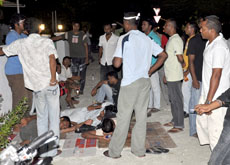
Human trafficking an emerging issue for the Maldives

A report on the Maldives in the South Asian Association for Regional Cooperation (SAARC) review of the Convention on Preventing and Combating Trafficking of Women and Children for Prostitution has highlighted the Maldives as a destination country for human trafficking, “where the primary form of trafficking is forced labour.”

The SAARC report, funded by the Asian Development Bank (ADB) and produced by the International Organisation for Migration (IOM), suggested that human trafficking in the Maldives “is presumably is associated with the country’s socio-economic status as the most developed South Asian country, and its reliance on the migration of foreign workers to support sectors such as tourism and construction.”

“The Maldives is a destination country for migrant workers trafficked from neighbouring Bangladesh and India for forced labour, and to a lesser extent women from Sri Lanka, Thailand, India and China who are trafficked to Male’ for commercial sexual exploitation,” the report said, adding that “there is also some existence of some inter-island trafficking of Maldivian girls to the capital for domestic servitude.”

The country’s main offenders were “registered employment agents who fraudulently recruit low-skilled migrant workers and subject them to conditions of forced labour once they are in the country.”

“The other major offending group are wealthy families who subject domestic servants to forced labour,” the report noted.

The trafficking of women and children for sexual exploitation was less marked than in other countries, the report noted, compared alongside the levels of forced labour, however “women of Chinese, Thai, Sri Lankan, and Filipino origin come to Male’ on the weekends from Colombo and some of them engage in commercial sex with the local migrant worker population.”

“In interviews, officials also spoke of occasions where they suspected cases of commercial sexual exploitation particularly when a large number of young women, sometimes of Eastern European origin, travel together with a single man to an exclusive private tourist resort for a short duration. [In this instance] there is little immigration officials can do in the absence of a complaint or some indication of abuse.”

IOM’s National Programme Officer Nishat Chowdhry presented the report at a meeting today in the Nalahiya Hotel, part of a review of the convention which until now has excluded male victims and crimes as forced labour.

“The scope of the convention is limited,” Chowdhry said. “Other aspects of trafficking, including for forced labour, human transplants and servitude have not been covered by convention,” she said. “There is growing consensus that the time is right to review the convention.”

President of the Human Rights Commission for the Maldives (HRCM) Ahmed Saleem described human trafficking as “a modern form of slavery with 800,000 estimated victims, mostly women and children.”

Saleem observed that a recent US State Department report into human trafficking had criticised the Maldives government for failure “to fully comply with the minimum standards for the elimination of human trafficking”, but noted that the government had now acknowledged the existence of the crime “even if overall efforts to [confront] it are insignificant.”

“The commission is convinced that this is a major human rights issue and that is why we have begun a comprehensive study we hope to complete as soon as possible,” he said.

Vice President Dr Mohamed Hassan Waheed, speaking at the event, noted that while the convention focused on one the “most serious transnational crimes against dignity and human rights”, there were “serious shortcomings both in coverage and implementation of this convention.”

“Specific limitations include the exclusion of male victims, prostitution excluding other forms of trafficking such as forced labour, sex slavery and other slave-like practices. I am concerned that even though the convention has been in force for fours years, it has not been adequately implemented and enforced in the region.”

The convention carried “inadequate provision for victim protection and rehabilitation,” he said.

“I am especially concerned about the trafficking of children, especially girl children. The effects of sexual exploitation of children are profound, maybe permanent. Sexual, physical and emotional development are stunted, self-esteem and confidence are undermined, and sexually exploited children become especially vulnerable to the effects of physical and verbal violence, drugs, sexually transmitted diseases. We are concerned that human trafficking is becoming a growing problem in our country.”

An industry driven “by greed and brutal disregard for human rights”, human trafficking “has become a worldwide multi-billion dollar industry,” Dr Hassan said.

“The problem is global but some of the worst forms are found in Asia, where more than a million people are exploited each year. Trafficking on this level cannot escape the attention of national and local law enforcement authorities and I would like to call on concerned authorities and counterparts in our neighbouring countries to enforce these laws and accept our obligations under this convention.”

Likes(1)Dislikes(0)

MPs reject bill banning alcohol, approve bill governing political parties

The parliament yesterday rejected a bill completely banning the importation of alcohol and pork to the Maldives

The bill on banning the importation of alcohol and pork was presented to the parliament by independent MP Ibrahim Muthalib, which he claimed was an amendment to the list of things that cannot not be imported under 75/4 of the law concerning contraband.

15 MPs voted in favour of the bill while 53 MPs voted against it. Four MPs did not vote.

“The last time I presented a bill banning the sale and usage of alcohol on inhabited islands parliament sent it off the floor claiming that it only banned particular areas (inhabited islands),” Muthalib said, upon presenting  the bill.

“This time I am presenting a bill to ban [alcohol and pork] from being brought inside the country at all.”

Almost all of the MPs were against the bill, claiming that it would harm the country’s tourism industry and its economy.

Meanwhile, another bill governing political parties was approved in a near-unanimous vote 68-2.

Maldivian Democratic Party MP Ahmed Abdulla presented the bill to the parliament on behalf of the government, with the stated aim of strengthening the democracy of the country by providing people “a peaceful” way to participate in political activities.

The bill was approved by the vote of 68 MPs, while 2 MPs voted against the bill.

Likes(3)Dislikes(1)

Arrests in Laamu Gan after gang attacks on police

Police have arrested 22 people including four children under the age of 18 in Laamu Gan, after they were attacked during a wave of gang violence.

Police said the attacks occurred on Saturday morning at 4:00am, after the gang, believed to be from Mathimaradhu, “appeared suddenly from a forest.”

Police alleged gang members broke the glass windows of a shop in the industrial area of Mathimaradhu, burnt down a hut in Mulurimagu [district] and broke the windows of two houses. When they tried to stop the gang members, police claim they they were attacked and a police vehicle damaged.

Two policemen were seriously injured in the attack, including one suffered a broken arm after he was hit by a metal tube and another who was struck in the arm by a piece of wood with nails in it.

Police have recovered some of the weapons used in the attack from a house in Mathimaradhu, including swords, knives, metal pipes and blocks.

Police Sub-Inspector Ahmed Shiyam said the injured two police officers have been brought to Male’ and admitted in Indira Gandhi Memorial Hospital (IGMH).

He said the police were investigating the case but refused to give more information.

Island Chief of Gan office Abdul Rahman said that the attack on Saturday night was a gang war between the two districts Mathimaradhu and Mukuri Magu that had been going on for a long time, “for at least three months.”

”Several times many of them have been injured,” Rahman said, ”but this is the first time they attacked the police and damaged property.”

He said most of the gang members were under the age of eighteen.

”We do not know why they have been fighting,” he said. ”We had not received any reports on these fights.”

He said there was a distance of 30 minutes between the two districts on foot.

Likes(1)Dislikes(0)

Hithaadhoo now out of water

Hithaadhoo in Baa Atoll has completely run out of water, claims Island councilor Amir Abdul Latheef.

He said he has been getting complaints since yesterday morning that all houses on the island had no water.

”We informed the utilities company that we have no water on the island,” Amir said, ”they told us that they would send water as soon as possible.”

Amir said the islanders were using ground water from the island, a practice banned by the Health Ministry twelve years ago because of the toxicity.

”Only a few wealthy men use mineral water but the majority of people cannot afford to buy water everyday,” he said. ”There are 1227 people on the island,” Amir noted.

He said he had never witnessed a situation similar to this in his whole life. ”[The last time] it rained was eight months ago,” he said,”the situation on the island is now much worse.”

He said the island office was trying to prevent infants from having to use the impure ground water.

”It rains occasionally but that much is not usable as the roofs are dusty and such small amount of rain does not even clean the roofs,” he said.

Amir said people of the island were now in danger of becoming sick with fevers and diseases due to drinking impure water.

State Minister for Health Abdul Baary Abdulla said there were many diseases that could potentially result from the use of contaminated water, including diarrhoea, stomach ailments and skin diseases.

Amir had recently complained several times that the island would completely run out of water during the weekend if the government does not provide it for them urgently.

Likes(1)Dislikes(0)

Shangri-La staff sacked for playing PlayStation, 157 now on strike

Staff at the Shangri-La Villingili Resort are on strike after four workers were dismissed for allegedly playing on a PlayStation in a vacant villa.

A person familiar with the matter told Minivan News that the four men, who were ‘villa hosts’ at the luxury resort in Addu Atoll, took their PlayStation to a vacant guest room during their lunch break, “double locked the door and put up a ‘Do Not Disturb’ sign.”

“The staff usually do not get a break during lunch time if the occupation of the island is high, but that day they got a break,” the source said, claiming the dismissal was “against the handbook of the resort.”

The source said the four men were dismissed after they were caught by security manager Jack David and Duty Manager Mohamed Ashraf. In response, 157 staff at the resort went on a four-day strike demanding their colleagues be reinstated.

The men were discovered when the house keeping manager found the room double locked and reported it to the duty manager, “as nobody was supposed to be inside,” the source said.

”The security manager and duty manager attended the place to see who was inside,” he said.

He claimed the security manager went to the back door of the villa just as one of the men inside opened it to see if anyone was outside.

”The security manager thought he was attempting to flee,” the source said.

”He pushed the man, saying ‘You do not know my background, I worked at the military for five years, your life is short now,’ and he fell to the ground and was hurt,” the source alleged.

The security manager “then ordered everyone to stay still until they finished investigating.”

He said that after taking pictures of the scene Ashraf told them the investigation was finished but did not allow them to leave.

”The of them the wanted to leave the room and go,” he said, “but security did not allow them to leave, and it because heated.”

He alleged that when one of them walked toward the door security pushed him back by neck.

”After shouting at each other for a while they managed to leave the room,” the source said.

Resort management gathered a council committee which included seven staff from the resort.

”The committee requested management to act according to the resort’s handbook,” he said, ”which stated that the four men should be given a ‘Category C’ punishment –  a written warning – while security management should be given ‘Category D’ punishment – dismissal.”

The source said the management wanted to give the same punishment to four staff and the security manager, “but everyone was against it, so we told the management that all the staff were against the decision,” he said.

”The next day the manager gathered us and said that he and the general manager had discussed the issue and decided to dismiss all five of them.”

He said that upon hearing the news staff across various sections of the resort were unhappy and petitioned management asking for the case to be reopened a dealt with according to the handbook.”

Shangri-La workers on strike

Bulk dismissal

”When we gave the petition to the manager he told us that everyone who had participated in the petition could also consider themselves dismissed and should leave the island immediately,” the source said.

”So all 65 of us gathered near the administration block demanding he take back the order and reinstate the jobs of the four dismissed villa hosts.”

He claimed the Shangri-La management refused to hold further discussion over the issue, and repeated that they were all dismissed and were to leave immediately.

”Police arrived that night and told us to leave the island within 10 minutes or they would use force,” he said, ”so we left on the resort’s ferry to Feydhoo in Seenu Atoll with the police.”

Police reportedly told the workers they could continue the strike on Feydhoo “in accordance with the law.”

”We are now in Feydhu continuing our strike and we now we have 157 Maldivian staff from Shangri-La with us,” he said.

”We will not stop until management decides to give us a written document reinstating the jobs of the four villa hosts.”

Vice President of the Tourism Employment Association of Maldives (TEAM) Mauroof Zakir said the association “fully supports” the strike.

”The International Union of Foodworkers (IUF) are also supporting the event,” Zakir said, adding that he was now at Feydhoo with the strikers taking part in the event.

Police Sub-Inspector Ahmed Shiyam confirmed that police arrived at the island upon request of the resort management.

Shiyam said the management claimed the situation was threatening to escalate into a brawl and requested police remove the staff from the island.

Shangri-La’s Director for Communication Leslie Garcia said investigation of the case was ongoing and she was unable to provide more information.

Deputy Minister of the Labour Relations Authority Aiminath Shifaya meanwhile said that the ministry was trying to resolve the issue peacefully by negotiating with management and employees.

Shifaya said two representatives of the ministry were now present on Feydhoo.

”We hope that the issue would be solved by tomorrow,” she said. ”Both sides are co-operating with us.”

Likes(1)Dislikes(0)

Comment: Fixing the economy will be painful

In my last article, I spoke about the seemingly intractable problems that our Maldivian economy faces – most notably the fact that we have spent far too much than is sustainable given our level of economic activity.

The theme here is to talk about how to deal with these problems and the challenges we face in doing so. No doubt explaining the problems – especially with the benefit of hindsight – is much easier than suggesting remedies. Moreover, given the extent of our past excess and misdeeds, the remedies required are likely to be both bitter and painful.

Our immediate problem is how to reduce our fiscal deficit. On a theoretical level – this is quite simple.

Approximately 50 percent of our expenditure is on paying government salaries and allowances – and we can cut down foreign travel, close down our embassies, turn off air conditioners at our offices – but ultimately unless we make some inroads into this important component of public spending – it will be impossible to do anything meaningful.

No doubt, all efforts must be made to reduce waste before we start slashing either incomes or jobs. The higher salary levels must take bigger cuts than the lower paid staff – as the government has already done so.

In reality however, this is both a political and a logistical nightmare. We all know members of family or friends struggling to make ends meet on the current civil service salaries. Laying off a large chunk of the population at a time of an economic crisis seems counterproductive to regenerating the economy.

Logistically, it is complicated because a system of voluntary first-come-first-serve resignations, particularly if the government is willing to forgive their education ‘bonds’, would mean that the most capable civil servants would depart first, leaving us with the least dynamic people actually running government. In an increasingly polarised community, it would be difficult to distinguish between people fired on the basis of professional incompetency or political allegiances.

Difficult though these policies may be, a country that has a third of its total work force working for the government is simply not sustainable. The key therefore becomes how to do this in a manner that has the least negative impact on our economy. For this – three broad initiatives are required.

First and foremost, significant opportunities for retraining must be made available. This must be combined with a public relations campaign on how retraining should be for anyone at any stage of their career. It must also be based on market requirements – with significant impact on developing skills necessary for our economy.

The tourism sector, foreign languages, technical skills, accountancy and business skills are just some of the options. More initiatives can be introduced to both existing and new private providers of training through public-private partnerships.

Other policies that must be pursued include the allocation of reduced rent or free land for private education providers, tax exemptions on educational material, as well as rebates of fees for those who successfully pass courses and find employment.

Secondly, access to credit for starting small businesses must be expanded. The key obstacles to this – particularly the high costs of borrowing from a narrow financial sector – must be addressed. The high costs of borrowing are partly due to the fact that the legal options for banks in the case of non-performance are uncertain.

Furthermore, without a credit information system, there is a significant missing component that makes people more disciplined when paying back their loans.

Last but not least, the fact that we realistically have one-and-a-half banks in the country (BML and to some extent SBI), the market mechanisms forcing these firms to be both efficient and customer orientated is missing. We need to encourage more banks to set up shop in the Maldives – and allow people access to a wide variety of banking products.

Finally, significant incentives must be provided for the private sector to start employing more Maldivians. This must be done first and foremost by revising our labour law. The existing legislation is overly burdensome and expensive for businesses – and more flexibility must be allowed.

With the coming of a new taxation mechanism, significant leeway must exist for the government to provide rebates and other incentives for those who employ more Maldivians. Start-up companies must also be provided with exemptions – particularly in strategic sectors deemed important for long-term growth.

However, even if we can introduce these policies – and this is a big ‘if’ given our intractable inability to get anything done within this political system – let us also not kid ourselves into thinking it would not involve a significant amount of hardship.

Even with countless retraining facilities, or access to credit or even benefits for private sector to employ locals – there will be a group of people simply unable to maintain their existing living conditions and as such their situation will no doubt deteriorate. One must assume that the current ‘pickiness’ of the local population to defer certain kinds of jobs to foreigners must also be revisited.

For those vulnerable groups, basic levels of protection – particularly in terms of access to healthcare and education – must be allowed. The current trajectory of the Government’s Madhanaa (health insurance) policy must therefore continue – and perhaps must be provided at subsidised rate to those unable to find jobs.

On a more fundamental level therefore, what we are looking at is a paradigm shift in the role of the state. If you take a long-term view of the Maldivian economy – it was effectively characterised by a system of subsistence fisheries and small scale agriculture – with the government earning revenue from trading of the excess products generated from these primary industries.

The country therefore had a system of governance that effectively involved a (selectively) benevolent state providing welfare for those that it deemed worthy – especially through jobs. Furthermore, the direct arm of the government – being mostly in Male – was felt on a smaller percentage of the people because the population of the country was more evenly distributed.

With the emergence of tourism however, we saw a dynamic private sector go on to take the driving seat of the economy. The state no longer has, or should have, the resources to provide direct employment to the people on such a large scale. No doubt, a basic level of protection to all must be provided – and what constitutes this basic level will continue to be debated for years to come. The role of the state must now become that of the regulator and the facilitator – allowing jobs, productivity and wealth to originate and be distributed according to forces of a dynamic market system.

All comment pieces are the sole view of the author and do not reflect the editorial policy of Minivan News. If you would like to write an opinion piece, please send proposals to minivan.news@gmail.com

Likes(2)Dislikes(0)

Fraudulent party registrations force EC to issue fingerprint forms

The Elections Commission (EC) has released a new political party registration form to avoid a recurrent problem of people being registered for political parties without their knowledge.

President of the EC Fuad Thaufeeq said the commission had uncovered an estimated 900-1100 people registered to political parties without their knowledge, “from all political parties.”

Fuad said the commission had sent notice to all the political parties that they would not accept any other registration form than the new form.

”Before all the parties had their own registration forms,” Fuad said. ”Those forms only required the person’s name and identity card number.”

Fuad said the new form required the person’s fingerprint, two witnesses and their signature.

”If anyone complains about the registrations [from now on] we can check the fingerprint through the police fingerprint database,” he said. ”If a form is presented with the wrong fingerprint we can identify the person and charge him with forgery, giving false information and signing another person’s signature.”

He said that the commission was contemplating creating a law concerning false registration.

”We cannot charge anybody over the 900-1100 false registrations,” he said, ”but hereafter we can identify it and treat it as a serious issue.”

He said the new registration form was now effective.

Dhivehi Rayyithunge Party (DRP) MP Ahmed Mahloof said that he was pleased with the new procedure.

Mahloof claimed that there were many recent complaints by DRP members that they had been registered instead as members of the Maldivian Democratic Party (MDP).

”They have stolen lots of our people,” he claimed. ”MDP would not even have a membership of 25,000 people.”

MDP MP Ahmed Easa said the new procedure was good and would avoid false registration.

Easa said MDP had received many complaints from people that they were registered in a political party without their knowledge.

”This form will make it more difficult for people to be registered in political parties,” he said.

Likes(1)Dislikes(0)

Parliament passes bill on broadcasting corporation

The parliament yesterday passed a bill establishing a broadcasting corporation, with board members to be appointed by parliament and responsible for controlling public media TVM and Voice of Maldives.

The bill effectively gives legal weight and parliamentary backing to the Maldives National Broadcasting Corporation (MNBC), which already runs state media.

Out of 69 MPs present, 42 voted to pass the bill. The bill was presented to the parliament by the government, with MPs attempting to introduce 35, but during the vote only 18 amendments were passed.

Spokesperson for the Maldivian Democratic Party (MDP) Parliamentary group Mohamed Shifaz said he was happy with the broadcasting bill but was unhappy on how the broadcasting corporation bill was passed.

Shifaz said that according to the bill the board members would be appointed by the parliament.

”The parliament will be appointing people for the board,” Shifaz said. “Parliament will do the interviewing and select people.”

Dhivehi Rayyithunge Party (DRP) MP Ahmed Mahloof said he was “very happy” with the bill, suggesting consternation within the MDP over the appointment of board members was “because TVM is the only media now which promotes the government.”

Mahloof said the MDP MPs were worried that if TVM became independent, “there will be no one to promote the MDP.”

”TVM would never report anything negative to the governemnt,” he said. ”It always promotes the government, that’s why they are worried that TVM might become independent when the parliament appoints board members for the broadcasting corporation.”

He said if the bill was approved by the president, media in the Maldives would become “free and independent.”

MDP MP Ahmed Easa said that appointing the board members by the parliament, announcing for interested applicants for the position and interviewing the applicants by the parliament made the parliament “a place where business is done.”

Easa said that the opposition MPs passed the bill because “they want to change the public media the way they want to.”

”It is fine if the parliament monitors the board,” he said, ”but if they are appointing people for the board that means the parliament is [participating in] the country’s business community.”

DRP MP Abdulla Mausoom said the bill was passed with majority support of MPs.

Mausoom said the President Mohamed Nasheed should “be very happy” with the way the bill was passed claiming that many people blamed the government for attempting to control the media.

”Now the president can say he has no power over the media,” Mausoom said.

Likes(3)Dislikes(0)

Convicted terrorist escapes DPRS on motorbike

A man sentenced for six years for charges of terrorism relating to the Himandhoo incident escaped yesterday as he was being transferred from the court to Malé Prison.

Spokesperson for the Juvenile Court Zaeema Nasheed identified the man as Hussein Nishan, 18, of Roze Hose in Himandhoo of North Ari Atoll.

Zaeema said that the man escaped by the time he was transferred to Male’ prison by a court officer from the Juvenile Court yesterday around 3:00pm.

”A court officer took him to the Department of Penitentiary and Rehabilitation Service (DPRS) and the department requested a court officer to take him to Male’ jail,” she said. ”It is the responsibility of the DPRS to take prisoners to the place where they are to be kept.”

She said Nishan fled on a motor-bike which stopped near Galolhu Male’ Hiya.

”The court officer immediately informed us about the incident,” Zaeema said, adding the department “immediately informed the police.”

She said the court officer did not manage to see the registration number of the motor bike.

Zaeema said there had several recent cases where prisoners had escaped custody, but noted that this was the most recent incident.

”We do not have a vehicle at the court [to transfer prisoners,” she said, ”and we have very low security procedures.”

She said Nishan was charged for terrorism in 2007 for attacking the Armed Forces of Maldives in Himandhoo when he was only 16 years old.

”The case was sent to the court by the Prosecutor General’s office on 24 July 2008.”

A source in DPRS told Minivan News that the court officer went with Nishan to DPRS around 4:00pm yesterday.

”We told him to transfer Nishan to Male’ Jail,” he said, ”and when we called after a while to check where he was, Niham said that the man escaped.”

He added that Nishan had cooperated during the trial.

Sub-Inspector Ahmed Shiyam confirmed the case was reported to the police yesterday afternoon.

Shiyam said Nishan had not yet been found and added that the police are searching for him.

Spokesperson for the DRPS Moosa Rameez did not respond to Minivan News at time of press.

President Mohamed Nasheed has previously vowed to the people of Himandhoo that the government will grant clemency to Himandhoo inmates convicted for terrorism.

Likes(1)Dislikes(0)