CMAG divided: Two hours of fighting before agreement on Maldives’ fate

A source close to the recent Commonwealth Ministerial Action Group (CMAG) meeting in New York has told Minivan News that severe divisions within the group regarding the Maldives’ status resulted in two hours of fierce debate before the wording of the final statement was agreed upon.

After discussing the meeting with three of the group’s delegations, the source revealed that it was the final paragraph regarding the Maldives’ situation which resulted what was described as prolonged “fighting”.

Paragraph 19 detailed the decision to “move consideration of Maldives in future to its agenda item ‘Matters of Interest to CMAG’”.

The reported divisions within the group shed further light upon the confusion which followed the release of the CMAG statement last week – five members were described as being “vehemently opposed” to removing the Maldives from its agenda.

“It was basically the Bangladeshi Chair versus the rest,” said the source.

After senior government figures as well as local media in the Maldives announced that the country had been removed from the agenda, CMAG member and Canadian Foreign Minister John Baird released a statement declaring his satisfaction that the Maldives remained on the agenda.

Earlier this week, Commonwealth Spokesman Richard Uku, told Minivan News that the Maldives was off the formal agenda and would resume its seat at the next meeting which is scheduled for April.

One of eight members in CMAG, the Maldives was suspended from the group in February after being placed on its investigative agenda.

“Being under the ‘Matters of Interest’ category simply reflects CMAG’s wishes to remain positively engaged. It should not be considered as a negative or punitive measure, because it is not,” said Uku.

“CMAG recognised the outcome of the Commission of National Inquiry report, reflecting the Government’s legitimacy,” he continued. “It recognised that there is more work to be done to follow up the CONI report recommendations to strengthen institutions.”

The source gave their own opinion of the outcome based their discussions with those present.

“The Maldives has been moved from one part of the agenda to another,” said the source. “The key wording in paragraph 19 was that the Maldives will resume its seat in April ‘in the absence of any serious concerns’.”

The source was told that this caveat alludes to Waheed’s agreement to pardon all politicians currently under investigation after allowing legal proceedings against them to be quickly concluded – Waheed reportedly told the group he could not stop legal proceedings.

The paragraph also hints at an alleged commitment made by Waheed to follow through with the CNI’s recommendations including prosecutions in relation to well-documented police brutality.

It is alleged that two of the group’s ministers have promised to walk out of April’s meeting should Maldivian Foreign Minister Dr Abdul Samad Abdulla resume his seat without these agreements having been adhered to.

Insulting CMAG

The meeting had been preceded by intense lobbying from both government and opposition groups regarding the Maldives’ inclusion on CMAG’s investigative agenda, reserved for those suspected of violating the Commonwealth’s core values of human rights and democracy.

Prominent figures in the government had suggested that, after having its legitimacy seemingly validated by the Commission of National Inquiry (CNI) report, the country should walk away from the Commonwealth should it not be removed from the agenda.

President Waheed echoed these sentiments in a speech given before a meeting during the United Nations General Assembly days before the CMAG meeting.

During the speech, Waheed took aim at the certain “powerful international actors”, describing them as serving “small justice to small states”.

Conversely, the opposition Maldivian Democratic Party (MDP) argued that CMAG’s revised mandate provided it with a remit to look beyond questionable changes of government to persistent violations of core Commonwealth principles.

Last week Foreign Minister and UN Special Rapporteur on Human Rights, Dr Ahmed Shaheed had predicted that CMAG would only remove the Maldives from its agenda if guarantees of free and fair elections were given.

The informed told Minivan News that Waheed was “grilled” by the panel for around 75 minutes, at one point being told that he was insulting CMAG with his seemingly contradictory answers.

The frustration of the Canadian representative when asking Waheed about persecution of opposition politicians was made clear in the press release the following day.

“President Waheed offered no substantial defence of these questions, which is a telling response in itself,” he said.

The source reported that some in the panel had felt the government’s argument for removal from the agenda due to the negative publicity it generated was “stupid”.

Regarding the reported agreement to pardon those politicians convicted in order for them to participate in next year’s elections, the source expressed concern that CMAG ministers may still have been “duped”.

“Ministers are not aware of constitutional clauses saying one year must pass after the pardon [before being eligible for elected office],” said the source.

The President’s Office had hinted previously that Waheed may consider clemency in the case of former President Mohamed Nasheed who currently faces charges of illegally detaining a judge and defaming senior members of the current government.

Nasheed failed to appear at the start of his criminal court trial yesterday, defying a travel ban to sail to the southern atolls for electioneering purposes.

Last week Nasheed’s MDP announced it would refuse to observe the authority of the courts until the judiciary is reformed as recommended in the final CNI report.

President’s Office spokesman Masood Imad was asked to give a government reaction to these allegations but had not responded at time of press.

Likes(2)Dislikes(0)

“Fragile democracy under threat”: Richard Branson, Ed Norton among signatories for fresh elections

Business tycoon Richard Branson and ‘Fight Club’ actor Ed Norton are among dozens of international celebrities and activists who have signed a letter calling for the Maldivian government to halt harassment of the opposition and “hold democratic elections at the earliest opportunity.”

The letter, published in the UK’s Guardian newspaper, expresses concern over former President Mohamed Nasheed’s “island arrest”.

“The ban was then followed by a series of orders to appear in court this week on spurious civil and criminal charges – a strategy of legal harassment pursued by the illegitimate regime of Mohamed Waheed. Its sole purpose is to sideline Nasheed from active politics and further stamp out any political opposition,” the letter stated.

President’s Office Spokesperson Masood Imad told Radio Australia on Tuesday that the government on assumption of office “made it clear we would in no way interfere with the process of the judiciary. The judge summoned Mr Nasheed but he absconded. I believe he will be summoned again and if he does not appear in court, he will issue an order for his arrest.”

The letter further stated that “the outlook for democracy in the Maldives is deteriorating. The circumstances surrounding Nasheed’s removal from power earlier this year remain a matter of dispute, but other matters are beyond doubt.”

Specifically, it noted that “no date has been set for free and fair elections by this unelected regime, which has links to former dictator Abdul Gayoom,” and that “nearly 2,000 peaceful demonstrators calling for elections have been detained by security forces, many beaten and hospitalised.”

“Sadly, much of this remains largely unreported by the world’s media. A young and fragile democracy is under threat once more and we therefore call upon [President] Mohamed Waheed to set a firm date for free and fair elections immediately, to end the culture of systematic police brutality and to release all political detainees including opposition leader Mohamed Nasheed.”

As well as Branson and Norton, signatories included Radiohead guitarist Thom Yorke, actress Darryl Hannah, 350.org founder Bill McKibben, the Eden Project’s Tim Smit, and philosopher and ethicist Peter Singer.

Norton, Branson and Hannah were fixtures at last year’s Slow Life Symposium held at the upmarket Soneva Fushi resort in the Maldives.

Branson first waded into Maldivian politics on his blog on February 24, calling on President Waheed to “do the right thing” and hold free and fair elections before the end of the year.

It was, Branson wrote to Dr Waheed, “completely astounding that you have been part of an overthrow of a democratically elected government that has effectively let the old regime back into power.”

“Knowing you, I would assume that you were given no choice and that it was through threats that you have ended up in this position,” Branson said. “I do very much hope that was the case rather than you doing it of your own free will.”

Days later, Branson wrote another entry, saying that he had spoken on the phone to Dr Waheed, who told him he had appointed “a respected person” to examine the truth of what caused President Nasheed to “resign”.

“He says that he didn’t know who issued an arrest warrant for President Nasheed after he left office but that it had been rescinded within 48 hours. He is determined to be an honest broker, to be seen to be one, and to get everyone’s confidence. He said that he offered to bring in people from President Nasheed’s party but they refused to join.”

A few days later, Branson wrote a third post, resuming his first call for early elections “as soon as feasibly possible”.

The Soneva Group meanwhile found itself embroiled in local politics in August, composing a statement in response to allegations published in the UK media that the company’s head, Sonu Shivdasani, had engaged a PR firm to “spruce up” the image of Dr Mohamed Waheed’s government.

The article in Private Eye magazine contended that post February 7, an “unlikely alliance” had emerged between certain resorts – desperate to stabilise the sudden political instability for the sake of their bottom lines – and the new government, a loose alliance of ambitious political elements who came to power on a platform of Islamic conservatism.

“The reality is that the Maldives – already favoured by footballers, Russian gangsters and off-duty Israeli arms dealers – are an even harder sell since the coup has given us an unlikely alliance between hoteliers promoting bikini-clad, cocktail-fuelled luxury and a government that includes two imams, wants to bring back the death penalty and has done nothing about the destruction by supporters of the coup of the national museum’s entire pre-Islamic collection,” the article stated.

In a counter statement from the group, obtained by Minivan News, the company sought to clarify the “facts” of the case.

“Sonu Shivdasani does not have a political relationship with President Mohamed Waheed, their interaction revolves specifically around environmental and ecological issues,” the Soneva statement read.

A source within the Soneva Group described the situation as “a bloody mess”.

Shivdasani “completely fell for Waheed’s line that Nasheed didn’t resign under duress” and had – unsuccessfully – asked a number of PR agencies to set up interviews for the new President, Minivan News was informed.

The source surmised that Shivdasani had “innocently, stupidly, somehow believed Waheed”, and “gone out of his way to help [the new President].”

Soneva’s statement meanwhile disputed the resort’s motivation to support the new government as being based on supposed plans to amend a corporate tax bill implemented by Nasheed, as, “to the best of my knowledge, there are no plans by the current President Mohamed Waheed to reduce or eliminate this tax.”

Likes(0)Dislikes(0)

Interpol red notice issued for arrest of ‘Maleesha Hajj Group’ head

Interpol has issued a red notice to apprehend 42 year-old Ismail Abdul Latheef, the head of the ‘Maleesha Hajj and Umrah Group’ who is being sought on suspicion of fraudulently collecting funds from Hajj pilgrims.

According to local newspapers, the company’s office remained closed and the contact numbers given to the persons who paid are not in use. Clients of the company have no hope of getting to Mecca this year, according to reports.

Police Sub-Inspector Hassan Haneef told newspaper Sun that police had given Interpol information about Latheef two days ago.

The owner of the business allegedly collected MVR 68,000 (US$4400) from 175 persons who wished to go to Mecca this year to fulfill the Hajj, one of the five pillars of Islam.

Based on this amount, Latheef is thought to have fraudulently obtained up to MVR 11.9 million (US$77,0000).

Police have previously said that attempts are ongoing to locate and summon Latheef for investigation.

According to police, Latheef’s whereabouts are unknown. It was possible that he had fled the country, they stated.

Authorities have claimed that 52 complaints have so far been received over alleged payments made to the Maleesha Hajj and Umra Group.

Some people who paid to the company have also complained at different media outlets.

Likes(0)Dislikes(0)

PPM MP Dr Afrasheem found brutally murdered

Additional reporting by Mariyath Mohamed.

MP of the government-aligned Progressive Party of the Maldives (PPM), Dr Afrasheem Ali, was brutally stabbed to death outside his home on Monday night.

The member for Ungoofaaru constituency in Raa Atoll was murdered after returning home from appearing on the TVM show “Islamee Dhiriulhun” (Islamic Life) with Deputy Minister of Islamic Affairs Mohamed Qubad Aboobakuru.

The show finished around 11:00pm, and Afrasheem’s body was discovered by his wife at the bottom of the stairs of their apartment building shortly after midnight.

The MP had been stabbed four times in the back of the head and a chunk of his skull was missing, according to reports on VTV. He also suffered stab wounds to the chest and neck.

The MP was rushed to ADK hospital where he was pronounced dead. The hospital was placed under heavy security.

Others present at the hospital in addition to police officers and citizens included former President Maumoon Abdul Gayoom, his daughter and State Minister for Foreign Affairs Dhunya Maumoon, his half-brother and People’s Alliance (PA) leader Abdulla Yameen, Speaker of Parliament Abdulla Shahid, Deputy Speaker Ahmed Nazim, Deputy of the PPM Umar Naseer, Defence Minister Mohamed Nazim, Tourism Minister Ahmed Adheeb, Dhivehi Rayithunge Party (DRP) Leader Ahmed Thasmeen Ali, Police Commissioner Abdulla Riyaz, Maldivian Democratic Party (MDP) Chairperson Reeko Moosa Manik, and a large number of MPs.

Much of the opposition’s senior contingent left for campaigning in the southern atolls yesterday, however the murder was widely condemned on twitter by its officials including Moosa, MP Sameer and the party’s UK Spokesperson Dr Farah Faizal.

In a live press conference shortly after 3:00am, Police Commissioner Riyaz called for restraint.

“I call on all to show restraint. I further call on all to not blame anyone at this time, and to not incite further acts in relation to this,” Riyaz stated.

Speaker Shahid – a DRP member – spoke from the hospital, announcing that parliament would be postponed until Wednesday.

“This will be observed as a national sorrow. I extend sincere condolences to Afrasheem’s family. I hope we can all act in unity in these sad times. I call on the investigative forces to solve this case and find those responsible for this heinous crime at the earliest possible time,” Shahid said.

“Dr Afrasheem Ali was very sincere in his work at the Majlis, and was honest and assertive. We always received his cooperation in the work of Majlis. We have lost a valuable son of the Maldives. May god bless his soul and grant him paradise.”

In a statement, the Ministry of Islamic Affairs noted Dr Afrasheem’s “valuable services”.

“The Ministry sends condolences to the family and prays the deceased is granted paradise. Minister Sheik Shaheem Mohamed Ali Saeed calls on the authorities to give the harshest possible punishment to those who have committed this brutal crime.”

President of the Human Rights Commission, Mariyam Azra, said she was “in complete shock”.

“I only heard of this when VTV called. I am in complete shock… I condemn this act. This should not at all occur in a society like ours. I pray that God blesses his soul and grants him paradise,” Azra told local media.

President Dr Mohamed Waheed Hassan has declared that the National Flag be flown at half-mast, from 2 October 2012 till the end of 4 October 2012.

There were unconfirmed reports that police had arrested a suspect in connection with the murder. Minivan News is trying to confirm this.

President’s Office Spokesperson Masood Imad meanwhile forwarded an SMS to foreign media declaring that “Nasheed’s strongest critic Dr Afrasheem has been brutally murdered.”

Background

Dr Afrasheem was elected to parliament in 2009 as a member of the then-opposition Dhivehi Rayithunge Party (DRP). Following the opposition’s split, Afrasheem sided with the Progressive Party of the Maldives (PPM) of former President Maumoon Abdul Gayoom, and faded into the political background.

Widely considered an Islamic moderate, Dr Afrasheem took outspoken and controversial positions on issues such as the permissibility of playing music, and praying next to the deceased.

Newspaper Haveeru reported on September 10 that Afrasheem had participated in a ‘scholar’s dialogue’ with Islamic Minister Sheikh Shaheem Ali Saeed, who had remarked on his conflicting positions on many issues compared to the majority of Maldivian scholars.

During his final television appearance last night, Dr Afrasheem spoke of there being no other God than Allah, and how he disagreed with some people who he claimed used different objects as a mediator.

Afrasheem insisted that he had never ever spoken of anything regarding religion which was not stated in the Quran or sayings of the Prophet (PBUH). He acknowledged that some people had raised questions about his stands, and said this could be due to misunderstandings.

As an example, he said he had been told recently by a local TV host that people were made kafir (non-believer) through certain acts, saying he had immediately responded that a believing Muslim could not be labelled a kafir just because he would not grow his beard or shorten his trousers, as long as he believed in the one God and the tenets of Islam.

Afrasheem also said that people in the Maldives and abroad who loved Islam sometimes made such statements, but said they did not really possess the knowledge of a scholar and that this position was wrong. Afrasheem stated that he was deeply saddened and asked for forgiveness from citizens if he had created a misconception in their minds due to his inability to express himself in the right manner.

He was attacked several times in 2008, including being hit in the head with a stone on May 27 on his way home from work, and was assaulted after he finished Friday prayers as an Imam in the Ibrahim Mosque in January. His car window was smashed while he was driving through Male’ on March 18, 2012.

The murdered MP was also formerly Parliament’s member of the Judicial Services Commission (JSC), until he was replaced in mid-2011 by Jumhoree Party (JP) Leader, resort tycoon Gasim Ibrahim.

The MDP had campaigned for Afrasheem’s removal from the judicial watchdog, after he dismissed Article 285 of the Constitution – demanding that all judges who do not meet its newly stipulated qualifications be dismissed after two years of it coming into force – as “symbolic”.

Afrasheem is the second member of the JSC to be stabbed in the street, following an attack on former President’s member on the commission, Aishath Velezinee, in early 2011.

Dr Afrasheem is to receive a State funeral and will be buried after Asr Prayers.

Dr Afrasheem’s final TV appearance prior to his murder:

Likes(0)Dislikes(0)

Nasheed fails to appear in court, defies travel ban

Additional reporting Daniel Bosley, Mariyath Mohamed and Mohamed Naahii.

Former President Mohamed Nasheed departed Male’ today to participate in his party’s ‘Vaudhuge Dhathuru’ (Journey of Pledges) campaign in the southern atolls, defying a court order that he remain in the capital.

Nasheed’s departure contravenes an order from the Hulhumale Magistrate Court last week that Nasheed be confined to Male’ ahead of his court trial, which was to be conducted at 4:00pm today.

Journalists in the courtroom were required to undergo heavy security screening and were stripped of mobile phones, recording equipment and notepads. However, 20 minutes later a court official stated that the hearing was cancelled as the defendant and his lawyers had failed to appear. A new date was not set.

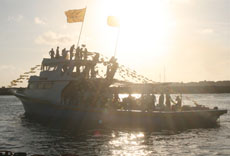
Nasheed meanwhile held a rally from atop a yellow flagged dhoni in front of 500 demonstrators near the petrol jetty in the south of Male’, before departing with five vessels and hundreds of supporters. Minivan News observed no police presence in the area.

“Once they started to set up a fabricated court, bring in judges who are not judges of that court, and the whole structure of it is so… politically motivated, it is very obvious it is not meant to serve justice,” Nasheed told the BBC.

“We intend to find out in this trip to what extent we were able to fulfil our pledges during this party’s period in government,” Nasheed told his supporters. “This is a journey of pledges. This is a journey for justice. This is a journey where we become one with the citizens.”

The party and its senior leadership will visit over 30 islands during the 14 day trip, taking in the atolls of Gaafu Alif, Gaafu Dhaalu, Fuvahmulah and Addu.

Meanwhile, the court hearing was to be the first in the case concerning Nasheed’s detention of Chief Judge of the Criminal Court, Abdulla Mohamed, while in office.

Nasheed also faces charges of defaming Police Commissioner Abdulla Riyaz and Defence Minister Mohamed Nazim as “traitors”, following February 7’s controversial transfer of power. The first hearing in Riyaz’s case has been postponed indefinitely.

Nasheed’s Maldivian Democratic Party (MDP) has expressed deep concern over the legality of the court’s procedures regarding the trials, which it contends are a politically-motivated attempt to convict the former president and prevent him from running in future Presidential elections.

Following the court-ordered travel ban on Nasheed ahead of the party’s southern atoll election campaign, the MDP announced that it would no longer recognise the authority of the courts in the Maldives until changes proposed by international entities were brought to the judicial system.

“This all looks very ‘Myanmar’ – using the courts and administrative manipulation to restrict political party activity,” said MDP MP and Spokesperson Hamid Abdul Ghafoor at the time.

“While President Waheed was lobbying the Commonwealth to remove the Maldives from its human rights watch-list, his regime had detained the leader of the opposition.”

The concerns were echoed by Canadian Foreign Minister John Baird, a member of the Commonwealth Ministerial Action Group (CMAG) who recently downgraded the Maldivesfrom its formal agenda to a ‘matter of interest’.

“Canada is deeply troubled by the reported September 25 travel ban of former President Nasheed in Malé,” said Baird.

“The recently adopted Commission of National Inquiry (CNI) report has raised substantial concerns about the independence of the judiciary. That too causes Canada grave concern as we strive to assure independent open elections in the Maldives,” he added.

“President Waheed offered no substantial defence of these questions, which is a telling response in itself,” said Baird. “Canada finds the declining state of democratic values in the Maldives alarming and deeply troubling.”

The court has maintained that the travel restriction is normal procedure for defendants ahead of court trials.

The case

Nasheed’s controversial decision to detain Judge Abdulla in January 2012 followed the judge’s repeated release of former Justice Minister – and current Home Minister – Dr Mohamed Jameel, in December 2011, whom the government had accused of inciting religious hatred over the publication of his party’s pamphlet, ‘President Nasheed’s devious plot to destroy the Islamic faith of Maldivians’.

Nasheed’s government further accused the judge of political bias, obstructing police, stalling cases, having links with organised crime and “taking the entire criminal justice system in his fist” so as to protect key figures of the former dictatorship from human rights and corruption cases, among other allegations.

Nasheed justified the judge’s arrest based on his constitutional mandate to protect the constitution. Judge Abdulla had in September 2011 received an injunction from the Civil Court preventing his investigation by the Judicial Services Commission (JSC), the watchdog tasked with overseeing the judiciary, which complied with the ruling.

Parliament’s Independent Commissions Committee, the body mandated with holding the judicial watchdog accountable, took no interest in the matter.

The then-opposition began nightly protests over the judge’s detention, while the government sought assistance from the UN and Commonwealth for urgent judicial reform.

However, Nasheed resigned on February 7 amid a police and military mutiny the day after the Commonwealth team arrived.

Judge Abdulla was released, and the Criminal Court issued a warrant for Nasheed’s arrest. The warrant was not acted upon.

Former Defence Minister Tholhath, former Chief of Defence Force Major General Moosa Ali Jaleel, Brigadier Ibrahim Mohamed Didi and Colonel Mohamed Ziyad are also facing charges for their role in detaining Judge Abdulla in January 2012.

The charges include a breach of article 81 of the Penal Code: “Arresting an innocent person intentionally and unlawfully by a state employee with the legal authority or power vested to him by his position is an offence. Punishment for a person guilty of this offence is imprisonment or banishment for 3 years or a fine of MVR 2000 (US$129.70).”

“The full story”

Former President’s Member on the JSC, Aishath Velezinee, has written a book extensively documenting the watchdog body’s undermining of judicial independence, and complicity in sabotaging the separation of powers.

Over 80 pages, backed up with documents, evidence and letters, The Failed Silent Coup: in Defeat They Reached for the Gun recounts the experience of the outspoken whistleblower as she attempted to stop the commission from re-appointing unqualified and ethically-suspect judges loyal to former President Maumoon Abdul Gayoom, after it dismissed the professional and ethical standards demanded by Article 285 of the constitution as “symbolic”.

That moment at the conclusion of the constitutional interim period marked the collapse of the new constitution and resulted in the appointment of a illegitimate judiciary, Velezinee contends, and set in motion a chain of events that ultimately led to President Mohamed Nasheed’s arrest of Abdulla Mohamed two years later.

According to Velezinee, “the assumption that Abdulla Mohamed is a constitutionally appointed judge is based on a false premise, a political creation [which] ignores all evidence refuting this.”

“Judge Abdulla Mohamed is at the centre of this story. I believe it is the State’s duty to remove him from the judiciary. He may have the legal knowledge required of a judge; but, as the State knows full well, he has failed to reach the ethical standards equally essential for a seat on the bench.

“A judge without ethics is a judge open to influence. Such a figure on the bench obstructs justice, and taints the judiciary. These are the reasons why the Constitution links a judge’s professional qualifications with his or her moral standards,” she wrote.

“There is no legal way in which the Civil Court can rule that the Judicial Service Commission cannot take action against Abdulla Mohamed. This decision says judges are above even the Constitution. Where, with what protection, does that leave the people?” Velezinee asked.

“The Judicial Service Commission bears the responsibility for removing Abdulla Mohamed from the bench. Stories about him have circulated in the media and among the general public since 2009, but the Commission took no notice. It was blind to Abdulla Mohamed’s frequent forays outside of the ethical standards required of a judge. It ignored his politically charged rulings and media appearances.

“Abdulla Mohamed is a man who had a criminal conviction even when he was first appointed to the bench during President Maumoon Abdul Gayoom’s time. Several complaints of alleged judicial misconduct are pending against him. The Judicial Service Commission has ignored them all. What it did, instead, is grant him tenure – a lifetime on the bench for a man such as Abdulla Mohamed. In doing so, the Judicial Service Commission clearly failed to carry out its constitutional responsibilities. It violated the Constitution and rendered it powerless.”

Likes(0)Dislikes(0)

‘Sun Travel’ Shiyam claims investors have “lost confidence” in the Maldives

MP for Meedhoo constituency Ahmed ‘Sun Travel’ Shiyam told the People’s Majlis that both local and foreign investors had lost confidence in the Maldives, local media reported.

“This is the result of the persons assigned with the people’s posts and money betraying them and acting without any policies or system,” Haveeru quoted Shiyam.

Shiyam argued that increasing embezzlement and corruption  was a major contributor to what he sees as the country’s impending bankruptcy.

“In order to ensure the progress of the country, everyone needs to be sincere and honorable. The members of the Parliament and the government must adore the people,” he said.

Investor confidence has been much discussed as the government continues to oppose the GMR deal to develop the country’s international airport – the country’s largest.

However, the Maldives National Chamber of Commerce and Industries (MNCCI) last week claimed that the legal wrangling between the government and India-based developer would not harm confidence in the country’s “challenging” investment climate.

Haveeru also reported comments made today by former President Maumoon Abdul Gayoom  regarding the GMR deal.

Detailing his recent meeting in India with GMR head G M Rao, Gayoom said that he had told Rao that the deal had been signed under dubious circumstances.

“I told him that we have no issues with India or any Indian company. We have issues with the actions of the previous government,” Gayoom is reported to have said.

“The agreement was signed with GMR in violation of the constitution and the laws. The Parliament was not even informed. The Maldivian people are also not aware of the details of the agreement. So these are the issues we have,” he said.

Likes(0)Dislikes(0)

Vice president praises Chinese significance to Maldives development

Vice President Mohamed Waheed Deen spoke yesterday at a ceremony marking 63 years since the People’s Republic of China was founded, expressing gratitude for the technical and economic assistance the Maldives had been provided and pledging further cooperation between the two nations in the future.

At the special reception held at Trader’s Hotel in Male’ yesterday, the vice president also praised the speed and nature of democratic development within China – something he hoped to see emulated in the Maldives.

“I have no doubt your country is going in the right direction and leading the world,” he told attendees, which included business figures, senior government representatives and diplomats.

“Even if you look at the political changes in china they have proved that they are taking patient, calculative, constructive and very objective directions and I believe that is how the democracy must be developed, not very hastily.”

The vice president, a local philanthropist and owner of the Bandos Island Resort and Spa, also praised the growing economic significance of China to the Maldives in terms of trade and tourism income.

“I am pleased to note that China is currently the number one tourist market for the Maldives and I hope that the number of Chinese tourists travelling to the Maldives will continue to increase,” he said. “In addition, trade between the Maldives and China has increased significantly in the past few years and China remains one of the largest trading partners of the Maldives.”

The reception was the first of its kind to be held by China in the Maldives since the country opened its first full diplomatic mission in Male’ last year.

According to the vice president, 2012 also marks 40 years since China and the Maldives first established diplomatic ties.

Likes(1)Dislikes(0)

Majlis reconvenes with elections and legislative reforms atop agenda

The People’s Majlis reconvened today with both opposition and government-aligned parties claiming elections and legislative reforms were among the key focuses of their respective parliamentary agendas following an extended break.

According to the Majlis’ Counsel General Fathmath Filza, today’s opening session saw debates take place on two declarations and eight bills, including the repeal of a motion to remove the Maldives’ membership within the Commonwealth.

The session was also said by the official to include the distribution of the Commonwealth-backed Committee of National Inquiry (CNI) report to all MPs and the respective parliamentary committees dealing with security services, independent institutions and national security.

“These committees will review the report and report to the Majlis on the actions that then need to be taken,” added Filza.

Despite reconvening temporarily for an emergency session to pass the General Regulations Act in August, the Majlis has not reconvened since July after Speaker Abdulla Shahid suspended the institution, deciding a safe environment could not be ensured in the chamber after heated exchanges on the floor.

This suspension led straight into the Majlis traditional recess period, although parliamentary committees have resumed their work as of last month.

Parliamentary Speaker Shahid told Minivan News today that the recess period had provided sufficient time for tensions between leaders on both sides of the country’s political divide to “calm”.

“This has allowed for dialogue between party leaders and for me to set up agreement to have the current third parliamentary session begin on time,” he claimed. “This is important to ensure parliamentarians were part of the process to address their respective agendas.”

The speaker said that in line with a number of reports from independent institutions, the decision had been taken – in line with parliament’s minority and majority leaderships – to pass the findings of the Commonwealth-backed Commission of National Inquiry (CNI) onto the relevant regulatory committees.

Function undisturbed

Abdulla Yameen, Parliamentary Group Leader of the government-aligned Progressive Party of Maldives (PPM) told Minivan News by SMS that with parliament resuming today, he expected the Majlis to function undisturbed despite ongoing tensions relating to February’s controversial power transfer.

From the perspective of the PPM, which presently holds minority leadership in the Majlis with the second largest number of MPs after the opposition Maldivian Democratic Party (MDP), Yameen said he believed passing pending legislation was his party’s foremost concern.

“[The PPM] hopes to see all pending legislative agenda addressed in order to ensure free and fair presidential elections,” said Yameen, who is the half-brother of former President Maumoon Abdul Gayoom.

Having met personally with former President Mohamed Nasheed late last month – without providing direct details of their discussions – Yameen said there had been agreement that the Majlis should function “smoothly”.

Meanwhile, MDP MP and Spokesperson Hamid Abdul Ghafoor claimed that in order to try and facilitate early elections, the party’s national council had asked for the Commission of National Inquiry (CNI) report to be distributed in the Majlis in attempts at having its recommendations implemented.

These recommendations, according to the MDP, include the need for reforms to strengthen the country’s independent institutions like the judiciary, as well as bringing senior defence force figures accused of mutinying against the former government to justice.

According to Ghafoor, the speaker has sent the CNI report to the relevant parliamentary committees to review recommendations made.

He claimed the request was part of a wider process to enact early elections within the Maldives – a key focus of the MDP since former President Mohamed Nasheed’s controversial resignation back in February.

Nasheed, who is presently the MDP’s presidential candidate, has continued to claim he was forced to resign under duress.

However, the party’s claims that the former government was removed from office in a “coup d’etat” were dismissed by the CNI report published in August.  The report was later accepted by the MDP, albeit “with reservations”.

These reservations were first raised by Ahmed ‘Gahaa’ Saeed, former President Nasheed’s appointee on the CNI panel, who alleged there had been a failure to take into account certain key evidence and witness accounts compiled by the panel regarding the transfer of power.

The MDP has claimed that despite its reservations, the CNI report has provided the party with a “way forward” to push for institutional reform.

Just last month, the MDP’s national council had called on the party’s parliamentary group to back a boycott of the Majlis over allegations that working within the present political process was failing to secure reforms highlighted in the Commission of National Inquiry (CNI) report.

The proposed boycott was criticised strongly at the time by parties serving within the coalition government of President Dr Mohamed Waheed Hassan.

Likes(0)Dislikes(0)

Tourism Ministry hits back at MIRA accusations over failure to collect resort rents

The Ministry of Tourism has hit back at claims made last week that it was failing in its duty to collect rents and associated non-tax revenue from the country’s largest industry.

Following claims made by the Commissioner General of Taxation at the Maldives Inland Revenue Authority (MIRA) that the tourism ministry was failing perform its duty of collecting such revenue, State Minister for Tourism Mizna Shareef has called the accusations “baseless and unfair.”

“Under the new tax regime, MIRA can go after those who don’t pay rent,” said Mizna. “It is very unfair and inappropriate for MIRA to make these statements.”

Mizna argued that the authority had been pressuring the tourism ministry to suspend operating licenses for late-payers without considering the wider implications for the industry as a whole.

“There has to be balance – the industry must be protected while rents are collected,” she continued.

Tourism is by far the largest industry in the country, contributing over 70 percent of GDP via associated industries and 90 percent of all foreign exchange receipts.

Allegations by groups in support of the now-opposition Maldivian Democratic Party (MDP) linked several prominent Maldivian resort operators with February’s disputed transfer of power.

A travel advisory created shortly after the transfer rated resorts on a traffic-light system, urging against travel to resorts marked ‘red’ – being linked with the alleged coup-makers. The site has since been taken down.

The recently completed Commission of National Inquiry (CNI) ruled that the transfer of power had occurred within constitutional boundaries – a decision over which the MDP has registered strong reservations.

Tourist arrivals have continued to rise this year, with the Asian (largely Chinese) market taking up the slack from a downturn in European holiday-makers, although growth has slowed considerably in comparison with last year.

Director General of Revenue Service at MIRA, Fathuhulla Jameel, was not responding to calls at the time of press.

Lease extension

MIRA’s figures for August showed that ‘Tourism Land Rent’ collected last month was only 19 percent of the amount collected in the corresponding period last year.

Tourism land rent for the year so far is shown to be only three quarters of that collected by the same point on 2011.

The importance of this revenue stream can be seen in the share of overall revenue tourism land rent alone contributes to the authority’s figures – making up 10 percent of MIRA’s income this year.

Another important source of tourism revenue comes from lease extension payments from resort operators – islands are ultimately the property of the state and are leased to the operators on long term bases.

Mizna took issue with the suggestion that the government had re-interpreted the lease extension payments with detrimental effects for the state’s annual budget.

MIRA’s figures show that revenue from lease period extension fees has been US$11million (MVR 168 million) so far this year, compared to US$20million (MVR 273 million) at the same point in 2011.

Mizna argued that the initial arrangement for the collection of lease extension payments had not been fully elucidated by the courts prior to the current government’s assumption of office.

A High Court ruling last December ruled in favour of the 2010 second amendment to the Maldives Tourism Act after it was said to contradict article 8 of the original legislation, pointed out Mizna.

The second amendment states that fees of US$100,000 for every year extended should be paid over a period of between 18 or 36 months depending on operator’s status when the act was published in the government gazette.

The Nasheed government had requested that the payments be made in a lump sum.

Former Tourism Mariyam Zulfa, speaking shortly after the new government took office, explained the Nasheed government’s reading of the system.

“The second amendment to the tourism law came into place it gave the option for resorts to extend the existing 25 year leases to 50 years. A time period was given and there is a clause that stipulates that the payment must be done in completion before the lease period can be extended,” she said in March.

“So, the Nasheed government had interpreted that clause as the payment to be paid in full for the period extended. So, because the wording is such that the payment must be complete before the extension is granted, we interpreted it as the full payment,” she continued.

“But there is another clause which says the manner in which the payment is calculated is on an annual basis. This government has over-interpreted that clause and has said that the payment has to be made annually,” argued Zulfa.

Likes(0)Dislikes(0)