Yameen pledges to end violent crime at ‘Successful 365 Days’ rally

With additional reporting by Ahmed Naish and Ismail Humaam Hamid

The Progressive Party of Maldives will rebuild a devastated nation through job opportunities for the youth and a crackdown on violent crime, said President Abdulla Yameen while celebrating one year in office.

Yameen urged young people to take advantage of the opportunities that would be created by growing tourism and large scale foreign-funded infrastructure projects, while pledging to bring peace and security to the nation.

“I want to say tonight as well in your presence, this government will have no mercy at all for those who slaughter Maldivian citizens with no mercy,” said Yameen at the ‘Successful 365 Days’ event held in Male’ this evening.

He pledged to implement the death penalty – reintroduced under his government, for the sake of human rights and dignity.

“Saving the Maldives from these big atrocities is the biggest aim of this government,” he said, stating that Maldivians by nature sought peace and stability.

Yameen said that proposed changes to legislation would remove violent crime which has blighted the country in recent months, suggesting the framers of the 2008 constitution wanted to create unrest and anarchy.

An estimated 3000 people attended the event at the carnival ground area to hear cabinet members and party colleagues detail the achievements of President Yameen’s anniversary.

While Islamic Minister Dr Mohamed Shaheem Ali Saeed said Yameen had united the nation, Speaker of the People’s Majlis Abdulla Maseeh Mohamed launched a book detailing the administration’s accomplishments.
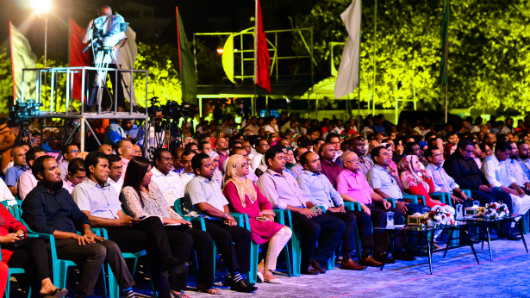
Speaking earlier in the evening President’s Office Undersecretary Dr Hussain Faiz listed the achievements of the cabinet’s social council, which he said included a doctor for each island, opening 46 pharmacies, and introducing sea ambulance services in six atolls.

Faiz also noted that the government had introduced the unlimited Aasandha healthcare scheme for persons with chronic illnesses, as well as raising the old age pension to MVR5000.

Pledges to provide unlimited healthcare to all citizens as well as a doctor for every family were two of the administration’s aims for an ambitious 100 day programme twelve months ago, while nationwide sea ambulances had been promised within the first year.

Faiz also noted the feasibility studies carried out into an Islamic University in the Maldives, while saying that the role of Islam and Quran had been expanded in the new national curriculum.

Discussing the government’s record on development and the economy, Minister of Fisheries and Agriculture Dr Mohamed Shainee noted that the country’s dollar shortage had been alleviated, while MVR68 million worth of loans were issued.

Shainee claimed that, in addition to 1,700 new businesses being registered, and new resorts being put up for bidding, 19 foreign investors had registered a commitment of investing over US$600 million.

The government has introduced legislation for special economic zones – with a minimum investment of US$150 million – in an attempt to draw in new developers, though the only significant agreement signed as yet has been the Chinese deal to begin redevelopment of Ibrahim Nasir International Airport.

The fisheries minister suggested that President Yameen’s background as an economist had contributed to the administration achieving the equivalent of six year’s work in one.


Related to this story

President Yameen’s anniversary – The Year in Review

Analysis: President Yameen’s first year – Towards good governance?

MDP condemns insecurity as PPM celebrates peace and order

Likes(4)Dislikes(0)

55 Thinadhoo arson suspects detained until end of trial

Fifty-five of the eighty-nine individuals facing terrorism charges in relations to violence in Gaafu Dhaalu Thinadhoo on February 8, 2012, have been detained until the end of the trial.

Criminal Court Judge Abdulla Mohamed told the court today that information had been received regarding the intimidation of witnesses, prompting the decision to hold a number of suspects until proceedings are completed.

The island’s atoll council office, its court building, police station, and several police vehicles were set on fire following the contested resignation of President Mohamed Nasheed on February 7, 2012.

Nine policemen were attacked, while police officials at the time declared the area unsafe for local policemen as Maldivian Democratic Party supporters had threatened to attack the residences of policemen.”

MDP lawyer Hisaan Hussain criticised today’s decision, saying: “We condemn this collective punishment which is not in line with our constitution or international law.”

Another lawyers familiar with case described the decision as “most unusual”,noting that the identities of state witnesses are not disclosed and have their voices disguised in order to protect their identity.

Defence lawyers have requested a written copy of the order to begin the appeal process but have yet to be provided with the relevant documents.

Hearings in the case began on October 1, while the trial of juvenile offenders in the same case is also nearing completion this month. Around 80 people are also currently facing terrorism charges in relation to unrest in Addu during the same period.

Acts of arson are considered terrorism under the Terrorism Prevention Act enacted by the administration of former President Maumoon Abdul Gayoom. The offence carries a jail term of between 10 to 15 years.

The MDP has contended that the trials against dozens of the party’s members and supporters in Addu City and Thinadhoo were acts of intimidation, accusing the government of threatening to prosecute persons who participate in MDP activities.

Hisaan today also criticised the use of a single judge – Abdulla Mohamed – in the 300-400 cases ongoing in relation to the February 8 unrest, calling the entire process “highly politically motivated”.

The detention of Judge Abdulla Mohamed in January 2012 – following repeated obstruction of investigations into his conduct – led to the intensification of anti-government protests, culminating in policemen mutinying on the evening of February 6.


Related to this story

Police officers testify against February 8 arson suspects

Terrorism trials begin for over 80 individuals from Thinadhoo

Special Operations (SO) officers stationed permanently on Thinadhoo

Police arrest 17 people on Thinadhoo in wake of February 8 protests

Likes(7)Dislikes(0)

Maldives economy “relatively buoyant” but fiscal imbalances continue to grow: IMF

While the Maldivian economy is performing well, fiscal indiscipline remains a problem as budget deficits continue to grow says the International Monetary Fund (IMF).

“We see that the economy is relatively buoyant,” said the IMF delegation in a statement given to the media today.

“However, despite the improvement in the real economy, the fiscal deficit has continued to widen and this is because of very high public expenditure and public debt is very high, so we think the fiscal position does need to be addressed.”

Parliamentary debate on the record MVR24.3 billion (US$1.5 billion) state budget for 2015 concluded this week, with opposition MPs expressing doubts over whether the MVR21.5 billion revenue forecast could be realised.

Regarding the recently introduced special economic zones (SEZs), the IMF delegation noted today the importance of a “transparent and even handed” regulatory framework and that any exemptions to tax are “clearly ring-fenced and limited”.

Meanwhile, it was noted that revisions to estimates of the current account deficit had indicated greater stability in the economy than previously thought.

During the IMF’s last visit to the country in February this year, the delegation expressed surprise at the resilience of the economy, admitting that it was still studying how the domestic economy has remained afloat in the face of soaring public debt and persistent budget deficits.

Maldives Monetary Authority estimates of the final current account deficits for 2014 fell from US$562.5 million in April to US$269.9 million in a macroeconomic report released in May.

The latter report,however, contained warnings against “slippages in revenue or current expenditure” which were echoed by the IMF today.

“The 2015 budget includes both revenue and spending measures to tackle the fiscal deficit and we think it’s very important that these measures are fully implemented,” explained the delegation today.

The IMF – which has previously urged greater taxation of the lucrative tourist industry – said today that it supported the recently announced green tax, as well as pushing for more efficient subsidies.

The delegation noted that measures to target electricity subsidies to areas where they are most needed had been included in next year’s budget.

MVR3.4 billion (US$220 million) – or 14 percent of the budget – is anticipated from new revenue raising measures which includes revisions of import duty rates from July onward, fees from investments to the SEZs, income from the home ownership programme, and leasing 10 islands for resort development.

Minister of Finance Abdulla Jihad noted in August that spiralling expenditure and revenue shortfalls could see the budget deficit balloon MVR4 billion (US$259 million), although he gave the Majlis a revised figure of MVR1.6 billion (US$103 million) when presenting budget this month.

While the World Bank recently predicted that the Maldives economy would grow by 4.5 percent this year, Jihad has said public debt is expected to reach MVR31 billion (US$2 billion) or 67 percent of GDP at the end of 2014.

“Despite achieving economic progress, the Maldivian economy is fragile and the Maldives’ financial situation is not in the most appropriate state at present,” Jihad told the Majlis.


Related to this story

Parliamentary budget debate concludes

Finance minister presents record MVR24.3 billion state budget to parliament

Slippages in revenue or expenditure will undermine debt sustainability: MMA macroeconomic report

IMF delegation surprised by resilience of Maldivian economy

Likes(4)Dislikes(0)

PG withdraws disobedience to order charges against home minister

Prosecutor General (PG) Muhthaz Muhsin has withdrawn disobedience to order charges against Home Minister Umar Naseer.

Muhsin had raised charges against Naseer in April for violating Article 8 (a) of the General Laws Act of 1968 when he called on anti-government protesters in January 2012 to storm the military headquarters with 50 ladders.

The clause prohibits speech or writing contravening Islamic tenets.

If found guilty, Naseer would have faced imprisonment, banishment, or house arrest not exceeding six months or a fine not exceeding MVR150 (US$10).

PG Office Spokesperson Adam Arif said charges had been withdrawn in August for further review, and stressed that the PG is authorised to withdraw charges at any point until a sentence is issued. The moves comes after concluding statements had been delivered at the Criminal Court.

Opposition Maldivian Democratic Party MP Imthiyaz Fahmy said the move “is yet another act by a PG backed by the government to deliberately show the people that the government enjoys complete impunity.”

The decision appears to reflect a thawing of a tense relationship between Naseer and President Abdulla Yameen.

Naseer was summoned to court during the acrimonious dissolution of a coalition agreement between Naseer’s Jumhooree Party (JP) and the ruling Progressive Party of the Maldives (PPM).

Four ministers had been appointed to the cabinet on JP slots, but following the split two defected and a further minister was dismissed. Naseer now remains as the sole JP minister in the cabinet.

Naseer initially joined the JP after he lost the PPM primaries to Yameen in 2013. Following this defeat, he publicly alleged widespread vote rigging and accused Yameen of illicit connections with gangs and the illegal drug trade.

Naseer also implicated Yameen in MP Dr Afrasheem Ali’s death, claiming he had witnessed a meeting between Yameen and an individual who was under investigation for Afrasheem’s brutal death.

Naseer has since retracted his statement under oath during a Majlis sitting.

In August, Yameen also reduced the home minister’s powers after Naseer allegedly ordered police officers to investigate Minister of Tourism Ahmed Adeeb – the PPM deputy leader – for alleged unlawful activities.

Criminal Court Chief Judge Abdulla Mohamed took over the case mid-way through the trial from Judge Abdulla Didi, after Naseer requested a change of judge folowing Didi’s refusal to accept a procedural point raised by Naseer.

Didi, on June 12, had issued an arrest warrant ordering the police to present Naseer at court today after he had missed three consecutive hearings due to official visits abroad.

The police, however, made no move to arrest the minister on his return to the Maldives, and Naseer arrived at the court on June 17 with a bodyguard escort.

Naseer had initially refused to cooperate with the trial, claiming clause Article 8 (a) contradicted the freedom of expression guaranteed by the constitution.


Related to this story

Home Minister Umar Naseer’s trial concludes at Criminal Court

Home Minister refuses to cooperate with disobedience trial

President Yameen does not have gang affiliations, Umar tells the Majlis

Umar Naseer is not a fugitive from justice, says Home Ministry

Likes(1)Dislikes(0)

PPM dismisses rumors Gayoom may leave party

The ruling Progressive Party of the Maldives (PPM) has dismissed rumors that President Maumoon Abdul Gayoom may leave the party as “baseless and false”.

“We assure our beloved members [Gayoom] will not leave this party and join another party or take on any position in another party,” said a statement released on Tuesday (November 18).

The former president of 30 years was elected as PPM president at the party’s 2012 congress, a year after his acrimonious split from the Dhivehi Rayyithunge Party (DRP).

The statement came in response to rumors Gayoom may rejoin the DRP, local media have said.

Speculation of tension between Gayoom and his half brother President Abdulla Yameen has grown since the PPM parliamentary group’s decision to reject Gayoom’s choice for the post of Prosecutor General, his nephew Maumoon Hameed.

However, the two have presented a united front with joint-appearances at party functions on PPM’s third anniversary in power.

Gayoom on November 13 congratulated Yameen for allegedly fulfilling majority of pledges in the PPM manifesto and said Maldivians had found new life in Yameen’s presidency.

Gayoom had founded the DRP in 2005 and ran on the party ticket for the 2008 multiparty presidential election. When he lost, Gayoom retired from politics and handed over the party reigns to him former running mate Ahmed Thasmeen Ali.

He was then given the title of Zaeem or Honorary leader.

However in April 2011, Gayoom established the Zaeem DRP or Z-DRP as a separate branch of DRP amidst growing tension between himself and Thasmeen. He went on to  establish the PPM in September 2011.

Thasmeen defected to the opposition Maldivian Democratic Party (MDP) during the presidential elections of September 2013 after he and former President Dr Mohamed Waheed gained only five percent of the popular vote.

MP ‘Colonel’ Mohamed Nasheed – who had defected to the DRP from the MDP – ahead of the presidential vote took over DRP and announced a rebrand effort. He has said the next DRP congress will see a resolution to award Gayoom the title of Zaeem again.

Nasheed has previously described the party as now being in the ‘ICU’, accusing the party’s former leadership of leaving behind MVR10million in debt (US$ 64,5161) and abandoning the party with its data and assets.


Related to this story

PPM MPs to vote Muhthaz for PG in defiance of party leader’s appeal

Gayoom’s new party to be called Progressive Party of Maldives

DRP announces rebrand effort

Likes(1)Dislikes(0)

China donates 200,000 energy efficient lights

China has today pledged to provide the Maldives with 200,000 energy efficient LED lights as part of an MoU for the provision of goods to assist in combatting climate change.

“Approximately MVR300 is estimated to be saved if the LED lights are used for 8 hours per day and if 75% of the LED lights which has been provided are used, MVR49 million would be saved,” read a press release from the Ministry of Environment and Energy.

The ministry last month launched the ‘It’s cool at 25’ campaign to reduce energy consumption in the country and potentially save MVR8,000 (US$519) – or seven percent – from household electricity bills.

Minister of Environment and Energy Throriq Ibrahim signed the MoU on behalf of the government, while Deputy Head of Commission at the Chinese Embassy in Maldives Liu Ching signed on behalf of the Chinese government.

In addition to providing an additional 250,000 LED lights in 2013 – subsequently used across 164 islands – China has more recently donated 200 waste bins worth MVR500,000 (US$32,425) to the Maldives.

As well as a steady stream of grant aid, the Chinese and Maldivian governments have recently penned deals regarding military aid and the development of Ibrahim Nasir International Airport, as well as the Chinese promising to “favorably consider” financing the Malé-Hulhulé bridge project.

Likes(1)Dislikes(0)

Free airport ferries for the disabled

Free ferries between Malé and Hulhulé will be provided for people with disabilities from midnight tonight, the Airports Ferry Operators Association has announced.

“People with disabilities can show their card at the ticket station and get tickets for free,” Secretary General of the Airports Ferry Operators Association Ibrahim Mohamed told Sun Online.

Likes(0)Dislikes(1)

More than one in three Maldivians offered bribes or witnessed vote buying, IFES survey reveals

More than one in three Maldivians were offered bribes for their votes or witnessed vote buying in the March parliamentary polls, a landmark study by the International Foundation for Electoral Systems (IFES) has revealed.

The ‘Money and Elections in the Maldives: Perceptions and Reality‘ report released today said vote buying in the Maldives has assumed “alarming proportions” and “if not addressed, it threatens to undermine the democratic process in the country.”

The survey gathered information from face-to-face interviews from across the Maldives and looked at prevalence of vote buying and fraud, and public perception on campaign finance.

Of the respondents who experienced or witnessed vote buying, 82 percent said they were offered cash. Of this, 53 percent said they were offered between MVR4,000 (US$262) and MVR20,000 (US$1,309) for their votes.

According to IFES, the figure for those who experienced vote buying is a conservative estimate as respondents to opinion surveys are generally reluctant to report unethical or illegal activity.

Ballot marking was the most common technique used to ensure that those offered money or gifts cast their ballot for the candidate or the party who offered them money or gifts (27 percent), the survey said.

A further eight percent were asked to swear an oath on the Qur’an while six percent were asked to turn over their identity papers.

More than a third of respondents believed fraud was committed during parliamentary polls.

Despite the alarming prevalence of vote buying, majority of Maldivians continue to have faith in the electoral process, with 8 out of 10 saying they believed voting gives them influence over decision-making in the country.

“Vote buying should be addressed before cynicism and apathy take root,” IFES said.

Campaign Finance

Nearly two thirds (66 percent) of Maldivians believed political parties and candidates spend most of their campaign funds on vote buying and gifts for voters, while 70 percent said they do not believe candidates are honest in reporting campaign spending.

When asked about key sources of campaign funding, most Maldivians believe political parties and candidates receive funds from party funds (40 percent), or that candidates are self funded (32 percent). Local businesses ranked third.

More significantly, nearly 4 out of 10 respondents said they did not know sources of funding, suggesting a significant lack of information regarding election campaign funding.

Despite the dismal picture, there is near unanimous support for campaign finance reform, specifically to combat vote buying, IFES said.

Approximately 90 percent said vote buying should remain illegal and 70 percent supported a cap on contributions by any one person.

Three quarters of respondents also said they would like to see campaign spending limits for political parties and candidates.

Hence, “Maldivian lawmakers have clear public support to introduce preventive measures to combat vote buying ahead of the next elections,” the report stated.

A clear majority, nearly 90 percent, do not believe government property, including vehicles and boats, should be allowed for campaigning or political purposes.

A majority also said candidates and political parties must not undertake charitable activities and community development activities such as building a playground or harbors, suggesting a majority recognised such activities can be utilised to generate support.

A slight majority also believed the hiring of local musicians during campaigns was inappropriate.

Survey findings indicated high levels of confidence in the Election Commission with 73 percent stating the commission performed well or very well.

Those who did not vote in the election identified re-registration and other logistical issues such as transportation as main reasons for not voting.

Nearly 4 out of 10 voters had to manually re-register before each election, the survey found. IFES has recommended legislative reform to ease the burden or re-registration and logistical difficulties for voters and the Election Commission

Of those who did not vote, 19 percent said there were no worthy candidates, while 16 percent said they had no interest and 7 percent said their vote does not matter.


Related to this story

Majlis elections: “Money politics threatens to hijack democratic process”, says Transparency Maldives

EU elections observers recommend legislation to improve future polls

Majlis elections: Undue influence, bribery, and disilussionment led to losses, says MDP

Likes(1)Dislikes(0)

MDN alerts PIC over failure to investigate criminal activity in missing journalist report

Human rights group Maldivian Democracy Network (MDN) has requested the Police Integrity Commission (PIC) to probe police’s failure to investigate dangerous criminal activity outlined in a report into the disappearance of Minivan News journalist Ahmed Rilwan.

The report – which claimed Rilwan was likely to have been abducted by radicalised gangs – was sent to the police on September 22 along with a letter requesting the police investigate its findings, MDN said.

The police proceeded to dismiss the report, however, claiming it was released for “political gain,” and has not yet informed the NGO if it has looked into any of the allegations.

The investigation – conducted by Glasgow based Athena Intelligence and Security – identified possible suspects in Rilwan’s disappearance, and confirmed hostile surveillance of Rilwan on the night he went missing. It also linked his disappearance to an abduction at knifepoint outside Rilwan’s apartment on the same night.

“The Maldives Police Services failed to investigate the various criminal actions outlined in the report in the past 2 months and 26 days,” MDN’s letter to the PIC on Monday read.

“We request that your commission investigate and take action against those police officers who have been negligent in this case.” Criminal activity highlighted in the report include:

  • Death threats issued against Rilwan by the administrators of Facebook Group Bilad Al-Sham and stalking by an individual called Ismail Abdul Raheem
  • Abduction with a knife reported on August 8 in front of Rilwan’s apartment
  • Hostile surveillance of Rilwan by at least two people belonging to Kuda Henveiru gang in Malé

Home Minister Umar Naseer has also acknowledged involvement of gangs in Rilwan’s disappearance. Meanwhile, Rilwan’s family has also lodged a complaint at the PIC accusing the Maldives Police Services of negligence.

The police had failed to treat the case seriously despite Rilwan’s high risk profile, the family said. Although an abduction reported outside Rilwan’s apartment at 2 am on August 8, the police only took statements from eyewitnesses on August 14, the family noted.

Further, the police officer in charge of the Hulhumalé police station prevented junior officers from apprehending and searching the car used in the abduction on the same night, the family said.

“If the abduction had been investigated immediately at the right time, the police would have been able to find the victim and clarify if it is our brother or not,” Rilwan’s sister Mariyam Fazna has said.

The police only searched Rilwan’s apartment 29 hours after the abduction was reported and searched his office 11 days afterwards. The police also failed to make a public announcement on Rilwan’s disappearance – despite a request by the family – and did not inform the public on how to act if they had any information related to the case, the family explained further.

In a statement to mark the 100 days of disappearance, Rilwan’s mother Aminath Easa said the state had failed to protect her son and bring perpetrators to justice.

Police Commissioner Hussain Waheed had previously denied negligence while the home minister told state television that some crimes could not be solved.


Related to this story

MDN investigation implicates radicalised gangs in Rilwan’s disappearance

Missing journalist’s family accuses police of negligence, files complaint

“The old posters fade, but we do not forget,” says Rilwan’s family

“Not all crimes in the world are solvable”: Home minister says on Rilwan’s disappearance

Likes(1)Dislikes(0)